Please click on images to see them full size.
Unless otherwise indicated all photographs
©Warren Zoell

Translate

Saturday, April 30, 2011

K't'inga Composite.


Here is a composite image of AMT's 1/537 scale Klingon K't'inga Battle Cruiser flying towards one of Jupiter's Galilean moons Ganymede. Out of all the Klingon ships in the Star Trek Universe This is perhaps my favourite design. Here are some images of the model.

Friday, April 29, 2011

Sulaco Composite


Here is an image of Halcyon models 1/2500 U.S.S. Sulaco flying towards the Jupiter Galilean moon Io. Here are images of the model. That is all;O}

Thursday, April 28, 2011

Battlestar Galactica Composites


Here are some images of my composites of two of the feature craft from the 1970's program Battlestar Galactica.

First up we have an image of Revell's 1/32 scale Cylon Raider doing a fly past of the moon during a full lunar eclipse. I punched up the red and the shadows a bit to give the craft that sense of foreboding.

Next we have Revell's 1/32 scale Colonial Viper (original release) flying over Neptune's moon Triton. If you look closely you can see a bit of distortion from the exhaust.

Wednesday, April 27, 2011

Speeder Bike Re Post.


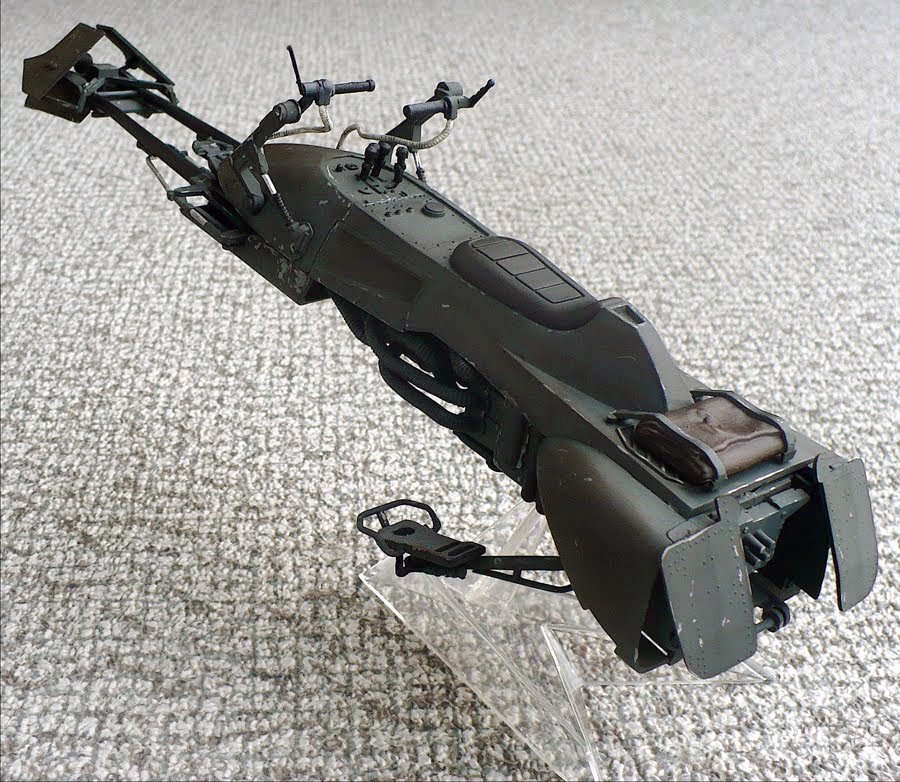
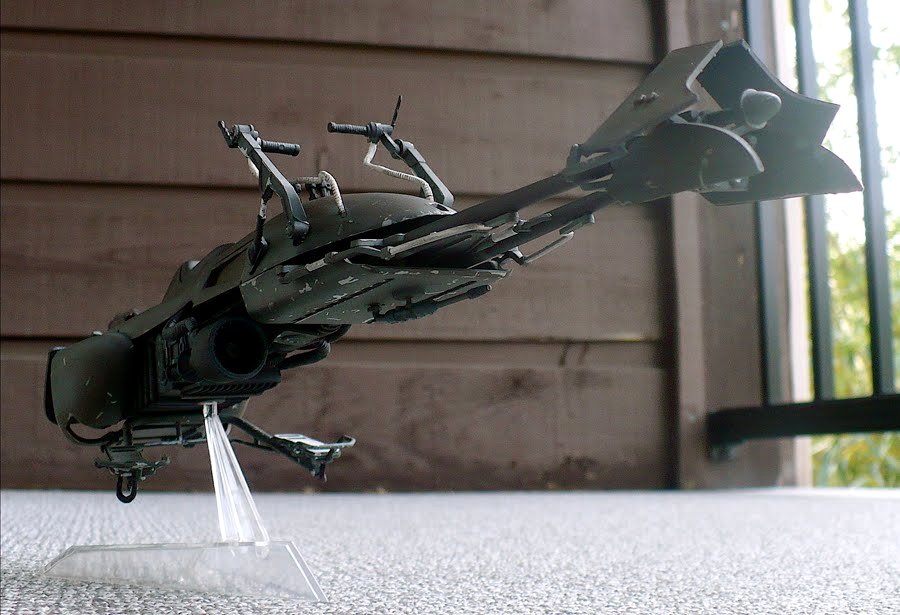
Here are some images of MPCs 1/11 scale Speeder Bike from Star Wars. From Wikipedia "Speeder bikes and swoop bikes are small, fast transports that use repulsorlift engines in the fictional Star Wars universe. Star Wars Episode VI: Return of the Jedi includes a prominent speeder bike chase; speeders and swoops also appear in Star Wars Episode I: The Phantom Menace, Star Wars Episode II: Attack of the Clones, Star Wars Episode III: Revenge of the Sith, Star Wars IV: A New Hope, and the Star Wars Expanded Universe's books, comics, and games.

Various concept sketches came from producer George Lucas' call for a "rocket powered scooter" in Return of the Jedi. While Industrial Light & Magic's (ILM) Nilo Rodis-Jamero designed a blocky vehicle with a large engine, Ralph McQuarrie's designs were more fanciful but with less of a sense of the vehicle's power source. The final designs resulted both in full-scale Imperial speeder bikes used by the actors for film against a bluescreen, along with miniatures mounted by articulated puppets. ILM used a steadicam recording at 1 frame per second to record the speeder bikes' path through the forest moon of Endor -- in reality, a California forest.Playing the footage at the standard rate of 24 frames per second caused a blurring effect, what looked like 100MPH actually was shot at 5MPH , which ILM used to simulate the vehicles' high speed.

The BARC speeder in Revenge of the Sith was designed to appear like a predecessor to the speeder bikes in Return of the Jedi. ILM's Doug Chiang designed Darth Maul's (Ray Park) speeder in The Phantom Menace to resemble a scythe, and Chiang's initial designs for the droid army's STAP vehicle resembled the speeder bikes from Return of the Jedi. An all-CGI swoop appearing in A New Hope stems from a design created for Shadows of the Empire, and the swoop also appears briefly in The Phantom Menace.

Tuesday, April 26, 2011

Glamorous Glennis Re Post


Here are some images of Pegasus Models 1/18 scale Bell X-1 research aircraft. How can I put this kindly? This model lends itself well to scratch building. You would think a model this size would have more detailing but alas no. To spruce up this model a bit I drilled out the engine exhausts, added seatbelt's and installed wiring coming off the back of the instrument panel just to spruce things up a bit. This kit looks like it was designed intentionally for the toy market as the the plastic is thick and very tough plus note that the movable wheel bay doors and landing gear have very visible hinges and the front spire does not blend well with the front of the aircraft plus it doesn't lend itself well to gluing so CA was necessary but considering the cost, $45 CDN it is well worth the buy if you are willing to put some time and effort into it. I have a book issued by Time/Life called Designers and test Pilots from their Epic of Flight series and a book called Aviation Pioneers from Osprey publications and in these books it showed the Bell X-1 Glamorous Glennis in a more weathered state. So off I went to the interweb to see if any model builders out there had posted a more weathered X-1 to get some ideas and to my surprise there weren't any. All I saw were shiny brand new looking X-1s and I think the reason why is that there isn't very many photographs out there showing a weathered X-1. So here without further ado is my version of a weathered Glamorous Glennis.

From Wikipedia '
The Bell X-1, originally designated XS-1, was a joint NACA-U.S. Army/US Air Force supersonic research project built by Bell Aircraft. It was the first aircraft to exceed the speed of sound in controlled, level flight, and was the first of the so-called X-planes, an American series of experimental aircraft designated for testing of new technologies and usually kept highly secret.

On 16 March 1945, the United States Army Air Forces' Flight Test Division and the National Advisory Committee for Aeronautics (NACA) (now NASA) contracted Bell Aircraft to build three XS-1 (for "Experimental, Supersonic", later X-1) aircraft to obtain flight data on conditions in the transonic speed range.

The X-1 was in principle a "bullet with wings", its shape closely resembled the Browning .50-caliber (12.7 mm) machine gun bullet that was known to be stable in supersonic flight. The pattern shape was followed to the point of seating the pilot behind a sloped, framed window inside a confined cockpit in the nose, with no ejection seat. After the aircraft ran into compressibility problems in 1947, it was modified to feature a variable-incidence tailplane. An all-moving tail was developed by the British for the Miles M.52, and first saw actual transonic flight on the Bell X-1 that allowed it to pass through the sound barrier safely.

The rocket propulsion system was a four-chamber engine built by Reaction Motors, Inc., one of the first companies to build liquid-propellant rocket engines in America. It burned ethyl alcohol diluted with water and liquid oxygen. The thrust could be changed in 1,500 lbf (6,700 N) increments by firing one or more of the chambers. The fuel and oxygen tanks for the first two X-1 engines were pressurized with nitrogen and the rest with steam-driven turbopumps. The all-important fuel turbopumps, necessary to raise the chamber pressure and thrust, while lightening the engine, were built by Robert Goddard who was under Navy contract to provide jet-assisted takeoff rockets.

Bell Aircraft Chief Test Pilot, Jack Woolams became the first to fly the XS-1, in a glide flight over Pinecastle Army Airfield, in Florida, on 25 January 1946. Woolams would complete nine additional glide flights over Pinecastle before March 1946, when the #1 aircraft was returned to Bell for modifications in anticipation of the powered flight tests, planned for Muroc Army Air Field (now Edwards Air Force Base) in California. Following Woolams' death on 30 August 1946, Chalmers "Slick" Goodlin was the primary Bell Aircraft test pilot of X-1-1 (serial 46-062). He made 26 successful flights in both of the X-1 aircraft from September 1946 until June 1947.

The Army Air Force was unhappy with the cautious pace of flight envelope expansion and Bell Aircraft's flight test contract for aircraft #46-062 was terminated and was taken over by the Army Air Force Flight Test Division on 24 June after months of negotiation. Goodlin had demanded a US$150,000 bonus for breaking the sound barrier. Flight tests of the X-1-2 (serial 46-063) would be conducted by NACA to provide design data for later production high-performance aircraft.

On 14 October 1947, just under a month after the United States Air Force had been created as a separate service, the tests culminated in the first manned supersonic flight, piloted by Air Force Captain Charles "Chuck" Yeager in aircraft #46-062, which he had christened Glamorous Glennis after his wife. The rocket-powered aircraft was launched from the bomb bay of a specially modified B-29 and glided to a landing on a runway. XS-1 flight number 50 is the first one where the X-1 recorded supersonic flight, at Mach 1.06 (361 m/s, 1,299 km/h, 807.2 mph) peak speed.

As a result of the X-1's initial supersonic flight, the National Aeronautics Association voted its 1948 Collier Trophy to be shared by the three main participants in the program. Honored at the White House by President Harry S. Truman were Larry Bell for Bell Aircraft, Captain Yeager for piloting the flights, and John Stack for the NACA contributions.

On 5 January 1949, Yeager used Aircraft #46-062 to carry out the only conventional (runway) take off performed during the X-1 program, reaching 23,000 ft (7,000 m) in 90 seconds.

The research techniques used in the X-1 program became the pattern for all subsequent X-craft projects. The NACA X-1 procedures and personnel also helped lay the foundation of America's space program in the 1960s. The X-1 project defined and solidified the post-war cooperative union between U.S. military needs, industrial capabilities, and research facilities. The flight data collected by the NACA in the X-1 tests then provided a basis for American aviation supremacy in the latter half of the 20th century.

Monday, April 25, 2011

Star Wars Composites


Here are some images of composites featuring craft from the Star Wars universe.
Though the TIE M1 Bizzarro is part of the Star Wars lexicon and has been mentioned and seen in video games the Jedi TIE Fighter is from my own imagination.

First up we have my 1/48 scale kitbash of my TIE M1 Experimental (Bizzarro) flying past Saturn's moon Mimas. I have often wondered if Mimas was the inspiration for the Death Star. This is why I used it in this image. Pictures of the model can be viewed here.

Next we have my 1/32 scale(?) kitbash of a Jedi TIE Fighter cruising towards the planet Mars.
When I built this model I had no idea what type of story line one could use for this craft. However Ludo over at Studio Cyberlab came up with a pretty good one. "After years of galactic warfare all the raw materials to construct the ships and weapons are exhausted. the only materials left are the war relics that are floating through space. A new era had began, who will scavenge the best left overs and construct the best weapons to win the battle..." Works for me! Pictures of the model can be viewed here.

Sunday, April 24, 2011

Composites


For those of you who have been viewing my web page for awhile may notice that from time to time I enjoy doing occasional composites of my models using Photoshop. That is placing photographs of my models into natural or unnatural settings. Well here are some images of my latest examples. I hope you enjoy them.

First up we have an image of Moebius Models 1/160 scale Orion III Space Clipper from 2001 a Space Odyssey. The image represents the Orion in a blast off accent on its way to an orbiting space station.
Next we have an image of my scratch built Unmanned Soviet Space Probe from 2010 Odyssey II (The Year We Make Contact) flying over The moon Europa, a Galilean satellite of Jupiter. Europa moon surface photo taken by NASA. Europa itself courtesy of God.

After that we have an image of Moebius Models 1/128 scale Seaview from the 60's TV series Voyage to the Bottom of the Sea in an underwater setting. Underwater composites I find tend to be more difficult than they appear. You have to match the object colour to its surroundings and then one has to add a slight blur to everything.

Finally we have an image of Lindberg's 1/200 scale 1950's concept Space Base Space Station.
I sometimes wonder that if the technology to build Space Stations were around in the 1950's if this is in fact what they would have looked like.

Saturday, April 23, 2011

Johnnie Johnson Re Post


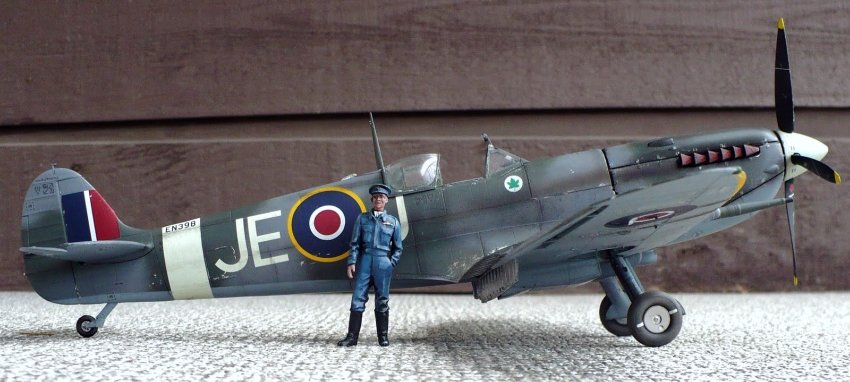
Here are some images of Tamiya's 1/32 scale Supermarine Spitfire MK IX C. This is the aircraft that was flown by wing commander J.E."Johnnie" Johnson for Kenley Wing "The Canadians" at RAF Kenley 1943. Johnnie Johnson became the western Allies top fighter ace of World War Two in the European theater with 34 victories to his credit as well as seven shared victories, three shared probables, ten shared damaged as well as one destroyed on the ground. In 1943 Johnnie Johnson took over Kenley Wing and despite initial objections from those obnoxious and stubborn Canadians were quickly won over by his sheer force of personality. Johnnie Johnson continued to serve with the RAF after the war eventually retiring in 1966 with the rank of Air Vice Marshal. He passed away on January 30th 2001. This kit has got to be the best 1/32 scale Spitfire ever produced, every bit as comparable to Tamiya's 1/32 scale Zero. The detail is amazing right down to the back of the shoulder straps attachment. My only real complaint is the decals lacked elasticity, easily fixed with plenty of Microsol though one should keep an eye out for cracking. Plus at around $150 Cdn can be quite the tidy sum. Oh and one other complaint. Why doesn't the figure look like Johnnie Johnson?

Friday, April 22, 2011

Hawker Class


Here are some images of my 1/537 scale kit bash of the Hawker Class Starship the U.S.S. Gambit.
The Hawker Class is every bit as powerful and as well equipped as the Constitution Class Starship only with a crew compliment of 125 persons.
The Hawker Class was created for singular scientific and information gathering missions into hostile areas where heavy defensive capabilities may the necessary to achieve the mission at hand.

Hawker Class:

Thursday, April 21, 2011

Bug


Here is an image of Dave Porter's 1/35 scale type 87 DAK VW Bug and here in his own words is his description.
This is a Afrika Corps VW bug by Italeri in 1/35 scale. This was a nice kit and it was a lot of fun to build. It has good details and kit includes a few extra items......five soldier figures, a fuel drum, and some weapons. I thought a building a little diorama featuring the bug would be a capital idea. I wanted some height to the project, so I added a resin and paper palm tree. The Alpine 1/35 DAK panzer commander is a great item. I painted him up and put him standing in the back of the vehicle along with some boxes, kit, and resin bottles of wine. The solder with the MP40 is included with the model. I finished the base with some rock, kitty litter, and layered and painted railroad ballast to simulate to North African desert.

Wednesday, April 20, 2011

BF 109 G


Here are some images of Fugimi's 1/48 scale Messerschmitt BF 109 G.

From Wikipedia"

The Bf 109 G-series was developed from the largely identical F-series airframe, although there were detail differences. Modifications included a reinforced wing structure, an internal bullet-proof windscreen, the use of heavier, welded framing for the cockpit transparencies, and additional light-alloy armour for the fuel tank. It was originally intended that the wheel wells would incorporate small doors to cover the outer portion of the wheels when retracted. To incorporate these the outer wheel bays were squared off. Two small inlet scoops for additional cooling of the spark plugs were added on both sides of the forward engine cowlings. A less obvious difference was the omission of the boundary layer bypass outlets, which had been a feature of the F-series, on the upper radiator flaps.

Like most German aircraft produced in World War II, the Bf 109 G-series was designed to adapt to different operational tasks with greater versatility; larger modifications to fulfil a specific mission task like long-range recon or long-range fighter-bomber were with "Rüststand" and given a "/R" suffix, smaller modifications on the production line or during overhaul like equipment changes were made with kits of pre-packaged parts known as Umrüst-Bausätze, usually contracted to Umbau and given a "/U" suffix. Field kits known as Rüstsätze were also available but those did not change the aircraft designation. Special high-altitude interceptors with GM-1 nitrous oxide injection high-altitude boost and pressurized cockpits were also produced.

The newly fitted Daimler-Benz DB 605A engine was a development of the DB 601E engine utilised by the preceding Bf 109F-4; displacement and compression ratio were increased as well as other detail improvements. Takeoff and emergency power of 1,475 PS (1,455 hp, 1,085 kW) was achieved with 1.42 atm of boost at 2,800 rpm. The DB605 suffered from reliability problems during the first year of operation, and this output was initially banned by VT-Anw.Nr.2206, forcing Luftwaffe units to limit maximum power output to 1,310 PS (1,292 hp, 964 kW) at 2,600 rpm and 1.3 atm manifold pressure. The full output was not reinstated until 8 June 1943 when Daimler-Benz issued a technical directive. Up to 1944, the G-series was powered by the 1,475 PS Daimler-Benz DB 605 driving a three-blade VDM 9-12087A variable-pitch propeller with a diameter of 3 m (9.8 ft) with even broader blades than used on the F-series. Pitch control, as on the 109F, was either "electro-mechanical"" (automatic) or "manual-electric" using a thumb-switch on the throttle lever. From 1944 a new high-altitude propeller with broader blades was introduced, designated VDM 9-12159, and was fitted to high-altitude variants with the DB 605AS or D-series engines.

The early versions of the Bf 109G closely resembled the Bf 109 F-4 and carried the same basic armament; however, as the basic airframe was modified to keep pace with different operational requirements, the basically clean design began to change. From the spring of 1943, the G-series saw the appearance of bulges in the cowling when the 7.92 mm (.312 in) MG 17 were replaced with 13 mm (.51 in) MG 131 machine guns (G-5 onwards) due to the latter's much larger breechblock, and on the wings (due to larger tyres), leading to the Bf 109 G-6's nickname "Die Beule" ("The Bulge"). The Bf 109G continued to be improved: new clear-view cockpits, greater firepower in the form of the 30 mm (1.18 in) MK 108 cannon were introduced in late 1943; and a new, enlarged supercharger for the DB605, a larger vertical stabilizer (G-5 onwards), and MW 50 power boost in 1944.

Erich Hartmann, the World's top scoring fighter ace, claiming 352 victories, flew only the Bf 109G, of which he said:

It was very manoeuverable, and it was easy to handle. It speeded up very fast, if you dived a little. And in the acrobatics manoeuver, you could spin with the 109, and go very easy out of the spin. The only problems occurred during takeoff. It had a strong engine, and a small, narrow-tread undercarriage. If you took off too fast it would turn [roll] ninety degrees away. We lost a lot of pilots in takeoffs.

From the Bf 109 G-5 on an enlarged wooden tail unit (identifiable by a taller vertical stabilizer and rudder with a morticed balance tab, rather than the angled shape) was often fitted. This tail unit was standardised on G-10s and K-4s. Although the enlarged tail unit improved handling, especially on the ground, it weighed more than the standard metal tail unit and required that a counterweight was fitted in the nose, increasing the variant's overall weight.

With the Bf 109G, a number of special versions were introduced to cope with special mission profiles. Here, long-range fighter-reconnaissance and high-altitude interceptors can be mentioned. The former were capable of carrying two 300 L (80 US gal) drop tanks, one under each wing; and the latter received pressurized cockpits for pilot comfort and GM-1 nitrous oxide "boost" for high altitudes. The latter system, when engaged, was capable of increasing engine output by 223 kW (300 hp) above the rated altitude to increase high-altitude performance.

Tuesday, April 19, 2011

Grand Slam Bomber


Here are some images of Tamiya's 1/48 scale Avro Lancaster Grand Slam Bomber B1 Special.
This aircraft served with 617 squadron No. 5 group, Woodhall Spa, Lincoln (Spring 1945).

From Wikipedia"
B I Special
32 Aircraft were adapted to take first the super-heavy "Tallboy" and then "Grand Slam" bombs. Upgraded engines with paddle-bladed propellers gave more power, and the removal of gun turrets reduced weight and gave smoother lines. For the Tallboy, the bomb-bay doors were bulged; for the Grand Slam, they were removed completely and the area faired over. For some Tallboy raids, the mid upper turret was removed. This modification was retained for the Grand Slam aircraft, and in addition the nose turret was later removed. Two airframes (HK541 and SW244) were modified to carry a dorsal "saddle tank" with 1,200 gal (5,455 L) mounted aft of a modified canopy for increasing range. No. 1577 SD Flight tested the aircraft in India and Australia in 1945 for possible use in the Pacific,[14] but the tank adversely affected handling characteristics when full and an early type of flight refuelling designed in the late 1930s for commercial flying boats was later used instead.

The Grand Slam was a 22,000 lb (10,000 kg) earthquake bomb used by RAF Bomber Command against strategic targets during the Second World War.

Known officially as the Bomb, Medium Capacity, 22,000 lb, it was a scaled up version of the Tallboy bomb and closer to the original size that the bombs' inventor, Barnes Wallis, had envisioned when he first developed his earthquake bomb idea.


Monday, April 18, 2011

Endeavour Re Post


Here are some better images of Conctructo's 1/60 scale H.M.C. Endeavour Captain James Cook commanding. James Cooks middle name was not known. The Endeavour was a bark made of English oak with a reinforced structure. It was prepared to accommodate a group of astronomers and scientists accompanying the expedition for the main purpose of observing the transit of Venus across the sun, an event due to happen in June 1769 and which was supposed to be visible from the island of Tahiti. The woods used for this model were Ayous, Ramin, Boxwood, Mukaly, Sapelly and Manzonia. I have always found that working with Sapelly wood to be difficult in one respect, it has a tendency to slightly change colour when you sand it. So one has to be careful.