Translate

Sunday, August 22, 2010

Sea Witch


Here are some images plus a composite of Revell's 1'72 scale Starfury Sea Witch from Babylon 5. From Wikipedia "

The Starfury fighter is a fictional vessel used by Earthforce, the military branch of the Earth Alliance, in the science fiction television series Babylon 5. The CGI model was first seen in the opening episode of the first season, "Midnight On The Firing Line" which first aired in the United States in January 1994, and has essentially appeared in every episode thereafter.

It also appears in the later, and short lived, Crusade television series, the special edition (not original) version of the pilot movie, The Gathering, the TV movies In the Beginning, Thirdspace, The River of Souls and A Call to Arms, as well as the The Lost Tales (the first in an anthology series which was to be released on DVD but was aborted due to funding issues). Plus a number of written short stories and novels based in the same fictional universe.

Saturday, August 21, 2010

Babylon 5


Here are some images plus a composite of Revell's 1/26000 scale Babylon 5 space station. From Wikipedia "

Babylon 5 is an American science fiction television series created, produced and largely written by J. Michael Straczynski. The show centers on the Babylon 5 space station: a focal point for politics, diplomacy, and conflict during the years 2257–2262. With its prominent use of planned story arcs, the series was often described as a "novel for television".

The pilot film premiered on February 22, 1993. The regular series aired from January 26, 1994 and ran for five full seasons. The show spawned six television films and a spin-off series, Crusade, which aired in 1999 and ran for thirteen episodes. On July 31, 2007, a DVD was released containing two short films about selected characters from the series.

Friday, August 20, 2010

Harrier


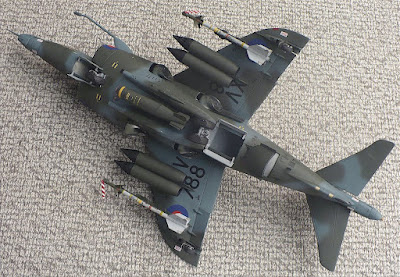
Here are some images of Airfix/Flight Path/Horizon 1/24 scale Hawker Siddeley/BEA Harrier GR3. From Wikipedia "

The Hawker Siddeley Harrier GR.1/GR.3 and the AV-8A Harrier are the first generation of the Harrier series, the first operational close-support and reconnaissance fighter aircraft with Vertical/Short Takeoff and Landing (V/STOL) capabilities, colloquially referred to as a "jump jet". The Harrier was the only truly successful V/STOL design of the many that arose from the 1960s.

In the 1970s, the Harrier was developed into the radar-equipped BAE Sea Harrier for the Royal Navy. The Harrier was also extensively redesigned as the BAE Harrier II and AV-8B Harrier II, which were built by British Aerospace and McDonnell Douglas.

The Harrier's lineage began with the Hawker P.1127. Design began in 1957 by Sir Sydney Camm, Ralph Hooper of Hawker Aviation and Stanley Hooker (later Sir Stanley) of the Bristol Engine Company. Rather than using rotors or a direct jet thrust the P.1127 had an innovative vectored thrust turbofan engine and the first vertical takeoff was on 21 October 1960. Six prototypes were built in total, one of which was lost at an air display.

The immediate development of the P.1127 was the Kestrel FGA.1, which appeared after Hawker Siddeley Aviation was created. The Kestrel's first flight was on 7 March 1964. It was strictly an evaluation aircraft, and only nine were built. These equipped the Tripartite Evaluation Squadron formed at RAF West Raynham in Norfolk, numbering 10 pilots from the RAF, USA and West Germany. One aircraft was lost and six of the remainder were transferred to the U.S. for evaluation by the Army, Air Force and Navy, designated XV-6A Kestrel.

At the time of the development of the P.1127, Hawker had started on a design for a supersonic version, the Hawker Siddeley P.1154. After this was cancelled in 1965, the RAF began looking at a simple upgrade of the Kestrel as the P.1127 (RAF).

An order for 60 production aircraft was received from the Royal Air Force in mid-1966, and the first pre-production Harriers, then known as the P.1127 (RAF), were flying by mid-1967, becoming known as Harrier GR.1.

The Hawker Siddeley Harrier GR.1 was the first production model derived from the Kestrel, it first flew on 28 December 1967, and entered service with the RAF on 1 April 1969. Construction took place at factories in Kingston upon Thames in southwest London and at Dunsfold, Surrey. The latter adjoined an airfield used for flight testing; both factories have since closed.

The ski-jump technique for STOVL used by Harriers launched from Royal Navy aircraft carriers was tested at the Royal Navy's airfield at RNAS Yeovilton (HMS Heron), Somerset. Their flight decks were designed with an upward curve to the bow following the successful conclusion of those tests.

The Harrier GR.3 featured improved sensors (such as a laser tracker in the lengthened nose), countermeasures and a further upgraded Pegasus Mk 103 and was to be the ultimate development of the 1st generation Harrier.

The AV-8As of the United States Marine Corps were very similar to the early GR.1 version, but with the more-powerful engine of the GR.3. The aircraft was powered by a 21,500 lbf (95.6 kN) thrust Roll-Royce Pegasus Mk 103 (F402-RR-402) turbofan engine. The AV-8A was armed with two 30 mm ADEN cannons (podded under the fuselage) and two AIM-9 Sidewinder air-to-air missiles. A total of 113 were ordered for the US Marines and the Spanish Navy.


Nothing to see here folks. Move along.

Spartan


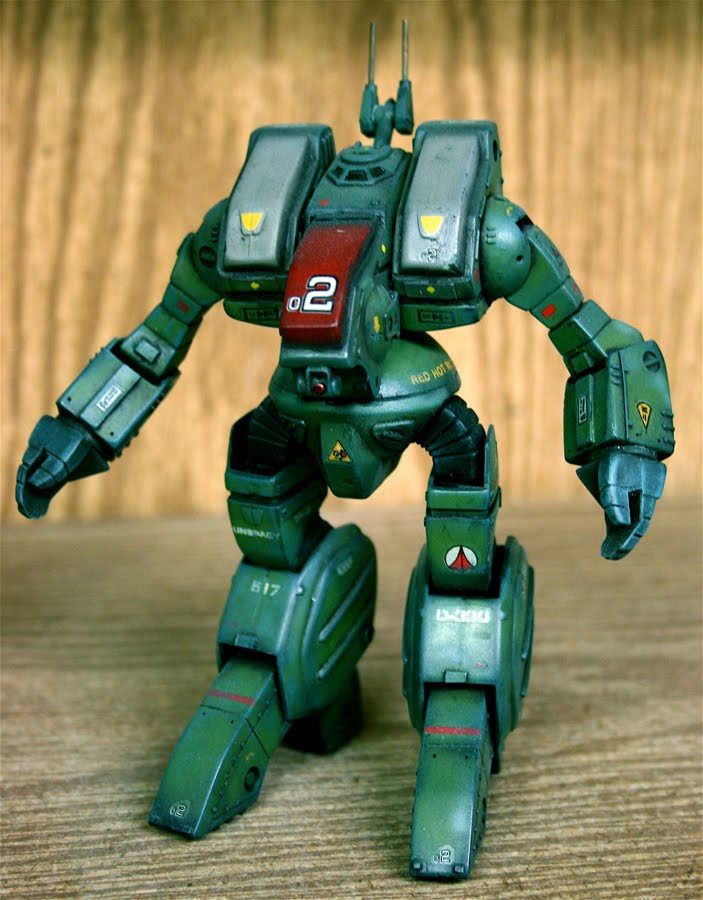
Here is an image of Dave Porter's 1/100 scale Spartan destroid.

Here is the Spartan destroid from Macross. It’s around fifty feet high and has several panels that open up to reveal missile batteries that it uses against enemy battle pods. The kit is in 1/100 scale from Imai. Again, the fit is pretty bad and the decals were not too bad. I find it interesting that these armor units have slogans and “nose art” included in the decal sheet. I finished the model in Tamiya colors and artist oil paint.

Thursday, August 19, 2010

TIE Interceptor


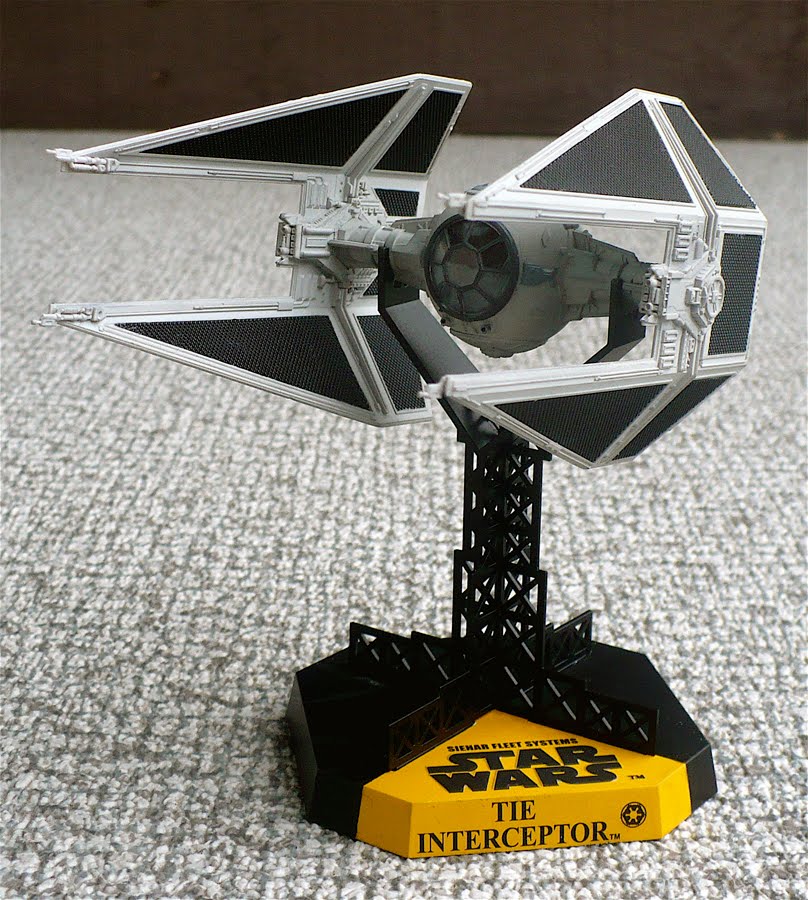
Here are some images of Fine Molds 1/72 scale TIE Interceptor. From Wik.... Wookieepedia "The TIE/In starfighter, or TIE Interceptor , was a TIE series starfighter used by the Galactic Empire. The TIE Interceptor was identifiable by its arrow-shaped solar collection panels, a distinct difference from the hexagonal solar arrays of its predecessor, the TIE Fighter. The Interceptor was one of the fastest starfighters in the galaxy at its prime, nearly rivaling the Alliance's RZ-1 A-wing interceptor.

Like most TIEs, the TIE Interceptor shared nearly identical cockpits, drive pods, and wing brace design with the TIE Fighter. The solar collector panels were lengthened and angled, and the forward center section was removed. This new solar array design gave the Interceptor its unmistakable dagger-like appearance, while providing the pilot with increased visibility and shrinking its profile making targeting more frustrating for enemy gunners. This wing design gave the craft a more menacing visage, continuing the Empire's reputation of ruling through fear.

The original production model came standard with four L-s9.3 laser cannons installed on each wingtip. New targeting software was among other advancements installed in the TIE Interceptor; the SFS T-s9a targeting computer offered greater accuracy during complex flight maneuvers. Twin laser cannon hardpoints still remained on the "chin" portion of the cockpit module. Provided technicians could find room for additional power generators, these cannons could also be utilized.

Later TIE Interceptor models were modified to carry four blaster cannons, replacing the original wingtip laser cannons, along with twin chin mounted laser cannons. It is believed these models participated in the Battle of Endor. However, the older model remained a common sight in Imperial fleets for years to come.

The TIE Interceptor fielded P-s5.6 twin ion engines. These new engines included an advanced ion-stream projector, thus allowing pilots access to more sophisticated combat maneuvers. Twin-port deflectors supported this feat by allowing the pilot individual manipulation of the deflectors, thus providing finer flight control. These advancements in engine technology made the TIE Interceptor a superior platform in space combat, achieving speeds beyond all other Alliance starfighters short of the A-wing.

The TIE Interceptor's primary role was as its title suggested. Like its predecessors the Interceptor lacked heavier armor, deflector shields, a hyperdrive, and life-support systems. Interceptor pilots were forced to rely on speed, maneuverability, superior numbers, and advanced weapon systems to prevail in its primary role of space superiority.

With no hyperdrive, the TIE Interceptor was reliant on a capital ship for an operations base. Star Destroyers and prominent shipyards such as Kuat and Fondor were common place for Interceptor squadrons; however, smaller vessels and more remote locations had to rely on aging TIE/ln fighters.

There was also a special variant, painted completely red with significant upgrades, that was available for use by the Emperor's Royal Guards. Aside from its paint job and upgrades, this model also featured two small wings protruding from each solar panel.

Glaug


Here is an image of Dave Porter's Glaug battle pod.

This is a “Glaug” battle pod from the Macross. It’s piloted by officers of the Zentraedi army (the bad guys). This kit is 1/200 scale and I built it straight from the box. I created a Martian surface for a base. The model is finished in Gunze colors and artist oils.

Wednesday, August 18, 2010

TIE M1


Here are some images of my kit bash model of a 1/48 scale TIE M1 Experimental. The models I used to build this were parts from two AMT/ERTL TIE fighters, one AMT/ERTL TIE interceptor, one Tamiya Tiger 1 tank, one Revell Explorer rocket and one Burraggo display base. From Wookieepedia, wookieep... "

The TIE Experimental M1, also known as the TIE Bizarro, was an experimental member of the TIE series and a part of the TIE Experimental Project.

One of the starfighters built by an Imperial research project led by Director Lenzer under the command of Grand Admiral Demetrius Zaarin, the M1 consisted of a single standard TIE/ln starfighter wing panel with two wing braces connected to a pair of standard TIE series cockpit pods. The port pod held the control systems, and the starboard pod held a turbolaser much heavier than the laser cannons equipped on any previous TIE.

Both pods had the trademark twin ion engines of the TIE series, and the fighter was actually slightly faster than the standard TIE/ln. The fighter was equipped with a hyperdrive, which was slaved to remote systems in a controller ship.

Rebel forces first encountered the M1 when they responded to a distress signal from a civilian convoy near the Belat system. A pair of A-wings escorting a staff transfer from Defiance to Liberty picked up the distress call during a course change between hyperspace jumps and responded to the attack. They found a squadron of TIE Experimental M1 fighters attacking a Cloburi Freight convoy, while a Beta-class ETR-3 escort transport stood by. The A-wings defeated the TIE M1s with minimal Rebel or civilian losses.

Later, when the Alliance ordered an intelligence-gathering strike on a TIE Experimental production facility, several waves of M1 fighters were found in the station's defense screen. They were also present at the main research facility, defending the hangar ship Sardis and space station Obsidian.

After the destruction of space platform Obsidian, no TIE Experimental fighters were seen again.

Defender


Here is an image of Dave Porter's 1/100 scale Defender.

This a mechanized robot weapon from the 1982 Japanimation TV series Macross. It’s supposed to be about 50 feet high. The kit is from Imai and it’s in 1/100 scale (stands about 6” tall). The fit wasn’t so good but the decals were very nice indeed. Dave finished it in Tamiya colors and artist oil paint.

Tuesday, August 17, 2010

TIE Advanced


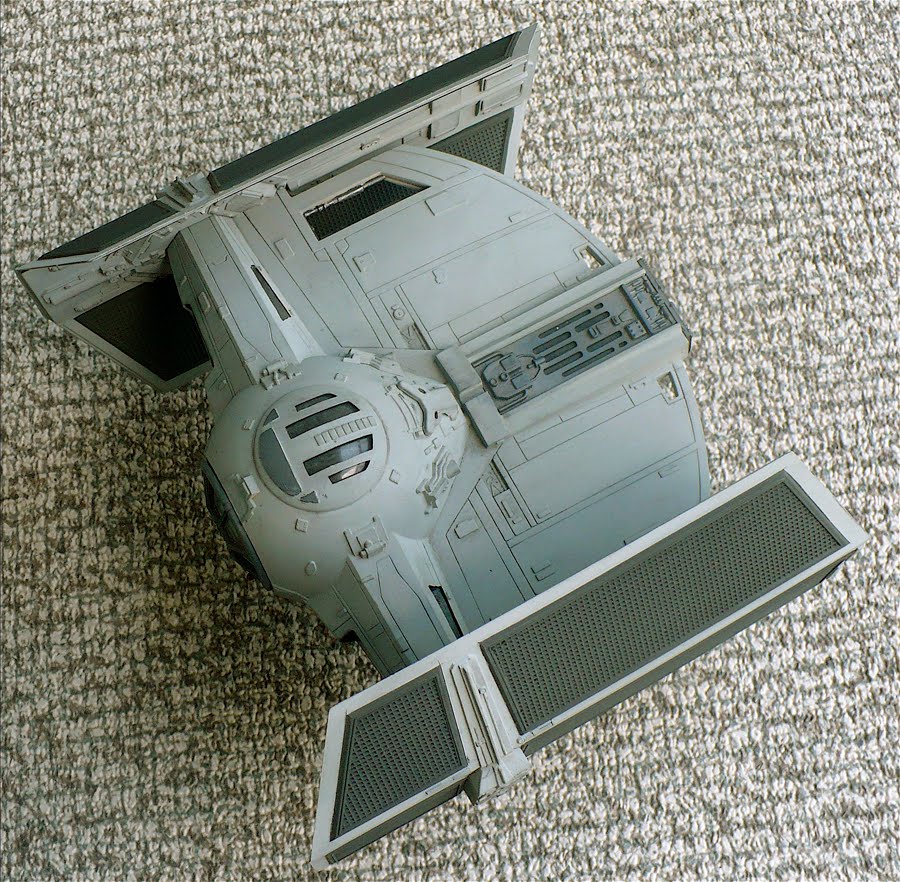
Here are some images of AMT/ERTL 1/36 scale Darth Vader's TIE Advanced X1 Fighter. From Wookieepedia, that's right Wookieepedia "

The TIE Advanced x1, or TIE/x1 was an advanced prototype starfighter touted as a replacement for the standard TIE Fighter and tested by Darth Vader at the Battle of Yavin and used by X1 during the Battle of Mustafar. At one point, the clone of Galen Marek stole Darth Vader's TIE Advanced x1 to escape Kamino.

While it never made it into production, many of its best design features were later incorporated into the TIE/sa bomber and TIE/In interceptor. Further development of the Advanced continued, eventually leading to the TIE Avenger and TIE Defender.

The TIE Advanced x1 featured a solar ionization reactor and paired twin ion engines like the original TIE Fighter. However, the x1 had an original spaceframe, with an elongated rear deck and reinforced durasteel-alloy hull. The x1's most important innovation was its "bent-wing" solar array wings, which had the advantages of increased surface area for more power while also reducing the craft's profile, compared to the TIE/ln starfighter's hexagonal panel wings.

Speed was only slightly improved due to the added mass of the vessel; a good deal of the extra power was bled off to the deflector shield generators. While less maneuverable than standard TIE fighters, it was more resilient in battle.

The TIE Advanced x1 had twin heavy blaster cannons in a fixed, front-mounted position, as well as a cluster missile launcher. In addition to its shields, it had a modest hyperdrive but no life-support systems. The target tracking system was also more sophisticated than the already formidable advanced targeting system on standard TIE craft, used to overcome the extremely powerful electronic jamming used by all combat craft to defeat target lock in battle. For best performance, the targeting system of the x1 required frequent adjustment in combat.

Monday, August 16, 2010

Nieuport 17


Here are some images of Eduard's 1/48 scale Nieuport 17. From Wikipedia "The type was a slightly larger development of the earlier Nieuport 11, and had a more powerful engine, larger wings, and a more refined structure in general. At first, it was equipped with a 110 hp (82 kW) Le Rhône 9J engine, though later versions were upgraded to a 130 hp (97 kW) engine. It had outstanding maneuverability, and an excellent rate of climb. Unfortunately, the narrow lower wing, marking it as a "sesquiplane" design with literally "one-and-a-half wings", was weak due to its single spar construction, and had a disconcerting tendency to disintegrate in flight. Initially, the Nieuport 17 retained the above wing mounted Lewis gun of the "11", but in French service this was soon replaced by a synchronised Vickers gun. In the Royal Flying Corps, the wing mounted Lewis was usually retained, by now on the improved Foster mounting, a curved metal rail which allowed the pilot to bring the gun down in order to change drums or clear jams. A few individual aircraft were fitted with both guns - but in practice this reduced performance unacceptably, and a single machine gun remained standard.

The type reached the French front in March 1916, and quickly began to replace the Nieuport 11 in French service. It was also ordered by the Royal Flying Corps and Royal Naval Air Service, as it was superior to any British fighter at that time. Worthy of note is the fact that during part of 1916, the Nieuport 17 equipped every fighter squadron of the Aéronautique Militaire. The Germans supplied captured examples to several of their aircraft manufacturers for them to copy. This resulted in the Siemens-Schuckert D.I which, apart from the engine installation, was a close copy and actually went into production, although in the event it was not used operationally on the Western Front.

By early 1917, the Nieuport was outclassed in most respects by the latest German fighters. Newer models (the Nieuport 24 and the 27) were brought out in an attempt to retain the type's ascendency. However, the SPAD S.VII had already replaced the Nieuport fighters in many French squadrons by mid-1917. The British persisted with Nieuports a little longer, not replacing their last Nieuport 24bis until early 1918.

Many Allied air aces flew Nieuport fighters, including Canadian ace W.A. Bishop, who received a Victoria Cross while flying it, and most famously of all, Albert Ball, V.C.

Like the other Nieuport types, the 17 was used as an advanced trainer for prospective fighter pilots after its operational days were over. This aircraft was flown by Adjudant Rene Dorme autumn 1918.

Sunday, August 15, 2010

Sea Venom


Here are some images of Matchbox's 1/32 scale de Havilland Sea Venom. From Wikipedia "The de Havilland Sea Venom was a British postwar carrier-capable jet aircraft developed from the de Havilland Venom. It served with the Royal Navy Fleet Air Arm and with the Royal Australian Navy. The French Navy operated the Aquilon, a version of the Sea Venom FAW.20 licence-built by SNCASE (Sud-Est).

The Sea Venom was the navalised version of the Venom NF.2 two-seat night fighter, and was used as an all-weather interceptor by the FAA. The necessary modifications for use on the Royal Navy's aircraft carriers included folding wings, a tailhook (which retracted into a characteristic "lip" over the jetpipe) and strengthened, long-stroke undercarriage. The canopy was modified to allow ejection from underwater. The first prototype made its first flight in 1951, and began carrier trials that same year. A further two prototypes were built. The first production Sea Venom took the designation FAW.20 (Fighter, All-Weather). It was powered by a single de Havilland Ghost 103 turbojet engine and its armament was the same as the RAF version. The next variant was the FAW.21, which included the modifications introduced in the Venom NF.2A and NF.3. Some of these modifications included the Ghost 104 engine, a clear-view canopy and American radar. The final Royal Navy variant was the FAW.22 powered by the Ghost 105 engine. 39 of this type were built in 1957–58. Some were later fitted out with the de Havilland Firestreak air-to-air missile.

Seven FAW.21s were modified in 1958 for Electronic countermeasures (ECM) purposes, with the cannon replaced by the ECM equipment. These became the ECM.21. 831 Naval Air Squadron, the sole squadron to be equipped with it, was shore-based at RAF Watton from 1963 and disbanded in 1966. Converted FAW.22s were similarly known as the ECM.22.

A modernised Sea Venom project, the DH.116 with swept wings and upgraded radar was considered, but cancelled as the Royal Navy believed that any replacement needed two engines. The de Havilland Sea Vixen ultimately replaced the Sea Venom.