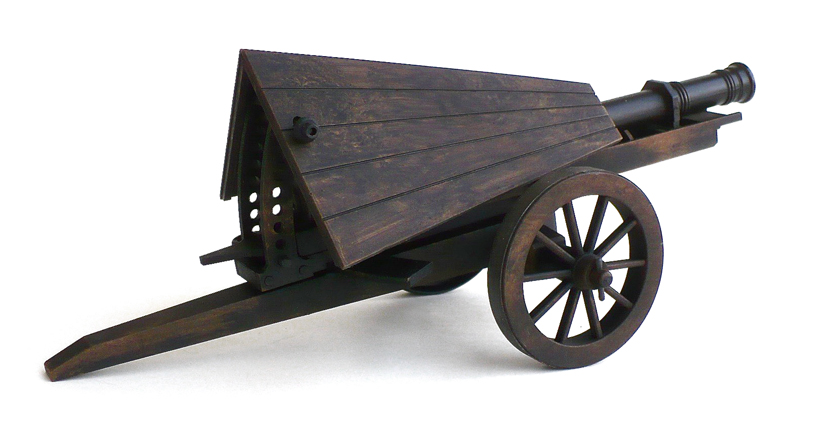
Here are some images of Mantua's 1/17 scale French Fortress Siege Mortar 1680.
From Cornwall Model Boats"
French fortress mortar - 1680
This nice model of a french fortress
mortar was recostructed from original plans. The barrel, large caliber,
squat & short range, could fire explosive balls, loaded with stones,
nails & scrap - iron.
Translate
Showing posts with label Cannons and Catapults. Show all posts
Friday, September 1, 2017
Tuesday, August 29, 2017
18th Century American Coast Cannon
Here are some images of Mantua Models 1/17 scale 18th Century American Coast Cannon.
From Cornwall Model Boats
This Small Cannon was influential in the defence of the eastern coasts of the USA for more than thirty. Easy to handle, this cannon was ideal for gunnery training and could fire a high volume of explosive balls.
From Cornwall Model Boats
This Small Cannon was influential in the defence of the eastern coasts of the USA for more than thirty. Easy to handle, this cannon was ideal for gunnery training and could fire a high volume of explosive balls.
Saturday, August 26, 2017
15th Century Cannon
Here are some images of Pocher's 1/20 scale 15th Century Cannon.
Like in the previous post, try as I might I couldn't find any information on this Cannon.
Ah Pocher! ever the pervayor of knowledge.
Like in the previous post, try as I might I couldn't find any information on this Cannon.
Ah Pocher! ever the pervayor of knowledge.
Thursday, August 24, 2017
Chinese Cannon Of The Forts Of Shan-Hai-Kuan
One would think that when Pocher produced this kit that they would have supplied some historical information on the subject at hand but alas no.
Web searches on this subject were so far unsuccessful.
Update - I've been told by avid model cannon collector Matthew that" the Chinese cannon was captured by Italian marines during boxer rebellion circa 1900 or so." Have a look at his fantastic site https://www.flickr.com/photos/110082008@N08/sets/72157638489604955/
Sunday, November 29, 2015
Leonardo da Vinci's Multiple Sling
Here are some images of Edu-Toys Leonardo da Vinci's Multiple Sling.
From the instructions"
Leonardo da Vinci's idea was to build a very powerful machine which could throw eight large projectiles at the same time.
He positioned eight long arms around a central pin, each of which had a sling capable of throwing a projectile attached to it.
This kind of project, where weapons were developed to hurl multiple projectiles to be more powerful, was common in da Vinci's time, because doing this meant creating more powerful weapons, simply by increasing their number and power, without the need to develop new building techniques and using familiar materials. They were therefore potentially attractive weapons because they were powerful,but they were also relatively inexpensive.
From the instructions"
Leonardo da Vinci's idea was to build a very powerful machine which could throw eight large projectiles at the same time.
He positioned eight long arms around a central pin, each of which had a sling capable of throwing a projectile attached to it.
This kind of project, where weapons were developed to hurl multiple projectiles to be more powerful, was common in da Vinci's time, because doing this meant creating more powerful weapons, simply by increasing their number and power, without the need to develop new building techniques and using familiar materials. They were therefore potentially attractive weapons because they were powerful,but they were also relatively inexpensive.
Thursday, November 26, 2015
Leonardo da Vinci's Spingarde
Here are some images of Academy's Leonardo da Vinci's Spingarde.
These are simple kits but they're fun.
From the instructions"
The Leonardo da Vinci Spingarde launcher was placed on a firm wooden structure and could launch projectiles at targets over a wide range, due to its ability to move in all directions. Although heavy, efficient aiming was not difficult, making it highly functional on the battlefield.
These are simple kits but they're fun.
From the instructions"
The Leonardo da Vinci Spingarde launcher was placed on a firm wooden structure and could launch projectiles at targets over a wide range, due to its ability to move in all directions. Although heavy, efficient aiming was not difficult, making it highly functional on the battlefield.
Tuesday, December 31, 2013
Leonardo Da Vinci Catapult
Here are some images of Edu Toys Leonardo Da Vinci Catapult.
This is a simple but great kit.
If you build it straight out of the box without any painting produces a fairly decent example. However if you wish to add a more realistic appearance, a nice black wash and scuffing plus some rusty steel details does the job. Plus this model can toss a marble like no tomorrow.
From Wikipedia"
Leonardo da Vinci sought to improve the efficiency and range of earlier designs. His design incorporated a large wooden leaf spring as an accumulator to power the catapult. Both ends of the bow are connected by a rope, similar to the design of a bow and arrow. The leaf spring was not used to pull the catapult armature directly, rather the rope was wound around a drum. The catapult armature was attached to this drum which would be turned until enough potential energy was stored in the deformation of the spring. The drum would then be disengaged from the winding mechanism, and the catapult arm would snap around. Though no records exist of this design being built during Leonardo's lifetime, contemporary enthusiasts have reconstructed it.
This is a simple but great kit.
If you build it straight out of the box without any painting produces a fairly decent example. However if you wish to add a more realistic appearance, a nice black wash and scuffing plus some rusty steel details does the job. Plus this model can toss a marble like no tomorrow.
From Wikipedia"
Leonardo da Vinci sought to improve the efficiency and range of earlier designs. His design incorporated a large wooden leaf spring as an accumulator to power the catapult. Both ends of the bow are connected by a rope, similar to the design of a bow and arrow. The leaf spring was not used to pull the catapult armature directly, rather the rope was wound around a drum. The catapult armature was attached to this drum which would be turned until enough potential energy was stored in the deformation of the spring. The drum would then be disengaged from the winding mechanism, and the catapult arm would snap around. Though no records exist of this design being built during Leonardo's lifetime, contemporary enthusiasts have reconstructed it.
Saturday, October 26, 2013
Onager
Here are some more images of Corel Models 1/25 scale Onager Catapult. The
Roman Onager was a field and siege catapult and is believed to have
been invented sometime in the 3rd and 4th centuries A.D. It is believed
the Romans got the idea for this catapult when they had seen a wild
Donkey being chased by hunters kicking back at them the stones it had
come across on the road. Hence the name Onager which is a type of
Donkey. The materials for this model were Walnut, Brass and copper and
was a straight forward build.
Catapulta
Here are some more images of Corel Models 1/25 scale Catapulta. This
catapult dates back to the last years of the Roman Empire where
construction techniques had made great advancements from the previous
Onager catapult. These types of catapults were generally used on Roman
Polyreme ships and usually placed at the stern. The maximum throwing
distance of these catapults was usually around 350 meters. The
materials used for this model were Walnut, Brass and Copper. This was a
very easy model to build, no issues.
Subscribe to:
Posts (Atom)