Translate

Showing posts with label Locomotive and Rail. Show all posts

Friday, July 5, 2019

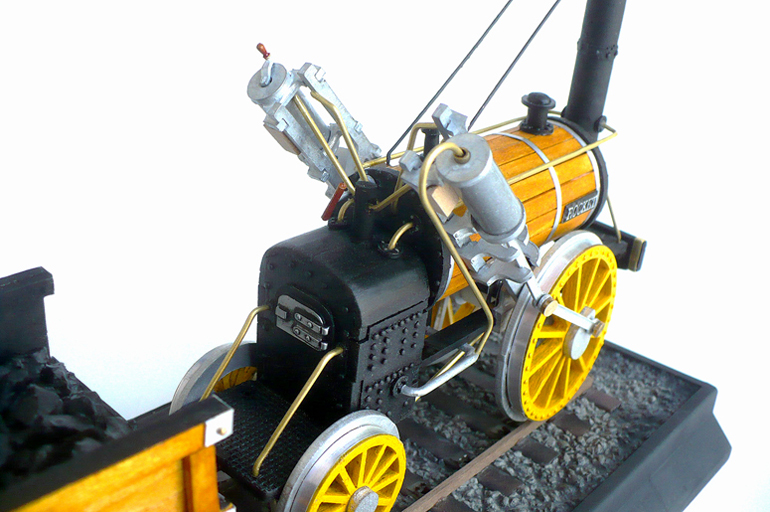
The Stephenson Rocket 1829

Here are some images of Ocre Models 1/24 scale Stephenson Rocket.
An all wood and metal kit this model builds up to a beautiful piece.

From Wikipedia"


Stephenson's Rocket was an early steam locomotive of 0-2-2 wheel arrangement. It was built for, and won, the Rainhill Trials held by the Liverpool and Manchester Railway in 1829 to choose the best design to power the railway.
Rocket was designed by Robert Stephenson in 1829, and built at the Forth Street Works of his company in Newcastle upon Tyne.
Though Rocket was not the first steam locomotive, it was the first to bring together several innovations to produce the most advanced locomotive of its day. It is the most famous example of an evolving design of locomotives by Stephenson that became the template for most steam engines in the following 150 years.
The locomotive was preserved and displayed in the Science Museum in London until 2018. It was loaned to Newcastle Discovery Museum between 22 June and 9 September 2018, to the Science and Industry Museum in Manchester from 25 September 2018 to 8 September 2019, and will move to the National Railway Museum in York later in 2019.

Saturday, December 17, 2016

1804 Pen - Y - Darren Locomotive

Here are some images plus a composite of Academy's 1804 Pen - Y - Darren  Locomotive.

From Wikipedia"
In 1802, Trevithick built one of his high-pressure steam engines to drive a hammer at the Pen-y-Darren Ironworks in Merthyr Tydfil, Mid Glamorgan . With the assistance of Rees Jones, an employee of the iron works and under the supervision of Samuel Homfray, the proprietor, he mounted the engine on wheels and turned it into a locomotive. In 1803, Trevithick sold the patents for his locomotives to Samuel Homfray.
Homfray was so impressed with Trevithick's locomotive that he made a bet with another ironmaster, Richard Crawshay, for 500 guineas that Trevithick's steam locomotive could haul ten tons of iron along the Merthyr Tydfil Tramroad from Penydarren (51°45′03″N 3°22′33″W) to Abercynon (51°38′44″N 3°19′27″W), a distance of 9.75 miles (16 km). Amid great interest from the public, on 21 February 1804 it successfully carried 10 tons of iron, 5 wagons and 70 men the full distance in 4 hours and 5 minutes, an average speed of approximately 2.4 mph (3.9 km/h). As well as Homfray, Crawshay and the passengers, other witnesses included Mr. Giddy, a respected patron of Trevithick and an 'engineer from the Government'. The engineer from the government was probably a safety inspector and particularly interested in the boiler's ability to withstand high steam pressures.
The configuration of the Pen-y-darren engine differed from the Coalbrookdale engine. The cylinder was moved to the other end of the boiler so that the firedoor was out of the way of the moving parts. This obviously also involved putting the crankshaft at the chimney end. The locomotive comprised a boiler with a single return flue mounted on a four wheel frame. At one end, a single cylinder with very long stroke was mounted partly in the boiler, and a piston rod crosshead ran out along a slidebar, an arrangement that looked like a giant trombone. As there was only one cylinder, this was coupled to a large flywheel mounted on one side. The rotational inertia of the flywheel would even out the movement that was transmitted to a central cog-wheel that was, in turn connected to the driving wheels. It used a high-pressure cylinder without a condenser, the exhaust steam was sent up the chimney assisting the draught through the fire, increasing efficiency even more.
The bet was won. Despite many people's doubts, it had been shown that, provided that the gradient was sufficiently gentle, it was possible to successfully haul heavy carriages along a "smooth" iron road using the adhesive weight alone of a suitably heavy and powerful steam locomotive. Trevithick's was probably the first to do so; however some of the short cast iron plates of the tramroad broke under the locomotive as they were intended only to support the lighter axle load of horse-drawn wagons and so the tramroad returned to horse power after the initial test run.
Homfray was pleased he won his bet. The engine was placed on blocks and reverted to its original stationary job of driving hammers.
In modern Merthyr Tydfil, behind the monument to Trevithick's locomotive is a stone wall, the sole remainder of the former boundary wall of Homfray's Penydarren House.
A full-scale working reconstruction of the Pen-y-darren locomotive was commissioned in 1981 and delivered to the Welsh Industrial and Maritime Museum in Cardiff; when that closed, it was moved to the National Waterfront Museum in Swansea. Several times a year it is run on a 40m length of rail outside the museum.

Tuesday, February 9, 2016

Cable Car

Here are some images of Artesania Latina's 1/22 scale San Fransisco Cable Car.

From Wikipedia"
A cable car is a type of cable transport used for mass transit where rail cars are hauled by a continuously moving cable running at a constant speed. Individual cars stop and start by releasing and gripping this cable as required. Cable cars are distinct from funiculars, where the cars are permanently attached to the cable, and cable railways, which are similar to funiculars, but where the rail vehicles are attached and detached manually.

The first cable-operated railway, employing a moving rope that could be picked up or released by a grip on the cars was the Fawdon railway (or wagonway) in 1826, a Colliery railway line.[3][4] The London and Blackwall Railway, which opened for passengers in east London, England, in 1840 used such a system. The rope available at the time proved too susceptible to wear and the system was abandoned in favour of steam locomotives after eight years. In America, the first cable car installation in operation probably was the West Side and Yonkers Patent Railway in New York City, which ran from 1 July 1868 to 1870. The cable technology used in this elevated railway involved collar-equipped cables and claw-equipped cars, and proved cumbersome. The line was closed and rebuilt, and reopened with steam locomotives.
Other cable cars to use grips were those of the Clay Street Hill Railroad, which later became part of the San Francisco cable car system. The building of this line was promoted by Andrew Smith Hallidie with design work by William Eppelsheimer, and it was first tested in 1873. The success of these grips ensured that this line became the model for other cable car transit systems, and this model is often known as the Hallidie Cable Car.
In 1881 the Dunedin cable tramway system opened in Dunedin, New Zealand and became the first such system outside San Francisco. For Dunedin, George Smith Duncan further developed the Hallidie model, introducing the pull curve and the slot brake; the former was a way to pull cars through a curve, since Dunedin's curves were too sharp to allow coasting, while the latter forced a wedge down into the cable slot to stop the car. Both of these innovations were generally adopted by other cities, including San Francisco.
In Australia the Melbourne cable tramway system operated from 1885 to 1940. It was one of the most extensive in the world with 1200 trams and trailers operating over 15 routes with 103 km (64 miles) of track. Sydney also had a few cable tram routes.
Cable cars rapidly spread to other cities, although the major attraction for most was the ability to displace horsecar (or mule-drawn) systems rather than the ability to climb hills. Many people at the time viewed horse-drawn transit as unnecessarily cruel, and the fact that a typical horse could work only four or five hours per day necessitated the maintenance of large stables of draft animals that had to be fed, housed, groomed, medicated and rested. Thus, for a period, economics worked in favour of cable cars even in relatively flat cities.
For example, the Chicago City Railway, also designed by Eppelsheimer, opened in Chicago in 1882 and went on to become the largest and most profitable cable car system. As with many cities, the problem in flat Chicago was not one of grades but of transportation capacity. This caused a different approach to the combination of grip car and trailer. Rather than using a grip car and single trailer, as many cities did, or combining the grip and trailer into a single car, like San Francisco's California Cars, Chicago used grip cars to pull trains of up to three trailers.
In 1883 the New York and Brooklyn Bridge Railway was opened, which had a most curious feature: though it was a cable car system, it used steam locomotives to get the cars into and out of the terminals. After 1896 the system was changed to one on which a motor car was added to each train to maneuver at the terminals, while en route, the trains were still propelled by the cable.

On 25 September 1883 a test of a cable car system was held by Liverpool United Tramways and Omnibus Company in Kirkdale, Liverpool. This would have been the first cable car system in Europe, but the company decided against implementing it. Instead the distinction went to the 1884 route from Archway to Highgate, north London, which used a continuous cable and grip system on the 1 in 11 (9%) climb of Highgate Hill. The installation was not reliable and was replaced by electric traction in 1909. Other cable car systems were implemented in Europe, though, among which was the Glasgow District Subway, the first underground cable car system, in 1896. (London's first deep-level tube railway, the City & South London Railway, had earlier also been built for cable haulage but had been converted to electric traction before opening in 1890.) A few more cable car systems were built in the United Kingdom, Portugal and France, but European cities, having many more curves in their streets, were less suitable for cable cars than American cities.
Though some new cable car systems were still being built, by 1890 the cheaper to construct and simpler to operate electrically-powered trolley or tram started to become the norm, and eventually started to replace existing cable car systems. For a while hybrid cable/electric systems operated, for example in Chicago where electric cars had to be pulled by grip cars through the loop area, due to the lack of trolley wires there. Eventually, San Francisco became the only street-running manually operated system to survive—Dunedin, the second city with such cars, was also the second-last city to operate them, closing down in 1957.
  In the last decades of the 20th century cable traction in general has seen a limited revival as automatic people movers, used in resort areas, airports (for example, Toronto Airport), huge hospital centers and some urban settings. While many of these systems involve cars permanently attached to the cable, the Minimetro system from Poma/Leitner Group and the Cable Liner system from DCC Doppelmayr Cable Car both have variants that allow the cars to be automatically decoupled from the cable under computer control, and can thus be considered a modern interpretation of the cable car.

The cable is itself powered by a stationary motor or engine situated in a cable house or power house. The speed at which it moves is relatively constant depending on the number of units gripping the cable at any given time.
The cable car begins moving when a clamping device attached to the car, called a grip, applies pressure to ("grips") the moving cable. Conversely the car is stopped by releasing pressure on the cable (with or without completely detaching) and applying the brakes. This gripping and ungripping action may be manual, as was the case in all early cable car systems, or automatic, as is the case in some recent cable operated people mover type systems. Gripping must be an even and gradual process in order to avoid bringing the car to cable speed too quickly and unacceptably jarring the passengers.
In the case of manual systems, the grip resembles a very large pair of pliers, and considerable strength and skill are required to operate the car. As many early cable car operators discovered the hard way, if the grip is not applied properly, it can damage the cable, or even worse, become entangled in the cable. In the latter case, the cable car may not be able to stop and can wreak havoc along its route until the cable house realizes the mishap and halts the cable.
One apparent advantage of the cable car is its relative energy efficiency, because of the economy of centrally located power stations, and the ability of descending cars to transfer energy to ascending cars. However, this advantage is totally negated by the relatively large energy consumption required to simply move the cable over and under the numerous guide rollers and around the many sheaves. Approximately 95% of the tractive effort in the San Francisco system is expended in simply moving the four cables at 9.5 miles per hour. Electric cars with regenerative braking do offer the advantages, without the problem of moving a cable. In the case of steep grades, however, cable traction has the major advantage of not depending on adhesion between wheels and rails. There is also the obvious advantage that keeping the car gripped to the cable will also limit the downhill speed to that of the cable.
Because of the constant and relatively low speed, a cable car's potential to cause harm in an accident can be underestimated. Even with a cable car traveling at only 9 miles per hour, the mass of the cable car and the combined strength and speed of the cable can do quite a lot of damage in a collision.

Friday, April 24, 2015

4-4-0 Steam Locomotive

Here are some images of AMT's 1/25 scale 4-4-0 Steam Locomotive .
I realize these trains were probably a medium dark green in colour but flat black just looks so cool.

From Wikipedia"
The General is a type 4-4-0 steam locomotive that was the subject of the Great Locomotive Chase of the American Civil War. The locomotive is preserved at the Southern Museum of Civil War and Locomotive History in Kennesaw, Georgia, and it is listed on the National Register of Historic Places. It was arguably the first train ever hijacked.

Built in 1855 by Rogers, Ketchum & Grosvenor in Paterson, New Jersey, The General provided freight and passenger service between Atlanta, Georgia, and Chattanooga, Tennessee, before the Civil War on the Western and Atlantic Railroad of the State of Georgia and later, the Western and Atlantic Railroad Company.
During the Civil War on April 12, 1862, The General was commandeered by Northerners led by James J. Andrews at Big Shanty (now Kennesaw, Georgia), and abandoned north of Ringgold, after being pursued by William Allen Fuller and the Texas. Low on water and wood, the General eventually lost steam pressure and speed, and slowed to a halt two miles north of Ringgold, where Andrews and his raiders abandoned the locomotive and tried to flee.
Later, the General narrowly escaped destruction when General John Bell Hood ordered the ordnance depot destroyed as he left Atlanta on September 1, 1864. However, the engine was severely damaged by being run into boxcars of ammunition and the Missouri locomotive. This was done deliberately so as to render the engine unusable for the approaching Union forces.

It had been speculated by some that, after the General had been damaged, the invading Union army restored the engine and operated it. However, many historians believe that the engine was left untouched for the remainder of the war. The Union army had based its repair shops in Nashville, and there is no evidence to suggest the engine was moved there. The United States Military Railroad Service had many new or like-new engines, so they had no need to restore captured ones such as the General. The USMRR had often left the damaged equipment of a captured railroad undisturbed, and its records, having listed the General as "captured and returned," further suggest such was the case of the General.
After the war ended, the General was repaired and continued service on the Western and Atlantic. In the 1870s, the General was completely rebuilt, it had received a new pilot, boiler, and other components. Most notably, its three dome configuration was reduced to two domes, and its Radley-Hunter style balloon stack was replaced with a diamond stack, as the engine had been converted to burn coal. Indeed, the rebuilt engine had little resemblance to its original form.
Before the Civil War, most railways in the south, including the W&A, did not give their engines numbers. Rather, they were simply named, such as the General. When the railroad began numbering engines after the war, the General was the 39th engine to be acquired by the road, and was numbered accordingly. Locomotives came and went as years progressed, and by 1880, a renumbering was necessary. At this time, the General was given the number "3," being the third oldest engine that the railroad had at the time. The engine continues to carry this number today.
In the mid-1880s, the Atlanta and Florida Railroad began construction. During this time, the W&A had a locomotive surplus after buying several more modern engines, so they leased the General to the A&F from 1887 to 1888 to assist in construction.
The locomotive was originally built to the southern states standard rail gauge of 5 ft (1,524 mm). After a change to the northern states gauge was mandated by June 1, 1886, The General was converted to be compatible with the U.S. Standard Gauge of 4 ft 8 12 in (1,435 mm).

The General was retired from service in 1891 and stored on a siding in Vinings, GA where it awaited its final fate. Early the next year, E. Warren Clark, a professional photographer, discovered the engine in Vinings, and approached John W. Thomas, president of the Nashville, Chattanooga and St. Louis Railway (which had won the lease on the Western and Atlantic Railroad of the State of Georgia in 1890), with the proposal of restoring the General for exhibition at the upcoming World's Columbian Exposition in Chicago. Thomas accepted, and the General was soon taken to the NC&StL Ry Shops at West Nashville to be restored. At this time, the engine was given a Radley-Hunter style balloon stack similar to the engine's original, and was reverted to a wood burner. The engine soon encountered problems involved with burning wood, so it was restored back to a coal burner. The engine was given a unique new stack at this time, one that, while designed for coal burning, was styled like the original so as to give the appearance of a wood burner.
While the engine's display in Chicago was costly, and left Warren Clark broke afterward, it had insured the General's preservation. In 1901, the General was placed on display in the Chattanooga Union Depot. There, it remained on display for nearly fifty years, only being removed for short periods for exhibitions. In particular, the engine was taken to Baltimore in 1927 to participate in the Baltimore and Ohio Railroad's "Fair of the Iron Horse," then in 1933 to Chicago's "Century of Progress" Exhibition, the 1939 New York World's Fair, and finally, the Chicago Railroad Fair in 1948.
In 1959, The Louisville and Nashville Railroad, removed the General from the Chattanooga Union Depot and began to restore the engine to operating condition at its South Louisville Shops, for the American Civil War Centennial. As part of the restoration, the General was given modern air brakes, a modern coupler (only on the tender, the older style coupler on the engine's front pilot remained), and was converted to burn oil. Throughout the 1960s, the engine pulled Louisville and Nashville Combine Car Number 665 as travelled to various places across the eastern US, including the 1964 New York World's Fair under its own power.

In the mid-1960s, the state of Georgia began to express interest in reclaiming the engine. Indeed, many proposals about the General had arisen since the 1930s, while it was still on display at Chattanooga, including plans to have the General be displayed in Underground Atlanta, Kennesaw Mountain, or at Stone Mountain Park, among others, some of which even included removing the Texas from the Cyclorama to be displayed with the engine. While much press coverage was given about these proposals, none of them had ever materialized. Even the city of Paterson, New Jersey, where the locomotive was built, expressed interest, since many engines had been built by Rogers and other firms in the city, but had none to display. Paterson eventually withdrew their proposal and sought other engines to display.
The state of Georgia's interest in the General soon raised tensions with the city of Chattanooga, where the General was displayed. In 1967, the city of Kennesaw, where the engine had been stolen in 1862, requested to have the engine visit and give rides during a fundraiser. The General was on its way there, when it was stopped by a group led by Chattanooga's mayor, Ralph H. Kelley. He believed the engine belonged to the city, and a lawsuit had been filed against the L&N concerning custody of the engine.
Thus began a long legal battle, eventually going to the US Supreme Court. This dispute lasted until 1970, when the Supreme Court ruled in favor of the railroad. The General was stored in Louisville during this time, only being publicly displayed over a weekend in November 1971, when it was displayed in the city's Union Station alongside the road's newer diesel engine no. 1776.

 After the L&N won the legal dispute concerning the engine's custody in 1970, they brought the engine to Atlanta via Knoxville and Cartersville, bypassing Chattanooga. In February 1972, a ceremony was held in Atlanta where L&N president Kendall formally presented the General to then state governor (and later President of the United States) Jimmy Carter. Afterwards, the engine was moved to Kennesaw where a museum site was prepared. On April 12, 1972, the Big Shanty Museum (later known as the Southern Museum of Civil War and Locomotive History) opened, and the General remained on display there since.

 Under the Whyte notation for the classification of steam locomotives by wheel arrangement, 4-4-0 represents the arrangement of four leading wheels on two axles, usually in a leading bogie, four powered and coupled driving wheels on two axles, and no trailing wheels. Almost every major railroad that operated in North America in the first half of the 19th century owned and operated locomotives of this type. Due to the large number of the type that were produced and used there, the 4-4-0 is most commonly known as the American type, but the type subsequently became popular in the United Kingdom, where large numbers were produced.

Wednesday, June 18, 2014

s.Sp.Artilleriewagen

Here are some more images of Dragon Models 1/35 scale s.Sp.Artilleriewagen. The s.Sp.Artilleriewagen was an armored rail car designed to protect cargo trains.

Tuesday, June 17, 2014

Krupp 28 cm K5 railway gun "Leopold"

Here are some more images of Dragon models 1/35 scale Krupp 28 cm K5 Railway Gun "Leopold". The K5 guns were probably the most successful of the large railway guns which could fire 565lb shells a distance of 40 miles. A total of 28 K5s were constructed between 1936 and 1945. This kit was a beautiful model to build although it is an expensive model to purchase. When I bought this kit in 2003 it was around $140 Cdn, today who knows. I have yet to see it re released. If you do manage to purchase one make some room because it does make an impressive display piece.

From Wikipedia'
The Krupp 28-cm-Kanone 5 (E), in short K5 with the (E) signifying Eisenbahnlafette (railway car gun-mount), was a heavy railway gun used by Germany throughout World War II.
Krupp's K5 series were consistent in mounting a 21.5 metres (71 ft) long gun barrel in a fixed mounting with only vertical elevation of the weapon. This gondola was then mounted on a pair of 12-wheel bogies designed to be operated on commercial and military rails built to German standards. This mounting permitted only two degrees of horizontal traverse. The carriage had to be aligned on the rails first, with only minimal fine leveling capable once halted. Hence the gun could only fire at targets tangential to an existing railway track.
To track targets needing greater traverse either a curved length of railway was used with the gun shunted backwards or forwards to aim; a cross-track was laid with the front bogie turned perpendicular to the rest of the gun and moved up and down the cross-track to train the weapon; or for 360 degree traverse, the so-called "Vögele Turntable" could be constructed, consisting of a raised rail section (the "firing bed") carrying the gun, running on a circular track with a central jack to raise the gun during traverse and to take some of the enormous weight.
The main barrel of the K5 is 283 mm (11.1 in) in calibre (caliber), and is rifled with twelve 7 mm (0.28 in) grooves. These were originally 10 mm (0.39 in) deep, but were shallowed to rectify cracking problems.
The K5 was the result of a crash program launched in the 1930s to develop a force of railway guns to support the Wehrmacht by 1939. K5 development began in 1934 with first testing following in 1936 at the Firing Test Range Rügenwalde-Bad (German: Schießplatz Rügenwalde-Bad) in Farther Pomerania at the South coast of the Baltic Sea. Initial tests were done with a 150 mm barrel under the designation K5M.
Production led to eight guns being in service for the Invasion of France, although problems were encountered with barrel splitting and rectified with changes to the rifling. The guns were then reliable until the end of the war, under the designation K5 Tiefzug 7 mm. Three of them were installed on the English Channel coast to target British shipping in the Channel, and proved successful at this task.
Towards the end of the war, development was done to allow the K5 to fire rocket-assisted projectiles to increase range. Successful implementation was done for firing these from the K5Vz.
A final experiment was to bore out two of the weapons to 310 mm (12.2 in) smoothbore to allow firing of the Peenemünder Pfeilgeschosse arrow shells. The two modified weapons were designated K5 Glatt.
Several other proposals were made to modify or create new models of the K5 which never saw production. In particular, there were plans for a model which could leave the railway by use of specially modified Tiger II tank chassis which would support the mounting box in much the same manner as the railway weapon's two bogies. This project was ended by the defeat of Germany.

Two types of high explosive projectile were used with the K5. The 28cm G35 weighed 255 kilograms (562 lb) and contained a charge of 30.5 kilograms (67 lb) of TNT. The 28cm Gr.39 m. Hbgr. Z. was slightly heavier, weighing 265 kilograms (584 lb) and containing around 44.5 kilograms (98 lb) of TNT.
The rocket-boosted shell was known as the 28cm R. GR.4351. This carried 14 kilograms (31 lb) of explosive and was boosted by around 20 kilograms (40 lb) of Double base powder rocket propellent. The total waeight was 248 kilograms (547 lb).

A K5(E) is preserved at the United States Army Ordnance Museum in Fort Lee (Petersburg, Virginia). It is composed of parts from two guns that shelled Anzio beachhead during World War II. They were named Robert and Leopold by the Germans, but are better known by their Allied nicknames - Anzio Annie and Anzio Express.
The guns were discovered on a railroad siding in the town of Civitavecchia, on 7 June 1944, shortly after the allies occupied Rome. Robert had been partially destroyed by the gun crew before they surrendered and Leopold was also damaged but not as badly. Both guns were shipped to the U.S. Aberdeen Proving Ground, (Aberdeen, Maryland) where they underwent tests. Leopold was restored using parts taken from Robert. In early 2011 it was moved to Fort Lee, Virginia (37.250338°N 77.340492°W) as a result of the 2005 Base Relocation and Closure (BRAC) Act.
A second surviving gun can be seen at the Batterie Todt museum, near Audinghen in northern France.

Monday, June 16, 2014

Kriegslokomotive BR52

Here are some images plus a composite of Trumpeter's 1/35 scale Kriegslokomotive BR52. From Wiki "Kriegslokomotiven were German 'war locomotives', produced in large numbers during the Second World War, whose construction were tailored to the economic circumstances of wartime Germany, such as shortages of materials, goods transportation (in support of military logistics), ease of maintenance under difficult conditions, resistance to extreme weather, limited life and rapid, cheap, mass production. In order to meet these requirements, economic drawbacks such as relatively high fuel consumption had to be reckoned with".


Friday, June 13, 2014

Railway Gondola Type OMMR

Here are some images of Dragon models 1/35 scale German Railway Gondola Type OMMR. I don't know what else I can tell you, it's an open rail car. I did put a couple of Goliath tracked mine vehicles and extra sand bags in it. And uh... well... Oh! I did use RLM 66 grey as its main colour.