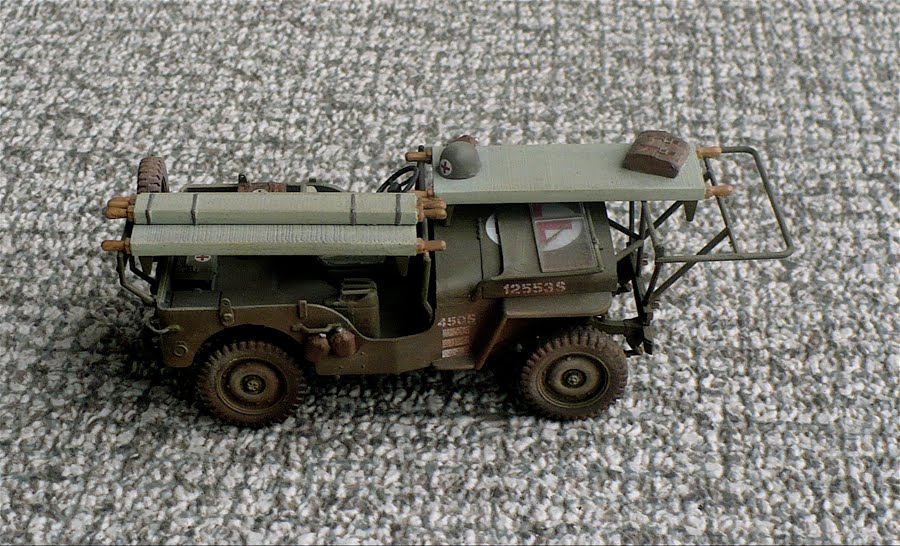
Her are some images of Italeri's 1/35 scale Ambulance Jeep. The Jeep was perhaps the best all round multipurpose vehicle ever constructed. Because of it's ability to handle most terrains without suffering from structural damage one of its tasks which it was ideally suited was that of an Ambulance having served this role from World War Two right up into the 1980's.
Translate
Sunday, October 24, 2010
Ambulance Jeep
Her are some images of Italeri's 1/35 scale Ambulance Jeep. The Jeep was perhaps the best all round multipurpose vehicle ever constructed. Because of it's ability to handle most terrains without suffering from structural damage one of its tasks which it was ideally suited was that of an Ambulance having served this role from World War Two right up into the 1980's.
Saturday, October 23, 2010
Sturmgeschütz IV
Here are some images of Monogram's 1/32 scale Sturmgeschuetz IV . From Wikipedia "
The Sturmgeschütz IV resulted from Krupp's effort to supply an assault gun. As Krupp did not build Panzerkampfwagen IIIs, they used the Panzerkampfwagen IV chassis in combination with a slightly modified Sturmgeschütz III superstructure.
- Initial Project The first known proposal for a Sturmgeschütz on the Panzer IV chassis is in Krupp drawing number W1468 dated February 1943. This initial drawing unitized the outdated Sturmgeschütz Ausf. F superstructure on a Panzer IV chassis 9. This proposal had a sloped front superstructure with a combat weight of 28.26 tons. Krupp abandoned it in February 1943 because it was too heavy. Plans for the StuG IV were halted.
- Another Project During the Führer Conference of August 19–22, 1943, after the battle of Kursk, Hitler had seen reports of the StuG III performing superior to the Panzer IV within certain restraints of how they were deployed. Convinced that a tank-hunter version would be superior to the tank version, Hitler planned to switch Panzer IV production to "Panzerjager IV" production as soon as possible. It was to mount the same 7.5 cm L70 used for the Panther. Another manufacturer, Vomag built a prototype Panzerjager IV with 7.5 cm L/48 gun and demonstrated it on October 20, 1943. It was later re-designated as Jagdpanzer IV Ausf. F. As the Jagdpanzer IV was already being produced by Vomag, the StuG IV may not have materialized, had it not been for the major disruption of StuG III production, and the scarce supply of the 7.5 cm L/70 gun designated for the Jagdpanzer IV.
- Restart of the StuG IV In November 1943, Alkett, a major StuG III manufacturer, was bombed. Alkett produced 255 StuG III in October 1943, but in December fell to just 24 vehicles. On December 6–7, 1943, at a conference with Hitler, he welcomed the suggestion of taking the StuG III superstructure and mounting it on a Panzer IV chassis. The StuG IV could be more quickly manufactured than the Jagdpanzer IV at the time. This re-started the Sturmgeschütz IV project. This time, the superstructure of the StuG III Ausf. G was mounted on a Panzer IV chassis 7, with a box compartment for the driver added. Combat weight was 23000kgs, lighter than the 23900 kg for the StuG III Ausf. G. On Dec. 16-17, 1943, Hitler was shown the StuG IV, and approved it. To make up for the large deficit in StuG III production, StuG IV production received full support.
From December 1943 to May 1945, Krupp built 1,108 StuG IVs and converted an additional 31 from battle-damaged Panzer IV hulls. While the number is smaller than the 9000+ StuG III, the StuG IV supplemented and fought along with StuG III during 1944-45, when they were most needed.
The StuG IV became known as an effective tank killer, especially on the Eastern Front.
Friday, October 22, 2010
Panther

Here are some images plus a composite of Dragon Models 1/35 scale Pz Kpfw V Ausf G Night Fighting Panther tank. From Wikipedia "
The Panther was a tank fielded by Nazi Germany in World War II that served from mid-1943 to the end of the European war in 1945. It was intended as a counter to the T-34, and to replace the Panzer III and Panzer IV, and, while never replacing the latter, it served alongside it as well as the heavier Tiger tanks until the end of the war. The Panther's excellent combination of firepower, mobility, and protection served as a benchmark for other nations' late war and immediate post-war tank designs, and it is frequently regarded as one of the best tank designs of World War II.
Until 1944, it was designated as the Panzerkampfwagen V Panther and had the ordnance inventory designation of Sd.Kfz. 171. On 27 February 1944, Hitler ordered that the Roman numeral V be deleted from the designation.
The Panther tank was a compromise of various requirements. While sharing essentially the same engine as the Tiger I tank, it had better frontal armor, better gun penetration, was lighter overall and thus faster, and could handle rough terrain better than the Tigers. The tradeoff was weaker side armor; the Panther proved to be deadly in open country and shooting from long range, but vulnerable to close-quarters combat. Also, the 75 mm gun fired a slightly smaller shell than the Tiger's 88 mm gun, providing less high explosive firepower against infantry, though it was still quite effective.
The Panther was also far cheaper to produce than the Tiger tanks, and only slightly more expensive than the Panzer IV, as its design came to fruition at the same time that the Reich Ministry of Armament and War Production was making great efforts to increase war production. Key elements of the Panther design, such as its armor, transmission and final drive, were compromises made specifically to improve production rates and address Germany's war shortages, whereas other elements such as its highly compact engine and its complex suspension system remained with their elegant but complicated engineering. The result was that Panther tank production was far higher than what was possible for the Tiger tanks, but not much higher than what had been accomplished with the Panzer IV. At the same time, the simplified final drive became the single major cause of breakdowns of the Panther tank, and was a problem that was never corrected.
The Panzerkampfwagen V Panther, next to the PzKpfw VI Tiger, is the best-known German tank of World War II. The Panther and the Soviet T-34 are considered to be the best tanks of World War II.
Wednesday, October 20, 2010
Albatros

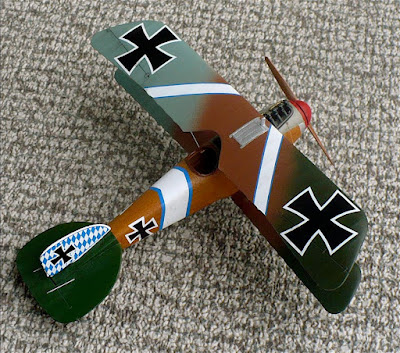
Here are some images of Eduard's 1/48 scale Albatros D III. From Wikipedia "The Albatros D.III was a biplane fighter aircraft used by the Imperial German Army Air Service (Luftstreitkräfte) and the Austro-Hungarian Air Service (Luftfahrtruppen) during World War I. The D.III was flown by many top German aces, including Manfred von Richthofen, Ernst Udet, Erich Löwenhardt, Kurt Wolff, and Karl Emil Schäfer. It was the preeminent fighter during the period of German aerial dominance known as "Bloody April" 1917.
The D.III entered squadron service in December 1916, and was immediately acclaimed by German aircrews for its maneuverability and rate of climb. Two faults with the new aircraft were soon identified. Like the D.II, early D.III's featured a Teves und Braun airfoil shaped radiator in the center of the upper wing, where it tended to scald the pilot if punctured. From the 290th D.III onward, the radiator was offset to the right.
More seriously, the new aircraft immediately began experiencing failures of the lower wing ribs and leading edge. On 23 January 1917, a Jasta 6 pilot suffered a failure of the lower right wing spar. On the following day, Manfred von Richthofen suffered a crack in the lower wing of his new D.III. On 27 January, the Kogenluft (Kommandierenden General der Luftstreitkräfte) issued an order grounding all D.IIIs pending resolution of the wing failure problem. On 19 February, after Albatros introduced a reinforced lower wing, the Kogenluft rescinded the grounding order. New production D.IIIs were completed with the strengthened wing while operational D.IIIs were withdrawn to Armee-Flugparks for modifications, forcing Jastas to use the Albatros D.II and Halberstadt D.II during the interim.
At the time, the continued wing failures were attributed to poor workmanship and materials at the Johannisthal factory. In fact, the cause of the wing failures lay in the sesquiplane arrangement taken from the Nieuport. While the lower wing had sufficient strength in static tests, it was subsequently determined that the main spar was located too far aft, causing the wing to twist under aerodynamic loads. Pilots were therefore advised not to perform steep or prolonged dives in the D.III. This design flaw persisted despite attempts to rectify the problem in the D.III and succeeding D.V.
Apart from its structural deficiencies, the D.III was considered pleasant and easy to fly, if somewhat heavy on the controls. The sesquiplane arrangement offered improved climb, maneuverability, and downward visibility compared to the preceding D.II. Like most contemporary aircraft, the D.III was prone to spinning, but recovery was straightforward.
Albatros built approximately 500 D.III aircraft at its Johannisthal factory. In the spring of 1917, D.III production shifted to Albatros' subsidiary, Ostdeutsche Albatros Werke (OAW), to permit Albatros to concentrate on development and production of the D.V. Between April and August 1917, Idflieg issued five separate orders for a total of 840 D.IIIs. The OAW variant underwent its Typenprüfung in June 1916. Production commenced at the Schneidemühl factory in June and continued through December 1917. OAW aircraft were distinguishable by their larger, rounded rudders.
Peak service was in November 1917, with 446 aircraft on the Western Front. The D.III did not disappear with the end of production, however. It remained in frontline service well into 1918. As of 31 August 1918, 54 D.III aircraft remained on the Western Front.
Tuesday, October 19, 2010
Expo Pt 5
Expo Pt 4


These pieces of art were built and painted by Wes Long. Wes is a horror and monster movie fan. He works with real monsters too as he is a paleo-tech laboring at a field station in south western Saskatchewan. He is currently working on a t-rex dig.The first is a Lon Chaney vignette featuring the actor in his famous roles.Here is a beautifully painted Mummy.Frankenstein needs no introduction. All of these figures were painted with artists acrylics.
Expo Pt 3
Expo Pt 2


Here are some more images from the Regina Model Expo 2010. First up we have Colin Kunkel’s 1/48 scale CT-113 Shooting Star. It won the award for “Best Canadian Aircraft”. Next we have Michael Evens diorama from a scene from the movie “Sahara” featuring an M3 Grant tank. The model was built by Michael Evans. After that we have a photo of club president Gene Stacyszyn giving the “Best Canadian Aircraft” award to Colin Kunkel. Next we have Gene Stacyszyn’s 1/350 scale Revell Kursk submarine. Next we have Dave Porter's 1/72 scale Type XXIII U-boat. The kit is by Alanger. After that we have The winner of the “Best Ship” category is Allan Magnus’ “Seehund U-boat in 1/72 scale. Next we have “Rascal” a hot rod built by Winnipeg modeler Rod Maskiw. There was a lot of kit bashing and scratch building required to finish this one-of-a-kind car model. He won numerous awards with this. Next we have the “Best Competition Auto” award which went to went Rod Maskiw for his ’41 Willys Coupe. The paint has a nice mirror finish and the engine is fully plumbed and wired. Finally we have Greg McKinnon who won the “Best Decaling” award for his Austin Gasser.
Expo 2010.


Here are some images of the Regina Model Expo 2010. A big thanks to Dave Porter for the Photo's and Information. First up we have the best weathering and best AFV awards are for a 1/35 Tamiya JS-II built by Cam Barker. Next we have the SR-71 display which was built by a group of modeling friends that call themselves “The Nurdwerks”. The subject was inspired by a photo of several of the aircraft just before their retirement. The kits are from Italeri and Monogram in 1/72 scale. After that we have Jeff Goff’s Canadian 25pdr gun, crew and transporter won the “Best Diorama” award. The kit is from Tamiya and is in 1/35 scale. Next we have the 1/72 scale robot “Hannibal’ from the Patlabor anime series. The model was built by Ted MacPherson. After that we have the “Best Jet” award which was given to Ryan Cunningham for his 1/48 scale Trumpeter Mig-17 in North Vietnam markings. There was an aftermarket cockpit added to the model. Finally a couple of pictures of the crowd.