Translate

Monday, February 14, 2011

Montague


Here are some images of my kitbash 1/1400 scale U.S.S. Montague.
In case you are wondering, yep you guessed it, I named this model starship after my cat.

With the exception for the two phaser banks on the top saucer section this model is kitbashed from AMT's Enterprise D model kit.
The life boat decals were taken from an Enterprise E decal sheet. The rest of the decals were made myself.

Sunday, February 13, 2011

M-60


Here is an U.S. Marine M-60 with a mine plow built in 1/35 scale. The model was constructed by Regina Modeler Barry Novak. Barry created the sand with the use of high density foam. There is numerous Verlinden items added to detail the model.

Friday, February 11, 2011

U Boot Repost


Here are some images of Revell's 1/72 scale TYP VII C U Boot. I decided to build my U Boat with a nice rusty appearance. I think it gives it a meaner look. I believe this kit to be a more recent release in the past couple of years or so (correct me if I'm wrong). So why then with todays technology did they design a kit with raised panel lines. Dear Revell, Stop it already!! Other then that this is a big nicely detailed kit and went together without any problems. Although the Amati 1/72 scale TYP VII U boat is most likely the better kit and 3 times the price, that's even if you can find one. At $100 Cdn the Revell kit makes a great economical alternative.
From Wikipedia"
Type VII U-boats were the most common type of German World War II U-boat. The Type VII was based on earlier German submarine designs going back to the World War I Type UB III, designed through the Dutch dummy company Ingenieurskantoor voor Scheepsbouw den Haag (I.v.S) (set up by Germany after World War I in order to maintain and develop German submarine technology and to circumvent the limitations set by the Treaty of Versailles) and built by shipyards around the world. The Finnish Vetehinen class and Spanish Type E-1 also provided some of the basis for the Type VII design. These designs led to the Type VII along with Type I, the latter being built in AG Weser shipyard in Bremen, Germany. The production of Type I was cut down only after two boats; the reasons for this are not certain and range from political decisions to faults of the type. The design of the Type I was further used in the development of the Type VII and Type IX. Type VII submarines were the most widely used U-boats of the war and were the most produced submarine class in history, with 709 built. The type had several modifications.
The Type VIIC was the workhorse of the German U-boat force, with 568 commissioned from 1940 to 1945. Boats of this type were built throughout the war. The first VIIC boat commissioned was the U-69 in 1940. The Type VIIC was an effective fighting machine and was seen almost everywhere U-boats operated, although their range was not as great as that of the larger Type IX. The VIIC came into service as the first "Happy Time" near the beginning of World War II was almost over, and it was this boat that saw the final defeat by the Allied anti-submarine campaign in late 1943 and 1944.
Type VIIC was a slightly modified version of the successful VIIB. They had very similar engines and power, and were larger and heavier which made them slightly slower than the VIIB. Many of these boats were fitted with snorkels in 1944 and 1945.
On the surface the boats were propelled by two supercharged Germaniawerft, 6 cylinder, 4-stroke M6V 40/46 diesels totaling 2,800 to 3,200 hp (2,100 to 2,400 kW) at 470 to 490 rpm.
For submerged propulsion, several different electric motors were used. Early models used the VIIB configuration of two AEG GU 460/8-276 electric motors, totaling 750 hp (560 kW) with a max rpm of 296, while newer boats used two BBC (Brown Boveri & Co) GG UB 720/8, two GL (Garbe Lahmeyer) RP 137/c electric motors or two SSW (Siemens-Schuckert-Werke) GU 343/38-8 electric motors with the same power output as the AEG motors.

Wednesday, February 9, 2011

Enterprise E


Here are some images of AMT's 1/1400 scale Sovereign Class Starship U.S.S. Enterprise NCC - 1701 - E. plus a great scene from the movie Star Trek First Contact.
From Memory Beta"

The Sovereign-class began development in 2365 intended to be the latest and greatest in Starfleet exploration starships. Following the USS Enterprise-D's encounter with the Borg later that year, Starfleet began to augment the design with Borg defense in mind. In 2366, Starfleet was exposed to the full force of the Borg in the Battle of Wolf 359. After suffering huge loses with almost no damage done to the Borg, Starfleet's entire policy of starship design shifted towards defense and the Sovereign-class design was subsequently altered to reflect this.

The prototype USS Sovereign was finally launched in 2370, followed two years later by the USS Enterprise-E.The Enterprise later faced the Borg during their incursion of Federation space in 2373. Proving to be highly successful against the Borg, the Sovereign was hailed as one of the "best balances of exploration and tactical capability since the Constitution-class of a century prior" and was expected to be Starfleet's leading class well into the 25th century. (ST reference: Starship Spotter).

This kit was built pretty much SOB with the exception for the Aztec decaling which were downloaded from Starship Modeler.


109 B


Here are some images of Hobbycraft's 1/48 scale BF 109 B.
From Wikipedia"

The first Bf 109 in serial production, the Bf 109B , was fitted with the 670 PS (661 hp, 493 kW) Jumo 210D engine driving a two-bladed fixed-pitch propeller. During the B-1 production run a variable pitch propeller was introduced and often retrofitted to older aircraft; these were then unofficially known as B-2s. Both versions saw combat with the Legion Condor during the Spanish Civil War, although it was apparent that the armament was still inadequate. Several aircraft were produced with an engine-mounted machine gun but it was very unreliable, most likely because of engine vibrations and overheating. Thus the Bf 109 V8 was constructed to test the fitting of two more machine guns in the wings; however, results showed that the wing needed strengthening. In the following V9 prototype both wing guns were replaced by 20 mm MG FF cannons.

A total of 341 Bf 109B of all versions were built by Messerschmitt, Fieseler, and Erla.

The short-lived Bf 109C was powered by a 700 PS (690 hp, 515 kW) Jumo 210G engine with direct fuel injection. Another important change was a strengthened wing, now carrying two more machine guns giving four 7.92 mm (.312 in) MG 17s in total. The C-0 were pre-production aircraft, the C-1 was the production version, and the C-2 was an experimental version with an engine-mounted machine gun. The C-3 was planned with 20 mm MG FF cannons replacing the two MG 17s in the wings, but it is not known how many C-3 (if any) were built or converted. The C-4 was planned to have an engine-mounted Motorkanone MG FF, but the variant was not produced.

A total of 58 Bf 109C of all versions were built by Messerschmitt.

Monday, February 7, 2011

Cord


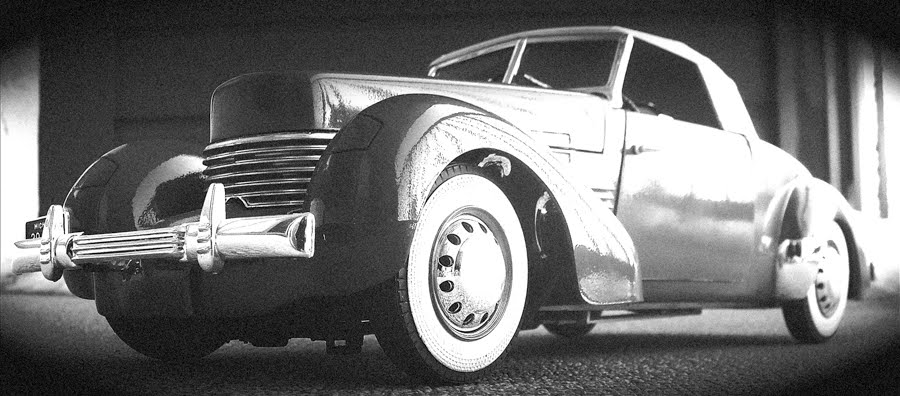
Here are some images of AMT's 1/12 scale 1937 Cord 812.
From Wikipedia"

Cord was the brand name of a United States automobile, manufactured by the Auburn Automobile Company from 1929 through 1932 and again in 1936 and 1937.

The Cord Corporation was founded and run by E. L. Cord as a holding company for his many transportation interests, including Auburn. Cord was noted for its innovative technology and streamlined designs. Cord had a philosophy to build truly different, innovative cars, believing they would also sell well and turn a profit.[citation needed] This did not always work well in practice.

The body design of the Cord 810 was the work of designer Gordon M. Buehrig and his team of stylists, which included young Vince Gardner. The first American front-wheel drive car with independent front suspension, but an archaic tube rear axle with semi-elliptic rear springs, it used a 4,739 cc (289 cu in) Lycoming V8 of the same 125 hp (93 kW) as the L-29. The semi-automatic four-speed transmission (three plus overdrive) extended in front of the engine, like a Traction Avant. (This transmission was later modified and used in the rear-engined 1948 Tucker Sedan.) This allowed Buehrig to dispense with the driveshaft and transmission tunnel; as a result, the new car was so low it required no running boards.

Reportedly conceived as a Duesenberg and nearly devoid of chrome, the 810 had hidden door hinges and rear-hinged hood, rather than the side-opening type more usual at the time, both new items. It also featured pontoon fenders with headlamps (modified Stinson landing lights) that disappeared into the fenders via dashboard hand cranks, a concealed fuel filler door, variable-speed windshield wipers (at a time when any wipers were rare, and those were likely operated by hand), and the famous louvered wraparound grill, from which its nickname "coffin-nose" derived. Its engine-turned dashboard included complete instrumentation, a tachometer, and standard radio (which would not become an industry standard offering until well into the 1950s).

The new car caused a sensation at the New York Auto Show in November 1935. The crowds around the 810 were so dense, attendees stood on the bumpers of nearby cars to get a look. Many orders were taken at the show, but the cars were not ready to deliver until February. Cord had rushed to build the 100 cars needed to qualify for the show, and the transmission was not ready.[2] Even so, Cord took many orders at the show, promising Christmas delivery, expecting production of 1000 per month. The semi-automatic transmission was more troublesome than expected,[5] and 25 December came and went with no cars built. In all, Cord managed to sell only 1174 of the new 810 in its first model year, as the result of mechanical troubles.

Supercharging was made available on the 1937 812 model. Supercharged 812 models were distinguished from the normally-aspirated 812s by the brilliant chrome-plated external exhaust pipes mounted on each side of the hood and grill.

It was too late to save Cord, but the contraction "Suped" (referring its supercharged engine) lived on in American lexicon as the hot-rodding phrase "Suped-Up" (as opposed to "souped-up", which referred to the drugging of horses).

Early reliability problems, including slipping out of gear and vapor lock, cooled initial enthusiasm. Although most new owners loved their sleek fast cars, the dealer base shrank rapidly. Unsold left-over and in-process 1936 810 models were re-numbered and sold as 1937 812 models. In 1937, after producing about 3000 of these cars, Auburn ceased production of the Cord. A single 1938 Cord prototype with some changes to the grille and transmission cover was built, and it still exists to this day (2009). The Cord empire was sold to the Aviation Corporation, and E.L. Cord moved to Nevada where he earned millions in real estate and other enterprises.

The design of the Cord 810/812 remains one of the most distinctive of the 20th century. In 1996, American Heritage magazine proclaimed the Cord 810 sedan ‘The Single Most Beautiful American Car’. The ‘Classic Cord’ Hot Wheels toy car of the 1960s, a convertible coupé, is one of the most valuable, and commands up to US$800 (2006) if still in an unopened package.

The sensational Cord 812 design was re-marketed almost immediately in 1940, but as a weakly-funded effort by ailing automakers Hupmobile and Graham-Paige, trying to save money by using the same body dies. Their 4-door sedans, the Hupp Skylark and the Graham Hollywood, were unremarkable. Retractable headlights gave way to plain headlight pods, and power came from a standard front-engine/rear-wheel drive design. Only about 1900 were built before production ceased in the fall of 1940. Between 1964 and 1970, two further attempts were made to replicate the original Buehrig design for limited production. Both Tulsa, Oklahoma-based companies soon halted production amid financial difficulties. The 1966 replica Cord 810 was powered by a Corvair drivetrain, while the 1968 thru 1970 models were Ford and Chrysler powered.

Sunday, February 6, 2011

Hot Rod


Here are some images of AMT's 1/25 scale Model T Hot Rod.
From Wikipedia"

Hot rods are typically American cars with large engines modified for linear speed. The origin of the term "hot rod" is unclear. One explanation is that the term is a contraction of "hot roadster," meaning a roadster that was modified for speed. Roadsters were the cars of choice because they were light. The term became commonplace in the 1930s or 1940s as the name of a car that had been "hopped up" by modifying the engine in various ways to achieve higher performance.

The term can also apply to other items that are "souped up" for a particular purpose, such as "hot-rodded amplifier".

The term seems first to have appeared in the late 1930s in southern California, where people would race their modified cars on the vast, empty dry lake beds northeast of Los Angeles under the rules of the Southern California Timing Association (SCTA). The activity increased in popularity after World War II, particularly in California because many returning soldiers had been given technical training in the service. The original hot rods were old cars (most often Fords, typically Model Ts, 1928–31 Model As, or 1932-34 Model Bs), modified to reduce weight. Typical modifications were removal of convertible tops, hoods, bumpers, windshields, and/or fenders; channeling the body; and modifying the engine by tuning and/or replacing with a more powerful type. Wheels and tires were changed for improved traction and handling. "Hot Rod" was sometimes a term used in the 1950s as a derogatory term for any car that did not fit into the mainstream. Hot rodder's modifications were considered to improve the appearance as well, leading to show cars in the 1960s replicating these same modifications along with a distinctive paint job.

Engine swaps often involved fitting the Ford Flathead engine, or "flatty", in a different chassis; the "60 horse" in a Jeep was a popular choice in the '40s. After the appearance of the 255 cu in (4.2 l) V8, because of interchangeability, installing the longer-stroke Mercury crank in the 239 was a popular upgrade among hot rodders, much as the 400 cu in (6.6 l) crank in small-blocks would become. In fact, in the 1950s, the flathead block was often fitted with crankshafts of up to 4.125 in (104.8 mm) stroke, sometimes more. In addition, rodders in the 1950s routinely bored them out by 0.1875 in (4.76 mm) (to 3.375 in (85.7 mm)); due to the tendency of blocks to crack as a result of overheating, a perennial problem, this is no longer recommended. In the '50s and '60s, the flatty was supplanted by the early hemi. By the 1970s, the small-block Chevy was the most common option, and since the '80s, the 350 cu in (5.7 l) Chevy has been almost ubiquitous.

Saturday, February 5, 2011

Model T


Here are some images of AMT's 1/25 scale Ford Model T Pickup.
From Wikipedia"

The Ford Model T (colloquially known as the Tin Lizzie, Flivver, T‑Model Ford, or T) is an automobile that was produced by Henry Ford's Ford Motor Company from 1908 through 1927. The Model T set 1908 as the historic year that the automobile became popular. It is generally regarded as the first affordable automobile, the car that opened travel to the common middle-class American; some of this was because of Ford's innovations, including assembly line production instead of individual hand crafting. The first production Model T was produced on August 12, 1908 and left the factory on September 27, 1908, at the Piquette Plant in Detroit, Michigan. The Model T was the first automobile mass produced on assembly lines with completely interchangeable parts, marketed to the middle class.[citation needed]

There were several cars produced or prototyped by Henry Ford from the founding of the company in 1903 until the Model T came along. Although he started with the Model A, there were not 19 production models (A through T); some were only prototypes. The production model immediately before the Model T was the Model S, an upgraded version of the company's largest success to that point, the Model N. The follow-up was the Ford Model A and not the Model U. Company publicity said this was because the new car was such a departure from the old that Henry wanted to start all over again with the letter A. As it happens, the first Plymouth car (1928), built by competitor Chrysler Corporation, was named Model U.

The Ford Model T was named the world's most influential car of the twentieth century in an international poll. Henry Ford said of the vehicle:

"I will build a car for the great multitude. It will be large enough for the family, but small enough for the individual to run and care for. It will be constructed of the best materials, by the best men to be hired, after the simplest designs that modern engineering can devise. But it will be so low in price that no man making a good salary will be unable to own one—and enjoy with his family the blessing of hours of pleasure in God's great open spaces."

By 1918, half of all the cars in the US were Model T’s. However it was a monolithic bloc; Ford wrote in his autobiography that he told his management team in 1909 that in the future “Any customer can have a car painted any colour that he wants so long as it is black”.

However, in the first years of production from 1908 to 1914, the Model T was not available in black but rather only grey, green, blue, and red. Green was available for the touring cars, town cars, coupes, and Landaulets. Grey was only available for the town cars, and red only for the touring cars. By 1912, all cars were being painted midnight blue with black fenders. It was only in 1914 that the "any color as long as it is black" policy was finally implemented. It is often stated that Ford suggested the use of black from 1914 to 1926 due to the cheap cost and durability of black paint. During the lifetime production of the Model T, over 30 different types of black paint were used on various parts of the car. These were formulated to satisfy the different means of applying the paint to the various parts, and had distinct drying times, depending on the part, paint, and method of drying.

Friday, February 4, 2011

Greenwood Corvette


Here is a 1/25 scale Monogram 1971 Greenwood Corvette racer built by Regina modeler Larry Draper. This is a nice kit to assemble. It’s got the proper race goodies to make an authentic build. Larry detailed the interior with a race harness and some extra wiring and he plumbed the engine.

ME 410


Here is a Monogram 1/48 scale ME-410 built by Regina modeler Lee David. The model was built pretty well straight out of the box. Lee used Aeromaster paint and artists oils to finish.

Thursday, February 3, 2011

Saladin Upgrade


Here are some images of my kitbash 1/537 scale Saladin Class Starship U.S.S. Tamerlane with upgrade.

From memory Beta"
The Saladin class was a type of Federation starship in service in the 23rd century, and is classified as a destroyer, escort or frigate.The Saladin-class destroyer was designed as a smaller and less expensive stablemate to the Constitution-class, but was less successful. It lacks the engine power of the cruiser and has been found lacking in maneuverability.

The Saladin-class was expected, during peacetime, to carry out essentially the same research and exploration duties as the Constitution-class. For this reason, it has the same laboratory facilities.


Existing ships of the class were uprated beginning in 2271 to make use of new technology and capabilities that were developed for the uprated Constitution-class. This greatly increased the performance longevity of the class, carrying them into the 2300's.

The class was retired in the early part of the 24th century, but a handful of the vessels were uprated once again to face the threats of the Dominion and Borg in 2373 in a desperate move by the Federation to field numbers against the twin threats.

The parts used for this kitbash were AMT's Enterprise refit and Enterprise TOS cutaway kit.

Wednesday, February 2, 2011

Not Mr. Spock


Here are some images of AMT's 1/12 scale Mr. Spock. This kit is an original issue not a re release.
I don't care what anyone says this model does not look like Mr. Spock. One would think that upon the re release they would would have created a new head for it but nope.
So what does one do in a situation like this? Answer: Convert him into a Crewman. I think it makes a nice alternative to the usual Mr. Spock figures one often sees. And he's wearing red which means he'll be dead in a few seconds.
The only addition I put to this kit was I added a cover for the communicator.