Here is my composite image of Revell's 1/32 scale Hawker Typhoon Mk 1B against a grey cloudy sky
This aircraft served with the Royal Aircraft Establishment and the Aeroplane and Armament Experimental Establishment in 1941.
Images of the model can be seen here.
Translate
Wednesday, December 5, 2012
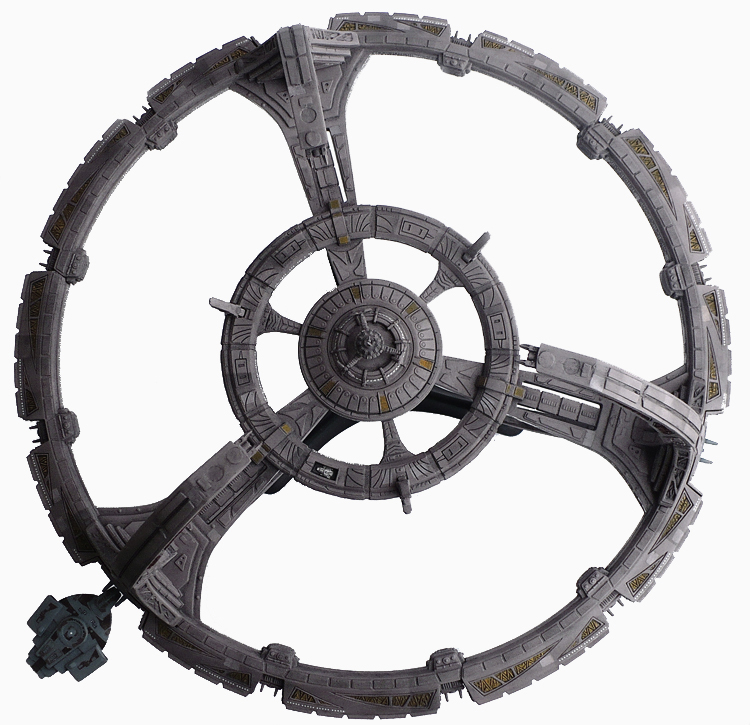
Star Trek's Deep Space Nine Composite
Here is my composite image of AMT/Round 2 model's 1/2500 scale Star Trek Deep Space Nine space station from the TV series of the same name.
Images of the model can be seen here.
Tuesday, December 4, 2012
Star Trek's Deep Space Nine
From Wikipedia"
Deep Space Nine (DS9; also known as Terok Nor) is a fictitious space station, and is the eponymous primary setting of the science fiction television series Star Trek: Deep Space Nine. It serves as a base for the exploration of the Gamma Quadrant via the Bajoran wormhole, and is a hub of trade and travel for the sector's denizens. It is run by a joint crew of Starfleet and Bajoran officers, and it is the home port of a number of Starfleet runabouts, as well as the starship USS Defiant.
Deep Space Nine, over a kilometer in diameter, is composed of a broad outer docking ring; an inner habitat ring containing residences; and a central core containing the promenade, the fusion reactors, and the operations center, known as "Ops". Three sets of docking pylons sweep up and down equidistantly around the docking ring, defining a spherical shape. It is of identical design to another Cardassian station, Empok Nor. In its series-long position at the mouth of the wormhole, the station is three hours away from Bajor by shuttle by one account, but five hours from another though it would appear that the journey could be completed in a much shorter length of time if necessary, by engaging warp within the star system.
Facilities
The promenade is the main public thoroughfare in which visitors and residents congregate, and on which can be found Quark's Bar (the crew's most frequently-seen off-hours location), which also includes holosuites, the infirmary, the replimat (a self-service replicator eatery), a Bajoran temple, Elim Garak's clothing shop, chief of security Odo's office, a Klingon restaurant, a mineral assay office, a candy kiosk, and, for a brief time during the first season, Keiko O'Brien's classroom. There are normally about 300 permanent residents of the station, though the station can accommodate up to 7,000.Originally a Cardassian mining and refinery station named "Terok Nor" in orbit around Bajor, it was built by slave Bajoran labor under Cardassian rule in 2351. The station was commanded by Gul Dukat, the last Cardassian prefect of Bajor. It was abandoned toward the end of the Cardassian occupation of Bajor in 2369; the Cardassians removed anything of value on their way out.
In 2369, the Bajorans assumed control of the station. The Bajoran provisional government requested the assistance of the United Federation of Planets, who renamed it Deep Space Nine (DS9) and placed Commander Benjamin Sisko in command. Despite the Federation presence, the station remains subject to Bajoran law. Shortly after Sisko assumed command, his crew discovered the Bajoran wormhole. The station was moved to the mouth of the wormhole to secure Bajor's claim to it, after which the station assumed great commercial, scientific and strategic importance.
After the encounter with the Dominion in 2370, in which the Galaxy-class USS Odyssey was destroyed by just three Dominion vessels and owing to other threats, it became obvious that the station's existing occupation-era weapons would be insufficient in defending the station. Using surplus and recycled parts along with some new parts, the station's weapons and defensive systems were heavily upgraded. The upgrade included the installation of multiple rotary torpedo launchers on the docking pylons and weapons sail towers, stowable phaser banks that retract into former runabout maintenance bays when not in use and improved shields that extend 300 meters around the station. The total torpedo inventory was increased to 5000.
These upgrades were first used against the Klingons in their offensive against Cardassia in early 2372. At the beginning of the Dominion War in late 2373, the station was temporarily lost to the Dominion. In early 2374, Federation and Klingon forces retook it after the Battle of Bajor.[13]
Aside from a failed Bajoran military coup, the Dominion's occupation, and a brief leave of absence from late 2374 to early 2375, Sisko, promoted to captain in 2371, remained in command of Deep Space Nine. In late 2375, at the end of the Dominion War, Colonel Kira Nerys assumed command.
In the continuing story novels, DS9 was forced to jettison its power core due to the actions of rebel Jem'Hadar. As one of his first actions as chief of operations of the station, Nog had Empok Nor towed to the station's location, and used its power core as a replacement. The remainder of Empok Nor was broken down for scrap and spare parts.
Later, DS9 would host Bajor's formal acceptance into the Federation. With the station now under Federation law, Quark almost closed down his bar, but remained open after Rom arranged to have it designated as the Ferengi embassy to Bajor, placing it under the jurisdiction of Ferenginar.
In the year 2383, DS9 - while under the command of Captain Ro Laren - was destroyed by a fleet of vessels belonging to the Typhon Pact. In honor of the station, and the Bajoran people, Starfleet Command and the Federation Council agreed to build a new station in the Bajoran system and name it Deep Space Nine.
Saturday, December 1, 2012
Heinkel HE 219 A2 "Uhu"
After building this kit all I can say is "Revell, you've come a long way baby!"
Plus with such an affordable price ($75 CDN) it is well worth the purchase.
From Wikipedia"
The Heinkel He 219 Uhu ("Owl") was a night fighter that served with the German Luftwaffe in the later stages of World War II. A relatively sophisticated design, the He 219 possessed a variety of innovations, including an advanced VHF-band intercept radar. It was also the first operational military aircraft in the world to be equipped with ejection seats, and the first operational German World War II-era aircraft with tricycle landing gear. Had the Uhu been available in quantity, it might have had a significant effect upon the strategic night bombing offensive of the Royal Air Force; but only 294 of all models were built by the end of the war and these saw only limited service.
Development and production of the He 219 was protracted and tortuous, due to political rivalries between Josef Kammhuber, commander of the German night fighter forces, Ernst Heinkel, the manufacturer, and Erhard Milch, responsible for aircraft construction in the Reichsluftfahrtministerium (RLM — the German Aviation Ministry). The aircraft was also complicated and expensive to build; these factors further limited the number of aircraft produced.
When engineer Robert Lusser returned to Heinkel from Messerschmitt, he began work on a new high-speed bomber project called P.1055. This was an advanced design with a pressurized cockpit, twin ejection seats (the first to be planned for use in any combat aircraft), tricycle landing gear (featuring a nose gear that rotated its main strut through 90° during retraction to fit flat within the forward fuselage), and remotely controlled defensive gun turrets similar to those used by the Messerschmitt Me 210. Power was to be provided by two DB 610 "coupled" engines producing (2,200 kW/2,950 hp) each, delivering excellent performance with a top speed of approximately 750 km/h (470 mph) and a 4,000 km (2,500 mi) range with a 2,000 kg (4,410 lb) bomb load.
The RLM rejected the design in August 1940 as too complex and risky. Lusser quickly offered four versions of the fighter with various wingspans and engines in order to balance the performance and risk. At the same time, he offered the P.1056 dedicated night fighter with four 20 mm cannons in the wings and fuselage. The RLM rejected all of these on the same grounds in 1941. Heinkel was furious and fired Lusser on the spot.
About the same time as Lusser was designing the P.1055, Kammhuber had started looking for a dedicated aircraft for his rapidly growing night fighter force. Heinkel quickly re-designed P.1055 for this role as the P.1060. This design was similar in layout, but somewhat smaller and powered by two of the largest displacement (at 44.5 litres/2,700 cu. in.) liquid-cooled aviation engines placed in mass production in Germany, the DB 603 inverted V12 engine, using annular radiators similar to the ones on the Jumo 211-powered Junkers Ju 88A but considerably more streamlined in appearance. This engine was not known for its altitude performance, which was a problem for Heinkel's short-winged design, but Daimler offered a new "G" version to address the issue. Heinkel was sure he had a winner and sent the design off to the RLM in January 1942 while he funded the first prototype himself. Nevertheless, the RLM again rejected the He 219 in favour of new Ju 88- and Me 210-based designs.
Construction of the prototype started in February 1942 but suffered a serious setback in March, when Daimler said that the DB 603G engine would not be ready in time. Instead, they would deliver a 603A engine with a new gear ratio to the propellers, with the new designation 603C. Even these took until August to arrive, and the prototype did not fly until 6 November 1942. When Kammhuber saw the prototype on the 19th, he was so impressed he immediately ordered it into production over Milch's objections. Milch — who had rejected the He 219 in January — was enraged.
Stability problems with the aircraft were noted, but Heinkel overcame these by offering a cash prize to engineers who could fix them. Further changes were made to the armament: the dorsal rear defensive guns — mounted atop the fuselage, and firing directly rearward from a fixed, internally mounted, rear-facing dorsal "step" position at a point just aft of the wings' trailing edge — were removed due to their ineffectiveness. The forward-firing armament was increased to two 20 mm cannons in the wing roots and four more guns mounted in the ventral tray, which had originally ended in a rearwards-facing "step" almost directly under the deleted rear dorsal "step", but was also deleted for similar reasons. The A-0 model also featured a bulletproof shield that could be raised in the front interior cockpit, hiding the entire bottom portion of windscreen, providing temporary pilot protection, leaving a slot by which the gunsight could be aimed at a bomber and fired. Production prototypes were then ordered as the He 219 A-0 and quickly progressed to the point where V7, V8 and V9 were handed over to operational units in June 1943 for testing.
Milch repeatedly tried to have the He 219 program killed and in the process, Kammhuber was removed from office. Production ceased for a time but was restarted because the new Junkers Ju 388s were taking too long to get into service.
The He 219 had an auspicious combat debut. On the night of 11–12 June 1943, Werner Streib flew the V9 and shot down five bombers between 01:05 and 02:22 hours, before crashing on landing. A claim has consistently been made that, "In the next 10 days the three Heinkel He 219A-0 pre-production aircraft would shoot down a total of 20 RAF aircraft, including six of the previously "untouchable" de Havilland Mosquito fighter-bombers. Greatly encouraged, Kammhuber continued to press for immediate production." No record of corresponding Mosquito losses or any documentary evidence exists, however, to suggest that He 219 pilots actually made claims for six Mosquitos during this time.
The first major production series was the He 219 A-0, although initially the preproduction series, it matured into a long running production series due to numerous changes incorporated into the design, along with the cancellation of several planned variants. Production problems as a result of Allied bombing in March meant the A-0 did not reach Luftwaffe units until October 1943. The A-0 were usually armed with two 20 mm MG 151/20 cannon in the wing roots and up to four 20 mm or 30 mm cannon in a ventral weapons bay. The first 10 to 15 aircraft were delivered with the 490 MHz UHF-band FuG 212 "Lichtenstein" C-1 radar set, complete with its 4 x 8-dipole element Matratze antenna array. A total of 104 He 219 A-0s were built until the summer of 1944, the majority of them at EHW or Heinkel-Süd in Wien-Schwechat.
The first planned version to reach production was the He 219 A-2 model, which had longer engine nacelles containing extra fuel tanks, 1670 PS DB 603AA engines with higher critical altitude and often also two 30 mm (1.18 in) MK 108 cannons as an offensive Schräge Musik upward-firing system in the rear fuselage. With the Schräge Musik system installed, the ventral weapons bay was only capable of holding two cannon due to space limitations. The A-2 featured an updated, 90 MHz VHF-band Telefunken FuG 220 Lichtenstein SN-2 radar system, complete with their larger, high-drag 4 x 2-dipole element Hirschgeweih aerials. It initially had less range than the C-1 radar, but improved accuracy and resolution and was also less vulnerable to chaff jamming through the late summer of 1944. A total of 85 He 219 A-2s were built until November 1944, the majority of them at EHR or Heinkel-Nord in Rostock-Marienehe (today's Rostock-Schmarl).
The He 219 was a capable fighter aircraft, allowing the pilots a large degree of autonomy. Ground control simply sent the aircraft into the right area and then the pilots took over and hunted down the bombers on their own; the SN-2 radar's 4 km (3 mi) range was greater than the distance between the bombers. While the performance of the A-2 was not extraordinary — approximately 580 km/h (360 mph) speed — it was enough of an advance over the Messerschmitt Bf 110Gs and Dornier Do 217Ns to allow the aircraft to chase several bombers in one sortie.
In order to combat the Mosquito, the He 219 had all excess weight removed. With some weapon and radio systems deleted, the aircraft was able to attain a speed of 650 km/h (400 mph). This version was given the designation A-6. None of these were produced but weight saving measures could be done at the unit level.
The last major production version was the A-7 with improved DB 603E engines. The A-7 was typically outfitted with two 20 mm MG 151/20 cannon in the wing roots (inboard of the propeller arcs), two 20 mm MG 151/20 in the ventral weapons bay, and two 30 mm (1.18 in) MK 108s as Schräge Musik. The production was to start in November/December 1944 with 210 aircraft ordered. The number produced is not exactly known as the original documents have either been lost or contained no subversion number.
The follow-on series was to be the He 219B fitted with the new, but very troublesome, 1,864 kW (2,500 hp) Junkers Jumo 222A/B 24-cylinder engines - a multibank inline engine, with six rows of cylinder blocks having four cylinders each - which would have allowed the He 219 to reach 700 km/h (440 mph), each of which were almost the same displacement and only very slightly heavier apiece as compared to the Double Wasp radial engines in the American P-61 purpose-built night fighter. The He 219B's wing was also to have had an increased wing span of 22.06 m (72.38 ft) for better high altitude performance. The Jumo 222s did not reach production status however, with just under 300 examples built in at least two differing displacement sizes, and only a test machine or two were ever fitted for the engines; some additional airframes with the enlarged wing were slated to fly with high-altitude versions of the DB 603. But again, only one or two test machines ever flew in that configuration.
A further adaptation would have been the He 219C, also intended to use the big wing and Jumo 222 powerplants as well as an all-new fuselage of 17.15 m (56.27 ft), with a complete three-man Ju 388J cockpit section forward and a manned power tail turret aft. Day bomber and night fighter versions were proposed and metal was cut for the project but, without the Jumo engines, they never flew.
Paper projects include the very-high-altitude He 219E with a vastly increased wingspan of 28.5 m (93.5 ft) and DB 614 engines, which were apparently an uprated DB 603G capable of 1,491 kW (2,000 hp).
A more reasonable project was the Hütter Hü 211, a design by Wolfgang Hütter that took a standard He 219 fuselage and tail and added a long-span, high aspect ratio wing of 24.55 m (80.54 ft) to create a fast, high altitude interceptor. Since this design was also meant to be powered by the ill-fated Jumo 222 it never flew, although work continued on two sets of wings until they were destroyed by Allied bombing.
The He 219 was the only piston-engined night fighter capable of facing the British Mosquito on equal terms, given its speed, manoeuvrability and firepower, but it never played a significant role in the war because the industry failed to make it available in sufficient numbers.
When the war had ended in Europe, the U.S. Army Air Forces Intelligence Service, as part of "Operation Lusty" (Luftwaffe Secret TechnologY), took control of three He 219s at the Grove base of the 1st Night Fighter Wing (Nachtjagdgeschwader 1) in Jutland, Denmark starting on 16 June 1945. These aircraft were made flight-worthy by "Watson's Whizzers" and flown to Cherbourg, France. He 219 A-2 Werknummer 290202 was shipped to the United States with 21 other captured German aircraft on board the British aircraft carrier HMS Reaper, and was reassembled at Ford Field, Newark, New Jersey.
Werknummer 290202 was given the foreign equipment number FE-614, and later T2-614. The aircraft was flown to Freeman Field, Indiana for flight testing along with a second of the three He 219s: a He 219 A-5 prototype, Werknummer 290060 and given the foreign equipment number FE-612. The fate of Werknummer 290060 is unknown. Following testing, He 219 A-2 Werknummer 290202 was then moved to Orchard Place Airport in Park Ridge, Illinois in 1946. It was stored in a vacant aircraft factory and then transferred to the Smithsonian's National Air Museum on 3 January 1949. Finally, the He 219 was crated and shipped to the Smithsonian's Silver Hill, Maryland storage facility in early 1955.
He 219 A-2 Werknummer 290202 is undergoing restoration in the collection of the Smithsonian National Air and Space Museum in Washington, D.C., USA. Recently the fuselage has been put on display at the Steven F. Udvar-Hazy Center by Dulles Airport, however, the wings are still being restored at the Paul Garber Facility in Silver Hill, Maryland. As of 2012, the completely restored fuselage and tail surfaces, along with the aircraft's partially restored engines and nacelles displayed nearby, can be seen displayed near the museum's Dornier Do 335 and Arado Ar 234, aircraft that accompanied it across the Atlantic over 60 years ago.
In April 2012, a previously unknown He 219 was salvaged from the sea bed, 100 meters from the beach, north of Hirtshals, Denmark. The remains are in several pieces, but will undergo restoration and eventually be displayed at Aalborg, Denmark. As of late April 2012, no information was available as to the sub-model or Werknummer of the aircraft.
Sunday, November 25, 2012
Stinger from seaQuest DSV
From Wikipedia"
seaQuest DSV was an American science fiction television series created by Rockne S. O'Bannon. It originally aired on NBC between 1993 and 1996. In its final season, it was renamed seaQuest 2032. Set in "the near future", seaQuest DSV originally mixed high drama with realistic scientific fiction. It originally starred film star Roy Scheider as Captain Nathan Bridger, designer and commander (for the first two seasons) of the titular naval submarine seaQuest DSV 4600. Other actors who comprised the show's original cast were Jonathan Brandis as Lucas Wolenczak, a teenaged computer genius, Stephanie Beacham as Kristin Westphalen, the chief medical officer and head of the seaQuest science department and Don Franklin as Commander Jonathan Ford, the first mate of the submarine. Michael Ironside starred as Captain Oliver Hudson, captain of the vessel during the third season. Steven Spielberg expressed interest in the project and served as one of the show's executive producers during the first two seasons.
Filming of the first season was marked by disputes between the producers and NBC, changes in the production staff, and even an earthquake. The second season contained changes in the cast, as well as disputes between cast members and producers, while the third season introduced a new lead actor and title. While initially popular, the series began to decline in ratings throughout its run, and was abruptly canceled in the middle of its third season.
Roy Scheider narrated the voiceover during the opening credits of each first-season episode:
The 21st century: mankind has colonized the last unexplored region on Earth; the ocean. As captain of the seaQuest and its crew, we are its guardians, for beneath the surface lies the future.
Friday, November 23, 2012
Macchi Castoldi MC-72 Schneider Racer Composite
Here is my composite image of Essdale Models 1/32 scale Macchi Castoldi MC-72 Schneider Racer flying along a bay.
Images of the model can be seen here.
Wednesday, November 21, 2012
Hawker Hurricane Mk 1 Composite
Here is my composite image of Airfix's 1/24 scale Hawker Hurricane Mk 1 Composite in a low level pass past the white cliffs of Dover England whilst being pursued by a Messerschmitt BF 109 E3.
Images of the Hawker Hurricane model can be seen here.
Images of the Messerschmitt BF 109 E3 can be seen here.
Images of the Hawker Hurricane model can be seen here.
Images of the Messerschmitt BF 109 E3 can be seen here.
Tuesday, November 20, 2012
Hawker Sea Fury Mk T-20 Target Tug Composite
Here is my composite image of Fisher's 1/32 scale Hawker Sea Fury Mk T-20 Target Tug flying over an arid terrain.
Images of the model can be seen here.
Monday, November 19, 2012
Messerschmitt ME 262 A 1a Composite
Here is my composite image of Trumpeter's 1/32 Messerschmitt ME 262 A 1a against a grey sky, which is common here in sunny Alberta.
Images of the model can be seen here.
Friday, November 16, 2012
Droid Tri-Fighter Composite
Images of the model can be seen here.
Monday, November 12, 2012
Macchi Castoldi MC-72 Schneider Racer
This resin kit is from a few years back so as a result it has some of those "garage kit" qualities.
As a result the kit required a little extra work, but in the end produced a decent example.
From Wikipedia"
The Macchi M.C. 72 was an experimental seaplane designed and built by the Italian aircraft company Macchi Aeronautica. The M.C. 72 held the world speed record for all aircraft for five years. In 1933 and 1934, it set a world record speed for propeller-driven seaplanes which still stands to this day.
The Macchi M.C. 72 was one of a series of seaplanes developed by Macchi Aeronautica. An earlier model, the M.24 was a twin-engine flying boat armed with machine guns and capable of carrying a torpedo. Later in the 1920s, Macchi focused on speed and on winning the Schneider Trophy. In 1922, the company hired aircraft designer Mario Castoldi to design high-speed aircraft.
In 1926, the company won the trophy with the M.39 which attained a top speed of 396 km/h (246 mph). Further aircraft: the M.52, M.52R and the M.67, were designed and built but victory in the Schneider races kept eluding the Italians. Castoldi then designed the ultimate racing seaplane, the M.C. 72, a single-seater aircraft with two floats.
The M.C. 72 design was unique with a fuselage partly metal to the cockpit and wood monocoque bolted to the front tubular portion by four bolts. The streamlined nose contours enclosed an oil tank with its outside wall exposed to the airstream. The wing was all metal with flat tubular water radiators smoothly faired into the wings. The twin pontoons had three smoothly-faired radiators on the outer surfaces, the forward radiator for water and the centre and rear radiators for oil cooling. The float struts also featured water radiators and another radiator was fitted during hot conditions under the fuselage running from cockpit to tail.
The M.C. 72 was built in 1931 with the idea of competing for what turned out to be the final Schneider Trophy race, but due to engine problems, the M.C. 72 was unable to compete.
Instead of halting development, Macchi continued work on the M.C. 72. Benito Mussolini personally took an interest in seeing development of the M.C. 72 continue and directed state funds to the company.
For two years, the M.C. 72 suffered from many mechanical defects, as well as the loss of two test pilots who died trying to coax world class speed out of the M.C. 72 (first Monti and then Bellini). The final design of M.C. 72 used double, contra-rotating propellers powered by a modified FIAT AS-6 engine V24 engine generating some 1,900-2,300 kW (2,500-3,100 hp) (thanks to supercharging).
After 35 flights, the engines were overhauled in preparation for a record attempt. The aircraft finally lived up to expectations when it set a new world speed record (over water) on 10 April 1933, with a speed of 682 km/h (424 mph). It was piloted by Warrant Officer Francesco Agello (the last qualified test pilot). Not satisfied, development continued as the aircraft's designers thought they could break 700 km/h (430 mph) with the M.C. 72. This feat was in fact achieved on 23 October 1934, when Agello piloted the M.C. 72 for an average speed of 709 km/h (440 mph) over three passes. This record remains (as of 2012) the fastest speed ever attained by a piston-engine seaplane. After this success, the M.C.72 was never flown again.
The M.C. 72 held the world speed record for all aircraft for five years. For comparison, the record holder for a land-based aircraft was held (for a time) by the Hughes H-1 Racer with a top speed of only 566 km/h (352 mph). Then in 1939, two German racing aircraft passed the M.C. 72. The first was a Heinkel He 100 which reached the speed of 746 km/h (463 mph). The second was a Messerschmitt Me 209 which set a new world speed record of 756 km/h (469 mph) in August – just days before the start of World War II. The current world speed record for a piston-engine aircraft is 528.33 mph (850.26 km/h) set by a heavily modified American Grumman F8F Bearcat named Rare Bear over 3 km in 1989. However, the M.C. 72 record still stands today as the world's fastest propeller-driven seaplane.
One M.C. 72, the aircraft that took the world record, survives. It is on display at the Italian Air Force Museum, near Rome.
Sunday, November 11, 2012
Tuesday, November 6, 2012
Harley Davidson FLH Classic With Sidecar
Here are some images of Tamiya's 1/6 scale 1980 AMF/Harley Davidson FLH Classic With Sidecar.
The only major thing I changed on this kit was that I lowered the bikes windshield and went with a single colour instead of the two tone pattern.
From Wikipedia"
Harley-Davidson Inc (NYSE: HOG, formerly HDI), often abbreviated H-D or Harley, is an American motorcycle manufacturer. Founded in Milwaukee, Wisconsin, during the first decade of the 20th century, it was one of two major American motorcycle manufacturers to survive the Great Depression. Harley-Davidson also survived a period of poor quality control and competition from Japanese manufacturers.
The company sells heavyweight (over 750 cc) motorcycles designed for cruising on highways. Harley-Davidson motorcycles (popularly known as "Harleys") have a distinctive design and exhaust note. They are especially noted for the tradition of heavy customization that gave rise to the chopper style of motorcycle. Except for the modern VRSC model family, current Harley-Davidson motorcycles reflect the styles of classic Harley designs. Harley-Davidson's attempts to establish itself in the light motorcycle market have met with limited success and have largely been abandoned since the 1978 sale of its Italian Aermacchi subsidiary.
Harley-Davidson sustains a loyal brand community which keeps active through clubs, events, and a museum. Licensing of the Harley-Davidson brand and logo accounted for $40 million (0.8%) of the company's net revenue in 2010.
The FLT Tour Glide was introduced in 1979. Sold alongside the existing FLH Electra Glide, the FLT had a larger frame with rubber engine mounts, a five-speed transmission, the 80 cu in (1,300 cc) engine, and a frame-mounted fairing. In order that the FLT frame, which was larger and heavier than the large and heavy FLH frame, would handle acceptably, the front forks were given radical steering geometry which had them mounted behind the steering head, with the frame behind the steering head being recessed to allow adequate steering lock.
The FLHT was introduced in 1983. This was an Electra Glide based on the FLT Tour Glide frame, but using the Electra Glide "batwing" fairing instead of the Tour Glide frame-mounted fairing.
Except for the base FLH, all 1984 FLs were equipped with the new rubber-mounted Evolution engine and a five-speed transmission.
All "Shovelhead" engines were discontinued by the 1985 model year. In that year, the four-speed solid-engine-mount FLH was modified to accept rubber mounting and the Evolution engine. The FLH was discontinued in 1986; all Touring models thereafter used the FLT/FLHT frame. Ironically, the FLT Tour Glide, which introduced the current Touring frame, was dropped from the lineup in 1996. The frame-mounted Tour fairing would return with the FLTR Road Glide in 1998.
The Evolution engine was replaced by the Twin Cam 88 engine on all large-frame Harley-Davidson motorcycles in 1999.
An unfaired version of the FLH Electra Glide, known as the FLHS Electra Glide Sport, was available from 1977 to 1982. An unfaired FLHT Electra Glide reintroduced the FLHS Electra Glide Sport name in 1987. In 1994, the FLHS Electra Glide Sport was replaced by the FLHR Road King, which continues to the present day.
The only major thing I changed on this kit was that I lowered the bikes windshield and went with a single colour instead of the two tone pattern.
From Wikipedia"
Harley-Davidson Inc (NYSE: HOG, formerly HDI), often abbreviated H-D or Harley, is an American motorcycle manufacturer. Founded in Milwaukee, Wisconsin, during the first decade of the 20th century, it was one of two major American motorcycle manufacturers to survive the Great Depression. Harley-Davidson also survived a period of poor quality control and competition from Japanese manufacturers.
The company sells heavyweight (over 750 cc) motorcycles designed for cruising on highways. Harley-Davidson motorcycles (popularly known as "Harleys") have a distinctive design and exhaust note. They are especially noted for the tradition of heavy customization that gave rise to the chopper style of motorcycle. Except for the modern VRSC model family, current Harley-Davidson motorcycles reflect the styles of classic Harley designs. Harley-Davidson's attempts to establish itself in the light motorcycle market have met with limited success and have largely been abandoned since the 1978 sale of its Italian Aermacchi subsidiary.
Harley-Davidson sustains a loyal brand community which keeps active through clubs, events, and a museum. Licensing of the Harley-Davidson brand and logo accounted for $40 million (0.8%) of the company's net revenue in 2010.
The FLT Tour Glide was introduced in 1979. Sold alongside the existing FLH Electra Glide, the FLT had a larger frame with rubber engine mounts, a five-speed transmission, the 80 cu in (1,300 cc) engine, and a frame-mounted fairing. In order that the FLT frame, which was larger and heavier than the large and heavy FLH frame, would handle acceptably, the front forks were given radical steering geometry which had them mounted behind the steering head, with the frame behind the steering head being recessed to allow adequate steering lock.
The FLHT was introduced in 1983. This was an Electra Glide based on the FLT Tour Glide frame, but using the Electra Glide "batwing" fairing instead of the Tour Glide frame-mounted fairing.
Except for the base FLH, all 1984 FLs were equipped with the new rubber-mounted Evolution engine and a five-speed transmission.
All "Shovelhead" engines were discontinued by the 1985 model year. In that year, the four-speed solid-engine-mount FLH was modified to accept rubber mounting and the Evolution engine. The FLH was discontinued in 1986; all Touring models thereafter used the FLT/FLHT frame. Ironically, the FLT Tour Glide, which introduced the current Touring frame, was dropped from the lineup in 1996. The frame-mounted Tour fairing would return with the FLTR Road Glide in 1998.
The Evolution engine was replaced by the Twin Cam 88 engine on all large-frame Harley-Davidson motorcycles in 1999.
An unfaired version of the FLH Electra Glide, known as the FLHS Electra Glide Sport, was available from 1977 to 1982. An unfaired FLHT Electra Glide reintroduced the FLHS Electra Glide Sport name in 1987. In 1994, the FLHS Electra Glide Sport was replaced by the FLHR Road King, which continues to the present day.
Thursday, November 1, 2012
Droid Tri-Fighter
Here are some images of Revell's Droid Tri-Fighter from Star Wars "Revenge of the Sith".
This is another of Revell's prepainted kits, but surprisingly the paint job wasn't too bad.
All I had to do with this model was weathering, a couple of coats of flat coat and a few paint touch ups.
I've noticed that this kit came with a tinted central sphere while I've seen other kits come with a clear sphere. I don't know why this is.
The model took about 3 hours to complete.
From Wookiepedia"
The droid tri-fighter, also known as the tri-droid fighter or simply tri-fighter, was a deadly Confederacy droid starfighter designed as a fast, agile and powerful space-superiority starfighter, built to excel in dogfighting. It would be used in large numbers in the later parts of the Clone Wars.
The droid tri-fighter was designed by the Colicoid Creation Nest—makers of the deadly droideka—and manufactured by Colla Designs and Phlac-Arphocc Automata Industries. The droid's ridged, three-armed design was based on the skull features of a fearsome predator native to the planet Colla IV.
The bracing arms surrounded the fighter's battle droid pilot housed in a rotating, gyroscopic core. The droid tri-fighter had three independent thrusters, providing it with great agility, and a powerful reactor and control/communications transceiver that gave the craft unusual range for a fighter drone.
It was armed with one heavy laser cannon protruding from the central ball, and a light laser cannon for each of the three arms. They could fire independently or together and could slightly tilt on rails to improve its deadly aim. Two to six missiles of variable payloads were housed within each arm. The nose-like cannon made the droid tri-fighter similar in appearance to the DSD1 dwarf spider droid also used by the Confederacy.
The droid tri-fighter was capable of deploying buzz droids via discord missiles fixed to the underside, and quickly became rival to the ARC-170 starfighter and the Alpha-3 Nimbus-class V-wing starfighter. Although it could not outrun the Eta-2 Actis-class light interceptor favored by the Jedi, it was bulkier and more heavily armed, making it a challenge for even the best living starpilots to overcome.
The droid tri-fighter was introduced into the Confederate Navy relatively late in the conflict, and its usage would further deplete Trade Federation coffers. One of its first recorded uses was on Praesitlyn, where they fought against the T-19 starfighters of the Praesitlyn Defense Force. Tri-fighters were also deployed at Sullust, Boz Pity, Saleucami, Dathomir and Belderone. It would prove troublesome for even Jedi pilots, as evidenced when three tri-fighters came close to overcoming Jedi ace Saesee Tiin before being taken out by Anakin Skywalker.
Many tri-fighters fought during the Battle of Coruscant, where they decimated ARC-170 squadrons. Swarms of them also fought in the battle within the city, harassing Jedi and clone pilots.Following the execution of the Separatist Council by Darth Sidious's new apprentice, Darth Vader, these units were de-activated. At least one derelict tri-fighter was located in an Imperial junkyard during the Galactic Civil War.
This is another of Revell's prepainted kits, but surprisingly the paint job wasn't too bad.
All I had to do with this model was weathering, a couple of coats of flat coat and a few paint touch ups.
I've noticed that this kit came with a tinted central sphere while I've seen other kits come with a clear sphere. I don't know why this is.
The model took about 3 hours to complete.
From Wookiepedia"
The droid tri-fighter, also known as the tri-droid fighter or simply tri-fighter, was a deadly Confederacy droid starfighter designed as a fast, agile and powerful space-superiority starfighter, built to excel in dogfighting. It would be used in large numbers in the later parts of the Clone Wars.
The droid tri-fighter was designed by the Colicoid Creation Nest—makers of the deadly droideka—and manufactured by Colla Designs and Phlac-Arphocc Automata Industries. The droid's ridged, three-armed design was based on the skull features of a fearsome predator native to the planet Colla IV.
The bracing arms surrounded the fighter's battle droid pilot housed in a rotating, gyroscopic core. The droid tri-fighter had three independent thrusters, providing it with great agility, and a powerful reactor and control/communications transceiver that gave the craft unusual range for a fighter drone.
It was armed with one heavy laser cannon protruding from the central ball, and a light laser cannon for each of the three arms. They could fire independently or together and could slightly tilt on rails to improve its deadly aim. Two to six missiles of variable payloads were housed within each arm. The nose-like cannon made the droid tri-fighter similar in appearance to the DSD1 dwarf spider droid also used by the Confederacy.
The droid tri-fighter was capable of deploying buzz droids via discord missiles fixed to the underside, and quickly became rival to the ARC-170 starfighter and the Alpha-3 Nimbus-class V-wing starfighter. Although it could not outrun the Eta-2 Actis-class light interceptor favored by the Jedi, it was bulkier and more heavily armed, making it a challenge for even the best living starpilots to overcome.
The droid tri-fighter was introduced into the Confederate Navy relatively late in the conflict, and its usage would further deplete Trade Federation coffers. One of its first recorded uses was on Praesitlyn, where they fought against the T-19 starfighters of the Praesitlyn Defense Force. Tri-fighters were also deployed at Sullust, Boz Pity, Saleucami, Dathomir and Belderone. It would prove troublesome for even Jedi pilots, as evidenced when three tri-fighters came close to overcoming Jedi ace Saesee Tiin before being taken out by Anakin Skywalker.
Many tri-fighters fought during the Battle of Coruscant, where they decimated ARC-170 squadrons. Swarms of them also fought in the battle within the city, harassing Jedi and clone pilots.Following the execution of the Separatist Council by Darth Sidious's new apprentice, Darth Vader, these units were de-activated. At least one derelict tri-fighter was located in an Imperial junkyard during the Galactic Civil War.
Wednesday, October 31, 2012
Nu Class Republic Attack Shuttle
This is another of Revell's prepainted kits that of course had to be completely repainted.
The only thing I didn't repaint was the stand and the little pilot figures.
From Wookiepedia"
The Nu-class attack shuttle was a vessel used by the Grand Army of the Republic during the Clone Wars.
The Nu-class was a faster, long-range supplementary design to the standard LAAT gunship line, and shared similar design characteristics to the NR2 gully jumper of the Great Galactic War. The class had heavier armor and shielding than most atmospheric craft. However, the LAAT/i remained somewhat competitive with the Nu: while the shuttle could only carry 30 Clone troopers, the LAAT/i could carry that and four speeder bikes in addition. The shuttle also lacked the missile launchers of the LAAT/i. As a result, it wasn't a complete replacement for the affectionately nicknamed "larty". It was designed with fold-down wings, similar to fighters like the V-19 Torrent and later shuttle designs like the Theta-class and Lambda-class. Its boarding hatch was located at the front of the shuttle, in what could be described as the vessel's "chin". It would also appear to have been equipped with some form of tractor beam or holding clamp; as used to carry Anakin Skywalker's escape pod after he had crashed the Defender into the command ship of the separatist blockade over the planet Ryloth.
A shuttle of this kind delivered Ahsoka Tano to Christophsis during a heavy battle there. Commander Cody and Captain Rex flew the Nu-class shuttle Obex as a transport while conducting an inspection tour of Republic outposts staffed with rookie troops. When they landed at the listening post on the Rishi moon, their shuttle was destroyed by Confederacy droid commandos.
Another Nu-class shuttle delivered Nahdar Vebb and a small squad of clone troopers to the third moon of Vassek during the mission to recapture Nute Gunray. After stumbling into General Grievous's castle, Jedi Master Kit Fisto ordered the clones to call in for reinforcements using the shuttle's transceiver, but it was destroyed by MagnaGuards.
A Nu-class shuttle was used on a diplomatic mission by Commander CC-5869, his troops, Jar Jar Binks, and Senator Kharrus, who were en route to Florrum to the Weequay pirates' lair with a bounty of spice on board as a ransom for Dooku. While entering Florrum's atmosphere, they were shot down by the pirates. Kharrus died in the crash along with the two pilots. The shuttle was unable to take off again because it was broken in two.
A Nu-class shuttle was used to transport Anakin Skywalker's escape pod after he destroyed the leading ship blockading Ryloth with the Defender.
At least one escort shuttle fell into the hands of the Imperial splinter faction known as the "hard-liners" stationed on the planetoid RZ7-6113-23. The shuttle was stolen by the bounty hunter Kir Kanos during his escape from the hard-liners' ship storehouse.
Subscribe to:
Posts (Atom)