Translate

Sunday, March 24, 2013

Corellian Engineering Corporation UT - 3015 Unmanned Freighter.

Here are some images of my 1/55 scale kit bash model of a Corellian Engineering Corporation UT - 3015 Unmanned Freighter. Inspired by the Star Wars Universe.
For this kit bash I used the MPC/ERTL model plus parts out of my spares box.
The decals were extras taken from the 1/24 scale Harrier Airfix kit.

Wednesday, March 20, 2013

Discovery Dragonfly Composite.

Here is another composite image of my scratch built model of the Discovery Dragonfly, based off of the novel 2001 A Space Odyssey by Arthur C Clarke.

Images of the model can be seen here, here, and here.

Sunday, March 17, 2013

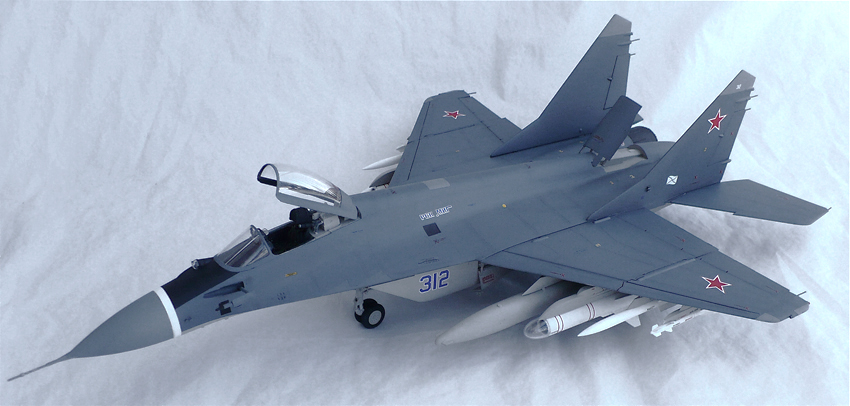
Mikoyan MiG-29K

Here are some images of Trumpeter's 1/32 scale Mikoyan MiG - 29K Fighter.

From Wikipedia"

The Mikoyan MiG-29K (Russian: Микоян МиГ-29K, NATO reporting name: Fulcrum-D) is an all-weather carrier-based multirole fighter aircraft developed by the Mikoyan design bureau. The MiG-29K was developed in the late 1980s from MiG-29M.
Production MIG-29K differ from prototypes by features such as a multi-function radar and several new cockpit displays; the adoption of HOTAS (hands-on-throttle-and-stick) controls; the integration of RVV-AE air-to-air missiles, along with missiles for anti-ship and anti-radar operations; and several ground/strike precision-guided weapons.
MiG-29K was not ordered into production and only two prototypes were originally built as the Russian Navy preferred the Su-27K in early 1990s. The Mikoyan Design Bureau did not stop its work on the MiG-29K aircraft despite the lack of financing since 1992. The programme got a boost in the late 1990s to meet an Indian requirement for a ship-borne fighter following the purchase of a former Soviet aircraft carrier. It was first received by the Indian Navy in 2009.

The MiG-29K project was initiated in the late 1970s when the Soviet Navy developed a requirement for a supersonic carrier-based fighter. As a first step to meet this requirement, the Mikoyan design bureau designed a "proof of concept" version of the MiG-29 fitted with a stronger undercarriage and a reinforced tail section with an arrestor hook, the MiG-29KVP (Korotkii Vzlet i Posadka, or "short take off and landing"). The KVP first flew on 21 August 1982, and was subject to extensive trials which demonstrated it could safely operate from a ski-jump, but ideally a production aircraft needed more power and greater wing area. It was decided to base the definitive naval version on the advanced MiG-29M (Product 9.15) that was already under development, further modified with new undercarriage and folding wings of greater area, with the new model designated the MiG-29K (Korabelniy – "ship based") or Project 9-31. The MiG-29K differed considerably from the MiG-29 production model, featuring a new multi-function radar, dubbed Zhuk; a cockpit with monochrome display and use of the HOTAS (hands-on-throttle-and-stick) principle; the RVV-AE air-to-air active homing missiles; antiship and antiradar missiles; as well as air-to-ground precision-guided weapons. To protect the engine from FOD, the engine inlets were fitted with retractable grills instead of the LERX louvres used by land-based MiG-29s. A MiG-29M on display. The MiG-29M was developed into a naval version, the MiG-29K.
The MiG-29Ks first flight was performed on 23 July 1988 at Saky by test pilot Toktar Aubakirov. On 1 November 1989, on the same day as the Sukhoi Su-27K, Aubakirov executed the first carrier landing of MiG-29K on the aircraft-carrying cruiser Tbilisi (now known as Admiral Kuznetsov), the first take-off from the carrier's deck was successfully performed the same day. During 1989–1991, the MiG-29K underwent further tests aboard the Admiral Kuznetsov. The project was put on hold with the collapse of the Soviet Union, while the Russian Navy only pursued the rival Su-33. Mikoyan continued work on the MiG-29K despite the lack of funding.
During its tests aboard the Admiral Kuznetsov aircraft-carrying cruiser, the aircraft had a springboard-assisted takeoff from strips 195 m and 95 m long. According to the results of the tests, the landing accuracy proved to be very high, which made it possible at a later stage to switch over to a three-cable arrester system on the Admiral Gorshkov. The landing accuracy is additionally enhanced through the employment of an autothrottle system. The takeoff characteristics allow for most flights to be possible under tropical conditions at a ship speed of 10 knots.
The MiG-29K program was revived in response to the decision of the Indian Navy to acquire the former Soviet Navy aircraft carrier Admiral Gorshkov in 2004. When Admiral Gorshkov was part of the Soviet fleet, it was a hybrid carrier/cruiser using vertical take-off (V/STOL) aircraft; thus the deck was refurbished with a take-off ramp and arrestor wires for operating MiG-29Ks. The ship's combat group is likely to include 12 MiG-29K fighters. The aircraft has an enlarged and folding wing, an arrestor hook and a corrosion-protected reinforced fuselage.
One factor favouring the MiG-29K over the Su-33 in the Indian decision was the larger size of the Su-33, which further limited the number of aircraft on deck. Modifications were made to the MiG-29K for Indian requirements, including the Zhuk-ME radar, RD-33MK engine, a combat payload up to 5,500 kg, 13 hardpoints, and updated 4-channel digital fly-by-wire flight control system. It is compatible with the full range of weapons carried by the MiG-29M and MiG-29SMT. The MiG-29KUB made its maiden flight at the Zhukovsky test centre on 22 January 2007.
The problem of lack of aircraft-carrier based AWACS platform may be tackled by further development of dual-seat MiG-29KUB. It is theoretically possible to outfit the MiG-29KUB with powerful radar, and encrypted data links, to permit networking of multiple MiG-29KUB aircraft for AEW coverage. The MiG-29KUB may also be enhanced in areas such as electronic warfare and long-range interdiction.
The MiG-29KUB two-seat variant took its first flight on 20 January 2007.
The MiG-29K was drastically modified from the Mikoyan MiG-29M for naval operations. The airframe and undercarriage were reinforced to withstand the stress experienced upon landing. Folding wings, an arrestor hook, and catapult attachments were added for carrier operations; the aircraft's undercarriage was also widened. The MiG-29K, unlike the early MiG-29, can both conduct aerial refueling and "buddy" refuel other aircraft. The MiG-29K has two widely-spaced RD-33MKs. The early prototypes were fitted with two RD-33K turbofan engines, each with afterburner thrust of 86.3 kN (19,800 lb) and a possible take-off thrust of 92.2 kN (20,723 lbf) for shipborne operations. The RD-33MK engine features 7% higher power over the base RD-33, enabled by the usage of improved materials for the turbine blades.
Internal fuel was increased from 3,340 kg to 4,560 kg, to give a combat radius of 850 km (531 mi). The range can be increased to 3,000 kilometers with 3 underwing fuel drop tanks. The maximum weight of the aircraft grew from 19.5 to 22.4 t, to allow for increased payloads. The MiG-29KUB two-seat fighter, intended for pilot training, can also conduct combat missions identical to the single-seat fighter.
The aircraft is equipped with three multifunctional color liquid-crystal displays (seven LCDs on the MiG-29KUB), a four-channel digital fly-by-wire flight control system, passive anti-radar missile homing system, Sigma-95 GPS receiver, TopGun helmet-mounted targeting system and electronic countermeasures (ECM). Additionally, an onboard oxygen generating system eliminates the need for heavy oxygen canisters. The types of combat missions undertaken by the MiG-29K can be increased by adding optronic/infrared imaging reconnaissance pods.
The Zhuk-ME is a development of the N010 Zhuk radar, introducing functions such as terrain mapping and following. The radar, weighing 220 kilograms (490 lb), features improved signal processing and a detection range of up to 120 km vs a 5 m2 RCS target for the export variant. In the air targeting mode, up to 10 targets can be tracked and 4 targets engaged simontaneously. In air to surface mode the radar can detect a tank from up to 25 kilometres (16 mi) away and a bridge from 120 kilometres (75 mi) away, a naval destroyer could be detected up to 300 kilometres (190 mi) away, while up to two surface targets can be tracked at once. The radar has a scanning area of +/- 85 degrees in azimuth and +56/-40 in elevation.
The Zhuk-AE radar was developed with modular approach, enabling upgrade of existing Zhuk ME radars deployed in MiG-29 platforms into the active electronically scanned array (AESA) Zhuk-AE standard. India is already operating the Bars phased array radar on its Su-30MKI and has specified AESA as a critical element of the MRCA platform. The Mig-29K can be outfitted with an IRST system integrated with both optical and laser systems. It can provide targeting solutions for ground and air targets at up to 15 km, with all-round 360 degree coverage. The IRST can also provide detailed trajectories of missiles at closer ranges.
MiG-29K has a GSh-30-1 30 mm cannon in the port wing root. It has provisions for laser-guided and electro-optical bombs, as well as air-to-surface missiles like Kh-25ML/25MP, Kh-29T, Kh-31G/31A, Kh-35U, and rockets. Kh-31P passive radar seeker missiles are used as anti-radiation missiles. Kh-35, Kh-31A antiship missiles are for anti-ship roles; for aerial combat air-to-air missile like RVV-AE, R-27ER/ET and R-73E are fitted. The aircraft is also adaptable to various foreign weapons.
The MiG-29K has a combination of low-observable technology, advanced electronic-warfare capabilities, reduced ballistic vulnerability, and standoff weapons to enhance the fighter's survivability. According to Mikoyan, extensive use of radar-absorbent materials reduce the MiG-29K's radar signature 4–5 times over the basic MiG-29. The RD-33MK turbofan engine was also engineered to reduce infrared and optical visibility.
The Russian Navy has a fleet of approximately 20 Su-33s, which are expected to be life expired by 2015. Production of new Su-33s is possible but not cost-effective for small volumes. The MiG-29K is more convenient, as the Indian Navy has already ordered the aircraft, saving on development and production set-up. India paid $730 million for the development and delivery of 16 units, while 24 for the Russian Navy would cost approximately $1 billion. In 2009, prior to delivery to India, MiG-29Ks underwent testing on board the Admiral Kuznetsov. In September 2011, it was announced that the MiG-29K was to conduct its first at-sea deployment on board Admiral Kuznetsov in the Mediterranean.
The Russian Navy ordered 24 MiG-29Ks in late 2009 for the Admiral Kuznetsov. Deliveries of the MiG-29K for the Russian Navy started in 2010. MiG and Russia were in final negotiations for an order for more MiG-29K/KUB aircraft in August 2011, with an order for 20 MiG-29K fighter-bombers and four MiG-29KUB operational trainers for operation from Admiral Kuznetsov, replacing the Sukhoi Su-33, being officially announced during February 2012.
In 2004 India ordered 12 MiG-29K single-seat and 4 MiG-29KUB two-seat fighters. The MiG-29K is to provide both airborne fleet air defense and surface attack capabilities. Deliveries began in December 2009. In January 2010, India and Russia signed a deal worth US$1.2 billion for the Indian Navy to receive an additional 29 MiG-29Ks. The MiG-29K entered operational service with India in February 2010. Further deliveries of 5 MiG-29Ks and a flight simulator took place in May 2011. Further deliveries are to continue through 2012. The fighters will be based at an air field in Goa on India's west coast until the Admiral Gorshkov joins the navy under the name of INS Vikramaditya in last quarter of 2013. The Vikramaditya is expected to carry up to 24 MiG-29K/KUB fighters. The future indigenous aircraft carrier Vikrant, currently being built by India, also is likely to carry these aircraft.
On 25 June 2011, a MiG-29KUB crashed during testing in Russia, prior to delivery to India, killing its two pilots. In light of this, further MiG-29K orders by India were frozen; the Indian Defense Ministry commented that the crash cast a shadow on the credibility of the aircraft. Russia has announced pilot error to have caused the crash, and there was no need to ground the aircraft. In August 2011, MiG's General Director Sergei Korotkov announced that the final 5 out of the 16 aircraft contracted in 2004 would be delivered by the end of the year; and that deliveries of a second batch of 29 MiG-29Ks would begin in 2012. In November 2012, the MiG-29K/KUB completed sea trials for the Indian Navy.


Sunday, March 10, 2013

North American F-100 D Super Saber

Here are some images of Trumpeter's 1/32 scale North American F-100 D Super Saber.

From Wikipedia"
The North American F-100 Super Sabre was a supersonic jet fighter aircraft that served with the United States Air Force (USAF) from 1954 to 1971 and with the Air National Guard (ANG) until 1979. The first of the Century Series collection of USAF jet fighters, it was the first USAF fighter capable of supersonic speed in level flight. The F-100 was originally designed by North American Aviation as a higher performance follow-on to the F-86 Sabre air superiority fighter.
Adapted as a fighter bomber, the F-100 would be supplanted by the Mach 2 class F-105 Thunderchief for strike missions over North Vietnam. The F-100 flew extensively over South Vietnam as the Air Force's primary close air support jet until replaced by the more efficient subsonic LTV A-7 Corsair II. The F-100 also served in other NATO air forces and with other U.S. allies. In its later life, it was often referred to as "the Hun," a shortened version of "one hundred."
 n January 1951, North American Aviation delivered an unsolicited proposal for a supersonic day fighter to the United States Air Force. Named Sabre 45 because of its 45° wing sweep, it represented an evolution of the F-86 Sabre. The mock-up was inspected 7 July 1951 and after over a hundred modifications, the new aircraft was accepted as the F-100 on 30 November 1951. Extensive use of titanium throughout the aircraft was notable. On 3 January 1952, the USAF ordered two prototypes followed by 23 F-100As in February and an additional 250 F-100As in August.
The YF-100A first flew on 25 May 1953, seven months ahead of schedule. It reached Mach 1.05 in spite of being fitted with a de-rated XJ57-P-7 engine. The second prototype flew on 14 October 1953, followed by the first production F-100A on 9 October 1953. The USAF operational evaluation from November 1953 to December 1955 found the new fighter to have superior performance but declared it not ready for widescale deployment due to various deficiencies in the design. These findings were subsequently confirmed during "Project Hot Rod" operational suitability tests. Particularly troubling was the yaw instability in certain regimes of flight which produced inertia coupling. The aircraft could develop a sudden yaw and roll which would happen too fast for the pilot to correct and would quickly overstress the aircraft structure to disintegration. It was under these conditions that North American's chief test pilot, George Welch, was killed while dive testing an early-production F-100A on 12 October 1954. Another control problem stemmed from handling characteristics of the swept wing at high angles of attack. As the aircraft approached stall speeds, loss of lift on the tips of the wings caused a violent pitch-up. This particular phenomenon (which could easily be fatal at low altitude where there was insufficient time to recover) became known as the "Sabre Dance".
Nevertheless, delays in the Republic F-84F Thunderstreak program pushed the Tactical Air Command to order the raw F-100A into service. TAC also requested that future F-100s should be fighter-bombers, with the capability of delivering nuclear bombs.
The North American F-107 was a follow-on Mach 2 development of the F-100 with the air intake moved above and behind the cockpit. It was not developed in favor of the Republic F-105 Thunderchief.

The F-100A officially entered USAF service on 27 September 1954 with 479th Fighter Wing at George AFB, California. By 10 November 1954, the F-100As suffered six major accidents due to flight instability, structural failures, and hydraulic system failures, prompting the Air Force to ground the entire fleet until February 1955. The 479th finally became operational in September 1955. Due to ongoing problems, the Air Force began phasing out the F-100A in 1958, with the last aircraft leaving active duty in 1961. By that time, 47 aircraft were lost in major accidents. Escalating tension due to construction of the Berlin Wall in August 1961 forced the USAF to recall the F-100As into active service in early 1962. The aircraft was finally retired in 1970.
The TAC request for a fighter-bomber was addressed with the F-100C which flew in March 1954 and entered service on 14 July 1955 with the 450th Fighter Wing, Foster AFB, Texas. Operational testing in 1955 revealed that the F-100C was at best an interim solution, sharing all the vices of the F-100A. The uprated J57-P-21 engine boosted performance but continued to suffer from compressor stalls. On a positive note, the F-100C was considered an excellent platform for nuclear toss bombing because of its high top speed. The inertia coupling problem was more or less addressed with installation of a yaw damper in the 146th F-100C, later retrofitted to earlier aircraft. A pitch damper was added starting with the 301st F-100C, at a cost of US$10,000 per aircraft.
The addition of "wet" hardpoints meant the F-100C could carry a pair of 275 U.S. gal (1,040 l) and a pair of 200 U.S. gal (770 l) drop tanks. However, the combination caused loss of directional stability at high speeds and the four tanks were soon replaced by a pair of 450 U.S. gal (1,730 l) drop tanks. The 450s proved scarce and expensive and were often replaced by smaller 335 US gal (1,290 l) tanks. Most troubling to TAC was the fact, that, as of 1965, only 125 F-100Cs were capable of utilizing all non-nuclear weapons in the Air Force inventory, particularly cluster bombs and AIM-9 Sidewinder air-to-air missiles. By the time the F-100C was phased out in June 1970, 85 had been lost in major accidents.
The definitive F-100D aimed to address the offensive shortcomings of the F-100C by being primarily a ground attack aircraft with secondary fighter capability. To this effect, the aircraft was fitted with autopilot, upgraded avionics, and, starting with the 184th production aircraft, the Sidewinder capability. In 1959, 65 aircraft were modified to also fire the AGM-12 Bullpup air-to-ground missile. To further address the dangerous flight characteristics, the wing span was extended by 26 in (66 cm) and the vertical tail area was increased by 27%.
The first F-100D (54–2121) flew on 24 January 1956, piloted by Daniel Darnell. It entered service on 29 September 1956 with 405th Fighter Wing at Langley AFB. The aircraft suffered from reliability problems with the constant speed drive which provides constant-frequency current to electrical systems. In fact, the drive was so unreliable that USAF required it to have its own oil system to minimize damage in case of failure. Landing gear and brake parachute malfunctions claimed a number of aircraft, and the refueling probes had a tendency to break away during high speed maneuvers. Numerous post-production fixes created such a diversity of capabilities between individual aircraft that by 1965 around 700 F-100Ds underwent High Wire modifications to standardize the weapon systems. High Wire modifications took 60 days per aircraft at a total cost of US$150 million. In 1966, Combat Skyspot program fitted some F-100Ds with an X band radar transmitter to allow for ground-directed bombing in inclement weather or at night.
In 1961, at England AFB, Louisiana, (401st Tactical Wing), there were four fighter-bomber squadrons. These were the 612th, 613th, 614th and the 615th (Fighting Tigers). During the Berlin Crisis (approximately September 1961) the 614th was deployed to Ramstein Air Base, Germany to support the West Germans. At the initial briefing, the 614th personnel were informed that due to the close proximity of the USSR, if an ICBM were to be launched, they would only have 30 minutes to launch the 614th aircraft and retire to the nearest German bunker.
In 1967, the USAF began a structural reinforcement program to extend the aircraft's service life from the designed 3,000 flying hours to 7,000. USAF alone lost 500 F-100Ds, predominantly in accidents. After one aircraft suffered wing failure, particular attention was paid to lining the wings with external bracing strips. During the Vietnam War, combat losses constituted as many as 50 aircraft per year. On 7 June 1957, an F-100D fitted with an Astrodyne booster rocket making 150,000 lbf (667.2 kN) of thrust successfully performed a zero length launch. This was accomplished with the addition of a large canister to the underside of the aircraft. This canister contained a black powder compound and was ignited electro-mechanically, driving the jet engine to minimal ignition point. The capability was incorporated into late-production aircraft. After a major accident, the USAF Thunderbirds reverted from F-105 Thunderchiefs to the F-100D which they operated from 1964 until it was replaced by the F-4 Phantom II in 1968.
The F-100 was the subject of many modification programs over the course of its service. Many of these were improvements to electronics, structural strengthening, and projects to improve ease of maintenance. One of the more interesting of these was the replacement of the original afterburner of the J-57 engine with the more advanced afterburners from retired Convair F-102 Delta Dagger interceptors. This modification changed the appearance of the aft end of the F-100, doing away with the original "petal-style" exhaust. The afterburner modification started in the 1970s and solved maintenance problems with the old type as well as operational problems, including compressor stall issues.
The F-100F two-seat trainer entered service in 1958. It received many of the same weapons and airframe upgrades as the F-100D, including the new afterburners. By 1970, 74 F-100Fs were lost in major accidents.
By 1972, the F-100 was mostly phased out of USAF active service and turned over to tactical fighter groups and squadrons in the ANG. In Air National Guard units, the F-100 was eventually replaced by the F-4 Phantom II, LTV A-7 Corsair II, and A-10 Thunderbolt II, with the last F-100 retiring in 1979, with the introduction of the F-16 Fighting Falcon. In foreign service, Royal Danish Air Force and Turkish Air Force F-100s soldiered on until 1982.
Over the lifetime of its USAF service, a total of 889 F-100 aircraft were destroyed in accidents, involving the deaths of 324 pilots.The deadliest year for F-100 accidents was 1958, with 116 aircraft destroyed, and 47 pilots killed.
After Super Sabres were withdrawn from service, a large number were converted into remote-controlled drones (QF-100) under the USAF Full Scale Aerial Target (FSAT) program for use as targets for various anti-aircraft weapons, including missile-carrying fighters and fighter-interceptors, with FSAT operations being conducted primarily at Tyndall AFB, FL. A few F-100s also found their way into civilian hands, primarily with defense contractors supporting USAF and NASA flight test activities at Edwards AFB, CA.


Wednesday, March 6, 2013

Honda Formula One RA 273 Racer

Here are some images of Tamiya's 1/12 scale Honda Formula One RA 273 Racer.

From Wikipedia"

The Honda RA273 was a Formula One racing car used by the Honda team in the 1966 and 1967 Formula One seasons.
The engine was re-designed from the RA272's 1,500cc V12 to a brand new 3,000cc V12 due to the change of regulations before the 1966 season. The new engine was designed by Shoichiro Irimajiri.

Honda entered Formula One Grand Prix racing in 1964, just four years after producing their first road car. They began development of the RA271 in 1962 and startled the European-dominated Formula One garages with their all-Japanese factory team (except for American drivers Ronnie Bucknum and Richie Ginther). More startling was the fact that Honda built their own engine and chassis, something only Ferrari and BRM – of the other teams still running in 1962 – had previously done.

John Surtees and Yoshio Nakamura at the 1968 Dutch Grand Prix.
In only their second year of competition, Honda reached the coveted top step of the podium with Ginther's win in the RA272 at the 1965 Mexican Grand Prix. For the new 3.0L rules from 1966, Honda introduced the Honda RA273. Although the RA273's engine was a well-designed, ~360 bhp V12, the car was let down by a relatively heavy and unwieldy in-house chassis. Honda returned to the winner's circle in 1967 with the new Honda RA300, driven by John Surtees. This won the 1967 Italian Grand Prix in only its first F1 race. The RA300 chassis was partly designed by Lola in the UK, and this resulted in the car being nicknamed the Hondola by the motoring press. This was the last competitive car that Honda produced for F1 in the 1960s.
The following year's Honda RA301 only reached the podium twice. The team's new Honda RA302 appeared in only a single race at Rouen-Les-Essarts, lasting only a few laps before its fiery crash resulted in the death of driver Jo Schlesser. The death prompted Honda to withdraw from F1 at the end of the 1968 Formula One season.

Thursday, February 28, 2013

Corellian Engineering Corporation YT - 1300 Transport Millennium Falcon

Here are some images of Fine Molds 1/72 scale Corellian Engineering Corporation YT - 1300 Transport (Han Solo's Modified) Millennium Falcon from the Star Wars Universe.
One way to know for certain the accuracy of a science fiction model kit is how easy it is to tell which models the greebling came from. This kit was a piece of cake.

From Wikipedia"
The Millennium Falcon is a spacecraft in the fictional Star Wars universe commanded by smuggler Han Solo (Harrison Ford) and his Wookiee first mate, Chewbacca (Peter Mayhew). The highly modified YT-1300 light freighter first appears in Star Wars Episode IV: A New Hope (1977), and subsequently in Star Wars Episode V: The Empire Strikes Back (1980), Star Wars Episode VI: Return of the Jedi (1983) and in a cameo in Star Wars Episode III: Revenge of the Sith (2005). The Falcon also appears in a variety of Star Wars Expanded Universe materials, including books, comics, and games; James Luceno's novel Millennium Falcon focuses on the titular ship.

According to Star Wars creator George Lucas, the Millennium Falcon's design was inspired by a hamburger, with the cockpit being an olive on the side. The ship originally had a more elongated appearance, but the similarity to the Eagle Transporters in Space: 1999 prompted Lucas to change the Falcon's design. The original model was modified, re-scaled, and used as Princess Leia's ship, Tantive IV.
The sound of the ship traveling through hyperspace comes from two tracks of the engine noise of a McDonnell Douglas DC-9, with one track slightly out of synchronization with the other. To this, sound designer Ben Burtt added the hum of the cooling fans on the motion-control rig at ILM.

Visually, the Millennium Falcon was represented by several models and external and internal sets. For A New Hope, a partial exterior set was constructed and the set dressed as Docking Bay 94 and the Death Star hangar. Besides the functional landing gear, an additional support held up the structure and was disguised as a fuel line. The interior set included the starboard ring corridor, the boarding ramp, cockpit access tunnel, gun turret ladder, secret compartments, and the forward hold. The cockpit was constructed as a separate set that could be rocked when the ship was supposed to shake. Several inconsistencies exist between the internal set and the external set, the cockpit access tunnel angle being the most noticeable.
The effects models for A New Hope matched the design of the exterior set. The primary model was 5 feet long and detailed with various kit parts. The ship was represented as a matte painting when Princess Leia (Carrie Fisher) sees it for the first time, showing the full upper surface. For the 1997 Special Edition, a digital model replaces the effects model in several shots, and is used in a new shot of the Falcon lifting off from Docking Bay 94.
For The Empire Strikes Back, a new external set was constructed in a hangar by Marcon Fabrications in Pembroke Dock, West Wales. Once completed, it weighed over 25 tons and used compressed air hover pads for movement around the set. It was disassembled and shipped to the studio for filming. As in A New Hope, the location set was changed around the ship set. The only major design change was to add additional landing gear where the disguised fuel line had been in A New Hope. As this set included the port side, that gave the set seven landing gear. The internal set was slightly refitted from A New Hope and featured a larger cargo hold, an additional corridor to port, and an equipment room. Two new interior sets were created that are not shown to connect to the rest of the set: a top hatch that Lando Calrissian (Billy Dee Williams) uses to rescue Luke Skywalker (Mark Hamill), and the compartment where Luke rests on a bunk.
The 5-foot-long effects model from A New Hope was modified to reflect the additional landing gear, and several new models were built, including one roughly the size of a U.S. Quarter Dollar. For the 1997 Special Edition, a CGI model replaced the effects model during the approach and landing on Cloud City.
No new models or sets were created for Return of the Jedi. A portion of the full-scale ship was used for a scene cut from Return of the Jedi in which several characters board the Falcon in a sandstorm on Tatooine. In the scene when Han exacts a promise from Lando not to damage the Falcon, the Falcon is represented by a backdrop painting. It is also in a matte painting of the entire hangar bay.
The internal and external sets were scrapped after filming on Return of the Jedi ended. The effects models were kept by Lucasfilm and some have been on display from time to time.
A digital version of the Falcon appears briefly on Coruscant in Revenge of the Sith. Lucas has stated that the ship is the Falcon and not another ship of similar design. A CGI version of the vessel also appears in the Disney attraction Star Tours: The Adventures Continue.

Han Solo won the Millennium Falcon from fellow rogue Lando Calrissian in a hand of the card game sabacc. In A New Hope, Obi-Wan Kenobi (Alec Guinness) and Luke Skywalker charter the ship to deliver them, C-3PO (Anthony Daniels), R2-D2 (Kenny Baker), and the stolen Death Star plans to Alderaan. Skywalker calls the ship "a piece of junk", but Solo counters by noting that the ship "may not look like much, but she's got it where it counts." When the Falcon is captured by the Death Star, the group conceal themselves in smuggling compartments built into the floor to avoid discovery during a search of the ship. Solo later collects his fee for delivering them to the hidden Rebel base and departs, but returns just in time to assist Luke in his attempt to destroy the Death Star.
Solo flies the Falcon, with Chewbacca, Leia, and C-3PO aboard, to elude the Imperial Starfleet in The Empire Strikes Back. They take refuge at Cloud City, where Darth Vader (David Prowse/James Earl Jones) captures Solo and freezes him in carbonite. Lando Calrissian helps the others escape and, at the film's end, he departs in the Falcon to track down Solo and his captor, Jabba the Hutt. Calrissian again flies the Falcon during the climax of Return of the Jedi, with friend and former smuggler Nien Nunb as co-pilot, leading the Rebels' successful attack on the second Death Star.
The Falcon is often connected to the Kessel Run; Solo, in A New Hope, brags that the Falcon made the Kessel Run in "less than twelve parsecs". As this is a unit of distance, not time, different explanations have been provided. In the fourth draft of the script, Kenobi "reacts to Solo’s stupid attempt to impress them with obvious misinformation." In the Expanded Universe, the Kessel Run is a pathway from Kessel past the Maw Black Hole Cluster used by smugglers to transport precious Glitterstim spice, and Solo's bragging refers to his ability to move the ship closer to the Maw's black holes and therefore cut the distance traveled. On the A New Hope DVD audio commentary, Lucas comments that, in the Star Wars universe, traveling through hyperspace requires careful navigation to avoid stars, planets, asteroids, and other obstacles, and that since no long-distance journey can be made in a straight line, the "fastest" ship is the one that can plot the "most direct course", thereby traveling the least distance. The novelization backs away and changes the line to "twelve Standard Time Units."
Solo's twelve-parsec Kessel Run was a result of being pursued by Imperial vessels, but also due to modifications to the ship's Hyperdrive by an engineer named Doc Han met in the Corporate Zone, all depicted in the novel Rebel Dawn by A. C. Crispin. (However, the Falcon makes its debut in the previous book in the trilogy, The Hutt Gambit, as Calrissian's personal ship.) In Dark Horse Comics' "The Kessel Run", Solo mentions a scam that Calrissian uses to win money back from Solo after losing the Falcon to him.

Sunday, February 24, 2013

The Moonbus From 2001 A Space Odyssey

Here are some more images of Moebius Models (from Aurora molds) 1/55 scale Moonbus from 2001 a space odyssey.

From Wikipedia"
The Moonbus is a fictional spacecraft from the movie 2001: A Space Odyssey. The vehicle is a small, low altitude rocket craft meant to be used for quick transportation of passengers and cargo above the surface of the Moon.
 A moonbus is a hypothetical small, light-duty VTOL (vertical take-off and landing) spacecraft designed primarily for short-range low-altitude point-to-point ferrying of people and supplies on a moon. A moonbus "flies" over terrain by regulating downward thrusters to counter the moon's gravity while using horizontal thrusters or angling downward thrust to move over the moon's surface. While plausible, this seems to be more trouble than it would be worth in actual practice. Given the moon's low gravity, it would be far easier to simply plot sub-orbital trajectories which would be far safer and require less supervision from pilots. Currently no practical moonbuses exist for lack of applicability. The first specific depiction of a moonbus appeared in the science fiction movie 2001: A Space Odyssey (Kubrick, 1968).

Thursday, February 21, 2013

Faichild/Republic A-10 Thunderbolt II N/AW

Here are some images of Trumpeter models 1/32 scale Faichild/Republic A-10 Thunderbolt II N/AW.

From the instructions"
There was hope since the beginning of the A-10 program that an enhanced variant of the aircraft could be developed for the Air Force.
this hope was based on the original air force A-10 system specification that was written in 1972 and stated  that the vehicle design shall allow for ease of growth
to a 2 seat version for training with combat capability and night adverse weather attack.
In 1978 the DOD made funds available for the development of a Night/Adverse Weather (N/W) variant of the A-10.
The N/AW development effort was jointly funded by the defense department and Fairchild/Republic 5 million and 2 million respectively.
As part of this effort Fairchild leased the first DT&E A-10 aircraft from the Air Force for the purpose of modifying it into a 2 seat variant designated the N/AW evaluator.
As Fairchild had allowed for expansion of the original design, the amount of rework to be performed on the aircraft would not be drastic.
The N/AW version was built primarily as a reaction to the fact that the Soviet forces in Europe devote about 40% of their training to night operations.
Current A-10's could operate at nght using illumination flares, but that activity would be nullified by reduced visibility.
As a result a requirement existed for evaluating a version that could fly in all types of weather.
The rework began in April of 1978 at the Farmingdale plant and took over 13 months to complete.
The N/AW version was 2000 lbs heavier than the conventional A-10 with the addition of the second cockpit station for the weapons systems operator (WSO).
The extra station included a duplicate of the forward cockpit except for the HUD controls and the titanium tub.
Flight controls would be duplicated with the addition of an extra yaw stick.
New avionics added to the N/AW evaluator were a multimode radar and a forward looking infrared (FLIR).
The multimode radar had modes for target indication, ground mapping, terrain tracking and target detection.
The threat detector function could detect radar signals from a surface to air missile battery or a radar directed anti aircraft gun.
The FLIR presented a realistic image of the terrain on the HUD (heads up display) and could be used for target identification for the 30mm gun, INS updating and as a secondary terrain avoidance monitor
to the multimode radar.
Besides the second cockpit, the N/AW differed from the A-10A in that the fin and rudder were modified.
The N/AW fin rudder were enlarged to improve lateral stability and control.
The aircraft was delivered to Edwards AFB for flight testing, which began on May 4th 1979.
 The initial flights were were devoted to air worthiness checks in the area of control handling from both cockpits.
Also new equipment such as the low altitude warning sensors were checked out in the various types of terrain and structures on the ground.
After the initial flights, tactical evaluations were were carried out that included low altitude flying target detection and gun attacks.
The primary objective of the air force with the N/AW was to see if the additional equipment could be handled by one pilot.
This could lead into enhanced single seat A-10's being developed by retrofitting the A-10 fleet.
Fairchild was coming from a different perspective as it felt the N/AW was a 2 man job.
Cost estimates for converting an A-10 to the 2 seat configuration was about $500,000 for the basic structural work and another million dollars for the additional night/adverse weather equipment.
The Air Force however were looking into the possibility of having single seat A-10's converted into N/AW aircraft.
In the event the LANTERN (low altitude time infrared navigation) system was proposed for the A-10ending the need for the N/AW specialized aircraft as the LANTERN enhanced
pilot capability for night time flying.
Throughout the next decade the LANTERN proposal would go through several design alterations and several nomenclature changes with the end result that no enhanced system was put into the A-10 before
the end of production.
There was also a proposal for a 2 seat trainer when the Air Force asked for trade studies on such an aircraft.
This was different from the N/AW evaluator as the second seat would be added for training purposes only and no advanced electronics would be added to this version which was designated as the A-10B.
Data collected from flight testing of the N/AW evaluator provided the Air Force with enough information to make a decision.
The Air Force requested that 20 A-10B aircraft be tacked onto the original order of 713 aircraft.
If additional A-10B's were needed, then existing A-10A's would be converted.
The proposed A-10B version was cut by congress in 1983. They felt along with several Air Force officials that the A-10A was already simple enough to fly and that a trainer version was not needed.
The final count for A-10 production was 713 aircraft.
The only 2 seat version for the A-10 program was the N/AW aircraft which still exists today, but only as a museum piece at Edwards AFB.
The inability of Fairchild/Republic to obtain an extension to the existing A-10 contract, along with the Air Forces cancellation of the company's other prime program,
the controversial T-46A trainer program forced it to close in early 1987.
The rights of the A-10 program, along with 116 engineers were obtained by Grumman Aerospace in late 1987.
In the late 1980's there was discussion about transferring A-10's to the Army.
Instead a slightly modified version for reconnaissance designated the OA-10 was developed.
This variant required minimal modification to existing A-10's with the external difference being what was carried under the wings.
Instaed of bombs and missiles, the OA-10 carried white phosphorus rockets for marking targets for other aircraft to destroy.
The OA-10 would still carry a full load of ammunition for the 30mm cannon fro self defense.
There were 2 groups of A-10's that were converted to AO-10 standards and these were stationed at Davis/Monthon AFB in Tucson Arizona.