Translate

Wednesday, December 17, 2014

1935 Morgan Three Wheeler

Here are some more images of Entex 1/16 scale 1935 Morgan Three Wheeler.

From Wikipedia"
H.F.S. Morgan's first car design was a single-seat three-wheeled runabout, which was fabricated for his personal use in 1909. Interest in his runabout led him to patent his design and begin production. While he initially showed single-seat and two-seat versions of his runabout at the 1911 Olympia Motor Exhibition, he was convinced at the exhibition that there would be greater demand for a two-seat model. The Morgan Motor Company was registered as a limited private company only in 1912 with "H.F.S." Morgan as managing director and his father, who had invested in his son's business, as its first chairman.
Morgan established its reputation via competition such as winning the 1913 Cyclecar Grand Prix at Amiens in France. This became the basis for the 'Grand Prix' model of 1913 to 1926, from which evolved the 'Aero', and 'Sports' models.
These models used air-cooled or liquid-cooled variations of motorcycle engines. The engine was placed ahead of the axis of the front wheels in a chassis made of steel tubes brazed into cast lugs.
The V-Twin models were not returned to production after World War II.

Sunday, December 14, 2014

Hawker Typhoon Mk. 1B

Here are some images of Airfix 1/24 scale Hawker Typhoon Mk. 1B.
This aircraft served with No.245 squadron, 2nd tactical air force, Germany and RAF Warmwell, Dorset, England June - August 1945.
The mistake I made with this model is that I thought I could build this kit with the engine and have removable cowl covers as well. I was wrong.
My advice to anyone wishing to build this model is that building it with the engine exposed is the easiest version to build. To build it with cowl covers is the most difficult as the covers are many and problematic when trying to line them up. Plus if you wish to build this kit with the cowl covers you're going to have to remove much of the engine parts in order to fit the covers. What I should have done is build a half and half variant. Oh well, hind sight is always 20/20 I guess. Fortunately I took a couple of pictures of the interior before covering it up.
One thing to note about this kit is that it's the first model airplane kit I've seen that actually has skin stress between the rivets. This lends to a much more realistic surface. Well done Airfix!

From the instructions"
Despite the Typhoon's prominent chin MP197 is the only Typhoon known to have carried a sharkmouth marking. The origin of this particular marking is obscure but we do know from the testimony of 245 squadron pilots that the marking was carried in action before the end of the war. MP197 arrived with 245 squadron in August 1944 at the height of Falaise Gap operations and remained with the unit for a year, until in fact the squadron was disbanded on 15 august 1945. Unfortunately 245 squadrons records do not record individual aircraft but from Flt Lt. H.T. 'Moose' Mossip's logbook it is apparent that he flew the aircraft a number of times in late 1944 and 1945, before he was killed in action on 7th of March. He may have been the originator of the marking. It is also known that it was later flown by the CO., Sqn. Ldr. Tony Zweigbergk. The colourful blue and white decoration was added in the summer of 1945. 245 squadron was disbanded in August 1945 and MP197 finished up at 83 Group Disbandment Centre and was 'struck off charge' there in November 1945.

From Wikipedia'
The Hawker Typhoon (Tiffy in RAF slang), was a British single-seat fighter-bomber, produced by Hawker Aircraft. It was intended to be a medium–high altitude interceptor, as a replacement for the Hawker Hurricane but several design problems were encountered and it never completely satisfied this requirement.
The Typhoon was designed to mount 12 machine guns and be powered by the latest 2000 hp engines. Its service introduction in mid-1941 was plagued with problems and for several months the aircraft faced a doubtful future. When the Luftwaffe brought the formidable Focke-Wulf Fw 190 into service in 1941, the Typhoon was the only RAF fighter capable of catching it at low altitudes; as a result it secured a new role as a low-altitude interceptor.
Through the support of pilots such as Roland Beamont it became established in roles such as night-time intruder and a long-range fighter. From late 1942 the Typhoon was equipped with bombs and from late 1943 RP-3 ground attack rockets were added to its armoury. Using these two weapons, the Typhoon became one of the Second World War's most successful ground-attack aircraft.

Only one complete Hawker Typhoon still survives – serial number MN235 – and it is on display at the RAF Museum in Hendon, North London. It was previously on display at the National Air and Space Museum (part of the Smithsonian Institution) in the US before being presented to the museum in commemoration of the RAF's 50th Anniversary in exchange for a Hawker Hurricane. Several other partial air frames are extant:
  • Typhoon Ib EJ922 (Private; Ex-Peter Smith Collection, UK),
  • Typhoon Ia JR505 (Brian Barnes Collection, UK),
  • Typhoon Ib JP843 (Roger Marley Collection, UK),
  • Typhoon Ib RB396 (David Robinson Collection, UK, under restoration; formerly on display at Fort Veldhuis museum, Netherlands).
Two unidentified cockpit sections are on display at the Imperial War Museum Duxford, and the Jet Age Museum in Gloucester.
A Hawker Typhoon replica at the Memorial de la Paix at Caen, France, was constructed using some original components.


On 9 June 1994, in recognition of the aircraft and crew's role in the liberation of Normandy, a Typhoon memorial was dedicated by Major M. Roland Heudier at Noyers-Bocage, France. Also present at the ceremony were General Yves Paul Ezanno DFC and bar and Squadron Leader Denis Sweeting, both former Squadron Leaders of No. 198 Squadron RAF.

Saturday, December 6, 2014

Friday, December 5, 2014

Mercedes-Benz SS 1927 Sonder Kabriolet

Here are some images of Minicraft's 1/16 scale Mercedes-Benz SS 1927/28 Sonder Kabriolet.
Only one of these cars were built in 1927.

Wednesday, December 3, 2014

Ford 1914 Model T Stake Truck

Here are some images of Entex (Bandai molds) 1/16 scale Ford 1914? Model T Stake Truck.

From Wikipedia"
The Ford Model T (colloquially known as the Tin Lizzie, Tin Lizzy, T‑Model Ford, Model T, or T) is an automobile that was produced by Henry Ford's Ford Motor Company from October 1, 1908, to May 27, 1927. It is generally regarded as the first affordable automobile, the car that opened travel to the common middle-class American; some of this was because of Ford's efficient fabrication, including assembly line production instead of individual hand crafting. The Ford Model T was named the world's most influential car of the 20th century in an international poll.

Although automobiles had already existed for decades, their adoption had been limited, and they were still mostly scarce and expensive. Automobiles were considered extreme luxury for the common man until the Model T. The Model T set 1908 as the historic year that the automobile became popular for the mass market. The first production Model T was produced on August 12, 1908 and left the factory on September 27, 1908, at the Piquette Plant in Detroit, Michigan. On May 26, 1927, Henry Ford watched the 15 millionth Model T Ford roll off the assembly line at his factory in Highland Park, Michigan.

There were several cars produced or prototyped by Henry Ford from the founding of the company in 1903 until the Model T was introduced. Although he started with the Model A, there were not 19 production models (A through T); some were only prototypes. The production model immediately before the Model T was the Model S, an upgraded version of the company's largest success to that point, the Model N. The follow-up was the Ford Model A (rather than any Model U). The company publicity said this was because the new car was such a departure from the old that Henry wanted to start all over again with the letter A.

The Model T was Ford's first automobile mass-produced on moving assembly lines with completely interchangeable parts, marketed to the middle class. Henry Ford said of the vehicle:

    I will build a car for the great multitude. It will be large enough for the family, but small enough for the individual to run and care for. It will be constructed of the best materials, by the best men to be hired, after the simplest designs that modern engineering can devise. But it will be so low in price that no man making a good salary will be unable to own one – and enjoy with his family the blessing of hours of pleasure in God's great open spaces.

Although credit for the development of the assembly line belongs to Ransom E. Olds with the first mass-produced automobile, the Oldsmobile Curved Dash, beginning in 1901, the tremendous advancements in the efficiency of the system over the life of the Model T can be credited almost entirely to the vision of Ford and his engineers.

Tuesday, December 2, 2014

MG TC Midget 1948

Here are some images of Entex 1/16 scale 1948 MG TC Miget roadster.

From Wikipedia"
The MG T series included the TA, TB, TC, TD, and TF Midget models, a range of body-on-frame convertible sports cars produced in a sequence from 1936 to 1955. The last of these models, the TF, was replaced by the MGA.
The TF name was reinstated in 2002 on the mid-engined MG TF sports car.
The TC Midget was the first postwar MG, launched in 1945. It was quite similar to the pre-war TB, sharing the same 1,250 cc (76 cu in) pushrod-OHV engine with a slightly higher compression ratio of 7.4:1 giving 54.5 bhp (40.6 kW) at 5200 rpm. The makers also provided several alternative stages of tuning for "specific purposes".
It was exported to the United States, even though only ever built in right-hand drive. The export version had slightly smaller US specification sealed-beam headlights and larger twin rear lights, as well as turn signals and chrome-plated front and rear bumpers.
The body was approximately 4 inches (100 mm) wider than the TB measured at the rear of the doors to give more cockpit space. The overall car width remained the same resulting in narrower running boards with two tread strips as opposed to the previous three. The tachometer was directly in front of the driver, while the speedometer was on the other side of the dash in front of the passenger.
10,001 TCs were produced, from September 1945 (chassis number TC0251) to Nov. 1949 (chassis number TC10251), more than any previous MG model. It cost £527 on the home market in 1947.
Fuel consumption was 28 mpg-imp (10.1 L/100 km; 23.3 mpg-US). Its 0–60 mph time was 22.7 seconds, a respectable performance at the time.

Monday, December 1, 2014

de Havilland PR Mk XVI Mosquito

Here are some images of Revell/Paragon 1/32 scale de Havilland PR Mk XVI Mosquito.

From Wikipedia"
The Mosquito PR Mk XVI had a pressurised cockpit and, like the Mk IX, was powered by two Rolls-Royce Merlin 72/73 or 76/77 piston engines. This version was equipped with three overload fuel tanks, totalling 760 imperial gallons (3,500 L) in the bomb bay, and could also carry two 50 imperial gallons (230 L) or 100 imperial gallons (450 L) drop tanks. A total of 435 of the PR Mk XVI were built. The PR Mk XVI had a maximum speed of 415 mph (668 km/h), a cruise speed of 250 mph (400 km/h), ceiling of 38,500 ft (11,700 m), a range of 2,450 nmi (4,540 km), and a climb rate of 2,900 feet per minute (884 m).

Monday, November 24, 2014

Rockwell B1 B Lancer

Here are some images of Monograms 1/48 scale Rockwell (now Boeing) B1-B Lancer. This supersonic penetration bomber was derived from the Mach 2 B1-A and first flew in 1974 and was cancelled by the Carter administration in 1977. Todays B1-B has modified electronics, strengthened airframe and landing gear, Flies at a lower altitude but has lower performance compared to its predecessor. The first production B1-Bs had unfortunate problems with their fuel and electronic countermeasures. I seen one of these beasts perform maneuvers at an air show once and I must say WOW! My ears rang for a week after that. This model is huge, easily the biggest 1/48 scale static model available and it has good detail as well, so if you are planning to buy this kit make some room. It costs somewhere between $60 and $80 Cdn nowadays so it is a good buy.

From Wikipedia"

The Rockwell (now part of Boeing) B-1 Lancer is a four-engine supersonic variable-sweep wing, jet-powered strategic bomber used by the United States Air Force (USAF). It was first envisioned in the 1960s as a supersonic bomber with Mach 2 speed, and sufficient range and payload to replace the Boeing B-52 Stratofortress. It was developed into the B-1B, primarily a low-level penetrator with long-range and Mach 1.25 speed capability at high altitude.
Designed by Rockwell International, development was delayed multiple times over its history, as the theory of strategic balance changed from flexible response to massive retaliation and back again. Each change in stance changed the perceived need for manned bombers. The initial B-1A version was developed in the early 1970s, but its production was canceled, and only four prototypes were built. The need for a new platform once again surfaced in the early 1980s, and the aircraft resurfaced as the B-1B version with the focus on low-level penetration bombing. However, by this point development of stealth technology was promising an aircraft of dramatically improved capability. Production went ahead as the B version would be operational before the "Advanced Technology Bomber" (which became the B-2 Spirit), during a period when the B-52 would be increasingly vulnerable. The B-1B entered service in 1986 with the USAF Strategic Air Command (SAC) as a nuclear bomber.
In the early 1990s, following the Gulf War and concurrent with the disestablishment of SAC and its reassignment to the newly formed Air Combat Command (ACC), the B-1B was converted to conventional bombing use. It first served in combat during Operation Desert Fox in 1998 and again during the NATO action in Kosovo the following year. The B-1B has supported U.S. and NATO military forces in Afghanistan and Iraq. The Lancer is the supersonic component of the USAF's long-range bomber force, along with the subsonic B-52 and Northrop Grumman B-2 Spirit. The bomber is commonly called the "Bone" (originally from "B-One"). With the retirement of the General Dynamics/Grumman EF-111A Raven in 1998 and the Grumman F-14 Tomcat in 2006, the B-1B is the U.S. military's only active variable-sweep wing aircraft. The B-1B is expected to continue to serve into the 2030s, with the Next-Generation Bomber to start supplementing the B-1B in the 2020s.

On taking office, Reagan was faced with the same decision as Carter before: whether to continue with the B-1 for the short term, or to wait for the development of the ATB, a much more advanced aircraft. Studies suggested that the existing B-52 fleet with ALCM would remain a credible threat until 1985, as it was predicted that 75% of the B-52 force would survive to attack its targets. After this, the introduction of the SA-10 missile, the MiG-31 interceptor and the first Soviet Airborne Early Warning and Control (AWACS) systems would make the B-52 increasingly vulnerable. During 1981, funds were allocated to a new study for a bomber for the 1990s time-frame, this led to the Long-Range Combat Aircraft (LRCA) project. The LRCA evaluated the B-1, F-111 and ATB as possible solutions; an emphasis was placed on multi-role capabilities, as opposed to purely strategic operations.
 The first B-1B at its roll-out ceremony outside a hangar in Palmdale, California in 1984
First B-1B debuted outside a hangar in Palmdale, California, 1984
In 1981, it was believed the B-1 could be in operation before the ATB, covering the transitionary period between the B-52's increasing vulnerability and the ATB's introduction. Reagan decided the best solution was to procure both the B-1 and ATB, and on 2 October 1981 Reagan announced that 100 B-1s were to be ordered to fill the LRCA role.
In January 1982 the U.S. Air Force awarded two contracts to Rockwell worth a combined $2.2 billion for the development and production of 100 new B-1 bombers. Numerous changes were made to the design to make it better suited to the now expected missions, resulting in the new B-1B. These changes included a reduction in maximum speed, which allowed the variable-aspect intake ramps to be replaced by simpler fixed geometry intake ramps in the newer design. This reduced the B version's radar signature; the reduction in radar cross-section was seen as a good trade off for the speed decrease. High subsonic speeds at low altitude became a focus area for the revised design,[ and low-level speeds were increased from about Mach 0.85 to 0.92. The B-1B has a maximum speed of Mach 1.25 at higher altitudes.
The B-1B's maximum takeoff weight was increased to 477,000 pounds (216,000 kg) from the B-1A's 395,000 pounds (179,000 kg) The weight increase was to allow for takeoff with a full internal fuel load and for external weapons to be carried. Rockwell engineers were able to reinforce critical areas and lighten non-critical areas of the airframe, so the increase in empty weight was minimal. In order to deal with the introduction of the MiG-31 and other aircraft with look-down capability, the B-1B's electronic warfare suite was significantly upgraded.
 B-1B with its wings swept back doing a banked turn during a demonstration
B-1B banking during a demonstration in 2004
Opposition to the plan was widespread within Congress. Critics pointed out that many of the original problems remained in both areas of performance and expense. In particular it seemed the B-52 fitted with electronics similar to the B-1B would be equally able to avoid interception, as the speed advantage of the B-1 was now minimal. It also appeared that the "interim" time frame served by the B-1B would be less than a decade, being rendered obsolete shortly after the introduction of a much more capable ATB design. The primary argument in favor of the B-1 was its large conventional payload, and that its takeoff performance allowed it to operate with a credible bombload from a much wider variety of airfields. The air force spread production subcontracts across many congressional districts, making the aircraft more popular on Capitol Hill.
B-1A #1 was disassembled and used for radar testing at the Rome Air Development Center at the former Griffiss Air Force Base, New York. B-1As #2 and #4 were modified to include B-1B systems. The first B-1B was completed and began flight testing in March 1983. The first production B-1B was rolled out on 4 September 1984 and first flew on 18 October 1984. The 100th and final B-1B was delivered on 2 May 1988; before the last B-1B was delivered, the air force had determined that the aircraft was vulnerable to Soviet air defenses

Sunday, November 23, 2014

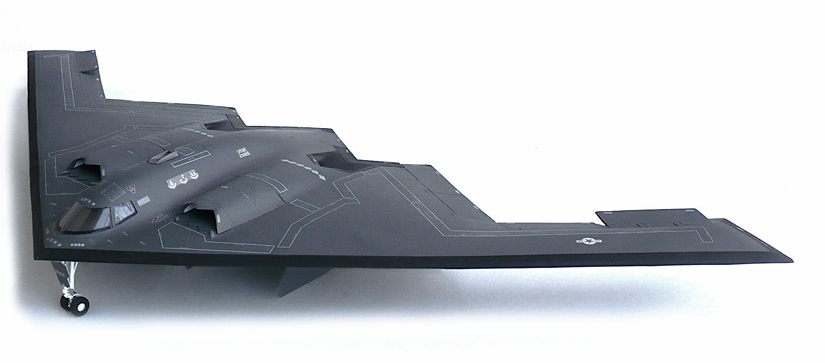
Northrop B2 Spirit

Here are some images of Testors 1/72 scale B2 Spirit stealth bomber.

From Wikipedia"

The Northrop (later Northrop Grumman) B-2 Spirit, also known as the Stealth Bomber, is an American strategic bomber, featuring low observable stealth technology designed for penetrating dense anti-aircraft defenses; it is able to deploy both conventional and nuclear weapons. The bomber has a crew of two and can drop up to eighty 500 lb (230 kg)-class JDAM GPS-guided bombs, or sixteen 2,400 lb (1,100 kg) B83 nuclear bombs. The B-2 is the only aircraft that can carry large air-to-surface standoff weapons in a stealth configuration.
Development originally started under the "Advanced Technology Bomber" (ATB) project during the Carter administration, and its performance was one of his reasons for the cancellation of the supersonic Rockwell B-1 Lancer. ATB continued during the Reagan administration, but worries about delays in its introduction led to the reinstatement of the B-1 program as well. Program costs rose throughout development. Designed and manufactured by Northrop Grumman, the cost of each aircraft averaged US$737 million (in 1997 dollars). Total procurement costs averaged $929 million per aircraft, which includes spare parts, equipment, retrofitting, and software support. The total program cost including development, engineering and testing, averaged $2.1 billion per aircraft in 1997.
Because of its considerable capital and operating costs, the project was controversial in the U.S. Congress and among the Joint Chiefs of Staff. The winding-down of the Cold War in the latter portion of the 1980s dramatically reduced the need for the aircraft, which was designed with the intention of penetrating Soviet airspace and attacking high-value targets. During the late 1980s and 1990s, Congress slashed plans to purchase 132 bombers to 21. In 2008, a B-2 was destroyed in a crash shortly after takeoff, though the crew ejected safely. A total of 20 B-2s remain in service with the United States Air Force, who plan to operate the B-2 until 2058.
The B-2 is capable of all-altitude attack missions up to 50,000 feet (15,000 m), with a range of more than 6,000 nautical miles (11,000 km) on internal fuel and over 10,000 nautical miles (19,000 km) with one midair refueling. Though originally designed primarily as a nuclear bomber, it was first used in combat dropping conventional ordnance in the Kosovo War in 1999 and saw further service in Iraq and Afghanistan.

In the mid-1970s, the search for a new U.S. strategic bomber aircraft to replace the Boeing B-52 Stratofortress was underway, to no avail. First the B-70 and then the B-1A were canceled after only prototypes of each aircraft were built. The B-70 was intended to fly above and beyond defensive interceptor aircraft, only to find these same attributes made it especially vulnerable to surface-to-air missiles (SAMs). The B-1 attempted to avoid SAMs by flying close to the ground to use terrain to mask its radar signature, only to face a new generation of interceptors with look-down/shoot-down capabilities that could attack them from above.
By the mid-1970s, it was becoming clear that there was a different way to avoid missiles and intercepts; known today as "stealth"; the concept was to build an aircraft with an airframe that deflected or absorbed radar signals so that little was reflected back to the radar unit. An aircraft having stealth characteristics would be able to fly nearly undetected and could be attacked only by weapons and systems not relying on radar. Although such possibilities existed, such as human observation, their relatively short detection range allowed most aircraft to fly undetected by defenses, especially at night.
In 1974, DARPA requested information from U.S. aviation firms about the largest radar cross-section of an aircraft that would remain effectively invisible to radars. Initially, Northrop and McDonnell Douglas were selected for further development. Lockheed had experience in this field due to developing the Lockheed A-12 and SR-71, which included a number of stealthy features, notably its canted vertical stabilizers, the use of composite materials in key locations, and the overall surface finish in radar-absorbing paint. A key improvement was the introduction of computer models used to predict the radar reflections from flat surfaces where collected data drove the design of a "faceted" aircraft. Development of the first such designs started in 1975 with "the hopeless diamond", a model Lockheed built to test the concept.
Plans were well advanced by the summer of 1975, when DARPA started the Experimental Survivability Testbed (XST) project. Northrop and Lockheed were awarded contracts in the first round of testing. Lockheed received the sole award for the second test round in April 1976 leading to the Have Blue program.

By 1976, these programs progressed to where a long-range strategic stealth bomber appeared viable. President Carter was aware of these developments during 1977, and it appears to have been one of the major reasons the B-1 was canceled. Further studies were ordered in early 1978, by which point the Have Blue platform had flown and proven the concepts. During the 1980 presidential election in 1979, Ronald Reagan repeatedly stated that Carter was weak on defense, and used the B-1 as a prime example. In return, on 22 August 1980, the Carter administration publicly disclosed that the United States Department of Defense (DoD) was working to develop stealth aircraft, including a bomber.
Front view of tailless aircraft parked in front of building. On the building face is a blue and red rectangular flag. In the foreground is a star shape on the ground
The B-2's first public display in 1988
The Advanced Technology Bomber (ATB) began in 1979. Full development of the black project followed, and was funded under the code name "Aurora". After the evaluations of the companies' proposals, the ATB competition was narrowed to the Northrop/Boeing and Lockheed/Rockwell teams with each receiving a study contract for further work. Both teams used flying wing designs. Northrop had prior experience developing the YB-35 and YB-49 flying wing aircraft. The Northrop design was larger while the Lockheed design included a small tail. In 1979, designer Hal Markarian produced a sketch of the aircraft, that bore considerable similarities to the final design. The Air Force originally planned to procure 165 of the ATB bomber.
The Northrop team's ATB design was selected over the Lockheed/Rockwell design on 20 October 1981. The Northrop design received the designation B-2 and the name "Spirit". The bomber's design was changed in the mid-1980s when the mission profile was changed from high-altitude to low-altitude, terrain-following. The redesign delayed the B-2's first flight by two years and added about US$1 billion to the program's cost. An estimated US$23 billion was secretly spent for research and development on the B-2 by 1989. MIT engineers and scientists helped assess the mission effectiveness of the aircraft under a five-year classified contract during the 1980s.

Both during development and in service, there has been considerable importance placed to the security of the B-2 and its technologies. Staff working on the B-2 in most, if not all, capacities have to achieve a level of special-access clearance, and undergo extensive background checks carried out by a special branch of the Air Force.
For the manufacturing, a former Ford automobile assembly plant in Pico Rivera, California, was acquired and heavily rebuilt; the plant's employees were sworn to complete secrecy regarding their work. To avoid the possibility of suspicion, components were typically purchased through front companies, military officials would visit out of uniform, and staff members were routinely subjected to polygraph examinations. The secrecy extended so far that access to nearly all information on the program by both Government Accountability Office (GAO) and virtually all members of Congress itself was severely limited until mid-1980s. Northrop (now Northrop Grumman) was the B-2's prime contractor; major subcontractors included Boeing, Hughes Aircraft (now Raytheon), GE, and Vought Aircraft.
In 1984, a Northrop employee, Thomas Cavanaugh was arrested for attempting to sell classified information to the Soviet Union; the information was taken from Northrop's Pico Rivera, California factory. Cavanaugh was eventually sentenced to life in prison and released on parole in 2001.
The B-2 was first publicly displayed on 22 November 1988 at Air Force Plant 42, Palmdale, California, where it was assembled. This viewing was heavily restricted, and guests were not allowed to see the rear of the B-2. However, Aviation Week editors found that there were no airspace restrictions above the presentation area and took photographs of the aircraft's then-secret planform and suppressed engine exhausts from the air, to the USAF's disappointment. The B-2's (s/n 82-1066 / AV-1) first public flight was on 17 July 1989 from Palmdale to Edwards AFB.
In October 2005, Noshir Gowadia, a design engineer who worked on the B-2's propulsion system, was arrested for selling B-2 related classified information to foreign countries. On 9 August 2010, Gowadia was convicted in the United States District Court for the District of Hawaii on 14 of 17 charges against him. On 24 January 2011, Gowadia was sentenced to 32 years in prison.

A procurement of 132 aircraft was planned in the mid-1980s, but was later reduced to 75. By the early 1990s, the Soviet Union dissolved, effectively eliminating the Spirit's primary Cold War mission. Under budgetary pressures and Congressional opposition, in his 1992 State of the Union Address, President George H.W. Bush announced B-2 production would be limited to 20 aircraft. In 1996, however, the Clinton administration, though originally committed to ending production of the bombers at 20 aircraft, authorized the conversion of a 21st bomber, a prototype test model, to Block 30 fully operational status at a cost of nearly $500 million.
In 1995, Northrop made a proposal to the USAF to build 20 additional aircraft with a flyaway cost of $566 million each.
The program was the subject of public controversy for its cost to American taxpayers. In 1996, the General Accounting Office (GAO) disclosed that the USAF's B-2 bombers "will be, by far, the most costly bombers to operate on a per aircraft basis", costing over three times as much as the B-1B (US$9.6 million annually) and over four times as much as the B-52H (US$6.8 million annually). In September 1997, each hour of B-2 flight necessitated 119 hours of maintenance in turn. Comparable maintenance needs for the B-52 and the B-1B are 53 and 60 hours respectively for each hour of flight. A key reason for this cost is the provision of air-conditioned hangars large enough for the bomber's 172 ft (52.4 m) wingspan, which are needed to maintain the aircraft's stealthy properties, particularly its "low-observable" stealthy skins. Maintenance costs are about $3.4 million a month for each aircraft.
The total "military construction" cost related to the program was projected to be US$553.6 million in 1997 dollars. The cost to procure each B-2 was US$737 million in 1997 dollars, based only on a fleet cost of US$15.48 billion. The procurement cost per aircraft as detailed in GAO reports, which include spare parts and software support, was $929 million per aircraft in 1997 dollars.
The total program cost projected through 2004 was US$44.75 billion in 1997 dollars. This includes development, procurement, facilities, construction, and spare parts. The total program cost averaged US$2.13 billion per aircraft. The B-2 may cost up to $135,000 per flight hour to operate in 2010, which is about twice that of the B-52 and B-1.

In its consideration of the fiscal year 1990 defense budget, the House Armed Services Committee trimmed $800 million from the B-2 research and development budget, while at the same time staving off a motion to end the project. Opposition in committee and in Congress was mostly broad and bipartisan, with Congressmen Ron Dellums (D-CA), John Kasich (R-OH), and John G. Rowland (R-CT) authorizing the motion to end the project, others in the Senate, such as Jim Exon (D-NE) and John McCain (R-AZ), also opposing the project.
The escalating cost of the B-2 program and evidence of flaws in the aircraft's ability to elude detection by radar, were among factors that drove opposition to continue the program. At the peak production period specified in 1989, the schedule called for spending US$7 billion to $8 billion per year in 1989 dollars, something Committee Chair Les Aspin (D-WI) said "won't fly financially." In 1990, the Department of Defense accused Northrop of using faulty components in the flight control system; the threat posed by bird ingestion potentially damaging engine fan blades also required redesigning.
In time, a number of prominent members of Congress began to oppose the program's expansion, including later Democratic presidential nominee John Kerry, who cast votes against the B-2 in 1989, 1991 and 1992 while a U.S. Senator, representing Massachusetts. By 1992, Republican President George H.W. Bush called for the cancellation of the B-2 and promised to cut military spending by 30% in the wake of the collapse of the Soviet Union. In October 1995, former Chief of Staff of the United States Air Force, General Mike Ryan, and former Chairman of the Joint Chiefs of Staff, General John Shalikashvili, strongly recommended against Congressional action to fund the purchase of any additional B-2s, arguing that to do so would require unacceptable cuts in existing conventional and nuclear-capable aircraft, and that the military had greater priorities in spending a limited budget.
Some B-2 advocates argued that procuring twenty additional aircraft would save money because B-2s would be able to deeply penetrate anti-aircraft defenses and use low-cost, short-range attack weapons rather than expensive standoff weapons. However, in 1995, the Congressional Budget Office (CBO), and its Director of National Security Analysis, found that additional B-2s would reduce the cost of expended munitions by less than US$2 billion in 1995 dollars during the first two weeks of a conflict, in which the Air Force predicted bombers would make their greatest contribution; a small fraction of the US$26.8 billion (in 1995 dollars) life cycle cost that the CBO projected an additional 20 B-2s would cost.
In 1997, as Ranking Member of the House Armed Services Committee and National Security Committee, Congressman Ron Dellums (D-CA), a long-time opponent of the bomber, cited five independent studies and offered an amendment to that year's defense authorization bill to cap production of the bombers to the existing 21 aircraft; the amendment was narrowly defeated. Nonetheless, Congress did not approve funding for the purchase of any additional B-2 bombers.

A number of upgrade packages have been applied to the B-2. In July 2008, the B-2's onboard computing architecture was extensively redesigned; it now incorporates a new integrated processing unit (IPU) that communicates with systems throughout the aircraft via a newly installed fibre optic network; a new version of the operational flight program software was also developed, with legacy code converted from the JOVIAL programming language used beforehand to standard C. Updates were also made to the weapon control systems to enable strikes upon non-static targets, such as moving ground vehicles.
On 29 December 2008, Air Force officials awarded a US$468 million contract to Northrop Grumman to modernize the B-2 fleet's radars. Changing the radar's frequency was required as the U.S. Department of Commerce has sold that radio spectrum to another operator. In July 2009, it was reported that the B-2 had successfully passed a major USAF audit. In 2010, it was made public that the Air Force Research Laboratory had developed a new material to be used on the part of the wing trailing edge subject to engine exhaust, replacing existing material that quickly degraded.
In 2013 the USAF contracted for the Defensive Management System Modernization program to replace the antenna system and other electronics to increase the B-2's frequency awareness.
In July 2010, political analyst Rebecca Grant speculated that when the B-2 becomes unable to reliably penetrate enemy defenses, the Lockheed Martin F-35 Lightning II may take on its strike/interdiction mission, carrying B61 nuclear bombs as a tactical bomber. However, in March 2012, the Pentagon announced that a $2 billion, 10-year-long modernization of the B-2 fleet was to begin. The main area of improvement would be replacement of outdated avionics and equipment.
It was reported in 2011 that the Pentagon was evaluating an unmanned stealth bomber, characterized as a "mini-B-2", as a potential replacement in the near future. In 2012, Air Force Chief of Staff General Norton Schwartz stated the B-2's 1980s-era stealth would make it less survivable in future contested airspaces, so the USAF is to proceed with the Next-Generation Bomber despite overall budget cuts. The Next-Generation Bomber was estimated, in 2012, to have a projected overall cost of $55 billion.
The Common Very Low Frequency Receiver upgrade will allow the B-2s to use the same Very low frequency transmissions as the SSBNs so as to continue in the nuclear mission until the Mobile User Objective System is fielded.
In 2014 the USAF outlined a series of upgrades including nuclear warfighting, a new integrated processing unit, the ability to carry cruise missiles, and threat warning improvements.

The first operational aircraft, christened Spirit of Missouri, was delivered to Whiteman Air Force Base, Missouri, where the fleet is based, on 17 December 1993. The B-2 reached initial operational capability (IOC) on 1 January 1997. Depot maintenance for the B-2 is accomplished by U.S. Air Force contractor support and managed at Oklahoma City Air Logistics Center at Tinker Air Force Base. Originally designed to deliver nuclear weapons, modern usage has shifted towards a flexible role with conventional and nuclear capability.
The B-2's combat debut was in 1999, during the Kosovo War. It was responsible for destroying 33% of selected Serbian bombing targets in the first eight weeks of U.S. involvement in the War. During this war, B-2s flew non-stop to Kosovo from their home base in Missouri and back. The B-2 was the first aircraft to deploy GPS satellite-guided JDAM "smart bombs" in combat use in Kosovo. The use of JDAMs and precision-guided munitions effectively replaced the controversial tactic of carpet-bombing, which had been harshly criticised due to it causing indiscriminate civilian casualties in prior conflicts, such as the 1991 Gulf War. On 7 May 1999, a B-2 dropped five JDAMs on a target building that was actually the Chinese Embassy, killing several staff.
The B-2 saw service in Afghanistan, striking ground targets in support of Operation Enduring Freedom. With aerial refueling support, the B-2 flew one of its longest missions to date from Whiteman Air Force Base, Missouri to Afghanistan and back. B-2s would be stationed in the Middle East as a part of a US military buildup in the region from 2003.
The B-2's combat use preceded a U.S. Air Force declaration of "full operational capability" in December 2003. The Pentagon's Operational Test and Evaluation 2003 Annual Report noted that the B-2's serviceability for Fiscal Year 2003 was still inadequate, mainly due to the maintainability of the B-2's low observable coatings. The evaluation also noted that the Defensive Avionics suite also had shortcomings with "pop-up threats".
During the Iraq War (Operation Iraqi Freedom), B-2s operated from Diego Garcia and an undisclosed "forward operating location". Other sorties in Iraq have launched from Whiteman AFB. As of September 2013 the longest combat mission has been 44.3 hours. "Forward operating locations" have been previously designated as Andersen Air Force Base in Guam and RAF Fairford in the United Kingdom, where new climate controlled hangars have been constructed. B-2s have conducted 27 sorties from Whiteman AFB and 22 sorties from a forward operating location, releasing more than 1,500,000 pounds (680,000 kg) of munitions, including 583 JDAM "smart bombs" in 2003.
In response to organizational issues and high-profile mistakes made within the Air Force, all of the B-2s, along with the nuclear-capable B-52s and the Air Force's intercontinental ballistic missiles (ICBMs), were transferred to the newly formed Air Force Global Strike Command on 1 February 2010.
In March 2011, B-2s were the first U.S. aircraft into action in Operation Odyssey Dawn, the UN mandated enforcement of the Libyan no-fly zone. Three B-2s dropped 40 bombs on a Libyan airfield in support of the UN no-fly zone. The B-2s flew directly from the U.S. mainland across the Atlantic Ocean to Libya; a B-2 was refueled by allied tanker aircraft four times during each round trip mission.
In August 2011, The New Yorker reported that prior to the May 2011 U.S. special forces raid into Abbottabad, Pakistan that resulted in the death of Osama bin Laden, U.S. officials had considered an airstrike by one or more B-2s as an alternative; an airstrike was rejected because of damage to civilian buildings in the area from using a bunker busting bomb. There were also concerns an airstrike would make it difficult to positively identify Bin Laden's remains and so concluding he was in fact dead would be difficult.
On 28 March 2013, two B-2s flew a round trip of 13,000 miles (20,800 km) from Whiteman Air Force base in Missouri to South Korea, dropping dummy ordnance on the Jik Do target range. The mission, part of the annual South Korean–United States military exercises, was the first time that B-2s overflew the Korean peninsula. Tensions between North and South Korea were high during and after the exercise, North Korea protested against the participation of the B-2s and made threats of retaliatory nuclear strikes against South Korea and the United States.