Translate

Showing posts with label German Vehicles.. Show all posts

Friday, February 21, 2020

Panzer II Pz.Kpfw II Ausf. B

Here are some images of Dragon's (DML) 1/6 scale Pz.Kpfw II Ausf. B Panzer II Light Tank.

From Wikipedia"
The Panzer II is the common name used for a family of German tanks used in World War II. The official German designation was Panzerkampfwagen II (abbreviated PzKpfw II).
Although the vehicle had originally been designed as a stopgap while larger, more advanced tanks were developed, it nonetheless went on to play an important role in the early years of World War II, during the Polish and French campaigns. The Panzer II was the most numerous tank in the German Panzer divisions at the beginning of the war. It was used in both North Africa against the Western Allies and on the Eastern Front against the Soviet Union.
The Panzer II was supplanted by the Panzer III and IV medium tanks by 1940/1941. By the end of 1942, it had been largely removed from front line service and it was used for training and on secondary fronts. The turrets of the then-obsolete Panzer Is and Panzer IIs were reused as gun turrets on specially built defensive bunkers, particularly on the Atlantic Wall. Production of the tank itself ceased by January 1944, but its chassis remained in use as the basis of several other armoured vehicles, chiefly self-propelled artillery and tank destroyers such as the Wespe and Marder II respectively. 

The first true production model, the Ausf. A, included an armour upgrade to 14.5 mm (0.57 in) on all sides, as well as a 14.5 mm floor plate, and an improved transmission. It entered production in July 1937 and was superseded by the Ausf. B in December 1937, which introduced only minimal changes.
A few minor changes were made in the Ausf. C version, which became the standard production model from June 1938 through April 1940. A total of 1,113 examples of Ausf. c, A, B, and C tanks were built from March 1937 through April 1940 by Alkett, FAMO, Daimler-Benz, Henschel, MAN, MIAG, and Wegmann. These models were almost identical and were used in service interchangeably. This was the most widespread tank version of the Panzer II. Earlier versions of Ausf. C have a rounded hull front, but many had additional armour plates bolted on the turret and hull front. Some were also retro-fitted with commander's cupolas.

Saturday, November 12, 2016

DAK Tiger 1

Here are some images of Tamiya/ARV Club 1/35 scale Tiger 1 Ausfuhrung Afrika DAK tank.

From Wikipedia"
The Tiger I was a German heavy tank of World War II deployed from 1942 in Africa and Europe usually in independent heavy tank battalions. Its final designation was Panzerkampfwagen VI Tiger Ausf. E often shortened to Tiger. The Tiger I gave the Wehrmacht its first armoured fighting vehicle that mounted the KwK 36 88-mm gun (not to be confused with the 8.8 cm Flak 36). 1,347 were built between August 1942 and August 1944. Production was phased out in favour of the Tiger II.
While the Tiger I has been called an outstanding design for its time, it was over-engineered, using expensive materials and labour-intensive production methods. The Tiger was prone to certain types of track failures and breakdowns, and was limited in range by its high fuel consumption. It was expensive to maintain, but generally mechanically reliable.[citation needed] It was also difficult to transport, and vulnerable to immobilization when mud, ice and snow froze between its overlapping and interleaved Schachtellaufwerk-pattern road wheels, often jamming them solid. This was a problem on the Eastern Front in the muddy rasputitsa season and during extreme periods of cold.
The tank was given its nickname "Tiger" by Ferdinand Porsche, and the Roman numeral was added after the later Tiger II entered production. The initial designation was Panzerkampfwagen VI Ausführung H (‘‘Panzer VI version H’’, abbreviated PzKpfw VI Ausf. H) where 'H' denoted Henschel as the designer/manufacturer. It was classed with ordnance inventory designation SdKfz 182. The tank was later redesignated as PzKpfw VI Ausf. E in March 1943, with ordnance inventory designation SdKfz 181.
Today, only a handful of Tigers survive in museums and exhibitions worldwide. The Bovington Tank Museum's Tiger 131 is currently the only one restored to running order.

Friday, April 8, 2016

Landwasserschlepper

Here are some images of Hobby Boss's 1/35 scale Landwasserschlepper.

From Wikipedia"
Ordered by the Heereswaffenamt in 1935 for use by German Army engineers, the Landwasserschlepper (or LWS) was intended as a lightweight river tug with some capacity to operate on land.
Intended to aid river crossing and bridging operations, it was designed by Rheinmetall-Borsig of Düsseldorf. The hull was similar to that of a motor launch, resembling a tracked boat with twin rear-mounted tunnelled propellers and twin rudders. On land, it rode on steel-shod tracks with four bogies per side.
By the autumn of 1940 three prototypes had been completed and were assigned to Tank Detachment 100 as part of Operation Sea Lion. It was intended to use them for pulling ashore unpowered assault barges during the invasion and for towing vehicles across the beaches. They would also have been used to carry supplies directly ashore during the six hours of falling tide when the barges were grounded. This involved towing a Kässbohrer amphibious trailer (capable of transporting 10-20 tons of freight) behind the LWS.
The Landwasserschlepper was demonstrated to General Franz Halder on 2 August 1940 by the Reinhardt Trials Staff on the island of Sylt and, though he was critical of its high silhouette on land, he recognized the overall usefulness of the design. It was proposed to build enough LWSs that each invasion barge could be assigned one or two of them, but difficulties in mass-producing the vehicle prevented implementation of that plan.
Due to protracted development, the Landwasserschlepper did not enter regular service until 1942 and, though it proved useful in both Russia and North Africa, it was produced in only small numbers. In 1944 a completely new design was introduced, the LWS II. This vehicle was based on a Panzer IV tank chassis and featured a small raised armored driver's cabin and a flat rear deck with four fold-down intake and exhaust stacks.
Landwasserschleppers remained operational until the end of the war in May 1945.

Thursday, April 7, 2016

VsKfz 617 Minenräumer

Here are some images of Meng's 1/35 scale vskfz 617  Minenräumer.

From the Instructions - (in all its broken English glory).
In order to reverse the tide. German troops developed the minesweeper - VsKfz 617 Minenräumer for the loss caused by the intensive mines of USSR in World War II. This vehicle was jointly designed by Alkett, Krupp and Daimler - Benz. The first prototype VsKfz was completed in 1942.
The VsKfz 617 is a kind of vehicle which cracks mines directly. It's hull is covered by variable shielding between 10 and 40mm. The power of the Maybach HL - 12 engine which used the power systems is 300 horsepower. The power is transmitted to the drive wheel by chains. During these ground displacements the changes of direction were accomplished by an orientation of an aft wheel controlled by a system of chains actuated by a wheel. The tracks which are called shoes are installed on the three wheels. Because of the rugged structures, the shoes are hard to blow off by anti tank weapons. The superstructure possesses a turret of the Pz. Kpfw I tank which is equipped with two 7.92mm MG-34 machine guns.
Now only one VsKfz 617 exists. Legends are circulating about it, hundreds of specialists , big and small, wrote and said strange things about its history and design, basing on hearsay, hypothesis and outright lies. According to some of these (already published abroad), the vehicle was captured during the battle for the Kursk Salient. Others say "No, That's an absurd" and then tell a tale of a vehicle excavated after the Germans evacuated Belarus. Not Belarus says another story, but in Poland, where it was found after the war by de-mining teams. In April 1945, during their advance, Soviet troops captured this vehicle in the center of the testing grounds of Kummersdorf. Stored a few times in Dresden, it was then dispatched to the USSR. The vehicle underwent several evaluation tests after capturing by Soviet troops, the results of the tests showed that the operational effectiveness of this vehicle was rather low and could not rule out the mines over rough terrain. The weak armor failed to provide the effectively protected and could easily be perforated  by various weapons. Its ponderous weight and awkward size made it incapable  of moving fast and the gearing was very uncertain. Maybe that was the result why German troops stopped to product and use it on a large scale. The VsKfz 617 now resides in the Kubinka Museum outside Moscow.

Sunday, August 30, 2015

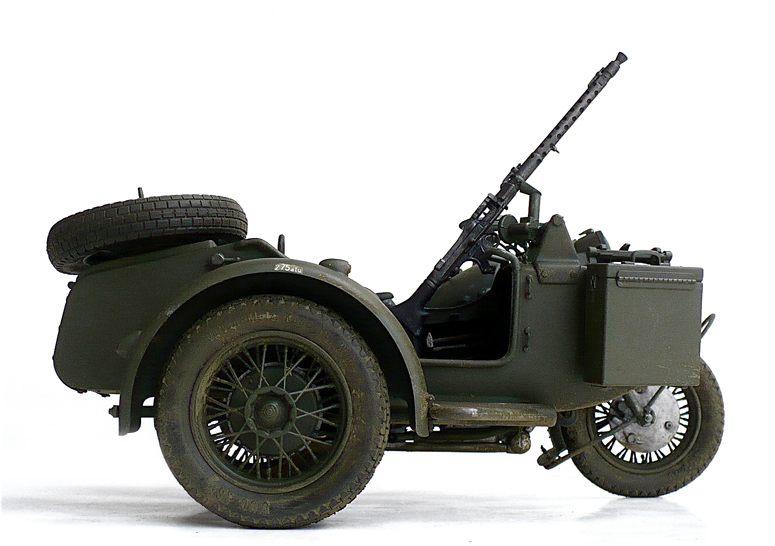
BMW R75 With Sidecar

Here are some images of ESCI's 1/9 scale BMW R75 with sidecar.

From Wikipedia"

 The BMW R75 is a World War II-era motorcycle and sidecar combination produced by the German company BMW.
In the 1930s BMW were producing a number of popular and highly effective motorcycles. In 1938 development of the R75 started in response to a request from the German Army.
Preproduction models of the R75 were powered by a 750 cc side valve engine, which was based on the R71 engine. However it was quickly found necessary to design an all new OHV 750 cc engine for the R75 unit. This OHV engine later proved to be the basis for subsequent post-war twin BMW engines like the R51/3, R67 and R68.
The third side-car wheel was driven with an axle connected to the rear wheel of the motorcycle. These were fitted with a locking differential and selectable road and off-road gear ratios through which all four and reverse gears worked. This made the R75 highly manoeuvrable and capable of negotiating most surfaces. A few other motorcycle manufactures, like FN and Norton, provided an optional drive to sidecars.
The BMW R75 and its rival the Zündapp KS 750 were both widely used by the Wehrmacht in Russia and North Africa, though after a period of evaluation it became clear that the Zündapp was the superior machine. In August 1942 Zündapp and BMW, on the urging of the Army, agreed upon standardization of parts for both machines, with a view of eventually creating a Zündapp-BMW hybrid (designated the BW 43), in which a BMW 286/1 side-car would be grafted onto a Zündapp KS 750 motorcycle. They also agreed that the manufacture of the R75 would cease once production reached 20,200 units, and after that point BMW and Zündapp would only produce the Zündapp-BMW machine, manufacturing 20,000 each year.
Since the target of 20,200 BMW R75's was not reached, it remained in production until the Eisenach factory was so badly damaged by Allied bombing that production ceased in 1944. A further 98 units were assembled by the Soviets in 1946 as reparations.
However the standardisation programme meant that machines that were produced by BMW and Zündapp used 70% of the same components. This simplifies the supply of spare parts for these vehicles, many of which are still in the hands of historic motorcycle enthusiasts. These vehicles are still highly desirable as collector's items because of their complex and durable technology, and are correspondingly expensive. A well-restored R75 can be still used for everyday purposes, on or off-road without problems.
During World War 2 the Soviet Union quietly purchased five units via Swedish intermediaries to study and subsequently build their own version, the M-72, which Stalin approved for production.
In 1954 a small number of modified R75 models were produced at Eisenach (then in Soviet-controlled East Germany) for testing under the designation AWO 700, but were not put into full production.
The success and reliability of the shaft-driven R75 during the war led to the US Army requesting that Harley-Davidson produce a similar shaft-driven cycle for American troops. This led to Harley producing their first ever shaft-driven model, the Harley-Davidson XA, which was a near duplicate of the R75.

Tuesday, June 30, 2015

5cm Pak 38

Here are some images of Dragon's 1/6 scale 5cm Pak 38.
As is typical with Dragon instructions, (and this kit is no exception) the instructions as usual are incomplete.
So I had venture forth unto the interweb and find some images of a completed model to reference in order to complete it. It's a nice kit though.

From Wikipedia"
The 5 cm Pak 38 (L/60) (5 cm Panzerabwehrkanone 38 (L/60)) was a German anti-tank gun of 50 mm calibre. It was developed in 1938 by Rheinmetall-Borsig AG as a successor to the 37 mm Pak 36, and was in turn followed by the 75 mm Pak 40.
 After the Spanish Civil War, the German authorities started to think that a new anti-tank gun would be needed, even though the 3.7 cm Pak 36 had proven to be very successful. They asked Rheinmetall-Borsig to produce a new and more capable AT-gun. They first designed the Pak 37 in 1935, but the German authorities didn't approve it because of its low capabilities. Rheinmetall-Borsig were forced to create a new gun under the designation Pak 38, which fitted a new and longer L/60 barrel and was approved for mass production in 1939.

The Pak 38 was first used by the German forces during the Second World War in April 1941. When the Germans faced Soviet tanks in 1941 during Operation Barbarossa, the Pak 38 was one of the few early guns capable of penetrating the 45 mm (1.8 in) armor of the T-34. The gun was also equipped with Panzergranate 40 APCR shots with a hard tungsten core, in an attempt to penetrate the armor of the heavier KV-1 tank. The Pak 38 was also used in the Atlantic Wall because of its range and anti-tank capabilities, which would have been very useful in destroying allied tanks on the shore.
Although it was replaced by more powerful weapons, it remained a potent and useful weapon and remained in service with the Wehrmacht until the end of the war.
The Pak 38 carriage was also used for the 7.5 cm Pak 97/38 and the 7.5 cm Pak 50(f) guns.
Romania imported in March 1943 a number of 110 Pak 38s. They remained in service until 1954, when the 57 mm anti-tank gun M1943 (ZiS-2) replaced them.

Sunday, June 28, 2015

Sd.Kfz.2 Kleines Kettenkrad


Here are some images of Dragon's 1/6 scale Sd.Kfz.2 Kleines Kettenkrad.
A model this size demands a model engine... it didn't come with one.
Dragon should fire their people who make the instructions as they are terrible, which is typical for Dragon. It's a good thing I had the ESCI 1/9 Kettenkrad for reference.

From Wikipedia"
The SdKfz 2, better known as the Kleines Kettenkraftrad HK 101 or Kettenkrad for short (Ketten = chain/tracks, krad = military abbreviation of the German word Kraftrad, the administrative German term for motorcycle), started its life as a light tractor for airborne troops. The vehicle was designed to be delivered by Junkers Ju 52 aircraft, though not by parachute. The vehicle had the advantage of being the only gun tractor small enough to fit inside the hold of the Ju 52, and was the lightest mass-produced German military vehicle to use the complex Schachtellaufwerk overlapped and interleaved road wheels used on almost all German military half-track vehicles of World War II.
Steering the Kettenkrad was accomplished by turning the handlebars: Up to a certain point, only the front wheel would steer the vehicle. A motion of the handlebars beyond that point would engage the track brakes to help make turns sharper. It was also possible to run the vehicle without the front wheel installed and this was recommended in extreme off-road conditions where speed would be kept low.
The SdKfz 2 was designed and built by the NSU Werke AG at Neckarsulm, Germany. First designed and patented in June 1939, it was first used in the invasion of the Soviet Union in 1941. Later in the war Stoewer from Stettin also produced Kettenkrads under license, accounting for about 10% of the total production.
Most Kettenkrads saw service on the Eastern Front, where they were used to lay communication cables, pull heavy loads and carry soldiers through the deep Russian mud. Later in the war, Kettenkrads were used as runway tugs for aircraft, especially for both the Me 262 jet fighter, and sometimes the Arado Ar 234 jet reconnaissance-bomber. In order to save aviation fuel, A German jet aircraft would be towed to the runway, rather than taxiing under their own power.
The vehicle was also used in the North African theater and on the Western Front.
The Kettenkrad came with a special trailer (Sd.Anh.1) that could be attached to it to improve its cargo capacity.
Being a tracked vehicle, the Kettenkrad could climb up to 24° in sand and even more on hard ground.
Only two significant sub-variations of the Kettenkrad were constructed. Production of the vehicle was stopped in 1944, at which time 8,345 had been built. After the war, production resumed at NSU. Around 550 Kettenkräder were built for agricultural use, with production ending in 1948 (some sources say 1949).

Monday, August 18, 2014

Citroen Traction Avant 11 CV

Here are some more images of Burrago's 1/24 scale Citroen Traction Avant 11 CV. Originally used as a civilian vehicle the 11 CV was used by both French and German military's during WWII. From Wikipedia "
The Citroën Traction Avant was an innovative front wheel drive automobile produced by the French manufacturer Citroën. About 760,000 units were produced from 1934 to 1957.
The Traction Avant, French for "forward traction", was designed by André Lefèbvre and Flaminio Bertoni in late 1933 / early 1934. While not the first production front wheel drive car - Alvis built the 1928 FWD in the UK, Cord produced the L29 from 1929 to 1932 in the United States and DKW the F1 in 1931 in Germany - it was the world's first front wheel drive steel monocoque production car. Along with DKWs 1930s models, the Traction successfully pioneered front wheel drive on the European mass car market.
The Traction Avant's structure was an arc-welded monocoque (unitized body). Most other cars of the era were based on a separate frame (chassis) onto which the non-structural body ("coachwork") was built. Monocoque construction (also called Unit Body or "Unibody" in the US today) results in a lighter vehicle, and is now used for virtually all car construction, although body-on-frame construction remains suitable for larger vehicles such as trucks.
This method of construction was viewed with great suspicion in many quarters, with doubts about its strength. A type of crash test was developed, taking the form of driving the car off a cliff, to illustrate its great inherent resilience.
The novel design made the car seem very low-slung relative to its contemporaries — the Traction Avant always possessed a unique look, which went from appearing rakish in 1934 to familiar and somewhat old fashioned by 1955.
The suspension was very advanced for the car's era. The front wheels were independently sprung, using a torsion bar and wishbone suspension arrangement, where most contemporaries used live axle and cart-type leaf spring designs. The rear suspension was a simple steel beam axle and a Panhard rod, trailing arms and torsion bars attached to a 3-inch (76 mm) steel tube, which in turn was bolted to the "monocoque".
Since it was considerably lighter than "conventional" designs of the era, it was capable of 100 km/h (62 mph), and consumed gasoline / petrol only at the rate of 10 litres per 100 kilometres (28 mpg-imp; 24 mpg-US).