Translate

Showing posts with label Space. Show all posts

Tuesday, July 16, 2019

Gemini

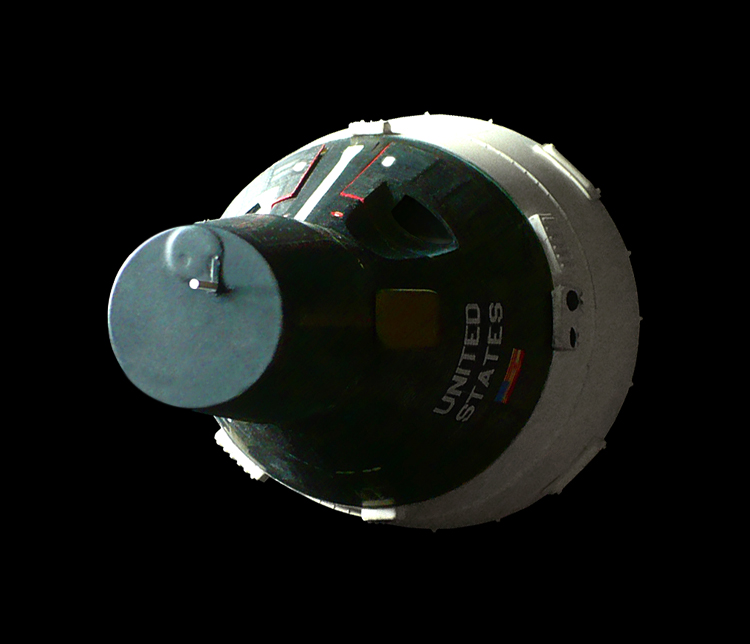
Here are some images of Revell's 1.24 scale McDonnell Gemini spacecraft.

From Wikipedia"

Project Gemini was NASA's second human spaceflight program. Conducted between projects Mercury and Apollo, Gemini started in 1961 and concluded in 1966. The Gemini spacecraft carried a two-astronaut crew. Ten Gemini crews flew low Earth orbit (LEO) missions during 1965 and 1966, putting the United States in the lead during the Cold War Space Race against the Soviet Union.
Gemini's objective was the development of space travel techniques to support the Apollo mission to land astronauts on the Moon. It performed missions long enough for a trip to the Moon and back, perfected working outside the spacecraft with extra-vehicular activity (EVA), and pioneered the orbital maneuvers necessary to achieve space rendezvous and docking. With these new techniques proven by Gemini, Apollo could pursue its prime mission without doing these fundamental exploratory operations.
All Gemini flights were launched from Launch Complex 19 (LC-19) at Cape Kennedy Air Force Station in Florida. Their launch vehicle was the Gemini–Titan II, a modified Intercontinental Ballistic Missile (ICBM). Gemini was the first program to use the newly built Mission Control Center at the Houston Manned Spacecraft Center for flight control.
The astronaut corps that supported Project Gemini included the "Mercury Seven", "The New Nine", and the 1963 astronaut class. During the program, three astronauts died in air crashes during training, including both members of the prime crew for Gemini 9. This mission was flown by the backup crew, the only time a backup crew has completely replaced a prime crew on a mission in NASA's history to date.
Gemini was robust enough that the United States Air Force planned to use it for the Manned Orbital Laboratory (MOL) program, which was later canceled. Gemini's chief designer, Jim Chamberlin, also made detailed plans for cislunar and lunar landing missions in late 1961. He believed Gemini spacecraft could fly in lunar operations before Project Apollo, and cost less. NASA's administration did not approve those plans. In 1969, McDonnell-Douglas proposed a "Big Gemini" that could have been used to shuttle up to 12 astronauts to the planned space stations in the Apollo Applications Project (AAP). The only AAP project funded was Skylab – which used existing spacecraft and hardware – thereby eliminating the need for Big Gemini. 

 The constellation for which the project was named is commonly pronounced /ˈɛmɪn/, the last syllable rhyming with eye. However, staff of the Manned Spacecraft Center, including the astronauts, tended to pronounce the name /ˈɛmɪni/, rhyming with knee. NASA's public affairs office issued a statement in 1965 declaring "Jeh-mih-nee" the "official" pronunciation. Gus Grissom, acting as Houston capsule communicator when Ed White performed his spacewalk on Gemini 4, is heard on flight recordings pronouncing the spacecraft's call sign "Jeh-mih-nee 4", and the NASA pronunciation is used in the film First Man.

Saturday, July 14, 2018

MIR Space Station

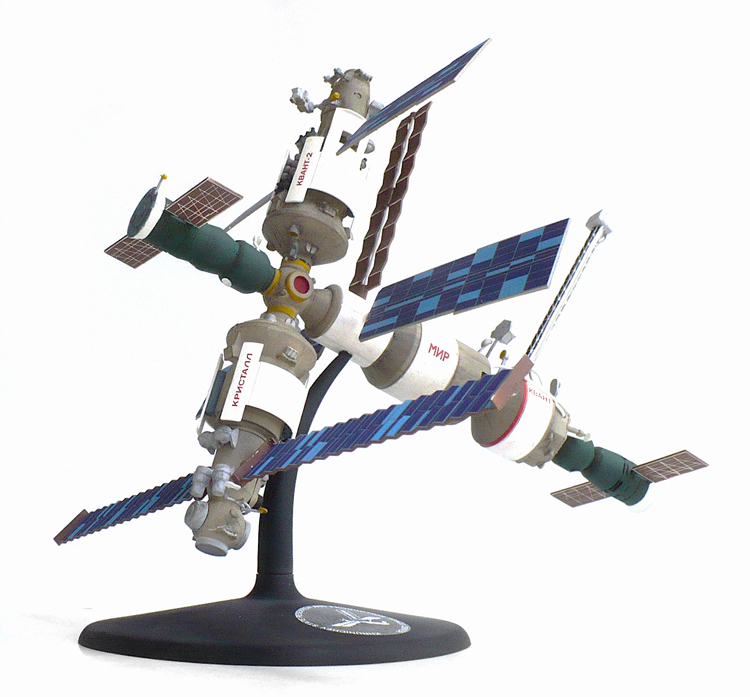
Here are some images of Heller's 1/125 scale MIR Space Station as it appeared in the early 1990's.

From Wikipedia"

Mir (Russian: Мир, IPA: [ˈmʲir]; lit. peace or world) was a space station that operated in low Earth orbit from 1986 to 2001, operated by the Soviet Union and later by Russia. Mir was the first modular space station and was assembled in orbit from 1986 to 1996. It had a greater mass than any previous spacecraft. At the time it was the largest artificial satellite in orbit, succeeded by the International Space Station after Mir's orbit decayed. The station served as a microgravity research laboratory in which crews conducted experiments in biology, human biology, physics, astronomy, meteorology and spacecraft systems with a goal of developing technologies required for permanent occupation of space.
Mir was the first continuously inhabited long-term research station in orbit and held the record for the longest continuous human presence in space at 3,644 days, until it was surpassed by the ISS on 23 October 2010. It holds the record for the longest single human spaceflight, with Valeri Polyakov spending 437 days and 18 hours on the station between 1994 and 1995. Mir was occupied for a total of twelve and a half years out of its fifteen-year lifespan, having the capacity to support a resident crew of three, or larger crews for short visits.
Following the success of the Salyut programme, Mir represented the next stage in the Soviet Union's space station programme. The first module of the station, known as the core module or base block, was launched in 1986 and followed by six further modules. Proton rockets were used to launch all of its components except for the docking module, which was installed by a US Space Shuttle mission STS-74 in 1995. When complete, the station consisted of seven pressurised modules and several unpressurised components. Power was provided by several photovoltaic arrays attached directly to the modules. The station was maintained at an orbit between 296 km (184 mi) and 421 km (262 mi) altitude and travelled at an average speed of 27,700 km/h (17,200 mph), completing 15.7 orbits per day.
The station was launched as part of the Soviet Union's manned spaceflight programme effort to maintain a long-term research outpost in space, and following the collapse of the USSR, was operated by the new Russian Federal Space Agency (RKA). As a result, most of the station's occupants were Soviet; through international collaborations such as the Intercosmos, Euromir and Shuttle–Mir programmes, the station was made accessible to space travelers from several Asian, European and North American nations. Mir was deorbited in March 2001 after funding was cut off. The cost of the Mir programme was estimated by former RKA General Director Yuri Koptev in 2001 as $4.2 billion over its lifetime (including development, assembly and orbital operation).

Friday, December 9, 2016

Apollo / Saturn V Rocket S-IVB

Here are some images of Revell's/kitbash 1/144 scale Apollo / Saturn V  Rocket S-IVB

From Wikipedia"
The Saturn V consisted of three stages—the S-IC first stage, S-II second stage and the S-IVB third stage—and the instrument unit. All three stages used liquid oxygen (LOX) as an oxidizer. The first stage used RP-1 for fuel, while the second and third stages used liquid hydrogen (LH2). The upper stages also used small solid-fueled ullage motors that helped to separate the stages during the launch, and to ensure that the liquid propellants were in a proper position to be drawn into the pumps.


 The S-IVB (sometimes S4b, always pronounced "ess four bee") was built by the Douglas Aircraft Company and served as the third stage on the Saturn V and second stage on the Saturn IB. It had one J-2 engine. For lunar missions it was fired twice: first for the orbit insertion after second stage cutoff, and then for translunar injection (TLI).

The S-IVB evolved from the upper stage of the Saturn I rocket, the S-IV, and was the first stage of the Saturn V to be designed. The S-IV used a cluster of six engines but used the same fuels as the S-IVB — liquid hydrogen and liquid oxygen. It was also originally meant to be the fourth stage of a planned rocket called the C-4, hence the name S-IV.
Eleven companies submitted proposals for being the lead contractor on the stage by the deadline of 29 February 1960. NASA administrator T. Keith Glennan decided on 19 April that Douglas Aircraft Company would be awarded the contract. Convair had come a close second but Glennan did not want to monopolize the liquid hydrogen-fueled rocket market as Convair was already building the Centaur rocket stage.
In the end the Marshall Space Flight Center decided to use the C-5 rocket (later called the Saturn V), which had three stages and would be topped with an uprated S-IV called the S-IVB which instead of using a cluster of engines would have a single J-2 engine. Douglas was awarded the contract for the S-IVB because of the similarities between it and the S-IV. At the same time it was decided to create the C-IB rocket (Saturn IB) that would also use the S-IVB as its second stage and could be used for testing the Apollo spacecraft in Earth orbit.

Douglas built two distinct versions of the S-IVB, the 200 series and the 500 series. The 200 series was used by the Saturn IB and differed from the 500 in the fact that it did not have a flared interstage and had less helium pressurization on board as it would not be restarted. On the 500 series, the interstage needed to flare out to match the larger diameter of the S-IC and S-II stages of the Saturn V. The 200 series also had three solid rockets for separating the S-IVB stage from the S-IB stage during launch. On the 500 series this was reduced to two, and additional linear APS thrusters were added for ullage operations prior to restarting the J-2 engine.
The S-IVB carried 73,280 liters (19,359 U.S. gallons) of LOX, massing 87,200 kg (192,243 lbs). It carried 252,750 liters (66,770 U.S. gallons) of LH2, massing 18,000 kg (39,683 lbs). Empty mass was 10,000 kg (23,000 lb)[1][2]
Attitude control was provided by 2 Auxiliary Propulsion System pods, and by engine gimballing. The APS modules provided 150 pounds of thrust each, and were fuelled by a hypergolic mixture of dinitrogen tetroxide and monomethyl hydrazine. They were used for three-axis control during coast phases, roll control during J-2 firings, and (on the 500 series) ullage for the second ignition of the J-2 engine and deorbit into the moon.
A surplus S-IVB tank, serial number 212, was converted into the hull for Skylab, the United States' first space station. Skylab was launched on a Saturn V on May 14, 1973, and re-entered the atmosphere on July 11, 1979. A second S-IVB, serial number 515, was also converted into a backup Skylab, which never flew.
During Apollo 13, Apollo 14, Apollo 15, Apollo 16 and Apollo 17, the S-IVB stages were crashed into the Moon to perform seismic measurements used for characterizing the lunar interior.

Friday, August 28, 2015

Titan IIIC

Here are some images of MPC's 1/100 scale Titan IIIC rocket booster.

From Wikipedia"
The Titan IIIC was an expendable launch system used by the United States Air Force from 1965 until 1982. It was the first Titan booster to feature large solid rocket motors and was planned to be used as a launcher for the Dyna-Soar and Manned Orbiting Laboratory, though both programs were cancelled before any astronauts flew. The majority of the launcher's payloads were DoD satellites, namely for military communications and early warning, though one flight was performed by NASA. The Titan IIIC was launched exclusively from Cape Canaveral while its sibling, the Titan IIID, was launched only from Vandenberg AFB.

The Titan rocket family was established in October 1955 when the Air Force awarded the Glenn L. Martin Company (later Martin Marietta and now Lockheed Martin) a contract to build an intercontinental ballistic missile (SM-68). It became known as the Titan I, the nation's first two-stage ICBM, and replaced the Atlas ICBM as the second underground, vertically stored, silo-based ICBM. Both stages of the Titan I used kerosene (RP-1) and liquid oxygen (LOX) as propellants. A subsequent version of the Titan family, the Titan II, was similar to the Titan I, but was much more powerful. Designated as LGM-25C, the Titan II was the largest USAF missile at the time and burned Aerozine 50 and nitrogen tetroxide (NTO) rather than RP-1 and LOX.
The Titan III family consisted of an enhanced Titan II core with or without solid rocket strap-on boosters and an assortment of upper stages. All SRM-equipped Titans (IIIC, IIID, IIIE, 34D, and 4) launched with only the SRMs firing at liftoff, the core stage not activating until SRM jettison at two minutes into launch. The Titan IIIA (an early test variant flown in 1964-65) and IIIB (flown from 1966-87 with various upper stages) had no SRMs. The Titan III launchers provided assured capability and flexibility for launch of large-class payloads.
As the IIIC consisted of mostly proven hardware, launch problems were generally only caused by the upper stages and/or payload. The second flight in October 1965 failed when the Transstage disintegrated in orbit and a flight the following August was lost when the shroud broke up at T+78 seconds, triggering an RSO destruct. The only other total failure was in 1978 when the Titan's second stage malfunctioned and had to be destroyed.
The first Titan IIIC flew on June 18, 1965 and was the most powerful launcher used by the Air Force until it was replaced by the Titan 34D in 1982. The last IIIC was launched in March 1982.

The Titan IIIC weighed about 1,380,000 lb (626,000 kg) at liftoff and consisted of a two-stage Titan core and upper stage called the Titan Transtage, both burning hypergolic liquid fuel, and two large UA1205 solid rocket boosters.
The solid boosters were ignited on the ground and were designated "stage 0". Each booster composed of five segments and was 10 ft (3.0 m) in diameter, 85 ft (26 m) long, and weighed nearly 500,000 lb (230,000 kg). They produced a combined 2,380,000 lbf (10,600 kN) thrust at sea level and burned for approximately 115 seconds. Solid booster jettison occurred at approximately 116 seconds.[3]
About two seconds later, the first core stage ignited. Designated the Titan 3A-1, this stage was powered by two Aerojet LR-87-11 engines that burned about 240,000 lb (110,000 kg) of Aerozine 50 and nitrogen tetroxide (NTO) and produced 526,000 lbf (2,340 kN) thrust over 147 seconds. The Aerozine 50 and NTO were stored in structurally independent tanks to minimize the hazard of the two mixing if a leak should have developed in either tank.
The second core stage, the Titan 3A-2, contained about 55,000 lb (25,000 kg) of propellant and was powered by a single Aerojet LR-91-11, which produced 102,000 lbf (450 kN) for 145 seconds.
The upper stage, the Titan Transtage, also burned Aerozine 50 and NTO. Its two Aerojet AJ-10-138 engines were restartable, allowing flexible orbital operations including orbital trimming, geostationary transfer and insertion, and delivery of multiple payloads to different orbits. This required complex guidance and instrumentation. Transtage contained about 22,000 lb (10,000 kg) of propellant and its engines delivered 16,000 lbf (71 kN).

Sunday, June 21, 2015

CZ-2E Chang Zheng (Long March)

Here are some images of Dragon Models 1/48 scale Chang Zheng (Long March) CZ-2E carrier rocket.

 From Wikipedia " 
                                                                                                                                                                                The Long March 2E made its maiden flight on 16 July 1990 and made 7 launches in total. The first failed launch occurred on 21 December 1992, during the launch of the original Optus B2. Windshear caused the payload fairing to implode 45 seconds into flight. Despite this, the rocket continued on to orbit, and deployed what was left of the upper stage and payload into a low Earth orbit The second failure occurred on 25 January 1995, during the launch of Apstar 2. Again, windshear led to the collapse of the payload fairing, however on this occasion, the rocket exploded. Debris fell on a nearby village killing a number of residents.

Saturday, December 27, 2014

Mercury Capsule Aurora 7

Here are some images of Atomic City's 1/12 scale Mercury Capsule Aurora 7 from NASA's Project Mercury.

From Wikipedia"

Project Mercury was the first human spaceflight program of the United States led by its newly created space agency NASA. It ran from 1959 through 1963 with the goal of putting a human in orbit around the Earth, and doing it before the Soviet Union, as part of the early space race. It involved seven astronauts flying a total of six solo trips. On May 5, 1961, Alan Shepard became the first American in space in a suborbital flight after the Soviet Union had put Yuri Gagarin into orbit one month earlier. John Glenn became the first American to reach orbit on February 20, 1962. He was the third person to do so, after Soviet Gherman Titov made a day-long flight in August 1961. When the project ended in May 1963, USA was still behind the Soviet space program, but the gap was seen as closing.
The space race started in 1957 with the launch of the Soviet satellite Sputnik 1. This came as a shock to the American public and led to the creation of NASA to gather the efforts in space exploration already existing in the US. After the launch of the first American satellite in 1958, manned space flight became the next goal. The spacecraft was produced by McDonnell Aircraft; it was cone shaped with room for one person together with supplies of water, food and oxygen for about one day in a pressurized cabin. It was launched from Cape Canaveral in Florida by a modified Atlas D or Redstone missile, and had an escape tower for protection from a failing rocket. The whole flight could be controlled from the ground through the Manned Space Flight Network, a system of tracking stations which also allowed communication with the astronaut. If necessary, the astronaut could take manual control. For reentry into Earth's atmosphere, small rockets were used to bring the spacecraft out of its orbit. A heat shield would protect the spacecraft from the heat of reentry, and a parachute would slow the craft for a water landing. Here both astronaut and spacecraft were picked up by a ship.
From a slow start with humiliating mistakes, the Mercury Project became popular worldwide and the manned flights were followed by millions on radio and TV not only in United States, but around the world. Apart from the manned missions, Mercury had a total of 20 unmanned launches as a part of the development of the project. This also involved test animals, most famously the chimpanzees Ham and Enos. Mercury laid the groundwork for Project Gemini and the follow-on Apollo moon-landing program, which was announced a few weeks after the first manned flight. The astronauts were collectively known as the "Mercury Seven" and they named their spacecraft with a "7" at the end. The project name was taken from Mercury, a Roman god. It is estimated to have cost $1.73 billion (current prices) and have involved the work of 2 million people.

 Project Mercury was officially approved on October 7, 1958 and publicly announced on December 17. Originally it was called Project Astronaut, but President Dwight Eisenhower thought that it gave too much attention to the pilot. Instead, the name Mercury was chosen from Greco-Roman mythology, which already lent names to rockets like the Atlas and Jupiter It absorbed military projects with the same aim such as the Air Force Man-in-Space-Soonest.

Following the end of World War II, a nuclear arms race evolved between the US and the Soviet Union to develop long-range missiles. At the same time both sides also developed satellites for espionage. Most of this took place in secret, therefore it came as a shock to the American public when the Soviet Union placed the first satellite into orbit in October 1957 and there was a growing fear in the US that the country was falling behind. A month later, the Soviets launched a dog into orbit and though the dog was not recovered, it was obvious that they were striving for manned spaceflight Unable to tell the public about the progress of military space projects, President Eisenhower decided to create a civilian space agency known as the National Aeronautics and Space Administration, based on the NACA, a federal aeronautical research agency. NASA was placed in charge of civilian and scientific space exploration and after having orbited an American satellite in 1958 the next goal became to put a man in space.
The limit of space was defined as an altitude of 62 mi (100 km) and the only way to reach it was by rocket. This created risks for the pilot, including explosion, subjection to high g-forces and vibrations during lift off through the atmosphere. In space, the pilot would experience zero gravity, a condition where he might suffer from disorientation. In this altitude he had to be in a pressurized chamber or suit and supplied with fresh air. Further possible risks were radiation from space and micrometeoroids, from which the air would normally protect him. At reentry to the denser part of the atmosphere, air compression would heat the spacecraft to more than 10,000 °F (5,540 °C). All these obstacles, however, seemed possible to overcome. Experiences from satellites suggested that the risk from micrometeoroids was negligible. As to the medical questions, experiments in the early 1950s with simulated weightlessness and high g-forces on humans, together with experiments of sending animals to the limit of space gave the conclusion that problems could be overcome by known technology. Finally, reentry was studied using the nuclear warheads of ballistic missiles. From this, the best solution to the heating problem was found to be a blunt heat shield facing the direction of movement during reentry, since it created a shock wave that let most of the heat flow around the spacecraft or warhead.

T. Keith Glennan had been appointed administrator of NASA with Hugh L. Dryden (last director of NACA) as his deputy from the creation of the agency on October 1, 1958. Glennan would report to the president through the National Aeronautics and Space Council. The group responsible for Project Mercury was NASA's Space Task Group and the goals of the program were to orbit a manned spacecraft around Earth, investigate the pilot's ability to function in space and to recover both pilot and spacecraft safely. Existing technology and off-the-shelf equipment would be used wherever practical, the simplest and most reliable approach to system design would be followed, and an existing launch vehicle would be employed together with a progressive test program. Spacecraft requirements included: a launch escape system to separate the spacecraft and its occupant from the launch vehicle in case of impending failure; attitude control for orientation of the spacecraft in orbit; a retrorocket system to bring the spacecraft out of orbit; drag braking blunt body for atmospheric reentry; and landing on water. To communicate with the spacecraft during an orbital mission, an extensive communications network had to be built. To begin with President Eisenhower hesitated to give the project top national priority (DX rating), which meant that it had to wait in line behind military projects for materials; however, this rating was granted in May 1959.
Twelve companies bid to build the Mercury spacecraft on a $20 million ($162 million) contract. In January 1959, McDonnell Aircraft Corporation was chosen to be prime contractor for the spacecraft.[29] Two weeks earlier, North American Aviation, based in Los Angeles, was awarded a contract for Little Joe, a small rocket to be used for development of the launch escape system. The World Wide Tracking Network for communication between the ground and spacecraft during a flight was awarded to the Western Electric Company. Redstone rockets for suborbital launches were manufactured in Huntsville, Alabama by the Chrysler Corporation and Atlas rockets by Convair in San Diego, California. For manned launches, the Atlantic Missile Range at Cape Canaveral Air Force Station in Florida was made available by the USAF. This was also the site of the Mercury Control Center while the computing center of the communication network was in Goddard Space Center, Maryland. Little Joe rockets were launched from Wallops Island, Virginia. Astronaut training took place at Langley Research Center in Virginia, Lewis Flight Propulsion Laboratory in Cleveland, Ohio, and Naval Air Development Center in Johnsville. Langley wind tunnels together with a rocket sled track at Holloman Air Force Base at Alamogordo, New Mexico were used for aerodynamic studies. Both Navy and Air Force aircraft were made available for the development of the spacecraft's landing system, and Navy ships and Navy and Marine Corps helicopters were made available for recovery. South of Cape Canaveral the town of Cocoa Beach boomed From here, 75,000 people watched the first American orbital flight being launched in 1962.

The principal designer of the Mercury spacecraft was Max Faget who started research for manned spaceflight during the time of the NACA. The spacecraft was 10.8 feet (3.3 m) long and 6.0 feet (1.8 m) wide; with the launch escape system added, the overall length was 25.9 feet (7.9 m). With 100 cubic feet (2.8 m3) of habitable volume, the spacecraft was just large enough for the single crew member. Inside were 120 controls: 55 electrical switches, 30 fuses and 35 mechanical levers. The heaviest spacecraft, Mercury-Atlas 9, weighed fully loaded 3,000 pounds (1,400 kg). Its outer skin was made of René 41, a nickel alloy able to withstand high temperatures.
The spacecraft was cone shaped with a neck at the narrow end. It had a convex base, which the heat shield was mounted on (2). It was composed of an aluminum honeycomb structure covered with multiple layers of fiberglass. Strapped to it was the retropack (1)which consisted of three rockets meant to brake the spacecraft for reentry. Between these were three minor rockets for separating the spacecraft from the launch vehicle at orbital insertion. The straps that held the package could be severed when it was no longer needed. Next to the heat shield was the pressurized crew compartment (3). This contained the astronaut strapped to his couch with the instruments in front of him and his back to the heat shield. Underneath the seat was the environmental control system, which supplied him with oxygen and heat. The system also cleaned the air of CO2, vapor and odors, as well as (on orbital flights) collect urine. The recovery compartment (4) at the narrow end of the spacecraft contained three parachutes: one drogue to stabilize free fall and two main parachutes of which only one was used, with the other as a reserve. Between the heat shield and the inner wall of the crew compartment was a landing skirt, which was deployed by letting down the heat shield before landing. On top of the recovery compartment was the antenna section (5) containing antennas for communication with the Earth and scanners for guiding the orientation of the spacecraft. Attached to it was a flap used to ensure that the spacecraft was faced in the correct direction (heat shield first) during reentry. A launch escape system (6) was mounted to the narrow end of the spacecraft. In case of failure during the first minutes of launch, three small solid-fueled rockets would fire for a second to bring the spacecraft free of the launch vehicle so it could deploy its parachute and land at sea.

Mercury-Atlas 7, launched May 24, 1962, was the fourth flight of Project Mercury, the first manned space program of the United States. The Mercury spacecraft, named Aurora 7, made three Earth orbits, piloted by astronaut Scott Carpenter. He was the sixth human and the fourth American in space.
A targeting error during reentry took the spacecraft 250 miles (about 400 km) off-course, delaying recovery of Carpenter and the spacecraft. The mission used Mercury spacecraft No. 18 and Atlas launch vehicle No. 107-D.
 The original prime crew for Mercury Atlas-7 was to have been Deke Slayton, with Schirra as his back-up. However Slayton was removed from all flight crew availability after the discovery of cardiac arrhythmia during a training run in the g-loading centrifuge. If Slayton had flown MA-7, his spacecraft would have been named Delta 7, as this would have been the fourth manned flight and Delta (Δ) is the fourth letter in the Greek alphabet.

Mercury spacecraft No. 18 was delivered to Cape Canaveral, Florida on November 15, 1961. Atlas No. 107-D was rolled out of the Convair factory in San Diego, California on February 25, 1962. It was delivered to Cape Canaveral on March 6, 1962.

MA-7 launch
The focus of Carpenter's five-hour mission was on science. The full flight plan included the first study of liquids in weightlessness, Earth photography, and an unsuccessful attempt to observe a flare fired from the ground. At dawn of the third and final orbit, Carpenter inadvertently bumped his hand against the inside wall of the cabin and solved a mystery from the previous flight. The resulting bright shower of particles outside the spacecraft - what John Glenn had called "fireflies" - turned out to be ice particles shaken loose from the spacecraft's exterior.
Like Glenn, Carpenter circled the Earth three times. Total time weightless 4 h 39 min 32 s. The performance of the Mercury spacecraft and Atlas launch vehicle was excellent in nearly every respect. All primary mission objectives were achieved. The single mission-critical malfunction which occurred involved a failure in the spacecraft pitch horizon scanner, a component of the automatic control system. This anomaly was adequately compensated for by the pilot in subsequent in-flight operations so that the success of the mission was not compromised. A modification of the spacecraft control-system thrust units was effective. Cabin and pressure-suit temperatures were high but not intolerable. Some uncertainties in the data telemetered from the bioinstrumentation prevailed at times during the flight; however, associated information was available which indicated continued well-being of the astronaut.
Equipment was included in the spacecraft which provided valuable scientific information; notably that regarding liquid behavior in a weightless state, identification of the airglow layer observed by Astronaut Glenn, and photography of terrestrial features and meteorological phenomena. An experiment which was to provide atmospheric drag and color visibility data in space through deployment of an inflatable sphere was partially successful. The flight further qualified the Mercury spacecraft systems for manned orbital operations and provided evidence for progressing into missions of extended duration and consequently more demanding systems requirements.
Partly because he had been distracted watching the fireflies and partly because of his busy schedule, and a malfunction of the automatic alignment system, Carpenter overshot his planned reentry mark and splashed down 250 miles (402 kilometers) from target.
Aurora 7 is displayed at the Museum of Science and Industry in Chicago, Illinois.

Thursday, February 20, 2014

Rockwell Space Transportation System Vehicle (Space Shuttle)

Here are some more images of  Tamiya's 1/100 scale Rockwell Space Transportation System Vehicle (Space Shuttle).

From Wikipedia'
The Space Shuttle was a crewed, partially reusable low Earth orbital spacecraft operated by the U.S. National Aeronautics and Space Administration (NASA). Its official program name was Space Transportation System, taken from a 1969 plan for a system of reusable spacecraft of which it was the only item funded for development. The first of four orbital test flights occurred in 1981, leading to operational flights beginning in 1982. They were used on a total of 135 missions from 1981 to 2011, launched from the Kennedy Space Center (KSC) in Florida. Operational missions launched numerous satellites, interplanetary probes, and the Hubble Space Telescope (HST); conducted science experiments in orbit; and participated in construction and servicing of the International Space Station.
Shuttle components included the Orbiter Vehicle (OV), a pair of recoverable solid rocket boosters (SRBs), and the expendable external tank (ET) containing liquid hydrogen and liquid oxygen. The Shuttle was launched vertically like a conventional rocket, with the two SRBs operating in parallel with the OV's three main engines, which were fueled from the ET. The SRBs were jettisoned before the vehicle reached orbit, and the ET was jettisoned just before orbit insertion using the orbiter's two Orbital Maneuvering System (OMS) engines. At the conclusion of the mission, the orbiter fired its OMS to drop out of orbit and re-enter the atmosphere. The orbiter glided to a runway landing on Rogers Dry Lake at Edwards Air Force Base in California or at the Shuttle Landing Facility at the KSC. After the landings at Edwards, the orbiter was flown back to KSC on the Shuttle Carrier Aircraft, a specially modified Boeing 747.
The first orbiter, Enterprise, was built purely for Approach and Landing Tests and had no capability to fly into orbit. Four fully operational orbiters were initially built: Columbia, Challenger, Discovery, and Atlantis. Of these, Challenger and Columbia were destroyed in mission accidents in 1986 and 2003, respectively, in which a total of fourteen astronauts were killed. A fifth operational orbiter, Endeavour, was built in 1991 to replace Challenger. The Space Shuttle was retired from service upon the conclusion of Atlantis' final flight on July 21, 2011.
Until another US manned spacecraft is ready, crews will travel to and from the International Space Station (ISS) exclusively aboard the Russian Soyuz spacecraft.
A planned successor to STS was the "Shuttle II", during the 1980s and 1990s, and later the Constellation program during the 2004–2010 period. CSTS was a proposal to continue to operate STS commercially, after NASA. In September 2011, NASA announced the selection of the design for the new Space Launch System that is planned to launch the Orion spacecraft and other hardware to missions beyond low earth-orbit.
The Commercial Orbital Transportation Services program began in 2006 with the purpose of creating commercially operated unmanned cargo vehicles to service the ISS. The SpaceX Dragon became operational in 2012, and the Orbital Sciences' Cygnus, is expected to be launched in September 2013. The Commercial Crew Development (CCDev) program was initiated in 2010 with the purpose of creating commercially operated manned spacecraft capable of delivering at least four crew members to the ISS, to stay docked for 180 days, and then return them back to Earth. These spacecraft are expected to become operational in the mid-2010s.


Space Shuttles have been features of fiction and nonfiction, from movies for kids to documentaries. Early examples include the 1979 James Bond film, Moonraker, the 1982 Activision videogame Space Shuttle: A Journey into Space (1982) and G. Harry Stine's 1981 novel Shuttle Down. In the 1986 film SpaceCamp, Atlantis accidentally launched into space with a group of U.S. Space Camp participants as its crew. The 1998 film Armageddon portrayed a combined crew of offshore oil rig workers and US military staff who pilot two modified Shuttles to avert the destruction of Earth by an asteroid. Retired American test pilots visited a Russian satellite in the 2000 Clint Eastwood adventure film Space Cowboys. In the 2003 film The Core, the Endeavour's landing is disrupted by the earth's magnetic core, and its crew is selected to pilot the vehicle designed to restart the core. The 2004 Bollywood movie Swades, where a Space Shuttle was used to launch a special rainfall monitoring satellite, was filmed at Kennedy Space Center in the year following the Columbia disaster that had taken the life of Indian-American astronaut KC Chawla. On television, the 1996 drama The Cape portrayed the lives of a group of NASA astronauts as they prepared for and flew Shuttle missions. Odyssey 5 was a short lived sci-fi series that featured the crew of a Space Shuttle as the last survivors of a disaster that destroyed Earth. The 2013 film Gravity features the fictional space shuttle Explorer, whose crew are killed or left stranded after it is destroyed by a shower of high speed orbital debris.
A United States Space Shuttle stamp
The Space Shuttle has also been the subject of toys and models; for example, a large Lego Space Shuttle model was constructed by visitors at Kennedy Space Center, and smaller models have been sold commercially as a standard "LegoLand" set. A 1984 pinball machine "Space Shuttle" was produced by Williams and features a plastic Space Shuttle model among other artwork of astronauts on the play field.

US postage commemorations

The U.S. Postal Service has released several postage issues that depict the Space Shuttle. The first such stamps were issued in 1981, and are on display at the National Postal Museum.