Translate

Wednesday, March 9, 2011

Space Shuttle Discovery


In honour of the final flight of the Space Shuttle Discovery I have decided to repost some photos of Tamiya's 1/100 scale Space Shuttle.
This saddens and angers me to no end as there is nothing to replace it (except that robot plane) and now American Astronauts are going to be catching rides to the ISS aboard Russian Soyuz craft. Americans were going back to the moon but as far as I can tell not any more.
From Wikipedia"

Space Shuttle Discovery (Orbiter Vehicle Designation: OV-103) is one of the orbiters in the Space Shuttle fleet of NASA, the space agency of the United States., operating from 1984 until 2011. When first flown in 1984, Discovery became the third operational orbiter, and it made its final landing on 9 March 2011 at 10:57:17 CST, with a cumulative total of one full year (365 days) in space. Discovery has performed both research and International Space Station (ISS) assembly missions.

Two orbiters, Atlantis and Endeavour, remain operational.

The spacecraft takes its name from four British ships of exploration named Discovery, primarily HMS Discovery, one of the ships commanded by Captain James Cook during his third and final major voyage, 1776–1779.

Others include

Discovery was the shuttle that launched the Hubble Space Telescope. The second and third Hubble service missions were also conducted by Discovery. It has also launched the Ulysses probe and three TDRS satellites. Discovery has been chosen twice as the return to flight orbiter, first in 1988 as the return to flight orbiter after the 1986 Challenger disaster, and then for the twin return to flight missions in July 2005 and July 2006 after the 2003 Columbia disaster. Discovery also carried Project Mercury astronaut John Glenn, who was 77 at the time, back into space during STS-95 on October 29, 1998, making him the oldest human being to venture into space.

Had the planned STS-62-A mission from Vandenberg Air Force Base in 1986 for the United States Department of Defense gone ahead, Discovery would have flown it.


Update: Here is a fantastic video from indiegun commemorating the final shuttle mission of Discovery


Tuesday, March 8, 2011

Sea Harrier


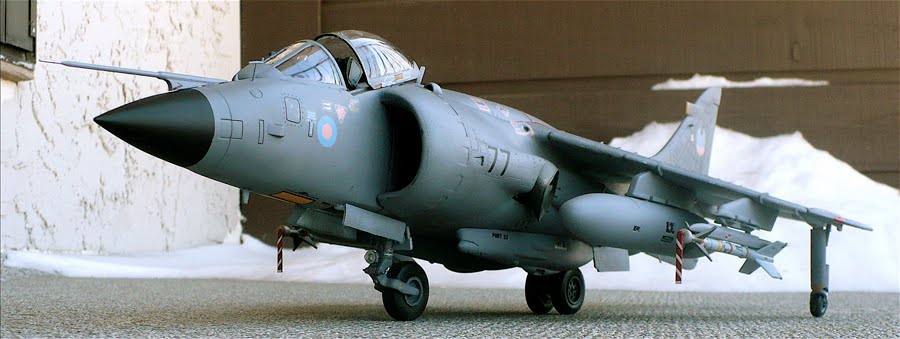
Here are some images of Airfix/Heritage Aviation's 1/24 scale BEA (British Aerospace) FRS1 Sea Harrier.
From Wikipedia"

The British Aerospace Sea Harrier is a naval VTOL/STOVL jet fighter, reconnaissance and attack aircraft, a development of the Hawker Siddeley Harrier. It first entered service with the Royal Navy in April 1980 as the Sea Harrier FRS1 and became informally known as the "Shar". Unusual in an era when most naval and land-based air superiority fighters are larger and supersonic, the subsonic Sea Harrier is tasked primarily for air defence when operating from Royal Navy aircraft carriers.

The Sea Harrier served in the Falklands War, both of the Gulf Wars, and the Balkans conflicts; on all occasions it mainly operated from aircraft carriers positioned within the conflict zone. Its usage in the Falklands War was its most high profile and important success, where it was the only fixed-wing fighter available to protect the British Task Force. The Sea Harriers shot down 20 enemy aircraft during the conflict with one loss to enemy ground fire. They were also used to launch ground attacks in the same manner as the Harriers operated by the Royal Air Force.

The Sea Harrier was marketed for sales abroad, but by 1983 India was the only operator other than Britain after sales to Argentina and Australia were unsuccessful. A second, updated version for the Royal Navy was made in 1993 as the Sea Harrier FA2, improving its air to air abilities and weapons compatibilities, along with a more powerful engine; this version continued manufacture until 1998. The aircraft was withdrawn early from Royal Navy service in March 2006 and replaced in the short term by the Harrier GR9, although the intended long term replacement is Lockheed Martin's F-35 Lightning II. The Sea Harrier is in active use in the Indian Navy, although it will eventually be replaced by the Mikoyan MiG-29K.

The Sea Harrier is a subsonic aircraft designed to fill strike, reconnaissance and fighter roles. It features a single Pegasus turbofan engine with two intakes and four vectorable nozzles. It has two landing gear on the fuselage and two outrigger landing gear on the wings. The Sea Harrier is equipped with four wing and three fuselage pylons for carrying weapons and external fuel tanks. Use of the ski jump allowed the aircraft to take off with a heavier loadout than otherwise possible.

The Sea Harrier was largely based on the Harrier GR3, but was modified to have a raised cockpit with a "bubble" canopy for greater visibility, and an extended forward fuselage to accommodate the Ferranti Blue Fox radar. Parts were changed to use corrosion resistant alloys or coatings were added to protect against the marine environment. After the Falklands War, the Sea Harrier was fitted with the new anti-ship Sea Eagle missile.

The Sea Harrier FA2 featured the Blue Vixen radar, which was described as one of the most advanced pulse doppler radar systems in the world; the Blue Fox radar was seen be some critics as having comparatively low performance for what was available at the time of procurement. The Blue Vixen formed the basis for development of the Eurofighter Typhoon's CAPTOR radar. The Sea Harrier FA2 also carried the AIM-120 AMRAAM missile, the first UK aircraft to be provided with this capability. An upgraded model of the Pegasus engine, the Pegasus Mk 106, was used in the Sea Harrier FA2; in response to the threat of radar-based anti aircraft weapons electronic countermeasures were added. Other improvements included an increase to the air-to-air weapons load, look-down radar, increased range, and improved cockpit displays.

The cockpit in the Sea Harrier includes a conventional centre stick arrangement and left-hand throttle. In addition to normal flight controls, the Harrier has a lever for controlling the direction of the four vectorable nozzles. The nozzles point rearward with the lever in the forward position for horizontal flight. With the lever back, the nozzles point downward for vertical takeoff or landing. The usefulness of the vertical landing capability of the Sea Harrier was demonstrated in an unintented incident on 6 June 1983, when Sub Lieutenant Ian Watson lost contact with the aircraft carrier HMS Illustrious and had to land on the foredeck of the Spanish cargo ship Alraigo.

In 2005, although already timetabled to be retired, a Sea Harrier was modified with an 'Autoland' system to allow the fighter to perform a safe vertical landing without any pilot interaction. Despite the pitching of a ship posing a natural problem, the system was designed to be aware of such data, and successfully performed a landing at sea in May 2005.

Monday, March 7, 2011

Harrier Repost


Here are some images of Airfix/Flight Path/Horizon 1/24 scale Hawker Siddeley/BEA Harrier GR3. From Wikipedia "

The Hawker Siddeley Harrier GR.1/GR.3 and the AV-8A Harrier are the first generation of the Harrier series, the first operational close-support and reconnaissance fighter aircraft with Vertical/Short Takeoff and Landing (V/STOL) capabilities, colloquially referred to as a "jump jet". The Harrier was the only truly successful V/STOL design of the many that arose from the 1960s.

In the 1970s, the Harrier was developed into the radar-equipped BAE Sea Harrier for the Royal Navy. The Harrier was also extensively redesigned as the BAE Harrier II and AV-8B Harrier II, which were built by British Aerospace and McDonnell Douglas.

The Harrier's lineage began with the Hawker P.1127. Design began in 1957 by Sir Sydney Camm, Ralph Hooper of Hawker Aviation and Stanley Hooker (later Sir Stanley) of the Bristol Engine Company. Rather than using rotors or a direct jet thrust the P.1127 had an innovative vectored thrust turbofan engine and the first vertical takeoff was on 21 October 1960. Six prototypes were built in total, one of which was lost at an air display.

The immediate development of the P.1127 was the Kestrel FGA.1, which appeared after Hawker Siddeley Aviation was created. The Kestrel's first flight was on 7 March 1964. It was strictly an evaluation aircraft, and only nine were built. These equipped the Tripartite Evaluation Squadron formed at RAF West Raynham in Norfolk, numbering 10 pilots from the RAF, USA and West Germany. One aircraft was lost and six of the remainder were transferred to the U.S. for evaluation by the Army, Air Force and Navy, designated XV-6A Kestrel.

At the time of the development of the P.1127, Hawker had started on a design for a supersonic version, the Hawker Siddeley P.1154. After this was cancelled in 1965, the RAF began looking at a simple upgrade of the Kestrel as the P.1127 (RAF).

An order for 60 production aircraft was received from the Royal Air Force in mid-1966, and the first pre-production Harriers, then known as the P.1127 (RAF), were flying by mid-1967, becoming known as Harrier GR.1.

The Hawker Siddeley Harrier GR.1 was the first production model derived from the Kestrel, it first flew on 28 December 1967, and entered service with the RAF on 1 April 1969. Construction took place at factories in Kingston upon Thames in southwest London and at Dunsfold, Surrey. The latter adjoined an airfield used for flight testing; both factories have since closed.

The ski-jump technique for STOVL used by Harriers launched from Royal Navy aircraft carriers was tested at the Royal Navy's airfield at RNAS Yeovilton (HMS Heron), Somerset. Their flight decks were designed with an upward curve to the bow following the successful conclusion of those tests.

The Harrier GR.3 featured improved sensors (such as a laser tracker in the lengthened nose), countermeasures and a further upgraded Pegasus Mk 103 and was to be the ultimate development of the 1st generation Harrier.

The AV-8As of the United States Marine Corps were very similar to the early GR.1 version, but with the more-powerful engine of the GR.3. The aircraft was powered by a 21,500 lbf (95.6 kN) thrust Roll-Royce Pegasus Mk 103 (F402-RR-402) turbofan engine. The AV-8A was armed with two 30 mm ADEN cannons (podded under the fuselage) and two AIM-9 Sidewinder air-to-air missiles. A total of 113 were ordered for the US Marines and the Spanish Navy.

Sunday, March 6, 2011

Henschel Hs 129


Hers are some images of AMT's 1/48 scale Henschel Hs 129.
From Wikipedia "
The Henschel Hs 129 was a World War II ground-attack aircraft fielded by the German Luftwaffe. Its nickname, the Panzerknacker (tank cracker), is a deliberate pun—in German, it also means "safe cracker". In combat service the Hs 129 lacked a sufficient chance to prove itself; the aircraft was produced in relatively small numbers and deployed during a time when the Luftwaffe was unable to protect them from attack.

The Hs 129 was designed around a single large "bathtub" of steel sheeting that made up the entire nose area of the plane, completely enclosing the pilot up to head level. Even the canopy was steel, with only tiny windows on the side to see out of and two angled blocks of glass for the windscreen. In order to improve the armor's ability to stop bullets, the fuselage sides were angled in forming a triangular shape, resulting in almost no room to move at shoulder level. There was so little room in the cockpit that the instrument panel ended up under the nose below the windscreen where it was almost invisible; some of the engine instruments were moved outside onto the engine nacelles, as on some models of Messerschmitt's Bf 110 heavy fighter, and the gunsight was mounted outside on the nose.

Henschel's plane came in 12% overweight with the engines 8% underpowered, and it understandably flew poorly. The controls proved to be almost inoperable as speed increased, and in testing, one plane flew into the ground from a short dive because the stick forces were too high for the pilot to pull out. The Fw design proved to be no better. Both planes were underpowered with their Argus As 410 engines, and very difficult to fly.

The RLM nevertheless felt they should continue with the basic concept. The only real deciding factor between the two designs was that the Henschel was smaller and cheaper. The Focke-Wulf was put on low priority as a backup, and testing continued with the Hs 129 A-0. A series of improvements resulted in the Hs 129 A-1 series, armed with two 20 mm MG 151/20 cannons and two 7.92 mm (.312 in) MG 17 machine guns, along with the ability to carry four 50 kg (110 lb) bombs under the fuselage midline.

mark twain Repost


Here are some images plus a composite of Artesania Latinas 1/80 scale riverboat paddle steamer King of the Mississippi. Holy shades of Samuel Clemens Batman! Actually the term "mark twain" was a term used by riverboat captains meaning two fathoms. However though Samuel Clemens was a riverboat captain he may also have gotten his pen name "Mark Twain" during his time in Nevada where saloon keepers used the term "mark twain" to represent two drinks of credit. Anyway back to the model. This model is not as difficult to build as may first appear as it is basically straight panels, not very many curves as with sail ships. This model makes a good intermediate project. The woods used for this model were Sapelly, Ramin, African Walnut, Boxwood, Beechwood and of coarse the ever popular Plywood.

Friday, March 4, 2011

Reliant


Here are some images of AMT/Round 2 model's 1/537 scale U.S.S. Reliant from Star Trek the Wrath of Khan.
From Memory Beta"

The USS Reliant (NCC-1864) was a Federation Miranda-class medium cruiser in service to Starfleet in the 23rd century. (ST roleplay module: Starfleet Operations Manual)

The Reliant was originally built as a Anton-subclass research cruiser. On reference stardate 2/1410, the Reliant was ordered to the Morena shipyards for a refit to Mk IV Anton specifications. While the ship was being dismantled for the engine refit, Starfleet Command decided to mount a different engine configuration unto the Reliant than was included on other Mk IV's. Due to this change, several external design changes had to be made, and Starfleet decided to make the Reliant the prototype of a new subclass: the Reliant-subclass. Following the extensive refit, the Reliant reentered service on stardate 2/1509. (TOS reference: Federation Ship Recognition Manual)

By the late 2270s, the Reliant was under the command of Captain Clark Terrell. In 2281, the Reliant proceeded to the planet Halka after learning that they had been attacked by the Orions. Lt. Commander Pavel Chekov led a landing party to the surface and learned that a local boy named Lojur took up arms against the Orions, and was subsequently banned from his village by the Elders. Chekov took pity on the boy and beamed him aboard the Reliant. (TLE novel: The Sundered)

In 2284, the Reliant was detached from active service and assigned to assist Dr. Carol Marcus and her Project Genesis team find a suitable uninhabited planet for testing. In 2285, Terrell and Chekov beamed down to a planet they believed to be Ceti Alpha VI. When they discovered Khan Noonien Singh and his followers, they discovered that they were, in fact, on Ceti Alpha V, and that Ceti Alpha VI had been destroyed.

Using Terrell and Chekov, Khan took control of the Reliant and marooned the crew on Ceti Alpha V. After engaging the USS Enterprise and inflicting heavy damage, Khan took the Reliant to the Regula 1 Space Laboratory where he captured the Genesis Device. A cat-and-mouse game with the Enterprise in the Mutara Nebula led to the Reliant being crippled. At a distance of +4,000 kilometers, Enterprise warped out-as Reliant was ultimately destroyed by Khan's detonation of the Genesis Device inside the nebula. (TOS movie: Star Trek II: The Wrath of Khan)

Following Khan's defeat, the Enterprise traveled to Ceti Alpha V and recovered the surviving members of the Reliant's crew. From there they were safely transported to Starbase 12. (TOS comic: "The Wormhole Connection")

The Aztec decals for this model were downloaded from Starship Modeler's web page.

Here is the trailer from Star Trek The Wrath of Khan.


Thursday, March 3, 2011

Porsche 356 Coup


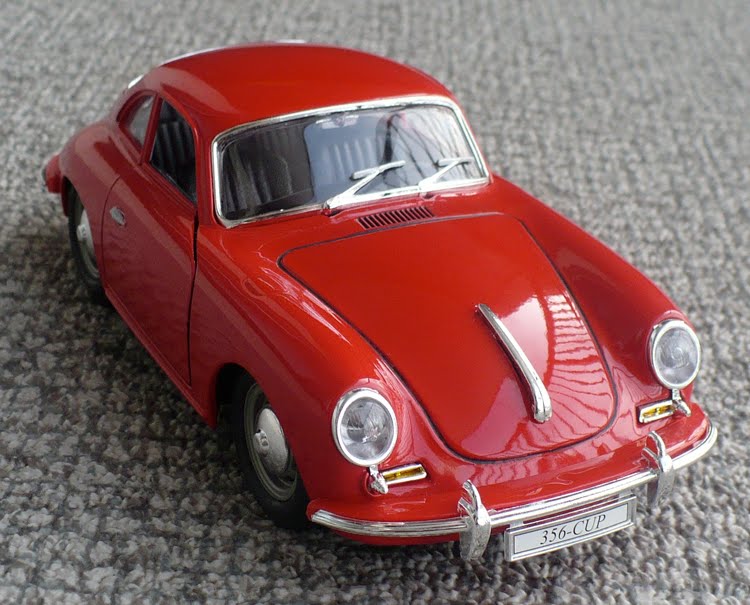
Here are some images of Bburaggo's 1/24 scale Porsche 356 coup (1961).
From Wikipedia"

Prior to World War II Porsche designed and built three Type 64 cars for a 1939 Berlin to Rome race that was cancelled. In 1948 the mid-engine, tubular chassis 356 prototype called "No. 1" was completed. This led to some debate as to the "first" Porsche automobile, but the 356 is considered by Porsche to be its first production model.

The 356 was created by Ferdinand "Ferry" Porsche (son of Dr. Ing. Ferdinand Porsche, founder of the company). Like its cousin, the Volkswagen Beetle (which Ferdinand Porsche Senior had designed), the 356 was a four-cylinder, air-cooled, rear-engine, rear-wheel-drive car utilizing unitized pan and body construction. While the 356's body was an original design by Porsche employee Erwin Komenda, its mechanicals (including engine, suspension and chassis) were derived from the Volkswagen. The first 356 was road certified in Austria on June 8, 1948, and used many Volkswagen parts for manufacturing economy. Quickly though, Porsche re-engineered and refined the car with a focus on performance. By the late '50s much fewer parts were shared between Volkswagen and Porsche. The early 356 automobile bodies produced at Gmünd, Austria were handcrafted in aluminum, but when production moved to Zuffenhausen, Germany in 1950, models produced there were steel-bodied.

Little noticed at its inception, the first 356s sold primarily in Austria and Germany. It took Porsche two years, starting with the first prototype in 1948, to manufacture the first 50 automobiles. By the early 1950s the 356 had gained some renown among enthusiasts on both sides of the Atlantic for its aerodynamics, handling, and excellent build quality. It was common for owners to race the car as well as drive it on the street. Increasing success with its racing and road cars brought Porsche orders for over 10,000 units in 1964, and by the time 356 production ended in 1965 approximately 76,000 had been produced.

The 356 has always been popular with the motor press. In 2004, Sports Car International ranked the 356C tenth on their list of Top Sports Cars of the 1960s. Today, the Porsche 356 is a highly regarded collector car. The Porsche 356 Carrera (with its special four-cam racing engine), Super 90 and Speedster models are today among the most desirable 356 models. Few 356 Carreras were produced and these often bring well over $250,000 at auction. A fully restored 356 Carrera Speedster (of which only about 140 were ever made) will sell for around $300,000 at auction.

The original selling price of a late 1950s Porsche was around US$4,000, which was also the price of a new Cadillac; today they regularly bring between US$20,000 to well over US$100,000 at auction.

Thousands of owners worldwide maintain the 356 tradition, preserving their cars and driving them regularly. The US-based 356 Registry is the largest American club.[citation needed]

According to Autozeitung magazine, a new generation of Porsche 356 will be produced in 2013.

Wednesday, March 2, 2011

Porsche 356 B Cabriolet


Here are some images of Bburaggo's 1/24 scale Porsche 356 B Cabriolet (1961).
From Wikipedia"
The Porsche 356 was the company's first production automobile. It was a lightweight and nimble handling rear-engine rear-wheel-drive 2 door sports car available in hardtop and convertible configurations. Design innovations continued during the years of manufacture, contributing to its motorsports success and popularity. Production started in 1948 at Gmünd, Austria where approximately 50 cars were built. In 1950 the factory relocated to Zuffenhausen, Germany and general production of the 356 continued until April 1965, well after the replacement model 911 made its autumn 1963 debut. It is estimated approximately half of the total production of 76,000 356s still survive.

The Porsche 356, close to stock or highly modified, has enjoyed much success in rallying, the 24 hours of Le Mans, the 1000 km Buenos Aires, the Mille Miglia, the Targa Florio, the Carrera Panamericana, as well as many other important car racing events.

Several Porsche 356s were stripped down in weight, and were modified in order to have better performance and handling for these races. A few notable examples include the Porsche 356 SL, and the Porsche 356A Carrera GT.

In the early 1960s Porsche collaborated with Abarth and built the Porsche 356B Carrera GTL Abarth coupé, which enjoyed some success in motor sports.

Tuesday, March 1, 2011

Luftwaffe 46


This is Dave Porter's 1/72nd Arado Amerika Bomber by Revell Germany. It was designed to fly from southern Europe and attack the U.S. Atlantic coast. The intent was to make a return trip, but an alternative was to set up a few protectorates in South America to engage in a long term campaign. Needless to say it was a very long shot. I finished the plane with Gunze paints and I used artist oils to weather it.

The model is a beauty. The fit is extremely good and it is very detailed. The cockpit and bomb bay are complete. It has as extensive decal sheet but no Swastikas.

The jet is the FW-283 Ramjet interceptor. The kit is in1/72 scale by HUMA. It was designed to climb like hell and it had much better endurance, speed and, range than an ME-163.