Translate

Monday, July 23, 2012

The Christie American Steam Fire Engine

Here are some images of MPC/AMT 1/12 scale Christie American steam fire engine.

From The instructions"
The Christie steam pumper was the backbone of America's fire fighting organizations prior to World War One. It was unique in that it was gas engine driven and it also employed front wheel drive. The unit served in most of the cities across the United States during the early 1900's.
The Christie was actually a modernization of the old turn of the century horse drawn steam pumpers. Walter Christie, a famed race car designer, and "Father of Front Wheel Drive Technology" designed a gas driven tractor to pull the old steam pumpers and thereby extend their useful lives. His tractor design worked so well that colorful old steam pumpers were used until well into the gasoline era.

Tuesday, July 17, 2012

Supermarine Spitfire F/Mk-24

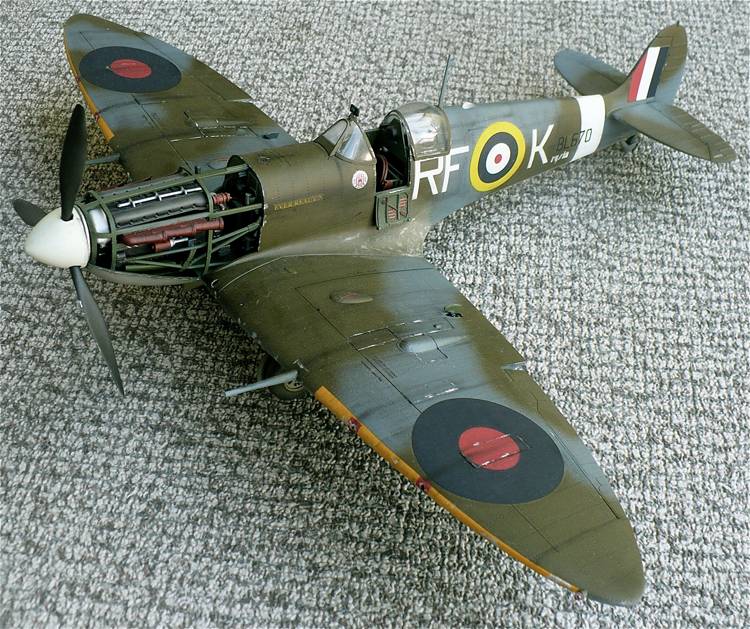
Here are some images of Revell's (Matchbox molds) 1/32 scale Supermarine F/Mk-24 Spitfire.

From Wikipedia"
The final Spitfire variant, the Mk 24, was similar to the Mk 22 except that it had an increased fuel capacity over its predecessors, with two fuel tanks of 33 gal (150 l) each installed in the rear fuselage. There were also zero-point fittings for rocket projectiles under the wings. All had the larger "Spiteful" tail units: modifications were also made to the trim tab gearings in order to perfect the F Mk 24's handling characteristics. Late production aircraft were built with the lighter, short-barrelled, electrically fired Mark V Hispano cannon.
Performance was impressive – the F Mk 24 achieved a maximum speed of 454 mph (731 km/h), and could reach an altitude of 30,000 ft (9,100 m) in eight minutes, putting it on a par with the most advanced piston-engined fighters of the era.
Although designed primarily as a fighter-interceptor aircraft, the Spitfire proved its versatility in several different roles. In fighter configuration the F Mk 24's armament consisted of 4 × short-barrelled 20 mm Hispano cannon – operational experience had proved that the hitting power of these larger weapons was necessary to overcome the thicker armoured plating encountered on enemy aircraft as the war progressed. The aircraft also served successfully in the fighter-bomber role, being capable of carrying 1 × 500 lb (230 kg) and 2 × 250 lb (110 kg) bombs, with rocket-projectile launch rails fitted as standard.
A total of 81 Mk 24s were completed, 27 of which were conversions from Mk 22s. The last Mk 24 to be built was delivered in February 1948. They were used by only one RAF squadron, 80 Squadron, until 1952. Some of the squadron's aircraft went to the Hong Kong Auxiliary Air Force where they were operated until 1955.
Introduced into service in 1946, the F Mk 24 differed greatly from the original Spitfire Mk I in many respects and undoubtedly brought the design to the peak of perfection, being twice as heavy, more than twice as powerful and exhibiting an increase in climb rate of 80% over the prototype aircraft, 'K5054'. These remarkable increases in performance arose chiefly from the introduction of the Rolls-Royce Griffon engine in place of the famous Merlin of earlier variants. Rated at 2,050 hp (1,530 kW), the 12-cylinder Vee liquid cooled Griffon 61 engine featured a two-stage supercharger, giving the Spitfire the exceptional performance at high altitude that had been sometimes lacking in early marks.

Friday, July 13, 2012

Westland Lysander MK. III Special Duties

Here are some images of Matchbox's 1/32 scale Westland Lysander MK. III  Special Duties (covert operations).

From Wikipedia"
The Westland Lysander was a British army co-operation and liaison aircraft produced by Westland Aircraft used immediately before and during the Second World War. After becoming obsolete in the army co-operation role, the aircraft's exceptional short-field performance enabled clandestine missions using small, unprepared airstrips behind enemy lines to place or recover agents, particularly in occupied France with the French Resistance help. Like other British army air co-operation aircraft it was given the name of a mythical or legendary leader, in this case the Spartan general Lysander.

In August 1941 a new squadron, No. 138 (Special Duties), was formed to undertake missions for the Special Operations Executive to maintain clandestine contact with the French Resistance. Among its aircraft were Lysander Mk IIIs, which flew over and landed in occupied France. While general supply drops could be left to the rest of No. 138's aircraft, the Lysander could insert and remove agents from the continent or retrieve Allied aircrew who had been shot down over occupied territory and had evaded capture. For this role the Mk IIIs were fitted with a fixed ladder over the port side to hasten access to the rear cockpit and a large drop tank under the belly. In order to slip in unobtrusively the Lysanders were painted matt black; operations almost always took place within a week of a full moon, as moonlight was essential for navigation.
The Lysanders flew from secret airfields at Newmarket and later Tempsford, but used regular RAF stations to fuel-up for the actual crossing, particularly RAF Tangmere. Flying without any navigation equipment other than a map and compass, Lysanders would land on short strips of land, such as fields, marked out by four or five torches. They were designed to carry one passenger in the rear cockpit, but in case of urgent necessity three could be carried in extreme discomfort. The pilots of No. 138 and, from early 1942, No. 161 Squadron transported 101 agents to, and recovered 128 agents from Nazi-occupied Europe. The Lysander was successful in this role, and continued to undertake such duties until the liberation of France in 1944.
 Lysander Mk III Powered by one 870 hp (649 kW) Bristol Mercury XX or 30 radial piston engine, 350 delivered from July 1940. Twin 0.303 in (7.7 mm) Browning guns in rear cockpit.
 After the war a number of surplus ex-RCAF Lysanders were employed as aerial applicators with Westland Dusting Service, operating in Alberta and western Canada. Two of these were saved for inclusion in Lynn Garrison's collection to be displayed in Calgary, Alberta.

Thursday, July 12, 2012

Landing Craft Air Cushion

Here are some images of Trumpeter's 1/72 scale Landing Craft Air Cushion (LCAC).

From Wikipedia"
The Landing Craft Air Cushion (LCAC) is a class of air-cushion vehicle (hovercraft) used as landing craft by the United States Navy's Assault Craft Units and the Japan Maritime Self-Defense Force (JMSDF). They transport weapons systems, equipment, cargo and personnel of the assault elements of the Marine Air/Ground Task Force both from ship to shore and across the beach.
 Concept design of the present day LCAC began in the early 1970s with the full-scale Amphibious Assault Landing Craft (AALC) test vehicle. During the advanced development stage, two prototypes were built. JEFF A was designed and built by Aerojet General in California, with four rotating ducted propellers. JEFF B was designed and built by Bell Aerospace in New Orleans, Louisiana. JEFF B had two ducted rear propellers similar to the proposed SK-10 which was derived from the previous Bell SK-5 / SR.N5 hovercraft tested in Vietnam. These two craft confirmed the technical feasibility and operational capability that ultimately led to the production of LCAC. JEFF B was selected as the design basis for today’s LCAC.

The first 33 were included in the FY82-86 defense budgets, 15 in FY89, 12 each in FY90, FY91 and FY92, while seven were included in FY93. The first LCAC was delivered to the Navy in 1984 and Initial Operational Capability (IOC) was achieved in 1986. Approval for full production was granted in 1987. After an initial 15-craft competitive production contract was awarded to each of two companies, Textron Marine & Land Systems (TMLS) of New Orleans, La, and Avondale Gulfport Marine, TMLS was selected to build the remaining craft. A total of ninety-one LCAC have now been built. The final craft, LCAC 91, was delivered to the U.S. Navy in 2001. This craft served as the basis for the Navy’s LCAC Service Life Extension Program (SLEP).
Eight mine sweeping kits were acquired in 1994-1995. A Service Life Extension Program (SLEP) is currently in progress to add service life to the craft design life of 10 years, delaying the need to replace these versatile craft. 27 were to undergo the SLEP between 2000 and 2007. All 74 are to be completed by 2015. A number of LCACs are currently under development and testing at the Naval Support Activity Panama City in Panama City, Florida.
The craft operates with a crew of five. In addition to beach landing, LCAC provides personnel transport, evacuation support, lane breaching, mine countermeasure operations, and Marine and Special Warfare equipment delivery. The four main engines are all used for lift and all used for main propulsion. They are interchangeable for redundancy. A transport model can seat 180 fully equipped troops. Cargo capacity is 1,809 sq ft (168.1 m2). Bow ramp is 28.8 ft (8.8 m) while the stern ramp is 15 ft (4.6 m). Noise and dust levels are high with this craft. If disabled the craft is difficult to tow. In recent years spray suppression has been added to the craft's skirt to reduce interference with driver's vision.
According to the USMC the craft can cross 70% of the world's coastlines as opposed to about 15% for conventional landing craft, though the craft has more difficulty in rough seas than a conventional ship.
The US craft are shore based on each coast at Little Creek, Virginia and Camp Pendleton, California. A further ten are on reduced readiness, while two are assigned to research and development, and seven to support roles.
The LCAC will be replaced with the Ship-to-Shore Connector (SSC), a 73 short ton ACV, starting in 2019.

Six LCAC are in use by the Japan Maritime Self-Defense Force. Approval for the sale was given by the United States Government on 8 April 1994. The craft were built by Textron Marine & Land Systems in New Orleans, Louisiana. Purchase of the first craft was included in the FY93 budget, second in FY95, third in FY99 and fifth and sixth in FY00.


Sunday, July 8, 2012

XCV-330 Enterprise Composite

Here is my composite image of my 1/144 scale (?) scratch build of my interpretation of the XCV-330 Enterprise from the Star Trek universe Based off of the Matt Jefferies Painting against an intense starfield.

Images of the model can be seen here.

Geschützwagen BP 42

Here are some images of Trumpeter's 1/35 scale Geschützwagen BP 42 Armored Rail Car.

From Nasa Technika"
Germany used armored trains on all fronts to protect the supply and transport trains from destructive action of guerrilla groups in the neck of German army. Sets labeled BP42 began to appear during 1942. In 1944 came a modernized version labeled BP44.
BP42/BP44 set was composed symmetrically. In the middle of the armored locomotive type Baureihe 57 or 93rd For a locomotive to be placed Geschutzwagen, Infanteriewagen, Kommandowagen, Kanonen und Flakwagen, and Panzerträgerwagen Abstosswagen. In 1944 was added Panzerjäger.
Commander car BP42/44 Kommandowagen type ATG-4 is at first sight differed dimensional location of the radio antenna on the roof of the wagon. This car was restored succeeded so far from the outside, is currently under repair and restoration of the interior.

Saturday, July 7, 2012

Rolladen-Schneider LS8-a/18


Here are some images of Revell's 1/32 scale Rolladen-Schneider LS8-a/18 glider.

From Wikipedia"
The Rolladen-Schneider LS8 is a Standard and 18 metre class single-seat glider developed by Rolladen-Schneider and in series production since 1995. Currently it is manufactured by DG Flugzeugbau.
By the mid-to–late eighties the LS4 had lost its leading position in the Standard Class to new arrivals, in particular the excellent Discus from Schempp-Hirth. The LS7, in spite of its advanced design, did not recapture the lead and, with flagging sales, Rolladen-Schneider went back to the drawing board.
Designer Wolf Lemke was skeptical of the usefulness of developing a new airfoil. There was no guarantee that the large effort and investment required would bring any palpable gains, as the LS7, ASW 24 and DG-600 had clearly shown. The tools available at the time were simply not up to the task of reliably predicting the performance in everyday conditions of the newer laminar profiles then emerging from the research labs.
The 15 meter Class LS6 was however achieving surprisingly good results flying with locked flaps in the non-FAI sanctioned Sports Class in the United States. Following this lead, Rolladen-Schneider modified an LS6-c by removing the flap handle, resetting the wing at a slightly higher angle of incidence and adding winglets. This experimental prototype outperformed state-of-the-art standard class sailplanes both in side-by-side flight tests and in contests including the German Championships at Neustadt-Glewe.
The LS8 that finally emerged in 1994 had a few improvements over the prototype, the most significant being the redesigned ailerons and the lighter and aerodynamically cleaner wing made possible by deleting the flap system.
LS8's scored second, fourth and fifth in the 1995 World Gliding Championships at Omarama, New Zealand, first, second and third in the 1997 World Gliding Championships at St Auban, France, six out of the first ten positions in the 1999 World Gliding Championships in Bayreuth, Germany, the first three places in the 2001 Women's World Gliding Championships in Lithuania and, more recently, first (and nine out of the first ten places) in the 2005 Women's World Gliding Championships in Klix, Germany. In 2006 World Gliding Championships at Eskilstulna, Sweden, LS8 took the first and third places. LS8 was the winner of 2002, 2004, 2005, and 2007 European Gliding Championship. Many regard it as the best all-round standard class glider.
Commercially the LS8 was very successful, due to its competition potential and to the gentle and easy flight characteristics that make it suitable for club and leisure flying. Primarily to cater to the latter market, versions with longer wings and a ‘turbo’ or sustainer version were developed. A total of 491 examples of all subtypes had been manufactured by December 2005.
Despite the commercial success of the LS8 the company producing it failed to prosper and after a slightly acrimonious court battle the LS8 and other Rolladen-Schneider aircraft passed to DG (DG Flugzeugbau) where the LS8 with some alterations to the mainwheel, the Turbo version etc. is still in current series production with slightly different model designations from the originals.

Thursday, July 5, 2012

German Anti Tank Weapons

Here are some images of Dragon Models 1/6 scale 2.7 cm Sturmpistole, Panzerbuschse 39 and Granatbuschse 39 anti tank weapons.
I bought this kit to apply extra accessories to my 1/6 scale Type 166 Schwimmwagen and there is a radio to be gotten as well and I will be posting photos when it is completed.

Tuesday, July 3, 2012

XCV-330 Enterprise

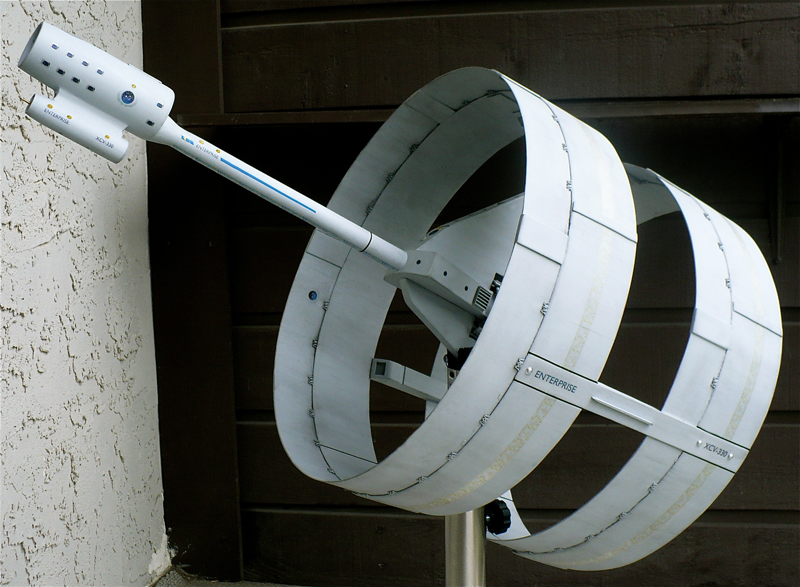
Here are some images of my 1/144 scale (?) scratch build of my interpretation of the XCV-330 Enterprise from the Star Trek universe Based off of the Matt Jefferies Painting.
I know, I know. Why would I have the United Federation of Planets logo all over the ship when the UFP did not come into existence yet when this ship was in service?  Well I say it was hauled out of the museum and put back into service after the formation of the UFP due to e required need for more transport vessels.

From Memory Alpha:

The USS Enterprise (XCV 330) was an Earth starship that was in service prior to 2143.
A painting of a ship from the same class appeared on the wall of the 602 Club on Earth in 2143. (ENT: "First Flight")A similar painting was on display on a wall in Admiral Maxwell Forrest's office on Earth in 2154. (ENT: "Home")
This Enterprise was honored with an illustration on the USS Enterprise's recreation deck after its refit in the early 2270s. (Star Trek: The Motion Picture


The following is from a Lincoln Enterprises catalog, describing some elevations of the ship that could be purchased through the company:
"Gene Roddenberry's imagination brings you "Starship". The vessel of the future as only he could picture it. This could be the forerunner of a new TV series, a Starship operated by an enormous computer which is a lifeform itself. Each human on board is a genius, a highly trained science specialist, part of a team of Galactic trouble shooters. A brand-new concept in future space travel. We also have three different views of the Metatransit system, side elevations of the systems analysis unit, and the Metaflier section of the Starship. Imagine yourself on a mission in space aboard this luxury cruiser. You'll be spellbound!"
  • Chart B of the Star Trek Maps (1980) features a side-view drawing (port) of the Enterprise. On that drawing, the ring-pylon is marked "7". The long "neck" of the ship is marked "ENTERPRISE" - no prefix or registry. The drawing is captioned:
"Starliners. Earth's first attempts at manned interstellar probes were launched during the 2050s at various target stars within fifteen light years of Sol. Only one, the UESP Enterprise, reached its destination – the sunlike binary pair of Alpha Centauri – before they were overtaken by the new faster-than-light spacecraft. The 120-meter-long Starliners had a crew complement of 35." The UESP-prefix presumably stands for "United Earth Space Probe", which would make Enterprise a ship of the United Earth Space Probe Agency.
  • The Star Trek Spaceflight Chronology (1980) features a side-view drawing and a detailed painting of the Enterprise. This however might not even be the same ship. Only the overall shape is similar. The book includes the following descriptions:
USS Enterprise - Declaration Class 2123-2165. Length: 300 m, Weight: 52.7 mil. kg, Ship's complement: 950. Propulsion: Adv. Second Generation Warp Drive. A total of 957 of these warp 3.2 starliners were built for the Cultural Exchange Project of the United Federation of Planets. The Enterprise was the first ship to be equipped with a subspace radio and was the most popular passenger carrier of its time.
It should be noted that in the timeline of the Spaceflight Chronology, for example, the Federation was incorporated in 2087 and the USS Enterprise (NCC-1701) was launched in 2188. So in the canon timeline, this Enterprise would have to be placed somewhere in the very late 22nd to the early 23rd century, well after the time of Star Trek: Enterprise.
  • In the July 2002 Issue 39 of Star Trek: The Magazine Doug Drexler stated, that the Enterprise was one of the inspirations for his design of the Vulcan Suurok-class starship. The ring-shaped configuration was solidified for other Vulcan starships in the series. This might retroactively suggest that the XCV 330, as an early design by Humans, was heavily based on Vulcan ships.
  • According to the novel Star Trek: Ex Machina, this Enterprise was only an unused prototype based on Vulcan ships of the same period.
  • The Star Trek: Ships of the Line (2011) calender listed in its center spread a comparison of the Enterprise (NX-01) and the Enterprise (XCV-330) and carried the following description:
The XCV ENTERPRISE was a radical reinvention of warp technology based on Vulcan design principles. It proved to be 17% more efficient than Vulcan ships, but had trouble turning at high warp speed, thus making it impractical for exploration where sudden course changes would have to be made. It was considered a technological dead-end in Earth Starship Design.
An updated version of the common paintings of this design is the January image in the calendar. The artwork was composed by artist Mark Rademaker.

Saturday, June 30, 2012

Messerschmitt BF 109 G-6 Early Version

Here are some images of Trumpeters 1/24 scale Messerschmitt BF 109 G-6 early version with it engine cowling removed.

From Wikipedia"
In February 1943, the G-6 was introduced with the 13 mm (.51 in) MG 131s, replacing the smaller 7.92 mm (.312 in) MG 17 – externally this resulted in two sizeable Beule blisters over the gun breeches, reducing speed by 9 km/h (6 mph). Over 12,000 examples were built well into 1944 although contradictory factory and RLM records do not allow an exact tally. The G-5 with a pressurized cockpit was identical to the G-6. A total of 475 examples were built between May 1943 and August 1944. The G-5/AS was equipped with a DB 605AS engine for high-altitude missions. GM-1-boosted G-5 and G-6 variants received the additional designation of "/U2". and were clearly identifyable as they use a modified, aerodynamically cleaner, engine cowl without the usual blisters.
The G-6/U4 variant was armed with a 30 mm (1.18 in) MK 108 cannon mounted as a Motorkanone firing through the propeller hub instead of the 20 mm MG 151/20 The G-6 was very often seen during 1943 fitted with assembly sets, used to carry bombs or a drop tank, for use as a night fighter, or to increase firepower by adding rockets or extra gondola guns.

Monday, June 25, 2012

Supermarine Spitfire MK Vb

Here are some images of Trumpeter Models 1/24 scale Supermarine Spitfire MK Vb showing it's engine. This aircraft was flown with the 303 Polish division March 1942.

From Wikipedia"
 
The VB became the main production version of the Mark Vs. Along with the new Merlin 45 series the B wing was fitted as standard. As production progressed changes were incorporated, some of which became standard on all later Spitfires. Production started with several Mk IBs which were converted to Mk VBs by Supermarine. Starting in early 1941 the round section exhaust stacks were changed to a "fishtail" type, marginally increasing exhaust thrust. Some late production VBs and VCs were fitted with six shorter exhaust stacks per side, similar to those of Spitfire IXs and Seafire IIIs; this was originally stipulated as applying specifically to VB(trop)s. After some initial problems with the original Mk I size oil coolers, a bigger oil cooler was fitted under the port wing; this could be recognised by a deeper housing with a circular entry. From mid-1941 alloy covered ailerons became a universal fitting.
A constant flow of modifications were made as production progressed. A "blown" cockpit hood, manufactured by Malcolm, was introduced in an effort to further increase the pilot's head-room and visibility. Many mid to late production VBs - and all VCs - used the modified, improved windscreen assembly with the integral bullet resistant centre panel and flat side screens introduced with the Mk III. Because the rear frame of this windscreen was taller than that of the earlier model the cockpit hoods were not interchangeable and could be distinguished by the wider rear framing on the hood used with the late-style windscreen.
Different propeller types were fitted, according to where the Spitfire V was built: Supermarine and Westland manufactured VBs and VCs used 10 ft 9 in (3.28 m) diameter, 3 bladed de Havilland constant speed units, with narrow metal blades, while Castle Bromwich manufactured VBs and VCs were fitted with a wide bladed Rotol constant speed propeller of either 10 ft 9 in (3.28 m) diameter, with metal blades, or (on late production Spitfires) 10 ft 3 in (3.12 m) diameter, with broader, "Jablo" (compressed wood) blades. The Rotol spinners were longer and more pointed than the de Havilland leading to a 3.5 in (8.9 cm) increase in overall length. The Rotol propellers allowed a modest speed increase over 20,000 ft (6,100 m) and an increase in the service ceiling. A large number of Spitfire VBs were fitted with "gun heater intensifier" systems on the exhaust stacks. These piped additional heated air into the gun bays. There was a short tubular intake on the front of the first stack and a narrow pipe led into the engine cowling from the rear exhaust.
The VB series were the first Spitfires able to carry a range of specially designed "slipper" drop tanks which were fitted underneath the wing centre-section. Small hooks were fitted, just forward of the inboard flaps: when the tank was released these hooks caught the trailing edge of the tank, swinging it clear of the fuselage.
With the advent of the superb Focke Wulf Fw 190 in August 1941 the Spitfire was for the first time truly outclassed, hastening the development of the "interim" Mk IX. In an effort to counter this threat, especially at lower altitudes, the VB was the first production version of the Spitfire to use "clipped" wingtips as an option, reducing the wingspan to 32 ft 2 in (9.8 m).The clipped wings increased the roll rate and airspeed at lower altitudes. Several different versions of the Merlin 45/50 family were used, including the Merlin 45M which had a smaller "cropped" supercharger impeller and boost increased to +18 lb. This engine produced 1,585 hp (1,182 kW) at 2,750 ft (838 m), increasing the L.F VB's maximum rate of climb to 4720 ft/min (21.6 m/s) at 2,000 ft (610 m).

Saturday, June 23, 2012

Spam Update

                                                                                                                                                                     Update: I'm afraid I have to turn the captcha back on as now I'm getting inundated with robot spam.
Sorry I have to do this as I don't like it any more then you do.
I know how it can be writing a comment, then having to prove you are not a machine, then having to wait for me to get up off my lazy ass and post it but I'm out of Ideas as to what I can do.
I suspect this problem started when Blogger switched over to their new format but I could be wrong.

Pictures of Home Pt 5

I've just upgraded my Mac.
Everything works great!
What could possibly go wrong?

Friday, June 22, 2012

Messerschmitt BF 110 G-4 Composite

Here is my composite image of Revell's 1/32 scale Messerschmitt BF 110 G-4 flying over an icy river on a cloudy day.

Images of the model can be seen here.

Thursday, June 21, 2012

Too much Spam

                                                           Just within the past few days I have noticed a marked increase in spam comments so as a result until this problem is rectified I will have to moderate incoming comments.
Sorry for the inconvenience.
I will however remove the "prove you're not a robot" thingy.
Update: I'm afraid I have to turn the captcha back on as now I'm getting inundated with robot spam.
Sorry I have to do this as I don't like it any more then you do.
I know how tedious it can be writing a comment, then having to prove you are not a machine, then having to wait for me to get up off my lazy ass and post it but I'm out of Ideas as to what I can do.
I suspect this problem started when Blogger switched over to their new format but I could be wrong.