Translate

Wednesday, September 11, 2013

Messerschmitt Bf 110 G-4 Night Fighter


Here are some more images of Revell's 1/32 scale Messerschmitt Bf 110 G-4 night fighter.

From Wikipedia"

Later production variants The production of the Bf 110 was put on a low priority in 1941 in expectation of its replacement by the Me 210. During this time, two versions of the Bf 110 were developed, the E and F models. The E was designed as a fighter bomber (Zerstörer Jabo), able to carry four 50 kg (110 lb) ETC-50 racks under the wing, along with the centerline bomb rack. The first E, the Bf 110 E-1 was originally powered by the DB 601B engine, but shifted to the DB 601P as they became available in quantity. A total of 856 Bf 110E models were built between August 1940 and January 1942. The E models also had upgraded armour and some fuselage upgrades to support the added weight. Most pilots of the Bf 110E considered the aircraft slow and unresponsive, one former Bf 110 pilot commenting the E was "rigged and a total dog."

The Bf 110F featured the new DB 601F engines which produced 993 kW/1,350 PS (almost double the power the original Jumo engines provided), which allowed for upgraded armour, strengthening, and increased weight with no loss in performance. Three common versions of the F model existed. Pilots typically felt the Bf 110F to be the best of the 110 line, being fully aerobatic and in some respects smoother to fly than the Bf 109, though not as fast. Eventually 512 Bf 110F models were completed between December 1941 and December 1942, when production gave way to the Bf 110G.

Although the Me 210 entered service in mid-1941, it was eventually withdrawn for further development. There were insufficient aircraft to fully replace the Bf 110, so it remained in service until the end of the war. In the wake of the failure of the Me 210, the Bf 110G was designed. Fitted with the DB 605B engines, producing 1,085 kW (1,475 PS) in "War Emergency" setting, and 997 kW (1,355 PS) at 5.8 km (19,000 ft) altitude, the Bf 110G also underwent some changes which improved the aerodynamics of the aircraft, as well as upgrading the nose armament. No Bf 110 G-1 existed, as the Bf 110 G-2 became the baseline Bf 110G and was fitted with a large number of Rüstsätze, making the G the most versatile of the Bf 110. The initial batch of six pre-series production G-0 aircraft built in June 1942 followed by 797 G-2, 172 G-3 and 2,293 G-4 models, built between December 1942 and April 1945. Pilots reported the Bf 110G to be a "mixed bag" in the air, in part due to all changes between the G and F series. However the Bf 110G was considered a superior gun platform with excellent all-around visibility, and considered, until the advent of the Heinkel He 219, the best of the Luftwaffe night fighters.
Armament
The Bf 110's main strength was its ability to accept unusually powerful air-to-air weaponry. Early versions had four 7.92 mm (.312 in) MG 17 machine guns in the upper nose and two 20 mm MG FF/M cannons fitted in the lower part of the nose. Later versions replaced the MG FF/M with the more powerful 20 mm MG 151/20 cannons and many G-series aircraft, especially those who served in the bomber-destroyer role, had two 30 mm (1.18 in) MK 108 cannons fitted instead of the MG 17. The defensive armament consisted of a single, flexibly-mounted 7.92 mm (.312 in) MG 15 machine gun. Late F-series and prototype G-series were upgraded to a 7.92 mm (.312 in) MG 81 machine gun with a higher rate of fire and the G-series was equipped with the twin-barrelled MG 81Z. Many G-series night fighters were retrofitted or factory-built with the Schräge Musik off-bore gun system, firing upward at an oblique angle for shooting down bombers while passing underneath, frequently equipped with two 20 mm MG FF/M, but field installations of the 20 mm MG 151/20 or 30 mm (1.18 in) MK 108 cannons were also utilized. The Schräge Musik weapons were typically mounted to the back of the rear cockpit.

The Bf 110 G-2/R1 was also capable of accepting armament such as the Bordkanone series 37 mm (1.46 in) BK 37 cannon. A single hit from this weapon was enough to destroy any Allied bomber.

The fighter-bomber versions could carry up to 2,000 kg (4,410 lb) of bombs, depending on the type.
The Bf 110 would be the backbone of the Nachtjagdgeschwader throughout the war. The first units undertook defence operations over Germany as early as the autumn of 1940. Opposition was light until 1942, when British heavy bombers started to appear.

One of the most notable actions of the Bf 110 occurred on the night of the 17/18 August 1943. Bf 110 units had been mass equipped with the Schräge Musik system, an emplacement of two upward-firing cannon, mounted almost midway down the cockpit canopy behind the pilot, which could attack the blind spot of RAF Bomber Command's Avro Lancaster bombers, which lacked a ventral turret. Using this, NJG 5's Leutnant Peter Erhardt destroyed four bombers in 30 minutes. Despite excellent visibility, none of the RAF bombers had reported anything unusual that would indicate a new weapon or tactics in the German night fighter force. This ignorance was compounded by the tracerless ammunition used by the Bf 110s, as well as firing on the British bombers blind spots. Many RAF crews witnessed a sudden explosion of a friendly aircraft, but assumed, in some cases, it was very accurate flak. Few of the German fighters were seen, let alone fired on.
In September 1943, Arthur Harris, convinced a strategic bombing campaign against Germany's cities would force a German collapse, pressed for further mass attacks. While RAF Bomber Command destroyed Hannover's city centre and 86% of crews dropped their bombs within 5 km (3 mi) of the aiming point, losses were severe. The Ruhr Area was the prime target for British bombers in 1943, and German defences inflicted a considerable loss rate. The Bf 110 had a hand in the destruction of some 2,751 RAF bombers in 1943, along with German flak and other night fighters. Later, the RAF developed a radar countermeasure; Window, to confuse German defences and introduced de Havilland Mosquitos to fly feints and divert the Bf 110s and other night fighter forces from their true target, which worked, initially. At this time, the Bf 110 remained the backbone of the fight-force, although it was now being reinforced by the Junkers Ju 88. In October 1943, General Josef Kammhuber reported the climbing attrition rate as "unacceptable", and urged Hermann Göring to stop committing the German night fighters to daylight operations. Many Nachtjagdgeschwader had taken part in costly daylight battles of attrition. From June-August, it had increased from around 2% to 9.8%. However the fortunes for the mostly Bf 110 equipped force turned during late August/September 1943. The night fighter arm claimed the destruction of 123 out of some 1,179 bombers over Hamburg on one night; a 7.2% loss rate. During the Battle of Berlin, 1,128 bombers were lost in five months. RAF Bomber Command had "nearly burned out". These losses were primarily a result of fighter defences, at the heart of which was the Bf 110. The German defences had won a victory which prevented deep penetration raids for a time. But Luftwaffe losses were high; 15% of crews were killed in the first three months of 1944.

Tuesday, September 10, 2013

General Dynamics F-16 C Fighting Falcon


Here are some more images of Hasegawa's 1/32 scale General Dynamics F-16 C Fighting Falcon.

From Wikipedia"
The General Dynamics F-16 Fighting Falcon is a multirole jet fighter aircraft originally developed by General Dynamics for the United States Air Force (USAF). Designed as a lightweight day fighter, it evolved into a successful all-weather multirole aircraft. Over 4,400 aircraft have been built since production was approved in 1976. Though no longer being purchased by the U.S. Air Force, improved versions are still being built for export customers. In 1993, General Dynamics sold its aircraft manufacturing business to the Lockheed Corporation, which in turn became part of Lockheed Martin after a 1995 merger with Martin Marietta.

The Fighting Falcon is a dogfighter with numerous innovations including a frameless bubble canopy for better visibility, side-mounted control stick to ease control while maneuvering, a seat reclined 30 degrees to reduce the effect of g-forces on the pilot, and the first use of a relaxed static stability/fly-by-wire flight control system that makes it a highly nimble aircraft. The F-16 has an internal M61 Vulcan cannon and has 11 hardpoints for mounting weapons, and other mission equipment. Although the F-16's official name is "Fighting Falcon", it is known to its pilots as the "Viper", due to it resembling a viper snake and after the Battlestar Galactica Colonial Viper starfighter.

In addition to USAF active, reserve, and air national guard units, the aircraft is used by the USAF aerial demonstration team, the U.S. Air Force Thunderbirds, and as an adversary/aggressor aircraft by the United States Navy. The F-16 has also been procured to serve in the air forces of 25 other nations.
The U.S. Air Force initially ordered 15 "Full-Scale Development" (FSD) aircraft (11 single-seat and four two-seat models) for its flight test program, but this was reduced to eight (six F-16A single-seaters and two F-16B two-seaters). The YF-16 design was altered for the production F-16. The fuselage was lengthened by 10.6 in (0.269 m), a larger nose radome was fitted to house the AN/APG-66 radar, wing area was increased from 280 sq ft (26 m2) to 300 sq ft (28 m2), the tailfin height was decreased slightly, the ventral fins were enlarged, two more stores stations were added, and a single side-hinged nosewheel door replaced the original double doors. These modifications increased the F-16's weight approximately 25% over that of the YF-16 prototypes.
Manufacture of the FSD F-16s got underway at General Dynamics' Fort Worth, Texas plant in late 1975, with the first example, an F-16A, being rolled out on 20 October 1976, followed by its first flight on 8 December. The initial two-seat model achieved its first flight on 8 August 1977. The initial production-standard F-16A flew for the first time on 7 August 1978 and its delivery was accepted by the USAF on 6 January 1979. The F-16 was given its formal nickname of “Fighting Falcon” on 21 July 1980, entering USAF operational service with the 388th Tactical Fighter Wing at Hill AFB on 1 October 1980.

On 7 June 1975, the four European partners, now known as the European Participation Group, signed up for 348 aircraft at the Paris Air Show. This was split among the European Participation Air Forces (EPAF) as 116 for Belgium, 58 for Denmark, 102 for the Netherlands, and 72 for Norway. These would be produced on two European production lines, one in the Netherlands at Fokker's Schiphol-Oost facility and the other at SABCA's Gossellies plant in Belgium; production would be divided among them as 184 and 164 units, respectively. Norway's Kongsberg Vaapenfabrikk and Denmark's Terma A/S also manufactured parts and subassemblies for the EPAF aircraft. European co-production was officially launched on 1 July 1977 at the Fokker factory. Beginning in mid-November 1977, Fokker-produced components were shipped to Fort Worth for assembly of fuselages, which were in turn shipped back to Europe (initially to Gossellies starting in January 1978); final assembly of EPAF-bound aircraft began at the Belgian plant on 15 February 1978, with deliveries to the Belgian Air Force beginning in January 1979. The Dutch line started up in April 1978 and delivered its first aircraft to the Royal Netherlands Air Force in June 1979. In 1980 the first aircraft were delivered to the Royal Norwegian Air Force by SABCA and to the Royal Danish Air Force by Fokker.

Since then, a further production line has been established at Ankara, Turkey, where Turkish Aerospace Industries (TAI) has produced 232 Block 30/40/50 F-16s under license for the Turkish Air Force during the late 1980s and 1990s, and has 30 Block 50 Advanced underway for delivery from 2010; TAI also built 46 Block 40s for Egypt in the mid-1990s. Korean Aerospace Industries opened another production line for the KF-16 program, producing 140 Block 52s from the mid-1990s to mid-2000s. If India selects the F-16IN for its Medium Multi-Role Combat Aircraft procurement, a sixth F-16 production line will be established in that nation to produce at least 108 fighters.
F-16C/D
The F-16C (single seat) and F-16D (two seat) variants entered production in 1984. The first C/D version was the Block 25 with improved cockpit avionics and radar which added all-weather capability with beyond-visual-range (BVR) AIM-7 and AIM-120 air-air missiles. Block 30/32, 40/42, and 50/52 were later C/D versions. The F-16C/D had a unit cost of US$18.8 million (1998).

Monday, September 9, 2013

Canadair F-86 F Sabre

Here are some more images of Kinetics 1/32 scale Canadair F 86 F Sabre with the Canadian Golden Hawks Aerobatic team markings. Currently I believe to be the best 1/32 scale Sabre on the market today although some improvements could be made such extendable leading edge air brakes. From Wikipedia "

The Golden Hawks were a Canadian military aerobatic flying team established in 1959 to celebrate the 35th anniversary or the Royal Canadian Air Force (RCAF) and the "Golden" 50th anniversary of Canadian flight, which began with the AEA Silver Dart in 1909.
Initially a six-plane team was envisioned as performing for only one year with the Canadair Sabre, but the Golden Hawks were so popular after their single 63-show season that the team was expanded. Another Sabre was added to the team, allowing for a five-aircraft main formation with two solo jets. They continued performing for three more seasons until they were disbanded for financial reasons, on February 7, 1964, having flown a total of 317 shows across North America.
Not only did the team perform the loops, rolls and other maneuvers standard to military formation flying, they had their own trademark maneuvers. One of the Golden Hawks' signature stunts was a low-level flyby of the crowd with their canopies open, waving at the spectators. The Golden Hawks pioneered the bomb burst maneuver and a two-aircraft coordinated solo program which virtually every military team since has adopted in various ways.
In Oakville, Ontario, 540 Golden Hawks Royal Canadian Air Cadet Squadron is named for the air demonstration team.
During the 1980s, 851 Royal Canadian Air Cadet Squadron based in Prince Edward County, Ontario owned a Sabre that at one time was used by the Golden Hawks. From 1961 to 1977 the same Sabre was on display at Pinecrest school in Bloomfield, Ontario. The Sabre currently resides in Barrie, Ontario.
In 2009, Hawk One, a fully refurbished Canadair Sabre in Golden Hawk colours, owned by Vintage Wings of Canada helped to celebrate the Centennial of Flight in Canada. Hawk One performed in air shows and flypasts across Canada.

Sunday, September 8, 2013

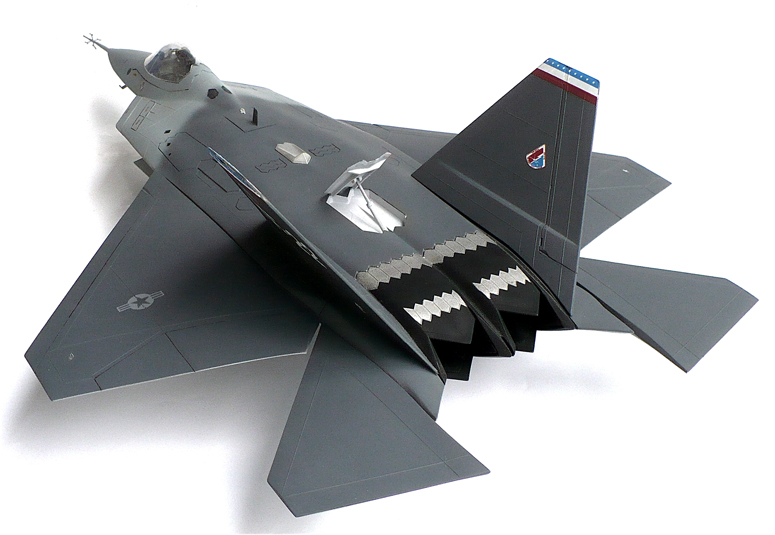
Lockheed/Boeing/General Dynamics YF-22

Here are some images of Testor's 1/32 scale Lockheed/Boeing/General Dynamics YF-22.

From Wikipedia"
The Lockheed/Boeing/General Dynamics YF-22 was a single-seat, twin-engined prototype fighter aircraft designed for the United States Air Force (USAF). The YF-22 was a finalist in the USAF's Advanced Tactical Fighter competition; two prototypes were built. The YF-22 won the contest against the Northrop YF-23, and entered production as the Lockheed Martin F-22 Raptor. The YF-22 is aerodynamically similar to the F-22, but with differences in the position and design of the cockpit, tail fins and wings, and in internal structural layout.
In the 1980s, the USAF began looking for a replacement for its fighter aircraft, especially to counter the advanced Su-27 and MiG-29. A number of companies, divided into two teams, submitted their proposals. Northrop and McDonnell Douglas submitted the YF-23. Lockheed, Boeing and General Dynamics proposed and built the YF-22, which, although marginally slower and having a larger radar cross-section, was more agile than the YF-23. Primarily for this reason, it was picked by the Air Force as the winner of the ATF in April 1991. Following the selection, the first YF-22 was retired to a museum, while the second prototype continued flying until an accident relegated it to the role of an antenna test vehicle.

Lockheed F 117 Nighthawk

Here are some images of Testors 1/32 scale Lockheed F 117 Nighthawk. This was the first F117 kit to be released and apparently cost over 1 million dollars to produce based purely from photographs taken during test flights as it was still classified. Considering what they had to go on it was a pretty impressive result. This aircrafts appearance was under much speculation during the 80s and model kit companies such as Testors/Italeri and Monogram released speculative model kits on this subject, both kits being called the F 19 as that was the assumed name of the aircraft.

From Wikipedia"
The Lockheed F-117 Nighthawk is a single-seat, twin-engine stealth ground-attack aircraft formerly operated by the United States Air Force (USAF). A product of Lockheed Skunk Works and a development of the Have Blue technology demonstrator, the F-117 was the first operational aircraft to be designed around stealth technology. The maiden flight for the type was conducted in 1981, and it achieved initial operating capability status in October 1983. The F-117 was "acknowledged" and revealed to the world in November 1988.
The F-117 was widely publicized for its role in the Persian Gulf War of 1991. It was commonly referred to as the "Stealth Fighter", although it was a strictly ground-attack aircraft. The F-117 also saw combat in Yugoslavia; during which the only aircraft of the type to be lost in combat was shot down by a surface-to-air (SAM) battery on 27 March 1999. The Air Force retired the F-117 on 22 April 2008, primarily because of the fielding of the F-22 Raptor and the impending introduction of the multirole F-35 Lightning II. Sixty-four F-117s were built, 59 of which were production versions with five demonstrators/prototypes.

Saturday, September 7, 2013

Granville P-45 B Fighter

Here are some more images a 1/32 scale Granville P-45 B fighter. Built from Lindberg's 1/32 Gee Bee R racer.
This model was based off of the Mercenary Graphics drawing and is a mythical aircraft. A what if plane if you will.

After the attack on Pearl Harbor the Gee Bee Racer was pressed into service and became the Granville P-45 fighter where it served on the Aleutian Islands and the Panama Canal Zone in 1942, where it gained some success against the Mitsubishi A5M4 (Claude).

Friday, September 6, 2013

Heinkel HE 51 B-2 Floatplane

Here are some more images of Silver Wings 1/32 scale Heinkel HE 51 B-2 Floatplane.

 From Wikipedia                                                                                                                                                               The Heinkel He 51 was a German single-seat biplane which was produced in a number of different versions. It was initially developed as a fighter, and a seaplane variant and a ground-attack version were also developed. It was a development of the earlier He 49.
In 1931, Heinkel recruited the talented aircraft designers, Walter and Siegfried Günter, and their first major design for Heinkel was the Heinkel He 49. While this was officially an advanced trainer, in fact it was a fighter. The first prototype, the He 49a, flew in November 1932, and was followed by two further prototypes, the He 49b, with a longer fuselage, and the He 49c, with a revised engine.

The type was ordered into production for the still secret Luftwaffe as the He 51, the first pre-production aircraft flying in May 1933. Deliveries started in July of the next year.

The He 51 was a conventional single-bay biplane, with all-metal construction and fabric covering. It was powered by a glycol-cooled BMW VI engine, with an armament of two 7.92 mm (.312 in) machine guns mounted above the engine.

The He 51 was intended to replace the earlier Arado Ar 65, but served side-by-side with the slightly later Ar 68. The He 51 was outdated the day it entered service, and after an initial run of 150 production fighters, the design was switched into the modified He 51B, with approximately 450 built, including about 46 He 51B-2 floatplanes, and then finally a further 100 He 51C light ground-attack plane.
On 6 August 1936, six of the He 51s were delivered to Spain to fight in the Spanish Civil War along with the fraction of the army in revolt. Initial operations were successful, with the Heinkels meeting and defeating a number of older biplane of the Spanish Republican Air Force, with two Nieuport Ni-52 fighters, a Breguet 19 and a Potez 54 destroyed on 18 August 1936, the first day of operations by Spanish-flown He 51s. Deliveries continued as the hostilities increased, with two Nationalist squadrons equipped by November, and the Legion Kondor forming three squadrons of 12 aircraft each manned by German "volunteers".

This time of superiority was short lived, with the arrival of large numbers of modern aircraft from the Soviet Union, including the Polikarpov I-15 biplane and new Polikarpov I-16 monoplane, together with the Tupolev SB bomber, which was 110 km/h (70 mph) faster. The He 51 proved unable to protect the Legion Kondor's bombers, forcing it to switch to night operations, while also unable to intercept the much faster SB. The He 51 was therefore withdrawn from fighter duty and relegated to the ground-attack role by both the Legion Kondor and the Spanish rebels, It was replaced in the fighter role by the Fiat CR.32 in the rebel Nationalist Air Force, with the Legion Kondor receiving Messerschmitt Bf 109s from April 1937 to allow it to operate successfully in fighter operations.

While a failure as a fighter, the Heinkel proved successful as a ground-attack aircraft, being used by Wolfram von Richthofen to develop the close support tactics which were used by the Luftwaffe in World War II. It continued in use as a ground attack aircraft for the remainder of the Civil War, although losses were heavy. After the war the 46 surviving aircraft would be joined by another 15 new builds, and serve in the utility role in Spain until 1952.

The experiences in Spain would prove once and for all that the days of the biplane fighter were over. Although the later model Fiat biplanes were superior to the He 51 and continued to soldier on in Nationalist service, the I-16s were basically untouchable because of their speed. If the conditions were right, they could use their heavy armament in a quick pass and then leave; if things weren't so favorable, they simply flew away. The lesson learned by all of the participants was that speed was far more important in combat than maneuverability.
The He 51 continued in front-line service with the Luftwaffe until 1938, with it remaining in service as an advanced trainer for the first few years of World War II.

Thursday, September 5, 2013

1829 Stephenson Rocket

Here are some images of Academy's 1/26 scale 1829 Stephenson Rocket.
I decided to go with white wheels, natural wood tender floor planks and a brown barrel. Though the rocket was basically all yellow I wanted a bit of contrast.
From Wikipedia"
The Rocket was the most advanced steam engine of its day. It was built for the Rainhill Trials held by the Liverpool & Manchester Railway in 1829 to choose the best and most competent design. It set the standard for a hundred and fifty years of steam locomotive power. Though the Rocket was not the first steam locomotive, Rocket's claim to fame is that it was the first steam locomotive to bring together several innovations to produce the most advanced locomotive of its day, and the template for most steam locomotives since. In fact, the standard steam locomotive design is often called the "Stephensonian" locomotive.

Rocket used a multi-tubular boiler, which made for much more efficient and effective heat transfer between the exhaust gases and the water. Previous locomotive boilers consisted of a single pipe surrounded by water. Rocket had 25 copper tubes running the length of the boiler to carry the hot exhaust gases from the firebox. This was a significant development, as it greatly increased the amount of steam produced, and subsequent designs used increased numbers of boiler tubes. Rocket also used a blastpipe, feeding the exhaust steam from the cylinders into the base of the chimney so as to induce a partial vacuum and pull air through the fire. Credit for the invention of the blastpipe is disputed between Sir Goldsworthy Gurney and Timothy Hackworth. The blastpipe worked well on the multi-tube boiler of Rocket but on earlier designs with a single pipe through the boiler it created so much suction that it tended to rip the top off the fire and throw burning cinders out of the chimney, vastly increasing the fuel consumption.
A closer view

Rocket had two cylinders set at 35 degrees from the horizontal, with the pistons driving a pair of 4 ft 8 in (1.42 m) diameter wheels. Most previous designs had the cylinders positioned vertically, which gave the engines an uneven swaying motion as they progressed along the track. Subsequently Rocket was modified so that the cylinders were set horizontally, a layout used on nearly all designs that followed. The second pair of wheels was 2 ft 6 in (0.76 m) in diameter, and uncoupled from the driving wheels, giving an 0-2-2 wheel arrangement. The firebox was separate from the boiler and was double thickness, being surrounded with water. Copper pipes led the heated water into the boiler.
A cutaway view of the cylinder and steam valve of the replica Rocket

There have been differences in opinion on who should be given the credit for designing Rocket. George Stephenson had designed several locomotives before but none as advanced as Rocket. At the time that Rocket was being designed and built at the Forth Banks Works, he was living in Liverpool overseeing the building of the Liverpool and Manchester Railway. His son Robert had recently returned from a stint working in South America and resumed as managing director of Robert Stephenson and Company. He was in daily charge of designing and constructing the new locomotive. Although he was in frequent contact with his father in Liverpool and probably received advice from him, it is difficult not to give the majority of the credit for the design to Robert. A third person who deserves a significant amount of credit is Henry Booth, the treasurer of the Liverpool and Manchester Railway. He is believed to have suggested to Robert Stephenson that a multi-tube boiler should be used.
The opening ceremony of the L&MR, on 15 September 1830, was a considerable event, drawing luminaries from the government and industry, including the Prime Minister, the Duke of Wellington. The day started with a procession of eight trains setting out from Liverpool. The parade was led by Northumbrian driven by George Stephenson, and included Phoenix driven by his son Robert, North Star driven by his brother Robert Sr. and Rocket driven by assistant engineer Joseph Locke. The day was marred by the death of William Huskisson, the Member of Parliament for Liverpool, who was struck and killed by Rocket at Parkside.
In 1834, the engine was selected for modifications to test a newly-developed rotary steam engine designed by Lord Dundonald. At a cost of nearly £80, Rocket's cylinders and driving rods were removed and two of the engines were installed directly on its driving axle with a feedwater pump in between. On October 22, of that year, an operational trial was held with disappointing results; one witness observing, that "the engine could not be made to draw a train of empty carriages". Due to inherent design flaws and engineering difficulties associated with their design, Dundonald's engines were simply too feeble for the task.

Monday, September 2, 2013

Bucket Wheel Excavator Schaufelradbagger 289

Here are some images of Revell's 1/200 scale Bucket Wheel Excavator Schaufelradbagger 289.
Not the most accurate of model kits but at a meter long it still makes an impressive display piece.
I wonder if there will be any aftermarket parts for this kit.

From Wikipedia"
Bucket-wheel excavators (BWEs) are heavy equipment used in surface mining. The primary function of BWEs is to act as a continuous digging machine in large-scale open pit mining operations. What sets BWEs apart from other large-scale mining equipment, such as bucket chain excavators, is their use of a large wheel consisting of a continuous pattern of buckets used to scoop material as the wheel turns. They are among the largest vehicles ever constructed, and the biggest bucket-wheel excavator ever built, Bagger 293, is the largest terrestrial (land) vehicle in human history according to the Guinness Book of World Records.
Bucket-wheel excavators have been used in mining for the past century, with some of the first being manufactured in the 1920s. They are used in conjunction with many other pieces of mining machinery (conveyor belts, spreaders, crushing stations, heap-leach systems, etc.) to move and mine massive amounts of overburden (waste). While the overall concepts that go into a BWE have not changed much, their size has grown drastically since the end of World War Two.
In the 1950s two German mining firms ordered the world's first extremely large BWEs, and had three BWEs built for mining lignite near Cologne, Germany. The German BWEs had a wheel of over 52 feet (16 m) in diameter, weighed 5,500 short tons (5,000 t) and was over 600 feet (180 m) long, with eighteen crawler units for movement and could cut a swath of over 600 feet (180 m) feet at one time
BWEs built since the 1990s, such as the Bagger 293, have reached sizes as large as 96 metres (314.9 feet) tall, 225 metres (738.2 feet) long, and as heavy as 14,200 metric tons (31.3 million lb). The bucket-wheel itself can be over 70 feet in diameter with as many as 20 buckets, each of which can hold over 15 cubic metres of material. BWEs have also advanced with respect to the extreme conditions in which they are now capable of operating. Many BWEs have been designed to operate in climates with temperatures as low as -45°C (-49°F). Developers are now moving their focus toward automation and the use of electrical power.


A bucket wheel excavator (BWE) consists of a superstructure to which several more components are fixed.
The bucket wheel from which the machines get their name is a large, round wheel with a configuration of scoops which is fixed to a boom and is capable of rotating. Material picked up by the cutting wheel is transferred back along the boom. In early cell-type bucket wheels, the material was transferred through a chute leading from each bucket, while newer cell-less and semi-cell designs use a stationary chute through which all of the buckets discharge.
A discharge boom receives material through the superstructure from the cutting boom and carries it away from the machine, frequently to an external conveyor system.
A counterweight boom balances the cutting boom and is cantilevered either on the lower part of the superstructure (in the case of compact BWEs) or the upper part (in the case of mid-size C-frame BWEs). In the larger BWEs, all three booms are supported by cables running across towers at the top of the superstructure.
Beneath the superstructure lay the movement systems. On older models these would be rails for the machine to travel along, but newer BWEs are frequently equipped with crawlers, which grant them increased flexibility of motion.
To allow it to complete its duties, the superstructure of a BWE is capable of rotating about a vertical axis (slewing). The cutting boom can be tilted up and down (hoisting). The speeds of these operations are on the orders of 30 m/min and 5 m/min, respectively. Slewing is driven by large gears, while hoisting generally makes use of a cable system.
 The scale of BWEs varies drastically and is dependent on the intended application. Compact BWEs designed by ThyssenKrupp may have boom lengths as small as 6m, weigh 50 tons, and move 100 fm3/hr of earth. Their larger models reach boom lengths of 80m, weigh 13,000 tons, and move 12,500 fm3/hr. The largest BWE ever constructed is TAKRAF's Bagger 293, which weighs 14,200 (metric) tons and is capable of moving 240,000 cubic metres of overburden every day.Excavations of 380,000 cubic metres per day have been recorded. The BWEs used in the United States tend to be smaller than those constructed in Germany.