Translate

Sunday, June 15, 2014

Billy Bishop's Nieuport 17

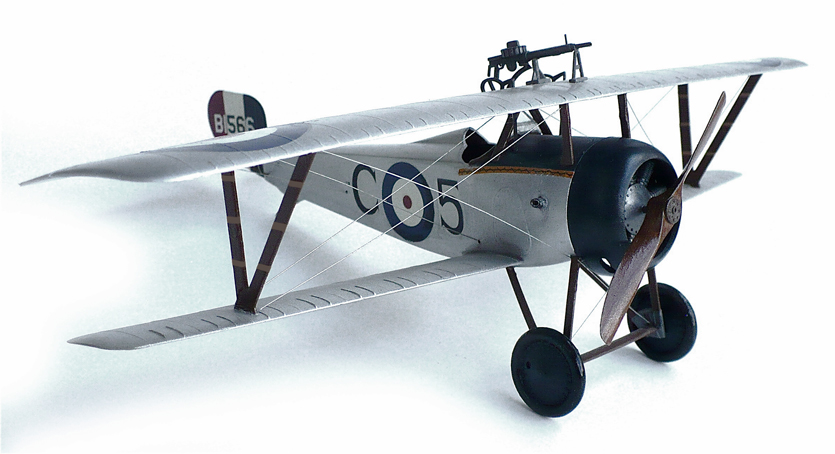
Here are some images of Hobbycraft's 1/32 scale Nieuport Ni 17. This is the aircraft Billy bishop flew during the World War One. Billy Bishop was Canada's leading fighter ace with over 72 victories to his credit. Some would say he was Britain's leading fighter ace as well though there is some conjecture on that point.

From Wikipedia"
The Nieuport 17 was a French biplane fighter aircraft of World War I, manufactured by the Nieuport company.
 
 The type was a slightly larger development of the earlier Nieuport 11, and had a more powerful engine, larger wings, and a more refined structure in general. At first, it was equipped with a 110 hp (82 kW) Le Rhône 9J engine, though later versions were upgraded to a 130 hp (97 kW) engine. It had outstanding maneuverability, and an excellent rate of climb. Unfortunately, the narrow lower wing, marking it as a "sesquiplane" design with literally "one-and-a-half wings", was weak due to its single spar construction, and had a disconcerting tendency to disintegrate in sustained dives at high speed. Initially, the Nieuport 17 retained the above wing mounted Lewis gun of the "11", but in French service this was soon replaced by a synchronised Vickers gun. In the Royal Flying Corps, the wing mounted Lewis was usually retained, by now on the improved Foster mounting, a curved metal rail which allowed the pilot to bring the gun down in order to change drums or clear jams. A few individual aircraft were fitted with both guns - but in practice this reduced performance unacceptably, and a single machine gun remained standard.
The type reached the French front in March 1916, and quickly began to replace the smaller Nieuport 11 and 16 in French service. The type went into service with Escadrille N.57 on May 2, 1916. With the British DH.2 the Nieuports were responsible for ending the reign of the Fokker Eindecker - the so-called 'Fokker scourge' period, proving a severe shock to German aviation high command. Most French aces used the nimble Nieuport during their career including Georges Guynemer, Charles Nungesser, Maurice Boyau, Armand Pinsard, Réné Dorne, Gabriel Guerin, Alfred Duellin and Jean Navarre. The type was also used by American volunteers of the Escadrille Lafayette when they replaced their earlier Nieuports. During part of 1916 the Nieuport 17 equipped every fighter squadron of the Aéronautique Militaire. Charles Nungesser scored most of his victories while flying Nieuports.
It was also ordered by the Royal Flying Corps and Royal Naval Air Service, as it was superior to any British fighter available at that time. Historians have found it difficult to identify how many of each Nieuport type were operated by the RFC as its surviving records tend to only specify 'Nieuport scout'. An unknown proportion of various Nieuport models including the N. 16, 17 and 24 were issued to squadrons. Individual Nieuport types are best identified from surviving photos rather than archives. British squadrons known to have used the type include Nos 1, 29, 32, 40 and 60 of the Royal Flying Corps and No 6 of the Royal Naval Air Service which was attached to the RFC. During the Battle of Arras much use was made of British Nieuports in balloon-busting attacks to prevent enemy artillery spotting. No 40 Squadron experimented with low level hedge-hopping attacks to reach the balloons while Nieuports of No 60 Squadron co-operated with F.E. 2bs of No 11 Squadron to carry out massed strafing attacks on German infantry entrenched on both sides of the River Scarpe.
Nieuport 17 plane in 1917
The Germans supplied captured examples to several of their own aircraft manufacturers for them to copy. This resulted in the Siemens-Schuckert D.I which, apart from the engine installation, was a close copy and actually went into production, although in the event it was not widely used operationally on the Western Front. German technicians also salvaged many engines from crashed Nieuports and re-used them in German machines including Fokker Dr1 triplanes. Albatros Werke adopted the Nieuport's sesquiplane wing structure for the Albatros D.III and D.V: called 'V-strutters' by the RFC to distinguish them from the earlier Albatros D.II. The German machines were heavier than the Nieuport and this aggravated the tendency to wing failures which the Nieuports had already experienced. Despite experimenting with extra bracing the Germans never fully solved the problem. Several pilots were killed while others experienced terrifying crash landings from altitude with a lower wing cracked or missing.
By mid-1917, the Nieuport was outclassed by the firepower and speed of the twin-gun latest German fighters, being one of the types suffering heavy casualties during Bloody April. An up-rated engine resulted in the Nieuport 17bis. Newer models (the Nieuport 24 and the 27) were brought out in an attempt to retain the type's ascendency. However, the powerful SPAD S.VII had already replaced the Nieuport fighters in many French squadrons by mid-1917. The British persisted with Nieuports a little longer, not replacing their last Nieuport 24bis until early 1918. The SPAD was powered by a water-cooled inline engine and proved stronger in a dive as it had a more conventional wing structure.
Many British Empire air aces flew Nieuport fighters, including Canadian ace W. A. Bishop, who received a Victoria Cross while flying it, and most famously of all, Albert Ball, V.C. who often hunted alone in his Nieuport. 'Mick' Mannock VC flew Nieuports early in his career with No 40 Squadron. His VC award reflected his whole combat career - including his time on Nieuports.
Italian aces such as Francesco Baracca, Silvio Scaroni and Pier Piccio all achieved victories while flying Nieuport fighters. In Belgium the 1st and 5th Belgian escadrilles were equipped with the Nieuport 17. Belgian aces flying the type included Andre de Meulemeester, Edmund Thieffry, Francis Jaquet and Jean Olieslagers. Imperial Russian forces operated the Nieuport. It is believed that the Russian ace Kazakov flew a Nieuport which was still marked with French-type roundels.
Like the other Nieuport types, the 17 was used as an advanced trainer for prospective fighter pilots after its operational days were over. The American Expeditionary Forces purchased 75 Nieuport 17s for training. The Nieuport 23 was a development of the 17. Charles Nungesser's own Nieuport 17bis was later converted to Nieuport 23 standard.

Roy Brown's Sopwith Camel

Here are some more images  of Accurate Miniatures 1/32 scale Sopwith Camel. This is the aircraft that was flown by Edmonton resident, World War One ace Capt Arthur Roy Brown the man officially credited with shooting down Manfred Von Richthofen aka the Red Baron, though recent studies suggest that the Red Baron may have actually been killed by Australian ground fire. What makes Capt Brown amazing is that he never lost a single pilot under his command. The reason for this was his training methods. One of his methods was that he would have new pilots position themselves high above a dog fight to study and observe maneuvers and tactics until he felt that they were ready to participate. In 2000/2001 when the city of Edmonton were compiling their top 100 Edmontonians of the 20th century Capt Arthur Roy Brown wasn't even mentioned. I guess fighting for King and country and keeping your pilots safe doesn't really cut it with today's progressive elite, but I digress. If you wish to know more on Capt Arthur Roy Brown you may do so here .

Friday, June 13, 2014

Railway Gondola Type OMMR

Here are some images of Dragon models 1/35 scale German Railway Gondola Type OMMR. I don't know what else I can tell you, it's an open rail car. I did put a couple of Goliath tracked mine vehicles and extra sand bags in it. And uh... well... Oh! I did use RLM 66 grey as its main colour.

Panzerjagerwagen


Here are some more images of Trumpeter's 1/35 scale Panzerjagerwagen. The Panzerjagerwagen with the Panzer IV turret and long 7.5-cm KwK cannon, were an important innovation of the BP 44 armor train type. It was the armored pursuit car that was replaced by the earlier pusher car. That now gave the train an effective means of defense against Russian tanks. In this instance, a program of new construction had been planned in 1944 by the German Army.

Thursday, June 12, 2014

USS Nimitz CVN 68

Here are some more images of Trumpeter/White Ensign's 1/350 scale U.S.S. Nimitz.
This was a fun model although I wish that Trumpeter would have provided more aircraft. Oh well I've ordered more but they're taking forever to come in.

From Wikipedia"
USS Nimitz (CVN-68) is a supercarrier in the United States Navy, the lead ship of her class. She is one of the largest warships in the world. She was laid down, launched and commissioned as CVAN-68, but was redesignated CVN 68 (nuclear-powered multimission aircraft carrier) on 30 June 1975 as part of the fleet realignment of that year.
The ship was named for World War II Pacific fleet commander Chester W. Nimitz, who was the Navy’s last fleet admiral. Unlike all subsequent Nimitz class carriers, Nimitz only uses her namesake's surname. She is also the first carrier of her class and the most recent supercarrier not to be named for someone who held elective office in the United States.
Nimitz was homeported at Naval Station Norfolk until 1987, when she was relocated to Puget Sound Naval Shipyard in Bremerton, Washington. After her mid-life overhaul and nuclear reactor refueling in 2001, Nimitz was relocated to NAS North Island, in San Diego, California.
Nimitz home port was changed from the NAS North Island, to Everett, Washington. This move is expected to save the Navy $100 million.
USS Nimitz first deployed to the Mediterranean on 7 July 1976 with Carrier Air Wing 8 embarked in company with the nuclear powered cruisers USS South Carolina and USS California. In November 1976, Nimitz was awarded the Battle "E" from Commander, Naval Air Force U.S. Atlantic Fleet, for being the most efficient and foremost aircraft carrier in the Atlantic Fleet. The cruise was uneventful, and the carrier returned to Norfolk, Virginia on 7 February 1977.
A second uneventful Mediterranean cruise was conducted from 1 December 1977 to 20 July 1978. The third deployment began on 10 September 1979 to the Mediterranean. The ship moved to the Indian Ocean in response to the Iran hostage crisis in which the U.S. Embassy in Tehran, Iran was overtaken and 52 hostages were held. (During this trip, the ship took part in the shooting of the movie The Final Countdown and played a central role in the film.) After four months on station, Operation Evening Light was launched from Nimitz's decks in an attempt to rescue the U.S. Embassy staff. The mission was aborted after a helicopter crashed at a refueling point in the Iranian desert. The ship finally returned home 26 May 1980, having spent 144 days at sea.

Tuesday, June 10, 2014

NZR E Class 1872 Vulcan

Here are some images of Entex Models 1/45 scale NZR E Class 1872 Vulcan.

From Wikipedia'
The NZR E class of Double Fairlie steam locomotives were two different types of Fairlie locomotive, and were the first classes to take that designation, followed by the E class Mallet compound locomotive of 1906 and then the E class battery electric locomotive of 1922. The other Double Fairlie class was the B class, and there were also the Single Fairlie R and S classes.
In 1872, two locomotives were ordered by the Otago provincial government to operate trains on the newly built Dunedin and Port Chalmers Railway. The first line to be built to the new national gauge standard of 3 feet 6 inches, it had as its consulting engineer Robert F. Fairlie, who persuaded the railway to order locomotives to his Double Fairlie design. Built by the Vulcan Foundry in England, the locomotives were shipped to New Zealand in kitset form. Arriving at Port Chalmers in August, they were unloaded onto the wharf and were assembled in situ. The railway's No.2 “Josephine” was assembled first due to its being closer to the end of the wharf, and after two weeks of assembly she first raised steam on 11 September 1872. After a short test run, “Josephine” was used to help finish the construction of the line while No.1 “Rose” was completed.
At the official opening of the Dunedin and Port Chalmers Railway, “Rose” hauled the first official train. Both locomotives continued in service until the railway was amalgamated into the Government system, becoming class “E” and gaining Otago section numbers. In 1879, “Josephine” was used as a banking locomotive south of Oamaru on the first train on the newly completed Main South Line between Dunedin and Christchurch, hauled by K 88. There was much discussion over whether “Josephine” or the new American locomotive should lead – K 88 kept its position as lead loco. “Josephine” had to be removed from the train at Palmerston, as the driver had forced her to take too much of the load and as a consequence she developed mechanical problems. Upon the general re-numbering of 1888-90 “Josephine” was numbered E 175, and lasted in NZR service until 1900. She was sold to the Public Works Department, re-numbered PWD 504 and used in the construction of railway lines before they were handed over to the Railways Department. She was transferred to the North Island and utilised in the construction of the North Island Main Trunk Railway before she returned to her former home for the construction of the Otago Central Railway, before her retirement in 1917. Both locomotives had a reputation of being rather unspectacular performers.
“Rose” suffered an accident just prior to 1890, and was withdrawn from service, never to be repaired. It is presumed she was scrapped or disposed of in the manner of the day. “Josephine”, once withdrawn from Public Works Department service in 1917, was sold for scrap to the Otago Iron Rolling Mills.
In 1875, seeking additional motive power for the lightly-laid lines of the period, the national Government placed an order with Avonside for six Double Fairlie locomotives that became the E class. Larger and more powerful than the Vulcan Double Fairlies, the Avonside locomotives proved to be the most successful Double Fairlies in NZ. An initial feature of the class was the positioning of the sandboxes on top of the smokebox and around the base of the funnel, later changed. The class also continued the use of Walschaerts valve gear that was introduced on the B class Double Fairlies.
 The class was assigned to the North Island, based in Wanganui and New Plymouth, where they saw out their entire careers. Three received names under the aborted naming scheme of the time – “Albatross”, “Pelican” and “Penguin”. They gave good reliable service, but the complexity resulting from the fact that they had double the moving parts of a normal locomotive led to maintenance difficulties.
 All had been officially withdrawn by 1906, but they continued to be maintained and used for many years after. In 1920 the Railways Department discovered their continued use, much to its annoyance, and they were removed from service and scrapped.

Only “Josephine”, one of the Vulcan locomotives, has survived. After being sold for scrap to the Otago Iron Rolling Mills in 1917, she languished at the company's Green Island premises. She was still there in 1926, when the company had her cosmetically restored (including the fitting of balloon funnels, which she never had in service) and she was placed on display at the New Zealand South Seas Exhibition of 1926 next to AB 608 “Passchendaele”. At this time she was placed in the ownership of the Otago Settlers Museum. This is believed to be the first example of railway preservation in New Zealand.
“Josephine” was subsequently displayed in the park area next to the museum, where she deteriorated in the elements. In the 1960s she was cosmetically restored again, this time with correct-style funnels, and placed inside a protective glass room adjoining the museum. She is one of the oldest preserved locomotive in New Zealand, giving way to the older A67, built in 1873, at Dunedin's, Ocean Beach Railway, and the only surviving provincial Government locomotive. There are no current plans to restore her to operational condition.
Although none of the other locomotives survived, one of the powered bogies from an Avonside E Class exists cylinder-less at Ferrymead Heritage Park, Christchurch.

The E classification was used a number of times for locomotives, in the case of Double Fairlies for two different types of locomotives, built by Vulcan in 1872 and Avonside in 1875. The Avonside locomotives were the first Double Fairlies to be classed E, with the Vulcan locomotives gaining the E classification upon being incorporated into the Government system not long after. As at the time separate classification systems existed for the different sections, the Vulcan pair assumed the E classification independently of the Avonside locomotives. Upon the general re-numbering of 1888-90 only “Josephine” of the Vulcan pair was still in service and retained the E classification, but load schedules would have differentiated between the South Island Vulcan Fairlie and the North Island Avonside Fairlies. As “Josephine” never ventured to the North Island in NZR service, the E classification would not have been an issue despite their being two distinct types of locomotive.

Saturday, June 7, 2014

Colonial Viper

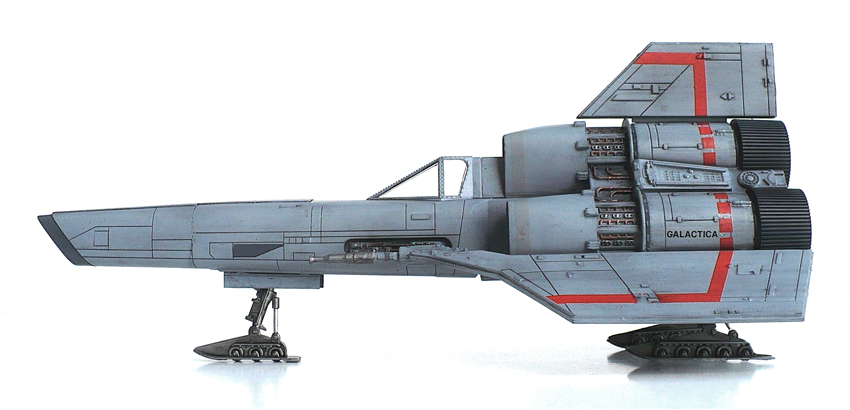
Here are some images of Moebius Models 1/32 scale Colonial Viper from the original Battlestar Galactica TV series of the 70's.
Is it just me or is the nose longer on this kit than it was on the TV show?
You'll note that I decided to put green lights into this, just to see what it would look like.
I also used a slightly darker grey, just to see what it would look like.
Another thing I did was place the Galactica name on the craft. I placed it in proximately the same area as one would see it on American navy jet fighters denoting the carrier they came from.

From Wikipedia"
The Colonial Viper is a fictional spacecraft in the Battlestar Galactica science-fiction franchise. It is the primary fighter spacecraft type used by the human protagonists in this fictional universe. Appearing in both the 1978 original series and the 2003 reimagined series, as well as various derivative works, the single-pilot spacecraft are carried aboard Battlestar Galactica and are the humans' main tools of defense against the fictional universe's antagonists - the cybernetic Cylon race.
The popularity of the original Battlestar Galactica series resulted in United States Air Force pilots nicknaming F-16 Fighting Falcons "Vipers". When the reimagined series was created, the Viper was one of the elements that the designers wanted to carry through with minimal alteration.
Colonial viper original-series.JPG
Original-series Vipers in flight.


In the original run of Battlestar Galactica, the Colonial Viper is the only known fighter flown by Colonial Pilots, referred to as "Colonial Warriors". There is only one known model of Viper seen in the series. Some materials list the Viper as a "Starhound Viper" or "Starhound Class" fighter, based on information in the novelization of "Saga of a Star World". The Vipers are launched from a long tube in one of a Battlestar's landing bays, assisted by a powered catapult mechanism. It appears that a Battlestar can launch at least three Vipers from each bay at once. Vipers are loaded into the launch tubes atop rails which engage recesses in the bottom of the fuselage between the lower wings. The rail system ensures that the Viper remains on the centerline of the launch tube.
Vipers typically use all three of their engines for powered flight, and can use a "Turbo" boost for greater speed, analogous to a modern fighter plane's afterburner. A pilot can turn on or off each engine by a push button, as seen in the startup sequence anytime a Viper is preparing to take off. Vipers can also reverse thrust for rapid deceleration, a useful tactic when being pursued by enemy ships that would then tend to overshoot the Viper, placing them in a vulnerable position. Vipers are capable of atmospheric as well as space flight, and can land and take off from a planetary surface. Viper engines are designed to collect commonly occurring gases in planetary atmospheres and in space to power the ship's fusion reactor. Vipers are also capable of supporting the pilot for up to two weeks in a form of "suspended animation" for extremely long missions.
The main flight control of a Viper is a three buttoned joystick, similar to a jet fighter. The three buttons are labeled FIRE, TURBO and IM, with the fire button being red. The IM button is the reverse thruster. Notably in "Saga of a Star World" and "The Gun on Ice Planet Zero (Pt. 2)" some Vipers have STORES on the joystick instead of FIRE.
Armament consist of two directed energy weapons (referred to as "lasers" and "laser torpedoes" at separate points in the series, "The Long Patrol" and "Saga of a Star World" respectively) that are linked together to fire simultaneously. They can also be modified to carry fire suppression equipment, as shown in the "Fire In Space" episode where they are used to battle a fire on the Galactica after the Cylons crash explosives-laden fighters into the launch bays. Vipers' computer systems include not only a targeting system for the craft's firepower, but also includes a military database called "Warbook," that assists warriors in identifying various spacecraft.
In the event of a crash landing, a Viper's cockpit can also be used as an escape pod, separating from the ship and parachuting to the ground. This system does not provide a soft landing—in fact, it can knock the pilot unconscious—but it is effective. A G-suit is worn under the pilot's uniform for protection against gravitational forces, as seen in "Lost Planet of the Gods, Part I". The flight helmet worn by the Warrior pilots resembles an ancient Egyptian headdress and has no faceplate. Viper pilots from each Battlestar have differing forehead ornamentation on their helmets: Pegasus pilot helmets feature a flying horse, while Galactica pilot helmets have a bird design. According to some sources, the Universal wardrobe department came up with designs for other helmets if they had ever been needed-pilots from battlestar Cerberus would have had a three-headed dog on their helmets, pilots from the Prometheus would have had a hand holding a flaming torch, and those from the Solaria would have featured a burning sun.

Each Viper contains spacesuits for its pilot(s). While not normally worn, they can be brought out and donned if an EVA is necessary (e.g. for emergency repairs). Vipers also contain emergency survival kits, which include a backpack with rations and a reflective blanket, a parka, and (following the capture and reverse-engineering of Cylon Centurions) a manual with schematics of Cylon circuitry


A "Recon Version" was piloted by Starbuck in "The Long Patrol". It possessed "nearly double the speed of a regular fighter", along with improved maneuverability, but lacked any armament due to the removal of the laser pumps. It also possessed C.O.R.A. (Computer, Oral Response Activated), a sultry female-voiced, voice-activated computer which doubled as an autopilot.
In the Galactica 1980 series, Vipers are shown to be newly capable of invisibility, which is explained in the episode "Galactica Discovers Earth". Other 1980 episodes indicate that a Colonial Warrior's uniform is meant to protect against the crushing effects of gravity, similar to an inertial damper. All Vipers also appear to be able to accommodate a passenger in the Galactica 1980 series, as hinted at in the first episode of the TV series. This is seen with Jamie Hamilton swapping between Troy and Dillon's Vipers throughout the series, and with Xavier tricking Troy & Dillon to fly his (sabotaged) Viper in "Spaceball". Vipers also appear to have largish cargo bays for their size as each one carries the Colonial equivalent of a motorcycle.
The 1988 film Space Mutiny, which used special effects shots from the original Battlestar Galactica, referred to the ships as "Stingray Vipers".
More advanced, upgraded versions, the Azure class and Scarlet class, appear in Richard Hatch's re-launch novel series and in his attempted revival trailer "Battlestar Galactica: The Second Coming". The Scarlet class features swept forward wings much like the X-29 experimental fighter plane.
In the 2003 Reimagining of the series, an Original Series Viper can be seen in the starboard flight pod "museum".
 While Vipers can operate from land and (according to the novel) have some refueling bases, they are mostly deployed from Battlestars. Each Battlestar is known to carry 75 Vipers. In the immediate aftermath of the cylon attack Galactica recovered 67 Vipers of which 25 belonged to its pre-attack squadrons, after this the Galactica hosted four squadrons named Blue, Red, Green and Yellow. Members of Silver Spar squadron later joined from the Pegasus after the Battle of Gamoray and the apparent destruction of that Battlesta

Wednesday, June 4, 2014

Sopwith Camel F.1

Here are some images of Hasegawa's 1/16 scale Sopwith Camel F.1 frame model.
This is one of the best kits ever created.

From Wikipedia"
The Sopwith Camel was a British First World War single-seat biplane fighter introduced on the Western Front in 1917. Manufactured by Sopwith Aviation Company, it had a short-coupled fuselage, heavy, powerful rotary engine, and concentrated fire from twin synchronized machine guns. Though difficult to handle, to an experienced pilot it provided unmatched manoeuvrability. A superlative fighter, the Camel was credited with shooting down 1,294 enemy aircraft, more than any other Allied fighter of the war. It also served as a ground-attack aircraft, especially near the end of the conflict, when it was outclassed in the air-to-air role by newer fighters.
ntended as a replacement for the Sopwith Pup, the Camel prototype was first flown by Harry Hawker at Brooklands on 22 December 1916, powered by a 110 hp Clerget 9Z. Known as the "Big Pup" early on in its development, the biplane design was structurally conventional for its time, featuring a box-like fuselage structure, an aluminium engine cowling, plywood-covered panels around the cockpit, and fabric-covered fuselage, wings and tail. For the first time on an operational British-designed fighter, two .303 in (7.7 mm) Vickers machine guns were mounted directly in front of the cockpit, firing forward through the propeller disc with synchronisation gear. A metal fairing over the gun breeches, intended to protect the guns from freezing at altitude, created a "hump" that led to the name Camel. The bottom wing was rigged with 3° dihedral but the top wing had no dihedral, so that the gap between the wings was less at the tips than at the roots. This was done at the suggestion of Fred Sigrist, the Sopwith works manager, in order to simplify construction. Approximately 5,490 Camels were built.
Unlike the preceding Pup and Triplane, the Camel was generally considered difficult to fly. The type owed its extreme manoeuvrability and its difficult handling to the close placement of the engine, pilot, guns and fuel tank (some 90% of the weight of the aircraft) within the front seven feet of the aircraft, coupled with the strong gyroscopic effect of the rotary engine. The Camel soon gained an unfortunate reputation with student pilots. The Clerget engine was particularly sensitive to fuel mixture control and incorrect settings often caused the engine to choke and cut out during take-off. Many crashed due to mishandling on take-off when a full fuel tank affected the centre of gravity. In level flight, the Camel was markedly tail-heavy. Unlike the Sopwith Triplane, the Camel lacked a variable incidence tailplane, so that the pilot had to apply constant forward pressure on the control stick to maintain a level attitude at low altitude. The aircraft could also be rigged so that at higher altitudes it was able to be flown "hands off." A stall immediately resulted in a particularly dangerous spin.


The type entered squadron service in June 1917 with No. 4 Squadron of the Royal Naval Air Service, near Dunkirk. The following month, it became operational with No. 70 Squadron of the Royal Flying Corps. By February 1918, 13 squadrons were fully equipped with the Camel.
The Camel proved to have a good margin of superiority over the Albatros D.III and D.V and offered heavier armament and better performance than the Pup and Triplane. In the hands of an experienced pilot, its manoeuvrability was unmatched by any contemporary type. Its controls were light and sensitive. The Camel turned rather slowly to the left, which resulted in a nose up attitude due to the torque of the rotary engine. But the engine torque also resulted in the ability to turn to the right in half the time of other fighters, although that resulted in more of a tendency towards a nose down attitude from the turn. Because of the faster turning capability to the right, to change heading 90° to the left, many pilots preferred to do it by turning 270° to the right.
Agility in combat made the Camel one of the best-remembered Allied aircraft of the First World War. RFC crew used to joke that it offered the choice between "a wooden cross, the Red Cross, or a Victoria Cross" Together with the S.E.5a and the SPAD S.XIII, the Camel helped to establish the Allied aerial superiority that lasted well into 1918.
Major William Barker's Sopwith Camel (serial no. B6313, the aircraft in which he scored the majority of his victories,) became the most successful fighter aircraft in the history of the RAF, shooting down 46 aircraft and balloons from September 1917 to September 1918 in 404 operational hours flying. It was dismantled in October 1918. Barker kept the dashboard watch as a memento, but was asked to return it the following day.
 An important role for the Camel was home defence. The RNAS flew a number of Camels from Eastchurch and Manston airfields against daylight raids by German Gotha bombers from July 1917. The public outcry against these raids and the poor response of London's defences resulted in the RFC diverting Camel deliveries from France to home defence, with 44 Squadron RFC reforming on the Camel in the home defence role in July 1917. When the Germans switched to night attacks, the Camel proved capable of being safely flown at night, and the home defence aircraft were modified with navigation lights to serve as night fighters. A number of Camels were more extensively modified as night fighters, with the Vickers machine guns being replaced by overwing Lewis guns, with the cockpit being moved rearwards so the pilot could easily reload the guns. This modification, which became known as the "Sopwith Comic" allowed the guns to be fired without affecting the night vision of the pilots, and allowed the use of new and more effective incendiary ammunition that was considered unsafe to fire from synchronised Vickers guns. By March 1918, the home defence squadrons were equipped with the Camel, with seven home defence squadrons flying Camels by August 1918. Camels were also used as night fighters over the Western Front, with 151 Squadron intercepting German night raids over the front, and carrying out night intruder missions against German airstrips, claiming 26 German aircraft shot down in five months of operations.

By mid-1918, the Camel was becoming limited, especially as a day fighter, by its slow speed and comparatively poor performance at altitudes over 12,000 ft (3,650 m). However, it remained useful as a ground-attack and infantry support aircraft. During the German offensive of March 1918, flights of Camels harassed the advancing German Army, inflicting high losses (and suffering high losses in turn) through the dropping of 25 lb (11 kg) Cooper bombs and ultra-low-level strafing. The protracted development of the Camel's replacement, the Sopwith Snipe, meant that the Camel remained in service until the Armistice.
In summer 1918, a 2F.1 Camel (N6814) was used in trials as a parasite fighter under Airship R23