Translate

Saturday, July 26, 2014

Panzer Jager 38t Marder III

Here are some more images of Italeri's 1/35 scale Panzer Jager 38t Marder III.

From Wikipedia"
The Marder III is the name for a series of World War II German tank destroyers built on the chassis of the Panzer 38(t). The German word Marder means "marten" in English. They were in production from 1942 to 1944 and served on all fronts until the end of the war.

Even in the early stages of Operation Barbarossa, the Wehrmacht already felt the need for a more mobile and more powerful anti-tank solution than the existing towed anti-tank guns such as Pak 36 or tank destroyers like the Panzerjäger I. This need became urgent in 1942, when anti-tank shells failed to penetrate the armour of new Soviet tanks like the T-34 and KV-1.
As an interim solution, it was decided to use captured French vehicles like the Lorraine (Marder I), obsolete tanks such as German Panzer II (Marder II), and Czech-supplied Panzer 38(t) (Marder III) as the base for makeshift tank destroyers. The result was the Marder series, which were armed with either captured Soviet 76.2mm F-22 Model 1936 divisional field guns, or German 7.5 cm PaK 40 anti-tank guns for later versions. Due to weight and space constraints of these small chassis, Marder series were not fully armored. Thin upper armor protection was provided only for the front and sides against shrapnel and small arms only. All Marder series had open tops. Some were issued with canvas tops to protect the crew from the elements. In this regard, Marder was more of a gun carriage than a proper Panzerjäger that could exchange shells with enemy tanks.
While the Panzer 38(t) had largely become obsolete as a tank in early 1942, it was still an excellent platform for adaptation into a tank destroyer, among other roles. Since the Soviet 76.2 mm field gun was captured in large quantities, the decision was made to mate this gun to the Panzer 38(t).
To do so, the production of the Panzer 38(t) Ausf. G was stopped and a modified superstructure was bolted onto the standard tank chassis. The upper structure mounted the gun and an extended gun shield, giving very limited protection for the commander and the loader. Armour protection overall ranged from 10 to 50 mm with no armor at all above and behind the gun compartment. The gun, commander and loader were located on top of the engine deck. It had a higher silhouette than the original Panzer 38 (t), which made it more vulnerable to enemy fire.
The now-called 7.62 cm PaK 36(r) was rechambered to be able to use standard German 75 mm ammunition, of which 30 rounds could be carried inside the vehicle. Apart from the main gun, there was a 7.92 mm machine gun mounted in the hull.
This tank destroyer was put into production as the Panzerjäger 38(t) für 7.62 cm PaK 36(r), Sd.Kfz. 139. A total of 344 vehicles were built in three series from April to November 1942. Chassis numbers were 1360-1479, 1527-1600 and 1601-1750.

The next variant of the Marder III fielded the standard 7.5 cm PaK 40 German anti-tank gun on a slightly modified Panzer 38(t) Ausf. H chassis. This chassis had the engine still in the rear of the vehicle but, unlike the previous model, this vehicle utilized the fighting compartment of Panzer 38 in the center. Center compartment allowed crew to stay low in the center of the vehicle, lowering crew exposure to small arms fire and fragments. But because of the rear-mounted engine, there was only enough room for two men to stand in the center. Large side armors gave additional protection for the crew. However, the horseshoe shape armor thinly protected front and side only. The rear and the top were exposed. Thirty-eight rounds of ammunition for the gun were carried. As with the Sd.Kfz.139, this vehicle also carried a 7.92 mm machine gun in the hull, of Czech manufacture.
The full name of the Ausf. H was the 7.5 cm PaK 40/3 auf Panzerkampfwagen 38(t) Ausf. H, Sd.Kfz. 138. a total of 275 vehicles were built in two series from November 1942 to April 1943. An additional 175 vehicles were converted from Panzer 38(t)'s in 1943. Chassis numbers of new vehicles were 1751–2075 and 2121–2147 (overlapping with simultaneous Grille production).

The last Marder III variant was based on the Geschützwagen 38(t) Ausf. M, a purpose-designed vehicle for self-propelled gun usage, again armed with the 75 mm PaK 40 anti-tank gun. Ausf. M was the final variant of the Marder series and was a significant improvement over previous models, with its lower silhouette, sloped armour and much more functional fighting compartment. In this variant, the engine was moved from the rear to the middle between driver and the rest of the crew. Because there was no engine in the rear, the gun and the crew did not have to sit on top of the engine deck as in previous models. The fighting compartment could be lowered down to the bottom floor level where the engine used to be. This decreased crew exposure, as well as visibility. Unlike the previous two Marder IIIs, the fighting compartment was closed at the rear protecting the crew up to their midsection. It stayed open-topped. It could only carry 27 rounds of ammunition. The machinegun port at the front was eliminated in the Ausf. M in favor of an MG 34 or MG 42 carried by the crew. In the previous two models, the commander served as a gunner. However, in Ausf. M, the radio man moved to the rear with the commander and gunner, serving as a loader. Combat effectiveness increased because the vehicle commander was freed from manning the gun.
The full name of the Ausf. M was Panzerjäger 38(t) mit 7.5 cm PaK 40/3 Ausf. M, Sd.Kfz. 138 . It was the variant which was produced in the largest numbers, in total 942 vehicles were built in two series from May 1943 to May 1944. Chassis numbers were 2166–2600 and 2601–3600 (overlapping with simultaneous Grille and Flakpanzer 38(t) production).

The various Marder IIIs fought on all fronts of the war, with the Sd. Kfz. 139 being used mainly at the Eastern Front, though some also fought in Tunisia. In February 1945 some 350 Ausf. M were still in service.
The Marder IIIs were used by the Panzerjäger Abteilungen of the Panzer divisions of both the Wehrmacht and the Waffen SS, as well as several Luftwaffe units, like the Hermann Göring division.
The Marder IIIs were mechanically reliable, as with all vehicles based on the Czechoslovak LT-38 chassis. Their firepower was sufficient to destroy the majority of Soviet tanks on the battlefield at combat range.
The Marder' IIIs weaknesses were mainly related to survivability. The combination of a high silhouette and open-top armor protection made them vulnerable to indirect artillery fire. The armor was also quite thin, making them highly vulnerable to enemy tanks and to close-range machinegun fire.
The Marders were not assault vehicles or tank substitutes; the open top meant that operations in urban areas or other close-combat situations were very risky. They were best employed in defensive or overwatch roles. Despite their mobility they did not replace the towed antitank guns.
In March 1942, before Marder III appeared, Germany already started production of StuG III assault gun with comparable anti-tank capability (StuG III Ausf. F and later variants). These were fully armored vehicles, built in much greater numbers than vulnerable Marder III. Among many German fully armored tank destroyers, also one based on Panzer 38(t) chassis was built in numbers since 1944: the Jagdpanzer 38(t). The weakly armored Marder series were phased out of production in favor of the Jagdpanzer 38(t) but Marder series vehicles served until the end of the conflict.

Friday, July 25, 2014

M 113 Armored Personnel Carrier

Here are some more images plus a composite of Tamiya's 1/35 scale M 113 Armored Personnel Carrier.

From Wikipedia "

The M113 is a fully tracked armored personnel carrier that has formed the backbone of the U.S. Army's mechanized infantry units from the time of its first fielding in Vietnam in April 1962. The M113 was the most widely used armored vehicle of the U.S. Army in the Vietnam War, earning the nickname 'Green Dragon' by some people, but largely known as an APC and ACAV (armored cavalry assault vehicle) by the allied forces, as it was used to break through heavy thickets in the midst of the jungle to attack and overrun enemy positions.
The M113 introduced new aluminum armor that made the vehicle much lighter than earlier vehicles. Thick enough to protect the crew and passengers against small arms fire but light enough that the vehicle was air transportable and moderately amphibious. In the United States Army the M113 series have long been replaced as front-line combat vehicles by the M2 and M3 Bradley but large numbers are still used in support roles such as armored ambulance, mortar carrier, engineer vehicle, command vehicle, etc. The Army's Heavy Brigade Combat Teams are currently equipped with around 6,000 M113s and 4,000 Bradleys. The M113's versatility spawned a wide variety of adaptations that live on worldwide, and in U.S. service. These variants together represent about half of U.S. Army armored vehicles today. To date, it is estimated that over 80,000 M113s of all types have been produced and used by over 50 countries worldwide, making it one of the most widely used armored fighting vehicles of all time. The Military Channel's "Top Ten" series named the M113 the most significant infantry fighting vehicle in history. The U.S. Army plans to retire the M113 family of vehicles by 2018 and is seeking replacement with the GCV Infantry Fighting Vehicle program.
The Vietnam War was the first combat opportunity for "mechanized" infantry, a technically new type of infantry with its roots in the armored infantry of World War II, now using the M113 Armored Personnel Carrier. In addition, Armored Cavalry squadrons in Vietnam consisted largely of M113s, after replacing the intended M114 in a variety of roles, and Armor battalions contained M113s within their headquarters companies, such as the maintenance section, medical section, vehicle recovery section, mortar section, and the scout (reconnaissance) section. U.S. Army mechanized infantry units in Vietnam were fully equipped with the M113 APC/ACAV, which consisted of one headquarters company and three line companies, normally with an authorized strength of approximately 900 men. Ten U.S. mechanized infantry battalions and one mechanized brigade were deployed to Vietnam from 1965 until their departure in 1972: 2/2nd Mechanized Infantry, 1/5th Mechanized Infantry, 2/8th Mechanized Infantry, 1/16th Mechanized Infantry, 2/22nd Mechanized Infantry, 4/23rd Mechanized Infantry, 2/47th Mechanized Infantry, 1/50th Mechanized Infantry, 5/60th Mechanized Infantry, 1/61st Mechanized Infantry, and the 1st Brigade, 5th Infantry Division (Mechanized)."
The U.S. Army 1st Brigade, 5th (Mech) Infantry Division in Vietnam was not composed of strictly mechanized infantry battalions. The 5th (M) ID (1st Bde), consisted of: the 5/4th Field Artillery, 1/11th Light Infantry (straight leg-no armored vehicles), 1/77th Armor (M48 Patton tanks), 1/61st Mechanized Infantry, "A" Troop" 4/12th Armored Cavalry (only one Troop of Cavalry), and the 3/5th Armored Cavalry OPCON (Operationally Controlled) /Attached from the 9th Infantry Division. The one troop of the 12th Armored Cavalry and the full squadron of the 5th Armored Cavalry were M551 Sheridan and M113 ACAV equipped
M113s were instrumental in conducting RIFs (Reconnaissance In Force), Search and Destroy missions, and large invasions (incursions) such as during the U.S. invasion of Cambodia on 1 May 1970 under President Richard Nixon, and later Laos (Operation Lam Son 719) in 1971; all of which utilized the M113 as the primary work horse for moving the ground armies. While operating with US Cavalry and Armor units, the M113s often worked in conjunction with US M48 Patton and M551 Sheridan tanks. During the Vietnam War, U.S. Army gun trucks (modified 2½-ton and 5-ton cargo trucks), along with V-100 armored cars, conducted convoy escorts for military traffic.
The USAF used M113 and M113A1 ACAV vehicles in USAF Security Police Squadrons, which provided air base ground defense support in Vietnam. M113s were supplied to the South Vietnam ARVN forces. One notable ARVN unit equipped with the M113 APC, the 3d Armored Cavalry Squadron, earned the Presidential Unit Citation. M113s were also supplied to the Cambodian government army, equipped with a turret for the machine gun and a recoilless rifle mounted on the roof.
Australian forces used the M113 in Vietnam. After initial experience showed the crew commander was too vulnerable to fire, the Australians tried a number of different guns shields and turrets, eventually standardizing with the Cadillac-Cage T-50 turret fitted with two .30 cal Browning machine guns, or a single .30/single .50 combination. Other turrets were tried as were various gun shields, the main design of which was similar to the gun shield used on the U.S. M113 ACAV version.
In addition, Australians operated an M113 variant fitted with a Saladin armored car turret, with a 76 mm gun as a fire support vehicle, or FSV, for infantry fire support. This has now also been removed from service.
Subsequent to Vietnam all Australian M113 troop carriers were fitted with the T50 turret. The FSV was eventually phased out and replaced with a modernized version known as the MRV (medium reconnaissance vehicle). The MRV featured a Scorpion turret with 76 mm gun, improved fire control, and passive night vision equipment.


Thursday, July 24, 2014

ISU-152 Self Propelled Gun

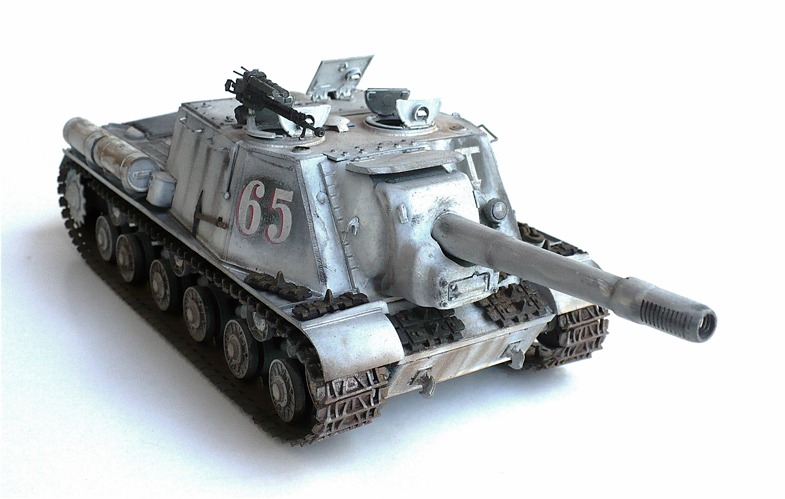
Here are some more images of Italeri's 1/35 scale ISU-152 Self Propelled Gun.

From Wikipedia "

The ISU-152 was a Soviet multirole fully enclosed and armored self-propelled gun developed and used during World War II, with a subsequent use, mainly in the Soviet military, till the 1970s. The ISU-152 marks its beginning on January 24, 1943. This was the moment of appearance of the first fighting vehicle of this family. It was designated Object 236 (Объект 236), using the same concept as the ISU-152. The Object 236 was completed in Factory No. 100 in Chelyabinsk, and on the same day, January 24, underwent trials on the Chebarkulski artillery range, 107 km from Chelyabinsk. By the February 7, 1943 the trials were over, passed with success. On February 14 the vehicle was adopted and put on production under the KV-14 (КВ-14) designation. In April 1943 was ordered KV-14 to be henceforth designated SU-152 (СУ-152). In time, the combat performance of SU-152, based on the KV-1S tank, made necessary the modernisation of the vehicle, using the new IS tank as a base. On May 25, 1943, shortly after deployment, the administration of Factory No. 100 ordered the beginning of the SU-152 modernization, which included an increase of the armor protection and other improvements. The development began in July 1943, under the supervision of Joseph Yakovlevich Kotin (the chief designer of Soviet heavy tanks) and G. N. Moskvin as the main designer, and in about a month the first modernized variant was ready. It was designated IS-152 (ИС-152). It underwent factory trials in September 1943, revealing a large number of different deficiencies, which sent it back for further improvement. In October 1943 a second (different) modernized variant was ready, designated Object 241 (Объект 241). It was an improvement over the IS-152. The factory trials began the same month, followed by state trials on the Gorohovetskom test range. On November 6, 1943, an order was issued for adoption of this variant, under the ISU-152 (ИСУ-152) designation, and in December its production began at the Chelyabinsk Kirovsk Plant, replacing the SU-152. 

Wednesday, July 23, 2014

STEYR RSO 1 Tractor

Here are some more images of Italeri's 1/35 scale STEYR RSO/1 Tractor. The RSO stands for Raupenschlepper Ost which means "crawling tractor east" In order to cope with poor road conditions on the Eastern front the Germans built tracked tractors to tow all types of vehicles and to carry various loads such as food, ammunition and supplies. The RSO/1 was built by Steyr Werks in Austria. It had a pressed steel cab and a wood cargo body. The RSO/1 proved to be ideal for the mud and slush conditions of the Russian front. These vehicles were part of the Germans desperate efforts to avoid defeat by an overwhelming Soviet military. Approximately 23,000 were produced.

Tuesday, July 22, 2014

M35A1 Quad-.50 Gun Truck

Here are some images of AR.V Club's 1/35 scale M35A1 Quad-.50 Gun Truck.

From Wikipedia "


 The M35 family of trucks is a long-lived vehicle initially deployed by the United States Army, and subsequently utilized by many nations around the world. A truck in the 2½ ton weight class, it was one of many vehicles in U.S. military service to have been referred to as the "deuce and a half." While the basic M35 cargo truck is rated to carry 5,000 pounds (2,300 kg) off road or 10,000 pounds (4,500 kg) on roads, they have been known to haul twice as much as rated. Trucks in this weight class are considered medium duty by the military and Department of Transportation. The M35 series formed the basis for a wide range of specialized vehicles.
The versatility of the pattern was perhaps shown best in its usage as an armored "gun truck" for patrol duties and convoy escort.
The simplest examples were produced by simply placing an existing light gun mount directly onto the cargo bed of the truck, and securing it in place. No armouring or special support equipment was installed. One such conversion was performed in Congo-Leopoldville in 1965, using an Oerlikon GAI 20 mm anti-aircraft gun. Another conversion in the Congo entailed mounting pods with 2.75" aircraft rockets on a pedestal on the cargo bed, but this proved unsuccessful.
The first more sophisticated conversions of the pattern were performed by the U.S. military in Vietnam. U.S. Army Artillery Battalions (Automatic Weapons, Self-Propelled) were often assigned Artillery Batteries (.50-caliber), units equipped with M35 trucks and M55 Quadmount systems mounting four M2 Browning machine guns. Units were also authorized a single M60 machine gun and M79 grenade launcher. While the M35 was designed to act as the prime mover for the M55 Quadmount system, which included a towed trailer, the M45 mount was often removed or the wheels removed from the trailer, and the system mounted on the bed of the truck. The M55 system was also mounted on the M54 truck.
More simplified armoring projects were conducted as well, adding armored walls of various thicknesses to standard cargo variants. A smaller bed-mounted multi-angle "box" was also tried. U.S. Army gun trucks used a wide variety of weapons including the M2 Browning machine gun, M60 machine gun, and even the M134 Minigun.
At the end of the Vietnam War most of these vehicles were returned to their standard configuration, except for a single original example shipped to the U.S. Army Transportation Museum at Fort Eustis, Virginia in 1971.
Numerous Vietnam veterans have expended countless hours to build full size replicas of their original Gun Trucks, using M35, M54, and even Army Dump Trucks as platforms, much the same as these veterans did in Vietnam. A functional display replica of the "Psychotic Reaction" Gun Truck Based on an M35A2 chassis is currently in use and being displayed at many military vehicle displays and Vietnam veteran reunions / events.
The concept lived on well after the Vietnam War. El Salvador converted a number of M35 type vehicles into armored trucks in the 1980s, after successful conversions of Magirus Deutz trucks. These vehicles were nicknamed "Mazingers" in reference to the Japanese cartoon Mazinger Z.
The Philippine Marine Corps also began converting M35 type trucks to an armored configuration by 2004. The first vehicle, dubbed "Talisman," utilized armor fabricated from derelict LVTP5 amphibious personnel carriers. Later gun trucks were built using more standard components and bear some resemblance to U.S. military vehicles of the Vietnam era. The Philippine Marine Corps had also begun the creation of an anti-aircraft element by 2006, utilizing M35 based vehicles. Two types of vehicles have been seen so far. One utilizes the Mk 56 Mod 0 mount from the Patrol Boat, River, with two M2 Browning machine guns, while the other features another former naval mount with a single Oerlikon 20 mm cannon.
Colombia maintains a fleet of REO M35 "Meteoro" armored trucks. These locally fabricated armored vehicles are used to guard tourist bus caravans as well as mobile checkpoints. Early vehicles were not fabricated to any particular standard and typically hosted three weapon stations that could be fitted with a 7.62 mm (.308-cal) or .50-caliber (12.7 mm) machine gun. The weapon stations may or may not have had a gun shield on any particular vehicle. More recent examples follow a pattern with the cab and fuel tanks armored and the drop side cargo bed converted to an armored box, atop which is a "gun tower," a set of four heavily armored weapon stations, one facing each direction. .50-caliber machine guns are mounted front and back, with 7.62 mm machine guns mounted to the sides. Losses in the Meteoro fleet instigated the purchase of the BTR-80 Caribe.

In addition to the basic cargo version, tank water and fuel. The CEMABLIN-(Centro de Mantenimiento de Blindados del Ejército Venezolano) locally manufactured a version of anti-air defense operations and support, thanks to all the necessary parts were stored and in perfect condition. 6 units were produced in early 1998. The "Fénix" system, was assigned to the 1103º BDAA 40mm. based at Fort Yaurepara in Zulia state. But they had problems with the tower's weight and shoot on the move. They were retired in 1998 and substituted by the AMX-13 M55/M4E1 "Ráfaga" 40mm also produced locally stored material advantage and in good condition. The "Fénix" is a M4E1 tower, recovered from a car M42 Duster and 2 M50 machine guns .30 caliber for Protective Part (a cylindrical tower made of welded armor plate with open top with twin mounting Bofors 40 mm gun), mounted on a tactical platform Truck 6x6 2 1/ 2 tons, Reo M-35.


Sunday, July 20, 2014

S.gl.Pkw. Steyr Kommandeurwagen

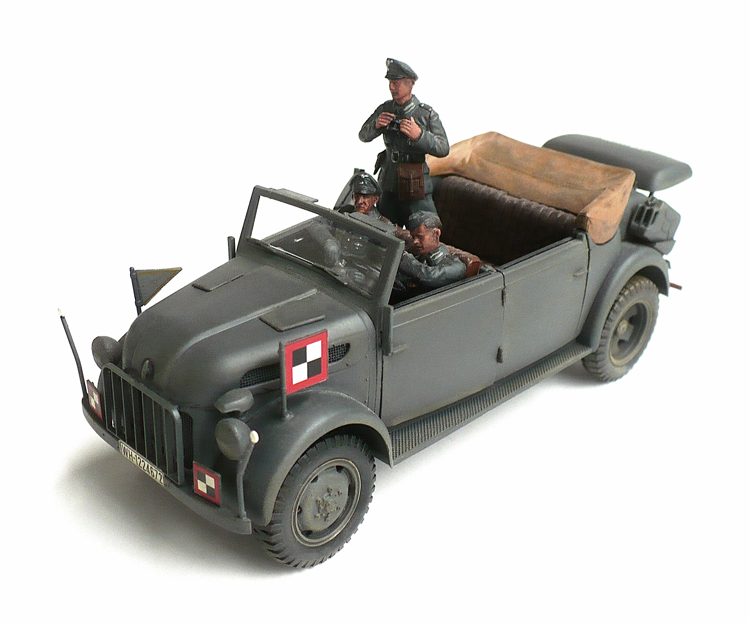
Here are some more images of Tamiyas 1/35 scale S.gl.Pkw. Steyr Kommandeurwagen. This was the vehicle of choice for high ranking German officers of World War 2 when out and about in the field. Originally this vehicle was designed to carry 8 passengers but to accommodate for comfort could only now carry 5 passengers. The model itself went together without any difficulty and is nicely detailed.

Friday, July 18, 2014

U.S.S. Reluctant

Here are some more images of my 1/1400 scale kitbash of the Hoplomachy Class Starship the U.S.S. Reluctant.
Based off the the Sovereign Class's secondary hull The Hoplomachy Class is built for one purpose. War.
After recent experiences with the Borg, The Dominion, The Cardassians and the Remans it was felt that the development of a purely military vessel was necessary. Based off already existing designs the Hoplomachy class can be quickly and easily produced.

Hoplomachy Class:

Dimensions:
Length: 515.4 meters
Width: 168.3 meters
Height: 83.6 meters

Specifications:
Decks: 17
Crew: 389 officers and crew
Speed: Warp 9.986
Armaments: 6 type 12 phaser arrays
10 torpedo launchers
2 Lazarus Systems type 9a phase cannons
Defenses: Deflector shields 7 layer

Auxiliary Craft: 8 work bees
4 shuttlecraft (2 with warp capabilities)
8 shuttlepods

Affiliation: Federation, Starfleet

This model was kitbashed from AMT's Enterprise E model kit as well as parts from my spares box. The 2 heat dissipation units atop the warp nacelles are actually snow skis from a 1/32 scale DeHavilland Tigermoth kit.
The aztecing decals were downloaded from Starship Modelers web site onto Testors decal sheet using my trusty printer.
Anyone see Mr. Roberts?

Thursday, July 17, 2014

DY 150 Class

Here are some images of Spaceship Miniatures DY 100 class converted to a DY 150 Class by yours truly.
Why would I convert this kit into my interpretation of a DY 150 Class?
Well, when this vacuform kit was released back in the late 80's The best information around then were a few photo's from books and images from the Star Trek episode "Space Seed".  So during that time this kit was about as accurate as it could be. Unfortunately now that proper blueprints and images are now available the accuracy of this DY 100 kit is not quite up to par. Solution? Make a DY Class upgrade. So thus I now present to you my interpretation of a DY 150 Class.

Wednesday, July 16, 2014

Enterprise Refit Under Construction

Here are some more images of my kitbash/scratchbuild 1/1000 scale U.S.S. Enterprise Refit under construction.
I think that if one were to refit the Enterprise, the logical way to do it would be to build the new shell over the old one. After which the old shell would either be removed manually or beamed out. the pylons, nacelles and sensor arrays would of course have to be completely replaced.

Tuesday, July 15, 2014

AT-AT (All Terrain Armored Transport)


Here are some more images of MPC's AT-AT (All Terrain Armored Transport) from Star Wars.

From Wikipedia "

The AT-AT is a large, four-legged walker introduced in The Empire Strikes Back and also appearing in Return of the Jedi.
Joe Johnston's original design for the Empire's war machines was a giant, multi-wheeled vehicle; this design later became the "Juggernaut" in West End Games' roleplaying material, and the design was reworked into the clone turbo tank for Star Wars Episode III: Revenge of the Sith.
For The Empire Strikes Back, however, the final design was a four-legged walker. Industrial Light & Magic (ILM) created models ranging from 6 to 50 centimeters in height. ILM filmed the AT-ATs using stop-motion animation against matte paintings created by Mike Pangrazio because attempts at compositing miniature footage against live-action background footage yielded mediocre results. Additionally, ILM studied elephants to determine the best way to animate the four-legged AT-ATs. Although the stop-motion animation style gave the AT-ATs a jerky, "staccato-like" effect on film, ILM found this movement acceptable because of the AT-ATs' mechanical nature. The sound of the AT-AT walking was created by Sound Designer Ben Burtt, by using the sound of an industrial sheet metal stamper.
Dialog in National Public Radio's adaptation of The Empire Strikes Back states that AT-ATs "look like animals"; the character goes on to describe the vehicles as carrying "extremely heavy armor and armaments". The AT-AT, designed to favor "fear over function", can carry five speeder bikes and 40 Imperial stormtroopers. The walkers themselves carry two blasters and two laser cannons. Manufactured by Kuat Drive Yards, Expanded Universe sources describe the AT-AT as being either 15 or 22.5 meters tall. Their armor is resistant to standard blaster weapons; however, the "neck" column of the walker holds no such invulnerability and, if shot, can cause the entire walker to be destroyed.