Please click on images to see them full size.
Unless otherwise indicated all photographs
©Warren Zoell

Translate

Tuesday, January 31, 2012

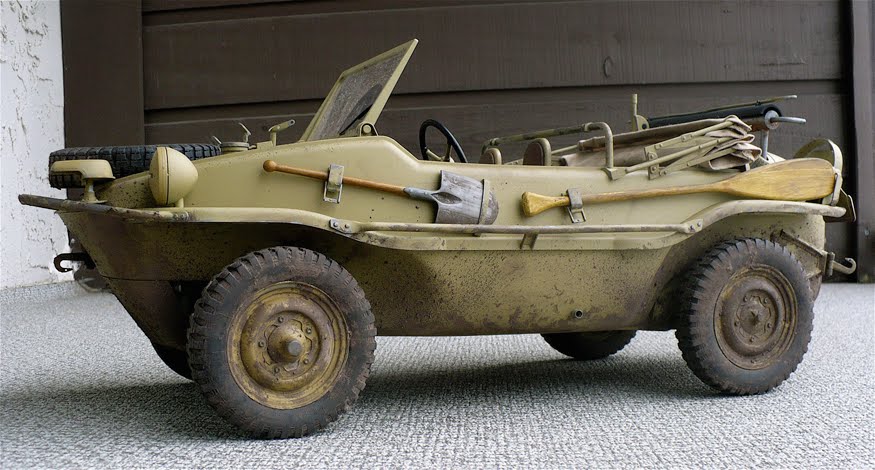
Volkswagen Schwimmwagen Type 166


Here are some images of Dragon Model's 1/6 scale Type 166 Schwimmwagen.
The first thing I noticed when I first opened the box was that it was quite literally packed to the top with parts. The next was the beautiful detail of these parts. However in keeping with Dragon's fine tradition with supplying their beautiful model kits with the worst possible instructions ever created by man or beast this kit did not disappoint. If Dragon models ever sees this I would like to ask them. How is it that you put all this effort in producing some of the finest kits in the world yet are a complete dismal failure when it comes to instructions? All these instructions show are pictures of the completed model with arrows pointing to parts with a number indicator, and some of those numbers are wrong. LOL!! As for assembly procedure and in what order sorry but you're on your own. Thankfully though they at least had the courtesy to supply a tree parts diagram. One notices that when the model is finished you're left with a lot of unused parts. I suspect these parts must be for a 1/6 scale Kubelwagen. That being said once you've struggled through its building you are left with one hell of a model. A real head turner. The mother of all Schwimmwagen kits.

Saturday, January 28, 2012

Y Wing Starfighter


Here are some images of Revell's 1/72 scale? Snap Tite kit Y Wing Starfighter from Star Wars.
The general rule of thumb when dealing with pre painted snap tite kits is of course to glue and to repaint them which is precisely what has been done here, and judging from the detail this kit comes with, well worth the effort.

From Wikipedia"
Y-wings are fictional Rebel Alliance and New Republic starfighters in the Star Wars universe. They appear in Star Wars Episode IV: A New Hope, Star Wars Episode V: The Empire Strikes Back, and Star Wars Episode VI: Return of the Jedi, as well as the Clone Wars TV series and the Expanded Universe's books, comics, and games.

Industrial Light & Magic's Colin Cantwell, who also designed the saga's TIE fighters, initially designed the Y-wing with a large bubble turret for a gunner. However, the dome did not appear properly when filmed against bluescreen, and subsequent designs excised the turret.

Y-wings are described in the Expanded Universe as durable but slow tactical strike spacecraft, although notes and diagrams by the special effects crew for Return of the Jedi (shown in The Art of Return of the Jedi) show the Y-wing as possessing the same speed and maneuverability as the X-wing and standard TIE fighter. The destruction of Y-wings tasked with destroying the Death Star at the Battle of Yavin in A New Hope leads to Luke Skywalker (Mark Hamill) firing the proton torpedoes that destroy the Empire's battle station. Only one Y-wing survives the battle.

Y-wings also participate at the Battle of Endor in Return of the Jedi. The Expanded Universe describes several Y-wing varieties, such as a one-seater version, a two-seater (one pilot, one gunner) variety, and the "Longprobe" reconnaissance ship.


The Eagle Has Landed


Here are some images of Dave Porter's Apollo 11 LM landing and here in his own words is his description.

This is a 1/48 scale depiction of one of the greatest events in human history. Apollo 11.(If you were to say “greatest” I wouldn’t argue.) This is an out of the box model of the Lunar Lander compliments of Monogram. Its a good kit that went together reasonably well. The moon surface is pretty neat and the Astronaut miniatures are cool too. The gold covering for the lander that was included in the kit didn’t work so well. I decided to sugar up and buy a few Caramilk bars in order to use the nice gold foil that they’re wrapped in.

Friday, January 27, 2012

F-4E Phantom


Here are some images of Dave Porter's F-4E Phantom and here in his own words is his description.

This a 1/48 scale F-4E Phantom from Esci. I built the kit straight from the box and I used Aeromaster paint and decals. It has nice recessed panel lines and it fit together very well. The F-4E was a logical development of the F-4C and F-4D as the Air Force’s front line fighter. The “tree” and the gun were important additions that made the F-4 come into it’s own. No Viet Nam era Navy Phantoms were equipped with a gun.

Wednesday, January 25, 2012

Atlas Booster With Mercury Capsule


Here are some images of Yee Old Revell's 1/110 scale Atlas Booster with Mercury Capsule.
I am often amazed at how much intricacy some of these old kits have even when compared to today's model kits. The launch building on this model is just one example.

From Wikipedia"

Mercury-Atlas 8 (MA-8) was an early manned space mission, part of NASA's Mercury program. Astronaut Walter M. Schirra, Jr., orbited the Earth six times in the Sigma 7 spacecraft on October 3, 1962, in a nine-hour flight focused mainly on technical evaluation rather than on scientific experimentation. This was the longest American orbital flight yet achieved in the Space Race, though well behind the several-day record set by the Soviet Vostok 3 earlier in the year. It confirmed the Mercury spacecraft's durability ahead of the one-day Mercury-Atlas 9 mission that followed in 1963.

Planning began for the third orbital mission in February 1962, aiming for a six-or-seven-orbit flight to build on the previous three-orbit missions. NASA officially announced the mission to the public on June 27, and the flight plan was finalised in late July. The mission focused on engineering tests rather than on scientific experimentation. The mission finally launched on the morning of October 3, having been delayed two weeks because of problems with the Atlas booster. A series of minor booster problems during launch and a faulty temperature controller in Schirra's pressure suit were the only technical problems noted during the flight. The spacecraft orbited in both automated and passive flight modes for prolonged periods while the pilot monitored it and carried out some minor scientific experiments. After six orbits, the capsule landed in the Pacific Ocean half a mile from the recovery carrier, and was hoisted aboard for Schirra to disembark.

The scientific results of the mission were mixed. The astronaut returned healthy and was released after nine hours of confinement in a low-gravity environment. Observation of the Earth's surface proved unproductive, however, because of heavy cloud cover and bad photographic exposures. The public and political reaction was muted compared with that of earlier missions, as the Cuban Missile Crisis quickly eclipsed the space race in the news. The mission was a technical success: all the engineering objectives had been completed without significant malfunctions, and the spacecraft had used even less fuel than expected. This confirmed the capabilities of the Mercury spacecraft and allowed NASA to plan with confidence for a day-long flight, MA-9, which had been an early goal of the Mercury program.


Critical Mass


Here is an image of Dave Porter's Hawker Sea Fury "Critical Mass", And here in his own words is his description. This is Critical Mass, a highly modified Hawker Sea Fury race plane that competed in the Unlimited class at the Reno air races. The kit is in 1/72 scale by High Planes models. I finished it in Testors Italian red, insignia white, and gloss black. The kit was fairly demanding to build but it scales out nicely.

Tuesday, January 24, 2012

Bismark


Here is an image of Dave Porter's SOB build of the popular 1/350 scale Bismarck by Tamiya. The kit was finished in Tamiya colors. It’s an old kit from the late seventies but it still stands up as a quality item.

Thursday, January 19, 2012

Junkers JU 87 B2 Stuka


Here are some images of MPC's (Airfix molds) 1/24 scale Junkers JU 87 B2 Stuka.
I can't attest to the accuracy of the paint and markings of this particular aircraft. The problem lies within the kit itself. First off as for the painting the kit calls for the aircraft to be painted olive drab. Never in my life have I ever seen a German aircraft painted olive drab, especially the early production Stukas. So I decided to paint it in the standard RLM 70, 71 camouflage pattern with an RLM 76 light blue under carriage. This was the standard colour pattern for Stukas of this type.
Next are the markings, particularly the yellow band around the the fuselage. On the box top it shows a thin yellow band however when one looks at the photo's of the model on the side of the box it shows thick yellow band further back on the fuselage. To make matters worse the instructions call for a thick yellow band closer to the canopy. A search on the interweb for this particular aircraft didn't yield any helpful results so I decided to go with what the instructions called for. So if anyone wishes to complain to me as regards the markings please understand I did my best.

From Wikipedia"

The Ju 87 B series was to be the first mass-produced variant. A total of six pre-production Ju 87 B-0 were produced, built from Ju 87 A airframes. Test flights began from the summer of 1937. A small number, at least three, served as conversion Cs or Es for potential naval variants.

The first production version was the Ju 87 B-1, with a considerably larger engine, its Junkers Jumo 211D generating 1,200 PS (883 kW, 1,184 hp), and completely redesigned fuselage and landing gear. This new design was again tested in Spain, and after proving its abilities there, production was ramped up to 60 per month. As a result, by the outbreak of World War II, the Luftwaffe had 336 Ju 87 B-1s on hand. The B-1 was also fitted with "Jericho trumpets", essentially propeller-driven sirens with a diameter of 0.7 m (2.3 ft) mounted on the wing's leading edge directly forward of the landing gear, or on the front edge of the fixed main gear fairing. This was used to weaken enemy morale and enhance the intimidation of dive-bombing. After the enemy became used to it, however, they were withdrawn. The devices caused a loss of some 20–25 km/h (10-20 mph) through drag. Instead, some bombs were fitted with whistles on the fin to produce the noise after release.

The trumpets were a suggestion from Generaloberst Ernst Udet (but some authors say the idea originated from Adolf Hitler). The Ju 87 B-2s that followed had some improvements and were built in a number of variants that included ski-equipped versions (the B-1 also had this modification), and at the other end, with a tropical operation kit called the Ju 87 B-2 trop. Italy's Regia Aeronautica received a number of the B-2s and named them the "Picchiatello", while others went to the other members of the Axis, including Hungary, Bulgaria and Romania. The B-2 also had an oil hydraulic system for closing the cowling flaps. This continued in all the later designs.

The tropicalised versions were initially named the Ju 87 B-2/U1. This was eventually designated the Ju 87 B-2 trop, equipped with tropical emergency equipment and sand filters for the powerplant.

Production of the Ju 87 B started in 1937. 89 B-1s were to be built at Junkers' factory in Dessau and another 40 at the Weserflug plant in Bremen by July 1937. Production would be carried out by the Weserflug company after April 1938, but Junkers continued producing Ju 87 up until March 1940. Total production amounted to 697 B-1s (311 by Junkers, 386 by Weserflug) and 225 B-2s (56 by Junkers, 169 by Weserflug). The last Ju 87B rolled off the production lines in October 1940

Saturday, January 14, 2012

BF 109 G


Here are some images of Revell's 1/32 scale Messerschmitt Bf 109 G done in Eric Hartmann's winter camouflage markings. (I know wrong G). This was more of a paint experiment anyway. Still it turned out pretty good I think.

From Wikipedia"

Erich Alfred Hartmann (19 April 1922 – 20 September 1993), nicknamed "Bubi" (the hypocoristic form of "young boy") by his comrades and "The Black Devil" by his Soviet enemies, was a German World War II fighter pilot and is the highest-scoring fighter ace in the history of aerial warfare. He claimed 352 aerial victories (of which 345 were won against the Soviet Air Force, and 260 of which were fighters) in 1,404 combat missions. He engaged in aerial combat 825 times while serving with the Luftwaffe. During the course of his career, Hartmann was forced to crash-land his damaged fighter 14 times. This was due to damage received from parts of enemy aircraft he had just shot down or mechanical failure. Hartmann was never shot down or forced to land due to fire from enemy aircraft.

Hartmann, a pre-war glider pilot, joined the Luftwaffe in 1940 and completed his fighter pilot training in 1942. He was posted to Jagdgeschwader 52 (JG 52) on the Eastern front and was fortunate to be placed under the supervision of some of the Luftwaffe's most experienced fighter pilots. Under their guidance, Hartmann steadily developed his tactics, which earned him the coveted Ritterkreuz mit Eichenlaub, Schwertern und Brillanten (Knight's Cross of the Iron Cross with Oak Leaves, Swords and Diamonds) on 25 August 1944 for claiming 301 aerial victories.

He scored his 352nd and last aerial victory on 8 May 1945. He and the remainder of JG 52 surrendered to United States Army forces and were turned over to the Red Army. In an attempt to pressure him into service with the Soviet-friendly East German Volksarmee, he was convicted of false/unjustifiable war crimes, a conviction posthumously voided by a Russian court as a malicious prosecution. Hartmann was sentenced to 25 years of hard labour and spent 10 years in various Soviet prison camps and gulags until he was released in 1955.

In 1956, Hartmann joined the newly established West German Luftwaffe and became the first Geschwaderkommodore of Jagdgeschwader 71 "Richthofen". Hartmann resigned early from the Bundeswehr in 1970, largely due to his opposition to the F-104 Starfighter deployment in the Bundesluftwaffe and the resulting clashes with his superiors over this issue. He was later involved in flight training. Hartmann died in 1993; he was 71.

Tuesday, January 10, 2012

Bussard Ramjet


Here are some images of my scratch built concept engine/ship of the Bussard Ramjet.

From Wikipedia"

The Bussard ramjet is a theoretical method of spacecraft propulsion proposed in 1960 by the physicist Robert W. Bussard, popularized by Larry Niven in his Known Space series of books, and referred to by Carl Sagan in the television series and book Cosmos.

Bussard proposed a ramjet variant of a fusion rocket capable of reasonable interstellar spaceflight, using enormous electromagnetic fields (ranging from kilometers to many thousands of kilometers in diameter) as a ram scoop to collect and compress hydrogen from the interstellar medium. High speeds force the reactive mass into a progressively constricted magnetic field, compressing it until thermonuclear fusion occurs. The magnetic field then directs the energy as rocket exhaust opposite to the intended direction of travel, thereby accelerating the vessel.

A major problem with using rocket propulsion to reach the velocities required for interstellar flight is the enormous amounts of fuel required. Since that fuel must itself be accelerated, this results in an approximately exponential increase in mass as a function of velocity change at non-relativistic speeds, asymptotically tending to infinity as it approaches the speed of light. In principle, the Bussard ramjet avoids this problem by not carrying fuel with it. An ideal ramjet design could in principle accelerate indefinitely until its mechanism failed. Ignoring drag, a ship driven by such an engine could theoretically accelerate arbitrarily close to the speed of light, and would be a very effective interstellar spacecraft. In practice, since the force of drag produced by collecting the interstellar medium increases approximately as its speed squared at non-relativistic speeds and asymptotically tends to infinity as it approaches the speed of light (taking all measurements from the ship's perspective), any such ramjet would have a limiting speed where the drag equals thrust. To produce positive thrust, the fusion reactor must be capable of producing fusion while still giving the incident ions a net rearward acceleration (relative to the ship).

Friday, January 6, 2012

The Songs Of A Distant Earth


Here are some images plus a composite of my scratch built model of the Colony Ship Magellan based off of Philippe Bouchet AKA "Manchu" illustration art for Arthur C Clarke's "The Songs Of A Distant Earth".

From Wikipedia"

The novel is set in the early 3800s and takes place almost entirely on the faraway oceanic planet of Thalassa. Thalassa has a small human population sent there by way of an embryonic seed pod, one of many sent out from Earth in an attempt to continue the human race's existence before the Earth is destroyed.

It starts with an introduction to the native Thalassans – the marine biologist Mirissa, her partner Brant and other friends and family. Their peaceful existence comes to an end with the appearance of the Magellan, a spaceship from Earth containing one million colonists who have been put into cryonic suspension.

In a series of descriptive passages the events leading up to the race to save the human species are explained. Scientists in the 1960s discover that the neutrino emissions from the Sun – a result of the nuclear reactions that fuel the star – are far diminished from expected levels. Less than a decade later, it is confirmed that the problem is not with the scientific equipment: the Sun is calculated to go nova around the year AD 3600.

The human race's technology advances enough for various factions to send out pods containing human and other mammalian embryos (and later on, simply stored DNA sequences), along with robot parents, to planets that are considered habitable. Sending live humans is ruled out due to the immense amount of fuel that a rocket-propelled spacecraft would have to carry in order to first accelerate to the speeds required to travel such great distances within an acceptable time, and then decelerate upon approaching the destination. However, less than a hundred years before the Sun is set to go nova a scientific break-through allows construction of the quantum drive, which bypasses this problem. There only remains enough time to build and send to the stars a single quantum-drive ship: the Magellan.

Thalassa's only connection with Earth (and anywhere else) was a single communication dish, which was destroyed during a volcanic eruption 400 years ago and never repaired, thus leaving the Thalassans unaware of later developments on Earth. The Magellan stops at Thalassa to replenish the mammoth ice shield that had prevented micrometeors from damaging it during its interstellar journey. Thalassa is the obvious choice for this operation, as 95% of the planet's surface is covered by water. At the end of the novel the Magellan continues on to its destination, the planet Sagan 2.

As a kind of sub-plot it is revealed that beneath Thalassa's oceans there live sentient beings similar to the sea scorpions of Earth, only much larger. They are discovered – and named Scorps – when it attracts attention that robots designed to seek out fish frequently go missing. The Scorps gain the robots' metal in order to make bands of honour and rank. The Scorps are proven farmers; they have created their own village out of underwater rock caves.

Some of the crew aboard the Magellan begin to consider mutiny, wanting to stay in the secure environment of Thalassa rather than make the journey on to an unknown planet that may indeed be habitable, but just as well not. The situation is solved just before take-off – the mutineers are left with the Thalassans, while the bulk of the crew and passengers continue on to Sagan 2.

The book finishes with Mirissa sending messages to her lover, Loren Lorenson aboard the Magellan, showing him their son. Loren is not going to see the child until long after its and Mirissa's death. Mirissa's last clear sight when she is old is of the fading star in the Thalassan sky that is the Quantum drive of the Magellan.

Wednesday, January 4, 2012

Red Arrows BAe Hawk


Here are some images of Revell's 1/32 scale British Aerospace BAe T.1a Hawk in Red Arrows markings.

From Wikipedia"
The BAE Systems Hawk is a British single-engine, advanced jet trainer aircraft. It first flew in 1974 as the Hawker Siddeley Hawk. The Hawk is used by the Royal Air Force, and other air forces, as either a trainer or a low-cost combat aircraft. The Hawk is still in production with over 900 Hawks sold to 18 customers around the world.

In 1964 the Royal Air Force specified a requirement (Air Staff Target (AST) 362) for a new fast jet trainer to replace the Folland Gnat. The SEPECAT Jaguar was originally intended for this role, but it was soon realised that it would be too complex an aircraft for fast jet training, and only a small number of two-seat versions were purchased. Accordingly, in 1968, Hawker Siddeley Aviation (HSA) began studies for a simpler aircraft, initially as special project (SP) 117. The design team was led by Ralph Hooper.[1] This project was funded by the company as a private venture, in anticipation of possible RAF interest. The design was conceived of as having tandem seating and a combat capability in addition to training, as it was felt the latter would improve export sales potential. Through 1969 the project was first renamed P.1182, then HS.1182. By the end of the year HSA had submitted a proposal to the Ministry of Defence based on the design concept, and in early 1970 the RAF issued Air Staff Target (AST) 397 which formalised the requirement for new trainers of this type. The RAF selected the HS.1182 for their requirement on 1 October 1971 and the principal contract, for 175 aircraft, was signed in March 1972.

Renamed "Hawk" following an employee naming competition (the name "Tercel", a male hawk, was the actual winning name, but the RAF preferred the more common and simpler name), the aircraft first flew on 21 August 1974.

At the time, its main competitor was the Dassault/Dornier Alpha Jet; both types were intended to be exported and John W. R. Taylor commented on the situation: "What Europe must avoid is the kind of wasteful competition that has the Hawker Siddeley Hawk and Dassault-Breguet/Dornier Alpha Jet battling against each other in the world market."

In 1977 Hawker Siddeley merged with other British aircraft companies to form the nationalised British Aerospace (BAe), which subsequently became BAE Systems upon merger with Marconi Electronic Systems in 1999.

Hawk T1A

The Hawk T1A is a modified Hawk T1, which was intended to replace the Hawker Hunter in the RAF's Tactical Weapons Units. A total of 89 aircraft were converted to carry two underwing AIM-9L Sidewinder air-to-air missiles and a centreline gun pod. During the 1980s, the RAF began using TWU Hawks in the Mixed Fighter Force (MFF) concept; the intention was to attach three of four Hawks to a Phantom or Tornado interceptor, which would guide them using its powerful radar onto enemy targets.

This is also the variant used by the RAF's Red Arrows display team; the underbody gun pod is repalced by a similarly shaped fairing used used to carry oil for the display smoke system.

Red Arrows"

The Red Arrows, officially known as the Royal Air Force Aerobatic Team, is the aerobatics display team of the Royal Air Force based at RAF Scampton, but due to move to RAF Waddington in 2011. The team was formed in late 1964 as an all-RAF team, replacing a number of unofficial teams that had been sponsored by RAF commands.

The Red Arrows badge shows the aircraft in their trademark diamond nine formation, with the motto Éclat, a French word meaning "brilliance" or "excellence".

Initially, they were equipped with seven Folland Gnat trainers inherited from the RAF Yellowjacks display team. This aircraft was chosen because it was less expensive to operate than front-line fighters. In their first season, they flew at 65 shows across Europe. In 1966, the team was increased to nine members, enabling them to develop their Diamond Nine formation. In late 1979, they switched to the BAE Hawk trainer. The Red Arrows have performed over 4,000 displays worldwide in 53 countries.