Here are some images of Testors 1/48 scale Area S4 UFO. From the Instruction sheet" The Testor Corporation seeks to neither confirm nor deny the existence of UFOs. While study of the subject is of interest, verification of claims requires overwhelming physical proof. As of this date such proof does not exist in Testor files. Designer John Andrews has devoted much of his life to the investigation of UFOs. This instruction manual is based on his research. What follows is the story in his words. BACKGROUND: UFO sightings were common during World War II. Called Foo Fighters, balls of light joined groups of airplanes, flew with them, then broke off and disappeared. They were harmless but could not be explained. After the war objects continued to be seen in the skies throughout the world. Discs were likened to pieces of pottery - dinner plates and cup saucers. The term Flying Saucer was soon in common use. Then a new identifier, Unidentified Flying Objects - UFOs - emerged. Objects were caught on film and videotape as well as being seen on radar. Governments created study groups and issued reports. The reports often attempted to explain away the objects as natural phenomena while adding the phrase, "...UFOs appear to not be a threat to our national security..." Many sightings were never explained. Efforts were made to laugh sightings away and to make people who reported UFOs appear as buffoons. A few were. The tactic did not work with many intelligent and experienced individuals who stood firm in telling what they saw. In July of 1947 a UFO allegedly crashed near Roswell, New Mexico. It was said small bodies were recovered along with parts of the damaged craft. On July 8th the United States Army Air Corps announced it had recovered a flying saucer. The next day Air Corps Headquarters hastily retracted their own story. Individuals involved with the incident ,have maintained it did happen and over the years additional people have come forward, some on their death bed, to tell of their involvement and to acknowledge the truth of the initial story. The case is now, in 1994, under investigation by the U.S. General Accounting Office. Unlike the United States government, the Belgian Air Force, coming to grips with a wave of sightings in 1990, did admit to UFOs over their territory. Belgian F-16 pilots had visual and radar contact with the UFOs but when they attempted to close on the craft the UFOs sped off. Unidentified Flying Objects appeared, at least to one government, very real. 50 years of UFO reports have been looked at - sometimes with awe; many times with laughter. Military pilots and airline pilots; radar technicians and scientists; and leaders of great nations have seen UFOs and have shown interest in the subject. A few nations have admitted to spending large sums of money investi- gating the topic. Technologies on Earth have rapidly evolved. We have sent craft from Earth to the outer limit of our own solar system. And now we can see well beyond that limit. Is there intelligent life out there? Perhaps the answer was given us in 1947 with the above cited Roswell crash. We should be asking another question: Have there been other. crashes? If you talk with physicist Bob Lazar the answer appears to be a loud, Yes!! Lazar worked in the nuclear lab at Los Alamos, New Mexico. Later he worked on a flying craft he claims was not made on this planet. He worked on it at a place known to some as S 4. S 4 is separated from the Area 51 flight test facility at Groom Lake, Nevada, by the Papoose Range of mountains. The site is said to be built into the western slopes of the mountains, east of and adjacent to Papoose Dry Lake. It is very remote. Congressmen attempting to visit the area are told they can't go because the area is radioactive. So indeed they are told... Lazar said 9 UFOs were housed at S 4 and he worked on one of them in the time period of 1988-89. He saw it operate. He saw metal in one section of the craft turn a clear blue colour and strange writing scrolled on its interior surface. He saw the ship rise and hover over the desert floor. It was silent with only a slight wobble in flight. He saw posters on lab walls that humorously said, "They're here!" The craft Lazar claimed he worked on - he called it the Sport Model - is modelled here. Done in 1/48th scale it has a 13 inch diameter while the actual craft is 52 feet in diameter. Lazar said power comes from an anti-matter nuclear reactor in near perfect thermodynamic balance. The propulsion force is gravity, created, amplified, and vector directed aboard the craft. He added -that time, as we know it, is altered and, when at full power, light is distorted around the vehicle. Bob Lazar cooperated fully with this researcher. He provided me with his W-2 tax statement. Using the Freedom of Information Act, I contacted the Internal Revenue Service, Naval Investigative Service Command and a prominent nuclear physicist Lazar said assisted in his getting the research position at S 4. Correspondence, back and forth, took well over.a year, then stopped but without answers to my questions regarding Lazar's work. I finally asked all 3 groups to tell me if Bob Lazar was a liar. Not one person in a position to truly know ever suggested Bob Lazar was not telling the truth. The mail stopped coming and I was stonewalled in my quest. for the truth. It is possible this kit is the world's first authentic plastic scale model of a flying craft designed and built on a planet of a star system outside our own Solar system. Enjoy your kit and watch the skies. We live in interesting times...... John Andrews
Translate
Saturday, October 15, 2011
Area S4 UFO
Here are some images of Testors 1/48 scale Area S4 UFO. From the Instruction sheet" The Testor Corporation seeks to neither confirm nor deny the existence of UFOs. While study of the subject is of interest, verification of claims requires overwhelming physical proof. As of this date such proof does not exist in Testor files. Designer John Andrews has devoted much of his life to the investigation of UFOs. This instruction manual is based on his research. What follows is the story in his words. BACKGROUND: UFO sightings were common during World War II. Called Foo Fighters, balls of light joined groups of airplanes, flew with them, then broke off and disappeared. They were harmless but could not be explained. After the war objects continued to be seen in the skies throughout the world. Discs were likened to pieces of pottery - dinner plates and cup saucers. The term Flying Saucer was soon in common use. Then a new identifier, Unidentified Flying Objects - UFOs - emerged. Objects were caught on film and videotape as well as being seen on radar. Governments created study groups and issued reports. The reports often attempted to explain away the objects as natural phenomena while adding the phrase, "...UFOs appear to not be a threat to our national security..." Many sightings were never explained. Efforts were made to laugh sightings away and to make people who reported UFOs appear as buffoons. A few were. The tactic did not work with many intelligent and experienced individuals who stood firm in telling what they saw. In July of 1947 a UFO allegedly crashed near Roswell, New Mexico. It was said small bodies were recovered along with parts of the damaged craft. On July 8th the United States Army Air Corps announced it had recovered a flying saucer. The next day Air Corps Headquarters hastily retracted their own story. Individuals involved with the incident ,have maintained it did happen and over the years additional people have come forward, some on their death bed, to tell of their involvement and to acknowledge the truth of the initial story. The case is now, in 1994, under investigation by the U.S. General Accounting Office. Unlike the United States government, the Belgian Air Force, coming to grips with a wave of sightings in 1990, did admit to UFOs over their territory. Belgian F-16 pilots had visual and radar contact with the UFOs but when they attempted to close on the craft the UFOs sped off. Unidentified Flying Objects appeared, at least to one government, very real. 50 years of UFO reports have been looked at - sometimes with awe; many times with laughter. Military pilots and airline pilots; radar technicians and scientists; and leaders of great nations have seen UFOs and have shown interest in the subject. A few nations have admitted to spending large sums of money investi- gating the topic. Technologies on Earth have rapidly evolved. We have sent craft from Earth to the outer limit of our own solar system. And now we can see well beyond that limit. Is there intelligent life out there? Perhaps the answer was given us in 1947 with the above cited Roswell crash. We should be asking another question: Have there been other. crashes? If you talk with physicist Bob Lazar the answer appears to be a loud, Yes!! Lazar worked in the nuclear lab at Los Alamos, New Mexico. Later he worked on a flying craft he claims was not made on this planet. He worked on it at a place known to some as S 4. S 4 is separated from the Area 51 flight test facility at Groom Lake, Nevada, by the Papoose Range of mountains. The site is said to be built into the western slopes of the mountains, east of and adjacent to Papoose Dry Lake. It is very remote. Congressmen attempting to visit the area are told they can't go because the area is radioactive. So indeed they are told... Lazar said 9 UFOs were housed at S 4 and he worked on one of them in the time period of 1988-89. He saw it operate. He saw metal in one section of the craft turn a clear blue colour and strange writing scrolled on its interior surface. He saw the ship rise and hover over the desert floor. It was silent with only a slight wobble in flight. He saw posters on lab walls that humorously said, "They're here!" The craft Lazar claimed he worked on - he called it the Sport Model - is modelled here. Done in 1/48th scale it has a 13 inch diameter while the actual craft is 52 feet in diameter. Lazar said power comes from an anti-matter nuclear reactor in near perfect thermodynamic balance. The propulsion force is gravity, created, amplified, and vector directed aboard the craft. He added -that time, as we know it, is altered and, when at full power, light is distorted around the vehicle. Bob Lazar cooperated fully with this researcher. He provided me with his W-2 tax statement. Using the Freedom of Information Act, I contacted the Internal Revenue Service, Naval Investigative Service Command and a prominent nuclear physicist Lazar said assisted in his getting the research position at S 4. Correspondence, back and forth, took well over.a year, then stopped but without answers to my questions regarding Lazar's work. I finally asked all 3 groups to tell me if Bob Lazar was a liar. Not one person in a position to truly know ever suggested Bob Lazar was not telling the truth. The mail stopped coming and I was stonewalled in my quest. for the truth. It is possible this kit is the world's first authentic plastic scale model of a flying craft designed and built on a planet of a star system outside our own Solar system. Enjoy your kit and watch the skies. We live in interesting times...... John Andrews
Friday, October 14, 2011
Alpha Moonbase
Here are some images of MPC/AMT/ERTL 1/3200 scale Alpha Moonbase from the television series Space 1999.
The base of this model is scratch built and designed to be hung on a wall.
From Wikipedia"
Thursday, October 13, 2011
Cam Barker's Panther F

Here is an image of Dragon models 1/35 Panther F built by Regina Modeller Cam Barker. The Panther F was a late war version up gunned with the 88mm L-71. The same main gun used on the King Tiger. Only a few of these were built before the end of the war and they had some very interesting experimental paint schemes.
Wednesday, October 12, 2011
Flying Saucer
Here are some images Lindberg models 1/48 scale "Flying Saucer".
From Fantastic Plastic"
The Lindberg "Flying Saucer" holds a place in history as being the world's first injection-molded science-fiction model. Re-released repeatedly during the 1950s and 1960s, it again hit the shelves in the 1970s in a "glow-in-the-dark" version, in the 1990s as one of the Golden Age science fiction kits resurrected by Glencoe Models, and finally in 2011 by Atlantis Models, which specialized in flying saucer subjects.
The model was also released by Lindberg in the mid-1950s as part of its "Spaceships of the Future" and "Past, Present and Future" collector's sets.
This classic alien "flying saucer" comes straight from the Golden Age of Little Green Men. A basic convex disc with a bubble-dome cockpit within which the big-headed Martian pilot is visible, the craft also featured twin jet/rocket engines on its "tail," additional engines on its "rotating" rim, and a pair of "zap guns" for shooting down pesky Air Force fighter planes. A timeless relic of Eisenhower Era mythology and paranoia, the Lindberg "Flying Saucer" captures in plastic the hopes, fears and innocence of Pre-Sputnik America.
From Atlantis.com" Scale models have been used for the real thing since the earliest days of film making. So it's rather appropriate that the first plastic space model was, in all likelihood, the first such kit to be used in a movie. In 1956 film maker Ed Wood used a few Lindberg flying saucer kits in his "Plan 9 From Outer Space" minus their jet engines and suspended on wires. The Lindberg models were mistakenly thought to be spinning Chevy wheel covers, a myth perpetuated by Tim Burton in his biopic of Ed Wood.Monday, October 10, 2011
Crashed BK 117
Here are some images of Revell's 1/32 scale MBB/Kawasaki BK 117 Helicopter crash landed along a river bank.
From Wikipedia" The MBB/Kawasaki BK117 is a twin-engined medium utility–transport helicopter. It was a joint development between Messerschmitt-Bölkow-Blohm (MBB) of Germany and Kawasaki of Japan. MBB was later purchased by Daimler-Benz and eventually became a part of Eurocopter. The BK117 is popular for passenger and VIP-transport, seating from seven up to 10 people. It is also used for aerial crane and sling work, law enforcement, and military transport, and is exceptional as an air ambulance and search and rescue platform. Its successor was developed from the BK117 C-1 version. It is produced as the EC 145.
Friday, October 7, 2011
Do you think we can restore her?
Here are some images of a small diorama of a Model A Ford abandoned, rusted out and half buried in the sand. I used Monograms 1/24 scale Model A for this one.
To apply the rust I used ground up chalk pastels into powder applied by dabbing my brush into some alcohol hand cleaner then into the chalk powder and onto the surface. Nice 'n'crusty.
Vern Gwin's F-102
Thursday, October 6, 2011
Zundapp KS 750 "Elephant"
Here are some images of Aurora/ ESCI 1/9 scale Zundapp KS 750 "Elephant" Motorcycle.
From Wikipedia"
Zündapp (aka Zuendapp) was a major German motorcycle manufacturer. The company was founded in 1917 in Nuremberg by Fritz Neumeyer, together with the Friedrich Krupp AG and the machine tool manufacturer Thiel under the name "Zünder- und Apparatebau G.m.b.H." as a producer of detonators. In 1919, as the demand for weapons parts declined after the First World War, Neumeyer became the sole proprietor of the company, and two years later he diversified into the construction of motorcycles. The company folded in 1984.
The first Zündapp motorcycle was the model Z22 in 1921. This was the Motorrad für Jedermann ("motorcycle for everyone"), a simple and reliable design that was produced in large series. Zündapp's history of heavy motorcycles began in 1933 with the K-series. The "K" stands for "Kardanantrieb", i.e. enclosed driveshaft with two universal joints, the type of drivetrain that these models used. They introduced the enclosed engine case, a novelty at the time. The series encompassed models from 200 to 800 cc displacement and was a major success, increasing Zündapp's market share in Germany from 5% in 1931 to 18% in 1937.
From 1931 Ferdinand Porsche and Zündapp developed the prototype Auto für Jedermann ("car for everyone"), which was the first time the name "Volkswagen" was used. Porsche preferred the 4-cylinder flat engine, but Zündapp used a water-cooled 5-cylinder radial engine. In 1932 three prototypes were running. All three cars were lost during the war, the last in 1945 in Stuttgart during a bombing raid.
From 1936 to 1938 Zündapp produced the KKS500 model. This was the first Zündapp with a foot gearchange, and 170 examples were built. From 1940 onwards Zündapp produced more than 18,000 units of the Zündapp KS 750. This is a sidecar outfit with a driven side wheel and a locking differential, supplied to the German Wehrmacht.
After the Second World War the company gradually shifted to producing smaller machines, notably the "Bella" motor scooter, which was, however, a relatively heavy machine for its type. In 1951 Zündapp released the last of its heavy motorcycle models, but also one of its most famous: the KS601 (the "green elephant") with a 598 cc two cylinder engine. From 1957 to 1958 the company also produced the Zündapp Janus microcar.
In 1958 the company moved from Nuremberg to Munich. Subsequently, the company developed several new smaller models, discontinued the development of four-stroke engines and only produced two-stroke models. Initially, Zündapp scooters and mopeds sold well, but later sales declined and in 1984 the company went bankrupt and closed.
After the bankruptcy, the entire production line and intellectual properties was bought by Xunda Motor Co., Tianjin, China. They produced small Zündapp motorcycles from 1987 till early 1990s. Zundapp is still in business, but makes Honda based 4-stroke motorcycles and electric mopeds. [
Zündapp also had a technical collaboration with Enfield India to build mopeds and motorcycles. A dedicated factory was built at Ranipet near Chennai in early 1980’s to manufacture small, lightweight two stroke motorcycles to be offered along with their flagship Royal Enfield Bullet. Enfield launched two 50cc motorcycles first,the step- thru Silver Plus and the 3-speed Explorer motorcycle. Later, 175cc Enfield Fury (based on Zündapp KS175) was introduced as a performance motorcycle. It had 5-speed gearbox, a hydraulic Brembo disc brake and a sleeveless hard chromed cylinder barrel, all were a first on a motorcycle in that country.
Michael Evan's Corvette Kamsack
Wednesday, October 5, 2011
Colin Kunkel's CF 18
Tuesday, October 4, 2011
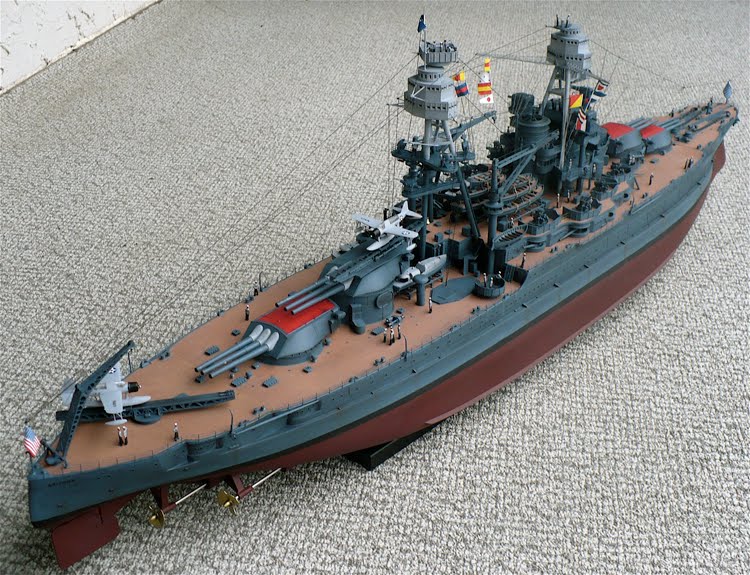
USS Arizona

Here are some images of Trumpeter's 1/200 scale USS Arizona (BB-39) Battleship.
Probably the most detailed and largest Arizona kit you will find. A beautiful model kit.
From Wikipedia"
USS Arizona (BB-39) was a Pennsylvania-class battleship built for the United States Navy and the first to be named "Arizona". On 4 March 1913, Congress authorized the construction of Arizona, named to honor the 48th state's admission into the union on 14 February 1912. The ship was the second and last of the Pennsylvania class of "super-dreadnought" battleships. Her keel was laid at the Brooklyn Navy Yard on 16 March 1914. She was launched on 19 June 1915, sponsored by Esther Ross, the daughter of a prominent Arizona pioneer, W.W. Ross of Prescott, Arizona. The ship's remaining machinery, including new Parsons turbines, was installed, and she was commissioned at her builder's yard on 17 October 1916, with Captain John D. McDonald in command.
Arizona served stateside during World War I. She is mostly remembered because of her sinking, with the loss of 1,177 lives, during the Japanese attack on Pearl Harbor on 7 December 1941, the event that provoked the United States into entering World War II. Unlike most of the other ships sunk or damaged that day, the Arizona could not be salvaged, although the U.S. Navy removed several elements of the ship that were reused.
The wreck still lies at the bottom of Pearl Harbor. The USS Arizona Memorial, dedicated in 1962 to all those who died during the Pearl Harbor attack, was built astraddle the ship's hull. The Arizona retains the right, in perpetuity, to fly the United States flag as if she were an active, commissioned naval vessel.
Arizona was significantly larger than her predecessors of the Nevada class. As completed she had an overall length of 608 feet (185.3 m), a beam of 97 feet (29.6 m) (at the waterline), and a draft of 29 feet 3 inches (8.9 m) at deep load. This was 25 feet (7.6 m) longer than the older ships. She displaced 29,158 long tons (29,626 t) at standard and 31,917 long tons (32,429 t) at deep load, over 4,000 long tons (4,060 t) more than the older ships. The ship had a metacentric height of 7.82 feet (2.4 m) at deep load.
The ship had four Parsons steam turbine sets, each of which drove a propeller 12 feet 1.5 inches (3.7 m) in diameter. They were powered by twelve Babcock & Wilcox water-tube boilers. The turbines were designed to produce a total of 31,500 shaft horsepower (23,500 kW), but only achieved 29,366 shp (21,898 kW) during Arizona's sea trials, when she slightly exceeded her designed speed of 21 knots (39 km/h; 24 mph). She was designed to carry 1,548 long tons (1,573 t) of fuel oil, but had a maximum capacity of 2,305 long tons (2,342 t). At full capacity, the ship could steam at a speed of 12 knots (22 km/h; 14 mph) for an estimated 7,552 nautical miles (13,990 km; 8,690 mi) with a clean bottom. She had four 300-kilowatt (402 hp) turbo generators.
Arizona carried twelve 45-caliber 14-inch guns in triple gun turrets. The turrets were numbered from I to IV from front to rear. The guns could not elevate independently and were limited to a maximum elevation of +15° which gave them a maximum range of 21,000 yards (19,000 m). The ship carried 100 shells for each gun. Defense against torpedo boats was provided by twenty-two 51-caliber five-inch guns mounted in individual casemates in the sides of the ship's hull. They proved to be very wet and could not be worked in heavy seas. At an elevation of 15°, they had a maximum range of 14,050 yards (12,850 m). Each gun was provided with 230 rounds of ammunition. The ship mounted four 50-caliber three-inch guns for anti-aircraft defense, although only two were fitted when completed. The other pair were added shortly afterwards on top of Turret III. Arizona also mounted two 21-inch (533 mm) torpedo tubes and carried 24 torpedoes for them.
The Pennsylvania-class design continued the all or nothing principle of armoring only the only most important areas of the ship begun in the preceding Nevada class. The waterline armor belt of Krupp armour measured 13.5 inches (343 mm) thick and only covered the ship's machinery spaces and magazines. It had a total height of 17 feet 6 inches (5.3 m), of which 8 feet 9.75 inches (2.7 m) was below the waterline; beginning 2 feet 4 inches (0.7 m) below the waterline, the belt tapered to its minimum thickness of 8 inches (203 mm). The transverse bulkheads at each end of the ship ranged from 13 to 8 inches in thickness. The faces of the gun turrets were 18 inches (457 mm) thick while the sides were 9–10 inches (230–250 mm) thick and the turret roofs were protected by 5 inches (127 mm) of armor. The armor of the barbettes was 18 to 4.5 inches (457 to 114 mm) thick. The conning tower was protected by 16 inches (406 mm) of armor and had a roof eight inches thick.
The main armor deck was three plates thick with a total thickness of 3 inches (76 mm); over the steering gear the armor increased to 6.25 inches (159 mm) in two plates. Beneath it was the splinter deck that ranged from 1.5 to 2 inches (38 to 51 mm) in thickness. The boiler uptakes were protected by a conical mantlet that ranged from 9–15 inches (230–380 mm) in thickness. A three-inch torpedo bulkhead was placed 9 feet 6 inches (2.9 m) inboard of the ship's side and the ship was provided with a complete double bottom. Testing in mid-1914 revealed that this system could withstand 300 pounds (140 kg) of TNT.
Shortly before 8:00 am, Japanese aircraft from six aircraft carriers struck the Pacific Fleet as it lay in port at Pearl Harbor, and—in the ensuing two attack waves—wrought devastation on the Battle Line and on air and military facilities defending Pearl Harbor. Onboard Arizona, the ship's air raid alarm went off about 07:55, and the ship went to general quarters soon thereafter. Shortly after 08:00, the ship was attacked by 10 Nakajima B5N "Kate" torpedo bombers, five each from the carriers Kaga and Hiryū. All of the B5Ns were carrying 410-millimeter (16.1 in) armor-piercing shells modified into 797-kilogram (1,760 lb) aircraft bombs. Flying at an estimated altitude of 3,000 meters (9,800 ft) Kaga's aircraft bombed from amidships to the ship's stern and were followed shortly afterwards by Hiryu's bombers which bombed the bow area.
The preliminary report, filed on 28 January 1942, on the damage suffered by Arizona during the attack listed seven bomb hits as well one torpedo hit on the port bow forward. This last hit was based on a report from the captain of the repair ship Vestal moored alongside and could not be verified at the time. One bomb was thought to have gone down the stack, but this was contradicted when the ship's superstructure was salvaged in 1942 and the cap of the funnel was intact. Later assessments show a total of four hits on the Arizona, plus three near misses. The near miss off the port bow is believed to have caused observers to believe that the ship had been torpedoed, although no torpedo damage has been found. The sternmost bomb ricocheted off the face of Turret IV and penetrated the deck to detonate in the captain's pantry, causing a small fire. The next forwardmost hit was near the port edge of the ship, abreast the mainmast, and probably detonated in the area of the anti-torpedo bulkhead. The next bomb struck near the port rear 5-inch AA gun.
The last bomb hit at 08:06 in the vicinity of Turret II, likely penetrating the armored deck near the ammunition magazines located in the forward section of the ship. While not enough of the ship is intact to judge the exact location, its effects are indisputable. About seven seconds after the hit, the forward magazines detonated in a cataclysmic explosion. It mostly vented through the sides of the ship and destroyed much of the interior structure of the forward part of the ship. This caused the forward turrets and conning tower to collapse downwards some 25–30 feet (7.6–9.1 m) and the foremast and funnel to collapse forward. The explosion took 1,177 lives of the 1,400 crewmen on board at the time, almost half of the lives lost during the attack. The explosion touched off fierce fires that burned for two days; debris showered down on Ford Island in the vicinity. Ironically, the blast from this explosion also put out fires on the repair ship Vestal, which was moored alongside.
Two competing theories have arisen about the cause of the explosion. The first is that that the bomb detonated in or near the black powder magazine used for the ship's saluting guns. This would have detonated first and then ignited the smokeless powder magazine which was used for the ship's main armament. A 1944 Navy Bureau of Ships report suggests that a hatch leading to the black powder magazine was left open, possibly with inflammable materials stocked nearby. The Naval History & Heritage Command explained that black powder might have been stockpiled outside of the armored magazine. This theory is attractive because black powder is easy to ignite and the relatively small amount of explosive filler in the bomb could have easily done so. The alternative explanation is that the bomb penetrated the armored decks and detonated directly inside one of the starboard magazines for the main armament. The problem is that smokeless powder is relatively insensitive to fire and the 14-inch powder bags actually required a black powder pad to ignite the powder. However, it seems unlikely that a definitive answer to this question will ever be found as the surviving physical evidence is insufficient to determine the cause of the magazine explosion.
Japanese credit for sinking
Credit for the hit was officially given to Petty Officer Noburu Kanai, who was considered to be the JNAF's "crack" bombardier; his pilot was Tadashi Kusumi.
Awards and recognition
Acts of heroism on the part of Arizona's officers and men were many, headed by those of Lieutenant Commander Samuel G. Fuqua, the ship's damage control officer, whose coolness in attempting to quell the fires and get survivors off the ship earned him the Medal of Honor.
Posthumous awards of the Medal of Honor also went to Rear Admiral Isaac C. Kidd, the first flag officer killed in the Pacific war, and to Captain Franklin Van Valkenburgh, who reached the bridge and was attempting to defend his ship when the bomb that hit the ammunition magazines destroyed her.
Dave Porter's B-25

Here is a very nice model of Revell's 1/72 B-25 Mitchell medium bomber. Dave
built it from the box. It has very nice recessed detail and a very fine
and complete interior. The glass very nice too. It come with two choices
of decals. Dave painted it with Tamyia colors. He toned down the olive drab
and gray colours to scale. Dave likes this B-25 version because of all the
fire power. It has 12 forward firing 50 cal. Machine guns. That's good
enough to take out Japanese transport ships and lighter destroyer
escorts.
Monday, October 3, 2011
ME 262 Mistel Re Post
Here are some images of Dragon models 1/48 scale Messerschmitt ME 262 Mistel. From Wiki "The Mistel (German: Mistletoe), also known as Beethoven-Gerät (Beethoven Device) and Vati und Sohn (Daddy and Son), was a Luftwaffe composite aircraft type of bomber, appearing late in World War II.
The scheme originally involved replacing the entire nose-located crew compartment of a war-weary bomber airframe (usually a Junkers Ju 88 variant) with a specially-designed solid nose filled with a large load of explosive, and guiding it to its target by a fighter aircraft mounted above it on a set of struts. After releasing the bomber, the fighter would return to base. The first such composite aircraft flew in July 1943 and was promising enough to begin a programme by Luftwaffe test unit KG 200, code-named "Beethoven"". Quite honestly I have no idea why Dragon would make an ME 262 Mistel kit when the Germans hadn't even conceptualized it on paper. Still looks kinda neat.
Saturday, October 1, 2011
Dave Porter's Millenium Falcon
Here are some images of Dave Porter's MPC 1/58 scale Millenium Falcon from Star Wars. Dave just finished this masterpiece in time for a model exposition but here we get a first look.
Dave added some lighting and landing gear as well as some fibre optics for the cockpit. Dave painted the model with Tamiya acrylics and artist oils.


