Translate

Saturday, November 12, 2011

Vostok 1


Here are some images of Revell's 1/24 scale Vostok 1 plus some added detail by yours truly.

From Wikipedia"

Vostok 1 (Russian: Восток-1, East 1 or Orient 1) was the first spaceflight in the Vostok program and the first human spaceflight in history. The Vostok 3KA spacecraft was launched on April 12, 1961. The flight took Yuri Gagarin, a cosmonaut from the Soviet Union, into space. The flight marked the first time that a human entered outer space, as well as the first orbital flight of a manned vehicle. Vostok 1 was launched by the Soviet space program, and was designed by Soviet engineers guided by Sergey Korolyov under military supervision of Kerim Kerimov and others.[7]

The spaceflight consisted of a single orbit of the Earth. According to official records, the spaceflight took 108 minutes from launch to landing. As planned, Gagarin landed separately from his spacecraft, having ejected with a parachute 7 km (23,000 ft) above ground. Historian Asif Siddiqi has written that Gagarin was in the spacecraft for 108 minutes after launch, and that he didn't touch ground for another 10 minutes. (The exact duration is useful to prove that Gagarin completed a full 360-degree orbit in inertial space. The longitude of launch to landing spanned a little more than 340 degrees, but the Earth also was rotating underneath him at about 15 degrees per hour while Gagarin was aloft.)

Due to the secrecy surrounding the Soviet space program at the time, many details of the spaceflight only came to light years later, and several details in the original press releases turned out to be false.


Thursday, November 10, 2011

Lest We Forget

To all soldiers living and passed who fought, fight and protect for our freedom, thank you. You are loved.

From The Earth To The Moon


Here are some images of my scratch built model of the Moon Train from the Jules Verne novel "From the Earth to the Moon". Based off of the 1865 etching.

From Wikipedia"

From the Earth to the Moon (French: De la Terre à la Lune, 1865) is a humorous science fantasy novel by Jules Verne and is one of the earliest entries in that genre. It tells the story of the president of a post-American Civil War gun club in Baltimore, his rival, a Philadelphia maker of armor, and a Frenchman, who build an enormous sky-facing Columbiad space gun and launch themselves in a projectile/spaceship from it to a Moon landing.

The story is also notable in that Verne attempted to do some rough calculations as to the requirements for the cannon and, considering the comparative lack of any data on the subject at the time, some of his figures are surprisingly close to reality. However, his scenario turned out to be impractical for safe manned space travel since a much longer muzzle would have been required to reach escape velocity while limiting acceleration to survivable limits for the passengers.

Influence on popular culture

The novel was adapted as the opera Le voyage dans la lune in 1875, with music by Jacques Offenbach.

In H. G. Wells' 1901 The First Men in the Moon (also relating to the first voyagers to the Moon) the protagonist, Mr. Bedford, mentions Verne's novel to his companion, Professor Cavor, who replies (in a possible dig at Verne) that he does not know what Bedford is referring to. Verne returned the dig later when he pointed out he used guncotton to send his men to the moon, and one could see it any day. "Can Mr. Wells show me some "cavourite"?", he asked archly.

The novel (along with Wells' The First Men in the Moon) inspired the first science fiction film, A Trip to the Moon, made in 1902 by Georges Méliès. In 1958, another film adaptation of this story was released, titled From the Earth to the Moon. It was one of the last films made under the RKO Pictures banner. The story also became the basis for the very loose adaptation Jules Verne's Rocket to the Moon (1967), a caper-style British comedy starring Burl Ives and Terry-Thomas. The 1961 Czechoslovak film The Fabulous Baron Munchausen combines characters and plot elements from the Verne novel with those of the stories of Baron Münchhausen and Cyrano de Bergerac.

The novel and its sequel were the inspiration for the computer game Voyage: Inspired by Jules Verne.

In 1889 Verne wrote a second sequel to the novel, The Purchase of the North Pole, which has the gun club members (led by J. T. Maston) plan to use the "Columbiad" to alter the tilt of the earth to enable the mineral wealth of the Arctic region to be put within reach of exploitation.

Among its other homages to classic science fiction, an issue of Planetary involved the Planetary group finding that the Gun Club had been successful in launching the projectile, but that a miscalculation led to a slowly decaying orbit over the decades with the astronauts long dead from lack of air and food.

Barbicane appears in Kevin J. Anderson's novel Captain Nemo: The Fantastic History of a Dark Genius as an Ottoman official whose chief rival, Robur, designs a number of innovative weapons to counteract him, including an attempt to launch a three-man mission to the Moon.

During their return journey from the moon, the crew of Apollo 11 made reference to Jules Verne's book during a TV broadcast on July 23. The mission's commander, astronaut Neil Armstrong, said, "A hundred years ago, Jules Verne wrote a book about a voyage to the Moon. His spaceship, Columbia [sic], took off from Florida and landed in the Pacific Ocean after completing a trip to the Moon. It seems appropriate to us to share with you some of the reflections of the crew as the modern-day Columbia completes its rendezvous with the planet Earth and the same Pacific Ocean tomorrow."

In Back to the Future Part III, Clara Clayton asks Emmett Brown if he believes mankind will ever "travel to the moon the way we travel across the country on trains." Being from the future Doc already knows that doesn't happen for another 84 years, but he affirms they will while quoting a passage from From the Earth to the Moon. Clara calls him out on this, and it's from this encounter that the pair discovers their mutual love of Jules Verne novels.

Sunday, November 6, 2011

Heinkel He 111 P-1


Here are some images of Revell's 1/32 scale Heinkel He 111 P-1 medium bomber.
This is a beautiful kit. The detail is amazing and the parts fit together very well. Other then a few minor points as regards the instructions this is well worth the money and it's big.

From Wikipedia"

The He 111P incorporated the updated Daimler-Benz DB 601A-1 water cooled engine and featured a newly designed nose section, including an asymmetric Ikaria nose mounting for an MG 15 machine gun that replaced the 'stepped' cockpit with a roomier and aerodynamically favourable glazed "dome" over the front of the aircraft. This new "bullet" smooth glazed nose was first tested out on the He 111 V8 in January 1938. These improvements allowed the aircraft to reach 475 km/h (295 mph) at 5,000 m (16,400 ft) and a cruise speed of 370 km/h (230 mph), although a full bombload reduced this figure to 300 km/h (190 mph). The design was implemented in 1937 because pilot reports indicated problems with visibility. The pilot's seat could actually be elevated, with the pilot's eyes above the level of the upper glazing, complete with a small pivoted windscreen panel, to get the pilot's head above the level of the top of the "glass tunnel" for a better forward view for takeoffs and landings.

One of Heinkel's rivals, Junkers, built 40 He 111Ps at Dessau. On 8 October 1938, the Junkers Central Administration commented:

Two aircraft were able to be inspected on 6th October in Bernburg. Apparent are the externally poor, less carefully designed components at various locations, especially at the junction between the empennage and the rear fuselage. All parts have an impression of being very weak; especially when one is used to taking a long look at Junkers' designs, one cannot dispel a feeling of uncertainty. The visible flexing in the wing must also be very high. The left and right powerplants are interchangeable. Each motor has an exhaust-gas heater on one side, but it is not connected to the fuselage since it is probable that as a result of incorrect air feed, the warm air in the fuselage is not free of carbon monoxide (CO). The fuselage is not subdivided into individual segments, but is attached over its entire length, after completion, to the wing centre section. Outboard of the powerplants, the wings are attached by universal joints. The latter can in no way be satisfactory and have been the cause of several failures.

The new design was powered by the DB 601 Ba engine with 1,175 PS and reduced the length of the aircraft by 1.1 m (3.6 ft). The He 111P's DB601 powerplant exhaust pipes had a second outlet on the top of the engine which pumped hot air back into the aircraft to warm crews. It was designated as P-0, and the first production lines reached their units in Fall 1938. In May 1939, the P-1 and P-2 went into service with improved radio equipment. The P-1 variant was produced with two DB 601Aa powerplants of 1,150 hp (860 kW). The fuel tanks had the added innovation of self-sealing fuel tanks to protect them from enemy fire. The Nose department itself was now fully glazed and the "stepped up" cockpit was dispensed with. The P-1 was powered by a DB 601Aa engine and given a semi-retractable tail wheel to decrease drag. Armament consisted of a MG 15 mounted in the Ikaria A Stand mount in the nose, and a sliding hood for the fuselage's dorsal B-Stand position. Installation of upgraded FuG III radio communication devices were also made and a new ESAC-250/III vertical bomb magazine was added. The overall takeoff weight was now 13,300 kg (29,321 lb).

The P-2, like the later P-4, was given stronger armour and two MG 15 machine guns in "waist" mounts on either side of the fuselage and two external bomb racks. Radio communications consisted of FuG IIIaU radios and the DB601 A-1 replaced the 601Aa powerplants. The Lotfernrohr 7 bombsights, which became the standard bombsight for German bombers, were also fitted to the P-2. The P-2 was also given "field equipment sets", to upgrade the weak defensive armament to four or five MG 15 machine guns. The P-2 had its bomb capacity raised to 4 ESA-250/IX vertical magazines. The P-2 thus had an empty weight of 6,202 kg (13,272 lb), a loaded weight increased to 12,570 kg (27,712 lb) and a maximum range of 2,100 km (1,305 mi).

The P-3 was powered with the same DB601A-1 engines. The aircraft was also designed to take off with a land catapult (KL-12). A towing hook was added to the fuselage under the cockpit for the cable. Just eight examples were produced, all without bomb equipment. The P-4 contained many changes from the P-2 and P-3. The jettisonable loads were capable of considerable variation. Two external SC 1800 kg (3,960 lb) bombs; two LMA air-dropped anti-shipping mines; one SC 1,800 kg plus four SC 250 kg; or one SC 2,500 kg external bomb could be carried on a ETC Rüstsatz rack. Depending on the load variation, a 835 L fuel and 120 L oil tank could be added in place of the internal bomb bay. The armament consisted of three defensive MG 15 machine guns. But these were not sufficient, so a further six MG 15s and one MG 17 machine gun was added. The radio communications were standard FuG X(10), Peil G V direction finding and FuBI radio devices. Because of the increase in defensive firepower, the crew numbers increased from four to five. The empty weight of the P-4 increased to 6,775 kg (14,936 lb), and the full takeoff weight increased to 13,500 kg (29,762 lb) owing to the mentioned alterations. The P-5 was powered by the DB601A. The variant was mostly used as a trainer and at least 24 production variants were produced before production ceased. The P-5 was alleged to have been fitted with PVC bomb racks, which cannot be confirmed. The P-5 was fitted with meteorological equipment, and was used in Luftwaffe weather units. Many of the He 111 Ps served during the Polish Campaign. With the Junkers Ju 88 experiencing technical difficulties, the He 111 and the Do 17 formed the backbone of the Kampfwaffe. On 1 September 1939, Luftwaffe records indicate the Heinkel strength at 705 (along with 533 Dorniers).

The P-6 variant was the last production model of the He 111 P series. In 1940, the RLM abandoned further production of the P series in favour of the H versions, mostly because the P-series' Daimler-Benz engines were sorely needed for Messerschmitt Bf 109 and Bf 110 fighter production. The remaining P-6s were redesignated P-6/R2s and used as heavy glider tugs. The most notable difference with previous variants was the upgraded DB 601N powerplants.

The P-7 variant's history is unclear. German archives do not produce any reliable information for this variant, if it existed. The P-8 was said to have been similar to the H-5 fitted with dual controls. Its existence cannot be established. The P-9 was produced as an export variant for the Hungarian Air Force. Due to the lack of DB 601E engines, the line was terminated in Summer 1940.

Thursday, November 3, 2011

Junkers JU 52 Repost


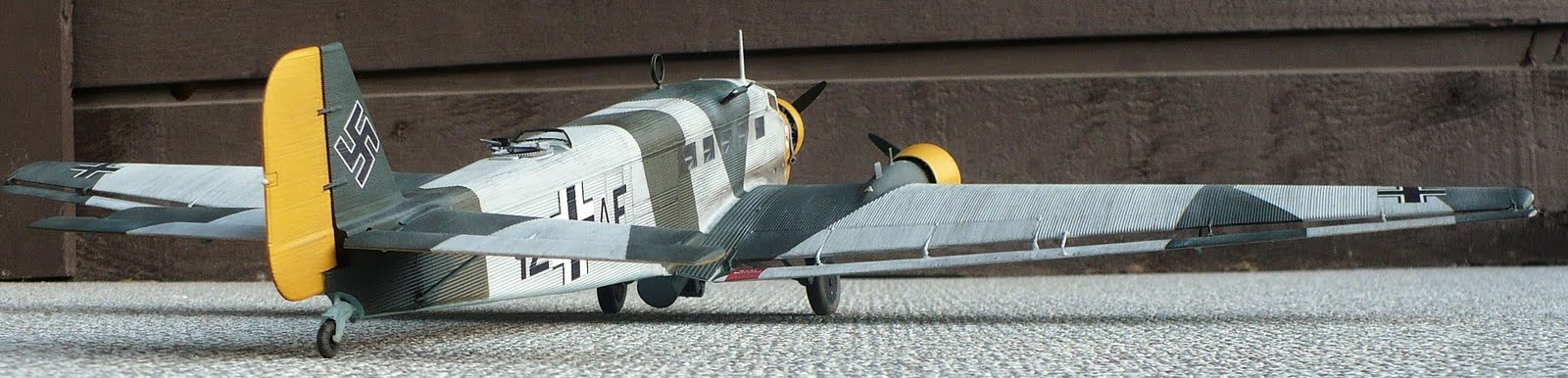
Here are some images of Monogram's 1/48 scale Junkers JU 52 transport. Manufactured from 1932 to 1945. It saw both civilian and military service during the 1930s and 1940s. In a civilian role, it flew with over 12 air carriers including Swissair and Luftansa as an airliner and freight hauler. In a military role, it flew with the Luftwaffe as a troop and cargo transport and briefly as a medium bomber. The Ju 52 continued in postwar service with military and civilian air fleets well into the 1980s. This is an excellent model in every way. Incredible detail and it assembled without any hitches. This kit is still around and one can get it for around $50 Cdn.

Tuesday, November 1, 2011

Lunar Approach Composite


Here is my composite image of Dragon Model's 1/72 scale Apollo 11"Lunar Approach" North American CSM "Columbia" + Grumman LM "Eagle" approaching the "Sea of Tranquillity" on the Moon just before turn around.

Images of the model can be seen here.

Monday, October 31, 2011

Lunar Approach


Here are some images of Dragon Model's 1/72 scale Apollo 11"Lunar Approach" North American CSM "Columbia" + Grumman LM "Eagle".

From Wikipedia"
The Command Module was the control center for the Apollo spacecraft and living quarters for the three crewmen. It contained the pressurized main crew cabin, crew couches, control and instrument panel, optical and electronic guidance systems, communications systems, environmental control system, batteries, heat shield, reaction control system, forward docking hatch, side hatch, five windows and the parachute recovery system. It was the only part of the Apollo/Saturn launch vehicle that returned to Earth intact.

The Service Module was a portion of the spacecraft that was unpressurized and contained fuel cells, batteries, a high gain antenna, radiators, water, hydrogen, oxygen, a reaction control system and propellant to enter and leave lunar orbit, and service propulsion systems. On Apollo 15, 16 and 17 it also carried a scientific instrument package, mapping camera and a small sub-satellite to study the moon.

A major portion of the service module was taken up by propellant and the main rocket engine. Capable of multiple restarts, this engine placed the Apollo spacecraft into and out of lunar orbit, and was used for mid-course corrections between the earth and the moon.

The Service Module remained attached to the Command Module throughout the mission. It was jettisoned just prior to reentry into the Earth's atmosphere.

The Lunar Module was the portion of the Apollo spacecraft that landed on the moon and returned to lunar orbit and was the first true "spaceship" since it was designed to fly solely in the vacuum of space. It was divided into two major parts, the Descent Module and the Ascent Module. It supplied life support systems for two astronauts for a total of four to five days. The spacecraft was designed and manufactured by the Grumman Aircraft Company led by Tom Kelly.

The Descent Stage contained the landing gear, landing radar antenna, descent rocket engine, and fuel to land on the moon. It also had several cargo compartments used to carry among other things, the Apollo Lunar Surface Experiment Packages ALSEP, the Modularized Equipment Transporter (MET) (a hand-pulled equipment cart used on Apollo 14), the Lunar Rover (moon car - Apollo 15, 16 and 17), surface television camera, surface tools and lunar sample collection boxes.

The Ascent Stage contained the crew cabin, instrument panels, overhead hatch/docking port, forward hatch, optical and electronic guidance systems, reaction control system, radar and communications antennas, ascent rocket engine and fuel to return to lunar orbit and rendezvous with the Apollo Command and Service Modules.

Thursday, October 27, 2011

Alien Tripod


Here are some images of Pegasus Hobbies 1/144 scale Alien Tripod from the 2005 movie "War of the Worlds" Based off the HG Wells novel.
This kit gives you the option of building this model in the laser arms configuration or the collecting cages and tentacles option (pictured).
The one thing one should be aware of is that this kit is made of ABS plastic so your standard model glue won't be as strong. I would recommend CA glue.
However this is one beautiful and cool model kit.

From Wikipedia"

War of the Worlds is a 2005 American science fiction film adaptation of H. G. Wells' novel of the same name, directed by Steven Spielberg and written by Josh Friedman and David Koepp. It is one of three film adaptations of War of the Worlds released that year, alongside The Asylum's version and Pendragon Pictures' version. It stars Tom Cruise as Ray Ferrier, a divorced dock worker estranged from his children and living separately from them. As his ex-wife drops their children off for him to look after for a few days, Earth is invaded by aliens (loosely based on H. G. Wells' Martians) driving Tripods and the earth's armies are defeated, and Ray tries to protect his children and flee to Boston to rejoin his ex-wife.

War of the Worlds marks Spielberg and Cruise's second collaboration, after the 2002 film Minority Report. The film was shot in 73 days, using five different sound stages as well as locations at Connecticut, Staten Island, California, Virginia, and New Jersey. The film was surrounded by a secrecy campaign so few details would be leaked before its release. Tie-in promotions were made with several companies, including Hitachi. The film was released in United States on 29 June and in United Kingdom on 1 July. The film generally received positive reviews, and attained a 73 percent "fresh" rating on the film review aggregator Rotten Tomatoes, based on 240 reviews. War of the Worlds was also a box office success, and was 2005's fourth most successful film both domestically, with $234 million in North America, and worldwide, with $591 million overall.

Industrial Light & Magic was the main special effects company for the movie. While Spielberg had used computers to help visualize sequences in pre-production before, Spielberg said, "This is the first film I really tackled using the computer to animate all the storyboards." He decided to employ the technique extensively after a visit to his friend George Lucas. In order to keep the realism, the usage of computer-generated imagery shots and bluescreen was limited, with most of the digital effects being blended with miniature and live-action footage. The design of the Tripods was described by Spielberg as "graceful," with artist Doug Chiang replicating aquatic lifeforms. The visual effects crew tried to blend organic and mechanical elements in the Tripods depiction, and made extensive studies for the movements of the vehicle to be believable, considering the "contradiction" of having a large tank-like head being carried by thin and flexible legs. Visual effects supervisor Pablo Helman considered depicting the scale of the Tripod as challenging, considering "Steven wanted to make sure that these creatures were 150 feet tall". The aliens themselves had designs based on jellyfish, with movements inspired by red-eyed tree frogs. Spielberg did not want any blood or gore during the Heat-Ray deaths; in the words of Helma, "this was going to be a horror movie for kids". So the effects crew came up with the vaporization of the bodies, and considering it could not be fully digital due to both the complexity of the effect and the schedule, live-action dust was used alongside the CGI ray assimilation and particles.

Wednesday, October 26, 2011

Dave Porter's Seaview


Here are some images of Dave Porter's Seaview. This was based on the old Aurora kit. Dave added some interior details and a couple of leds to light it. Dave made a base with the use of some real coral.

Sunday, October 23, 2011

Out Of The Silent Planet Composite


Here is my composite image of my 1/72 scale scratch build Weston Spacecraft from C.S. Lewis's novel "Out Of The Silent Planet" coming in for a landing on Malacandra (Mars)

Images of the model can be seen here.


From Wikipedia"

The Space Trilogy, Cosmic Trilogy or Ransom Trilogy is a trilogy of science fiction novels by C. S. Lewis, famous for his later series The Chronicles of Narnia. A philologist named Elwin Ransom is the hero of the first two novels and an important character in the third.

The books in the trilogy are:

  • Out of the Silent Planet (1938), set mostly on Mars. In this book Elwin Ransom voyages to Mars and discovers that Earth is exiled from the rest of the solar system due to its fallen nature and is known as "the silent planet".
  • Perelandra (1943), set mostly on Venus. Also known as Voyage to Venus. Here Dr Ransom journeys to an unspoiled Venus in which the first humanoids have just emerged.
  • That Hideous Strength (1945), set on Earth. A scientific think tank called the N.I.C.E. is secretly in touch with demonic entities who plan to ravage and lay waste to planet Earth.

In 1946, the publishing house Avon (now an imprint of HarperCollins) published a version of That Hideous Strength specially abridged by C.S. Lewis entitled The Tortured Planet.

Saturday, October 22, 2011

Out Of The Silent Planet


"Weston! Weston!" he gasped. "What is it? It's not the moon, not that size. It can't be, can it?" "No replied Weston, "it's the Earth." - From Out of the Silent Planet by C.S. Lewis.

Here are some images of my scratch built 1/72 scale Weston Spacecraft from the C.S. Lewis novel "Out of the Silent Planet". Based off the 1965 edition book cover by Bernard Symancyk. with some slight alterations of my own.

From Wikipedia"
Out of the Silent Planet is the first novel of a science fiction trilogy written by C. S. Lewis, sometimes referred to as the Space Trilogy, Ransom Trilogy or Cosmic Trilogy. The other volumes are Perelandra (also published as Voyage to Venus) and That Hideous Strength, and a fragment of a sequel was published posthumously as The Dark Tower. The trilogy was inspired and influenced by David Lindsay's A Voyage to Arcturus (1920).
According to biographer A. N. Wilson, Lewis wrote the novel after a conversation with J.R.R. Tolkien in which both men lamented the state of contemporary fiction. They agreed that Lewis would write a space-travel story, and Tolkien would write a time-travel one. Tolkien's story only exists as a fragment, published in The Lost Road and other writings (1987) edited by his son Christopher.
Here is a fantastic video of an opening title movie credit roll created by David Scherbarth for a non existent movie "Out of the Silent Planet".
Though no movie has been made (Yet). It does give one hope. Enjoy.

out of the silent planet from David Scherbarth on Vimeo.

Wednesday, October 19, 2011

Atomic Cannon


Here are some images of Renwal/Monogram/Revell 1/32 scale M65 Atomic Cannon.
This is the rerelease of the original 1957 kit from Renwal. The original kit I'm led to understand can fetch up to $1000. This one though, about $60.

From Wikipedia"
The M65 Atomic Cannon, often called Atomic Annie, was a towed artillery piece built by the United States and capable of firing a nuclear device. It was developed in the early 1950s, at the beginning of the Cold War, and fielded by 1953 in Europe and Korea.

Picatinny Arsenal was tasked to create a nuclear capable artillery piece in 1949. Robert Schwartz, the engineer who created the preliminary designs, essentially scaled up the 240mm shell (then the maximum in the arsenal) and used the German K5 railroad gun as a point of departure for the carriage. (The name "Atomic Annie" likely derives from the nickname "Anzio Annie" given to a German K5 gun which was employed against the American landings in Italy.) The design was approved by the Pentagon, largely through the intervention of chief of the Ballistics Section of the Ordnance Department’s Research and Development Division, Samuel Feltman, and a three-year developmental effort was begun. The project proceeded quickly enough to produce a demonstration model to participate in Dwight Eisenhower's inaugural parade in January of 1953.

The cannon was transported by two specially designed tractors, both capable of independent steering in the manner of some extra-long fire engines. Each of the tractors was rated at 375 hp, and the somewhat awkward combination could achieve speeds of 35 miles an hour and negotiate right turns on 28 ft wide, paved or packed roads. The artillery piece could be unlimbered in 15 minutes and then returned to traveling configuration in 15 minutes more.

On May 25, 1953 at 8:30am local time, the Atomic Cannon was tested at Nevada Test Site (specifically Frenchman Flat) as part of the Upshot-Knothole series of nuclear tests. The test--codenamed Grable--was attended by then Chairman of the Joint Chiefs of Staff Adm. Arthur W. Radford and Secretary of Defense Charles E. Wilson; it resulted in the successful detonation of a 15 kt shell (warhead W9) at a range of 7 miles. This was the first and only nuclear shell to be fired from a cannon.

Subsequent to the successful test, there were at least 20 of the cannons manufactured at Watervliet and Watertown Arsenals, at a cost of $800,000 each. They were deployed overseas to Europe and Korea, often continuously shifted around to avoid being detected and targeted by opposing forces. Due to the size of the apparatus, their limited range, the development of nuclear shells compatible with existing artillery pieces (the W48 for the 155mm and the W33 for the 203mm), and the development of rocket and missile based nuclear artillery, the M65 was effectively obsolete soon after it was deployed. However, it remained a prestige weapon and was not retired until 1963.


Monday, October 17, 2011

UFO


Here are some images of Aurora/Monogram's 1/72 scale UFO from the television series "The Invaders"

From Wikipedia"

The Invaders, a Quinn Martin Production (season one was produced in association with the ABC Television Network - or as it was listed in the end credits, "The American Broadcasting Company Television Network"), is an ABC science fiction television program created by Larry Cohen that ran in the United States for two seasons, from January 10, 1967 to March 26, 1968. Dominic Frontiere, who had provided scores for Twelve O'Clock High and The Outer Limits, provided scores for The Invaders as well.

Roy Thinnes starred as architect David Vincent, who accidentally learns of the secret alien invasion already underway and thereafter travels from place to place, trying to foil the aliens' plots and warn a skeptical populace of the danger. As the series progresses, Vincent is able to convince a small number of people to help him fight the aliens, most significantly millionaire industrialist Edgar Scoville (Kent Smith) who became a semi-regular character as of December 1967.

Neither the Invaders nor their planet were ever named. Their human appearance was a disguise; they were never shown in their true form except in one episode, "Genesis", in which an ill alien researcher loses his human form and is briefly seen immersed in a tank of electrified, salinated water. Unless they receive periodic treatments in what Vincent called "regeneration chambers", which consume a great deal of electrical power, they revert to their alien form. One scene in the series showed an alien beginning to revert, filmed in soft focus and with pulsating red light.

They had certain characteristics by which they could be detected, such as the absence of a pulse and the inability to bleed. Nearly all were emotionless and had "mutated" little fingers which could not move and were bent at an unnatural angle, although there were "deluxe models" who could manipulate this finger. There were also a number of mutant aliens, who experienced emotions similar to those of humans, and who even opposed the alien takeover. The existence of the Invaders could not be documented by killing one and examining the body: When they died (at least while in human form), their bodies would glow red and disintegrate — along with their clothes, any items they were carrying at the time and anything they touched when dying— leaving little more than traces of black ash. On several occasions, a dying alien would grab or otherwise make deliberate contact with a piece of their technology to prevent it from falling into the hands of humans.

The type of spaceship by which the Invaders reach the Earth is a flying saucer of a design derivative of that shown in the contestable early-1950s photographs of self-proclaimed UFO "contactee" George Adamski, but instead of having three spheres on the underside, the Invaders' craft has five shallower protrusions. It was a principle of the production crew to not show them with set and prop designs and control panels that were utterly alien from the conventional human ones (such as H.R. Giger would later present in Alien).

They use a small, handheld, disc-shaped weapon with five glowing white lights applied to the back of the victim's head or neck to induce a seemingly-natural death, which is usually diagnosed as a cerebral hemorrhage. They also employ powerful weapons to disintegrate witnesses, vehicles and - in one episode - a sick member of their own race whose infection's side effects was causing dangerous notoriety. Also in their arsenal is a small device consisting of two spinning transparent crystals joined at their corners which forces human beings to do the aliens' bidding.