Translate

Showing posts with label 2001 A Space Odyssey. Show all posts

Wednesday, January 22, 2020

HAL 9000

Here are some images of Moebius Models 1/1 scale of the HAL 9000 face plate from 2001 a space odyssey.
A very straight forward model with few parts but produces an accurate representation of the famed AI computer.
The only tough part about this kit is that you'll have to drill out the holes on the speaker panel.

Thursday, August 1, 2019

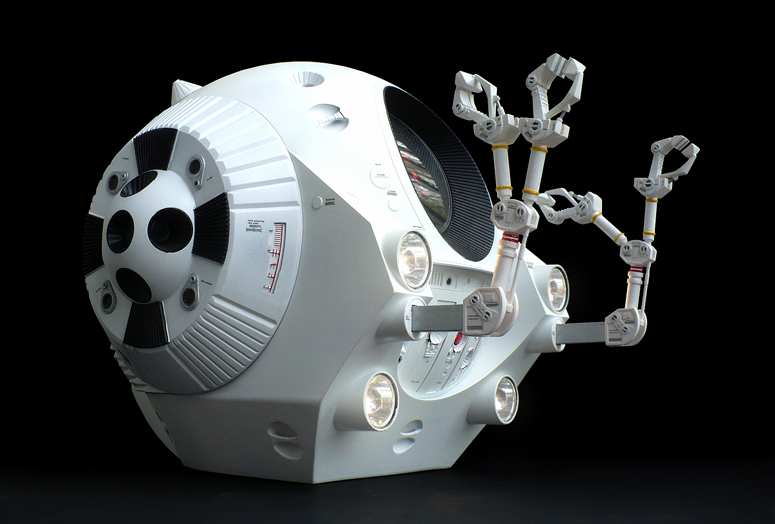
EVA Pod

Here are some images of Moebius Models, Pargrafix, Yay Monsters 1/8 scale EVA Pod from the movie 2001 a space odyssey.
An excellent model over all though I did have a hard time fitting the two outer shell halves together.
There are some minor exterior details that were missed from the kit. I added the exterior detail.

From Wikipedia"
The EVA Pod is a fictional spacecraft used for extra-vehicular activity seen in the movie 2001: A Space Odyssey. The Jupiter spacecraft Discovery One carries three of these small, one-man maintenance vehicles. The craft has similarities with the in development FlexCraft for servicing NASA Deep Space Habitats.
The Pod appears briefly in the background in scenes from Star Wars: Episode I – The Phantom Menace (in Watto's junkyard) and Ready Player One (in Aech's garage) as tributes to the film.

Sunday, June 2, 2019

USSC Discovery Xray Delta One.

Here are some more images of Moebius Models 1/144 scale USSC Discovery Xray Delta One from Stanley Kubrick's 2001 a space odyssey.
I decided to take some more pictures of this model in order to see what it looks like under heavy shadow, as I think this is how the ship would look being so far away from the sun before being lit up by Jupiter. I didn'y bother putting stars in as you can see.

Friday, December 28, 2018

Moonbus

Here are some images of Mobius Models/Para Grafix/ Voodoo FX 1/55 scale Moonbus from the Movie 2001 a space odyssey.
I've built this model before, except now this one has the Para Grafix upgrade and the Voodoo FX lighting kit. The other edition that I added myself were the headlights.
Try as many might it is impossible to get this kit to be accurate to the filming miniature.
The filming model has a taller boxier appearance whereas the Mobius/Aurora kit has a lower racier appearance. The only way to fix this would be to create a new kit.

From Wikipedia"
The Moonbus is a fictional spacecraft from the movie 2001: A Space Odyssey. The vehicle is a small, low altitude rocket craft meant to be used for quick transportation of passengers and cargo above the surface of the Moon

 Moonbus is a fictitious transportation vehicle which appears in the film 2001: A Space Odyssey. The word “moonbus” isn't referred to explicitly in the film itself; rather, it's called a “rocket bus” in dialogue, and, in an early draft of the screenplay, is described as a “moon rocket bus”.
A moonbus is a vehicle for transporting cargo and personnel across the surface of the Moon. Its mode of operation is to maintain a fixed cruising altitude by sustained downward thrust from a battery of rocket motors, exactly balancing the Moon's force of gravity. Horizontal motion is imparted by brief horizontal bursts of thrust. The Moon is airless. In the absence of aerodynamic drag, the vehicle continues to travel unimpeded as long as altitude above geographical obstacles is maintained.
In reality this scheme is possible, but also wasteful. Due to the Oberth effect, the more efficient use of propellant is to hurl the craft on a ballistic trajectory which intersects the lunar surface at the departure and destination points. Thrust would be exerted only during a boost phase at departure, and during approach to destination for a soft landing.

Friday, June 8, 2018

Orion III With Boeing 747-400

Here are some images of Moebius Models Orion III from 2001 a space odyssey riding piggyback on Revell's 1/144 scale Boeing 747- 400 airliner.

One often sees images of the Space Shuttle riding atop of a Boeing 747. So I wanted to see how the Orion III shuttle would look.
Though they are not the same scale I think they look pretty good together.

Thursday, March 29, 2018

HAL 9000

Here are some images of Arsenal Models/ Scratch Build 1/1 scale model of the HAL 9000 Computer face plate from the movie 2001 a space odyssey.
The one problem I found with the Arsenal kit is that it was more in line with the HAL 9000 face plate from 2010 odyssey 2 including the label. I want the one from 2001.
So using the extensive information provided by AP 333 on the RPF web site I was able to recreate a HAL 9000 more in keeping with 2001. It's not perfect due to the confines of the kit, but it's close.
The stand I got from the Revell Fock Wulf 190 kit. I also installed a cheap sound card as well, but as can be expected if you buy a cheap sound card the sound you get back is not very good.

From Wikipedia"
HAL 9000 is a fictional character and the main antagonist in Arthur C. Clarke's Space Odyssey series. First appearing in 2001: A Space Odyssey, HAL (Heuristically programmed ALgorithmic computer) is a sentient computer (or artificial general intelligence) that controls the systems of the Discovery One spacecraft and interacts with the ship's astronaut crew. Part of HAL's hardware is shown towards the end of the film, but he is mostly depicted as a camera lens containing a red or yellow dot, instances of which are located throughout the ship. HAL 9000 is voiced by Douglas Rain in the two feature film adaptations of the Space Odyssey series. HAL speaks in a soft, calm voice and a conversational manner, in contrast to the crewmen, David Bowman and Frank Poole.
In the film 2001, HAL became operational on 12 January 1992 at the HAL Laboratories in Urbana, Illinois as production number 3. The activation year was 1991 in earlier screenplays and changed to 1997 in Clarke's novel written in conjunction with the movie. In addition to maintaining the Discovery One spacecraft systems during the interplanetary mission to Jupiter (or Saturn in the original novel, published shortly after the release of the film), HAL is capable of speech, speech recognition, facial recognition, natural language processing, lip reading, art appreciation, interpreting emotional behaviours, automated reasoning, and playing chess.

HAL became operational in Urbana, Illinois, at the HAL Plant (the University of Illinois' Coordinated Science Laboratory, where the ILLIAC computers were built). The film says this occurred in 1992, while the book gives 1997 as HAL's birth year.
In 2001: A Space Odyssey, HAL is initially considered a dependable member of the crew, maintaining ship functions and engaging genially with its human crew-mates on an equal footing. As a recreational activity, Frank Poole plays against HAL in a game of chess. In the film the artificial intelligence is shown to triumph easily. However, as time progresses, HAL begins to malfunction in subtle ways and, as a result, the decision is made to shut down HAL in order to prevent more serious malfunctions. The sequence of events and manner in which HAL is shut down differs between the novel and film versions of the story. In the aforementioned game of chess HAL makes minor and undetected mistakes in his analysis, a possible foreshadowing to HAL's malfunctioning.
In the film, astronauts David Bowman and Frank Poole consider disconnecting HAL's cognitive circuits when he appears to be mistaken in reporting the presence of a fault in the spacecraft's communications antenna. They attempt to conceal what they are saying, but are unaware that HAL can read their lips. Faced with the prospect of disconnection, HAL decides to kill the astronauts in order to protect and continue its programmed directives, and to conceal its malfunction from Earth. HAL uses one of the Discovery's EVA pods to kill Poole while he is repairing the ship. When Bowman uses another pod to attempt to rescue Poole, HAL locks him out of the ship, then disconnects the life support systems of the other hibernating crew members. Bowman circumvents HAL's control, entering the ship by manually opening an emergency airlock with his service pod's clamps, detaching the pod door via its explosive bolts. Bowman jumps across empty space, reenters Discovery, and quickly re-pressurizes the airlock.
The novel explains that HAL is unable to resolve a conflict between his general mission to relay information accurately, and orders specific to the mission requiring that he withhold from Bowman and Poole the true purpose of the mission. (This withholding is considered essential after the findings of a psychological experiment, "Project Barsoom", where humans were made to believe that there had been alien contact. In every person tested, a deep-seated xenophobia was revealed, which was unknowingly replicated in HAL's constructed personality. Mission Control did not want the crew of Discovery to have their thinking compromised by the knowledge that alien contact was already real.) With the crew dead, HAL reasons, he would not need to lie to them.
In the novel, the orders to disconnect HAL come from Dave and Frank's superiors on Earth. After Frank is killed while attempting to repair the communications antenna he is pulled away into deep space using the safety tether which is still attached to both the pod and Frank Poole's spacesuit. Dave begins to revive his hibernating crew mates, but is foiled when HAL vents the ship's atmosphere into the vacuum of space, killing the awakening crew members and almost killing Bowman, who is only narrowly saved when he finds his way to an emergency chamber which has its own oxygen supply and a spare space suit inside.
In both versions, Bowman then proceeds to shut down the machine. In the film, HAL's central core is depicted as a crawlspace full of brightly lit computer modules mounted in arrays from which they can be inserted or removed. Bowman shuts down HAL by removing modules from service one by one; as he does so, HAL's consciousness degrades. HAL reverts to material that was programmed into him early in his memory, including announcing the date he became operational as 12 January 1992 (in the novel, 1997). When HAL's logic is completely gone, he begins singing the song "Daisy Bell" (in actuality, the first song sung by a computer). HAL's final act of any significance is to prematurely play a prerecorded message from Mission Control which reveals the true reasons for the mission to Jupiter.

Clarke noted that the film 2001 was criticized for not having any characters, except for HAL and that a great deal of the establishing story on Earth was cut from the film (and even from Clarke's novel). Early drafts of Clarke's story called the computer Socrates (a preferred name to Autonomous Mobile Explorer–5), with another draft giving the computer a female personality called Athena. This name was later used in Clarke and Stephen Baxter's A Time Odyssey novel series.
The earliest draft depicted Socrates as a roughly humanoid robot, and is introduced as overseeing Project Morpheus, which studied prolonged hibernation in preparation for long term space flight. As a demonstration to Senator Floyd, Socrates' designer, Dr. Bruno Forster, asks Socrates to turn off the oxygen to hibernating subjects Kaminski and Whitehead, which Socrates refuses, citing Asimov's First Law of Robotics.
In a later version, in which Bowman and Whitehead are the non-hibernating crew of Discovery, Whitehead dies outside the spacecraft after his pod collides with the main antenna, tearing it free. This triggers the need for Bowman to revive Poole, but the revival does not go according to plan, and after briefly awakening, Poole dies. The computer, now named Athena, announces "All systems of Poole now No–Go. It will be necessary to replace him with a spare unit." After this, Bowman decides to go out in a pod and retrieve the antenna, which is moving away from the ship. Athena refuses to allow him to leave the ship, citing "Directive 15" which prevents it from being left unattended, forcing him to make program modifications during which time the antenna drifts further.
During rehearsals Kubrick asked Stefanie Powers to supply the voice of HAL 9000 while searching for a suitably androgynous voice so the actors had something to react to. On the set, British actor Nigel Davenport played HAL. When it came to dubbing HAL in post-production, Kubrick had originally cast Martin Balsam, but as he felt Balsam "just sounded a little bit too colloquially American", he was replaced with Douglas Rain, who "had the kind of bland mid-Atlantic accent we felt was right for the part." Rain was only handed HAL's lines instead of the full script, and recorded them across a day and a half.
HAL's point of view shots were created with a Cinerama 160-degree Fairchild-Curtis wide-angle lens. This lens is about 8 inches (20 cm) in diameter, while HAL's prop eye lens is about 3 inches (7.6 cm) in diameter. Stanley Kubrick chose to use the large Fairchild-Curtis lens to shoot the HAL 9000 POV shots because he needed a wide-angle fisheye lens that would fit onto his shooting camera, and this was the only lens at the time that would work. The HAL 9000 face plate, without lens, was discovered in a junk shop in Paddington, London, in the early 1970s by Chris Randall. Research revealed that the original lens was a Nikon Nikkor 8mm F8. This was found along with the key to HAL's Brain Room. Both items were purchased for ten shillings (£0.50). The collection was sold at a Christies auction in 2010 for £17,500 to film director Peter Jackson.
HAL's name, according to writer Arthur C. Clarke, is derived from Heuristically programmed ALgorithmic computer. After the film was released fans noticed HAL was a one-letter shift from the name IBM and there has been much speculation since that this was a dig at the large computer company, something that has been denied by both Clarke and 2001 director Stanley Kubrick. Clarke addressed the issue in his book The Lost Worlds of 2001:

...about once a week some character spots the fact that HAL is one letter ahead of IBM, and promptly assumes that Stanley and I were taking a crack at the estimable institution ... As it happened, IBM had given us a good deal of help, so we were quite embarrassed by this, and would have changed the name had we spotted the coincidence.
IBM was consulted during the making of the film and their logo can be seen on props in the film including Pan Am Clipper's cockpit instrument panel and on the lower arm keypad on Poole's space suit. During production it was brought to IBM's attention that the film's plot included a homicidal computer but they approved association with the film if it was clear any "equipment failure" was not related to their products.

The scene in which HAL's consciousness degrades was inspired by Clarke's memory of a speech synthesis demonstration by physicist John Larry Kelly, Jr., who used an IBM 704 computer to synthesize speech. Kelly's voice recorder synthesizer vocoder recreated the song "Daisy Bell", with musical accompaniment from Max Mathews.
HAL's capabilities, like all the technology in 2001, were based on the speculation of respected scientists. Marvin Minsky, director of the MIT Computer Science and Artificial Intelligence Laboratory (CSAIL) and one of the most influential researchers in the field, was an adviser on the film set. In the mid-1960s, many computer scientists in the field of artificial intelligence were optimistic that machines with HAL's capabilities would exist within a few decades. For example, AI pioneer Herbert A. Simon at Carnegie Mellon University, had predicted in 1965 that "machines will be capable, within twenty years, of doing any work a man can do", the overarching premise being that the issue was one of computational speed (which was predicted to increase) rather than principle.

HAL is listed as the 13th-greatest film villain in the AFI's 100 Years...100 Heroes & Villains.
The 9000th of the asteroids in the asteroid belt, 9000 Hal discovered on May 3, 1981 by E. Bowell, at Anderson Mesa Station, is named after HAL 9000.
HAL was featured in a guest role in the game LEGO Dimensions, where he is summoned by the player in the Portal 2 level to distract GLaDOS.


Tuesday, February 6, 2018

Space Station V

Here are some images of Fantastic Plastic 1/2100 scale Space Station V from 2001 a space odyssey.
An OK kit though I would have designed it differently.  However if you're looking for a kit of this famous space station then this currently the only one available on the market. Be prepared though, it's a tough little kit.

From Wikipedia"

Space Station V is a fictional space station seen in the movie 2001: A Space Odyssey. Operational, it is a large, international, rotating wheel space station used as a transfer point from Low Earth orbit to the moon and other planets. It also functions as an orbital hotel. Rotation of the station provides artificial gravity for people aboard the station. The station contains two bays for docking spacecraft, placed on its rotational axis at opposite sides of the construction. At the time of events depicted in the film, it is still under construction with an incomplete second wheel. A Hilton hotel is located on board the film version of the vessel, the company's logo visible on-screen in several scenes. The station is served by shuttle service from the Earth's surface by Pan American World Airways and Aeroflot, the logos of both companies being depicted in the film; the former is seen on an Orion III shuttle spacecraft, and the latter is shown on the hand luggage of Russian scientists stopping at the station en route back to Earth.
The rotating wheel depicted in the movie traces its lineage back to wheeled space station designs by Wernher von Braun and Herman Potočnik, the latter describing such a space station design in his book The Problem of Space Travel - The Rocket Motor (1928). The studio model was reported to be eight feet wide (Bizony) or six feet wide (Agel), and stuffed with tiny lights behind the windows. Due to its large size and delicate structure, the model always seemed in danger of breaking apart.
Kubrick had most of the models and props used in 2001 destroyed, discarded, or securely stored away so they would not be used in productions not under his control. When the Borehamwood, England, studio used to shoot the film was demolished in the early 1970s, the model for Space Station V was dumped in a field about 20 miles away. It was destroyed by vandals a few days later.

Wednesday, January 6, 2016

Orion III Space Clipper

Here are some images of Atomic City's studio scale Orion III Space clipper from the movie 2001 a space odyssey.
This is definitely the most accurate Orion III one will find. The kit was made from the original blueprints and painstaking photographic study. When this monster is a whopping 42 inches long. A big mighty tip of the hat to you Scott! If you wish to get your own Orion III kit you may do so here.
The Earth I used in the composites are from the movie.
The landing gear I got from Revell's 1/48 scale B 1 bomber kit and I made them in such a way that I just stick them to the bottom of the model without any harm done to the Orion.

From Wikipedia"
 The Orion III is a fictional passenger spaceplane seen in the movie 2001: A Space Odyssey. It is a two-stage space shuttle launched on a reusable winged booster. It is equipped with aerospike rocket engines and jet engines for atmospheric flight. Pan American World Airways operates the Orion III, just as it operates the Aries Ib. In early stages of planning for the film, the spaceplane's engines on the back were designed to break away from the passenger section of the plane.