Translate

Showing posts with label WWI British. Show all posts

Sunday, May 13, 2018

Airco DH.9A (Ninak)

Here are some images of Wingnut Wings 1/32 scale Airco DH.9A Ninak light bomber.
This aircraft served with 99 Sqn October 1918.

From Wikipedia"
The Airco DH.9A was a British single-engined light bomber designed and first used shortly before the end of the First World War. It was a development of the unsuccessful Airco DH.9 bomber, featuring a strengthened structure and, crucially, replacing the under-powered and unreliable inline 6-cylinder Siddeley Puma engine of the DH.9 with the American V-12 Liberty engine.
Colloquially known as the "Ninak" (from the phonetic alphabet treatment of designation "nine-A"), it served on in large numbers for the Royal Air Force following the end of the war, both at home and overseas, where it was used for colonial policing in the Middle East, finally being retired in 1931. Over 2,400 examples of an unlicensed version, the Polikarpov R-1, were built in the Soviet Union, the type serving as the standard Soviet light bomber and reconnaissance aircraft through the 1920s.

The DH.9A was planned as an improved version of the existing Airco DH.9. The DH.9 was a disappointment owing to its under-performing and unreliable engines, and the DH.9A was to use a more powerful engine to resolve this. As the Rolls-Royce Eagle engine used in the successful DH.4 was unavailable in sufficient quantities, the new 400 hp (298 kW) American Liberty engine was chosen instead.
As Airco was busy developing the Airco DH.10 twin-engined bomber, detailed design was carried out by Westland Aircraft. The DH.9 was fitted with new, longer-span wings and a strengthened fuselage structure.
The first prototype flew in March 1918, powered by a Rolls-Royce Eagle as no Liberty engines were yet available. The prototype proved successful, with the first Liberty-engined DH.9A flying on 19 April 1918, and deliveries to the Royal Air Force starting in June. By the end of the war, a total of 2,250 DH.9As had been ordered, with 885 being built by the end of the year. As it was decided that the DH.9A would be a standard type in the postwar RAF, the majority of outstanding orders were fulfilled, with 1,730 being built under the wartime contracts before production ceased in 1919.
While the existing aircraft were subject to a programme of refurbishment, a number of small contracts were placed for new production of DH.9As in 1925–26. These contracts resulted in a further 268 DH.9As being built. The new production and refurbished aircraft included batches of dual control trainers, as well as six aircraft powered by 465 hp Napier Lion engines, which were capable of a maximum speed of 144 mph.
The Soviet Union built large numbers of an unlicensed copy of the DH.9A, the R-1. After the production of 20 DH.4 copies, followed by about 200 copies of the DH.9 powered by the Mercedes D.IV engine (also designated R-1) and a further 130 powered by the Siddeley Puma (designated R-2), a copy of the DH.9A powered by the M-5 engine, a Soviet copy of the DH.9A's Liberty, entered production in 1924.

US version and pressurised flights

The United States also planned to adopt the DH.9A as a replacement for the DH.4. Development work on the Americanization of the aircraft commenced at McCook Field in Dayton, Ohio. Modifications included a new fuel system with increased fuel capacity, revised wings and tail surfaces, and replacement of the Vickers machine gun on the port side of the British built aircraft with a Browning machine gun on the starboard side. Plans called for Curtiss to build 4,000 modified aircraft, designated USD-9A. This order was cancelled with the end of the war and only nine were built by McCook Field and Dayton-Wright. One McCook aircraft was additionally modified with an enclosed, pressurised cockpit. In 1921, test pilot Lt. Harold R. Harris made the world's first high-altitude flight in a pressurised aircraft in the USD-9A at McCook Field in Dayton, Ohio.

First World War

The DH.9A entered service in July 1918 with No. 110 Squadron RAF, moving to France on 31 August 1918 to serve with the RAF's Independent Air Force on strategic bombing missions. Its first mission was against a German airfield on 14 September 1918. A further three squadrons commenced operations over the Western Front before the Armistice, with 99 Squadron (also serving with the Independent Air Force) replacing DH.9s, while 18 Squadron and 216 Squadron replaced DH.4s. Despite the superior performance of the DH.9A over the DH.9, the DH.9A squadrons suffered high losses during their long range bombing missions over Germany. Other squadrons flew coastal patrols from Great Yarmouth before the end of the year.
The United States Marine Corps Northern Bombing Group received at least 53 DH-9As, and commenced operations in September 1918.

Interwar RAF service

While the squadrons in service at the end of the First World War quickly disbanded or re-equipped in the postwar dis-armament, the DH.9A continued in service as the RAF's standard light bomber, with 24 squadrons being equipped between 1920 and 1931, both at home and abroad.
The first post war operations were in southern Russia in 1919, in support of the "White Army" against the Bolsheviks in the Russian Civil War. In September 1919, the RAF personnel were ordered to return home, leaving their aircraft behind. A squadron of DH.9As was deployed to Turkey in response to the Chanak Crisis in 1922, but did not engage in combat.
The DH.9A was one of the key weapons used by Britain to manage the territories that were in its control following the collapse of the Ottoman Empire following the Great War. Five squadrons of DH.9As served in the Middle East, occasionally carrying out bombing raids against rebellious tribesmen and villages. An additional radiator was fitted under the fuselage to cope with the high temperatures, while additional water containers and spares (including spare wheels lashed to the fuselage) were carried in case the aircraft were forced down in the desert, the DH.9A's struggling under ever heavier loads. Despite this the aircraft served successfully, with the Liberty engine being picked out for particular praise for its reliability ("as good as any Rolls Royce") in such harsh conditions. Some DH.9A aircraft were also transported to India to supplement the British Indian Army.
At home, the DH.9A continued on in regular RAF service until 1930, also forming the initial equipment of the Royal Auxiliary Air Force (RAuxAF).

Soviet service

The R-1 and R-2 were heavily used by the Soviet Air Forces through the 1920s as its standard light bomber and reconnaissance aircraft. The Soviets deployed them in support of the Chinese Kuomintang forces in the Northern Expedition against warlords in 1926–27, and against Chinese forces for control of the Chinese Eastern Railway in Manchuria in 1929. R-1s and R-2s were also used in support of operations during the Basmachi Revolt in central Asia.

Thursday, March 22, 2018

Sopwith Camel F.1

Here are some more images of Hasegawa's 1/16 scale Sopwith Camel F.1 frame model.
Just doing some more experiments with dark backgrounds. I find them to be more difficult to work with than white backgrounds but they give a warmer feel to the pictures I think.

From Wikipedia"
The Sopwith Camel was a British First World War single-seat biplane fighter introduced on the Western Front in 1917. Manufactured by Sopwith Aviation Company, it had a short-coupled fuselage, heavy, powerful rotary engine, and concentrated fire from twin synchronized machine guns. Though difficult to handle, to an experienced pilot it provided unmatched manoeuvrability. A superlative fighter, the Camel was credited with shooting down 1,294 enemy aircraft, more than any other Allied fighter of the war. It also served as a ground-attack aircraft, especially near the end of the conflict, when it was outclassed in the air-to-air role by newer fighters.
ntended as a replacement for the Sopwith Pup, the Camel prototype was first flown by Harry Hawker at Brooklands on 22 December 1916, powered by a 110 hp Clerget 9Z. Known as the "Big Pup" early on in its development, the biplane design was structurally conventional for its time, featuring a box-like fuselage structure, an aluminium engine cowling, plywood-covered panels around the cockpit, and fabric-covered fuselage, wings and tail. For the first time on an operational British-designed fighter, two .303 in (7.7 mm) Vickers machine guns were mounted directly in front of the cockpit, firing forward through the propeller disc with synchronisation gear. A metal fairing over the gun breeches, intended to protect the guns from freezing at altitude, created a "hump" that led to the name Camel. The bottom wing was rigged with 3° dihedral but the top wing had no dihedral, so that the gap between the wings was less at the tips than at the roots. This was done at the suggestion of Fred Sigrist, the Sopwith works manager, in order to simplify construction. Approximately 5,490 Camels were built.
Unlike the preceding Pup and Triplane, the Camel was generally considered difficult to fly. The type owed its extreme manoeuvrability and its difficult handling to the close placement of the engine, pilot, guns and fuel tank (some 90% of the weight of the aircraft) within the front seven feet of the aircraft, coupled with the strong gyroscopic effect of the rotary engine. The Camel soon gained an unfortunate reputation with student pilots. The Clerget engine was particularly sensitive to fuel mixture control and incorrect settings often caused the engine to choke and cut out during take-off. Many crashed due to mishandling on take-off when a full fuel tank affected the centre of gravity. In level flight, the Camel was markedly tail-heavy. Unlike the Sopwith Triplane, the Camel lacked a variable incidence tailplane, so that the pilot had to apply constant forward pressure on the control stick to maintain a level attitude at low altitude. The aircraft could also be rigged so that at higher altitudes it was able to be flown "hands off." A stall immediately resulted in a particularly dangerous spin.


The type entered squadron service in June 1917 with No. 4 Squadron of the Royal Naval Air Service, near Dunkirk. The following month, it became operational with No. 70 Squadron of the Royal Flying Corps. By February 1918, 13 squadrons were fully equipped with the Camel.
The Camel proved to have a good margin of superiority over the Albatros D.III and D.V and offered heavier armament and better performance than the Pup and Triplane. In the hands of an experienced pilot, its manoeuvrability was unmatched by any contemporary type. Its controls were light and sensitive. The Camel turned rather slowly to the left, which resulted in a nose up attitude due to the torque of the rotary engine. But the engine torque also resulted in the ability to turn to the right in half the time of other fighters, although that resulted in more of a tendency towards a nose down attitude from the turn. Because of the faster turning capability to the right, to change heading 90° to the left, many pilots preferred to do it by turning 270° to the right.
Agility in combat made the Camel one of the best-remembered Allied aircraft of the First World War. RFC crew used to joke that it offered the choice between "a wooden cross, the Red Cross, or a Victoria Cross" Together with the S.E.5a and the SPAD S.XIII, the Camel helped to establish the Allied aerial superiority that lasted well into 1918.
Major William Barker's Sopwith Camel (serial no. B6313, the aircraft in which he scored the majority of his victories,) became the most successful fighter aircraft in the history of the RAF, shooting down 46 aircraft and balloons from September 1917 to September 1918 in 404 operational hours flying. It was dismantled in October 1918. Barker kept the dashboard watch as a memento, but was asked to return it the following day.
 An important role for the Camel was home defence. The RNAS flew a number of Camels from Eastchurch and Manston airfields against daylight raids by German Gotha bombers from July 1917. The public outcry against these raids and the poor response of London's defences resulted in the RFC diverting Camel deliveries from France to home defence, with 44 Squadron RFC reforming on the Camel in the home defence role in July 1917. When the Germans switched to night attacks, the Camel proved capable of being safely flown at night, and the home defence aircraft were modified with navigation lights to serve as night fighters. A number of Camels were more extensively modified as night fighters, with the Vickers machine guns being replaced by overwing Lewis guns, with the cockpit being moved rearwards so the pilot could easily reload the guns. This modification, which became known as the "Sopwith Comic" allowed the guns to be fired without affecting the night vision of the pilots, and allowed the use of new and more effective incendiary ammunition that was considered unsafe to fire from synchronised Vickers guns. By March 1918, the home defence squadrons were equipped with the Camel, with seven home defence squadrons flying Camels by August 1918. Camels were also used as night fighters over the Western Front, with 151 Squadron intercepting German night raids over the front, and carrying out night intruder missions against German airstrips, claiming 26 German aircraft shot down in five months of operations.

By mid-1918, the Camel was becoming limited, especially as a day fighter, by its slow speed and comparatively poor performance at altitudes over 12,000 ft (3,650 m). However, it remained useful as a ground-attack and infantry support aircraft. During the German offensive of March 1918, flights of Camels harassed the advancing German Army, inflicting high losses (and suffering high losses in turn) through the dropping of 25 lb (11 kg) Cooper bombs and ultra-low-level strafing. The protracted development of the Camel's replacement, the Sopwith Snipe, meant that the Camel remained in service until the Armistice.
In summer 1918, a 2F.1 Camel (N6814) was used in trials as a parasite fighter under Airship R23

Saturday, January 6, 2018

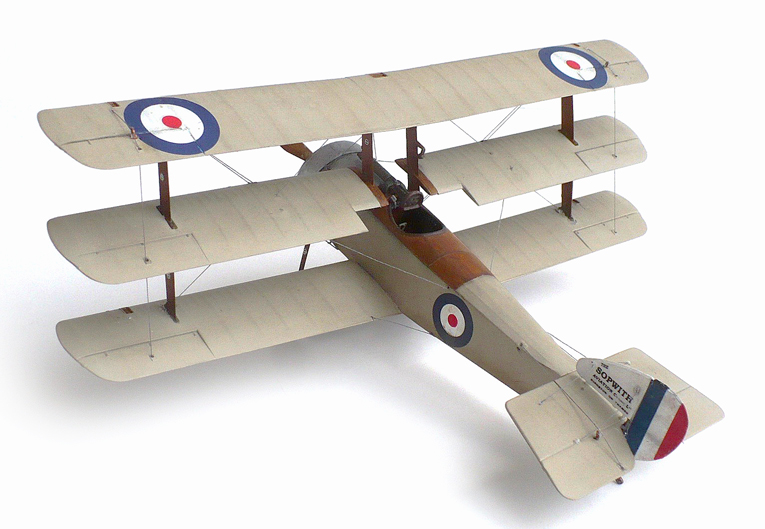
Sopwith Triplane

Here are some images of Roden's 1/32 scale Sopwith Triplane.
The plane represented here is the N500 prototype.

From Wikipedia"

 The Sopwith Triplane was a British single seat fighter aircraft designed and manufactured by the Sopwith Aviation Company during the First World War. It was the first military triplane to see operational service. The Triplane joined Royal Naval Air Service squadrons in early 1917 and was immediately successful. It was nevertheless built in comparatively small numbers and was withdrawn from active service as Sopwith Camels arrived in the latter half of 1917. Surviving Triplanes continued to serve as operational trainers until the end of the war.

The Triplane began as a private venture by the Sopwith Aviation Company. The fuselage and empennage closely mirrored those of the earlier Pup, but chief engineer Herbert Smith gave the new aircraft three narrow-chord wings to provide the pilot with an improved field of view. Ailerons were fitted to all three wings. By using the variable incidence tailplane, the aircraft could be trimmed to fly hands-off. The introduction of a smaller 8 ft span tailplane in February 1917 improved elevator response.
The Triplane was initially powered by the 110 hp Clerget 9Z nine-cylinder rotary engine, but most production examples were fitted with the 130 hp Clerget 9B rotary. At least one Triplane was tested with a 110 hp Le Rhône rotary engine, but this did not provide a significant improvement in performance.
The initial "prototype of what was to be referred to simply as the Triplane" first flew on 28 May 1916, with Sopwith test pilot Harry Hawker at the controls. Within three minutes of takeoff, Hawker startled onlookers by looping the aircraft, serial N500, three times in succession. The Triplane was very agile, with effective, well-harmonised controls. When maneuvering, however, the Triplane presented an unusual appearance. One observer noted that the aircraft looked like "a drunken flight of steps" when rolling.
In July 1916, N500 was sent to Dunkirk for evaluation with "A" Naval Squadron, 1 Naval Wing. It proved highly successful. The second prototype, serial N504, was fitted with a 130 hp Clerget 9B. N504 first flew in August 1916 and was eventually sent to France in December. This aircraft served as a conversion trainer for several squadrons.


Between July 1916 and January 1917, the Admiralty issued two contracts to Sopwith for a total of 95 Triplanes, two contracts to Clayton & Shuttleworth Ltd. for a total of 46 aircraft, and one contract to Oakley & Co. Ltd. for 25 aircraft. Seeking modern aircraft for the Royal Flying Corps, the War Office also issued a contract to Clayton & Shuttleworth for 106 Triplanes. In February 1917, the War Office agreed to exchange its Triplane orders for the Admiralty's SPAD S.VII contracts.
Production commenced in late 1916. Sopwith and Clayton & Shuttleworth completed their RNAS production orders, but Oakley, which had no prior experience building aircraft, delivered only three Triplanes before its contract was cancelled in October 1917. For unknown reasons, the RFC Triplane contract issued to Clayton & Shuttleworth was simply cancelled rather than being transferred to the RNAS. Total production amounted to 147 aircraft.

No. 1 Naval Squadron became fully operational with the Triplane by December 1916, but the squadron did not see any significant action until February 1917, when it relocated from Furnes to Chipilly.[14] No. 8 Naval Squadron received its Triplanes in February 1917. Nos. 9 and 10 Naval Squadrons equipped with the type between April and May 1917. The only other major operator of the Triplane was a French naval squadron based at Dunkirk, which received 17 aircraft.
The Triplane's combat debut was highly successful. The new fighter's exceptional rate of climb and high service ceiling gave it a marked advantage over the Albatros D.III, though the Triplane was slower in a dive. The Germans were so impressed by the performance of the Triplane that it spawned a brief triplane craze among German aircraft manufacturers. Their efforts resulted in no fewer than 34 different prototypes, including the Fokker V.4, prototype of the successful Fokker Dr.I.
Pilots nicknamed the aircraft the Tripehound or simply the Tripe. The Triplane was famously flown by "B" Flight 10 Naval Squadron, better known as "Black Flight". This all-Canadian flight was commanded by the ace Raymond Collishaw. Their aircraft, named Black Maria, Black Prince, Black George, Black Death and Black Sheep, were distinguishable by their black-painted fins and cowlings. Black Flight claimed 87 German aircraft in three months while equipped with the Triplane. Collishaw scored 34 of his eventual 60 victories in the aircraft, making him the top Triplane ace.
The Triplane's combat career was comparatively brief, in part because the Triplane proved difficult to repair. The fuel and oil tanks were inaccessible without dismantling the wings and fuselage. Even relatively minor repairs had to be made at rear echelon repair depots. Spare parts became difficult to obtain during the summer of 1917, resulting in the reduction of No. 1 Naval Squadron's complement from 18 to 15 aircraft.
The Triplane also gained a reputation for structural weakness because the wings of some aircraft collapsed in steep dives. This defect was attributed to the use of light gauge bracing wires in the 46 aircraft built by subcontractor Clayton & Shuttleworth. Several pilots of No. 10 Naval Squadron used cables or additional wires to strengthen their Triplanes. In 1918, the RAF issued a technical order for the installation of a spanwise compression strut between the inboard cabane struts of surviving Triplanes. One aircraft, serial N5912, was fitted with additional mid-bay flying wires on the upper wing while used as a trainer.
Another drawback of the Triplane was its light armament. Contemporary Albatros fighters were armed with two guns but most Triplanes carried one synchronised Vickers machine gun. Efforts to fit twin guns to the Triplane met with mixed results. Clayton & Shuttleworth built six experimental Triplanes with twin guns. Some of these aircraft saw combat service with Nos. 1 and 10 Naval Squadrons in July 1917 but performance was reduced and the single gun remained standard. Triplanes built by Oakley would have featured twin guns, an engineering change which severely delayed production.
In June 1917, No. 4 Naval Squadron received the first Sopwith Camels and the advantages of the sturdier, better-armed fighter quickly became evident. Nos. 8 and 9 Naval Squadrons re-equipped with Camels between early July and early August 1917. No. 10 Naval Squadron converted in late August, turning over its remaining Triplanes to No. 1 Naval Squadron. No. 1 operated Triplanes until December, suffering heavy casualties as a consequence. By the end of 1917, surviving Triplanes were used as advanced trainers with No. 12 Naval Squadron.

Survivors and modern reproductions

Canada
  • Reproduction – Reserve Hanger, Canada Aviation and Space Museum in Ottawa, Ontario. This Triplane is a reproduction of N5492 RNAS "Black Maria" (Raymond Collishaw) built by American amateur airplane-maker Carl R. Swanson between 1963 and 1966. The Museum purchased it in 1966, and provided and installed its Clerget 9B rotary engine. Wing Commander Paul A. Hartman piloted the aircraft during its first flight, on May 5, 1967 at Rockcliffe airport. It remained airworthy and flew on special occasions until 1971.
Russia
  • N5486 – On static display at the Central Air Force Museum in Monino, Moscow. It was supplied to the Russian Government for evaluation in May 1917. In Russia, the aircraft was fitted with skis and used operationally until captured by the Bolshevists. The aircraft then served in the Red Air Force, probably as a trainer, and was rebuilt many times.
United Kingdom

Wednesday, July 19, 2017

Felixstowe F.2A

Here are some images of Wingnut Wings 1/32 scale Felixstowe F.2A early.
With a three foot wingspan this is one impressive kit.  Plus despite its high detail and complexity is a pretty straight forward kit with no real issues, fit or otherwise.
My only complaint is that the high detail interior is mostly hidden by the fuselage. Oh well.

From Wikipedia"
The Felixstowe F.2 was a 1917 British flying boat class designed and developed by Lieutenant Commander John Cyril Porte RN at the naval air station, Felixstowe during the First World War adapting a larger version of his superior Felixstowe F.1 hull design married with the larger Curtiss H-12 flying boat. The Felixstowe hull had superior water contacting attributes and became a key base technology in most seaplane designs thereafter.

Before the war Porte had worked with American aircraft designer Glenn Curtiss on a flying boat, America in which they intended to cross the Atlantic in order to win the £10,000 prize offered by the British Daily Mail newspaper for the first aircraft to cross the Atlantic. Following the outbreak of war in Europe, Porte returned to England and rejoined the Royal Navy, eventually becoming commander of the naval air station at Felixstowe where he recommended the purchase from Curtiss of an improved version of the America flying boat on which he had worked, the Curtiss H-4 type, resulting in the RNAS receiving two prototype Americas and 62 H-4s.
The Curtiss H-4 was found to have a number of problems, being both underpowered and having a hull too weak for sustained operations and having poor handling characteristics when afloat or taking off. One flying boat pilot, Major Theodore Douglas Hallam, wrote that they were "comic machines, weighing well under two tons; with two comic engines giving, when they functioned, 180 horsepower; and comic control, being nose heavy with engines on and tail heavy in a glide."
To try to resolve the H-4's hydrodynamic issues, in 1915 Porte carried out a series of experiments on four H-4s fitted with a variety of modified hulls,using the results of these tests to design a new 36-foot-long (11 m) hull which was fitted to the wings and tail of an H-4, serial number 3580, with a pair of 150 hp (112 kW) Hispano-Suiza 8 engines as the Felixstowe F.1. Rather than the lightweight boat-type structure of the Curtiss boats, the F.1's hull was based around a sturdy wooden box-girder similar to that used in contemporary landplanes, to which were attached a single-step planing bottom and side sponsons. Once modified by the fitting of a further two steps, the new hull proved to give much better take off and landing characteristics and was much more seaworthy.
Porte then designed a similar hull, for the larger Curtiss H-12 flying boat, which while larger and more capable than the H-4s, shared failings of a weak hull and poor water handling. The combination of the new Porte II hull, this time fitted with two steps, with the wings of the H-12, a new tail and powered by two Rolls-Royce Eagle engines was named the Felixstowe F.2; its first flight was in July 1916,[10] proving greatly superior to the Curtiss on which it was based. The F.2 entered production as the Felixstowe F.2A, being used as a patrol aircraft, with about 100 being completed by the end of World War I. Another seventy were built, and these were followed by two F.2C which were built at Felixstowe.
In February 1917, the first prototype of the Felixstowe F.3 was flown. This was larger and heavier than the F.2, giving it greater range and heavier bomb load, but poorer agility. Approximately 100 Felixstowe F.3s were produced before the end of the war.
The Felixstowe F.5 was intended to combine the good qualities of the F.2 and F.3, with the prototype first flying in May 1918. The prototype showed superior qualities to its predecessors but the production version was modified to make extensive use of components from the F.3, in order to ease production, giving lower performance than either the F.2A or F.3.

The Felixstowe F.2A was used as a patrol aircraft over the North Sea until the end of the war. Its excellent performance and maneuverability made it an effective and popular type, often fighting enemy patrol and fighter aircraft, as well as hunting U-boats and Zeppelins. The larger F.3, which was less popular with its crews than the more maneuverable F.2A, served in the Mediterranean and the North Sea.
The F.5 did not enter service until after the end of World War I, but replaced the earlier Felixstowe boats (together with Curtiss flying boats) to serve as the RAF's standard flying boat until being replaced by the Supermarine Southampton in 1925.

Sunday, December 4, 2016

Sopwith Pup RFC

Here are some images of Wingnut Wings 1/32 scale Sopwith Pup RFC (Royal Flying Corps).
This aircraft served with 46 Squadron, Pilot Lt A.S. Lee, July - August 1917.

From Wikipedia"
The Sopwith Pup was a British single-seater biplane fighter aircraft built by the Sopwith Aviation Company. It entered service with the Royal Flying Corps and the Royal Naval Air Service in the autumn of 1916. With pleasant flying characteristics and good manoeuvrability, the aircraft proved very successful. The Pup was eventually outclassed by newer German fighters, but it was not completely replaced on the Western Front until the end of 1917. Remaining Pups were relegated to Home Defence and training units. The Pup's docile flying characteristics also made it ideal for use in aircraft carrier deck landing and takeoff experiments.

In 1915, Sopwith produced a personal aircraft for the company's test pilot Harry Hawker, a single-seat, tractor biplane powered by a 50 hp Gnome rotary engine. This became known as Hawker's Runabout; another four similar aircraft have been tentatively identified as Sopwith Sparrows. Sopwith next developed a larger fighter that was heavily influenced by this design, though more powerful and controlled laterally with ailerons rather than by wing warping.
The resulting aircraft was a single-bay, single-seat biplane with a fabric-covered, wooden framework and staggered, equal-span wings. The cross-axle type main landing gear was supported by V-struts attached to the lower fuselage longerons. The prototype and most production Pups were powered by the 80 hp (60 kW) Le Rhône 9C rotary engine. Armament was a single 0.303 inch (7.7 mm) Vickers machine gun synchronized with the Sopwith-Kauper synchronizer.
A prototype was completed in February 1916 and sent to Upavon for testing in late March. The Royal Naval Air Service (RNAS) quickly ordered two more prototypes, then placed a production order. Sopwith was heavily engaged in production of the 1½ Strutter, and produced only a small number of Pups for the RNAS. Deliveries commenced in August 1916.
The Royal Flying Corps (RFC) also placed large orders for Pups. The RFC orders were undertaken by sub-contractors Standard Motor Co. and Whitehead Aircraft. Deliveries did not commence until the beginning of 1917. A total of 1,770 Pups were built by Sopwith (96), Standard Motor Co. (850), Whitehead Aircraft (820), and William Beardmore & Co. (30).

In May 1916, the RNAS received its first Pups for operational trials with "A" Naval Squadron. The first Pups reached the Western Front in October 1916 with No. 8 Squadron RNAS, and proved successful, with the squadron's Pups claiming 20 enemy machines destroyed in operations over the Somme battlefield by the end of the year. The first RFC Squadron to re-equip with the Pup was No. 54 Squadron, which arrived in France in December. The Pup quickly proved its superiority over the early Fokker, Halberstadt and Albatros biplanes. After encountering the Pup in combat, Manfred von Richthofen said, "We saw at once that the enemy aeroplane was superior to ours."
The Pup's light weight and generous wing area gave it a good rate of climb. Agility was enhanced by installing ailerons on both wings. The Pup had half the horsepower and armament of the German Albatros D.III, but was much more manoeuvrable, especially over 15,000 ft (4,500 m) due to its low wing loading. Ace James McCudden stated that "When it came to manoeuvring, the Sopwith [Pup] would turn twice to an Albatros' once ... it was a remarkably fine machine for general all-round flying. It was so extremely light and well surfaced that after a little practice one could almost land it on a tennis court." However, the Pup was also longitudinally unstable.
At the peak of its operational deployment, the Pup equipped only four RNAS squadrons (Nos. 3, 4, 8 and 9), and three RFC squadrons (Nos. 54, 46 and 66). By the spring of 1917, the Pup had been outclassed by the newest German fighters. The RNAS replaced their Pups, first with Sopwith Triplanes, and then with Sopwith Camels. The RFC soldiered on with Pups, in spite of increasing casualties, until it was possible to replace them with Camels in December 1917.

The raids on London by Gotha bombers in mid-1917 caused far more damage and casualties than the earlier airship raids. The ineffective response by British interceptor units had serious political repercussions. In response, No. 66 Squadron was withdrawn to Calais for a short period, and No. 46 was transferred for several weeks to Sutton's Farm airfield near London. Two new Pup squadrons were formed specifically for Home Defence duties, No. 112 in July, and No. 61 in August.
The first Pups delivered to Home Defence units utilised the 80 hp Le Rhône, but subsequent Home Defence Pups standardised on the more powerful 100 hp Gnome Monosoupape, which provided improved rate of climb. These aircraft were distinguishable by the addition of vents in the cowling face.

Sopwith Pups were also used in many pioneering carrier experiments. On 2 August 1917, a Pup flown by Sqn Cdr Edwin Dunning became the first aircraft to land aboard a moving ship, HMS Furious. Dunning was killed on his third landing when the Pup fell over the side of the ship. The Pup began operations on the carriers in early 1917; the first aircraft were fitted with skid undercarriages in place of the standard landing gear. Landings utilised a system of deck wires to "trap" the aircraft. Later versions reverted to the normal undercarriage. Pups were used as ship-based fighters on three carriers: HMS Campania, Furious and Manxman. A number of other Pups were deployed to cruisers and battleships where they were launched from platforms attached to gun turrets. A Pup flown from a platform on the cruiser HMS Yarmouth shot down the German Zeppelin L 23 off the Danish coast on 21 August 1917.
The U.S. Navy also employed the Sopwith Pup with famed Australian/British test pilot Edgar Percival testing the use of carrier-borne fighters. In 1926, Percival was catapulted in a Pup off the battleship USS Idaho at Guantanamo Bay, Cuba.
 The Pup saw extensive use as a trainer. Student pilots completing basic flight training in the Avro 504k often graduated to the Pup as an intermediate trainer. The Pup was also used in Fighting School units for instruction in combat techniques. Many training Pups were in fact reserved by senior officers and instructors as their personal runabouts while a few survived in France as personal or squadron 'hacks' after the type was withdrawn from combat.
 The Pup was officially named the Sopwith Scout. The "Pup" nickname arose because pilots considered it to be the "pup" of the larger two-seat Sopwith 1½ Strutter. The name never had official status as it was felt to be "undignified," but a precedent was set, and all later Sopwith types apart from the Triplane acquired animal names (Camel, Dolphin, Snipe etc.), which ended up with the Sopwith firm being said to have created a "flying zoo" during the First World War

Wednesday, October 5, 2016

Bristol M.1 C

Here are some images of Special Hobby's 1/32 scale Bristol M.1 C.

From Wikipedia"
In 1916, Frank Barnwell, chief designer of Bristol Aeroplane Company, realising that the performance of existing fighter aircraft was inadequate, designed a new single-seat tractor monoplane fighter as a private venture, the Bristol M.1.
The first prototype, the M.1A made its maiden flight on 14 July 1916. It was of conventional wood and fabric construction, with a carefully streamlined circular cross-section fuselage. The wing was shoulder mounted and was braced with flying wires running from the wing to the lower fuselage and landing wires from the wings to a cabane made of two semi-circular steel tube hoops positioned over the pilot's cockpit. A 110 horsepower (82 kW) Clerget rotary engine drove a two-bladed propeller fitted with a large hemispherical spinner to reduce drag. It was purchased by the War Office for evaluation, and demonstrated impressive performance during official testing, reaching a speed of 128 miles per hour (206 km/h) and climbing to 10,000 feet (3,000 m) in 8 minutes 30 seconds, although the forward and downward view was criticized by test pilots.
The War Office ordered four modified aircraft, designated M.1B, in October 1916. These differed from the first prototype in having a more conventional cabane consisting of a pyramid of four straight steel struts, a large clear-view cut-out panel in the starboard wing root to give improved view for landing and a single .303 in (7.7 mm) Vickers machine gun mounted on the port wing root.
Despite excellent performance - it had a maximum speed some 30-50 mph (50–80 km/h) higher than any of the contemporary German Fokker Eindecker and French Morane-Saulnier N monoplanes - it was rejected by the Air Ministry for service on the Western Front, ostensibly because its landing speed of 49 mph was considered too high for small French airfields, but more likely because of a widespread belief that monoplane aircraft were inherently unsafe in combat. The RFC had imposed a ban on monoplanes after the crash of one of the Bristol-Coanda Monoplanes on 10 September 1912, and despite the subsequent 1913 Monoplane Committee clearing the design type there persisted a deep-rooted suspicion of monoplanes. This suspicion may also have been re-inforced by the RFC's underwhelming experience with various Morane-Saulnier monoplanes, especially the Morane-Saulnier N, which was also criticised for its high landing speed.
Nevertheless, a production order for 125 aircraft was placed on 3 August 1917. Designated M.1C, this version was fitted with a Le Rhône rotary engine and had a Vickers machine gun centrally-mounted in front of the pilot.
A single M.1, registered G-EAVP was rebuilt as a high-speed testbed for the Bristol Lucifer three cylinder radial engine. This aircraft was designated the M.1D.

Thirty-three M.1Cs served in the Middle East and the Balkans in 1917–18, while the rest were used by UK-based training units, where they were popular as personal mounts for senior officers.
One pilot of the M.1Cs that served on the Macedonian Front was Captain Frederick Dudley Travers DFC of No. 150 Squadron RAF, the only ace on this type. Travers switched from the Royal Aircraft Factory SE.5a, in which he had scored three of his four kills and scored the last five of his victories between 2 and 16 September 1918, possibly all in the M.1C serial number C4976. Amongst his victims was a Fokker D.VII, widely regarded as the best German fighter of its day.
Twelve were sent to Chile on second half of 1918 in part payment for the battleships Almirante Latorre and Almirante Cochrane being built for Chile in Britain but commandeered for the Royal Navy before completion. One of these, flown by Lt. Dagoberto Godoy, was used to fly from Santiago to Mendoza, Argentina and back on 12 December 1918, the first flight across the Andes mountain chain.
The Lucifer engined M.1D, painted red and registered G-EAVP, was successfully raced during 1922, winning the handicap prize in the 1922 Aerial Derby, piloted by L.L. Carter. The next year it was fitted with a specially tuned 140 hp (100 kW) Lucifer and entered for the Grosvenor Cup, during which it is crashed at Chertsey on approach to Croydon Airport, killing the pilot, Ernest Leslie Foot.