Translate

Showing posts with label Post War British. Show all posts

Saturday, March 10, 2018

English Electric F.3 Lightning

Here are some more images of Trumpeter's 1/32 scale English Electric F.3 Lightning.
I'm just doing some more experimenting with black backgrounds. I find silver coloured aircraft tends to show up better with a dark background.

From Wikipedia"
The English Electric Lightning is a supersonic jet fighter aircraft of the Cold War era, noted for its great speed. It is the only all-British Mach 2 fighter aircraft and was the first aircraft in the world capable of supercruise. The Lightning was renowned for its capabilities as an interceptor; pilots commonly described it as "being saddled to a skyrocket". Following English Electric's integration into the unified British Aircraft Corporation, the aircraft was marketed as the BAC Lightning.
The Lightning was prominently used by the Royal Air Force RAF and the Royal Saudi Air Force. The aircraft was a regular performer at airshows, it is one of the highest-performance aircraft ever used in formation aerobatics.[citation needed] Following retirement in the late 1980s, many of the remaining aircraft became museum exhibits; until 2010, three examples were kept flying at "Thunder City" in Cape Town, South Africa. In September 2008, the Institution of Mechanical Engineers conferred on the Lightning its "Engineering Heritage Award" at a ceremony at BAE Systems' site at Warton Aerodrome.
The first operational Lightning, designated the F.1, was designed as a point defence interceptor to defend mainland Britain from bomber attack. To best perform this intercept mission, emphasis was placed on rate-of-climb, acceleration, and speed, rather than range and combat endurance. It was equipped with two 30 mm ADEN cannon in front of the cockpit windscreen and an interchangeable fuselage weapon pack containing either an additional two ADEN cannon, 48, two inch air-to-air rockets, or two de Havilland Firestreak air-to-air missiles, a heavy fit optimized for attack of large aircraft. The Ferranti AI.23 radar (immediate predecessor of the AI.24 Foxhunter) supported autonomous search, automatic target tracking, and ranging for all weapons, while the pilot attack sight provided gyroscopically derived lead angle and backup stadiametric ranging for gun firing. The radar and gunsight were collectively designated the AIRPASS: Airborne Interception Radar and Pilot Attack Sight System.
The next two Lightning variants, the F.1A and F.2, saw steady but relatively minor refinement of the basic design, and the next variant, the F.3, was a major departure. The F.3 had higher thrust Avon 301R engines, a larger, squared-off fin and strengthened intake bullet allowing a service clearance to Mach 2.0 (the F.1, F.1A and F.2 were limited to Mach 1.7), the A.I.23B radar and Red Top missile offering a limited forward hemisphere attack capability—and most notoriously—deletion of the nose cannon. The new engines and fin made the F.3 the highest performance Lightning yet, but with an even higher fuel consumption and resulting shorter range. The next variant, the F.6, was already in development, but there was a need for an interim solution to partially address the F.3’s shortcomings. The F.3A was that interim solution.
The F.3A introduced two improvements: a new, non-jettisonable, 610 gal (2,770 l) ventral fuel tank, and a new, kinked, conically cambered wing leading edge, incorporating a slightly larger leading edge fuel tank, raising the total usable internal fuel to 716 gal (3,250 l). The conically cambered wing noticeably improved maneuverability, especially at higher altitudes, and the ventral tank nearly doubled available fuel. The increased fuel was very welcome, but the lack of cannon armament was felt to be a deficiency. It was thought that cannon were desirable to fire warning shots in the intercept mission.
The F.6 was the ultimate Lightning version to see British service. Originally, it was nearly identical to the F.3A with the exception that it had provisions to carry 260 gal (1,180 l) ferry tanks on pylons over the wings. These tanks were jettisonable in an emergency, and gave the F.6 a substantially improved deployment capability. There remained one glaring shortcoming: the lack of cannon. This was finally rectified in the form of a modified ventral tank with two ADEN cannon mounted in the front. The addition of the cannon and their ammunition decreased the tank's fuel capacity from 610 gal to 535 gal (2,430 l), but the cannon made the F.6 a “real fighter” again.
The final British Lightning was the F.2A. This was an F.2 upgraded with the cambered wing, the squared fin, and the 610 gal ventral. The F.2A retained the A.I.23 and Firestreak missile, the nose cannon, and the earlier Avon 211R engines. Although the F.2A lacked the thrust of the later Lightnings, it had the longest tactical range of all Lightning variants, and was used for low-altitude interception over Germany.
There were several unique and distinctive features in the design of the Lightning; principally the use of stacked and staggered engines, a notched delta wing, and a low-mounted tailplane. The vertically stacked, longitudinally staggered engines was the solution devised by Petter to the conflicting requirements of minimizing frontal area, providing undisturbed engine airflow across a wide speed range, and packaging two engines to provide sufficient thrust to meet performance goals. The configuration allowed the twin engines to be fed by a single nose inlet, with the flow split vertically aft of the cockpit, and the nozzles tightly stacked, effectively tucking one engine behind the cockpit. The result was a low frontal area, an efficient inlet, and excellent single-engine handling. Unfortunately, this stacked configuration led to complicated maintenance procedure, and the recurring problem of fluid leakage from the upper engine being a fire hazard.


Lightning XM215 at Farnborough Air Show, England, in 1964
The fuselage was tightly packed, leaving no room for fuel tankage or main landing gear. While the notched delta wing lacked the volume of a standard delta wing, each wing contained a fairly conventional three-section main fuel tank and leading-edge tank, holding 312 imp gal (1,420 l); the wing flap also contained a 33 imp gal (150 l) fuel tank and an additional 5 imp gal (23 l) was contained in a fuel recuperator, bringing the aircraft's total internal fuel capacity to 700 imp gal (3,200 l). The main landing gear was sandwiched outboard of the main tanks and aft of the leading edge tanks, with the flap fuel tanks behind. The long main gear legs retracted toward the wingtip, necessitating an exceptionally thin main tyre inflated to the high pressure of 330–350 psi (23–24 bar).
A conformal ventral store was added to the design to house, alternatively, a fuel tank or a rocket engine. The rocket engine, a Napier Double Scorpion motor, also contained a reserve of 200 imp gal (910 l) of high-test peroxide (HTP) to drive the rocket’s turbopump and act as an oxidizer. Fuel for the rocket would have been drawn from the Lightning’s internal tankage. The rocket engine was intended to boost the Lightning’s performance against a supersonic, high altitude bomber threat, but this threat never emerged, thus the Lightning’s basic performance was deemed sufficient and the rocket engine option was cancelled in 1958. The ventral store saw wide use as an extra fuel tank, initially this was jettisonable and held 250 gal (247 gal usable, 1,120 l). Later ventral tanks were non-jettisonable.
Despite its acceleration, altitude and top speed, the Lightning found itself outclassed by newer fighters in terms of radar, avionics, weapons load, range, and air-to-air capability. More of a problem was the obsolete avionics and weapons fit. The radar had a short range and no track-while scan capability; it could only detect targets in a fairly narrow (40 degree) arc. While an automatic collision course attack system was developed and successfully demonstrated by English Electric, it was not adopted owing to cost concerns. Plans to supplement or replace the obsolete Red Top and Firestreak missiles with modern AIM-9L Sidewinder missiles never came to fruition because of lack of funding,

Monday, January 1, 2018

Supermarine Seafire Mk XV

Here are some images of Revell/AA Productions Supermarine Seafire Mk XV (early).
This aircraft served in No. 883 squadron RCN Dartmouth, Nova Scotia, Canada 1947.

From Wikipedia"
The Supermarine Seafire was a naval version of the Supermarine Spitfire adapted for operation from aircraft carriers. In concept, it is relatively comparable to the Hawker Sea Hurricane, a navalised version of the Spitfire's stablemate, the Hawker Hurricane. The name Seafire had been derived from the abbreviation of the longer name Sea Spitfire.
The idea of adopting a navalised carrier-capable version of the Supermarine Spitfire had been mooted by the Admiralty as early as May 1938. Despite a pressing need to replace various types of obsolete aircraft that were still in operation with the Fleet Air Arm (FAA), some opposed the notion, such as Winston Churchill, although these disputes were often a result of an overriding priority being placed on maximising production of land-based Spitfires instead. During 1941 and early 1942, the concept was again pushed for by the Admiralty, cumulating in an initial batch of Seafire Mk Ib fighters being provided in late 1941, which were mainly used for pilots to gain experience operating the type at sea. While there were concerns over the low strength of its undercarriage, which had not been strengthened like many naval aircraft would have been, its performance was found to be acceptable.
From 1942 onwards, further Seafire models were quickly ordered, including the first operationally-viable Seafire F Mk III variant. This led to the type rapidly spreading throughout the FAA. In November 1942, the first combat use of the Seafire occurred during in Operation Torch, the Allied landings in North Africa. In July 1943, the Seafire was used to provide air cover for the Allied invasion of Sicily; and reprised this role in September 1943 during the subsequent Allied invasion of Italy. During 1944, the type was again used in quantity to provide aerial support to Allied ground forces during the Normandy landings and Operation Dragoon in Southern France. During the latter half of 1944, the Seafire became a part of the aerial component of the British Pacific Fleet, where it quickly proved to be a capable interceptor against the feared kamikaze attacks by Japanese pilots which had become increasingly common during the final years of the Pacific War.
The Seafire continued to be used for some time after the end of the war. The FAA opted to promptly withdraw all of its Merlin-powered Seafires and replace them with Griffon-powered counterparts. The type saw further active combat use during the Korean War, in which FAA Seafires performed hundreds of missions in the ground attack and combat air patrol roles against North Korean forces during 1950. The Seafire was withdrawn from service during the 1950s. In FAA service, the type had been replaced by the newer Hawker Sea Fury, the last piston engine fighter to be used by the service, along with the first generation of jet-propelled naval fighters, such as the de Havilland Vampire, Supermarine Attacker, and Hawker Sea Hawk.
 After the Mk III series, the next Seafire variant to appear was the Seafire F Mk XV, which was powered by a Griffon VI – single-stage supercharger, rated at 1,850 hp (1,379 kW) at 2,000 ft (610 m) driving a 10 ft 5 in Rotol propeller. Designed in response to Specification N.4/43 this appeared to be a naval Spitfire F Mk XII; in reality the Mk XV was an amalgamation of a strengthened Seafire III airframe and wings with the wing fuel tanks, retractable tailwheel, larger elevators and broad-chord "pointed" rudder of the Spitfire VIII. The engine cowling was different to that of the Spitfire XII series, being secured with a larger number of fasteners and lacking the acorn shaped blister behind the spinner. The final 30 Mk XVs were built with the blown "teardrop" cockpit canopy and cut down rear fuselage introduced on the Spitfire Mk XVI. On the first 50 aircraft manufactured by Cunliffe-Owen a heavier, strengthened A-frame arrestor hook was fitted to cope with the greater weight. On subsequent Mk XVs a new form of "sting" type arrestor hook was used; this version was attached to the reinforced rudder post at the rear of the fuselage and was housed in a fairing below the base of the shortened rudder. A vee-shaped guard forward of the tailwheel prevented arrestor wires getting tangled up with the tailwheel. 390 Seafire XVs were built by Cunliffe-Owen and Westland from late 1944. Six prototypes had been built by Supermarine.

Monday, October 9, 2017

de Havilland Sea Hornet NF.21

Here are some images of HPH Models 1/32 scale de Havilland Sea Hornet NF.21.

From Wikipedia'

The Hornet was designed with the possibility of naval service on carriers firmly in mind. To this end good low-speed handling was required, along with good all-round visibility for the pilot. The basic Hornet design excelled at meeting these requirements. Shortly after the first Hornet prototype flew, Specification N.5/44 was issued to de Havilland, covering the modification of the Hornet for naval service. The Heston Aircraft Company was contracted to carry out the conversion work on three early production F.1s. The work entailed altering the wings to incorporate folding mechanisms so that each outer wing panel, from the aileron/flap line outboard could be folded upwards and inwards at an angle. The hinges were part of the upper wing skin structure while the lower wing skins incorporated securing latches, and Lockheed hydraulic jacks were used to move the wing panels. Slotted flaps were introduced to improve low speed "flaps down" control.

Sea Hornet NF.21 of the Airwork FRU displayed at RNAS Stretton in 1955. The radar thimble nose of this variant is evident
The lower rear fuselage was reinforced with two additional spruce longerons designed to take the stresses imposed by the external "vee" framed arrestor hook, which was flush-mounted below the fuselage. The frame was made up of steel tubing with a forged-steel hook and was held against the fuselage by a "snap gear". Because the Hornet used the American "3-point" system of catapult-assisted takeoff, two forged steel catapult bridle hooks were fitted, one below each wing, close to the fuselage The de Havilland rubber-in-compression undercarriage legs could not absorb the rebound energies imposed by carrier landings. They were replaced by more conventional hydraulic oleos which embodied torque links.
Merlin 133/134s (derated from 2,070 hp/1,543 kW to 2,030 hp/1,535 kW) were fitted to all Sea Hornets. Other specialised naval equipment (mainly different radio gear) was fitted and provision was made for three camera ports, one on each side of the rear fuselage and one pointing down. Sea Hornet F.20s also incorporated the modifications of the Hornet F.3, although the internal fuel capacity was 347 Imp gal (1,557 l), slightly reduced from that of the F.1. The modifications added some 550 lb (249 kg) to the weight of the aircraft. Maximum speed was decreased by 11 mph (18 km/h).[14]
The Hornet NF.21 was designed to fill a need for a naval night fighter. Special flame-dampening exhausts were installed, and a second basic cockpit was added to the rear fuselage, just above the wing trailing edges. ASH radar equipment was placed in the rear of this cockpit, with the radar operator/navigator seated facing aft. To gain access, a small trapdoor was provided in the lower fuselage; a fixed, teardrop-shaped bubble canopy, which could be jettisoned in an emergency, provided a good field of view. At the front of the aircraft, the nose underwent a transformation with the small rotating ASH radar dish being housed under an elongated "thimble" radome. The horizontal tail units were increased in span. The effect of these modifications on performance was minimal; about 4 mph (6 km/h).
The Sea Hornet PR.22 was a dedicated photo reconnaissance aircraft version of the F.20. The cannon were removed and the apertures faired over. Three cameras were installed in the rear fuselage: two F.52s for night use and one K.19B for day. A total of 23 PR.22s were built, interspersed with F.20s being built at Hatfield.
Captain Eric "Winkle" Brown, former fighter pilot and officer of the Fleet Air Arm, was one of the world's most accomplished test pilots and he still holds the record for flying the greatest number of aircraft types.
Just after VE Day the first semi-naval Sea Hornet PX 212 arrived at the RAE, Farnborough. Eric Brown initiated "work-up to deck-landing" trials. 37 years later, he was still impressed:

"...the next two months of handling and deck landing assessment trials were to be an absolute joy; from the outset the Sea Hornet was a winner!"
"The view from the cockpit, positioned right forward in the nose beneath a one-piece aft-sliding canopy was truly magnificent. The Sea Hornet was easy to taxi, with powerful brakes... the takeoff using 25 lb (2,053 mm Hg, 51" Hg) boost and flaps at one-third extension was remarkable! The 2,070 hp (1,540 kW) Merlin 130/131 engines fitted to the prototypes were to be derated to 18 lb (1,691 Hg, 37" Hg) boost and 2,030 hp (1,510 kW) as Merlin 133/134s in production Sea Hornets, but takeoff performance was to remain fantastic. Climb with 18 lb boost exceeded 4,000 ft/min (1,200 m/min)"...
"In level flight the Sea Hornet's stability about all axes was just satisfactory, characteristic, of course, of a good day interceptor fighter. Its stalling characteristics were innocuous, with a fair amount of elevator buffeting and aileron twitching preceding the actual stall"...
"For aerobatics the Sea Hornet was absolute bliss. The excess of power was such that manoeuvres in the vertical plane can only be described as rocket-like. Even with one propeller feathered the Hornet could loop with the best single-engine fighter, and its aerodynamic cleanliness was such that I delighted in its demonstration by diving with both engines at full bore and feathering both propellers before pulling up into a loop!"
During this series of tests Captain Brown found that the ailerons were too heavy and ineffectual for deck landing and there were some problems with throttle movement, brakes and the rubber-in-compression undercarriage legs were still fitted. De Havilland were quick to modify the aircraft. Eric Brown:

"Landings aboard Ocean had been made without any crash barrier... Yet, in the case of the Sea Hornet, I had felt such absolute confidence that I was mentally relaxed... Indeed, there was something about the Sea Hornet that made me feel that I had total mastery of it; I revelled in its sleek form and the immense surge of power always to hand..."
"Circumstances had conspired against the Sea Hornet in obtaining the recognition that it justly deserved as a truly outstanding warplane...in my book the Sea Hornet ranks second to none for harmony of control, performance characteristics and, perhaps most important, in inspiring confidence in its pilot. For sheer exhilarating flying enjoyment, no aircraft has ever made a deeper impression on me than did this outstanding filly from the de Havilland stable."


Monday, September 19, 2016

Hawker FB 11 Sea Fury

Here are some more images of Fisher Model and Pattern's 1/32 scale Hawker FB 11 Sea Fury.

From Wikipedia "The Hawker Sea Fury was a British fighter aircraft developed for the Royal Navy by Hawker during the Second World War. The last propeller-driven fighter to serve with the Royal Navy, it was also one of the fastest production single piston-engined aircraft ever built.


The Hawker Fury was an evolutionary successor to the successful Hawker Typhoon and Tempest fighters and fighter-bombers of World War II. The Fury was designed in 1942 by Sydney Camm, the famous Hawker designer, to meet the Royal Air Force’s requirement for a lightweight Tempest Mk.II replacement. Developed as the "Tempest Light Fighter", it used modified Tempest semi-elliptical outer wing panels, bolted and riveted together on the fuselage centerline. The fuselage itself was similar to the Tempest, but fully monocoque with a higher cockpit for better visibility. The Air Ministry was sufficiently impressed by the design to write Specification F.2/43 around the concept.
Six prototypes were ordered; two were to be powered by Rolls-Royce Griffon engines, two with Centaurus XXIIs, one with a Centaurus XII and one as a test structure. The first Fury to fly, on 1 September 1944, was NX798 with a Centaurus XII with rigid engine mounts, powering a Rotol four-blade propeller. Second on 27 November 1944 was LA610, which had a Griffon 85 and Rotol six-blade contra-rotating propeller. By now development of the Fury and Sea Fury was closely interlinked so that the next prototype to fly was a Sea Fury, SR661, described under "Naval Conversion." NX802 (25 July 1945) was the last Fury prototype, powered by a Centaurus XV. With the ending of the Second World War in Europe, the RAF Fury contract was cancelled and development centred on the Sea Fury. LA610 was eventually fitted with a Napier Sabre VII, which was capable of developing 3,400-4,000 hp (2,535-2,983 kW). As a result it became the fastest piston engined Hawker aircraft, reaching a speed of around 485 mph (780 km/h).
The Royal Navy’s earlier Supermarine Seafire had never been completely suitable for carrier use, having a poor view for landing and a narrow-track undercarriage that made landings and takeoffs "tricky". Consequently, the Sea Fury F X (later F 10) replaced it on most carriers. Sea Furies were issued to Nos. 736, 738, 759 and 778 Squadrons of the Fleet Air Arm.
The F 10 was followed by the Sea Fury FB 11 fighter-bomber variant, which eventually reached a production total of 650 aircraft. The Sea Fury remained the Fleet Air Arm’s primary fighter-bomber until 1953 and the introduction of the Hawker Sea Hawk and Supermarine Attacker.
A total of 74 Sea Furies FB 11 (and one FB 10) served with the Royal Canadian Navy (RCN) between 1948 and 1956. All flew from the aircraft carrier HMCS Magnificent in 871 squadron.
The last flights of the Canadian Sea Furies were made by Lieutenant Commander Derek Prout, who ferried WG565 to Calgary, Alberta to serve as an instructional airframe at the local Provincial Institute of Technology, and F/O Lynn Garrison who flew WG565 on 1 April 1958.
Because production continued until well after the end of the Second World War and aircraft remained in Royal Navy service until 1955, dozens of airframes have survived in varying levels of condition. A number of Sea Furies were overhauled by Hawker Aircraft at their factory at Blackpool during 1959 and supplied to civil companies in Germany, equipped with target-towing gear for Luftwaffe contract flying. Some of these aircraft survive today, owned and operated by warbird enthusiasts.
Around a dozen heavily modified Sea Furies are raced regularly at the Reno Air Races as of 2009. Most of these replace the original sleeve-valve Centaurus radial, because rotational speed and tuning potential are limited in contrast to more conventional engines such as the Rolls Royce Merlin. Most racing Sea Furies use the Pratt & Whitney Wasp Major or the Wright R-3350 Duplex-Cyclone radial engine.
WJ232, the aircraft 'Hogey' Carmichael flew during the 9 August 1952 action which resulted in him being credited with the destruction of a MiG-15 jet fighter, remains in operation in Australia in its original Royal Navy markings, with civil registration VH-SHF.
Following their retirement, something like 46 Sea Furies were stored in a wooden World War Two hangar. Some had less than 4 hours total time - little more than factory test flights. As they were about to be sold to Lynn Garrison, and his associates, by Crown Assets Disposal Corporation, a fire destroyed the hangar and its contents. The aircraft were being offered to Ramfis Trujillo, son of the Dominican president, who was studying at America's Leavenworth Army School.
Many additional airframes remain as static displays in museums worldwide. One of these ex- RCN WG565 is on display in Calgary, Alberta, Canada (I walked on the wing of this aircraft). It was ferried there for instructional use in the Alberta Provincial Institute of Technology by Lieutenant Commander Derek Prout. On 1 April 1958, Flying Officer Lynn Garrison, of 403 City of Calgary Squadron, RCAF, made the last military flight for this type in Canada.

Saturday, October 4, 2014

Hawker Sea Fury FB 11 In Nederland Markings

Here are some images of Hobby Craft's 1/48 scale scale Hawker Sea Fury FB 11 in Nederland markings.

From Wikipedia"
The Hawker Sea Fury was a British fighter aircraft designed and manufactured by Hawker. It was the last propeller-driven fighter to serve with the Royal Navy, and also one of the fastest production single piston-engined aircraft ever built. Developed during the Second World War, the Sea Fury entered service two years after the war ended. The Sea Fury proved to be a popular aircraft with a number of overseas militaries, and was used during the Korean War in the early 1950s.
The Sea Fury's development was formally initiated in 1943 in response to a wartime requirement of the RAF, thus the aircraft was initially named Fury. As the Second World War drew to a close, the RAF cancelled their order for the aircraft; however, the Royal Navy saw the type as a suitable carrier aircraft to replace a range of increasingly obsolete or poorly suited aircraft being operated by the Fleet Air Arm. Development of the Sea Fury proceeded, and the type began entering operational service in 1947.
The Sea Fury has many design similarities to Hawker's preceding Tempest fighter, but the Sea Fury was a considerably lighter aircraft; both the Sea Fury's wings and fuselage originate from the Tempest but were significantly modified and redesigned. Production Sea Furies were fitted with the powerful Bristol Centaurus engine, and armed with four wing-mounted Hispano V cannons. While originally developed as a pure aerial fighter aircraft, the definitive Sea Fury FB 11 was a fighter-bomber, the design having been found suitable for this mission as well.
The Sea Fury attracted a number of international orders as both a carrier and land-based aircraft; it was operated by a number of countries, including Australia, Burma, Canada, Cuba, Egypt, West Germany, Iraq, and Pakistan. The type acquitted itself well in the Korean War, fighting effectively even against the MiG-15 jet fighter. Although the Sea Fury was retired by the majority of its military operators in the late 1950s in favour of jet-propelled aircraft, a considerable number of aircraft saw subsequent use in the civil sector, and several remain airworthy in the 21st century both as heritage and racing aircraft.
The Hawker Fury was an evolutionary successor to the successful Hawker Typhoon and Tempest fighters and fighter-bombers of World War II. The Fury's design process was initiated in September 1942 by Sydney Camm, one of Hawker's foremost aircraft designers, to meet the Royal Air Force’s requirement for a lightweight Tempest Mk.II replacement; the Tempest, while a successful aircraft, had been viewed as being heavy and oversized for typical fighter duties. Developed as the "Tempest Light Fighter", the semi-elliptical wing of the Tempest was incorporated, but was shortened in span by attaching the two wings at the aircraft centreline, eliminating the centre-section. The fuselage itself was broadly similar in form to that of the Tempest, but was a fully monocoque structure, while the cockpit level was higher, affording the pilot better all round visibility.
The project was formalized in January 1943 when the Air Ministry issued Specification F.2/42 around the "Tempest Light Fighter". This was followed up by Specification F.2/43, issued in May 1943, which required a high rate of climb of not less than 4,500 ft/min (23 m/s) from ground level to 20,000 feet (6,096 m), good fighting manoeuvrability and a maximum speed of at least 450 mph (724 km/h) at 22,000 feet (6,705 m). The armament was to be four 20mm Hispano V cannon with a total capacity of 600 rounds, plus the capability of carrying two bombs each up to 1,000 pounds (454 kg). In April 1943, Hawker had also received Specification N.7/43 from the Admiralty, who sought a navalised version of the developing aircraft; in response, Sidney Camm proposed the consolidation of both service's requirements under Specification F.2/43, with the alterations required for naval operations issued on a supplemental basis. Around 1944, the aircraft project finally received its name; the Royal Air Force's version becoming known as the Fury and the Fleet Air Army's version as the Sea Fury.
A total of six prototypes were ordered; two were to be powered by Rolls-Royce Griffon engines, two with Centaurus XXIIs, one with a Centaurus XII and one as a test structure. Hawker used the internal designations P.1019 and P.1020 respectively for the Griffon and Centaurus versions, while P.1018 was also used for a Fury prototype which was to use a Napier Sabre IV. The first Fury to fly, on 1 September 1944, was NX798 with a Centaurus XII with rigid engine mounts, powering a Rotol four-blade propeller. Second on 27 November 1944 was LA610, which had a Griffon 85 and Rotol six-blade contra-rotating propeller. By now development of the Fury and Sea Fury was closely interlinked so that the next prototype to fly was a Sea Fury, SR661, described under "Naval Conversion." NX802 (25 July 1945) was the last Fury prototype, powered by a Centaurus XV. LA610 was eventually fitted with a Napier Sabre VII, which was capable of developing 3,400–4,000 hp (2,535–2,983 kW); this aircraft become possibly the fastest piston-engined Hawker aircraft after reaching a speed of around 485 mph (780 km/h).

 The Netherlands was the first export customer for the Sea Fury, and the Netherlands Royal Navy operated the aircraft from two of their aircraft carriers, both of which were named HNLMS Karel Doorman as they were operated at separate periods from one another. It was common for Royal Netherlands Navy vessels to operate alongside Royal Navy ships, thus Dutch Sea Furies also regularly operated from FAA land bases and RN carriers. During 1947, Dutch Sea Furies operating from HNLMS Karel Doorman were employed in a ground support capacity against insurgent fighters in the Dutch East Indies. The Dutch procured and license-built additional Sea Furies for carrier operations, although the type was ultimately replaced by the jet-powered Hawker Sea Hawk from the late 1950s onwards

Tuesday, September 23, 2014

BAE Systems Hawk

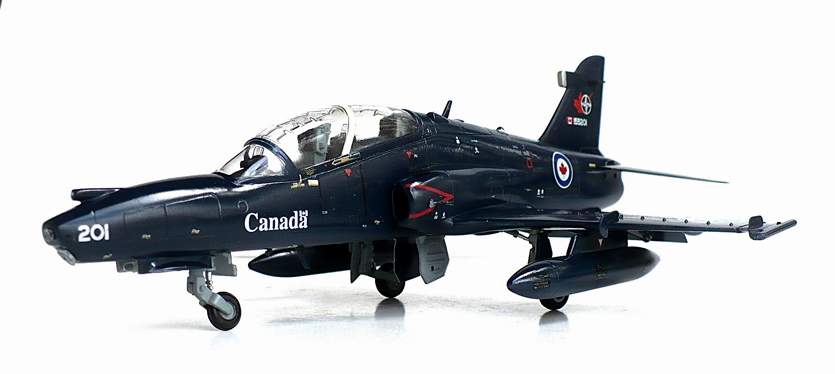
Here are some images of Airfix's 1/48 scale BAE Systems Hawk.

From Wikipedia"
The BAE Systems Hawk is a British single-engine, advanced jet trainer aircraft. It was first flown at Dunsfold, Surrey, in 1974 as the Hawker Siddeley Hawk, and subsequently produced by its successor companies, British Aerospace and BAE Systems, respectively. It has been used in a training capacity and as a low-cost combat aircraft.
Operators of the Hawk include the Royal Air Force (notably the Red Arrows display team) and a considerable number of foreign military operators. The Hawk is still in production in the UK and under licence in India by Hindustan Aeronautics Limited (HAL) with over 900 Hawks sold to 18 operators around the world.
In 1964 the Royal Air Force specified a requirement (Air Staff Target (AST) 362) for a new fast jet trainer to replace the Folland Gnat. The SEPECAT Jaguar was originally intended for this role, but it was soon realised that it would be too complex an aircraft for fast jet training and only a small number of two-seat versions were purchased. Accordingly, in 1968, Hawker Siddeley Aviation (HSA) began studies for a simpler aircraft, initially as special project (SP) 117. The design team was led by 
This project was funded by the company as a private venture, in anticipation of possible RAF interest. The design was conceived of as having tandem seating and a combat capability in addition to training, as it was felt the latter would improve export sales potential. By the end of the year HSA had submitted a proposal to the Ministry of Defence based on the design concept, and in early 1970 the RAF issued Air Staff Target (AST) 397 which formalised the requirement for new trainers of this type. The RAF selected the HS.1182 for their requirement on 1 October 1971 and the principal contract, for 175 aircraft, was signed in March 1972.

The prototype aircraft first flew on 21 August 1974. All development aircraft were built on production jigs; the program remained on time and to budget throughout. The Hawk T1 entered RAF service in late 1976. The first export Hawk 50 flew on 17 May 1976. This variant had been specifically designed for the dual-role of lightweight fighter and advanced trainer; it had a greater weapons capacity than the T.1.
More variants of the Hawk followed and common improvements to the base design typically include increased range, more powerful engines, redesigned wing and undercarriage, the addition of radar and forward-looking infrared (FLIR), GPS navigation, and night vision compatibility. Later models were manufactured with a great variety in terms of avionics fittings and system compatibility to suit the individual customer nation, cockpit functionality was often rearranged and programmed to be common to an operator's main fighter fleet to increase the Hawk's training value.
In 1981 a derivative of the Hawk was selected by the United States Navy as their new trainer aircraft. Designated the McDonnell Douglas T-45 Goshawk, the design was navalised and strengthened to withstand operating directly from the decks of carriers in addition to typical land-based duties; This T-45 entered service in 1994; initial aircraft had analogue cockpits, while later deliveries featured a digital glass cockpit. All airframes are planned to undergo avionics upgrades to a common standard.

A major competitor to the Hawk for export sales has been the Dassault/Dornier Alpha Jet; aviation expert John W. R. Taylor commented: "What Europe must avoid is the kind of wasteful competition that has the Hawker Siddeley Hawk and Dassault-Breguet/Dornier Alpha Jet battling against each other in the world market." By early 1998, a total of 734 Hawks had been sold, more than 550 of which had been to export customers. Military customers often procured the Hawk as a replacement for older aircraft such as the BAC Strikemaster, Hawker Hunter, and Douglas A-4 Skyhawk.
A Hawk T2 of the Royal Air Force in 2009
During the 1980s and 1990s, British Aerospace, the successor company to Hawker Siddeley, was trying to gain export sales of the variable-wing Panavia Tornado strike aircraft; however countries such as Thailand and Indonesia, whom had shown initial interest in the Tornado, concluded that the Hawk to be a more suitable and preferable aircraft for their requirements. Malaysia and Oman cancelled their arranged Tornado orders in the early 1990s, both choosing to procure the Hawk instead. Aviation authors Norman Polmar and Dana Bell stated of the Hawk: "Of the many similar designs competing for a share of the world market, the Hawk has been without equal in performance as well as sales".
On 22 December 2004, the Ministry of Defence awarded a contract to BAE Systems to develop an advanced model of the Hawk for the RAF and Royal Navy. The Hawk Mk. 128, otherwise designated as Hawk T2, replaces conventional instrumentation with a glass cockpit, to better resemble modern fighter aircraft such as the new mainstay of the RAF, the Eurofighter Typhoon. In October 2006, a GB£450 million contract was signed for the production of 28 Hawk 128s. The aircraft's maiden flight occurred on 27 July 2005 from BAE Systems' Warton Aerodrome.
According to BAE Systems, as of July 2012 they have sold nearly 1000 Hawks so far, with sales continuing to date. In July 2012, Australian Defence Minister Stephen Smith confirmed that Australia's fleet of Hawk Mk 127s would be upgraded to a similar configuration to the RAF's Hawk T2 as part of a major mid-life upgrade. As of 2012, the Hawk T2 is one of the competitors for the United States Air Force's T-X program to acquire a new trainer fleet.

The Hawk is an advanced trainer with a two-man tandem cockpit, a low-mounted cantilever wing and is powered by a single turbofan engine. Unlike many of the previous trainers in RAF service, the Hawk was specifically designed for training. Hawker had developed the aircraft to have a high level of servicability, as well as lower purchasing and operating costs than previous trainers like the Jet Provost. The Hawk has been praised by pilots for its agility, in particular its roll and turn handling.
The design of the fuselage included a height differential between the two seats of the cockpit; this provided generous levels of visibility for the instructor in the rear seat. Each cockpit is fitted with a Martin-Baker Mk 10B zero-zero rocket-assisted ejection seat. Air is fed to the aircraft's rear-mounted Rolls-Royce Turbomeca Adour engine via intakes on each of the forward wing roots. During the aircraft's development, Hawker had worked closely with Rolls-Royce to reduce the engine's fuel consumption and to ensure a high level of reliability.
Even within the development stages, a Hawk variant was intended to also serve as a single-seat ground-attack fighter; both the trainer and fighter models were developed with the export market in mind.[4] On single seat models, the forward cockpit area which normally houses a pilot is replaced by an electronics bay for avionics and onboard systems, including a fire control computer, multi-mode radar, laser rangefinder and forward-looking infrared (FLIR). Some export customers, such as Malaysia, have extensive modifications to their aircraft, including the addition of wingtip hardpoint stations and a fittable inflight refuelling probe.

The Hawk was designed to be manoeuvrable and can reach Mach 0.88 in level flight and Mach 1.15 in a dive, thus allowing trainees to experience transonic flight before advancing to a supersonic trainer. The airframe is very durable and strong, stressed for +9 g, the normal limit in RAF service is +7.5/-4 g. A dual hydraulic system supplies power to operate systems such as the aircraft's flaps, airbrakes and landing gear, together with the flight controls. A ram air turbine is fitted in front of the single tail fin to provide backup hydraulic power for the flight controls in the event of an engine failure,[ additionally a gas turbine auxiliary power unit is housed directly above the engine.
The Hawk is designed to carry a centreline gun pod, such as the 30 mm ADEN cannon, two under-wing pylons, and up to four hardpoints for fitting armaments and equipment.[4] In RAF service, Hawks have been equipped to operate of Sidewinder air-to-air missiles. In the early 1990s, British Aerospace investigated the possibility of arming the Hawk with the Sea Eagle anti-ship missile for export customers.[