Translate

Showing posts with label Atomic Bomb. Show all posts

Friday, November 4, 2016

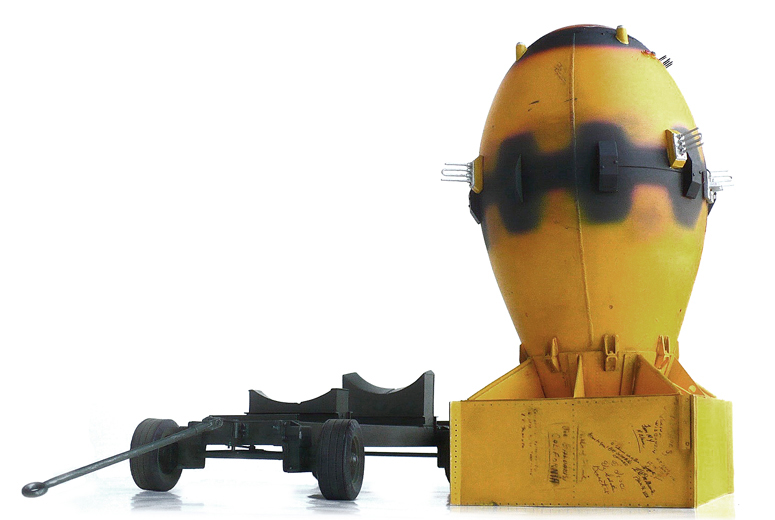
Fat Man

Here are some images of Masterpiece Models 1/12 scale Fat Man atomic bomb.

From Wikipedia"
"Fat Man" was the codename for the type of atomic bomb that was detonated over the Japanese city of Nagasaki by the United States on 9 August 1945. It was the second of the only two nuclear weapons ever used in warfare, the first being Little Boy, and its detonation marked the third-ever man-made nuclear explosion in history. It was built by scientists and engineers at Los Alamos Laboratory using plutonium from the Hanford Site and dropped from the Boeing B-29 Superfortress Bockscar. For the Fat Man mission, Bockscar was piloted by Major Charles W. Sweeney.
The name Fat Man refers generically to the early design of the bomb, because it had a wide, round shape. It was also known as the Mark III. Fat Man was an implosion-type nuclear weapon with a solid plutonium core. The first of that type to be detonated was the Gadget, in the Trinity nuclear test, less than a month earlier on 16 July at the Alamogordo Bombing and Gunnery Range in New Mexico.
Two more Fat Man bombs were detonated during the Operation Crossroads nuclear tests at Bikini Atoll in 1946. Some 120 Fat Man units were produced between 1947 and 1949, when it was superseded by the Mark 4 nuclear bomb. The Fat Man was retired in 1950.

In 1942, prior to the Army taking over wartime atomic research, Robert Oppenheimer held conferences in Chicago in June and Berkeley, California, in July, at which various engineers and physicists discussed nuclear bomb design issues. A gun-type design was chosen, in which two sub-critical masses would be brought together by firing a "bullet" into a "target". Richard C. Tolman suggested an implosion-type nuclear weapon, but the idea attracted scant consideration.
The feasibility of a plutonium bomb was questioned in 1942. James Conant heard on 14 November from Wallace Akers, the director of the British "Tube Alloys" project, that James Chadwick had "concluded that plutonium might not be a practical fissionable material for weapons because of impurities." Conant consulted Ernest Lawrence and Arthur Compton, who acknowledged that their scientists at Berkeley and Chicago respectively knew about the problem, but could offer no ready solution. Conant informed the director of the Manhattan Project, Brigadier General Leslie R. Groves, Jr., who in turn assembled a special committee consisting of Lawrence, Compton, Oppenheimer, and McMillan to examine the issue. The committee concluded that any problems could be overcome simply by requiring higher purity.
Oppenheimer, reviewing his options in early 1943, gave priority to the gun-type weapon, but as a hedge against the threat of pre-detonation, he created the E-5 Group at the Los Alamos Laboratory under Seth Neddermeyer to investigate implosion. Implosion-type bombs were determined to be significantly more efficient in terms of explosive yield per unit mass of fissile material in the bomb, because compressed fissile materials react more rapidly and therefore more completely. Nonetheless, it was decided that the plutonium gun would receive the bulk of the research effort, since it was the project with the least amount of uncertainty involved. It was assumed that the uranium gun-type bomb could be easily adapted from it.
 The gun-type and implosion-type designs were codenamed "Thin Man" and "Fat Man" respectively. These code names were created by Robert Serber, a former student of Oppenheimer's who worked on the Manhattan Project. He chose them based on their design shapes; the Thin Man would be a very long device, and the name came from the Dashiell Hammett detective novel The Thin Man and series of movies by the same name; the Fat Man would be round and fat and was named after Sydney Greenstreet's character in The Maltese Falcon. Little Boy would come last, as a variation of Thin Man.

Neddermeyer discarded Serber and Tolman's initial concept of implosion as assembling a series of pieces in favor of one in which a hollow sphere was imploded by an explosive shell. He was assisted in this work by Hugh Bradner, Charles Critchfield, and John Streib. L. T. E. Thompson was brought in as a consultant, and discussed the problem with Neddermeyer in June 1943. Thompson was skeptical that an implosion could be made sufficiently symmetric. Oppenheimer arranged for Neddermeyer and Edwin McMillan to visit the National Defense Research Committee's Explosives Research Laboratory near the laboratories of the Bureau of Mines in Bruceton, Pennsylvania (a Pittsburgh suburb), where they spoke to George Kistiakowsky and his team. But Neddermeyer's efforts in July and August at imploding tubes to produce cylinders tended to produce objects that resembled rocks. Neddermeyer was the only person who believed that implosion was practical, and only his enthusiasm kept the project alive.
Oppenheimer brought John von Neumann to Los Alamos in September 1943 to take a fresh look at implosion. After reviewing Neddermeyer's studies, and discussing the matter with Edward Teller, von Neumann suggested the use of high explosives in shaped charges to implode a sphere, which he showed could not only result in a faster assembly of fissile material than was possible with the gun method, but which could greatly reduce the amount of material required, because of the resulting higher density. The idea that, under such pressures, the plutonium metal itself would be compressed came from Teller, whose knowledge of how dense metals behaved under heavy pressure was influenced by his pre-war theoretical studies of the Earth's core with George Gamow. The prospect of more-efficient nuclear weapons impressed Oppenheimer, Teller, and Hans Bethe, but they decided that an expert on explosives would be required. Kistiakowsky's name was immediately suggested, and Kistiakowsky was brought into the project as a consultant in October 1943.
The implosion project remained a backup until April 1944, when experiments by Emilio G. Segrè and his P-5 Group at Los Alamos on the newly reactor-produced plutonium from the X-10 Graphite Reactor at Oak Ridge and the B Reactor at the Hanford site showed that it contained impurities in the form of the isotope plutonium-240. This has a far higher spontaneous fission rate and radioactivity than plutonium-239. The cyclotron-produced isotopes, on which the original measurements had been made, held much lower traces of plutonium-240. Its inclusion in reactor-bred plutonium appeared unavoidable. This meant that the spontaneous fission rate of the reactor plutonium was so high that it would be highly likely that it would predetonate and blow itself apart during the initial formation of a critical mass. The distance required to accelerate the plutonium to speeds where predetonation would be less likely would need a gun barrel too long for any existing or planned bomber. The only way to use plutonium in a workable bomb was therefore implosion.


The impracticability of a gun-type bomb using plutonium was agreed at a meeting in Los Alamos on 17 July 1944. All gun-type work in the Manhattan Project was directed at the Little Boy, enriched-uranium gun design, and the Los Alamos Laboratory was reorganized, with almost all of the research oriented around the problems of implosion for the Fat Man bomb. The idea of using shaped charges as three-dimensional explosive lenses came from James L. Tuck, and was developed by von Neumann. To overcome the difficulty of synchronizing multiple detonations, Luis Alvarez and Lawrence Johnston invented exploding-bridgewire detonators to replace the less precise primacord detonation system. Robert Christy is credited with doing the calculations that showed how a solid subcritical sphere of plutonium could be compressed to a critical state, greatly simplifying the task, since earlier efforts had attempted the more-difficult compression of a hollow spherical shell. After Christy's report, the solid-plutonium core weapon was referred to as the "Christy Gadget".
The task of the metallurgists was to determine how to cast plutonium into a sphere. The difficulties became apparent when attempts to measure the density of plutonium gave inconsistent results. At first contamination was believed to be the cause, but it was soon determined that there were multiple allotropes of plutonium. The brittle α phase that exists at room temperature changes to the plastic β phase at higher temperatures. Attention then shifted to the even more malleable δ phase that normally exists in the 300–450 °C (570–840 °F) range. It was found that this was stable at room temperature when alloyed with aluminum, but aluminum emits neutrons when bombarded with alpha particles, which would exacerbate the pre-ignition problem. The metallurgists then hit upon a plutonium–gallium alloy, which stabilized the δ phase and could be hot pressed into the desired spherical shape. As plutonium was found to corrode readily, the sphere was coated with nickel.

A pumpkin bomb (Fat Man test unit) being raised from the pit into the bomb bay of a B-29 for bombing practice during the weeks before the attack on Nagasaki.
The size of the bomb was constrained by the available aircraft. The only Allied aircraft capable of carrying the Fat Man were the British Avro Lancaster and the American Boeing B-29 Superfortress. For logistic and nationalistic reasons, the B-29 was preferred, but this constrained the bomb to a maximum length of 132 inches (3,400 mm), width of 60 inches (1,500 mm) and weight of 20,000 pounds (9,100 kg). Removing the bomb rails allowed a maximum width of 66 inches (1,700 mm). Drop tests began in March 1944, and resulted in modifications to the Silverplate aircraft due to the weight of the bomb. High-speed photographs revealed that the tail fins folded under the pressure, resulting in an erratic descent. Various combinations of stabilizer boxes and fins were tested on the Fat Man shape to eliminate its persistent wobble until an arrangement dubbed a "California Parachute", a cubical open-rear tail box outer surface with eight radial fins inside of it, four angled at 45° and four orthogonally to the line of fall holding the outer square-fin box to the bomb's rear end, was approved. In drop tests in early weeks, the Fat Man missed its target by an average of 1,857 feet (566 m), but this was halved by June as the bombardiers became more proficient with it.
The early Y-1222 model Fat Man was assembled with some 1,500 bolts. This was superseded by the Y-1291 design in December 1944. This redesign work was substantial, and only the Y-1222 tail design was retained. Later versions included the Y-1560, which had 72 detonators; the Y-1561, which had 32; and the Y-1562, which had 132. There were also the Y-1563 and Y-1564, which were practice bombs with no detonators at all. The final wartime Y-1561 design was assembled with just 90 bolts.
Because of its complicated firing mechanism and the need for previously untested synchronization of explosives and precision design, it was thought that a full test of the concept was needed before the scientists and military representatives could be confident it would perform correctly under combat conditions. On 16 July 1945, a Y-1561 model Fat Man, known as the Gadget for security reasons, was detonated in a test explosion at a remote site in New Mexico, known as the "Trinity" test. It gave a yield of about 20 kilotonnes (84 TJ). Some minor changes were made to the design as a result of the Trinity test. Philip Morrison recalled that "There were some changes of importance... The fundamental thing was, of course, very much the same."

Wednesday, November 2, 2016

Little Boy

Here are some images of Masterpiece Models 1/12 scale Little Boy atomic bomb.
During my researches I discovered that there were signatures on the original Little Boy bomb. Looking at the photographs it was difficult to make out these signatures. There was however one signature that stood out. That signature appears to be "R. Savior". But I could be wrong.

From Wikipedia"
"Little Boy" was the codename for the type of atomic bomb dropped on the Japanese city of Hiroshima on 6 August 1945 during World War II by the Boeing B-29 Superfortress Enola Gay, piloted by Colonel Paul W. Tibbets, Jr., commander of the 509th Composite Group of the United States Army Air Forces. It was the first atomic bomb to be used in warfare. The Hiroshima bombing was the second artificial nuclear explosion in history, after the Trinity test, and the first uranium-based detonation. It exploded with an energy of approximately 15 kilotons of TNT (63 TJ). The bomb caused significant destruction to the city of Hiroshima.
Little Boy was developed by Lieutenant Commander Francis Birch's group of Captain William S. Parsons's Ordnance (O) Division at the Manhattan Project's Los Alamos Laboratory during World War II. Parsons flew on the Hiroshima mission as weaponeer. The Little Boy was a development of the unsuccessful Thin Man nuclear bomb. Like Thin Man, it was a gun-type fission weapon, but derived its explosive power from the nuclear fission of uranium-235. This was accomplished by shooting a hollow cylinder of enriched uranium (the "bullet") onto a solid cylinder of the same material (the "target") by means of a charge of nitrocellulose propellant powder. It contained 64 kg (141 lb) of enriched uranium, of which less than a kilogram underwent nuclear fission. Its components were fabricated at three different plants so that no one would have a copy of the complete design.
After the war ended, it was not expected that the inefficient Little Boy design would ever again be required, and many plans and diagrams were destroyed, but by mid-1946 the Hanford Site reactors were suffering badly from the Wigner effect, so six Little Boy assemblies were produced at Sandia Base. The Navy Bureau of Ordnance built another 25 Little Boy assemblies in 1947 for use by the Lockheed P2V Neptune nuclear strike aircraft (which could be launched from but not land on the Midway-class aircraft carriers). All the Little Boy units were withdrawn from service by the end of January 1951.
 The names for all three atomic bomb design projects during World War IIFat Man, Thin Man, and Little Boy—were created by Robert Serber, a former student of Los Alamos Laboratory director Robert Oppenheimer who worked on the Manhattan Project. According to Serber, he chose them based on their design shapes. The "Thin Man" was a long device, and its name came from the Dashiell Hammett detective novel and series of movies of the same name. The "Fat Man" was round and fat, and was named after Sydney Greenstreet's "Kasper Gutman" character in The Maltese Falcon. Little Boy came last, and was named after Elisha Cook, Jr.'s character in the same film, as referred to by Humphrey Bogart.

Because uranium-235 was known to be fissionable, it was the first approach to bomb development pursued. As the first design developed (as well as the first deployed for combat), it is sometimes known as the Mark I. The vast majority of the work came in the form of the isotope enrichment of the uranium necessary for the weapon, since uranium-235 makes up only 1 part in 140 of natural uranium. Enrichment was performed at Oak Ridge, Tennessee, where the electromagnetic separation plant, known as Y-12, became fully operational in March 1944. The first shipments of highly enriched uranium were sent to the Los Alamos Laboratory in June 1944.
Most of the uranium necessary for the production of the bomb came from the Shinkolobwe mine and was made available thanks to the foresight of the CEO of the High Katanga Mining Union, Edgar Sengier, who had 1,000 long tons (1,000 t) of uranium ore transported to a New York warehouse in 1939.[6] At least part of the 1,200 long tons (1,200 t) of uranium ore and uranium oxide captured by the Alsos Mission in 1944 and 1945 was used in the bomb.

As part of Project Alberta, Commander A. Francis Birch (left) assembles the bomb while physicist Norman Ramsey watches. This is one of the rare photos where the inside of the bomb can be seen.
Little Boy was a simplification of Thin Man, the previous gun-type fission weapon design. Thin Man, 17 feet (5.2 m) long, was designed to use plutonium, so it was also more than capable of using enriched uranium. The Thin Man design was abandoned after experiments by Emilio G. Segrè and his P-5 Group at Los Alamos on the newly reactor-produced plutonium from Oak Ridge and the Hanford site showed that it contained impurities in the form of the isotope plutonium-240. This has a far higher spontaneous fission rate and radioactivity than the cyclotron-produced plutonium on which the original measurements had been made, and its inclusion in reactor-bred plutonium (needed for bomb making due to the quantities required) appeared unavoidable. This meant that the background fission rate of the plutonium was so high that it would be highly likely the plutonium would predetonate and blow itself apart in the initial forming of a critical mass.
In July 1944, almost all research at Los Alamos was redirected to the implosion-type plutonium weapon. Overall responsibility for the uranium gun-type weapon was assigned to Captain William S. Parsons's Ordnance (O) Division. All the design, development, and technical work at Los Alamos was consolidated under Lieutenant Commander Francis Birch's group.
In contrast to the plutonium implosion-type nuclear weapon and the plutonium gun-type fission weapon, the uranium gun-type weapon was straightforward if not trivial to design. The concept was pursued so that in case of a failure to develop a plutonium bomb, it would still be possible to use the gun principle. The gun-type design henceforth had to work with enriched uranium only, and this allowed the Thin Man design to be greatly simplified. A high-velocity gun was no longer required, and a simpler weapon could be substituted. The simplified weapon was short enough to fit into a B-29 bomb bay.
The design specifications were completed in February 1945, and contracts were let to build the components. Three different plants were used so that no one would have a copy of the complete design. The gun and breech were made by the Naval Gun Factory in Washington, D.C.; the target case and some other components were by the Naval Ordnance Plant in Center Line, Michigan; and the tail fairing and mounting brackets by the Expert Tool and Die Company in Detroit, Michigan. The bomb, except for the uranium payload, was ready at the beginning of May 1945. The uranium 235 projectile was completed on 15 June, and the target on 24 July. The target and bomb pre-assemblies (partly assembled bombs without the fissile components) left Hunters Point Naval Shipyard, California, on 16 July aboard the heavy cruiser USS Indianapolis, arriving 26 July. The target inserts followed by air on 30 July.
Although all of its components had been tested, no full test of a gun-type nuclear weapon occurred before the Little Boy was dropped over Hiroshima. The only test explosion of a nuclear weapon concept had been of an implosion-type device employing plutonium as its fissile material, and took place on 16 July 1945 at the Trinity nuclear test. There were several reasons for not testing a Little Boy type of device. Primarily, there was little uranium-235 as compared with the relatively large amount of plutonium which, it was expected, could be produced by the Hanford Site reactors. Additionally, the weapon design was simple enough that it was only deemed necessary to do laboratory tests with the gun-type assembly. Unlike the implosion design, which required sophisticated coordination of shaped explosive charges, the gun-type design was considered almost certain to work.
The danger of accidental detonation made safety a concern. Little Boy incorporated basic safety mechanisms, but an accidental detonation could still occur. Tests were conducted to see whether a crash could drive the hollow "bullet" onto the "target" cylinder resulting in a massive release of radiation, or possibly nuclear detonation. These showed that this required an impact of 500 times that of gravity, which made it highly unlikely. There was still concern that a crash and a fire could trigger the explosives. If immersed in water, the uranium halves were subject to a neutron moderator effect. While this would not have caused an explosion, it could have created widespread radioactive contamination. For this reason, pilots were advised to crash on land rather than at sea.
 The Little Boy was 120 inches (300 cm) in length, 28 inches (71 cm) in diameter and weighed approximately 9,700 pounds (4,400 kg). The design used the gun method to explosively force a hollow sub-critical mass of uranium-235 and a solid target cylinder together into a super-critical mass, initiating a nuclear chain reaction. This was accomplished by shooting one piece of the uranium onto the other by means of four cylindrical silk bags of cordite. The bomb contained 64 kg (141 lb) of enriched uranium. Most was enriched to 89% but some was only 50% uranium-235, for an average enrichment of 80%. Less than a kilogram of uranium underwent nuclear fission, and of this mass only 0.6 g (0.021 oz) was transformed into several forms of energy, mostly kinetic energy, but also heat and radiation.
 The Little Boy pre-assemblies were designated L-1, L-2, L-3, L-4, L-5, L-6, L-7, and L-11. L-1, L-2, L-5, and L-6 were expended in test drops. The first drop test was conducted with L-1 on 23 July 1945. It was dropped over the sea near Tinian in order to test the radar altimeter by the B-29 later known as Big Stink, piloted by Colonel Paul W. Tibbets, the commander of the 509th Composite Group. Two more drop tests over the sea were made on 24 and 25 July, using the L-2 and L-5 units in order to test all components. Tibbets was the pilot for both missions, but this time the bomber used was the one subsequently known as Jabit. L-6 was used as a dress rehearsal on 29 July. The B-29 Next Objective, piloted by Major Charles W. Sweeney, flew to Iwo Jima, where emergency procedures for loading the bomb onto a standby aircraft were practiced. This rehearsal was repeated on 31 July, but this time L-6 was reloaded onto a different B-29, Enola Gay, piloted by Tibbets, and the bomb was test dropped near Tinian. L-11 was the assembly used for the Hiroshima bomb.

When the war ended, it was not expected that the inefficient Little Boy design would ever again be required, and many plans and diagrams were destroyed. However, by mid-1946 the Hanford Site reactors were suffering badly from the Wigner effect. Faced with the prospect of no more plutonium for new cores and no more polonium for the initiators for the cores that had already been produced, Groves ordered that a number of Little Boys be prepared as an interim measure until a cure could be found. No Little Boy assemblies were available, and no comprehensive set of diagrams of the Little Boy could be found, although there were drawings of the various components, and stocks of spare parts.

One of five casings built for the Little Boy bomb used on Hiroshima on display at the Imperial War Museum in London during 2015
At Sandia Base, three Army officers, Captains Albert Bethel, Richard Meyer and Bobbie Griffin attempted to re-create the Little Boy. They were supervised by Harlow W. Russ, an expert on Little Boy who served with Project Alberta on Tinian, and was now leader of the Z-11 Group of the Los Alamos Laboratory's Z Division at Sandia. Gradually, they managed to locate the correct drawings and parts, and figured out how they went together. Eventually, they built six Little Boy assemblies. Although the casings, barrels, and components were tested, no enriched uranium was supplied for the bombs. By early 1947, the problem caused by the Wigner effect was on its way to solution, and the three officers were reassigned.
The Navy Bureau of Ordnance built 25 Little Boy assemblies in 1947 for use by the nuclear-capable Lockheed P2V Neptune aircraft carrier aircraft (which could be launched from but not land on the Midway-class aircraft carriers). Components were produced by the Naval Ordnance Plants in Pocatello, Idaho, and Louisville, Kentucky. Enough fissionable material was available by 1948 to build ten projectiles and targets, although there were only enough initiators for six. All the Little Boy units were withdrawn from service by the end of January 1951.
The Smithsonian Institution displays a Little Boy; it was complete, except for enriched uranium, until 1986. The Department of Energy took the weapon from the museum to remove its inner components, so the bombs could not be stolen and detonated with fissile material. The government returned the emptied casing to the Smithsonian in 1993. Three other disarmed bombs are on display in the United States; another is at the Imperial War Museum in London.

Thursday, February 18, 2016

Boeing B-29-45-MO (Enola Gay)

Here are some images of Monogram's 1/48 scale Boeing B-29-45-MO (Enola Gay).

From Wikipedia"

The Enola Gay is a Boeing B-29 Superfortress bomber, named for Enola Gay Tibbets, the mother of the pilot, Colonel Paul Tibbets, who selected the aircraft while it was still on the assembly line. On 6 August 1945, during the final stages of World War II, it became the first aircraft to drop an atomic bomb. The bomb, code-named "Little Boy", was targeted at the city of Hiroshima, Japan, and caused unprecedented destruction. Enola Gay participated in the second atomic attack as the weather reconnaissance aircraft for the primary target of Kokura. Clouds and drifting smoke resulted in Nagasaki being bombed instead.
After the war, the Enola Gay returned to the United States, where it was operated from Roswell Army Air Field, New Mexico. It was flown to Kwajalein for the Operation Crossroads nuclear tests in the Pacific, but was not chosen to make the test drop at Bikini Atoll. Later that year it was transferred to the Smithsonian Institution, and spent many years parked at air bases exposed to the weather and souvenir hunters, before being disassembled and transported to the Smithsonian's storage facility at Suitland, Maryland, in 1961.
In the 1980s, veterans groups engaged in a call for the Smithsonian to put the aircraft on display, leading to an acrimonious debate about exhibiting the aircraft without a proper historical context. The cockpit and nose section of the aircraft were exhibited at the National Air and Space Museum (NASM) in downtown Washington, D.C., for the bombing's 50th anniversary in 1995, amid a storm of controversy. Since 2003, the entire restored B-29 has been on display at NASM's Steven F. Udvar-Hazy Center. The last survivor of its crew, Theodore Van Kirk, died on July 28, 2014, at the age of 93.

The Enola Gay (Model number B-29-45-MO, Serial number 44-86292, Victor number 82) was built by the Glenn L. Martin Company (now Lockheed Martin) at its Bellevue, Nebraska plant, located at what is now known as Offutt Air Force Base. The bomber was one of 15 B-29s with the "Silverplate" modifications necessary to deliver atomic weapons. These modifications included an extensively modified bomb bay with pneumatic doors and British bomb attachment and release systems, reversible pitch propellers that gave more braking power on landing, improved engines with fuel injection and better cooling, and the removal of protective armor and gun turrets.

Enola Gay after Hiroshima mission, entering hard-stand. It is in its 6th Bombardment Group livery, with victor number 82 visible on fuselage just forward of the tail fin.
Enola Gay was personally selected by Colonel Paul W. Tibbets, Jr., the commander of the 509th Composite Group, on 9 May 1945, while still on the assembly line. The aircraft was accepted by the United States Army Air Forces (USAAF) on 18 May 1945 and assigned to the 393d Bombardment Squadron, Heavy, 509th Composite Group. Crew B-9, commanded by Captain Robert A. Lewis, took delivery of the bomber and flew it from Omaha to the 509th's base at Wendover Army Air Field, Utah, on 14 June 1945.
Thirteen days later, the aircraft left Wendover for Guam, where it received a bomb-bay modification, and flew to North Field, Tinian, on 6 July. It was initially given the Victor (squadron-assigned identification) number 12, but on 1 August, was given the circle R tail markings of the 6th Bombardment Group as a security measure and had its Victor number changed to 82 to avoid misidentification with actual 6th Bombardment Group aircraft.During July, the bomber made eight practice or training flights, and flew two missions, on 24 and 26 July, to drop pumpkin bombs on industrial targets at Kobe and Nagoya. Enola Gay was used on 31 July on a rehearsal flight for the actual mission.
The partially assembled Little Boy gun-type nuclear weapon L-11 was contained inside a 41-inch (100 cm) x 47-inch (120 cm) x 138-inch (350 cm) wooden crate weighing 10,000 pounds (4,500 kg) that was secured to the deck of the USS Indianapolis. Unlike the six Uranium-235 target discs, which were later flown to Tinian on three separate aircraft arriving 28 and 29 July, the assembled projectile with the nine Uranium-235 rings installed was shipped in a single lead-lined steel container weighing 300 pounds (140 kg) that was securely locked to brackets welded to the deck of Captain Charles B. McVay III's quarters. Both the L-11 and projectile were dropped off at Tinian on 26 July 1945.

On 5 August 1945, during preparation for the first atomic mission, Tibbets assumed command of the aircraft and named it after his mother, Enola Gay Tibbets, who had herself been named for the heroine of a novel. When it came to selecting a name for the plane, Tibbets later recalled that:
my thoughts turned at this point to my courageous red-haired mother, whose quiet confidence had been a source of strength to me since boyhood, and particularly during the soul-searching period when I decided to give up a medical career to become a military pilot. At a time when Dad had thought I had lost my marbles, she had taken my side and said, "I know you will be all right son."

On 5 August 1945, during preparation for the first atomic mission, Tibbets assumed command of the aircraft and named it after his mother, Enola Gay Tibbets, who had herself been named for the heroine of a novel. When it came to selecting a name for the plane, Tibbets later recalled that:
my thoughts turned at this point to my courageous red-haired mother, whose quiet confidence had been a source of strength to me since boyhood, and particularly during the soul-searching period when I decided to give up a medical career to become a military pilot. At a time when Dad had thought I had lost my marbles, she had taken my side and said, "I know you will be all right son."
The name was painted on the aircraft on 5 August by Allan L. Karl, an enlisted man in the 509th. Regularly assigned aircraft commander Robert Lewis was unhappy to be displaced by Tibbets for this important mission, and became furious when he arrived at the aircraft on the morning of 6 August to see it painted with the now-famous nose art.
Hiroshima was the primary target of the first nuclear bombing mission on 6 August, with Kokura and Nagasaki as alternative targets. Enola Gay, piloted by Tibbets, took off from North Field, in the Mariana Islands, about six hours' flight time from Japan, accompanied by two other B-29s, The Great Artiste, carrying instrumentation, and a then-nameless aircraft later called Necessary Evil, commanded by Captain George Marquardt, to take photographs. The director of the Manhattan Project, Major General Leslie R. Groves, Jr., wanted the event recorded for posterity, so the takeoff was illuminated by floodlights. When he wanted to taxi, Tibbets leaned out the window to direct the bystanders out of the way. On request, he gave a friendly wave for the cameras.

Hiroshima explosion.
After leaving Tinian, the aircraft made their way separately to Iwo Jima, where they rendezvoused at 2,440 meters (8,010 ft) and set course for Japan. The aircraft arrived over the target in clear visibility at 9,855 meters (32,333 ft). Captain William S. "Deak" Parsons of Project Alberta, who was in command of the mission, armed the bomb during the flight to minimize the risks during takeoff. His assistant, Second Lieutenant Morris R. Jeppson, removed the safety devices 30 minutes before reaching the target area.
The release at 08:15 (Hiroshima time) went as planned, and the Little Boy took 43 seconds to fall from the aircraft flying at 31,060 feet (9,470 m) to the predetermined detonation height about 1,968 feet (600 m) above the city. Enola Gay traveled 11.5 mi (18.5 km) before it felt the shock waves from the blast. Although buffeted by the shock, neither Enola Gay nor The Great Artiste was damaged.
The detonation created a blast equivalent to 16 kilotons of TNT (67 TJ). The U-235 weapon was considered very inefficient, with only 1.7% of its fissile material fissioning. The radius of total destruction was about one mile (1.6 km), with resulting fires across 4.4 square miles (11 km2). Americans estimated that 4.7 square miles (12 km2) of the city were destroyed. Japanese officials determined that 69% of Hiroshima's buildings were destroyed and another 6–7% damaged. Some 70,000–80,000 people, or some 30% of the city's population, were killed by the blast and resultant firestorm, and another 70,000 injured. Out of those killed, 20,000 were soldiers.

Enola Gay returned safely to its base on Tinian to great fanfare, touching down at 2:58 pm, after 12 hours 13 minutes. The Great Artiste and Necessary Evil followed at short intervals. Several hundred people, including journalists and photographers, had gathered to watch the planes return. Tibbets was the first to disembark, and was presented with the Distinguished Service Cross on the spot.


Wednesday, November 13, 2013

M65 Atomic Cannon

Here are some more images of Renwal/Monogram/Revell 1/32 scale M65 Atomic Cannon.
This is the rerelease of the original 1957 kit from Renwal. The original kit I'm led to understand can fetch up to $1000. This one though, about $60.

From Wikipedia"
The M65 Atomic Cannon, often called Atomic Annie, was a towed artillery piece built by the United States and capable of firing a nuclear device. It was developed in the early 1950s, at the beginning of the Cold War, and fielded by 1953 in Europe and Korea.
Picatinny Arsenal was tasked to create a nuclear capable artillery piece in 1949. Robert Schwartz, the engineer who created the preliminary designs, essentially scaled up the 240mm shell (then the maximum in the arsenal) and used the German K5 railroad gun as a point of departure for the carriage. (The name "Atomic Annie" likely derives from the nickname "Anzio Annie" given to a German K5 gun which was employed against the American landings in Italy.) The design was approved by the Pentagon, largely through the intervention of chief of the Ballistics Section of the Ordnance Department’s Research and Development Division, Samuel Feltman, and a three-year developmental effort was begun. The project proceeded quickly enough to produce a demonstration model to participate in Dwight Eisenhower's inaugural parade in January of 1953.

The cannon was transported by two specially designed tractors, both capable of independent steering in the manner of some extra-long fire engines. Each of the tractors was rated at 375 hp, and the somewhat awkward combination could achieve speeds of 35 miles an hour and negotiate right turns on 28 ft wide, paved or packed roads. The artillery piece could be unlimbered in 15 minutes and then returned to traveling configuration in 15 minutes more.

On May 25, 1953 at 8:30am local time, the Atomic Cannon was tested at Nevada Test Site (specifically Frenchman Flat) as part of the Upshot-Knothole series of nuclear tests. The test--codenamed Grable--was attended by then Chairman of the Joint Chiefs of Staff Adm. Arthur W. Radford and Secretary of Defense Charles E. Wilson; it resulted in the successful detonation of a 15 kt shell (warhead W9) at a range of 7 miles. This was the first and only nuclear shell to be fired from a cannon.
Subsequent to the successful test, there were at least 20 of the cannons manufactured at Watervliet and Watertown Arsenals, at a cost of $800,000 each. They were deployed overseas to Europe and Korea, often continuously shifted around to avoid being detected and targeted by opposing forces. Due to the size of the apparatus, their limited range, the development of nuclear shells compatible with existing artillery pieces (the W48 for the 155mm and the W33 for the 203mm), and the development of rocket and missile based nuclear artillery, the M65 was effectively obsolete soon after it was deployed. However, it remained a prestige weapon and was not retired until 1963.

Monday, December 10, 2012

Little Boy And Fat Man


Here are some images of Monogram's 1/48 scale atomic bombs Little Boy and Fat Man.
These little models came with Monogram's 1/48 scale B 29 Superfortress kit.

From Wikipedia"
"Little Boy" was the codename for the atomic bomb dropped on Hiroshima on August 6, 1945 by the Boeing B-29 Superfortress Enola Gay, piloted by Colonel Paul Tibbets of the 393rd Bombardment Squadron, Heavy, of the United States Army Air Forces. It was the first atomic bomb to be used as a weapon. The second, the "Fat Man", was dropped three days later on Nagasaki.
The weapon was developed by the Manhattan Project during World War II. It derived its explosive power from the nuclear fission of uranium 235. The Hiroshima bombing was the second artificial nuclear explosion in history, after the Trinity test, and the first uranium-based detonation. Approximately 600 to 860 milligrams of matter in the bomb was converted into the active energy of heat and radiation (see mass-energy equivalence for detail). It exploded with an energy of 16 kilotons of TNT (67 TJ). It has been estimated that 130,000 to 150,000 people had died as a result of its use by the end of December 1945. Its design was not tested in advance, unlike the more complex plutonium bomb (Fat Man). The available supply of enriched uranium was very small at that time, and it was thought that the simple design of a uranium "gun" type bomb was so sure to work that there was no need to test it at full scale.


"Fat Man" was the codename for the atomic bomb that was detonated over Nagasaki, Japan, by the United States on August 9, 1945. It was the second of two nuclear weapons to be used in warfare to date (the other being "Little Boy"), and its detonation caused the third man-made nuclear explosion. The name also refers more generically to the early nuclear weapon designs of U.S. weapons based on the "Fat Man" model. It was an implosion-type weapon with a plutonium core, similar to "GADGET", the experimental device "detonated only a month earlieron 16 July at Alamagordo Air Base, New Mexico. "Fat Man" was possibly named after Winston Churchill, though Robert Serber said in his memoirs that as the "Fat Man" bomb was round and fat, he named it after Sydney Greenstreet's character of "Kasper Gutman" in The Maltese Falcon.
The original target for the bomb was the city of Kokura, but obscuring clouds necessitated changing course to the alternative target, Nagasaki. "Fat Man" was dropped from the B-29 bomber Bockscar, piloted by Major Charles Sweeney of the 393d Bombardment Squadron, Heavy, and exploded at 11:02 AM (JST), at an altitude of about 1,650 feet (500 m), with a yield of about 21 kilotons of TNT or 88 terajoules. The Mitsubishi-Urakami Ordnance Works, the factory that manufactured the type 91 torpedoes released in the attack on Pearl Harbor, was destroyed in the blast. Because of poor visibility due to cloud cover, the bomb missed its intended detonation point, and damage was somewhat less extensive than that in Hiroshima. An estimated 39,000 people were killed outright by the bombing at Nagasaki, and a further 25,000 were injured. Thousands more died later from related blast and burn injuries, and hundreds more from radiation illnesses from exposure to the bomb's initial radiation. The bombing raid on Nagasaki had the third highest fatality rate in World War II after the nuclear strike on Hiroshima and the March 9/10 1945 Operation Meetinghouse fire bombing raid on Tokyo.

 The names for all three atomic bomb design projects during WW II ("Fat Man", "Thin Man", and "Little Boy") were allegedly created by Robert Serber, a former student of Los Alamos director Robert Oppenheimer who worked on the project, according to Serber. According to his later memoirs, he chose them based on their design shapes; the "Thin Man" would be a very long device, and the name came from the Dashiell Hammett detective novel and series of movies by the same name; the "Fat Man" bomb would be round and fat and was named after Sidney Greenstreet's "Kasper Gutman" character in The Maltese Falcon. "Little Boy" would come last and be named only to contrast to the "Thin Man" bomb. The original "Thin Man" had been expected to be as long as 17 feet, but when it was discovered that U-235 would require a slower projectile speed than first measurements had indicated, it was realized that the gun-design could be shortened to 6 feet, and this design was named "Little Boy" in contrast. However, in his memoirs, Paul Tibbets, commander of the 509th Composite Group said the code names were part of an Air Force cover story. According to Tibbets, Project Silverplate, the Air Force program to modify the B-29 to carry atomic bombs, was given the cover story of modifying the B-29 into a passenger plane. One plane was allegedly for the use of Winston Churchill, 'the fat man', and the other for Franklin Roosevelt, 'the thin man.'