Translate

Showing posts with label WWI French. Show all posts

Tuesday, June 5, 2018

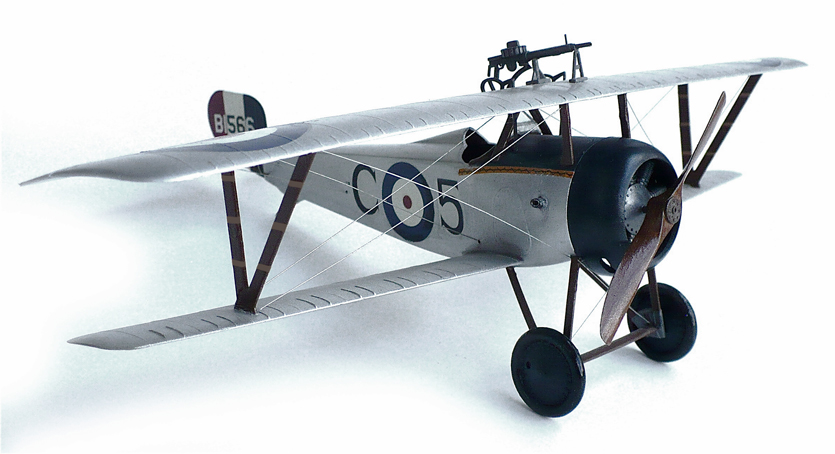
Nieuport NI 24 Bis

Here are some images of Roden's 1/32 scale Nieuport NI 24 Bis.

From Wikipedia"
The Nieuport 24 was a French sesquiplane fighter aircraft during World War I designed by Gustave Delage as a replacement for the successful Nieuport 17. In the event its performance was little better than the type it was meant to replace, which was largely superseded by the SPAD S.7 instead. Operational Nieuport 24s served with French, British and Russian units, and the type also served widely as an advanced trainer.

The Nieuport 24 introduced a new fuselage of improved aerodynamic form, rounded wingtips, and a tail unit incorporating a small fixed fin and a curved rudder. The tailskid was sprung internally and had a neater appearance than that on earlier Nieuports. A 130 hp Le Rhône rotary engine was fitted.
There were initial structural problems with the new tail, and most production aircraft of the type were of the Nieuport 24bis model, which retained the fuselage and wings of the 24, but reverted to the Nieuport 17 type tailplane, tailskid and rectangular balanced rudder. The new tail was finally standardised on the Nieuport 27.
A batch of Nieuport 24bis were built in England for the Royal Naval Air Service.
The standard armament of the Nieuport 17 (a synchronised Vickers in French service - a Lewis gun on a Foster mounting on the top wing in British service) was retained to save weight and retain a good performance, although many 24s were used as advanced trainers and normally flown without guns.

In the summer of 1917, when the Nieuport 24 and 24bis. were coming off the production line, most French fighter squadrons were replacing their Nieuport 17s with SPAD S.VIIs – and many of the new fighters went to fighter training schools, and to France’s allies, including the Russians, and the British, who used theirs well into 1918, due to a shortage of S.E.5as. A few French units retained the Nieuport through late 1917 – the type was actually preferred by some pilots, especially the famous Charles Nungesser.
Some of the large number of Nieuport advanced trainers bought by the Americans for their flying schools in France in November 1917 were 24s or 24bis.

Friday, September 9, 2016

Nieuport Ni 17B "Binky"

Here are some images on Hobby Craft's 1/32 scale Nieuport Ni 17.

From IPMS Stockholm -


The Nieuport 17B designation was only used by the British RNAS for the ten of these aircraft that it obtained. These aircraft were basically the same as the Type 17, but fitted with a Le Rhone 80-hp engine to make them lighter and thereby increase their range. The RNAS received all ten of its aircraft (Serial Nos 3956 - 3958 and 8745 - 8751) by August 1916 before the French official designation of Type 21 for them was introduced, so they remained known as Type 17B to the British throughout their service.
The aircraft is in the standard French camouflage scheme of dull green and brown, with the engine cowling, struts, and tail skid mounting in their natural metal or wood colours. The roundels are of the normal British type on the wings, and the serial number is painted in white on the rear fuselage. Note that the wheel covers are painted white.
No. 3956 served with the RNAS from August 1916 until May 1917, during which time it operated with four different squadrons. The name BINKY was painted on it in white whilst it was with 3 Squadron.

Thursday, February 25, 2016

Le Rhone Type 9C

Here are some images of Williams Brothers 1/6 scale Le Rhone Type 9C rotary engine.

From Wikipedia"
Le Rhône was the name given to a series of popular rotary aircraft engines produced in France by Société des Moteurs Le Rhône and the successor company of Gnome et Rhône. They powered a number of military aircraft types of the First World War. Le Rhône engines were also produced under license worldwide.
Although not powerful (the largest wartime version produced 130 horsepower (97 kW)), they were dependable rotary engines. The Le Rhône 9 was a development of the Le Rhône 7, a seven-cylinder design. Examples of Le Rhône engines are on public display in aviation museums with several remaining airworthy, powering vintage aircraft types.

The copper induction tubes had their crankcase ends located in different places on the 80 and 110 horsepower (60 and 82 kW) versions – the 80 hp versions had them entering the crankcase in a location forward of the vertical centerline of each cylinder, while the 110 hp version had them located behind the cylinder's centerline. This resulted in the 80 hp version's intake plumbing being "fully visible" from the front, while the 110 hp version had the lower ends of its intake tubes seemingly "hidden" behind the cylinders.
A complicated slipper bearing system was used in the Le Rhône engine. The master rod was of a split-type, which permitted assembly of the connecting rods. It also employed three concentric grooves, designed to accept slipper bearings from the other cylinders. The other connecting rods used inner-end bronze shoes, which were shaped to fit in the grooves. The master rod was numbered as number one and the shoes of numbers two, five and eight rode in the outer groove, the shoes of three, six and nine in the middle groove and four and seven in the inner groove. Although this system was complex, the Le Rhône engines worked very well.
The Le Rhône engines used an unconventional valve actuation system, with a single centrally-pivoting rocker arm moving the exhaust valve and the intake valve. When the arm moved down it opened the intake valve and when it moved up it opened the exhaust value. To make this system work a two-way push-pull rod was fitted, instead of the more conventional one-way pushrod. This feature required the cam followers to incorporate a positive action, a function designed in by using a combination of links and levers. This design prevented valve overlap and so limited power output, but as the engine structure and cooling arrangements would not have been adequate at a higher power output this should not be considered a significant design fault.

As well as production by Société des Moteurs Gnome et Rhône, which had bought out Société des Moteurs Le Rhône in 1914, the Le Rhône was produced in Germany (by Motorenfabrik Oberursel), Austria, the United Kingdom (by Daimler), Russian Empire and Sweden.
80 hp (60 kW) le Rhône engines were made under license in the United States by Union Switch and Signal of Pennsylvania, and the 110 hp (82 kW) Oberursel Ur.II rotary engine used by Germany in World War I, in such famous fighters such as the Fokker Dr.I triplane, was a close copy of the 110 hp (82 kW) le Rhône 9J version.
The Le Rhône 9C is a nine-cylinder rotary aircraft engine produced in France by Gnome et Rhône. Also known as the Le Rhône 80 hp in a reference to its nominal power rating, the engine was fitted to a number of military aircraft types of the First World War. Le Rhône 9C engines were also produced under license in Great Britain by several companies, and in the United States.
In common with other Le Rhône series engines, the 9C featured highly visible telescopic copper induction pipes and used a single push-pull rod to operate its two overhead valves.
Examples of Le Rhône 9C engines are on view in aviation museums either installed in aircraft exhibits or as stand-alone displays. A few examples of the 9C engine remain airworthy both in Europe and North America, one powering a vintage Sopwith Pup biplane in England, and a small number of others having powered reproduction WW I-era aircraft at Old Rhinebeck Aerodrome and other American "living" aviation museums that fly their restored original engines in both similarly restored original, and airworthy reproduction period aircraft.

Wednesday, September 2, 2015

Morane Saulnier Type N (Bullet)

Here are some images of Special Hobby's 1/32 scale Morane Saulnier Type N Bullet.

From Wikipedia"
The Morane-Saulnier N, also known as the Morane-Saulnier Type N, was a French monoplane fighter aircraft of the First World War. Designed and manufactured by Morane-Saulnier, the Type N entered service in April 1915 with the Aéronautique Militaire designated as the MS.5C.1. It also equipped four squadrons of the Royal Flying Corps, in which it was designated the Bullet, and was operated in limited numbers by the 19th Squadron of the Imperial Russian Air Force.

While the Type N was a graceful-looking aircraft and utilised an advanced, aerodynamic design, it was not easy to fly due to its stiff controls (using wing warping instead of ailerons) and high landing speed. The Type N mounted a single unsynchronized forward-firing machine gun (either a .303-in Vickers or 7.9 mm Hotchkiss) which used the deflector wedges, first demonstrated on the Morane-Saulnier Type L, in order to fire through the propeller arc.
A large metal "casserolle" spinner designed to streamline the aircraft caused the engines to overheat because the spinner deflected air away from the engine. In 1915, the spinner was removed from the design and no more overheating problems were found. The removal of the spinner caused very little loss in performance.
The Type N was not particularly successful. Only 49 aircraft were built and it was quickly rendered obsolete by the pace of aircraft development.

Wednesday, July 15, 2015

SPAD XIII "International"

Here are some images of Hobbycraft's 1/32 scale SPAD XIII "International.
This aircraft was flown by Capt. Georges Guynemer, SPA 3, France 1917.

From Wikipedia"
The SPAD S.XIII was a French biplane fighter aircraft of World War I, developed by Société Pour L'Aviation et ses Dérivés (SPAD) from the earlier highly successful SPAD S.VII. It was one of the most capable fighters of the war, and one of the most-produced, with 8,472 built and orders for around 10,000 more cancelled at the Armistice.

The S.XIII was of similar layout to the S.VII, i.e. a single engined biplane of mainly wooden construction with fabric covering, but was generally larger and heavier. Armament was two Vickers machine guns with 400 rounds per gun replacing the single gun of the earlier aircraft. Powerplant was a geared Hispano-Suiza engine, at first a 8Ba giving 200 hp (150 kW), but in later aircraft a high-compression 8Bc or 8Be delivering 220 hp (160 kW). The sum of these improvements was a notable improvement in flight and combat performance. It was faster than its main contemporaries, the British Sopwith Camel and the German Fokker D.VII, and its relatively higher power-to-weight ratio gave it a good rate of climb. The SPAD was renowned for its speed and strength in a dive, although the maneuverability of the type was relatively poor and the aircraft was difficult to control at low speeds: needing to be landed with power on, unlike contemporary fighters like the Royal Aircraft Factory SE.5 which could be landed with power off.
While giving the Spad XIII outstanding performance, the geared engines proved to be unreliable, suffering from poor lubrication and vibration. This significantly and severely affected serviceability, with it being stated in November 1917, that the Spad S.XIII was "incapable of giving dependable service". Even in April 1918, an official report stated that two-thirds of the 200 hp SPADs were out of use at any one time due to engine problems. At least one US observer believed at the time that the French were giving the US SPAD XIII squadrons lower quality engines from their least favored manufacturers while keeping the best for themselves. The problems with the engine were considered a worthy price to pay for the improved performance, however, and as time went by, improved build quality and changes to the engine design led to increased serviceability.
In the last few months of the war, fearing a shortage of Vickers guns, US Spad XIII squadrons began replacing their Vickers .303 machine guns with .30/06-calibre Marlin M1917 and M1918 aircraft machine guns. By the end of the war about one half of the aircraft in US service had been converted.

The SPAD S.XIII first flew on 4 April 1917, with deliveries to the French Air Service starting in the next month. The new fighter played an important part in the French plans for its fighter force, being expected to replace the SPAD S.VII, as well as the few remaining Nieuport fighters in front line service. Deliveries were much slower than expected, however, with 764 delivered by the end of March 1918 compared with a planned 2,230. The S.XIII eventually equipped virtually every French fighter squadron, 74 Escadrilles using the SPAD during the First World War. At the end of the war plans were underway to replace the S.XIII with fighters using the 300 hp (220 kW) Hispano-Suiza 8F, such as the Nieuport-Delage NiD 29, the SPAD S.XX and the Sopwith Dolphin II, however the SPAD S.XIII remained in service with France as a fighter until 1923. Other Allied forces were quick to adopt the new fighter as well, with SPAD XIIIs equipping 15 of the 16 operational U.S. pursuit squadrons at the Armistice. Nearly half of the 893 purchased for the United States Army Air Service were still in service in 1920. After the war, it was also exported to Japan, Poland and Czechoslovakia. In the United States, some SPAD XIIIs were re-engined with 180 hp Wright-Hispano engines to improve reliability and to prepare pilots for the new Thomas-Morse MB-3 fighter (which used SPAD type wings in its construction) in 1922.
The S.XIII was flown by famous French fighter pilots such as Georges Guynemer and Rene Fonck, and also by Italian ace Francesco Baracca. Aces of the United States Army Air Service who flew the Spad XIII include Eddie Rickenbacker (America's leading World War I ace with 26 confirmed victories) and Frank Luke (18 victories).
In December 1917, No 23 Squadron of the Royal Flying Corps equipped with the SPAD S.XIII, retaining them until April 1918 when it re-equipped with the Sopwith Dolphin, while No. 19 Squadron (officially equipped with the earlier S.VII) also operated at least one SPAD S.XIII.

Tuesday, June 16, 2015

SPAD S.XIII

Here are some images of Revell's 1/28 scale SPAD S.XIII.

From Wikipedia"
The SPAD S.XIII was a French biplane fighter aircraft of World War I, developed by Société Pour L'Aviation et ses Dérivés (SPAD) from the earlier highly successful SPAD S.VII. It was one of the most capable fighters of the war, and one of the most-produced, with 8,472 built and orders for around 10,000 more cancelled at the Armistice.

The SPAD S.VII was a single-seat fighter aircraft powered by a 150 horsepower (110 kW) Hispano-Suiza 8A water cooled V-8 engine and armed with a single synchronised Vickers machine gun. It demonstrated excellent performance for the time, and entered service with the French Aéronautique Militaire in August 1916. By early 1917, however it had been surpassed by the latest German fighters, leading French flying ace Georges Guynemer to lobby for an improved version telling the SPAD designer Louis Béchereau that "The 150 hp SPAD is not a match for the Halberstadt ... More speed is needed." An initial solution was to increase the compression ratio of the Hispano-Suiza engine, increasing its power to 180 hp (130 kW), which gave significantly improved performance, allowing the SPAD S.VII to remain competitive, but Hispano-Suiza were developing a geared version of the 8A engine, which would produce greater power, and this engine was chosen by Béchereau for two new fighter aircraft. First to fly was the S.XII, armed with a 37 mm cannon firing through the propeller shaft. This saw limited use, but was followed into production by the more conventionally armed S.XIII.


The S.XIII was of similar layout to the S.VII, i.e. a single engined biplane of mainly wooden construction with fabric covering, but was generally larger and heavier. Armament was two Vickers machine guns with 400 rounds per gun replacing the single gun of the earlier aircraft. Powerplant was a geared Hispano-Suiza engine, at first a 8Ba giving 200 hp (150 kW), but in later aircraft a high-compression 8Bc or 8Be delivering 220 hp (160 kW). The sum of these improvements was a notable improvement in flight and combat performance. It was faster than its main contemporaries, the British Sopwith Camel and the German Fokker D.VII, and its relatively higher power-to-weight ratio gave it a good rate of climb. The SPAD was renowned for its speed and strength in a dive, although the maneuverability of the type was relatively poor and the aircraft was difficult to control at low speeds: needing to be landed with power on, unlike contemporary fighters like the Royal Aircraft Factory SE.5 which could be landed with power off.
While giving the Spad XIII outstanding performance, the geared engines proved to be unreliable, suffering from poor lubrication and vibration. This significantly and severely affected serviceability, with it being stated in November 1917, that the Spad S.XIII was "incapable of giving dependable service". Even in April 1918, an official report stated that two-thirds of the 200 hp SPADs were out of use at any one time due to engine problems. At least one US observer believed at the time that the French were giving the US SPAD XIII squadrons lower quality engines from their least favored manufacturers while keeping the best for themselves. The problems with the engine were considered a worthy price to pay for the improved performance, however,and as time went by, improved build quality and changes to the engine design led to increased serviceability.
In the last few months of the war, fearing a shortage of Vickers guns, US Spad XIII squadrons began replacing their Vickers .303 machine guns with .30/06-calibre Marlin M1917 and M1918 aircraft machine guns. By the end of the war about one half of the aircraft in US service had been converted.

The SPAD S.XIII first flew on 4 April 1917, with deliveries to the French Air Service starting in the next month. The new fighter played an important part in the French plans for its fighter force, being expected to replace the SPAD S.VII, as well as the few remaining Nieuport fighters in front line service. Deliveries were much slower than expected, however, with 764 delivered by the end of March 1918 compared with a planned 2,230.The S.XIII eventually equipped virtually every French fighter squadron, 74 Escadrilles using the SPAD during the First World War. At the end of the war plans were underway to replace the S.XIII with fighters using the 300 hp (220 kW) Hispano-Suiza 8F, such as the Nieuport-Delage NiD 29, the SPAD S.XX and the Sopwith Dolphin II, however the SPAD S.XIII remained in service with France as a fighter until 1923. Other Allied forces were quick to adopt the new fighter as well, with SPAD XIIIs equipping 15 of the 16 operational U.S. pursuit squadrons at the Armistice. Nearly half of the 893 purchased for the United States Army Air Service were still in service in 1920. After the war, it was also exported to Japan, Poland and Czechoslovakia. In the United States, some SPAD XIIIs were re-engined with 180 hp Wright-Hispano engines to improve reliability and to prepare pilots for the new Thomas-Morse MB-3 fighter (which used SPAD type wings in its construction) in 1922.
The S.XIII was flown by famous French fighter pilots such as Georges Guynemer and Rene Fonck, and also by Italian ace Francesco Baracca. Aces of the United States Army Air Service who flew the Spad XIII include Eddie Rickenbacker (America's leading World War I ace with 26 confirmed victories) and Frank Luke (18 victories).
In December 1917, No 23 Squadron of the Royal Flying Corps equipped with the SPAD S.XIII, retaining them until April 1918 when it re-equipped with the Sopwith Dolphin, while No. 19 Squadron (officially equipped with the earlier S.VII) also operated at least one SPAD S.XIII.

Saturday, January 24, 2015

Nieuport 17

Here are some images of Eduard's 1/48 scale Nieuport 17. From Wikipedia "The type was a slightly larger development of the earlier Nieuport 11, and had a more powerful engine, larger wings, and a more refined structure in general. At first, it was equipped with a 110 hp (82 kW) Le Rhône 9J engine, though later versions were upgraded to a 130 hp (97 kW) engine. It had outstanding maneuverability, and an excellent rate of climb. Unfortunately, the narrow lower wing, marking it as a "sesquiplane" design with literally "one-and-a-half wings", was weak due to its single spar construction, and had a disconcerting tendency to disintegrate in flight. Initially, the Nieuport 17 retained the above wing mounted Lewis gun of the "11", but in French service this was soon replaced by a synchronised Vickers gun. In the Royal Flying Corps, the wing mounted Lewis was usually retained, by now on the improved Foster mounting, a curved metal rail which allowed the pilot to bring the gun down in order to change drums or clear jams. A few individual aircraft were fitted with both guns - but in practice this reduced performance unacceptably, and a single machine gun remained standard.
The type reached the French front in March 1916, and quickly began to replace the Nieuport 11 in French service. It was also ordered by the Royal Flying Corps and Royal Naval Air Service, as it was superior to any British fighter at that time. Worthy of note is the fact that during part of 1916, the Nieuport 17 equipped every fighter squadron of the Aéronautique Militaire. The Germans supplied captured examples to several of their aircraft manufacturers for them to copy. This resulted in the Siemens-Schuckert D.I which, apart from the engine installation, was a close copy and actually went into production, although in the event it was not used operationally on the Western Front.
By early 1917, the Nieuport was outclassed in most respects by the latest German fighters. Newer models (the Nieuport 24 and the 27) were brought out in an attempt to retain the type's ascendency. However, the SPAD S.VII had already replaced the Nieuport fighters in many French squadrons by mid-1917. The British persisted with Nieuports a little longer, not replacing their last Nieuport 24bis until early 1918.
Many Allied air aces flew Nieuport fighters, including Canadian ace W.A. Bishop, who received a Victoria Cross while flying it, and most famously of all, Albert Ball, V.C.
Like the other Nieuport types, the 17 was used as an advanced trainer for prospective fighter pilots after its operational days were over. This aircraft was flown by Adjudant Rene Dorme autumn 1918.

Friday, January 23, 2015

Morane-Saulnier Type N Bullet

Here are some images of Eduard's 1/48 scale Morane-Saulnier Type N Bullet.

From Wikipedia"
 The Morane-Saulnier N, also known as the Morane-Saulnier Type N, was a French monoplane fighter aircraft of the First World War. Designed and manufactured by Morane-Saulnier, the Type N entered service in April 1915 with the Aéronautique Militaire designated as the MS.5C.1. It also equipped four squadrons of the Royal Flying Corps, in which it was designated the Bullet, and was operated in limited numbers by the 19th Squadron of the Imperial Russian Air Force.

While the Type N was a graceful-looking aircraft and utilised an advanced, aerodynamic design, it was not easy to fly due to its stiff controls (using wing warping instead of ailerons) and high landing speed. The Type N mounted a single unsynchronized forward-firing machine gun (either a .303-in Vickers or 7.9 mm Hotchkiss) which used the deflector wedges, first demonstrated on the Morane-Saulnier Type L, in order to fire through the propeller arc.
A large metal "casserolle" spinner designed to streamline the aircraft caused the engines to overheat because the spinner deflected air away from the engine. In 1915, the spinner was removed from the design and no more overheating problems were found. The removal of the spinner caused very little loss in performance.
The Type N was not particularly successful. Only 49 aircraft were built and it was quickly rendered obsolete by the pace of aircraft development.

Variants

Morane-Saulnier Type N
Single-seat fighter-scout monoplane.
Morane-Saulnier Type Nm
The Type Nm had a modified tail unit. Built in small numbers.

Sunday, June 15, 2014

Billy Bishop's Nieuport 17

Here are some images of Hobbycraft's 1/32 scale Nieuport Ni 17. This is the aircraft Billy bishop flew during the World War One. Billy Bishop was Canada's leading fighter ace with over 72 victories to his credit. Some would say he was Britain's leading fighter ace as well though there is some conjecture on that point.

From Wikipedia"
The Nieuport 17 was a French biplane fighter aircraft of World War I, manufactured by the Nieuport company.
 
 The type was a slightly larger development of the earlier Nieuport 11, and had a more powerful engine, larger wings, and a more refined structure in general. At first, it was equipped with a 110 hp (82 kW) Le Rhône 9J engine, though later versions were upgraded to a 130 hp (97 kW) engine. It had outstanding maneuverability, and an excellent rate of climb. Unfortunately, the narrow lower wing, marking it as a "sesquiplane" design with literally "one-and-a-half wings", was weak due to its single spar construction, and had a disconcerting tendency to disintegrate in sustained dives at high speed. Initially, the Nieuport 17 retained the above wing mounted Lewis gun of the "11", but in French service this was soon replaced by a synchronised Vickers gun. In the Royal Flying Corps, the wing mounted Lewis was usually retained, by now on the improved Foster mounting, a curved metal rail which allowed the pilot to bring the gun down in order to change drums or clear jams. A few individual aircraft were fitted with both guns - but in practice this reduced performance unacceptably, and a single machine gun remained standard.
The type reached the French front in March 1916, and quickly began to replace the smaller Nieuport 11 and 16 in French service. The type went into service with Escadrille N.57 on May 2, 1916. With the British DH.2 the Nieuports were responsible for ending the reign of the Fokker Eindecker - the so-called 'Fokker scourge' period, proving a severe shock to German aviation high command. Most French aces used the nimble Nieuport during their career including Georges Guynemer, Charles Nungesser, Maurice Boyau, Armand Pinsard, Réné Dorne, Gabriel Guerin, Alfred Duellin and Jean Navarre. The type was also used by American volunteers of the Escadrille Lafayette when they replaced their earlier Nieuports. During part of 1916 the Nieuport 17 equipped every fighter squadron of the Aéronautique Militaire. Charles Nungesser scored most of his victories while flying Nieuports.
It was also ordered by the Royal Flying Corps and Royal Naval Air Service, as it was superior to any British fighter available at that time. Historians have found it difficult to identify how many of each Nieuport type were operated by the RFC as its surviving records tend to only specify 'Nieuport scout'. An unknown proportion of various Nieuport models including the N. 16, 17 and 24 were issued to squadrons. Individual Nieuport types are best identified from surviving photos rather than archives. British squadrons known to have used the type include Nos 1, 29, 32, 40 and 60 of the Royal Flying Corps and No 6 of the Royal Naval Air Service which was attached to the RFC. During the Battle of Arras much use was made of British Nieuports in balloon-busting attacks to prevent enemy artillery spotting. No 40 Squadron experimented with low level hedge-hopping attacks to reach the balloons while Nieuports of No 60 Squadron co-operated with F.E. 2bs of No 11 Squadron to carry out massed strafing attacks on German infantry entrenched on both sides of the River Scarpe.
Nieuport 17 plane in 1917
The Germans supplied captured examples to several of their own aircraft manufacturers for them to copy. This resulted in the Siemens-Schuckert D.I which, apart from the engine installation, was a close copy and actually went into production, although in the event it was not widely used operationally on the Western Front. German technicians also salvaged many engines from crashed Nieuports and re-used them in German machines including Fokker Dr1 triplanes. Albatros Werke adopted the Nieuport's sesquiplane wing structure for the Albatros D.III and D.V: called 'V-strutters' by the RFC to distinguish them from the earlier Albatros D.II. The German machines were heavier than the Nieuport and this aggravated the tendency to wing failures which the Nieuports had already experienced. Despite experimenting with extra bracing the Germans never fully solved the problem. Several pilots were killed while others experienced terrifying crash landings from altitude with a lower wing cracked or missing.
By mid-1917, the Nieuport was outclassed by the firepower and speed of the twin-gun latest German fighters, being one of the types suffering heavy casualties during Bloody April. An up-rated engine resulted in the Nieuport 17bis. Newer models (the Nieuport 24 and the 27) were brought out in an attempt to retain the type's ascendency. However, the powerful SPAD S.VII had already replaced the Nieuport fighters in many French squadrons by mid-1917. The British persisted with Nieuports a little longer, not replacing their last Nieuport 24bis until early 1918. The SPAD was powered by a water-cooled inline engine and proved stronger in a dive as it had a more conventional wing structure.
Many British Empire air aces flew Nieuport fighters, including Canadian ace W. A. Bishop, who received a Victoria Cross while flying it, and most famously of all, Albert Ball, V.C. who often hunted alone in his Nieuport. 'Mick' Mannock VC flew Nieuports early in his career with No 40 Squadron. His VC award reflected his whole combat career - including his time on Nieuports.
Italian aces such as Francesco Baracca, Silvio Scaroni and Pier Piccio all achieved victories while flying Nieuport fighters. In Belgium the 1st and 5th Belgian escadrilles were equipped with the Nieuport 17. Belgian aces flying the type included Andre de Meulemeester, Edmund Thieffry, Francis Jaquet and Jean Olieslagers. Imperial Russian forces operated the Nieuport. It is believed that the Russian ace Kazakov flew a Nieuport which was still marked with French-type roundels.
Like the other Nieuport types, the 17 was used as an advanced trainer for prospective fighter pilots after its operational days were over. The American Expeditionary Forces purchased 75 Nieuport 17s for training. The Nieuport 23 was a development of the 17. Charles Nungesser's own Nieuport 17bis was later converted to Nieuport 23 standard.