Translate

Showing posts with label Scratch Build. Show all posts

Friday, October 28, 2016

Peterbilt 280 With Fruehauf Tanker Trailer From The Movie Duel


Here are some images of AMT/IMC/AITruck Models/Scratch/Kitbash 1/25 scale Peterbilt 280 With Fruehauf Tanker Trailer From The Movie Duel (1971).
Other Than a lot of Scratch and Kitbash work, the kits used were AMT's Peterbilt 359 Conventional Tractor. IMC's Big Rig Tanker Trailer and of course American Industrial Truck Model's 351/280 Peterbilt conversion kit.

From Wikipedia"
Duel is a 1971 television (and later full-length theatrical) thriller film directed by Steven Spielberg in his full-length film directing debut and written by Richard Matheson, based on Matheson's short story of the same name. It stars Dennis Weaver as a terrified motorist stalked on a remote and lonely road by the mostly unseen driver of a mysterious tanker truck.

The script is adapted by Richard Matheson from his own short story, originally published in Playboy magazine. It was inspired by a real-life experience in which Matheson was tailgated by a trucker while on his way home from a golfing match with friend Jerry Sohl on November 22, 1963, the same day as the John F. Kennedy assassination. The short story was given to Spielberg by his secretary, who reportedly read the magazine for the stories.
Duel was Spielberg's second feature-length directing effort, after his 1971 The Name of the Game NBC television series episode "L.A. 2017". It was two years after directing a segment of the pilot for the anthology television series Night Gallery and several other TV episodes. Duel was initially shown on American television as an ABC Movie of the Week installment. It was eventually released to cinemas in Europe and Australia; it had a limited cinema release to some venues in the United States, while it was widely praised in the UK. The film's success enabled Spielberg to establish himself as a film director.
Much of the movie was filmed in and around the communities of Canyon Country, Agua Dulce, and Acton, California. In particular, sequences were filmed on Sierra Highway, Agua Dulce Canyon Road, Soledad Canyon Road, and Angeles Forest Highway. Many of the landmarks from Duel still exist today, including the tunnel, the railroad crossing, and Chuck's Café, where Mann stops for a break. The building is still on Sierra Highway and has housed a French restaurant called Le Chene since 1980.The "Snakerama" gas station seen in the film appears in Spielberg's comedy film 1941 (1979) as an homage to Duel, with Lucille Benson again appearing as the proprietor.
Production of the television film was overseen by ABC's director of movies of the week Lillian Gallo. The original made-for-television version was 74 minutes long and its filming was completed in 13 days (three longer than the scheduled 10 days), leaving 10 days for editing prior to broadcast as the ABC Movie of the Week. Following Duel's successful TV airing, Universal released the film overseas in 1972. The TV movie was not long enough for theatrical release, so Universal had Spielberg spend two days filming several new scenes, turning Duel into a 90-minute film. The new scenes were set at the railroad crossing, school bus, and the telephone booth. A longer opening sequence was added with the car backing out of a garage and driving through the city. Expletives were also added, to make the film sound less like a television production.
Spielberg lobbied to have Dennis Weaver in the starring role because he admired Weaver's work in Orson Welles' Touch of Evil. Weaver repeats one of his lines from the Welles classic, telling the truck driver in the cafe that he has "another think coming." Interestingly, this phrase is commonly misstated as "another thing coming", as Weaver's character did in Touch of Evil.
In the Archive of American Television website, Spielberg is quoted in an interview given by Weaver as saying: "You know, I watch that movie at least twice a year to remember what I did".

The car was carefully chosen, a red Plymouth Valiant, although three cars were used in the filming.] The original release featured a 1970 model with a 318 V-8 engine and "Plymouth" spelled out in block letters across the hood, as well as trunk lid treatment characteristic of the 1970 model; a 1971 model with a 225 Slant Six was also used. When the film was released in theatres and scenes were added, a 1972 model with a 225 Slant Six was added, with the "Plymouth" name on the hood as one emblem. All three cars were dressed with wheel covers available only to Valiant models, only in 1971.
The Valiant's red color was also intentional; Spielberg did not care what kind of car was used in the film, but wanted it to be red to enable the vehicle to stand out in the wide shots of the desert highway.

Spielberg had what he called an "audition" for the truck, wherein he viewed a series of trucks to choose the one for the film. He selected the older 1955 Peterbilt 281 over the current flat-nosed "cab-over" style of trucks because the long hood of the Peterbilt, its split windshield, and its round headlights gave it more of a "face", adding to its menacing personality. Additionally, Spielberg said that the multiple license plates on the front bumper of the Peterbilt subtly suggested that the truck driver is a serial killer, having "run down other drivers in other states". For each shot, several people were tasked to make it uglier, adding some "truck make-up". The shots of the truck are done in such a way as to make it seem "alive" in terms of its attack on Mann.
The truck had twin rear axles, a Cummins NTC 350 turbocharged engine with a 5-speed main transmission, and a 3-speed auxiliary transmission, making it capable of hauling loads over 30 tons and top speeds reaching 75–80 mph. During the original filming, the crew only had one truck, so the final scene of the truck falling off the cliff had to be completed in one take. For the film's theatrical release, though, additional trucks were purchased in order to film the additional scenes that were not in the original made-for-television version (the school bus scene and the railroad crossing scene). Only one of those trucks has survived.
Stock footage of both vehicles was later used in an episode of the television series The Incredible Hulk, titled "Never Give a Trucker an Even Break". Spielberg was not happy about this, but the usage was legal, as the show was produced by Universal and the Duel contract said nothing about reusing the footage in other Universal productions.
The truck was purchased several times. It is currently owned by a truck collector and is on display at Brad's Trucks in North Carolina.

Wednesday, November 5, 2014

Compendium Class Star Destroyer Directorate

Here are some images of my scratch built Compendium Class Star Destroyer "Directorate" of my own design.
Inspired by the Star Wars universe.

Monday, January 13, 2014

Weston Spacecraft From Out Of The Silent Planet.

Here are some more images of my scratch built 1/72 scale Weston Spacecraft from the C.S. Lewis novel "Out of the Silent Planet". Based off the 1965 edition book cover by Bernard Symancyk. with some slight alterations of my own.

From Wikipedia"

Out of the Silent Planet is the first novel of a science fiction trilogy written by C. S. Lewis, sometimes referred to as the Space Trilogy, Ransom Trilogy or Cosmic Trilogy. The other volumes are Perelandra (also published as Voyage to Venus) and That Hideous Strength, and a fragment of a sequel was published posthumously as The Dark Tower. The trilogy was inspired and influenced by David Lindsay's A Voyage to Arcturus (1920).
According to biographer A. N. Wilson, Lewis wrote the novel after a conversation with J.R.R. Tolkien in which both men lamented the state of contemporary fiction. They agreed that Lewis would write a space-travel story, and Tolkien would write a time-travel one. Tolkien's story only exists as a fragment, published in The Lost Road and other writings (1987) edited by his son Christopher.
The Space Trilogy, Cosmic Trilogy or Ransom Trilogy is a trilogy of science fiction novels by C. S. Lewis, famous for his later series The Chronicles of Narnia. A philologist named Elwin Ransom is the hero of the first two novels and an important character in the third.

The books in the trilogy are:

  • Out of the Silent Planet (1938), set mostly on Mars. In this book Elwin Ransom voyages to Mars and discovers that Earth is exiled from the rest of the solar system due to its fallen nature and is known as "the silent planet".
  • Perelandra (1943), set mostly on Venus. Also known as Voyage to Venus. Here Dr Ransom journeys to an unspoiled Venus in which the first humanoids have just emerged.
  • That Hideous Strength (1945), set on Earth. A scientific think tank called the N.I.C.E. is secretly in touch with demonic entities who plan to ravage and lay waste to planet Earth.

In 1946, the publishing house Avon (now an imprint of HarperCollins) published a version of That Hideous Strength specially abridged by C.S. Lewis entitled The Tortured Planet.

Wednesday, March 20, 2013

Discovery Dragonfly Composite.

Here is another composite image of my scratch built model of the Discovery Dragonfly, based off of the novel 2001 A Space Odyssey by Arthur C Clarke.

Images of the model can be seen here, here, and here.

Wednesday, January 30, 2013

Out Of The Silent Planet Composite

Here is my composite image of my 1/72 scale scratch build Weston Spacecraft from C.S. Lewis's novel "Out Of The Silent Planet"leaving the Earth's influence.

Images of the model can be seen here.

Saturday, September 22, 2012

Friday, September 21, 2012

Post Apocalyptic Submarine

Here are some images of my scratch/ kit bash 1/72 scale Post Apocalyptic Submarine.
This model was built from the other Trieste II DSV kit. The remnants of two ME 262 jet engines, a TV aerial, the rudder from a HE 177 and various sundries of greebling and wotnot.

The two main things in my opinion that are important when creating post apocalyptic machinery is that it must look like it was put together piece meal, as one would expect to see in a post apocalyptic environment. The second thing is that they must have a face. I feel it gives an addition of character to said model.

Pictures of my other Post Apocalyptic vehicle can be seen here.

Tuesday, July 3, 2012

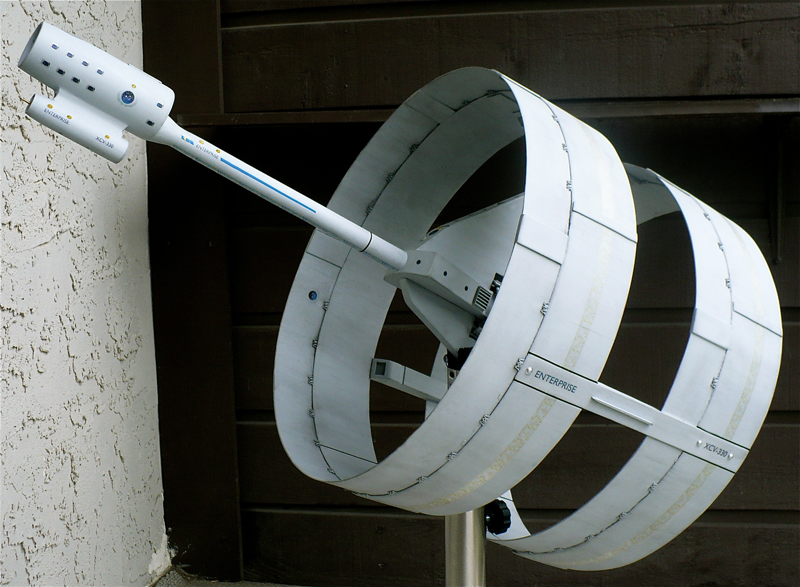
XCV-330 Enterprise

Here are some images of my 1/144 scale (?) scratch build of my interpretation of the XCV-330 Enterprise from the Star Trek universe Based off of the Matt Jefferies Painting.
I know, I know. Why would I have the United Federation of Planets logo all over the ship when the UFP did not come into existence yet when this ship was in service?  Well I say it was hauled out of the museum and put back into service after the formation of the UFP due to e required need for more transport vessels.

From Memory Alpha:

The USS Enterprise (XCV 330) was an Earth starship that was in service prior to 2143.
A painting of a ship from the same class appeared on the wall of the 602 Club on Earth in 2143. (ENT: "First Flight")A similar painting was on display on a wall in Admiral Maxwell Forrest's office on Earth in 2154. (ENT: "Home")
This Enterprise was honored with an illustration on the USS Enterprise's recreation deck after its refit in the early 2270s. (Star Trek: The Motion Picture


The following is from a Lincoln Enterprises catalog, describing some elevations of the ship that could be purchased through the company:
"Gene Roddenberry's imagination brings you "Starship". The vessel of the future as only he could picture it. This could be the forerunner of a new TV series, a Starship operated by an enormous computer which is a lifeform itself. Each human on board is a genius, a highly trained science specialist, part of a team of Galactic trouble shooters. A brand-new concept in future space travel. We also have three different views of the Metatransit system, side elevations of the systems analysis unit, and the Metaflier section of the Starship. Imagine yourself on a mission in space aboard this luxury cruiser. You'll be spellbound!"
  • Chart B of the Star Trek Maps (1980) features a side-view drawing (port) of the Enterprise. On that drawing, the ring-pylon is marked "7". The long "neck" of the ship is marked "ENTERPRISE" - no prefix or registry. The drawing is captioned:
"Starliners. Earth's first attempts at manned interstellar probes were launched during the 2050s at various target stars within fifteen light years of Sol. Only one, the UESP Enterprise, reached its destination – the sunlike binary pair of Alpha Centauri – before they were overtaken by the new faster-than-light spacecraft. The 120-meter-long Starliners had a crew complement of 35." The UESP-prefix presumably stands for "United Earth Space Probe", which would make Enterprise a ship of the United Earth Space Probe Agency.
  • The Star Trek Spaceflight Chronology (1980) features a side-view drawing and a detailed painting of the Enterprise. This however might not even be the same ship. Only the overall shape is similar. The book includes the following descriptions:
USS Enterprise - Declaration Class 2123-2165. Length: 300 m, Weight: 52.7 mil. kg, Ship's complement: 950. Propulsion: Adv. Second Generation Warp Drive. A total of 957 of these warp 3.2 starliners were built for the Cultural Exchange Project of the United Federation of Planets. The Enterprise was the first ship to be equipped with a subspace radio and was the most popular passenger carrier of its time.
It should be noted that in the timeline of the Spaceflight Chronology, for example, the Federation was incorporated in 2087 and the USS Enterprise (NCC-1701) was launched in 2188. So in the canon timeline, this Enterprise would have to be placed somewhere in the very late 22nd to the early 23rd century, well after the time of Star Trek: Enterprise.
  • In the July 2002 Issue 39 of Star Trek: The Magazine Doug Drexler stated, that the Enterprise was one of the inspirations for his design of the Vulcan Suurok-class starship. The ring-shaped configuration was solidified for other Vulcan starships in the series. This might retroactively suggest that the XCV 330, as an early design by Humans, was heavily based on Vulcan ships.
  • According to the novel Star Trek: Ex Machina, this Enterprise was only an unused prototype based on Vulcan ships of the same period.
  • The Star Trek: Ships of the Line (2011) calender listed in its center spread a comparison of the Enterprise (NX-01) and the Enterprise (XCV-330) and carried the following description:
The XCV ENTERPRISE was a radical reinvention of warp technology based on Vulcan design principles. It proved to be 17% more efficient than Vulcan ships, but had trouble turning at high warp speed, thus making it impractical for exploration where sudden course changes would have to be made. It was considered a technological dead-end in Earth Starship Design.
An updated version of the common paintings of this design is the January image in the calendar. The artwork was composed by artist Mark Rademaker.

Wednesday, May 9, 2012

Messenger Class Warp Shuttle Composite


Here is my composite image of my scratch n bash model of the Messenger Class Warp Shuttle the CS Lewis passing over the planet mercury.

Images of the model can be seen here.

Tuesday, May 8, 2012

Messenger Class Warp Shuttle


Here are some images of my scratch n bash model of a Messenger Class Warp Shuttle the CS Lewis.
A series of four Warp shuttles were produced of this class being first launched in 2251.
JRR Tolkien NCC-291198/630
CS Lewis NCC-291198/631
O Barfield NCC-291198/632
C Williams NCC-291198/633
Equipped with multiple sensors the Messenger Class is ideally suited for long distance scientific missions where the use of heavy cruisers wouldn't be cost effective.
Proposed shuttles are as follows
H Dyson NCC-291199/734
C Tolkien NCC-291199/735
W Lewis NCC-291199/736
RL Green NCC-291199/737
A Fox NCC-291199/738
RA Harvard NCC-291199/739
JAW Bennett NCC-291199/740
D Cecil NCC-291199/741
N Coghill NCC-291199/742

Wednesday, April 18, 2012

Post Apocalyptic Catamaran


Here are some images of my scratch 'n' bash 1/32 scale Post Apocalyptic Catamaran.
Are you sick and tired of dredging your way across the radioactive sludge only to discover that when you've reached the other side you have another appendage where one hadn't been before?
Well now there's a better way!!
The IFOR Sludgebegone Catamaran! Powered by a world war II Alison engine the IFOR Sludgebegone offers both power and functionality with the grace and style of tomorrow. Wot?
Now available in three exciting colours. Dark grey, coal grey, or a medium grey with a hint of black. Plus the IFOR Sludgebegone now comes with two 50 caliber machine guns for fighting off those pesky mutants who just can't take no for an answer.
But wait! There's more.
Buy one now for the low low price of $1,429,635 and 48 cents and you'll get the second one, yes the second one for absolutely free!! Your wife could use it for weekend shopping, picking up the kids at soccer practice or picking up that extra bag of Soylent Green. The uses are endless . With the IFOR (I'm feeling overtly radioactive) Sludgebegone you'll wonder how you've lived without it.
Offer not available in Quebec.

Saturday, March 3, 2012

The Eye of Japetus Composite


"When Bowman had first observed Japetus, that curious elliptical patch, of brilliance had been partly in shadow, illuminated only by the light of Saturn. Now, as the Moon moved slowly along its seventy-nine-day orbit, it was emerging into the full light of day.
As he watched it grow, and Discovery rose more and more sluggishly toward her inevitable appointment, Bowman became aware of a disturbing obsession. He never mentioned it in his conversations – or, rather, his running commentaries – with Mission Control, because it might have seemed that he was already suffering from delusions."- Arthur C Clarke from the novel 2001 a space odyssey-

Here is my composite image of Discovery XD 1 from the novel 2001 a space odyssey approaching the Saturn moon Japetus.

Images of the model can be seen here

Friday, February 24, 2012