Translate

Showing posts with label Dioramas. Show all posts

Tuesday, April 8, 2014

European Tram

Here are some images of MiniArt's 1/35 scale European Tram.
As neat as I think this subject is, I found it to be an unpleasant model to build.
The plastic I found was too brittle. Plus as for the parts there were too many tree attachments even right down to the smallest of parts. eg: three tree attachments for a tiny handle. It was insane. That combined with the brittle plastic made it for an unpleasant experience I can tell you. Also glue didn't seem to give a strong bond with this plastic. Finally, this is opinion mind you, I felt where it took several parts to make a component, it could have been made as one part without any loss of detail.
Nice as the model is in the end.

Tuesday, January 21, 2014

Universal Carrier Diorama

Here are some better images of my 1/35 scale Universal Carrier (Ben Gun Carrier) diorama. The Universal Carrier and soldiers are from Tamiya and the building ruin is from Mini Art. With a bit of imagination one can create a decent diorama without having to scratch build and without hurting the pocket book to much and they make great display pieces.

Monday, January 20, 2014

Nebelwerfer Diorama

Here are some better images of my 1/35 scale Nebelwerfer diorama. The Nebelwerfer is from Italeri, the figures are from Tamiya/Dragon and the building ruin is from Mini Art. Used by the German Army to launch smoke grenades to hide troop movements the Nebelwerfer could cover targets with up to 650 rockets in approx 90 seconds.

Friday, December 20, 2013

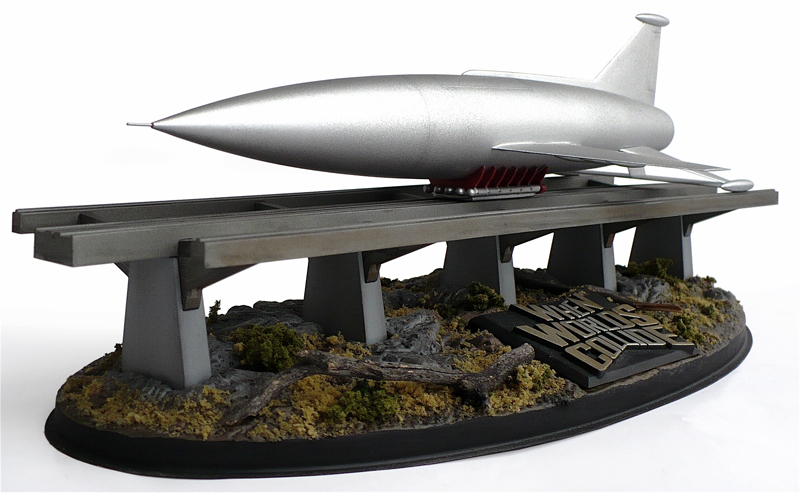
The Space Ark from "When Worlds Collide"


Here are some more images of Pegasus Hobbie's 1/350 scale Space Ark from the 1951 movie "When Worlds Collide".

From Wikipedia"
When Worlds Collide is a 1951 science fiction film based on the 1933 novel co-written by Philip Gordon Wylie and Edwin Balmer. The film was shot in Technicolor, directed by Rudolph Maté and was the winner of the 1951 Academy Award for special effects.

Producer George Pal considered making a sequel based on the novel After Worlds Collide, but the box office failure of his 1955 Conquest of Space made it impossible.

Pilot David Randall (Richard Derr) is paid to fly top-secret photographs from South African astronomer Dr. Emery Bronson (Hayden Rorke) to Dr. Cole Hendron (Larry Keating) in America. Hendron, with the assistance of his daughter Joyce (Barbara Rush), confirms their worst fears— Bronson has discovered a star named Bellus and it's on a collision course with Earth.

Hendron warns the delegates of the United Nations that the end of the world is little more than eight months away. He pleads for the construction of spaceships to transport a lucky few to Zyra, a planet in orbit around Bellus that will pass very close to the Earth, in the faint hope that it can sustain life and save the human race from extinction. However, other, equally-distinguished scientists scoff at his claims, and he is not believed. With no help from the United Nations or the United States government, Hendron receives help from wealthy humanitarian friends, who arrange a lease on a former proving ground to construct a spaceship. To finance the construction, Hendron's group is forced to turn to self-centered, wheelchair-bound industrialist Sidney Stanton (John Hoyt). Stanton demands the right to select the passengers, but Hendron insists that he is not qualfied to make those choices and that all his money can buy is a single seat on the ark.

Joyce becomes attracted to Randall and prods her father into finding reasons to keep him around, much to the annoyance of her boyfriend, medical doctor Tony Drake (Peter Hansen). The ship's construction is a race against time. Groups in other nations also begin building ships. Formerly-skeptical scientists admit that Hendron is right and governments prepare for the inevitable. Martial law is declared and residents in coastal regions are moved to inland cities.

Zyra first makes a close approach, its gravitational attraction causing massive earthquakes, volcanic eruptions, and tidal waves that wreak havoc. Several people are killed at the construction camp, including Dr. Bronson. In the aftermath, Drake and Randall travel by helicopter to provide assistance to survivors. When Randall alights to rescue a little boy, Drake has to resist a strong temptation to strand him.

As the day of doom approaches, the ship is loaded with food, medicine, microfiche copies of books, equipment, and animals. Finally, most of the passengers are selected by lottery, though Hendron reserves seats for a handful of people: himself, Stanton, Joyce, Drake, pilot Dr. George Fry (Alden Chase), the young boy who was rescued, and Randall, for his daughter's sake. When a young man turns in his winning ticket because his girl was not selected, Hendron arranges for both to go. Randall refuses his seat and only pretends to participate in the lottery, believing that he has no useful skills. For Joyce's sake, Drake fabricates a "heart condition" for Fry, making a backup pilot necessary. Randall is the obvious choice.

The cynical Stanton becomes increasingly anxious as time passes. Knowing human nature, he fears what the desperate lottery losers might do. As a precaution, he has stockpiled weapons. Stanton's suspicions prove to be well-founded. His much-abused assistant, Ferris (Frank Cady), tries to get himself included in the crew at gunpoint, only to be shot dead by Stanton. During the final night, the selected passengers and animals are quietly moved to the launch pad to protect them from any more violence.

Shortly before takeoff, many of the lottery losers riot, taking up Stanton's weapons to try to force their way aboard. Hendron stays behind at the last moment, forcibly keeping the crippled Stanton and his wheelchair from boarding, in order to lighten the spaceship. With an effort born of desperation, Stanton stands up and starts walking in a futile attempt to board the ship before it takes off.

From space, the ship's television monitor shows Earth's collision with Bellus. Hendron's sacrifice proves to be crucial, as the fuel runs out too soon and Randall glides the ship to an unpowered rough landing on Zyra. The passengers debark and find the planet to be habitable. Remains of an alien civilization are visible in the distance. David Randall and Joyce Hendron walk hand-in-hand to explore their new home.

Saturday, February 4, 2012

Abandoned Tram In A Winter Wonderland


Here are some images of Lindberg's 1/48 scale Tram Car kit left abandoned amongst some trees during winter.
In case anyone's curious the snow is baking powder.

Friday, December 30, 2011

The Mercury 9 Rocket


Here are some images of Pegasus Model's 1/350 scale Mercury 9 Rocket.
This kit really lends itself well to dioramas.
The launch pad is from the Revell Saturn V 1/144 scale kit.

From the box:
"Bringing together some of the most talented artist's and designers in the industry, this series offers some of the coolest designs ever available in a model kit! (Well I wouldn't go that far).

This first featured artist is Scott Willis. A life long artist, Scott has an extensive art and design background which includes over 20 years of work in the aerospace industry, as well as consumer products and movie concept art design.

An award winning designer and long time science fiction fan, Scott brings an excitement and passion to designing every project he creates. Inspired by the classic TV and movie rockets of the 60's and 70's, the "Mercury 9" rocket is a modern take on the classic rocket designs he grew up with as a kid. Time for blast off!" 10! 9! 8!...

Wednesday, November 30, 2011

The Space Ark from "When Worlds Collide"


Here are some images of Pegasus Hobbie's 1/350 scale Space Ark from the 1951 movie "When Worlds Collide".

From Wikipedia"

When Worlds Collide is a 1951 science fiction film based on the 1933 novel co-written by Philip Gordon Wylie and Edwin Balmer. The film was shot in Technicolor, directed by Rudolph Maté and was the winner of the 1951 Academy Award for special effects.[1]

Producer George Pal considered making a sequel based on the novel After Worlds Collide, but the box office failure of his 1955 Conquest of Space made it impossible.

Pilot David Randall (Richard Derr) is paid to fly top-secret photographs from South African astronomer Dr. Emery Bronson (Hayden Rorke) to Dr. Cole Hendron (Larry Keating) in America. Hendron, with the assistance of his daughter Joyce (Barbara Rush), confirms their worst fears— Bronson has discovered a star named Bellus and it's on a collision course with Earth.

Hendron warns the delegates of the United Nations that the end of the world is little more than eight months away. He pleads for the construction of spaceships to transport a lucky few to Zyra, a planet in orbit around Bellus that will pass very close to the Earth, in the faint hope that it can sustain life and save the human race from extinction. However, other, equally-distinguished scientists scoff at his claims, and he is not believed. With no help from the United Nations or the United States government, Hendron receives help from wealthy humanitarian friends, who arrange a lease on a former proving ground to construct a spaceship. To finance the construction, Hendron's group is forced to turn to self-centered, wheelchair-bound industrialist Sidney Stanton (John Hoyt). Stanton demands the right to select the passengers, but Hendron insists that he is not qualfied to make those choices and that all his money can buy is a single seat on the ark.

Joyce becomes attracted to Randall and prods her father into finding reasons to keep him around, much to the annoyance of her boyfriend, medical doctor Tony Drake (Peter Hansen). The ship's construction is a race against time. Groups in other nations also begin building ships. Formerly-skeptical scientists admit that Hendron is right and governments prepare for the inevitable. Martial law is declared and residents in coastal regions are moved to inland cities.

Zyra first makes a close approach, its gravitational attraction causing massive earthquakes, volcanic eruptions, and tidal waves that wreak havoc. Several people are killed at the construction camp, including Dr. Bronson. In the aftermath, Drake and Randall travel by helicopter to provide assistance to survivors. When Randall alights to rescue a little boy, Drake has to resist a strong temptation to strand him.

As the day of doom approaches, the ship is loaded with food, medicine, microfiche copies of books, equipment, and animals. Finally, most of the passengers are selected by lottery, though Hendron reserves seats for a handful of people: himself, Stanton, Joyce, Drake, pilot Dr. George Fry (Alden Chase), the young boy who was rescued, and Randall, for his daughter's sake. When a young man turns in his winning ticket because his girl was not selected, Hendron arranges for both to go. Randall refuses his seat and only pretends to participate in the lottery, believing that he has no useful skills. For Joyce's sake, Drake fabricates a "heart condition" for Fry, making a backup pilot necessary. Randall is the obvious choice.

The cynical Stanton becomes increasingly anxious as time passes. Knowing human nature, he fears what the desperate lottery losers might do. As a precaution, he has stockpiled weapons. Stanton's suspicions prove to be well-founded. His much-abused assistant, Ferris (Frank Cady), tries to get himself included in the crew at gunpoint, only to be shot dead by Stanton. During the final night, the selected passengers and animals are quietly moved to the launch pad to protect them from any more violence.

Shortly before takeoff, many of the lottery losers riot, taking up Stanton's weapons to try to force their way aboard. Hendron stays behind at the last moment, forcibly keeping the crippled Stanton and his wheelchair from boarding, in order to lighten the spaceship. With an effort born of desperation, Stanton stands up and starts walking in a futile attempt to board the ship before it takes off.

From space, the ship's television monitor shows Earth's collision with Bellus. Hendron's sacrifice proves to be crucial, as the fuel runs out too soon and Randall glides the ship to an unpowered rough landing on Zyra. The passengers debark and find the planet to be habitable. Remains of an alien civilization are visible in the distance. David Randall and Joyce Hendron walk hand-in-hand to explore their new home.

Friday, October 14, 2011

Alpha Moonbase


Here are some images of MPC/AMT/ERTL 1/3200 scale Alpha Moonbase from the television series Space 1999.
The base of this model is scratch built and designed to be hung on a wall.

From Wikipedia"
Located in the Moon crater Plato and constructed out of quarried rock and ores, Moonbase Alpha is four kilometres in diameter and extends up to one kilometre in areas below the lunar surface. The complex extends outward from the central Main Mission tower in a series of concentrically-arranged curved structures connected by travel-tube transit tunnels. (The look is more than reminiscent of Clavius Base in the film 2001: A Space Odyssey.) Apart from the central tower, the surface buildings are two to three storeys in height.
Originally, the base was designed to serve as both Earth's primary space research and exploration centre and a monitoring station co-ordinating the nuclear waste disposal areas on the Moon's far side. Construction began on 3 February 1983, but was briefly halted during the 1987 world war. Construction commenced afterwards under the auspices of the new World Space Commission. Though operational and occupied for years, final completion of the Alpha construction project occurred in 1997.
Moonbase Alpha is totally self-sustaining. Power is generated by four nuclear reactors and the accumulation of solar energy. Earth-normal artificial gravity is generated by eight towers surrounding the complex. Water is obtained from ice deposits under the lunar surface, recycled and purified. Nutritional requirements are met by a variety of familiar-appearing foodstuffs produced biochemically on Alpha This diet was supplemented by frozen-food products imported from Earth before all contact with home was severed in September 1999. (At the time of "Breakaway", about eighty percent of food and water products were produced chemically on Moonbase.)
The international pooling of technical skill and resources after the War of 1987 resulted in the advanced construction of Moonbase Alpha. The operations and living areas are both functional and spacious (unlike early space capsules and Earth-orbiting stations). Main Mission, the control centre of the installation, is a massive, multi-leveled room. Opening into Main Mission from behind large sliding doors is the Command Office, which includes a large conference and conversation area. Corridors run eight feet wide throughout the base and the pipes and wiring trunks that festooned the walls of previous ocean-going military vessels and spacecraft are concealed behind four-foot-by-eight-foot modular panels.
All Alpha personnel have their own suite of rooms in the Residence Section with sitting room, sleeping alcove and private bathroom. Suites with a separate, larger bedroom are available to married staff members. Personnel also have the option to live with a roommate if desired. The Recreation Section boasts a gymnasium, private work-out rooms, a solarium with adjacent sauna and swimming pool, bowling alley, performing-arts theatre and separate cinema and a reference library with both real books and electronic equivalents. Recreation lounges and restaurants are scattered throughout the complex.
Several buildings are given over to research in a number of scientific fields including astronomy, geology, chemistry, biology and astrophysics. Others are devoted to the Technical and Maintenance Sections and are responsible for the repair and upkeep of Moonbase and its many complex systems. The Eagle transporters and other ancillary craft are maintained and stored in an underground hangar complex.
In contrast, Year Two revealed that an underground complex had been constructed and expanded upon between the two series and that the majority of Alpha's command, operations and living centres had been relocated there.[17] The vulnerable Main Mission had been abandoned in favour of the safer underground Command Centre, a smaller control room with many of the same features of Main Mission. The Medical Section once occupied an entire building on the Moon's surface and included several large wards, trauma, casualty and diagnostic units, intensive care wards and operating theatres. Underground, it was reduced to a few rooms, the main Medical Centre acting as a combination patient ward, examination room and surgery all in one. Living quarters were now one small room which did not even appear to have a private bath.
Other facilities revealed in Series Two were a complement of offensive laser batteries which had been installed around the Moonbase complex (starting in "The Metamorph"). These large weapons were stored underground and raised to the surface when deployed. They had a range of at least forty-three thousand kilometres and were controlled from the Weapons Section, a small, bunker-like room. In "The Exiles", the Golos cylinders were taken for examination in an 'underground research area', a laboratory facility constructed inside a lunar mountain on the rim of the crater containing Moonbase. This secure area, designed for the performance of potentially hazardous experiments, was connected to Alpha only by travel-tube and boasted its own Eagle landing pad.

Monday, October 10, 2011

Crashed BK 117


Here are some images of Revell's 1/32 scale MBB/Kawasaki BK 117 Helicopter crash landed along a river bank.
From Wikipedia" The MBB/Kawasaki BK117 is a twin-engined medium utility–transport helicopter. It was a joint development between Messerschmitt-Bölkow-Blohm (MBB) of Germany and Kawasaki of Japan. MBB was later purchased by Daimler-Benz and eventually became a part of Eurocopter. The BK117 is popular for passenger and VIP-transport, seating from seven up to 10 people. It is also used for aerial crane and sling work, law enforcement, and military transport, and is exceptional as an air ambulance and search and rescue platform. Its successor was developed from the BK117 C-1 version. It is produced as the EC 145.

Friday, October 7, 2011

Do you think we can restore her?


Here are some images of a small diorama of a Model A Ford abandoned, rusted out and half buried in the sand. I used Monograms 1/24 scale Model A for this one.

To apply the rust I used ground up chalk pastels into powder applied by dabbing my brush into some alcohol hand cleaner then into the chalk powder and onto the surface. Nice 'n'crusty.