Here are some images of Protar's 1/9 scale 1927 Bianchi "Freccia Celeste" 350cc.
The main problem when building older kits is the frailty and brittleness of the metal and plastic
This kit was no exception. Though it's a beautiful kit I don't know if its problems were due to the way plastics and metals were made in the past or if it's just age. Needless to say it made for a more difficult build.
Translate
Showing posts with label Motorcycles. Show all posts
Friday, April 19, 2019
Monday, May 1, 2017
Moto Guzzi 500cc Four Cylinder Inline
Here are some images of Protar's 1/9 scale Moto Guzzi 500cc Four Cylinder Inline racing motorcycle.
Unfortunately I cannot find very much information on this motorcycle, except for an old photograph from about the mid 1950's
A very rare kit for a very rare motorcycle.
Unfortunately I cannot find very much information on this motorcycle, except for an old photograph from about the mid 1950's
A very rare kit for a very rare motorcycle.
Sunday, August 30, 2015
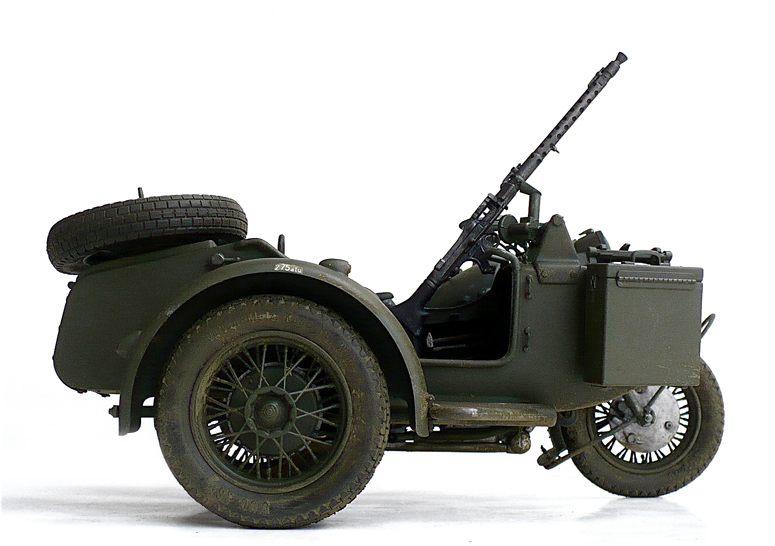
BMW R75 With Sidecar
Here are some images of ESCI's 1/9 scale BMW R75 with sidecar.
From Wikipedia"
The BMW R75 is a World War II-era motorcycle and sidecar combination produced by the German company BMW.
In the 1930s BMW were producing a number of popular and highly effective motorcycles. In 1938 development of the R75 started in response to a request from the German Army.
Preproduction models of the R75 were powered by a 750 cc side valve engine, which was based on the R71 engine. However it was quickly found necessary to design an all new OHV 750 cc engine for the R75 unit. This OHV engine later proved to be the basis for subsequent post-war twin BMW engines like the R51/3, R67 and R68.
The third side-car wheel was driven with an axle connected to the rear wheel of the motorcycle. These were fitted with a locking differential and selectable road and off-road gear ratios through which all four and reverse gears worked. This made the R75 highly manoeuvrable and capable of negotiating most surfaces. A few other motorcycle manufactures, like FN and Norton, provided an optional drive to sidecars.
The BMW R75 and its rival the Zündapp KS 750 were both widely used by the Wehrmacht in Russia and North Africa, though after a period of evaluation it became clear that the Zündapp was the superior machine. In August 1942 Zündapp and BMW, on the urging of the Army, agreed upon standardization of parts for both machines, with a view of eventually creating a Zündapp-BMW hybrid (designated the BW 43), in which a BMW 286/1 side-car would be grafted onto a Zündapp KS 750 motorcycle. They also agreed that the manufacture of the R75 would cease once production reached 20,200 units, and after that point BMW and Zündapp would only produce the Zündapp-BMW machine, manufacturing 20,000 each year.
Since the target of 20,200 BMW R75's was not reached, it remained in production until the Eisenach factory was so badly damaged by Allied bombing that production ceased in 1944. A further 98 units were assembled by the Soviets in 1946 as reparations.
However the standardisation programme meant that machines that were produced by BMW and Zündapp used 70% of the same components. This simplifies the supply of spare parts for these vehicles, many of which are still in the hands of historic motorcycle enthusiasts. These vehicles are still highly desirable as collector's items because of their complex and durable technology, and are correspondingly expensive. A well-restored R75 can be still used for everyday purposes, on or off-road without problems.
During World War 2 the Soviet Union quietly purchased five units via Swedish intermediaries to study and subsequently build their own version, the M-72, which Stalin approved for production.
In 1954 a small number of modified R75 models were produced at Eisenach (then in Soviet-controlled East Germany) for testing under the designation AWO 700, but were not put into full production.
The success and reliability of the shaft-driven R75 during the war led to the US Army requesting that Harley-Davidson produce a similar shaft-driven cycle for American troops. This led to Harley producing their first ever shaft-driven model, the Harley-Davidson XA, which was a near duplicate of the R75.
From Wikipedia"
The BMW R75 is a World War II-era motorcycle and sidecar combination produced by the German company BMW.
In the 1930s BMW were producing a number of popular and highly effective motorcycles. In 1938 development of the R75 started in response to a request from the German Army.
Preproduction models of the R75 were powered by a 750 cc side valve engine, which was based on the R71 engine. However it was quickly found necessary to design an all new OHV 750 cc engine for the R75 unit. This OHV engine later proved to be the basis for subsequent post-war twin BMW engines like the R51/3, R67 and R68.
The third side-car wheel was driven with an axle connected to the rear wheel of the motorcycle. These were fitted with a locking differential and selectable road and off-road gear ratios through which all four and reverse gears worked. This made the R75 highly manoeuvrable and capable of negotiating most surfaces. A few other motorcycle manufactures, like FN and Norton, provided an optional drive to sidecars.
The BMW R75 and its rival the Zündapp KS 750 were both widely used by the Wehrmacht in Russia and North Africa, though after a period of evaluation it became clear that the Zündapp was the superior machine. In August 1942 Zündapp and BMW, on the urging of the Army, agreed upon standardization of parts for both machines, with a view of eventually creating a Zündapp-BMW hybrid (designated the BW 43), in which a BMW 286/1 side-car would be grafted onto a Zündapp KS 750 motorcycle. They also agreed that the manufacture of the R75 would cease once production reached 20,200 units, and after that point BMW and Zündapp would only produce the Zündapp-BMW machine, manufacturing 20,000 each year.
Since the target of 20,200 BMW R75's was not reached, it remained in production until the Eisenach factory was so badly damaged by Allied bombing that production ceased in 1944. A further 98 units were assembled by the Soviets in 1946 as reparations.
However the standardisation programme meant that machines that were produced by BMW and Zündapp used 70% of the same components. This simplifies the supply of spare parts for these vehicles, many of which are still in the hands of historic motorcycle enthusiasts. These vehicles are still highly desirable as collector's items because of their complex and durable technology, and are correspondingly expensive. A well-restored R75 can be still used for everyday purposes, on or off-road without problems.
During World War 2 the Soviet Union quietly purchased five units via Swedish intermediaries to study and subsequently build their own version, the M-72, which Stalin approved for production.
In 1954 a small number of modified R75 models were produced at Eisenach (then in Soviet-controlled East Germany) for testing under the designation AWO 700, but were not put into full production.
The success and reliability of the shaft-driven R75 during the war led to the US Army requesting that Harley-Davidson produce a similar shaft-driven cycle for American troops. This led to Harley producing their first ever shaft-driven model, the Harley-Davidson XA, which was a near duplicate of the R75.
Friday, March 14, 2014
FLH 1980 U.S. Army Motorcycle
Here are some images of IMEX's 1/12 scale Harley Davidson FLH 1980 U.S.
Army Motorcycle. Try as I might I could not find any information on this
motorcycle. I found lots of information on the Harley Davidson FL
series bikes but nothing on an FLH 1980 U.S. Army Motorcycle. Not even
the instructions provided any information. I hate it when model
companies do that.
Thursday, March 13, 2014
Ducati 888 Superbike Racer
Here are some images of Tamiya's 1/12 scale Ducati 888 Superbike Racer with its coverings removed.
From Wikipedia'
The Ducati 888 was a motorcycle manufactured by Ducati as an upgrade to the Ducati 851. The earlier 851 had introduced liquid cooling, computerized fuel injection and four-valve heads to the company's two cylinder motors. In 1991 Ducati increased the capacity of the 851 to 888 cc to create the 888. Both engines featured the Desmoquattro valvetrain concept in which a four valve per cylinder motor was given desmodromic valve actuation, with cams both opening and closing the valves.
Continuing refinement yielded the next two generations of the Ducati Desmoquattro superbike, resulting in the 916/996 and 999 lines.
From Wikipedia'
The Ducati 888 was a motorcycle manufactured by Ducati as an upgrade to the Ducati 851. The earlier 851 had introduced liquid cooling, computerized fuel injection and four-valve heads to the company's two cylinder motors. In 1991 Ducati increased the capacity of the 851 to 888 cc to create the 888. Both engines featured the Desmoquattro valvetrain concept in which a four valve per cylinder motor was given desmodromic valve actuation, with cams both opening and closing the valves.
Continuing refinement yielded the next two generations of the Ducati Desmoquattro superbike, resulting in the 916/996 and 999 lines.
Monday, March 10, 2014
Matchless G 50
From Wikipedia"
The Matchless G50 is a racing British motorcycle made by Associated Motorcycles (AMC) at the former Matchless works in Plumstead, London. Developed in 1958 from the 350cc AJS 7R, but with the engine capacity increased to 500 cc, 180 G50s (for 50 bhp) were built in the next four years. Although less powerful than its main competitor the Norton Manx the G50 proved highly competitive at three hundred pounds and was faster round bends. If success is measured by longevity then this is the most successful Matchless motorcycles as high specification replicas are still being produced to this day although financial problems at AMC ended production in 1963.
In 1963, the AMA decided that the G50 should not be allowed to race in the USA as it was not based on a production street bike. Matchless solved the problem by creating the street-legal G50 CSR, fitting the G50 engine into the G80CS Scrambler frame.
The designation CSR stood for Competition, Sprung and Roadster but quickly got called the Coffee Shop racer. It later became known as the Golden Eagle after the name was used in advertising (due to the gold finish of the engine casings).
By the time the G50 was reinstated, however, it was no longer in production.
There were just two colour options - bright blue with a tan seat or bright red and black with a black seat.
Financial problems at AMC ended production in 1963 and all the tooling and spares were sold to sidecar Grand Prix racer Colin Seeley in 1966. Seeley went on to develop the engine and made his own custom frames to produce a number of G50 'specials' some of which were known as the called the Seeley Condor. These exclusive motorcycles continue to be hand built to this day to individual customer specifications by TGA Ltd, now based in northern France. As well as building motorcycles from new parts, TGA also convert secondhand racing motorcycles for road use.
Sunday, March 9, 2014
AJS 7R 350 cc
Here are some images of Protar's 1/9 scale AJS 7R 350 cc Racing Motorcycle.
From Wikipedia"
The AJS 7R was a 350 cc racing motorcycle built from 1948 to 1963 by Associated Motor Cycles, also known as the ‘Boy Racer’, first won victories for the factory, and then went on to win races for privateers when made generally available from 1954.
A new design by Phil Walker, the chain-driven overhead camshaft 7R had the history of the pre-war AJS ‘cammy’ singles behind it. Initially, the 7R was not as powerful as its competitors, producing 32 bhp (24 kW) at 7500 rpm. The duplex frame and Teledraulic front forks remained relatively unchanged during production, while the engine had a number of changes. The included valve angle was progressively narrowed, and the crankshaft strengthened. In 1956 the engine dimensions changed from the original long-stroke 74 x 81 mm to the ‘squarer’ 75.5 x 78 mm. The AMC gearbox replaced the older Burman unit in 1958.
In 1951 AJS development engineer Ike Hatch developed a 75.5 mm bore x 78 mm stroke, three valve head version of the 7R making 36 bhp (27 kW). It was called the AJS 7R3, and was Ike's response to the Italian multi-cylinder racers. They did well enough in their first year, not as well the second. For 1954 Jack Williams, the works team manager, developed the bike further, lowering the engine in the frame, and making some tuning changes that gave 40 bhp (30 kW) @ 7800 rpm. It immediately won the first two rounds of the World Championship and took first at the Isle of Man TT. These were factory specials, but one has survived, and a second has been reconstructed from spares.
AJS 7Rs won the 1961, 62 and 63 Junior Manx TT races and came second in 1966. The 1957 AJS 7R 350 cc, with 75.5 mm bore and 78 mm stroke, gave 38.5 bhp (28.7 kW) at 7600-7800 rpm, and weighed 285 lb (129 kg). The top speed was 180-190 km/h (115-120 mph).
AMC withdrew from the world of works, and one-off, road racing at the end of the 1954, with the death of Ike Hatch, and in the face of fierce competition from the other European bikes.
After this AJS made a production version of the standard two valve AJS 7R, for privateers and a 500 cc version, badged as a Matchless G50 was also sold. By the end of production in 1963 the two valve OHC AJS 7R engine made over 40 bhp (30 kW).
Subscribe to:
Posts (Atom)