Translate

Showing posts with label Leonardo da Vinci. Show all posts

Sunday, April 16, 2017

Leonardo Da Vinci's Flying Pendulum Clock

Here are some images of Academy's Leonardo da Vinci's Flying Pendulum Clock.

From Wikipedia"
A flying pendulum clock is a clock that uses a flying pendulum escapement mechanism. A small metal ball, connected by string wraps around one brass post, then unwinds before repeating on the other brass post.
The flying pendulum clock was invented and patented in 1883 by Adler Christian Clausen and J. C. Slafter in Minneapolis. The clock was later called the Ignatz Flying pendulum clock after a character in the Krazy Kat comic. It has been called "the craziest clock in the world" due to the motion of the escapement.
 This clock was first designed by Leonardo di Vinci

Saturday, July 9, 2016

Leonardo Da Vinci's Great Kite

Here are some images of Edu-Toys Leonardo Da Vinci's Great Kite.

From the instructions"
Da Vinci was a prolific inventor; he designed hundreds of war machines for work, but also for theatre and the world of music. Of all the machines he invented, the flying machines were the most incredible, and not a single book on the world of aviation fails to recognize Leonardo Da Vinci as the forerunner in studies of human flight.
The Codex of Flight, preserved in the Royal Library of Turin represents the most advanced and organic state of Da Vinci's studies on flight. The genius of Da Vinci drew inspiration for his work from his direct observation of the flight of a bird; the Kite. By analyzing the Turin notebook carefully, the Leonardo3 Research centre discovered that the design for the "Codex of Flight flying machine" is described with extreme precision.
Da Vinci described its dimensions, the materials with which it is to be built, its shape and how it works; the whole notebook revolves precisely around the construction and use of the machine. The piloting must have been complex. He would use his hands and feet that could activate ropes and rotate, move and open and close the wings with his own movements. Da Vinci's design is not drawn in its entirety. We must therefore reconstruct the indispensable parts. These include; the canvas to cover the wings, some articulations and pulleys, and the tail, which Da Vinci knew was indispensable for controlling the machine. Da Vinci's instructions for building the machine are extremely precise and even regard the materials to be used. He also advised which ones to avoid.
On folio 7r of the Codex of flight he wrote: ... not one single piece of metal must be used in the construction, because this material breaks or wears away under stress, so there is no need to complicate the job.
Da Vinci suggested using resistant leather for the joints and silk for the ropes. The canvas would be taffeta, a very thick silk, or linen canvas that is starched so any holes are sealed to prevent any air from passing through. Also with regards to the canvas that would cover the wings he suggested referring to the wing membrane of a bat since, unlike bird feathers, air does not pass through it...
"Remember that your bird must only copy the bat because the membranes act as a framework, Connecting the major articulations. If you wanted to copy the wings of feathered birds you would would have to remember that they have stronger bones and quills because they are permeable; the feathers are divided and the air passes through them. On the other hand, the bat is held up by its membranes, which connect everything together and are not permeable.
We can presume the rest of the machine was to be made of wood, using different species based on their properties: ash wood for the wings, because it's flexible; beech wood for the pulleys, since it's easy to polish; and walnut wood or something else more resistant for the structural parts. The Great Kite, described and drawn in the Codex of Flight, is one of the most complex flying machines that Da Vinci designed. It's likely that Da Vinci never finished building it, but he profoundly believed that his project was worthwhile and fervently desired to test it, launching it, with a pilot (some poor sap), on the edge of a mountain top. In fact, in one of the most famous phrases from the Codex of Flight, Da Vinci wrote:
"The first Great Bird will make its first flight, launched from the peak of Mount Cecero and will fill the universe with amazement and all the reports of its great fame will confer eternal glory upon the places where it was conceived".

Friday, July 8, 2016

Leonardo Da Vinci's Arch Bridge

Here are some images of Academy Hobby Model Kits Leonardo Da Vinci's Arch Bridge.

From the instructions"
The design uses a self supporting arch concept to distribute weight through the full curve of the arch.
The more weight the bridge carries, the stronger it becomes.
On the other hand, if one key component is removed, the bridge will fall.
It was originally intended as a quick build, wood bridge for use by the military.
Removing a single piece of wood while the enemy was crossing could cause the bridge to collapse drowning enemy forces.

Monday, March 7, 2016

Leonardo Da Vinci's Mechanical Dragonfly

Here are some images of Edu Toy's Leonardo Da Vinci's Mechanical Dragonfly.
The box says "Mechanical Butterfly", though its description and appearance are that of a dragonfly.

From the Instructions"
Da Vinci was the first person to apply himself to the study of animal flight and human flight with such passion. Throughout his life da Vinci dreamt of building a flying machine which would enable man to fly. In spite of being unable to fulfill this task, da Vinci has the distinction of being the first person in the history of human flight to study the subject from a scientific point of view, investigating every possible solution. He even devised plans for muscle powered flying, where the pilot of the machine trys to replicate the beating of a birds wings, gliding, without moving the wings, and mechanical flight, where the machine flies  without a pilot but only thanks but only thanks to the movement of mechanical parts like gears and wings. In his manuscripts da Vinci drew many contraptions, not all of which need a pilot. Many flying machines are preliminary studies, where most of the time da Vinci tried to imitate the anatomy of an animal; a bird, a bat, or an insect, such as a dragonfly. One of the projects for a flying machine with no pilot is the mechanical dragonfly,on folio 1051v of the Codex Atlanticus. da Vinci himself advised where one can admire admire these incredible flying insects: To see four winged flying, look near ditches and you will see dragonflies. It is extremely difficult to create a mechanical replica of the natural movement of an animal. The beating of the dragonfly's four wings is particularly complex and da Vince was well aware of how difficult it would be to create this machine. he himself described it in great detail. It is not simply wings beating up and down; it's a jointed motion. Whilst beating down the wings are "flat" in order to push as much air as possible, whereas when they are raised, they are angled so that they create less resistance. If the dragonfly and therefore da Vinci's machine, was not like this, it would not be able to fly because the power created when the wings beat downwards, would be canceled out when the wings returned to their starting point. Da Vinci wrote: The wings must return to the top very quickly, whereas pushing backwards with the part of the wing which pushes the air must be done at the speed required by the engine each individual time. The movement of each four wings is synchronized with the others. Da Vinci resolved the problem by designing to pairs of wings, one for the front and one for the back, exactly as on a dragonfly. When the wings are beating, the pairs of wings around their main linch-pin. The energy of this movement is provided by two spring loaded motors which drive a mechanical system made by gearwheels, a camshaft and connecting rods which in turn allow the pairs of wings to move alternately and in synchrony. Whilst the wings move more quickly up and down pushing the air, rods of exactly the right length fold the wings downwards ensuring they are angled when they come back up, exactly as it happens in the animal movement. The mechanism is very delicate and in order to make the machine work correctly it must be very fine tuned. Furthermore, the power the motors were able to supply would definitely not have been sufficient to lift the machine off the ground. In spite of this, the machine plan is absolutely fascinating and even if they are too slow, the wings move exactly in the same way as a dragonfly's.

Sunday, March 6, 2016

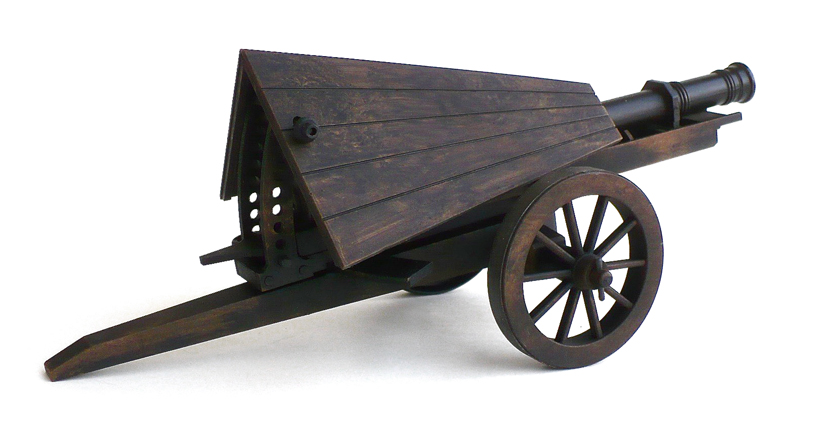
Leonardo Da Vinci's Ship's Cannon With Shield

Here are some images of Edu Toys Leonardo Da Vinci's Ship's Cannon With Shield.

From the Instructions "

Leonardo da Vinci was also a military engineer; he studied weapons and medieval military techniques at length. A large part of his manuscripts show machines and military architecture, some are copies of machines by Taccola Francesco di Giorgio, others are his own inventions or modifications of existing machines. He also spent a lot of time working on naval battles, designing dozens of ships with as many attacking methods as means of defense on the sea. One of the most original projects is that of the ship with shield and cannon. Da Vinci drew this naval weapon in manuscript B for the first time, almost certainly copying it from a previous author, because the drawing of this project was already presented in the treatises of engineers who came before da Vinci and to whom he referred when studying. Again, it was a general idea, only roughly drawn and without any technical details. Da Vinci subsequently revisited the project; he reconsidered it, improved it and redrew it clearly and in its entirety on folio 172r of the Codex Atlanticus. The idea was to use a small, agile vessel equipped with a cannon. The prow of the ship and the cannon are protected by a wooden shield. Da Vinci studied this subject closely, identified the weak points and invented his own version with many more functions. He transformed the almost "fantastic" medieval drawing into a truly achievable engineering project. First, he concentrated on the structure of the vessel which needed to be reinforced and keep the cannon firmly in the middle. The shield, which previous engineers had shown as being immobile and almost temporary, in da Vinci's drawing was split in two and became part of the structure and mobile. A system of ropes and pulleys keeps the shields raised to protect the ship. Once the winches are locked, the weight of the shields themselves causes them to rotate outwards to uncover the cannon which can then fire. The shield rotate on two non-parallel axes and da Vinci designed a geometric shape of them so that when lowered, they fit around the curve of the ship. The resulting contact between hull and shield is not an easy line to calculate and da Vinci proposed a few variations. Firing the cannon is another problem to deal with, as this causes a recoil powerful enough to push the ship backwards. The semi-submerged shields themselves act as breaks, keeping the ship steady as it fires. Da Vinci's drawing on folio 172r even shows the metal covered prow of the ship with a detail showing the device that attaches the shield hinges. The metal covered prow is there to deliver the first blow to the enemy and is therefore a secondary weapon. The shields are not just to protect the prow, but also to hide the main weapon: the cannon. The ship could therefore approach the enemy quickly, and its tapered and futuristic shape made it also rather menacing. It was protected by a shield which made the cannon invisible and meant that enemy weapons would be ineffective work. The angle of the shield was also useful to deflect cannon fire. When rammed quickly into the enemy, it could create the first serious damage thanks to its metal covered prow. Once the enemy ship was "hooked' and presumably a breach had been created in the hull, it was the moment to unveil the secret weapon. The shields having been quickly lowered thanks to their own weight, the cannon was ready to fire directly into the enemy ship. In theory, a small vessel such as this could therefore sink a large galleon. It is not known whether a ship like this was ever built. There are no records of it and perhaps this project too remained amongst the many projects that Leonardo da Vinci never carried out.  

Sunday, November 29, 2015

Leonardo da Vinci's Multiple Sling

Here are some images of Edu-Toys Leonardo da Vinci's Multiple Sling.

From the instructions"
Leonardo da Vinci's idea was to build a very powerful machine which could throw eight large projectiles at the same time.
He positioned eight long arms around a central pin, each of which had a sling capable of throwing a projectile attached to it.
This kind of project, where weapons were developed to hurl multiple  projectiles to be more powerful, was common in da Vinci's time, because doing this meant creating more powerful weapons, simply by increasing their number and power, without the need to develop new building techniques and using familiar materials. They were therefore potentially attractive weapons because they were powerful,but they were also relatively inexpensive.

Saturday, November 28, 2015

Leonardo da Vinci's Mechanical Drum

Here are some images of Academy's Leonardo da Vinci's Mechanical Drum.

From the instructions"
The cart was equipped with a mechanical mechanism that caused the two side drums to beat whenever the cart was pulled or pushed.

Thursday, November 26, 2015

Leonardo da Vinci's Spingarde

Here are some images of Academy's Leonardo da Vinci's Spingarde.
These are simple kits but they're fun.

From the instructions"
The Leonardo da Vinci Spingarde launcher was placed on a firm wooden structure and could launch projectiles at targets over a wide range, due to its ability to move in all directions. Although heavy, efficient aiming was not difficult, making it highly functional on the battlefield.

Monday, June 30, 2014

Da Vinci Flying Machine

Here are some images of Academy's Da Vinci Flying Machine.
A very simple model but fun. The wings flap when you wind it up.

Sunday, June 29, 2014

Da Vinci Clock

Here are some images of Academy's Da Vinci Clock.
So far as I can tell this so far is the best of the Academy Leonardo Da Vinci kits, and it work to.
You can get up to 1 hour out of it before rewinding.

From Leonardo Da Vinci Inventions"

To put away any initial confusion – Leonardo da Vinci did not invent the clock. What he did was design a more accurate clock.
While clocks that showed hours and minutes had become increasingly accurate in da Vinci’s time (the 15th century), they didn’t really make a big leap forward until the incorporation of the pendulum about 200 years later. But, da Vinci actually designed a more accurate clock in his lifetime.
Leonardo’s clock had two separate mechanisms: one for minutes and one for hours. Each was made up of elaborately connected weights, gears and harnesses. The clock also has a dial for keeping track of moon phases.
Da Vinci’s major innovation was to have springs, rather than weights operate his clock. He also included the detail of some materials that would be used to make the clock – including diamonds and rocks.