Translate

Showing posts with label WWII Soviet. Show all posts

Friday, June 1, 2018

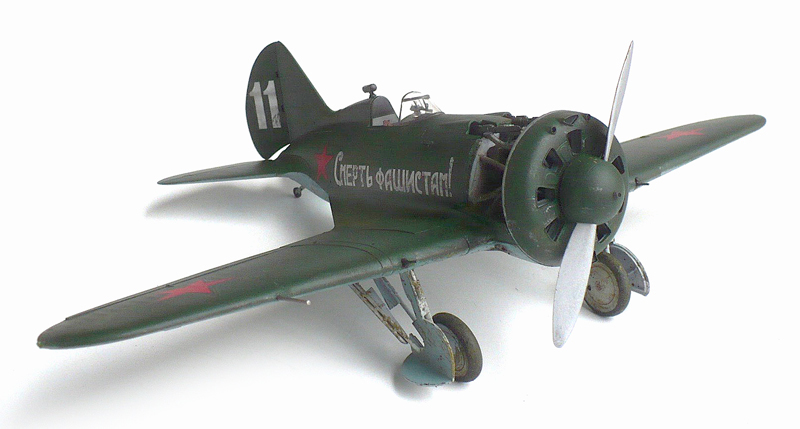
Polikarpov I-16 Type 24

Here are some images of ICM's 1/32 scale Polikarpov I-16 type 24.

From Wikipedia"
The Polikarpov I-16 was a Soviet fighter aircraft of revolutionary design; it was the world's first low-wing cantilever monoplane fighter with retractable landing gear to attain operational status and as such "introduced a new vogue in fighter design." The I-16 was introduced in the mid-1930s and formed the backbone of the Soviet Air Force at the beginning of World War II. The diminutive fighter, nicknamed "Ishak" or "Ishachok" ("Donkey" or "Burro") by Soviet pilots, figured prominently in the Second Sino-Japanese War, the Battle of Khalkhin Gol and the Spanish Civil War – where it was called the Rata ("Rat") by the Nationalists or Mosca ("Fly") by the Republicans. The Finnish nickname was Siipiorava ("Flying Squirrel").

While working on the Polikarpov I-15 biplane, Nikolai Nikolaevich Polikarpov began designing an advanced monoplane fighter. It featured cutting-edge innovations such as retractable landing gear and a fully enclosed cockpit, and was optimized for speed with a short stubby fuselage (similar to the Gee Bee R-1) and a Wright R-1820 radial engine in a NACA cowling. The aircraft was small, light and simple to build.

Full-scale work on the TsKB-12 prototype began in June 1933, and the aircraft was accepted into production on 22 November 1933, a month before it took to the air. The TsKB-12 was of mixed construction, using a wooden monocoque fuselage and wings employing a KhMA chrome-molybdenum steel alloy wing spar, dural ribs and D1 aluminum alloy skinning on the center and leading edges, with the remaining portions of the wings fabric covered. Another modern feature were the ailerons which ran along almost the entire trailing edge of the wing and also operated as flaps (in the manner of more modern flaperons) by drooping 15°. The cockpit was covered by a 40-centimetre-wide (16 in) canopy which featured an Aldis-type tubular gun sight which could slide back and forth on runners fitted with rubber bungee cords. A 225 l (59.4 US gal) fuel tank was fitted directly in front of the cockpit. The main landing gear was fully retractable by a hand crank. The armament consisted of a pair of 7.62×54mmR (0.30 in) ShKAS machine guns in the wings, mounted on the outboard side of the main gear and 900 rounds of ammunition.[citation needed]
These features were proposed at first by Andrei Tupolev; however, the NII VVS was more concerned about the stresses a typical combat aircraft was subjected to in combat, and initially considered the risk too great. However, TsAGI, with the help of the 3rd Design Brigade under the leadership of Pavel Sukhoi and Aleksandr Putylov, eventually convinced NII VVS that what was being proposed was not only feasible, but would enhance the aircraft's performance.

The TsKB-12 was designed for the Wright Cyclone SR-1820-F-3 9-cylinder radial engine (rated at 529 kW/710 hp); a license to build this engine under the supervision of the Shvetsov design bureau in the Soviet Union was being negotiated. As the license was not yet approved, Polikarpov was asked to settle for the less powerful M-22 (Soviet-built version of the Gnome-Rhone Jupiter 9ASB, which itself was a licensed version of the Bristol Jupiter VI) with 358 kW (480 hp). This was deemed acceptable because the projected top speed still exceeded 300 km/h (185 mph).[citation needed]
The M-22-powered TsKB-12 first took to the air on 30 December 1933 with the famous Soviet test pilot Valery Chkalov at the controls. The second TsKB-12, with a Cyclone engine and three-bladed propeller, flew in January of the following year. Initial government trials in February 1934 revealed very good maneuverability, but the aircraft did not tolerate abrupt control inputs. Thus the TsKB-12 was deemed dangerous to fly and all aerobatics were forbidden. The M-22 version was preferred due to the vibration of the Cyclone-powered aircraft. Pilots commented early on about the difficulty of climbing into the cockpit, a trait that persisted through the I-16's service life. Before continuing test flights the designers had to answer the question of spin behavior. Wind tunnel testing suggested that the TsKB-12, with its short tail, would enter an unrecoverable flat spin, but real-life trials were necessary to confirm this. Since Cyclone engines were rare, it was decided to risk the M-22 prototype for this purpose. On March 1 and 2, 1934, Chkalov performed 75 spins and discovered that the aircraft had very benign stall behavior (dipping a wing and recovering without input from the pilot when airspeed increased) and intentional spins could be easily terminated by placing the controls in the neutral position. The stories of vicious spin behavior of the I-16 perpetuated in modern literature is unfounded (perhaps extrapolated from Gee Bee experience). In fact, the I-16's stablemate, the biplane Polikarpov I-153, exhibited much worse spin characteristics.

Service trials of the new fighter, designated I-16, began on 22 March 1934. The M-22 prototype reached 359 km/h (223 mph). The manually retracted landing gear was prone to jamming and required considerable strength from the pilot. Most of the test flights were performed with the gear extended. On 1 May 1934, the M-22 prototype participated in the flyover of Red Square. Approximately thirty I-16 Type 1 aircraft were delivered, but were not assigned to any VVS fighter squadron. Most pilots who flew the I-16 Type 1 for evaluation purposes did not find the aircraft to have many redeeming characteristics. Regardless of pilot opinion, much attention was focused on the Cyclone-powered aircraft and the M-25 (the license-built Cyclone). On 14 April 1934, the Cyclone prototype was damaged when one of the landing gear legs collapsed while it was taxiing.
The third prototype with a Cyclone engine incorporated a series of aerodynamic improvements and was delivered for government trials on 7 September 1934. The top speed of 437 km/h (270 mph) no longer satisfied the Air Force, who now wanted the experimental Nazarov M-58 engine and 470 km/h (290 mph). Subsequently, the M-22-powered version entered production at Factory 21 in Nizhny Novgorod and Factory 39 in Moscow. Because it was the fourth aircraft produced by these factories, it received the designation I-16 Type 4. Aircraft fitted with these new engines required a slightly changed airframe, including armor plating for the pilot and changes to the landing gear doors to allow for complete closure.
The M-25 fitted I-16, the I-16 Type 5, featured a new engine cowling which was slightly smaller in diameter and featured nine forward-facing shuttered openings to control cooling airflow, a redesigned exhaust with eight individual outlet stubs, and other changes. The M-25 was rated at 474 kW (635 hp) at sea level and 522 kW (700 hp) at 2,300 m (7,546 ft). Due to the poor quality of the canopy glazing, the I-16 Type 5 pilots typically left the canopy open or removed the rear portion completely. By the time the Type 5 arrived, it was the world's lightest production fighter (1,460 kg/3,219 lb), as well as the world's fastest, able to reach speeds of 454 km/h (282 mph) at altitude and 395 km/h (245 mph) at sea level. While the Type 5 could not perform the high-G maneuvers of other fighters, it possessed superior speed and climb rates, and had extremely responsive aileron control, which gave it a very good roll rate, which led to precision maneuvers in loops and split-Ss.
A total of 7,005 single-seat and 1,639 two-seat trainer variants were produced.

Initial service experience revealed that the ShKAS machine guns had a tendency to jam. This was the result of the guns being installed in the wings upside-down to facilitate the fit. The problem was addressed in later modifications. Evaluations from pilots confirmed the experience with prototypes. Controls were light and very sensitive, abrupt maneuvers resulted in spins, and spin behavior was excellent. An aileron roll could be performed in under 1.5 seconds (roll rate over 240 degrees/second). The machine guns were fired via a cable and the required effort, coupled with sensitive controls, made precision aiming difficult. The rear weight bias made the I-16 easy to handle on unprepared airfields because the aircraft was rather unlikely to flip over the nose even if the front wheels dug in.
The I-16 was a difficult fighter to fly. The pilots had poor visibility, the canopy tended to become fouled with engine oil, and the moving portion was prone to slamming shut during hard maneuvers, which caused many pilots to fix it in the open position. The front section of the fuselage, with the engine, was too close to the centre of gravity, and the pilot's cockpit too far to the rear. The Polikarpov had insufficient longitudinal stability and it was impossible to fly the aircraft "hands off".

Friday, September 12, 2014

Ilyushin Il-2 Šturmovík

Here are some images of Italeri's 1/48 scale Ilyushin IL-2 Sturmovik.

From Wikipedia"
The Ilyushin Il-2 (Cyrillic: Илью́шин Ил-2) was a ground-attack aircraft (Cyrillic: Штурмови́к, Šturmovík) in the Second World War, produced by the Soviet Union in very large numbers. With 36,183 examples of the Il-2 produced during the war, and in combination with its successor, the Ilyushin Il-10, a total of 42,330 were built, making it the single most produced military aircraft design in all of aviation history, as well as one of the most produced piloted aircraft in history along with the American postwar civilian Cessna 172 and the Soviet Union's own Polikarpov Po-2 Kukuruznik biplane, itself sometimes seen side-by-side with the big armored Ilyushin monoplane on the front lines.
To Il-2 pilots, the aircraft was simply the diminutive "Ilyusha". To the soldiers on the ground, it was the "Hunchback", the "Flying Tank" or the "Flying Infantryman". Its postwar NATO reporting name was "Bark". The Il-2 aircraft played a crucial role on the Eastern Front. Joseph Stalin paid the Il-2 a great tribute in his own inimitable manner: when a particular production factory fell behind on its deliveries, Stalin sent an angrily-worded cable to the factory manager, stating "They are as essential to the Red Army as air and bread. "I demand more machines. This is my final warning!"

 The idea for a Soviet armored ground-attack aircraft dates to the early 1930s, when Dmitry Pavlovich Grigorovich designed TSh-1 and TSh-2 armored biplanes. However, Soviet engines at the time lacked the power needed to provide the heavy aircraft with good performance. Il-2 was designed by Sergey Ilyushin and his team at the Central Design Bureau in 1938. TsKB-55 was a two-seat aircraft with an armoured shell weighing 700 kg (1,540 lb), protecting crew, engine, radiators, and the fuel tank. Standing loaded, the Ilyushin weighed more than 4,700 kg (10,300 lb), making the armoured shell about 15% of the aircraft's gross weight. Uniquely for a World War II attack aircraft, and similarly to the forward fuselage design of the World War I-era Imperial German Junkers J.I armored, all-metal biplane, the Il-2's armor was designed as a load-bearing part of the Ilyushin's monocoque structure, thus saving considerable weight. The prototype TsKB-55, which first flew on 2 October 1939, won the government competition against Sukhoi Su-6 and received VVS designation BSh-2. The prototypes - TsKB-55 and TskB-57 - were built at Moscow plant #39, at that time the Ilyushin design bureau's base.

The BSh-2 was overweight and underpowered, with the original Mikulin AM-35 1,022 kW (1,370 hp) engine designed to give its greatest power outputs at high altitude. Because of this it was redesigned as the TsKB-57, a lighter single-seat design, with the more powerful 1,254 kW (1,680 hp) Mikulin AM-38 engine, a development of the AM-35 optimised for low level operation. The TsKB-57 first flew on 12 October 1940. The production aircraft passed State Acceptance Trials in March 1941, and was redesignated Il-2 in April. Deliveries to operational units commenced in May 1941.
The 23 mm armament of Il-2 was subject to a competition. One of the first 1940 photographs of the Il-2 show it equipped with two MP-6 guns developed by Jacob Taubin (Яков Таубин) at OKB-16. The MP-6 gun weighed 70 kg and developed an initial muzzle velocity of 900 m/s. It operated on the short recoil principle and had a rate of fire of about 600 rpm. (The development of the MP-6 gun can be traced back to 1937. The initial version was tested in the spring of 1940 on a Bf 110 bought from Germany, because there was no suitable Soviet aircraft on which to mount it. In the summer of 1940 it was tested on the Pashinin I-21.) Factory trials of the MP-6 gun on the Il-2 were conducted in August 1940. In the early Il-2 prototypes, these guns were fed by 81-round clips. In flight, these clips sometimes became dislodged because of their large surface, which caused them to experience significant aerodynamic pressure. Competitive tests were conducted in the spring of 1941 between the MP-6 gun modified to belt-fed and the newly developed, gas-operated Volkov-Yartsev VYa-23, which had otherwise rather similar characteristics. The VYa-23 was declared winner at this trial. Subsequently, in May 1941, development of the MP-6 gun was terminated and Taubin was arrested and summarily executed in October that year.
 The Il-2 is a single-engine, propeller-driven, low-wing monoplane of mixed construction with a crew of two (one in early versions), specially designed for assault operations. Its most notable feature was the inclusion of armor in an airframe load-bearing scheme. Armor plates replaced the frame and paneling throughout the nacelle and middle part of the fuselage, and an armored hull made of riveted homogeneous armor steel AB-1 (AB-2) secured the aircraft’s engine, cockpit, water and oil radiators, and fuel tanks.

The Il-2 was eventually produced in vast quantities, becoming the single most widely produced military aircraft in aviation history, but only 249 had been built by the time Nazi Germany invaded the Soviet Union on 22 June 1941.
Production early in the war was slow because after the German invasion the aircraft factories near Moscow and other major cities in western Russia had to be moved east of the Ural Mountains. Ilyushin and his engineers had time to reconsider production methods, and two months after the move Il-2s were again being produced. The tempo was not to Premier Stalin's liking, however, and he issued the following telegram to Shenkman and Tretyakov:
You have let down our country and our Red Army. You have the nerve not to manufacture IL-2s until now. Our Red Army now needs IL-2 aircraft like the air it breathes, like the bread it eats. Shenkman produces one IL-2 a day and Tretyakov builds one or two MiG-3s daily. It is a mockery of our country and the Red Army. I ask you not to try the government's patience, and demand that you manufacture more ILs. This is my final warning.
— Stalin
As a result, "the production of Shturmoviks rapidly gained speed. Stalin's notion of the Il-2 being 'like bread' to the Red Army took hold in Ilyushin's aircraft plants and the army soon had their Shturmoviks available in quantity.

The first use in action of the Il-2 was with the 4th ShAP (Ground Attack Regiment) over the Berezina River days after the invasion began. The aircraft was so new that the pilots had no training in flight characteristics or tactics, and the ground crew no training in servicing or re-arming. The training received only enabled the pilots to take-off and land, none of the pilots had fired the armament, let alone learned tactics. There were 249 Il-2s available on 22 June 1941. In the first three days, 4th ShAP had lost 10 Il-2s to enemy action, a further 19 were lost to other causes, and 20 pilots were killed. By 10 July, 4th ShAP was down to 10 aircraft from a strength of 65.
Tactics improved as Soviet aircrews became used to the Il-2's strengths. Instead of a low horizontal straight approach at 50 metres altitude, the target was usually kept to the pilot's left and a turn and shallow dive of 30 degrees was utilized, using an echeloned assault by four to twelve aircraft at a time. Although the Il-2's RS-82 and RS-132 rockets could destroy armored vehicles with a single hit, they were so inaccurate that experienced Il-2 pilots mainly utilized the cannon. Another potent weapon of the Il-2s was the PTAB shaped charge bomblets (protivotankovaya aviabomba, "anti-tank aviation bomb"). They were designated PTAB-2.5-1.5, as they had the size of a 2.5 kg (5.5 lb) bomb, but weighed only 1.5 kg (3.3 lb) due to the empty space in the shaped charge. Up to 192 were carried in four external dispensers (cluster bombs) or up to 220 in the inner wing panels' internal ventral weapon bays. The HEAT charge could easily penetrate the relatively thin upper armor of all heavy German tanks. PTABs were first used on a large scale in the Battle of Kursk.
Thereafter, the Il-2 was widely deployed on the Eastern Front. The aircraft could fly in low light conditions and carried weaponry capable of defeating the thick armor of the Panther and Tiger I tanks.

The true capabilities of the Il-2 are difficult to determine from existing documentary evidence. W. Liss in Aircraft profile 88: Ilyushin Il-2 mentions an engagement during the Battle of Kursk on 7 July 1943, in which 70 tanks from the German 9th Panzer Division were claimed to be destroyed by Ilyushin Il-2s in just 20 minutes. In another report of the action on the same day, a Soviet staff publication states that:

Ground forces highly valued the work of aviation on the battlefield. In a number of instances enemy attacks were thwarted thanks to our air operations. Thus on 7 July enemy tank attacks were disrupted in the Kashara region (13th Army). Here our assault aircraft delivered three powerful attacks in groups of 20-30, which resulted in the destruction and disabling of 34 tanks. The enemy was forced to halt further attacks and to withdraw the remnants of his force north of Kashara.
—Glantz and Orenstein 1999, p. 260.
In the Battle of Kursk, General V. Ryazanov became a master in the use of attack aircraft en masse, developing and improving the tactics of Il-2 operations in co-ordination with infantry, artillery and armoured troops. Ryazanov was later awarded the Gold Star of Hero of Soviet Union twice, and the 1st Attack Aircraft Corps under his command became the first unit to be awarded the honorific title of Guards. The Sturmovik nevertheless suffered heavy losses: the Luftwaffe command claimed 6,900 Il-2s in 1943 and 7,300 in 1944. Although these figures were exaggerated by a factor of between 2 to 2.2, the actual losses were substantial. In 1943, one loss corresponded to 26 Sturmovik sorties. About half of those lost were shot down by fighters, the rest falling to anti-aircraft fire.
The main problem with the Il-2 was the inaccuracy of its attacks. Towards the end of war the Soviets were able to concentrate massive numbers of Sturmoviks to support their main offensives. However, particularly against dug-in and armored targets, the effect was often more psychological than actual physical destruction of targets. In the 9 June offensive in the Karelian Isthmus in Finland, the Finnish AA forces were far too few in numbers to counter the armadas of Pe-2 and Il-2, but they quickly found that the Il-2 attacks generally missed their marks widely, particularly with bombs. While some attacks against large unprotected targets such as horse and truck convoys and railyards had devastating results, attacks against dug-in point targets were usually ineffective. The frequent duels between dug-in 20 and 40mm AA guns and Il-2 attackers never resulted in the complete destruction of the gun, while many Il-2s were brought down in these attacks.
The heavy armor of the Il-2 also meant that it would typically carry only comparatively light bomb-loads, which together with the poor accuracy of its attacks made it a far less deadly attack aircraft than the contemporary Allied fighter-bombers such as the Republic P-47 Thunderbolt and Hawker Typhoon. The rocket projectiles especially were not effective, even the larger RS-132 (of which four were carried) having a warhead with only 0.9 kg (2.0 lb) of explosives, which compared poorly with the P-47's typical load of ten 5 inch (13 cm) HVARs with each having a 21 kg (46 lb) warhead, or the 8 to 12 "60 lb" (27 kg) warheads of the Hawker Typhoon's RP-3 rockets. Likewise the Shturmovik's bombs were usually only 50 kg (rarely 100 kg), too small to compensate for the typically wide variation from target point. To compensate for the poor accuracy of the Il-2's bombsight, in 1943 the Soviet Command decided to use shaped-charge armor-piercing projectiles against enemy armored vehicles, and the PTAB-2.5-1.5 SCAP aircraft bomb was put into production. These small-calibre bombs were loaded directly into the bomb bays and were dropped onto enemy vehicles from altitudes up to 100 meters (328 ft). As each Il-2 could carry up to 192 bombs, a fire carpet 70 meters (229 ft.) long and 15 meters (49 ft) wide covered the enemy tanks, giving a high "kill" probability. Pilots of 291st ShAP were the first to use the PTAB-2.5-1.5 bombs. During one sortie on 5 June 1943, six attack aircraft led by Lt. Col. A. Vitrook destroyed 15 enemy tanks in one attack, and during five days of the enemy advance the 291st Division claimed to have destroyed or damaged 422 enemy tanks.
Thanks to the heavy armor protection, the Il-2 could take a great deal of punishment and proved difficult for both ground and aircraft fire to shoot down. One Il-2 in particular was reported to have returned safely to base despite receiving more than 600 direct hits and having all its control surfaces completely shredded as well as numerous holes in its main armor and other structural damage. Some enemy pilots favored aiming down into the cockpit and wing roots in diving attacks on the slow, low-flying Il-2 formations. Several Luftwaffe aces claimed to attack while climbing from behind, out of view of the rear gunner, aiming for the Il-2's non-retractable oil cooler. This has been disputed by some Il-2 pilots in postwar interviews, since Il-2s typically flew very close to the ground (cruise altitudes below 50 m (160 ft) were common) and the radiator protruded a mere 10 cm (4 in) from the aircraft.
A major threat to the Il-2 was German ground fire. In postwar interviews, Il-2 pilots reported 20 mm (0.79 in) and 37 mm (1.46 in) artillery as the primary threat. While the fabled 88 mm (3.46 in) calibre gun was formidable, low-flying Il-2s presented too fast-moving a target for the 88's relatively low rate of fire, and while occasional hits were scored Soviet pilots apparently did not treat the 88 with the same respect as high-altitude Western heavy bomber crews. Similarly the attempts in Finland during summer '44 to augment the small numbers of 20/40mm AA in the field army by heavier 76mm guns drawn from homeland defence proved also relatively ineffective and few Il-2s were downed despite attempting different tactics with time-fused fragmentation, contact-fused, and shrapnel ammunition: the heavy guns simply lacked the reaction times to take advantage of the brief firing opportunities presented by the low-altitude Il-2 attacks. Single-barrel 20mm guns were also found somewhat inadequate due to limited firepower: one or two shells were often not enough to destroy the Il-2, and unless the Il-2 was attacking the gun itself, thus presenting effectively a stationary target, scoring more hits during a firing opportunity was rare. However, a single hit from a 37mm AA gun was usually enough to bring down an Il-2. Soviet anti-aircraft artillery also frequently mistook it for German aircraft, often with lethal consequences.
The armored tub, ranging from 5–12 mm (0.2-0.5 in) in thickness and enveloping the engine and the cockpit, could deflect all small arms fire and glancing blows from larger-caliber ammunition. There are reports of the armored windscreen surviving direct hits from 20 mm (0.79 in) rounds. Unfortunately, the rear gunners did not have the benefit of all-around armor protection, especially from the rear and to the sides and suffered about four times more casualties than the pilots. Added casualties resulted from the Soviet policy of not returning home with unused ammunition which typically resulted in repeated passes on the target. Soviet troops often requested additional passes even after the aircraft were out of ammunition to exploit the intimidating effect Il-2s had on German ground troops, who gave it the nickname Schlächter (Slaughterer), perhaps a play on the term Schlachtflugzeug ("ground attack aircraft"). Nicknames such as "The Flying Tank" and "Der Schwarze Tod" (the "Black Death") were coined by soldiers. Luftwaffe pilots called it Eiserner Gustav (Iron Gustav) or the Zementbomber (Concrete bomber). The Finnish nickname maatalouskone ("agricultural machine" or "tractor") derived from a word play with maataistelukone (ground attack aircraft, literally "ground combat aircraft" where kone, literally "machine", in turn is shortened from lentokone, aircraft, literally "flying machine")

Thursday, January 10, 2013

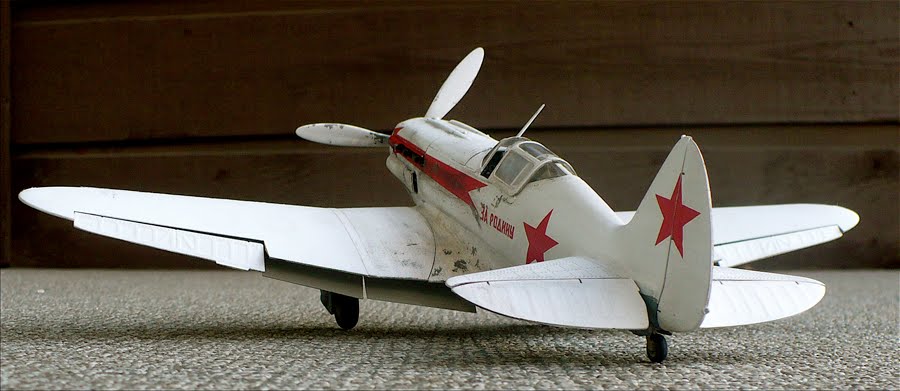
Mikoyan Gurevich MiG 3

Here are some more images of Trumpeter models 1/32  scale Mikoyan Gurevich MiG 3.
This aircraft flew with the 12 guards IAP  Air Defense of Moscow.

From Wikipedia"
The MiG-3's top speed of 640 km/h (398 mph) at 7,200 metres (23,622 ft) was faster than the 615 km/h (382 mph) of the German Messerschmitt Bf 109F-2 in service at the beginning of 1941 and the British Supermarine Spitfire V's 603 km/h (375 mph). At lower altitudes the MiG's speed advantage disappeared as its maximum speed at sea level was only 505 km/h (314 mph) while the Bf 109F-2 could do 515 km/h (320 mph). Unfortunately for the MiG-3 and its pilots, aerial combat over the Eastern Front generally took place at low and medium altitudes where it had no speed advantage.
The MiG's loaded weight of 3,350 kg (7,385 lb) was greater than the Bf 109F-2's 2,728 kg (6,014 lb) and it was less maneuverable in the horizontal plane than the Bf 109 due to its higher wing loading. This lack of maneuverability was exacerbated by the MiG-3's poor climb performance, its instability at high speeds (which can contribute to shell trajectory inaccuracy during a pursuit) and its weak armament.
The MiG-3's standard armament was one 12.7 mm (0.50 in) UBS machine gun and two 7.62 mm (0.30 in) ShKAS machine guns. This was a rather light armament by international standards, for example most versions of the German Messerschmitt Bf 109 that it encountered were equipped with one 20 mm (0.79 in) autocannon and two 7.92 mm (0.31 in) machine guns. To remedy this problem, 821 aircraft were built with one 12.7 mm UBK machine gun in a pod under each wing in mid-1941. This lowered its speed by about 20 km/h (12 mph) at all altitudes, which was unpopular with the pilots, some of whom removed the pods. One hundred aircraft were equipped with a pair of UBS machine guns in lieu of the ShKAS weapons. Another 215 aircraft also had just the UBS machine guns but were fitted to carry six RS-82 rockets. A total of 72 aircraft mounted a pair of 20 mm ShVAK cannon. A wide variety of armaments were experimented with by various units at the requests of their pilots or to make up shortages.

Thursday, June 2, 2011

Mig 3 Composite


Here is my composite image of Trumpeter's 1/32 scale Mikoyan Gurevich Mig 3 against a winter grey sky.

Images of the model can be seen here.

Sunday, October 31, 2010

Mig 3


Here are some images of Trumpeter's 1/32 scale Mikoyan Gurevich Mig 3. This aircraft served with the 12 Gaurds IAP Air Defense of Moscow 1942. From Wikipedia "

The Mikoyan-Gurevich MiG-3 (Russian: Микоян и Гуревич МиГ-3) was a Soviet fighter aircraft used during World War II. It was a development of the MiG-1 by the OKO (opytno-konstrooktorskiy otdel — Experimental Design Department) of Zavod (Factory) No. 1 to remedy problems that had been found during the MiG-1's development and operations. It replaced the MiG-1 on the production line at Factory No. 1 on 20 December 1940 and was built in large numbers during 1941 before Factory No. 1 was converted to build the Ilyushin Il-2.

On 22 June 1941 at the beginning of Operation Barbarossa, some 981 were in service with the VVS, the PVO and Naval Aviation. The MiG-3 was difficult to fly in peacetime and much more so in combat. It had been designed for high-altitude combat but combat over the Eastern Front was generally at lower altitudes where it was inferior to the German Messerschmitt Bf 109 as well as most modern Soviet fighters. It was also pressed into service as a fighter-bomber during the autumn of 1941 but it was equally unsuited for this. Over time the survivors were concentrated in the PVO, where its disadvantages mattered less, the last being withdrawn from service before the end of the war.

The MiG-3's top speed of 640 km/h (398 mph) at 7,200 metres (23,622 ft) was faster than the 615 km/h (382 mph) of the German Messerschmitt Bf 109F-2 in service at the beginning of 1941 and the British Supermarine Spitfire V's 603 km/h (375 mph). At lower altitudes the MiG's speed advantage disappeared as its maximum speed at sea level was only 505 km/h (314 mph) while the Bf 109F-2 could do 515 km/h (320 mph). Unfortunately for the MiG-3 and its pilots, aerial combat over the Eastern Front generally took place at low and medium altitudes where it had no speed advantage.

The MiG's loaded weight of 3,350 kg (7,385 lb) was greater than the Bf 109F-2's 2,979 kg (6,568 lb) and it was less maneuverable in the horizontal plane than the Bf 109 due to its higher wing loading. This lack of maneuverability was exacerbated by the MiG-3's poor climb performance, its instability at high speeds and its weak armament.

The MiG-3's standard armament was one 12.7 mm (0.50 in) UBS machine gun and two 7.62 mm (0.300 in) ShKAS machine guns. This was a rather light armament by international standards, for example most versions of the German Messerschmitt Bf 109 that it encountered were equipped with one 20 mm (0.79 in) autocannon and two 7.92 mm (0.312 in) machine guns. To remedy this problem 821 aircraft were built with one 12.7 mm UBK machine gun in a pod under each wing in mid-1941. This lowered its speed by about 20 km/h (12 mph) at all altitudes, which was unpopular with the pilots, some of whom removed the pods. One hundred aircraft were equipped with a pair of UBS machine guns in lieu of the ShKAS weapons. Another 215 aircraft also had just the UBS machine guns but were fitted to carry six RS-82 rockets. A total of 72 aircraft mounted a pair of 20 mm ShVAK cannon. A wide variety of armaments were experimented with by various units at the requests of their pilots or to make up shortages.

Friday, September 24, 2010

Yak-3


Here are some images of Eduard's 1/48 scale Yakovlev Yak-3. From Wikipedia "The Yakovlev Yak-3 (Russian language: Як-3) was a World War II Soviet fighter aircraft. Robust and easy to maintain, was much liked by pilots and ground crew alike. It was one of the smallest and lightest major combat fighters fielded by any combatant during the war, and its high power-to-weight ratio gave it excellent performance. It proved a formidable dogfighter. Marcel Albert, the official top-scoring World War II French ace that flew the Yak in USSR with the Normandie-Niémen Group, regarded it a superior aircraft to the P-51D Mustang and to the Supermarine Spitfire. After the war ended, it flew with the Czech and Polish Air Forces.

Lighter and smaller than Yak-9 but powered by the same engine, the Yak-3 was a forgiving, easy-to-handle aircraft loved by both rookie and veteran pilots and ground crew as well. It was a robust, easy to maintain and a highly successful dogfighter. It was used mostly as a tactical fighter, flying low over battlefields and engaging in dogfights below 13,000 ft.

On 17 July 1944, eight Yaks attacked a formation of 60 German aircraft, including escorting fighters. In the ensuing dogfight, the Luftwaffe lost three Junkers Ju 87s and four Bf 109Gs, for no losses to the Yaks. Consequently, the Luftwaffe issued an order to "avoid combat with Yak fighters without an oil cooler under the nose and with an inclined aerial mast below 5000 m". In fact, most of the Yak-3s had no mast, the aerial wire running from canopy to fin.

But unresolved wartime problems included plywood surfaces coming unstuck when the aircraft was pulled out of a high-speed dive.

Other drawbacks of the aircraft were short range, and poor engine reliability. The pneumatic system for actuating landing gear, flaps and brakes, typical for all Yakovlev fighters of the time, was problematic. Though less reliable than hydraulic or electrical alternatives, the pneumatic system was preferred due to significant weight savings.

In 1944, the Normandie-Niemen Group re-equipped with the Yak-3, scoring with it the last 99 of their 273 air victories against the Luftwaffe.

Friday, July 2, 2010

Bark


Here are some images of Italeri's 1/48 scale Ilyushin IL-2 Shturmovik. From Wikipedia "
The Ilyushin Il-2 was a ground attack aircraft (Shturmovik) in the Second World War, produced by the Soviet Union in very large numbers. In combination with its successor, the Ilyushin Il-10, a total of 42,330 were built, making it the single most produced military aircraft design in all of aviation history, as well as one of the most produced piloted aircraft in history along with the Cessna 172 and the Polikarpov Po-2. It is regarded as the best ground attack aircraft of World War 2. It was a prominent aircraft for tank killing with its accuracy in dive bombing and its 37mm guns penetrating their thin back armor.

To Il-2 pilots, the aircraft was simply the diminutive "Ilyusha". To the soldiers on the ground, it was the "Hunchback," the "Flying Tank" or the "Flying Infantryman". Its postwar NATO reporting name was "Bark". The Il-2 aircraft played a crucial role on the Eastern Front, and in Soviet opinion it was the most decisive aircraft in the history of modern land warfare. Joseph Stalin paid the Il-2 a great tribute in his own inimitable manner: when a particular production factory fell behind on its deliveries, Stalin sent a cable to the factory manager, stating "They are as essential to the Red Army as air and bread.".