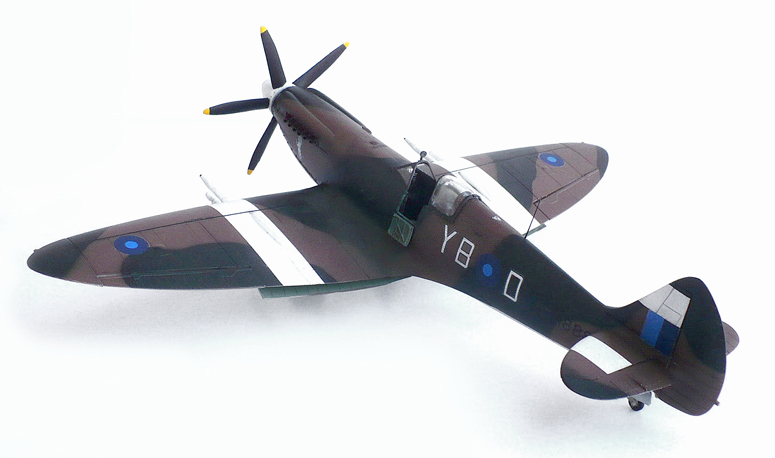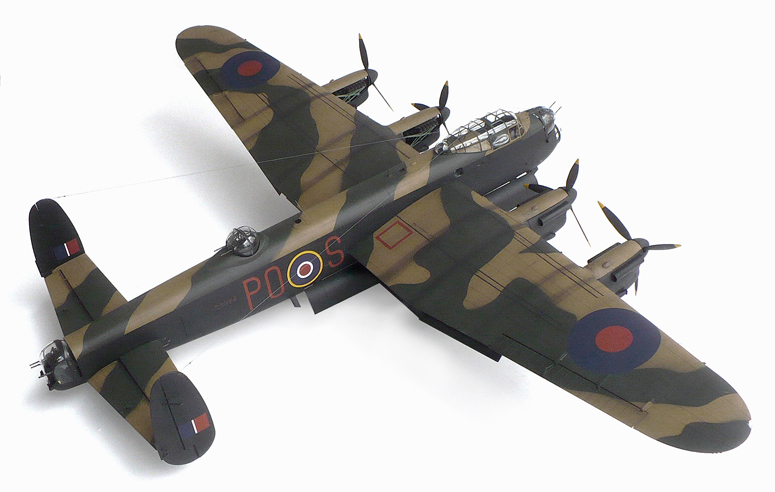
Here are some images of HK Models 1/32 scale Avro Lancaster BI.
Over all this is a pretty good kit although it had a Tamiya feel to it. The only real complaints I have is that the main instrument panel needed a bit to be desired so that had to be spruced up a bit. Plus when installing the inner nacelles it was a bit of a choir to get it seated properly so consider yourself warned. But overall it's one impressive beast when finished. One thing I love about this kit is the way the main wings slide and snap onto the fuselage. No glue required. This means that if you have to transport it you can remove the main wings before transport. This is a BI version of the famed "Sugar". It must have been converted to a BIII later on in it's career.
From Wikipedia"
The Avro Lancaster is a British four-engined Second World War heavy bomber. It was designed and manufactured by Avro as a contemporary of the Handley Page Halifax, both bombers having been developed to the same specification, as well as the Short Stirling, all three aircraft being four-engined heavy bombers adopted by the Royal Air Force (RAF) during the same wartime era.
The Lancaster has its origins in the twin-engine Avro Manchester which had been developed during the late 1930s in response to the Air Ministry Specification P.13/36 for a capable medium bomber
for "world-wide use". Originally developed as an evolution of the
Manchester (which had proved troublesome in service and was retired in
1942), the Lancaster was designed by Roy Chadwick and powered by four Rolls-Royce Merlins and in one version, Bristol Hercules engines. It first saw service with RAF Bomber Command in 1942 and as the strategic bombing offensive
over Europe gathered momentum, it was the main aircraft for the
night-time bombing campaigns that followed. As increasing numbers of the
type were produced, it became the principal heavy bomber used by the RAF, the RCAF and squadrons from other Commonwealth and European countries serving within the RAF, overshadowing contemporaries such as the Halifax and Stirling.
A long, unobstructed bomb bay meant that the Lancaster could take
the largest bombs used by the RAF, including the 4,000 lb (1,800 kg),
8,000 lb (3,600 kg) and 12,000 lb (5,400 kg) blockbusters, loads often supplemented with smaller bombs or incendiaries. The "Lanc", as it was known colloquially, became one of the most heavily used of the Second World War night bombers, "delivering 608,612 long tons of bombs in 156,000 sorties". The versatility of the Lancaster was such that it was chosen to equip 617 Squadron and was modified to carry the Upkeep "Bouncing bomb" designed by Barnes Wallis for Operation Chastise, the attack on German Ruhr valley
dams. Although the Lancaster was primarily a night bomber, it excelled
in many other roles, including daylight precision bombing, for which
some Lancasters were adapted to carry the 12,000 lb (5,400 kg) Tallboy and then the 22,000 lb (10,000 kg) Grand Slam earthquake bombs (also designed by Wallis). This was the largest payload of any bomber in the war.
In 1943, a Lancaster was converted to become an engine test bed for the Metropolitan-Vickers F.2 turbojet. Lancasters were later used to test other engines, including the Armstrong Siddeley Mamba and Rolls-Royce Dart turboprops and the Avro Canada Orenda and STAL Dovern turbojets. Postwar, the Lancaster was supplanted as the main strategic bomber of the RAF by the Avro Lincoln, a larger version of the Lancaster. The Lancaster took on the role of long range anti-submarine patrol aircraft (later supplanted by the Avro Shackleton) and air-sea rescue. It was also used for photo-reconnaissance and aerial mapping, as a flying tanker for aerial refuelling and as the Avro Lancastrian, a long-range, high-speed, transatlantic passenger and postal delivery airliner. In March 1946, a Lancastrian of BSAA flew the first scheduled flight from the new London Heathrow Airport.
The original Lancasters were produced with Rolls-Royce Merlin XX engines and SU carburettors. Minor details were changed throughout the production series – for example the pitot
head design was changed from being on a long mast at the front of the
nose to a short fairing mounted on the side of the fuselage under the
cockpit. Later production Lancasters had Merlin 22 and 24 engines. No
designation change was made to denote these alterations.
Translate
Showing posts with label WWII British. Show all posts
Tuesday, May 14, 2019
Wednesday, June 13, 2018
Supermarine Spitfire Mk VI
Here are some images of Trumpeter Models 1/24 scale Supermarine Spitfire Mk VI.
From Wikipedia"
At the time that the Mk V was placed in production there were growing fears that the Luftwaffe were about to start mass-producing very high flying bombers such as the Junkers Ju 86, which could fly above the reach of most fighters of the time. It was decided that a new Spitfire variant would be required with improved high altitude performance. During a meeting held at the RAE at Farnborough on 17 February 1941 the Air Ministry asked "that a Spitfire should be provided with a pressure cabin capable of maintaining a pressure differential of 1 lb per square inch at 40,000 feet." A Marshall-manufactured compressor was to be used, and it was agreed that the sliding canopy could be replaced by one which could not be slid open, as long as it could be jettisoned by the pilot.
The pressurised cabin was used to counter the physiological problems encountered by pilots at high altitudes. The cabin was not like the fully pressurised cabin of a modern airliner; the pressure differential provided by the modified cockpit of the VI was only two pounds per square inch (which was double the Air Ministry requirement). To achieve this, the forward and rear cockpit bulkheads were completely enclosed, with all control and electrical cables exiting though special rubber sealing grommets. In addition, the side cockpit door was replaced with alloy skin and the canopy was no longer a sliding unit: externally there were no slide rails. Once the pilot was in, the canopy was locked in place with four toggles and sealed with an inflatable rubber tube. It could be jettisoned by the pilot in an emergency. The windscreen of production Mk VIs was the same as the type fitted to the Mark III and some Mk Vs although it was fitted with an inward opening clear-view panel on the port quarter pane. The effect was to make 37,000 ft (11,000 m) seem like 28,000 ft (8,500 m) to the pilot, who would still have to wear an oxygen mask. Pressurisation was achieved by a Marshall-manufactured compressor located on the starboard side of the engine, fed by a long intake below the starboard exhaust stubs. Mk VIs were built with the Coffman cartridge starter, with a small teardrop fairing just ahead of the compressor intake.
The engine was a Rolls-Royce Merlin 47 driving a four-bladed Rotol propeller of 10 ft 9 in (3.27 m) diameter; the new propeller provided increased power at high altitudes, where the atmosphere is much thinner. To help smooth out airflow around the wingtips the standard rounded types were replaced by extended, pointed versions extending the wingspan to 40 ft 2 in (12.2 m). Otherwise the wings were Type B.
The maximum speed of the Mk VI was 356 mph (573 km/h) at 21,800 ft (6,600 m). However, because of the limitations of the single stage supercharger, at 38,000 ft (12,000 m) the maximum speed had fallen away to 264 mph (425 km/h). The service ceiling was 39,200 ft (11,900 m).
The threat of a sustained high altitude campaign by the Luftwaffe did not materialise and only 100 of the Mk VIs were built by Supermarine. Only two units, 124 Squadron and 616 Squadron, were fully equipped with this version, although several other units used them in small numbers as a stop-gap. More often than not, the Spitfire VIs were used at lower altitudes where it was outperformed by conventional Spitfires. At high altitudes it was discovered that modified Spitfire Vs could perform almost as well as the Mk VI. At low levels, especially, pilots were often forced to fly with the canopy removed because the cockpit would get uncomfortably hot and they were not confident it would be possible to jettison the canopy in case of an emergency.
In 1943 five Spitfire VIs (BS106, BS124, BS133, BS134 and BS149) were converted to improvised PR Mk VIs by 680 Squadron in Egypt. These aircraft had been "tropicalised" using the same bulky Vokes filter and other equipment used by Spitfire VB Trops, as well as being painted in a "desert" camouflage scheme.
By the time these aircraft arrived they were no longer required to intercept high-flying Junkers Ju 86P reconnaissance aircraft although there was a need for a pressurised RAF photo reconnaissance aircraft to carry out missions over Crete and the rest of Greece. 103 MU at Aboukir carried out the modifications by removing the armament and installing vertical F8 cameras in the rear fuselage. These Spitfires were used a few times in April and May 1943 but were withdrawn from service by August. They were the first pressurised PR Spitfires.
From Wikipedia"
At the time that the Mk V was placed in production there were growing fears that the Luftwaffe were about to start mass-producing very high flying bombers such as the Junkers Ju 86, which could fly above the reach of most fighters of the time. It was decided that a new Spitfire variant would be required with improved high altitude performance. During a meeting held at the RAE at Farnborough on 17 February 1941 the Air Ministry asked "that a Spitfire should be provided with a pressure cabin capable of maintaining a pressure differential of 1 lb per square inch at 40,000 feet." A Marshall-manufactured compressor was to be used, and it was agreed that the sliding canopy could be replaced by one which could not be slid open, as long as it could be jettisoned by the pilot.
The pressurised cabin was used to counter the physiological problems encountered by pilots at high altitudes. The cabin was not like the fully pressurised cabin of a modern airliner; the pressure differential provided by the modified cockpit of the VI was only two pounds per square inch (which was double the Air Ministry requirement). To achieve this, the forward and rear cockpit bulkheads were completely enclosed, with all control and electrical cables exiting though special rubber sealing grommets. In addition, the side cockpit door was replaced with alloy skin and the canopy was no longer a sliding unit: externally there were no slide rails. Once the pilot was in, the canopy was locked in place with four toggles and sealed with an inflatable rubber tube. It could be jettisoned by the pilot in an emergency. The windscreen of production Mk VIs was the same as the type fitted to the Mark III and some Mk Vs although it was fitted with an inward opening clear-view panel on the port quarter pane. The effect was to make 37,000 ft (11,000 m) seem like 28,000 ft (8,500 m) to the pilot, who would still have to wear an oxygen mask. Pressurisation was achieved by a Marshall-manufactured compressor located on the starboard side of the engine, fed by a long intake below the starboard exhaust stubs. Mk VIs were built with the Coffman cartridge starter, with a small teardrop fairing just ahead of the compressor intake.
The engine was a Rolls-Royce Merlin 47 driving a four-bladed Rotol propeller of 10 ft 9 in (3.27 m) diameter; the new propeller provided increased power at high altitudes, where the atmosphere is much thinner. To help smooth out airflow around the wingtips the standard rounded types were replaced by extended, pointed versions extending the wingspan to 40 ft 2 in (12.2 m). Otherwise the wings were Type B.
The maximum speed of the Mk VI was 356 mph (573 km/h) at 21,800 ft (6,600 m). However, because of the limitations of the single stage supercharger, at 38,000 ft (12,000 m) the maximum speed had fallen away to 264 mph (425 km/h). The service ceiling was 39,200 ft (11,900 m).
The threat of a sustained high altitude campaign by the Luftwaffe did not materialise and only 100 of the Mk VIs were built by Supermarine. Only two units, 124 Squadron and 616 Squadron, were fully equipped with this version, although several other units used them in small numbers as a stop-gap. More often than not, the Spitfire VIs were used at lower altitudes where it was outperformed by conventional Spitfires. At high altitudes it was discovered that modified Spitfire Vs could perform almost as well as the Mk VI. At low levels, especially, pilots were often forced to fly with the canopy removed because the cockpit would get uncomfortably hot and they were not confident it would be possible to jettison the canopy in case of an emergency.
In 1943 five Spitfire VIs (BS106, BS124, BS133, BS134 and BS149) were converted to improvised PR Mk VIs by 680 Squadron in Egypt. These aircraft had been "tropicalised" using the same bulky Vokes filter and other equipment used by Spitfire VB Trops, as well as being painted in a "desert" camouflage scheme.
By the time these aircraft arrived they were no longer required to intercept high-flying Junkers Ju 86P reconnaissance aircraft although there was a need for a pressurised RAF photo reconnaissance aircraft to carry out missions over Crete and the rest of Greece. 103 MU at Aboukir carried out the modifications by removing the armament and installing vertical F8 cameras in the rear fuselage. These Spitfires were used a few times in April and May 1943 but were withdrawn from service by August. They were the first pressurised PR Spitfires.
Wednesday, January 3, 2018
Supermarine Spitfire Mk XIV C
Here are some images of Revell/AA Productions 1/32 scale Supermarine Spitfire Mk XIV C in India markings.
From Wikipedia"
The first Griffon-powered Spitfires suffered from poor high altitude performance due to having only a single stage supercharged engine. By 1943, Rolls-Royce engineers had developed a new Griffon engine, the 61 series, with a two-stage supercharger. In the end it was a slightly modified engine, the 65 series, which was used in the Mk XIV. The resulting aircraft provided a substantial performance increase over the Mk IX. Although initially based on the Mk VIII airframe, common improvements made in aircraft produced later included the cut-back fuselage and tear-drop canopies, and the E-Type wing with improved armament.
The Mk XIV differed from the Mk XII in that the longer, two-stage supercharged Griffon 65, producing 2,050 hp (1,528 kW), was mounted 10 inches (25.4 cm) further forward. The top section of the engine bulkhead was angled forward, creating a distinctive change of angle to the upper cowling's rear edge. A new five bladed Rotol propeller of 10 ft 5 in (3.18 m) in diameter was used, although one prototype JF321 was fitted with a six bladed contra rotating unit. The "fishtail" design of ejector exhaust stub gave way to ones of circular section. The increased cooling requirements of the Griffon engine meant that all radiators were much bigger and the underwing housings were deeper than previous versions.
The cowling fasteners were new, flush fitting "Amal" type and there were more of them. The oil tank (which had been moved from the lower cowling location of the Merlin engine variants to forward of the fuselage fuel tanks) was increased in capacity from 6 to 10 gal.
To help balance the new engine, the radio equipment was moved further back in the rear fuselage and the access hatch was moved from the left fuselage side to the right. Better VHF radio equipment allowed for the aerial mast to be removed and replaced by a "whip" aerial further aft on the fuselage spine. Because the longer nose and the increased slipstream of the big five-bladed propeller a new tail unit with a taller, broader fin and a rudder of increased area was adopted.
The first batch of aircraft to fly with the Griffon 60 series engines were six converted Mk VIIIs JF316 to JF321 which were called Mk VIIIG. The first one of these was flown by Jeffrey Quill on 20 January 1943,
When the new fighter entered service with 610 Squadron in December 1943 it was a leap forward in the evolution of the Spitfire. Jeffrey Quill flew the first production aircraft, RB140 in October 1943:
In operational service many pilots initially found that the new
fighter could be difficult to handle, particularly if they were used to
earlier Spitfire marks. Don Healy of 17 Squadron, based at Madura recalled that the Mk XIV was;
The first test of the aircraft was in intercepting V1 flying bombs and the Mk XIV was the most successful of all Spitfire marks in this role. When 150 octane fuel was introduced in mid-1944 the "boost" of the Griffon engine was able to be increased to +25 lbs (80.7"), allowing the top speed to be increased by about 30 mph (26 kn; 48 km/h) to 400 mph (350 kn; 640 km/h) at 2,000 ft (610 m).
The Mk XIV was used by the 2nd Tactical Air Force as their main high-altitude air superiority fighter in northern Europe with six squadrons operational by December 1944.
One problem which did arise in service was localised skin wrinkling on the wings and fuselage at load attachment points; although Supermarine advised that the Mk XIVs had not been seriously weakened, nor were they on the point of failure, the RAF issued instructions in early 1945 that all F and FR Mk XIVs were to be refitted with clipped wings.
Spitfire XIVs began to arrive in the South-East Asian Theatre in June 1945, too late to operate against the Japanese. It was this type which was rumoured to have been buried at an airfield in Burma after the war.
From Wikipedia"
The first Griffon-powered Spitfires suffered from poor high altitude performance due to having only a single stage supercharged engine. By 1943, Rolls-Royce engineers had developed a new Griffon engine, the 61 series, with a two-stage supercharger. In the end it was a slightly modified engine, the 65 series, which was used in the Mk XIV. The resulting aircraft provided a substantial performance increase over the Mk IX. Although initially based on the Mk VIII airframe, common improvements made in aircraft produced later included the cut-back fuselage and tear-drop canopies, and the E-Type wing with improved armament.
The Mk XIV differed from the Mk XII in that the longer, two-stage supercharged Griffon 65, producing 2,050 hp (1,528 kW), was mounted 10 inches (25.4 cm) further forward. The top section of the engine bulkhead was angled forward, creating a distinctive change of angle to the upper cowling's rear edge. A new five bladed Rotol propeller of 10 ft 5 in (3.18 m) in diameter was used, although one prototype JF321 was fitted with a six bladed contra rotating unit. The "fishtail" design of ejector exhaust stub gave way to ones of circular section. The increased cooling requirements of the Griffon engine meant that all radiators were much bigger and the underwing housings were deeper than previous versions.
The cowling fasteners were new, flush fitting "Amal" type and there were more of them. The oil tank (which had been moved from the lower cowling location of the Merlin engine variants to forward of the fuselage fuel tanks) was increased in capacity from 6 to 10 gal.
To help balance the new engine, the radio equipment was moved further back in the rear fuselage and the access hatch was moved from the left fuselage side to the right. Better VHF radio equipment allowed for the aerial mast to be removed and replaced by a "whip" aerial further aft on the fuselage spine. Because the longer nose and the increased slipstream of the big five-bladed propeller a new tail unit with a taller, broader fin and a rudder of increased area was adopted.
The first batch of aircraft to fly with the Griffon 60 series engines were six converted Mk VIIIs JF316 to JF321 which were called Mk VIIIG. The first one of these was flown by Jeffrey Quill on 20 January 1943,
Changes to the aircraft were restricted to those essential to enable it to accept the new engine ... I found that it had a spectacular performance doing 445 mph at 25,000 ft, with a sea-level rate of climb of over 5,000 ft per minute. I remember being greatly delighted with it; it seemed to me that from this relatively simple conversion, carried out with a minimum of fuss and bother, had come up with something quite outstanding ... The MK VIIIG, with virtually the same tail surfaces both vertical and horizontal as the Merlin MK VIII, was very much over-powered and the handling in the air was unacceptable for an operational type ... I soon realised that a new throttle box would be needed giving a much greater angular travel for the hand lever ... The next essential ... was an improvement in the directional stability and control and a new fin was drawn out with a substantial increase in area (7.42 sq. ft) and a much larger rudder and fitted to the second aircraft JF317. This, though not ideal, produced a very marked improvement in directional characteristics and we were able to introduce minor changes thereafter and by various degrees of trimmer tab and balance tab to reach an acceptable degree of directional stability and control. The enlarged fin of JF317 had a straight leading edge but for production a more elegant curved line was introduced.One prototype, JF321, was fitted and tested with a Rotol six-bladed contra-rotating propeller unit; although this promised to eliminate the characteristic swing on take-off (caused by the propeller slipstream) the propeller unit was prone to failure. The pitch control mechanism controlled the pitch on the front propeller,
— Quill
... and this was transmitted to the rear propeller (which was rotating in the opposite direction) through the transitional bearing mechanism. If this failed the pitch of the rear propeller was no longer under control and might do anything which was potentially dangerous.A similar contra-rotating propeller unit was later used on production Seafire 46 and 47s.
— Quill
When the new fighter entered service with 610 Squadron in December 1943 it was a leap forward in the evolution of the Spitfire. Jeffrey Quill flew the first production aircraft, RB140 in October 1943:
So the Mk XIV was in business, and a very fine fighter it was. It fully justified the faith of those who, from the early days in 1939, had been convinced that the Griffon engine would eventually see the Spitfire into a new lease of life ... It was a splendid aeroplane in every respect. We still had some work to do to improve its longitudinal and directional characteristics, but it was powerful and performed magnificently. The only respect in which the XIV fell short was in its range.The Mk XIV could climb to 20,000 ft (6,100 m) in just over five minutes and its top speed, which was achieved at 25,400 ft (7,700 m), was 446 mph (718 km/h).
— Quill
...a hairy beast to fly and took some getting used to. I personally preferred the old Mk Vs from a flying standpoint ... Even with full aileron, elevator and rudder, this brute of a fighter took off slightly sideways.In spite of the difficulties pilots appreciated the performance increases. Wing Commander Peter Brothers, O/C Culmhead Wing in 1944–1945 and a Battle of Britain veteran;
It was truly an impressive machine, being able to climb almost vertically – it gave many Luftwaffe pilots the shock of their lives when, having thought they had bounced you from a superior height, they were astonished to find the Mk XIV climbing up to tackle them head-on, throttle wide open!F Mk XIVs had a total of 109.5 gal of fuel consisting of 84 gal in two main tanks and a 12.5 imp gal fuel tank in each leading edge wing tank; other 30, 45, 50 or 90 gal drop tanks could be carried. The fighter's maximum range was just a little over 460 miles (740 km) on internal fuel, since the new Griffon engine consumed much more fuel per hour than the original Merlin engine of earlier variants. By late 1944, Spitfire XIVs were fitted with an extra 33 gal in a rear fuselage fuel tank, extending the fighter's range to about 850 miles (1,370 km) on internal fuel and a 90 gal drop tank. Mk XIVs with "tear-drop" canopies had 64 gal. As a result, F and FR Mk XIVEs had a range that was increased to over 610 miles (980 km), or 960 miles (1,540 km) with a 90 gal drop tank.
The first test of the aircraft was in intercepting V1 flying bombs and the Mk XIV was the most successful of all Spitfire marks in this role. When 150 octane fuel was introduced in mid-1944 the "boost" of the Griffon engine was able to be increased to +25 lbs (80.7"), allowing the top speed to be increased by about 30 mph (26 kn; 48 km/h) to 400 mph (350 kn; 640 km/h) at 2,000 ft (610 m).
The Mk XIV was used by the 2nd Tactical Air Force as their main high-altitude air superiority fighter in northern Europe with six squadrons operational by December 1944.
One problem which did arise in service was localised skin wrinkling on the wings and fuselage at load attachment points; although Supermarine advised that the Mk XIVs had not been seriously weakened, nor were they on the point of failure, the RAF issued instructions in early 1945 that all F and FR Mk XIVs were to be refitted with clipped wings.
Spitfire XIVs began to arrive in the South-East Asian Theatre in June 1945, too late to operate against the Japanese. It was this type which was rumoured to have been buried at an airfield in Burma after the war.
Wednesday, March 1, 2017
Hawker Typhoon Mk. 1B "Car Door"
Here are some images of Airfix's 1/24 scale Hawker Typhoon Mk.1B "Car Door'. With many of its panels removed.
From Wikipedia"
The Hawker Typhoon (Tiffy in RAF slang), was a British single-seat fighter-bomber, produced by Hawker Aircraft. It was intended to be a medium–high altitude interceptor, as a replacement for the Hawker Hurricane but several design problems were encountered and it never completely satisfied this requirement.
The Typhoon was originally designed to mount twelve .303 inch (7.7 mm) Browning machine guns and be powered by the latest 2000 hp engines. Its service introduction in mid-1941 was plagued with problems and for several months the aircraft faced a doubtful future. When the Luftwaffe brought the formidable Focke-Wulf Fw 190 into service in 1941, the Typhoon was the only RAF fighter capable of catching it at low altitudes; as a result it secured a new role as a low-altitude interceptor.
Through the support of pilots such as Roland Beamont it became established in roles such as night-time intruder and long-range fighter. From late 1942 the Typhoon was equipped with bombs and from late 1943 RP-3 ground attack rockets were added to its armoury. With those weapons and its four 20mm Hispano cannon, the Typhoon became one of the Second World War's most successful ground-attack aircraft.
The Typhoon was first produced with forward-opening "car door" style cockpit doors (complete with wind-down windows), with a transparent "roof" hinged to open to the left. The first 162 Typhoons featured a built-up metal-skinned dorsal fairing behind the pilot's armoured headrest; the mast for the radio aerial protruded through the fairing. From mid- to late 1941 the solid metal aft dorsal fairing was replaced with a transparent structure (later nicknamed "The Coffin Hood"), the pilot's head armour plate was modified to a triangular shape and the side cut-outs were fitted with armoured glass; the first production Typhoon to be fitted with this new structure was R7803. All earlier aircraft were quickly withdrawn and modified. From early 1942 a rear-view mirror was mounted in a perspex blister moulded into the later "car-door" canopy roofs. This modification was not very successful, because the mirror was subject to vibration. Despite the new canopy structure, the pilot's visibility was still restricted by the heavy frames and the clutter of equipment under the rear canopy; from August 1943, as an interim measure, pending the introduction of the new "bubble" canopy and cut-down dorsal fairing, the aerial mast and its associated bracing was removed and replaced with a whip aerial further back on the rear fuselage.
Starting in January 1943, R8809 was used to test a new, clear, one piece sliding "bubble" canopy and its associated new windscreen structure which had slimmer frames which, together with the "cut-down" rear dorsal fairing, provided a far superior all-around field of view to the car-door type. From November 1943 all production aircraft, starting with JR333, were to be so fitted. However, the complex modifications required to the fuselage and a long lead time for new components to reach the production line meant that it took some time before the new canopy became standard. In order to have as many Typhoons of 2nd TAF fitted before "Operation Overlord" conversion kits were produced and Gloster, Hawker and Cunliffe-Owen modified older Typhoons still fitted with the car-door canopy.
From Wikipedia"
The Hawker Typhoon (Tiffy in RAF slang), was a British single-seat fighter-bomber, produced by Hawker Aircraft. It was intended to be a medium–high altitude interceptor, as a replacement for the Hawker Hurricane but several design problems were encountered and it never completely satisfied this requirement.
The Typhoon was originally designed to mount twelve .303 inch (7.7 mm) Browning machine guns and be powered by the latest 2000 hp engines. Its service introduction in mid-1941 was plagued with problems and for several months the aircraft faced a doubtful future. When the Luftwaffe brought the formidable Focke-Wulf Fw 190 into service in 1941, the Typhoon was the only RAF fighter capable of catching it at low altitudes; as a result it secured a new role as a low-altitude interceptor.
Through the support of pilots such as Roland Beamont it became established in roles such as night-time intruder and long-range fighter. From late 1942 the Typhoon was equipped with bombs and from late 1943 RP-3 ground attack rockets were added to its armoury. With those weapons and its four 20mm Hispano cannon, the Typhoon became one of the Second World War's most successful ground-attack aircraft.
The Typhoon was first produced with forward-opening "car door" style cockpit doors (complete with wind-down windows), with a transparent "roof" hinged to open to the left. The first 162 Typhoons featured a built-up metal-skinned dorsal fairing behind the pilot's armoured headrest; the mast for the radio aerial protruded through the fairing. From mid- to late 1941 the solid metal aft dorsal fairing was replaced with a transparent structure (later nicknamed "The Coffin Hood"), the pilot's head armour plate was modified to a triangular shape and the side cut-outs were fitted with armoured glass; the first production Typhoon to be fitted with this new structure was R7803. All earlier aircraft were quickly withdrawn and modified. From early 1942 a rear-view mirror was mounted in a perspex blister moulded into the later "car-door" canopy roofs. This modification was not very successful, because the mirror was subject to vibration. Despite the new canopy structure, the pilot's visibility was still restricted by the heavy frames and the clutter of equipment under the rear canopy; from August 1943, as an interim measure, pending the introduction of the new "bubble" canopy and cut-down dorsal fairing, the aerial mast and its associated bracing was removed and replaced with a whip aerial further back on the rear fuselage.
Starting in January 1943, R8809 was used to test a new, clear, one piece sliding "bubble" canopy and its associated new windscreen structure which had slimmer frames which, together with the "cut-down" rear dorsal fairing, provided a far superior all-around field of view to the car-door type. From November 1943 all production aircraft, starting with JR333, were to be so fitted. However, the complex modifications required to the fuselage and a long lead time for new components to reach the production line meant that it took some time before the new canopy became standard. In order to have as many Typhoons of 2nd TAF fitted before "Operation Overlord" conversion kits were produced and Gloster, Hawker and Cunliffe-Owen modified older Typhoons still fitted with the car-door canopy.
Saturday, June 4, 2016
Supermarine Spitfire Mk. Vb/Trop
From Wikipedia"
The VB became the main production version of the Mark Vs. Along with the new Merlin 45 series the B wing was fitted as standard. As production progressed changes were incorporated, some of which became standard on all later Spitfires. Production started with several Mk IBs which were converted to Mk VBs by Supermarine. Starting in early 1941 the round section exhaust stacks were changed to a "fishtail" type, marginally increasing exhaust thrust. Some late production VBs and VCs were fitted with six shorter exhaust stacks per side, similar to those of Spitfire IXs and Seafire IIIs; this was originally stipulated as applying specifically to VB(trop)s. After some initial problems with the original Mk I size oil coolers, a bigger oil cooler was fitted under the port wing; this could be recognised by a deeper housing with a circular entry. From mid-1941 alloy covered ailerons became a universal fitting.
Spitfire VC(trop), fitted with Vokes filters and "disc" wheels, of 417 Squadron RCAF in Tunisia in 1943.
Different propeller types were fitted, according to where the Spitfire V was built: Supermarine and Westland manufactured VBs and VCs used 10 ft 9 in (3.28 m) diameter, 3 bladed de Havilland constant speed units, with narrow metal blades, while Castle Bromwich manufactured VBs and VCs were fitted with a wide bladed Rotol constant speed propeller of either 10 ft 9 in (3.28 m) diameter, with metal blades, or (on late production Spitfires) 10 ft 3 in (3.12 m) diameter, with broader, "Jablo" (compressed wood) blades. The Rotol spinners were longer and more pointed than the de Havilland leading to a 3.5 in (8.9 cm) increase in overall length. The Rotol propellers allowed a modest speed increase over 20,000 ft (6,100 m) and an increase in the service ceiling. A large number of Spitfire VBs were fitted with "gun heater intensifier" systems on the exhaust stacks. These piped additional heated air into the gun bays. There was a short tubular intake on the front of the first stack and a narrow pipe led into the engine cowling from the rear exhaust.
The VB series were the first Spitfires able to carry a range of specially designed "slipper" drop tanks which were fitted underneath the wing centre-section. Small hooks were fitted, just forward of the inboard flaps: when the tank was released these hooks caught the trailing edge of the tank, swinging it clear of the fuselage.
With the advent of the superb Focke Wulf Fw 190 in August 1941 the Spitfire was for the first time truly outclassed, hastening the development of the "interim" Mk IX. In an effort to counter this threat, especially at lower altitudes, the VB was the first production version of the Spitfire to use "clipped" wingtips as an option, reducing the wingspan to 32 ft 2 in (9.8 m).The clipped wings increased the roll rate and airspeed at lower altitudes. Several different versions of the Merlin 45/50 family were used, including the Merlin 45M which had a smaller "cropped" supercharger impeller and boost increased to +18 lb. This engine produced 1,585 hp (1,182 kW) at 2,750 ft (838 m), increasing the L.F VB's maximum rate of climb to 4720 ft/min (21.6 m/s) at 2,000 ft (610 m).
VB Trop of 40 Squadron SAAF
fitted with the "streamlined" version of the Aboukir filter, a
broad-bladed, 10 ft 3 in (3.12 m) diameter Rotol propeller, and clipped
wings.
Monday, July 20, 2015
Supermarine Seafire Mk 1B
Here are some images of Revell's 1/32 scale Supermarine Seafire Mk 1B.
This aircraft was flown by Lt. commander Duncan Hamilton Port Reitz
Kenya 1943. This kit is just a re release of the old MK 1 Spitfire kit
with some added accouterments to convert it to a MK 5 or a Seafire IB. I
wonder about those wing blisters.
From Wikipedia"
In late 1941 and early 1942, the Admiralty assessed the Spitfire for possible conversion. In late 1941, a total of 48 Spitfire Mk Vb were converted by Air Training Service Ltd. at Hamble to become "hooked Spitfires". This was the Seafire Mk Ib and would be the first of several Seafire variants to reach the Royal Navy's Fleet Air Arm. This version of the Seafire was mainly used to allow the Royal Navy to gain experience in operating the Spitfire on aircraft carriers. The main structural change was made to the lower rear fuselage which incorporated an A-frame style arrestor hook and strengthened lower longerons. It was soon discovered that the fuselage, especially around hatches, was too weak for carrier operations. In an attempt to alleviate this condition, reinforcing strips were riveted around hatch openings and along the main fuselage longerons. A further 118 Seafire Mk Ib's incorporating the fuselage reinforcements were modified from Spitfire Vbs by Cunliffe-Owen at Eastleigh and Air Training Service. These aircraft were equipped with Naval HF radio equipment and IFF equipment as well as a Type 72 homing beacon. In these and all subsequent Seafires the instruments were re-calibrated to read kn and nmi rather than mph and mi. The fixed armament was the same as that of the Spitfire Vb; two 20 mm (.79 in) Hispano Mk II cannon with 60 rpg fed from a "drum" magazine and four .303 in (7.7 mm) Browning machine guns with 350 rpg. Provision was also made to carry a 30 gal (136 l) "slipper" fuel tank under the fuselage. In June 1942, the first deliveries of the Seafire took place to 807 Squadron. Another front line unit, 801 Squadron operated this version on board HMS Furious from October 1942 through to September 1944.
From Wikipedia"
In late 1941 and early 1942, the Admiralty assessed the Spitfire for possible conversion. In late 1941, a total of 48 Spitfire Mk Vb were converted by Air Training Service Ltd. at Hamble to become "hooked Spitfires". This was the Seafire Mk Ib and would be the first of several Seafire variants to reach the Royal Navy's Fleet Air Arm. This version of the Seafire was mainly used to allow the Royal Navy to gain experience in operating the Spitfire on aircraft carriers. The main structural change was made to the lower rear fuselage which incorporated an A-frame style arrestor hook and strengthened lower longerons. It was soon discovered that the fuselage, especially around hatches, was too weak for carrier operations. In an attempt to alleviate this condition, reinforcing strips were riveted around hatch openings and along the main fuselage longerons. A further 118 Seafire Mk Ib's incorporating the fuselage reinforcements were modified from Spitfire Vbs by Cunliffe-Owen at Eastleigh and Air Training Service. These aircraft were equipped with Naval HF radio equipment and IFF equipment as well as a Type 72 homing beacon. In these and all subsequent Seafires the instruments were re-calibrated to read kn and nmi rather than mph and mi. The fixed armament was the same as that of the Spitfire Vb; two 20 mm (.79 in) Hispano Mk II cannon with 60 rpg fed from a "drum" magazine and four .303 in (7.7 mm) Browning machine guns with 350 rpg. Provision was also made to carry a 30 gal (136 l) "slipper" fuel tank under the fuselage. In June 1942, the first deliveries of the Seafire took place to 807 Squadron. Another front line unit, 801 Squadron operated this version on board HMS Furious from October 1942 through to September 1944.
Subscribe to:
Posts (Atom)