Translate

Showing posts with label Post War Soviet. Show all posts

Tuesday, July 8, 2014

Mig 37-E Ferret

Here are some more images plus a composite of Italeri's 1/48 scale Mikoyan Mig 37-E Ferret. This is a fictional aircraft designed by Italeri/Testor's as a follow up to their F-19 Stealth fighter. The MiG-37 is a stealth fighter designed using advances in technology from the Soviet Union's space and aviation programs as a reaction to the American F-19 stealth project.

Sunday, December 1, 2013

Mikoyan Gurevich MiG 15 Bis


Here are some more images of Trumpeter's 1/32 Mikoyan Gurevich MiG 15 Bis.

From Wikipedia" The Mikoyan-Gurevich MiG-15 (Russian: Микоян и Гуревич МиГ-15) was a jet fighter developed for the USSR by Artem Mikoyan and Mikhail Gurevich. The MiG-15 was one of the first successful swept-wing jet fighters, and it achieved fame in the skies over Korea, where early in the war, it outclassed all straight-winged enemy fighters in daylight. The MiG-15 also served as the starting point for development of the more advanced MiG-17 which was still an effective threat to supersonic American fighters over North Vietnam in the 1960s. The MiG-15 is believed to have been the most widely produced jet aircraft ever made, with over 12,000 built. Licensed foreign production perhaps raised the total to over 18,000. The MiG-15 is often mentioned along with the North American F-86 Sabre in lists of the best fighter aircraft of the Korean War and in comparison with fighters of other eras.

Thursday, October 17, 2013

Mikoyan-Gurevich MiG-23 ML Flogger-G

Here are some images of Trumpeter's 1/32 scale Mikoyan-Gurevich MiG-23 ML Flogger-G.

From Wikipedia"
The Mikoyan-Gurevich MiG-23 (Russian: Микоян и Гуревич МиГ-23; NATO reporting name: Flogger) is a variable-geometry fighter aircraft, designed by the Mikoyan-Gurevich design bureau in the Soviet Union. It is considered to belong to the Soviet third generation jet fighter category, along with similarly aged Soviet fighters such as the MiG-25 "Foxbat". It was the first attempt by the Soviet Union to design look-down/shoot-down radar and one of the first to be armed with beyond visual range missiles, and the first MiG production fighter aircraft to have intakes at the sides of the fuselage. Production started in 1970 and reached large numbers with over 5,000 aircraft built. Today the MiG-23 remains in limited service with various export customers.
The MiG-23's predecessor, the MiG-21 (NATO reporting name "Fishbed"), was fast and agile, but limited in its operational capabilities by its primitive radar, short range, and limited weapons load (restricted in some aircraft to a pair of short-range R-3/K-13 (AA-2 "Atoll") air-to-air missiles). The MiG-23 was to be a heavier, more powerful machine designed to remedy these deficiencies, and match Western aircraft like the F-4 Phantom. The new fighter was to feature a totally new S-23 sensor and weapon system capable of firing beyond-visual-range (BVR) missiles.


A major design consideration was take-off and landing performance. Existing Soviet fast jets required very long runways which, combined with their limited range, restricted their tactical usefulness. The VVS demanded the new aircraft have a much shorter take-off run. Low-level speed and handling was also to be improved over the MiG-21. This led Mikoyan to consider two options: lift jets, to provide an additional lift component, and variable-geometry wings, which had been developed by TsAGI for both "clean-sheet" aircraft designs and adaptations of existing designs.
The first prototype, called "23-01" but also known as the MiG-23PD, was a tailed delta similar to the MiG-21 but with two lift jets in the fuselage. However, it became apparent very early that this configuration was unsatisfactory, as the lift jets became useless dead weight once airborne. The second prototype, known as "23-11", featured variable-geometry wings which could be set to angles of 16, 45 and 72 degrees, and it was clearly more promising. The maiden flight of 23–11 took place on 10 June 1967, and three more prototypes were prepared for further flight and system testing. All featured the Tumansky R-27-300 turbojet engine with a thrust of 7850 kp. The order to start series production of the MiG-23 was given in December 1967.
The General Dynamics F-111 and McDonnell Douglas F-4 Phantom II were the main Western influences on the MiG-23. The Soviets, however, wanted a much lighter, single-engined fighter to maximize agility. Both the F-111 and the MiG-23 were designed as fighters, but the heavy weight and inherent stability of the F-111 turned it into a long-range interdictor and kept it out of the fighter role. The MiG-23's designers kept the MiG-23 light and agile enough to dogfight with enemy fighters.

The MiG-23's armament evolved as the type's avionics were upgraded and new variants were deployed. The earliest versions, which were equipped with the MiG-21's fire control system, were limited to firing variants of the R-3/K-13 (AA-2 "Atoll") missile. The R-60 (AA-8 "Aphid") replaced the R-3 during the '70s, and from the MiG-23M onwards the BVR R-23/R-24 (AA-7 "Apex") was carried. The MiG-23MLD is capable of firing the R-73 (AA-11 "Archer"), but this missile was not exported until the MiG-29 was released for export. The helmet-mounted sight associated with the R-73 missile was fitted on the MiG-23MLDG and other experimental MiG-23MLD subvariants that never entered production as had been originally planned. The reason was that these MiG-23MLD subvariants had less priority than the then ongoing MiG-29 program, and the Mikoyan bureau therefore decided to concentrate all their efforts on the MiG-29 program and halted further work on the MiG-23. Nevertheless, a helmet-mounted sight is now offered as part of the MiG-23-98 upgrade. There were reports of the MiG-23MLD being capable of firing the R-27 (AA-10 "Alamo") beyond experimental tests; however, it seems only Angola's MiG-23-98s are capable of doing so. A MiG-23 was used to test and fire the R-27, R-73, and R-77 (AA-12 "Adder") air-to-air missiles during their early flight and firing trials. Ground-attack armament includes 57 mm rocket pods, general purpose bombs up to 500 kg in size, gun pods, and Kh-23 (AS-7 "Kerry") radio-guided missiles. Up to four external fuel tanks could be carried.
The MiG-23 had the advantage of being quite cheap in the early 1980s. For example, the MiG-23MS was priced between US$3.6 million and US$6.6 million depending on the customer; on the other hand in 1980, the General Dynamics F-16 Fighting Falcon was priced at US$14 million, and the Flogger's closest Western competitor was the Israeli $4.5 million Kfir C2. This allowed the Soviets to mass-produce the MiG-23 in significant numbers in order to gain a significant quantitative advantage over NATO air forces, especially since the Western world was recoiling under the effects of the 1973 Oil Crisis.

Many potential enemies of the USSR and its client states have had opportunities to evaluate the MiG-23’s performance. In the 1970s, after a political realignment by the Egyptian government, Egypt gave MiG-23MSs to the United States and the People's Republic of China in exchange for military hardware. In the US, these MiG-23MSs, and other variants acquired later from Germany, were used as part of a Soviet military hardware evaluation program. Dutch pilot Leon Van Maurer, who had more than 1,200 hours flying F-16s, flew against MiG-23MLs from air bases in Germany and the U.S. as part of NATO's aerial mock combat training with Soviet equipment. He concluded the MiG-23ML was superior in the vertical to early F-16 variants, just slightly inferior to the F-16A in the horizontal, and had superior BVR capability.
The Israelis tested a MiG-23MLD flown to them by a Syrian defector, and found it had better acceleration than the F-16 and F/A-18.
U.S. and Israeli reports also found that the MiG-23's Head-Up Display (HUD) doubles as a radarscope, allowing the pilot to keep his eyes focused at infinity while operating his radar. This allowed the Soviets to omit the separate radarscope from the MiG-23. This feature was carried over into the MiG-29, though in that aircraft, a cathode ray tube (CRT) is carried on the upper right corner to double as a radarscope. Western opinions about this "head-up radarscope" are mixed. The Israelis were impressed, but an American F-16 pilot criticized it as "sticking a transparent map in front of the HUD" and not providing a three-dimensional presentation that would accurately cue a pilot's eyes to look for a fighter as it appears in a particular direction.[citation needed]
Additionally, a Cuban pilot flew a MiG-23BN to the U.S. in 1991, and a Libyan MiG-23 pilot also defected to Greece in 1981. In both cases, the aircraft were later repatriated.
The early MiG-23M series was also used to test the American Northrop F-5s captured by the North Vietnamese and sent to the former USSR for evaluation. The Russians acknowledged the F-5 was a very agile aircraft, and at some speeds and altitudes better than the MiG-23M, one of the main reasons the MiG-23MLD and MiG-29 developments were started. These tests allowed the Russians to make modifications to several of their fourth-generation aircraft. The MiG-23, however, was not designed to combat F-5s, a weakness reflected by early MiG-23 variants.
Early Western reports claimed that the aircraft had poor dogfighting capability, due to being designed to outaccelerate the F-111. Later analysis showed the MiG-23 to be equivalent to the F-4, surpassed only by newer fourth-generation fighters, such as the F-15 and F-16. (The MiG-23 is considered a third-generation jet fighter.) The Soviet combat manual for MiG-23MLD pilots claims the MiG-23MLD to have a slight superiority over the F-4 and Kfir, but is no match for the F-15 and F-16 in most combat parameters. This manual also recommends tactics to be used against these fighters.

Friday, September 20, 2013

MiG 21 UM "Mongol" - 2

Here are some more images of Trumpeter's 1/32 scale MiG 21 UM "Mongol"

From Wikipedia"
The Mikoyan-Gurevich MiG-21 (Russian: Микоян и Гуревич МиГ-21; NATO reporting name "Fishbed") is a supersonic jet fighter aircraft, designed by the Mikoyan-Gurevich Design Bureau in the Soviet Union. It was popularly nicknamed "balalaika", from the aircraft's planform-view resemblance to the Russian stringed musical instrument or ołówek (English: pencil) by Polish pilots due to the shape of its fuselage. Early versions are considered second-generation jet fighters, while later versions are considered to be third-generation jet fighters. Some 50 countries over four continents have flown the MiG-21, and it still serves many nations a half-century after its maiden flight. The fighter made aviation records. At least by name, it is the most-produced supersonic jet aircraft in aviation history and the most-produced combat aircraft since the Korean War, and it had the longest production run of a combat aircraft (1959 to 1985 over all variants).
The UM Variant was a two seat advanced trainer version of the MiG 21 MF.

This aircraft bears the markings of Finland. Finland. Finland.

Wednesday, September 18, 2013

Sukhoi Su-27 B Flanker


Here are some images of Trumpeter, Zacto Models, Eduard, Master Casters, Black Box, Aires, Linden Hill 1/32 scale Sukhoi Su-27 B Flanker.
You may be wondering "What's with all the aftermarket parts?".
Well this was necessary to correct the many inaccuracies of the Trumpeter kit.
The parts corrected were the nose (which was short by almost 1cm), the air intakes,the entire cockpit, the wheel wells, the wheels, the exhausts, various greebling, and the stencils.
As a friend of mine pointed out being that China of which Trumpeter Models is from is a communist country, one would think that they would have an SU-27 sitting on the ramp.
Why Trumpeter models screwed up on this one is anyone's guess. 
So if you wish to build a reasonably accurate 1/32 scale model of an Su-27., it's going to cost you at least twice the price of the kit and the Trumpeter kit is currently the only one available.
 I've decided to do "Blue 17" for this kit of which I had to make my own "17's".
During my search of "Blue 17" on the internet I came across about 4 different versions of it, so I picked the best one I liked. Whether or not it is completely accurate I couldn't say. Which would be in keeping with the rest of the model LOL!!

From Wikipedia"
 The Sukhoi Su-27 (Russian: Сухой Су-27) (NATO reporting name: Flanker) is a twin-engine supermanoeuverable fighter aircraft designed by Sukhoi. It was intended as a direct competitor for the large United States fourth generation fighters, with 3,530-kilometre (1,910 nmi) range, heavy armament, sophisticated avionics and high manoeuvrability. The Su-27 most often flies air superiority missions, but is able to perform almost all combat operations. Complementing the smaller MiG-29, the Su-27's closest US counterpart is the F-15 Eagle. The Su-27 entered service with the Soviet Air Force in 1985.
There are several related developments of the Su-27 design. The Su-30 is a two-seat, dual-role fighter for all-weather, air-to-air and air-to-surface deep interdiction missions. The Su-33 ‘Flanker-D’ is a navy fleet defence interceptor for use on aircraft carriers. Further versions include the side-by-side 2-seat Su-34 ‘Fullback’ strike variant and the Su-35 ‘Flanker-E’ improved air defence fighter.

In 1969, the Soviet Union learned of the U.S. Air Force's "F-X" program, which resulted in the F-15 Eagle. The Soviet leadership soon realised that the new American fighter would represent a serious technological advantage over existing Soviet fighters. What was needed was a better-balanced fighter with both good agility and sophisticated systems. In response, the Soviet General Staff issued a requirement for a Perspektivnyy Frontovoy Istrebitel (PFI, literally "Prospective Frontline Fighter", roughly "Advanced Frontline Fighter"). Specifications were extremely ambitious, calling for long range, good short-field performance (including the ability to use austere runways), excellent agility, Mach 2+ speed, and heavy armament. The aerodynamic design for the new aircraft was largely carried out by TsAGI in collaboration with the Sukhoi design bureau.
When the specification proved too challenging and costly for a single aircraft in the number needed, the PFI specification was split into two: the LPFI (Lyogkyi PFI, Lightweight PFI) and the TPFI (Tyazholyi PFI, Heavy PFI). The LPFI program resulted in the Mikoyan MiG-29, a relatively short-range tactical fighter, while the TPFI program was assigned to Sukhoi OKB, which eventually produced the Su-27 and its various derivatives.

The Sukhoi design, which was altered progressively to reflect Soviet awareness of the F-15's specifications, emerged as the T-10 (Sukhoi's 10th delta wing design), which first flew on 20 May 1977. The aircraft had a large delta wing, clipped, with two separate podded engines and a twin tail. The ‘tunnel’ between the two engines, as on the F-14 Tomcat, acts both as an additional lifting surface and hides armament from radar.

Su-27 (T-10) in front of a Mil Mi-12
The T-10 was spotted by Western observers and assigned the NATO reporting name 'Flanker-A'. The development of the T-10 was marked by considerable problems, leading to a fatal crash on 7 May 1978. Extensive redesigns followed, and a heavily revised version, the T-10S, made its first flight on 20 April 1981.
 The production Su-27 (sometimes Su-27S, NATO designation 'Flanker-B') began to enter VVS operational service in 1985, although manufacturing difficulties kept it from appearing in strength until 1990. The Su-27 served with both the V-PVO and Frontal Aviation.

The Su-27's basic design is aerodynamically similar to the MiG-29, but it is substantially larger. The swept wing blends into the fuselage at the leading edge extensions and is essentially a cropped delta (the delta wing with tips cropped for missile rails or ECM pods). The Su-27 is also an example of a tailed delta wing configuration, retaining conventional horizontal tailplanes, though it is not a true delta.

Sketch of Su-27 performing Pugachev's Cobra manoeuvre
The Su-27 had the Soviet Union’s first operational fly-by-wire control system, developed based on Sukhoi OKB’s experience in the Sukhoi T-4 bomber project. Combined with relatively low wing loading and powerful basic flight controls, it makes for an exceptionally agile aircraft, controllable even at very low speeds and high angles of attack. In airshows the aircraft has demonstrated its manoeuvrability with a Cobra (Pugachev’s Cobra) or dynamic deceleration – briefly sustained level flight at a 120° angle of attack.
The naval version of the 'Flanker', the Su-27K (or Su-33), incorporates canards for additional lift, reducing take-off distances. These canards have also been incorporated in some Su-30s, the Su-35, and the Su-37.

Su-27 carrying R-27 missiles
The Su-27 is armed with a single 30 mm Gryazev-Shipunov GSh-30-1 cannon in the starboard wingroot, and has up to 10 hardpoints for missiles and other weapons. Its standard missile armament for air-to-air combat is a mixture of Vympel R-73 (AA-11 Archer), Vympel R-27 (AA-10 'Alamo') weapons, the latter including extended range and IR guided models.

Radar and sensors

The Su-27 is equipped with a Phazotron N001 Myech coherent pulse-Doppler radar with track-while-scan and look-down / shoot-down capability. The fighter also has an OLS-27 infrared search and track (IRST) system in the nose just forward of the cockpit with a 80–100 km range.

Sunday, March 17, 2013

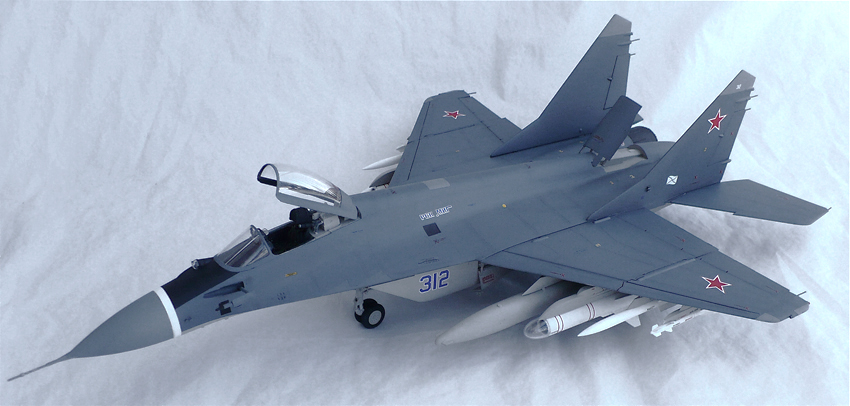
Mikoyan MiG-29K

Here are some images of Trumpeter's 1/32 scale Mikoyan MiG - 29K Fighter.

From Wikipedia"

The Mikoyan MiG-29K (Russian: Микоян МиГ-29K, NATO reporting name: Fulcrum-D) is an all-weather carrier-based multirole fighter aircraft developed by the Mikoyan design bureau. The MiG-29K was developed in the late 1980s from MiG-29M.
Production MIG-29K differ from prototypes by features such as a multi-function radar and several new cockpit displays; the adoption of HOTAS (hands-on-throttle-and-stick) controls; the integration of RVV-AE air-to-air missiles, along with missiles for anti-ship and anti-radar operations; and several ground/strike precision-guided weapons.
MiG-29K was not ordered into production and only two prototypes were originally built as the Russian Navy preferred the Su-27K in early 1990s. The Mikoyan Design Bureau did not stop its work on the MiG-29K aircraft despite the lack of financing since 1992. The programme got a boost in the late 1990s to meet an Indian requirement for a ship-borne fighter following the purchase of a former Soviet aircraft carrier. It was first received by the Indian Navy in 2009.

The MiG-29K project was initiated in the late 1970s when the Soviet Navy developed a requirement for a supersonic carrier-based fighter. As a first step to meet this requirement, the Mikoyan design bureau designed a "proof of concept" version of the MiG-29 fitted with a stronger undercarriage and a reinforced tail section with an arrestor hook, the MiG-29KVP (Korotkii Vzlet i Posadka, or "short take off and landing"). The KVP first flew on 21 August 1982, and was subject to extensive trials which demonstrated it could safely operate from a ski-jump, but ideally a production aircraft needed more power and greater wing area. It was decided to base the definitive naval version on the advanced MiG-29M (Product 9.15) that was already under development, further modified with new undercarriage and folding wings of greater area, with the new model designated the MiG-29K (Korabelniy – "ship based") or Project 9-31. The MiG-29K differed considerably from the MiG-29 production model, featuring a new multi-function radar, dubbed Zhuk; a cockpit with monochrome display and use of the HOTAS (hands-on-throttle-and-stick) principle; the RVV-AE air-to-air active homing missiles; antiship and antiradar missiles; as well as air-to-ground precision-guided weapons. To protect the engine from FOD, the engine inlets were fitted with retractable grills instead of the LERX louvres used by land-based MiG-29s. A MiG-29M on display. The MiG-29M was developed into a naval version, the MiG-29K.
The MiG-29Ks first flight was performed on 23 July 1988 at Saky by test pilot Toktar Aubakirov. On 1 November 1989, on the same day as the Sukhoi Su-27K, Aubakirov executed the first carrier landing of MiG-29K on the aircraft-carrying cruiser Tbilisi (now known as Admiral Kuznetsov), the first take-off from the carrier's deck was successfully performed the same day. During 1989–1991, the MiG-29K underwent further tests aboard the Admiral Kuznetsov. The project was put on hold with the collapse of the Soviet Union, while the Russian Navy only pursued the rival Su-33. Mikoyan continued work on the MiG-29K despite the lack of funding.
During its tests aboard the Admiral Kuznetsov aircraft-carrying cruiser, the aircraft had a springboard-assisted takeoff from strips 195 m and 95 m long. According to the results of the tests, the landing accuracy proved to be very high, which made it possible at a later stage to switch over to a three-cable arrester system on the Admiral Gorshkov. The landing accuracy is additionally enhanced through the employment of an autothrottle system. The takeoff characteristics allow for most flights to be possible under tropical conditions at a ship speed of 10 knots.
The MiG-29K program was revived in response to the decision of the Indian Navy to acquire the former Soviet Navy aircraft carrier Admiral Gorshkov in 2004. When Admiral Gorshkov was part of the Soviet fleet, it was a hybrid carrier/cruiser using vertical take-off (V/STOL) aircraft; thus the deck was refurbished with a take-off ramp and arrestor wires for operating MiG-29Ks. The ship's combat group is likely to include 12 MiG-29K fighters. The aircraft has an enlarged and folding wing, an arrestor hook and a corrosion-protected reinforced fuselage.
One factor favouring the MiG-29K over the Su-33 in the Indian decision was the larger size of the Su-33, which further limited the number of aircraft on deck. Modifications were made to the MiG-29K for Indian requirements, including the Zhuk-ME radar, RD-33MK engine, a combat payload up to 5,500 kg, 13 hardpoints, and updated 4-channel digital fly-by-wire flight control system. It is compatible with the full range of weapons carried by the MiG-29M and MiG-29SMT. The MiG-29KUB made its maiden flight at the Zhukovsky test centre on 22 January 2007.
The problem of lack of aircraft-carrier based AWACS platform may be tackled by further development of dual-seat MiG-29KUB. It is theoretically possible to outfit the MiG-29KUB with powerful radar, and encrypted data links, to permit networking of multiple MiG-29KUB aircraft for AEW coverage. The MiG-29KUB may also be enhanced in areas such as electronic warfare and long-range interdiction.
The MiG-29KUB two-seat variant took its first flight on 20 January 2007.
The MiG-29K was drastically modified from the Mikoyan MiG-29M for naval operations. The airframe and undercarriage were reinforced to withstand the stress experienced upon landing. Folding wings, an arrestor hook, and catapult attachments were added for carrier operations; the aircraft's undercarriage was also widened. The MiG-29K, unlike the early MiG-29, can both conduct aerial refueling and "buddy" refuel other aircraft. The MiG-29K has two widely-spaced RD-33MKs. The early prototypes were fitted with two RD-33K turbofan engines, each with afterburner thrust of 86.3 kN (19,800 lb) and a possible take-off thrust of 92.2 kN (20,723 lbf) for shipborne operations. The RD-33MK engine features 7% higher power over the base RD-33, enabled by the usage of improved materials for the turbine blades.
Internal fuel was increased from 3,340 kg to 4,560 kg, to give a combat radius of 850 km (531 mi). The range can be increased to 3,000 kilometers with 3 underwing fuel drop tanks. The maximum weight of the aircraft grew from 19.5 to 22.4 t, to allow for increased payloads. The MiG-29KUB two-seat fighter, intended for pilot training, can also conduct combat missions identical to the single-seat fighter.
The aircraft is equipped with three multifunctional color liquid-crystal displays (seven LCDs on the MiG-29KUB), a four-channel digital fly-by-wire flight control system, passive anti-radar missile homing system, Sigma-95 GPS receiver, TopGun helmet-mounted targeting system and electronic countermeasures (ECM). Additionally, an onboard oxygen generating system eliminates the need for heavy oxygen canisters. The types of combat missions undertaken by the MiG-29K can be increased by adding optronic/infrared imaging reconnaissance pods.
The Zhuk-ME is a development of the N010 Zhuk radar, introducing functions such as terrain mapping and following. The radar, weighing 220 kilograms (490 lb), features improved signal processing and a detection range of up to 120 km vs a 5 m2 RCS target for the export variant. In the air targeting mode, up to 10 targets can be tracked and 4 targets engaged simontaneously. In air to surface mode the radar can detect a tank from up to 25 kilometres (16 mi) away and a bridge from 120 kilometres (75 mi) away, a naval destroyer could be detected up to 300 kilometres (190 mi) away, while up to two surface targets can be tracked at once. The radar has a scanning area of +/- 85 degrees in azimuth and +56/-40 in elevation.
The Zhuk-AE radar was developed with modular approach, enabling upgrade of existing Zhuk ME radars deployed in MiG-29 platforms into the active electronically scanned array (AESA) Zhuk-AE standard. India is already operating the Bars phased array radar on its Su-30MKI and has specified AESA as a critical element of the MRCA platform. The Mig-29K can be outfitted with an IRST system integrated with both optical and laser systems. It can provide targeting solutions for ground and air targets at up to 15 km, with all-round 360 degree coverage. The IRST can also provide detailed trajectories of missiles at closer ranges.
MiG-29K has a GSh-30-1 30 mm cannon in the port wing root. It has provisions for laser-guided and electro-optical bombs, as well as air-to-surface missiles like Kh-25ML/25MP, Kh-29T, Kh-31G/31A, Kh-35U, and rockets. Kh-31P passive radar seeker missiles are used as anti-radiation missiles. Kh-35, Kh-31A antiship missiles are for anti-ship roles; for aerial combat air-to-air missile like RVV-AE, R-27ER/ET and R-73E are fitted. The aircraft is also adaptable to various foreign weapons.
The MiG-29K has a combination of low-observable technology, advanced electronic-warfare capabilities, reduced ballistic vulnerability, and standoff weapons to enhance the fighter's survivability. According to Mikoyan, extensive use of radar-absorbent materials reduce the MiG-29K's radar signature 4–5 times over the basic MiG-29. The RD-33MK turbofan engine was also engineered to reduce infrared and optical visibility.
The Russian Navy has a fleet of approximately 20 Su-33s, which are expected to be life expired by 2015. Production of new Su-33s is possible but not cost-effective for small volumes. The MiG-29K is more convenient, as the Indian Navy has already ordered the aircraft, saving on development and production set-up. India paid $730 million for the development and delivery of 16 units, while 24 for the Russian Navy would cost approximately $1 billion. In 2009, prior to delivery to India, MiG-29Ks underwent testing on board the Admiral Kuznetsov. In September 2011, it was announced that the MiG-29K was to conduct its first at-sea deployment on board Admiral Kuznetsov in the Mediterranean.
The Russian Navy ordered 24 MiG-29Ks in late 2009 for the Admiral Kuznetsov. Deliveries of the MiG-29K for the Russian Navy started in 2010. MiG and Russia were in final negotiations for an order for more MiG-29K/KUB aircraft in August 2011, with an order for 20 MiG-29K fighter-bombers and four MiG-29KUB operational trainers for operation from Admiral Kuznetsov, replacing the Sukhoi Su-33, being officially announced during February 2012.
In 2004 India ordered 12 MiG-29K single-seat and 4 MiG-29KUB two-seat fighters. The MiG-29K is to provide both airborne fleet air defense and surface attack capabilities. Deliveries began in December 2009. In January 2010, India and Russia signed a deal worth US$1.2 billion for the Indian Navy to receive an additional 29 MiG-29Ks. The MiG-29K entered operational service with India in February 2010. Further deliveries of 5 MiG-29Ks and a flight simulator took place in May 2011. Further deliveries are to continue through 2012. The fighters will be based at an air field in Goa on India's west coast until the Admiral Gorshkov joins the navy under the name of INS Vikramaditya in last quarter of 2013. The Vikramaditya is expected to carry up to 24 MiG-29K/KUB fighters. The future indigenous aircraft carrier Vikrant, currently being built by India, also is likely to carry these aircraft.
On 25 June 2011, a MiG-29KUB crashed during testing in Russia, prior to delivery to India, killing its two pilots. In light of this, further MiG-29K orders by India were frozen; the Indian Defense Ministry commented that the crash cast a shadow on the credibility of the aircraft. Russia has announced pilot error to have caused the crash, and there was no need to ground the aircraft. In August 2011, MiG's General Director Sergei Korotkov announced that the final 5 out of the 16 aircraft contracted in 2004 would be delivered by the end of the year; and that deliveries of a second batch of 29 MiG-29Ks would begin in 2012. In November 2012, the MiG-29K/KUB completed sea trials for the Indian Navy.


Wednesday, December 14, 2011

MiG 15 Bis Composite


Here is my composite image of Trumpeter Model's 1/32 Mikoyan Gurevich MiG 15 Bis cruising over a mountainous terrain in winter.

Images of the model can be seen here.

Monday, September 26, 2011

MiG 21 UM "Mongol"


Here are some images of Trumpeter's 1/32 scale MiG 21 UM "Mongol"

From Wikipedia"
The Mikoyan-Gurevich MiG-21 (Russian: Микоян и Гуревич МиГ-21; NATO reporting name "Fishbed") is a supersonic jet fighter aircraft, designed by the Mikoyan-Gurevich Design Bureau in the Soviet Union. It was popularly nicknamed "balalaika", from the aircraft's planform-view resemblance to the Russian stringed musical instrument or ołówek (English: pencil) by Polish pilots due to the shape of its fuselage. Early versions are considered second-generation jet fighters, while later versions are considered to be third-generation jet fighters. Some 50 countries over four continents have flown the MiG-21, and it still serves many nations a half-century after its maiden flight. The fighter made aviation records. At least by name, it is the most-produced supersonic jet aircraft in aviation history and the most-produced combat aircraft since the Korean War, and it had the longest production run of a combat aircraft (1959 to 1985 over all variants).
The UM Variant was a two seat advanced trainer version of the MiG 21 MF.

This aircraft bears the markings of Finland. Finland. Finland.

Thursday, September 22, 2011

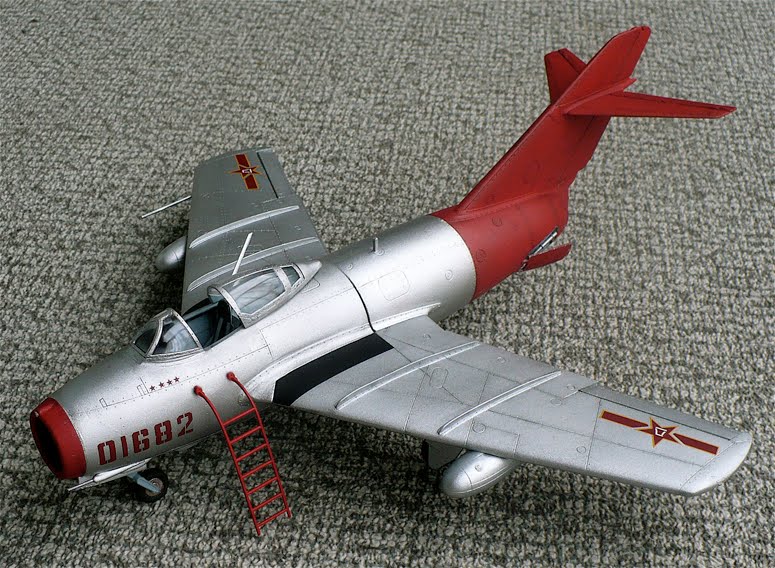
MiG 15 Bis


Here are some images of Trumpeter's 1/32 Mikoyan Gurevich MiG 15 Bis.
The two big problems I've noticed with this model is the back half of the fuselage does not line up properly with the front half which is OK because it will be displayed in two parts anyway. The second problem is the canopy. The canopy framework lines are far two thick for this aircraft and I intend on replacing it with an aftermarket part just as soon as the opportunity arises.

From Wikipedia"

The Mikoyan-Gurevich MiG-15 (Russian: Микоян и Гуревич МиГ-15) was a jet fighter developed for the USSR by Artem Mikoyan and Mikhail Gurevich. The MiG-15 was one of the first successful swept-wing jet fighters, and it achieved fame in the skies over Korea, where early in the war, it outclassed all straight-winged enemy fighters in daylight. The MiG-15 also served as the starting point for development of the more advanced MiG-17 which was still an effective threat to supersonic American fighters over North Vietnam in the 1960s. The MiG-15 is believed to have been the most widely produced jet aircraft ever made, with over 12,000 built. Licensed foreign production perhaps raised the total to over 18,000. The MiG-15 is often mentioned along with the North American F-86 Sabre in lists of the best fighter aircraft of the Korean War and in comparison with fighters of other eras.

NATO and USAF reporting names were as follows:

  • MiG-15P: NATO reporting name "Fagot", USAF/DoD reporting name "Type 19".
  • MiG-15UTI: NATO reporting name "Midget", USAF/DoD reporting name "Type 29".