Translate

Thursday, June 16, 2011

Consolidated B 24 D Liberator (Pregnant Cow)


Here are some images of Monogram's 1/48 scale Consolidated B 24 D Liberator (Pregnant Cow). This model represents the aircraft Teggie Ann which took part in the raid on the Ploesti oilfields in Romania during world war two. If you wish to read more on Ploesti you may do so here.

From Wikipedia"
The Consolidated B-24 Liberator was an American heavy bomber, designed by Consolidated Aircraft Company of San Diego, California. Its mass production was brought into full force by 1943 with the aid of the Ford Motor Company through its newly-constructed Willow Run facility, where peak production had reached one B-24 per hour and 650 per month in 1944. Other factories soon followed. The B-24 ended World War II as the most produced Allied heavy bomber in history, and the most produced American military aircraft at over 18,400 units, due largely to Henry Ford and the harnessing of American industry. It still holds the distinction as the most-produced American military aircraft. The B-24 was used by several Allied air forces and navies, and by every branch of the American armed forces during the war, attaining a distinguished war record with its operations in the Western European, Pacific, Mediterranean, and China-Burma-India Theaters.
Often compared with the better-known B-17 Flying Fortress, the B-24 was a more modern design with a higher top speed, greater range, and a heavier bomb load; however, it was also more difficult to fly, with heavy control forces and poor formation-flying characteristics. Popular opinion among aircrews and general staffs tended to favor the B-17's rugged qualities above all other considerations in the European Theater. The placement of the B-24's fuel tanks throughout the upper fuselage and its lightweight construction, designed to increase range and optimize assembly line production, made the aircraft vulnerable to battle damage. The B-24 was notorious among American aircrews for its tendency to catch fire. Moreover, its high fuselage-mounted Davis wing also meant it was dangerous to ditch or belly land, since the fuselage tended to break apart. Nevertheless, the B-24 provided excellent service in a variety of roles thanks to its large payload and long range.
The B-24's most famous mission was the low-level strike against the Ploesti oil fields, in Romania on 1 August 1943, which turned into a disaster because the enemy was underestimated, fully alerted and attackers disorganized.

Wednesday, June 15, 2011

Bristol Beaufighter TF.X Composite


Here is my composite image of Revell/Lodela 1/32 scale Bristol Beaufighter TF.X flying through the clouds.

Images of the model can be seen here.

Tuesday, June 14, 2011

Saladin Class Upgrade Composite


Here is my composite image of my kitbash 1/537 scale Saladin Class Starship U.S.S. Tamerlane with upgrade on a fly pass of Uranus (stop giggling). Images of the model can be seen here.

Monday, June 13, 2011

AT - ST and Millennium Falcon Composite.


Here is my composite image of MPC's AT-ST (all terrain scout transport) with MPC's 1/58 scale Millennium Falcon from Star Wars passing overhead.
Images of the AT - ST model can be seen here.

Images of the Millenium Falcon model can be seen here.

Sunday, June 12, 2011

Phantom Mustang


Here are some images of Monograms 1/32 scale North American P 51 D Phantom Mustang.
Everything is connected. I just need a couple of double dees to make it go.

Saturday, June 11, 2011

Xebec Re Post


Here are some images plus a composite of Amati's 1/60 scale Xebec armed vessel 1753. The following description is taken off Historic Ships. "Used by Barbary pirates, Xebecs were equipped with both sails and oars. They featured a distinctive hull with overhanging bow and stern. The lateen rig allowed it to sail close hauled to wind, giving it an advantage in pursuit or escape. The oars allowed the Xebec to approach vessels that were becalmed. Sea-going Mediterranean peoples used Xebecs as corsairs and built them with a narrow floor to achieve a higher speed than their victims.but with a considerable beam that enable them to carry an extensive sail plan. They carried a crew of 300 to 400 men and mounted 16 to 40 guns". My only complaint about this model is that it did not come with a double planking option considering the cost $260 Cdn you would think they would have done so. I should point out that this kit does not come with any instructions, plans only. So one should have some model ship building experience before attempting this model.

Friday, June 10, 2011

Lockheed/Boeing/General Dynamics YF-22 Composite


Here is my composite image of Testor'e 1/32 scale Lockheed YF 22 Rapier prototype against a blue sky.

Images of the model can be seen here.
From Wikipedia" The Lockheed/Boeing/General Dynamics YF-22 was a prototype fighter aircraft designed for the United States Air Force. The YF-22 was a finalist in the United States Air Force's Advanced Tactical Fighter competition, and examples were built. The YF-22 won the contest against the Northrop YF-23, and entered production as the Lockheed Martin F-22 Raptor. The YF-22 is similar to the F-22, but with differences in the cockpit, tail fins and wings.
The USAF's Advanced Tactical Fighter (ATF) program was conceived in the early 1980s, to provide a replacement for the F-15 Eagle. The Air Force issued a request for proposals (RFP) for the fighter in September 1985, then modified the RFP to include flying prototypes in the final selection. Proposals were submitted by Boeing, General Dynamics, Lockheed, Northrop, and McDonnell Douglas in July 1986. Lockheed and Northrop were selected in October 1986 for the demonstration phase, ending in a flyoff of prototypes. The companies had previously agreed to form the Lockheed/ General Dynamics/Boeing team and Northrop/McDonnell Douglas team.

The Lockheed team designed the YF-22 and the Northrop team designed the YF-23. Two examples of each prototype were built for the Demonstration-Validation phase: one with General Electric YF120 engines, the other with Pratt & Whitney YF119 engines.

The YF-22 was given the unofficial name "Lightning II", after the World War II fighter P-38, by Lockheed, which persisted until the mid-1990s when the USAF officially named the aircraft "Raptor". The F-35 later received the Lightning II name in 2006.

The YF-22 first flew on 29 September 1990. Flight testing began afterwards and added the second aircraft for each competitor in late October 1990. The YF-22 with GE engines achieved Mach 1.58 in supercruise. Flight testing continued until December 1990. Following flight testing, the contractor teams submitted proposals for ATF production.

Thursday, June 9, 2011

Bristol Beaufighter TF.X


Here are some images Of Revell/Lodela 1/32 scale Bristol Beaufighter TF.X.

From Wikipedia"

1941 saw the development of the Beaufighter Mk.IC long-range heavy fighter. This new variant entered service in May 1941 with a detachment from No. 252 Squadron operating from Malta. The aircraft proved so effective in the Mediterranean against shipping, aircraft and ground targets that Coastal Command became the major user of the Beaufighter, replacing the now obsolete Beaufort and Blenheim.

Coastal Command began to take delivery of the up-rated Mk.VIC in mid 1942. By the end of 1942 Mk VICs were being equipped with torpedo-carrying gear, enabling them to carry the British 18 in (457 mm) or the US 22.5 in (572 mm) torpedo externally. The first successful torpedo attacks by Beaufighters came in April 1943, with No. 254 Squadron sinking two merchant ships off Norway.

The Hercules Mk XVII, developing 1,735 hp (1,294 kW) at 500 ft (150 m), was installed in the Mk VIC airframe to produce the TF Mk.X (Torpedo Fighter), commonly known as the "Torbeau". The Mk X became the main production mark of the Beaufighter. The strike variant of the "Torbeau" was designated the Mk.XIC. Beaufighter TF Xs would make precision attacks on shipping at wave-top height with torpedoes or "60lb" RP-3 rockets. Early models of the Mk Xs carried metric-wavelength ASV (air-to-surface vessel) radar with "herringbone" antennae carried on the nose and outer wings, but this was replaced in late 1943 by the centimetric AI Mark VIII radar housed in a "thimble-nose" radome, enabling all-weather and night attacks.

The North Coates Strike Wing of Coastal Command, based at RAF North Coates on the Lincolnshire coast, developed tactics which combined large formations of Beaufighters using cannon and rockets to suppress flak while the Torbeaus attacked at low level with torpedoes. These tactics were put into practice in mid 1943, and in a 10-month period, 29,762 tons (27,000 tonnes) of shipping were sunk. Tactics were further adapted when shipping was moved from port during the night. North Coates Strike Wing operated as the largest anti-shipping force of the Second World War, and accounted for over 150,000 tons (136,100 tonnes) of shipping and 117 vessels for a loss of 120 Beaufighters and 241 aircrew killed or missing. This was half the total tonnage sunk by all strike wings between 1942 and 1945.

Beaufighter TF Mk X
Two-seat torpedo fighter aircraft. The last major version (2,231 built) was the Mk X, among the finest torpedo and strike aircraft of its day. The later production models featured a dorsal fin.

Wednesday, June 8, 2011

Lysander Composite


Here is my composite image of Revell's/ Matchbox 1/32 scale Westland Lysander MK III flying over a muddy river.

Images of the model can be seen here.

From Wikipedia"
The Westland Lysander was a British army co-operation and liaison aircraft produced by Westland Aircraft. It was used during the Second World War. The aircraft's exceptional short-field performance made possible clandestine missions using small, unprepared airstrips behind enemy lines that placed or recovered agents, particularly in occupied France. Like other British army air co-operation aircraft it was given the name of a mythical or legendary leader, in this case Spartan general Lysander.

104 British-built Lysanders were delivered to Canada supplementing 225 that were built under license at Malton, Ontario (near Toronto) with production starting in October 1938 and the first aircraft flying in August 1939.

The RCAF primarily operated them in the Army Co-operation role, where they represented a major improvement over the antiquated Westland Wapiti which could trace its origins back to 1916.

Initial training was conducted at Rockcliffe, Ontario (now a part of Ottawa, Ontario) with 123 Squadron running an Army Cooperation school there. Units that operated the Lysander for training in this role in Canada include 2 Squadron, 110 Squadron (which became 400 Squadron overseas) and 112 Squadron.

414 Squadron RCAF was formed overseas with Lysanders, joining 2 Squadron RCAF, 110 squadron RCAF and 112 Squadron RCAF and all four were ready to begin operations when the high losses suffered by RAF Lysanders put plans on hold but they continued training with the Lysanders until replacements were available.

118 Squadron and 122 Squadron would be the only units to use their Lysanders for active duty operations - 118 in Saint John, New Brunswick, and 122 at various locations on Vancouver Island where they performed anti-submarine patrols and conducted search and rescue operations. During the same period, 121 Squadron used the Lysander for Target Towing duties, with a high visibility yellow and black striped paint job but by late 1944 all Lysanders had been withdrawn from flying duties.

Tuesday, June 7, 2011

Spitfire MK 22 Re Post


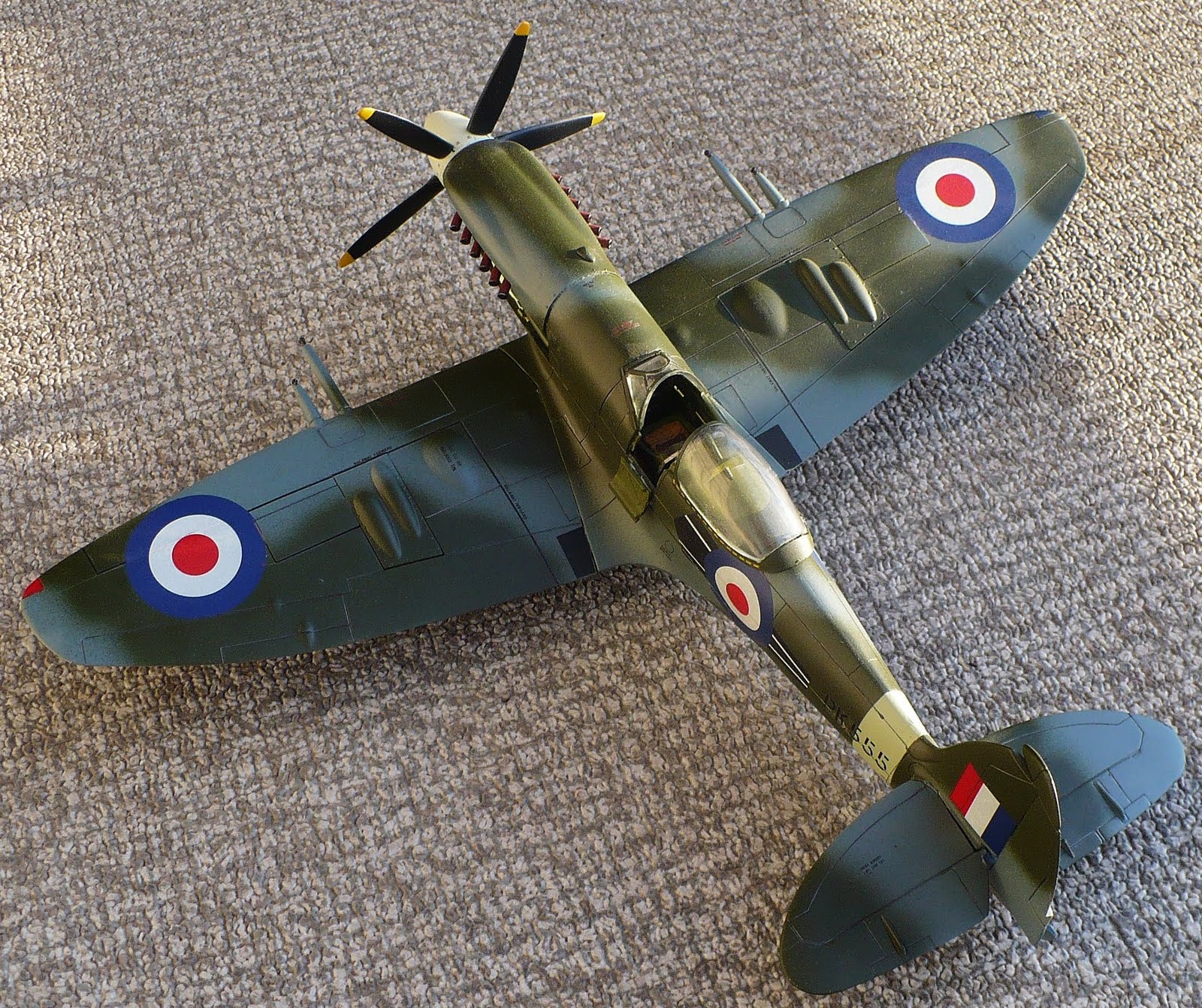
Here are some images of Revells 1/32 scale Supermarine Spitfire MK 22 former Matchbox molds. If you buy this kit you will find that a lot of parts could have been easily made into a single part which can be annoying at times. Still it's the only 1/32 scale MK 22/24 on the market.

Monday, June 6, 2011

Space Shuttle Discovery Composite


Here is my composite of Tamiya's 1/100 scale Space Shuttle Discovery orbiting the Earth over a Hurricane.

Images of the model can be seen here.

Sunday, June 5, 2011

Arado Ar 196A-3


Here are some images of Revell's 1/32 scale Arado Ar 196A-3 Seaplane.

This is an amazing kit. The fit and detail is excellent. Certainly a far cry from the Revell of old. I love technology especially when it comes to model kits. However despite the excellence of this kit I do have a couple of points of contention. The first being some of the instruction panels. Some of these panels show assembly instructions for the starboard side of the craft when the assembly is meant for the port and vis versa. However this is common mistake that I am sure will be remedied on subsequent re releases but if you decide to purchase this kit just take note and be careful.
The other problem are the canopies. They come in the kit as a series of flat panels of which have to be assembled as opposed to receiving the canopies fully formed. The problem I have with this is that on the main central and back canopies you can see the attachment tabs through the top. You may wish to remove these before assembly though putting them together will be a little more difficult. Why Revell chose to make them this way is anyone's guess.

From Wikipedia"
The Ar 196 was a shipboard reconnaissance aircraft built by the German firm Arado starting in 1936. The next year it was selected as the winner of a design contest, and became the standard aircraft of the Kriegsmarine (German Navy) throughout World War II.

In 1933, the Kriegsmarine looked for a standardized shipboard reconnaissance aircraft. After a brief selection period, the Reichsluftfahrtministerium (German Air Ministry, RLM) decided on the Heinkel He 60 biplane. This was one of a line of developments of a basic biplane airframe that appeared as a number of floatplanes, trainers, and fighters. Deliveries started in a matter of months.

By 1935, it was clear that the He 60's performance was lacking, and the RLM asked Heinkel to design its replacement. The result was the He 114. The first prototype was powered by the Daimler-Benz DB 600 inline engine, but it was clear that supplies of this engine would be limited, and the production versions turned to the BMW 132 radial engine instead.

The plane proved to have only slightly better performance than the He 60, and its sea-handling was poor. Rushed modifications resulted in a series of nine prototypes in an attempt to solve some of the problems, but they didn't help much. The Navy gave up, and the planes were eventually sold off to Romania, Spain and Sweden.

In October 1936, the RLM asked for a He 114 replacement. The only stipulations were that it would use the BMW 132, and they wanted prototypes in both twin-float and single-float configurations. Designs were received from Dornier, Gotha, Arado and Focke-Wulf. Heinkel declined to tender, contending that the He 114 could still be made to work.

With the exception of the Arado design, they were all conventional biplanes. That gave the Arado better performance than any of the others, and the RLM ordered four prototypes. The RLM was also rather conservative by nature, so they also ordered two of the Focke-Wulf Fw 62 design as a backup. It quickly became clear that the Arado would work effectively, and only four prototypes of the Fw 62 were built.

The Ar 196 prototypes were all delivered in summer 1937, V1 (which flew in May) and V2 with twin floats as A models, and V3 and V4 on a single float as B models. Both versions demonstrated excellent water handling, and there seemed to be little to decide one over the other. Since there was a possibility of the smaller outrigger floats on the B models "digging in", the twin-float A model was ordered into production. A single additional prototype, V5, was produced in November 1938 to test final changes.

10 A-0s were delivered in November and December 1938, with a single 7.92 mm (.312 in) MG 15 machine gun in the rear seat for defense. Five similarly equipped B-0s were also delivered to land-based squadrons. This was followed by 20 A-1 production models starting in June 1939, enough to equip the surface fleet.

Starting in November production switched to the heavier land-based A-2 model. It added shackles for two 50 kg (110 lb) bombs, two 20 mm MG FF cannons in the wings, and a 7.92 mm (.312 in) MG 17 machine gun in the cowling. The A-4 replaced it in December 1940, strengthening the airframe, adding another radio, and switching props to a VDM model. The apparently mis-numbered A-3 replaced the A-4, with additional strengthening of the airframe. The final production version was the A-5 from 1943, which changed radios and cockpit instruments, and switched the rear gun to the much-improved MG 81Z. In all versions, 541 Ar 196s (526 production models) were built before production ended in August 1944, about 100 of these from SNCA and Fokker plants.

The Ar 196C was a proposed aerodynamically-refined version. The Ar 196C project was cancelled in 1941.

The plane was loved by its pilots, who found it handled well both in the air and on the water. With the loss of the German surface fleet the A-1s were added to coastal squadrons, and continued to fly reconnaissance missions and submarine hunts into late 1944. Two notable operations were the capture of HMS Seal, and the repeated interception of RAF Armstrong-Whitworth Whitley bombers. Although it was no match for a fighter, it was considerably better than its Allied counterparts, and generally considered the best of its class. Owing to its good handling on water, the Finnish Air Force utilized Ar 196 solely on transporting and supplying special forces patrols behind enemy lines, landing on small lakes in remote areas. Several fully equipped soldiers were carried in the fuselage.

Arado in Allied hands

The first Arado Ar 196 to fall into allied hands was an example belonging to the German cruiser Admiral Hipper captured in Lyngstad by a Norwegian Marinens Flyvebaatfabrikk M.F.11 seaplane of the Trøndelag naval district on 8 April 1940, at the dawn of the Norwegian Campaign. After being towed to Kristiansund by the torpedo boat HNoMS Sild, it was used against its former owners, flying with Norwegian markings. At 0330 on April 18, the Arado was evacuated to the UK by a Royal Norwegian Navy Air Service pilot. The plane was shortly thereafter crashed by a British pilot while on transit to the Helensburgh naval air base for testing. At the end of the war, at least another Arado Ar 196 was left at a Norwegian airfield and kept in use as a liaison aircraft by the Royal Norwegian Air Force for a year on the West coast.

Saturday, June 4, 2011

BF 109 K Re Post


Here are some images of Revells 1/32 scale Messerschmidt BF 109 K-4. I believe this kit is the old Hasegawa kit but I wouldn't swear to it. The BF 109 K was a conglomeration of the best the G series had to offer. Anyway the exterior detail on this model is very well defined. The interior though simple and straight forward does lend itself well to added after market parts. Overall an excellent model and for 40 bucks CDN well worth it.

From Wikipedia"

The Bf 109K was the last of the series to see operational duty and the last in the Bf 109 evolutionary line. The K series was a response to the bewildering array of series, models, modification kits and factory conversions for the Bf 109, which made production and maintenance complicated and costly — something Germany could ill-afford late in the war. The RLM ordered Messerschmitt to rationalise production of the Bf 109, consolidating parts, types, and so on, to produce a uniform, standard model with better interchangeability of parts and equipment. At the same time, the existing flaws of the design were to be remedied. Work on the new version began in the spring of 1943, and the prototype was ready by the autumn of that year. Series production started in August 1944 with the K-4 model, due to changes in the design and delays with the new DB 605D powerplant. The K-4 was the only version to be mass produced.

Externally the K series could be identified by changes in the locations of the radio equipment hatch, which was moved forward and to a higher position between frames four and five, and the filler point for the fuselage fuel tank, which was moved forward to a location between frames two and three. In addition, the D/F loop was moved aft to sit between frames three and four on the top fuselage spine and a small circular plate above the footstep on the port side of the fuselage was deleted. The rudder was fitted as standard with a Flettner tab and two fixed tabs although some rare examples were not fitted with the fixed tabs. All K-4s were to be fitted with a long retractable tailwheel (350 x 135 mm/14 x 5 in) with two small clamshell doors covering the recess when the tail-wheel was retracted.

The wings featured the large rectangular fairings for the large 660 x 190 mm (26 x 7 in) main wheels. Small wheel well doors, originally planned for the G series, were fitted to the outer ends of the wheel bays, covering the outer wheels when retracted. These doors were often removed by front-line units. The ailerons were fitted with small, adjustable trim tabs. The radio equipment was the FuG 16ZY with an antenna mast fitted under the port outer wing and FuG 25a IFF as well as the FuG 125 Hermine D/F equipment. Internally, the oxygen bottles were relocated from the rear fuselage to the right wing. Flettner tabs for the ailerons were also to be fitted to serial production aircraft to reduce control forces, but are only seen on photos of later production aircraft.

Armament of the K-4 consisted of a 30 mm (1.18 in) MK 108 engine-mounted cannon (Motorkanone) with 65 rounds, and two 13 mm (.51 in) MG 131s in the nose with 300 rpg although some K-4s were fitted with the MG 151/20 as the Motorkanone. Additional Rüstsätze, or equipment kits, such as a 300 L (80 US gal) drop tank (R III), bombs up to the size of 500 kg/1,100 lb (R I), underwing 20 mm Mauser MG 151/20 cannon gondola pods (R IV) or 21 cm (8 in) Wfr.Gr. 21 rockets (as on the Gustav models) could be carried after minimal preparations; the latter two however were rarely used by Bf 109 units at this stage of the war, but there is evidence that III./JG 26 were almost completely equipped with K-4s which were fitted with R IV. In addition there were problems with the 30 mm (1.18 in) MK 108 Motorkanone:

The 30mm cannon were extremely potent weapons, but they had a tendency to jam, and apparently all of the K-4s supplied to III./JG 26 were also equipped with 20mm-guns in the hated underwing tubs. Uffz. Georg Genth's regular aircraft was a G-10, but on occasion he flew a K-4. He preferred the G-10 as a dogfighter, as the K-4's bulky armament sharply reduced its manouevrability.

Power was provided by a Daimler-Benz DB 605DM (early models) of 1,800 PS output and later the DB 605DB/DC powerplant with 1,850/2,000 PS output. A wide-chord, three bladed VDM 9-12159 propeller of 3 m diameter was used, as on the G-6/AS, G-14/AS and G-10.

Deliveries began in mid-October 1944. 534 examples had been delivered by the Messerschmitt A.G., Regensburg by the end of November 1944, and 856 by the end of the year. Regensburg delivered a total of 1593 by the end of March 1945, after which production figures are missing. With such a high rate of production, despite continuous heavy fighting, by the end of January 1945 314 K-4s - about every fourth 109 - were listed on hand with the 1st line Luftwaffe units. Ultimately it was intended to equip all Bf 109 units with the 109K, which marked the final stage of 109 development before the jet age.

The Bf 109 K-4 was the fastest 109 of World War II, reaching 715 km/h (445 mph) at 7,500 m (24,610 ft) altitude; improved propellers were being developed when the war ended which would boost the speed to 727 km/h (452 mph), and 741 km/h (460 mph) was expected with a swept-back propeller design. Rate of climb was outstanding 4,820 ft (1,470 m)/min at 1.98 atm. The standard Revi 16C reflector sight was fitted, which was to be replaced later by the EZ 42 Gyro gunsight.[102] With such improvements in performance, the Bf 109 remained comparable to opposing fighters until the end of the war. However, the deteriorating ability of the thousands of novice Luftwaffe pilots by this stage of the war meant the 109's strengths were of little value against the numerous and well-trained Allied fighter pilots.

Several other versions were projected based on the 109K airframe - K-6, K-8, K-10 and K-14. In the proposed K-6 the armament would have been two 13 mm (.51 in) MG 131 above the engine, along with a 30 mm (1.18 in) MK 108 Motorkanone and an internally-mounted MK 108 in each wing, with 45 rpg. Alternatively, the wing MK 108s could be substituted by 20 mm MG 151/20s, with 100 rpg. Armour weight was increased to 200 lb (91 kg). Takeoff weight was 7,986 lb (3,622 kg). Some K-6 prototypes were built and tested at the Tarnewitz weapons-testing centre.

Project drawings of the K-8 show an K-series airframe powered by the two-stage DB 605L high altitude engine, a high-velocity 30 mm (1.18 in) MK 103mot Motorkanone, and two 30 mm (1.18 in) MK 108 cannons in the wings; the cowl 13 mm (.51 in) MG 131s were dispensed with.

Some sources point to limited use of the K-14, intended as high-altitude heavy fighter. Two airframes are listed as delivered to II./JG52 under Major Wilhelm Batz in late spring of 1945, these being armed with only one 30 mm (1.18 in) cannon, but the type's existence cannot be positively confirmed. The K-14 was to be powered by the two-stage supercharged DB 605L engine, the use of a four-bladed propeller 460 mph (740 km/h), and an operational altitude of 38,000 ft (12,000 m) was projected. Armour and armament were otherwise similar to the K-6.

Friday, June 3, 2011

ME 262 B-1A Re Post


Here are some images Revells 1/32 scale ME 262 B-1A Night Fighter. With a bit of sanding of the raised panel lines and a bit of scribing plus a bit of extra cockpit work (the cockpit is terrible) one may produce an acceptable piece.

Thursday, June 2, 2011

Mig 3 Composite


Here is my composite image of Trumpeter's 1/32 scale Mikoyan Gurevich Mig 3 against a winter grey sky.

Images of the model can be seen here.

Wednesday, June 1, 2011

Messerschmitt BF 109 G-6 Composite


Here is my composite image of Trumpeters 1/24 scale Messerschmitt BF 109 G-6 early version against a blue cloudy sky. Images of the model can be seen here.