Translate

Monday, August 27, 2012

Moon Bus Composite II

Here is my composite image of Moebius Models 1/55 scale Moon Bus from "2001 A Space Odyssey" this time flying over Hadley Rille.
Moon pic NASA.

Images of the Moon Bus siting at Hadley Rille can be seen here.

Sunday, August 26, 2012

Greek F 104 -G Starfighter Composite

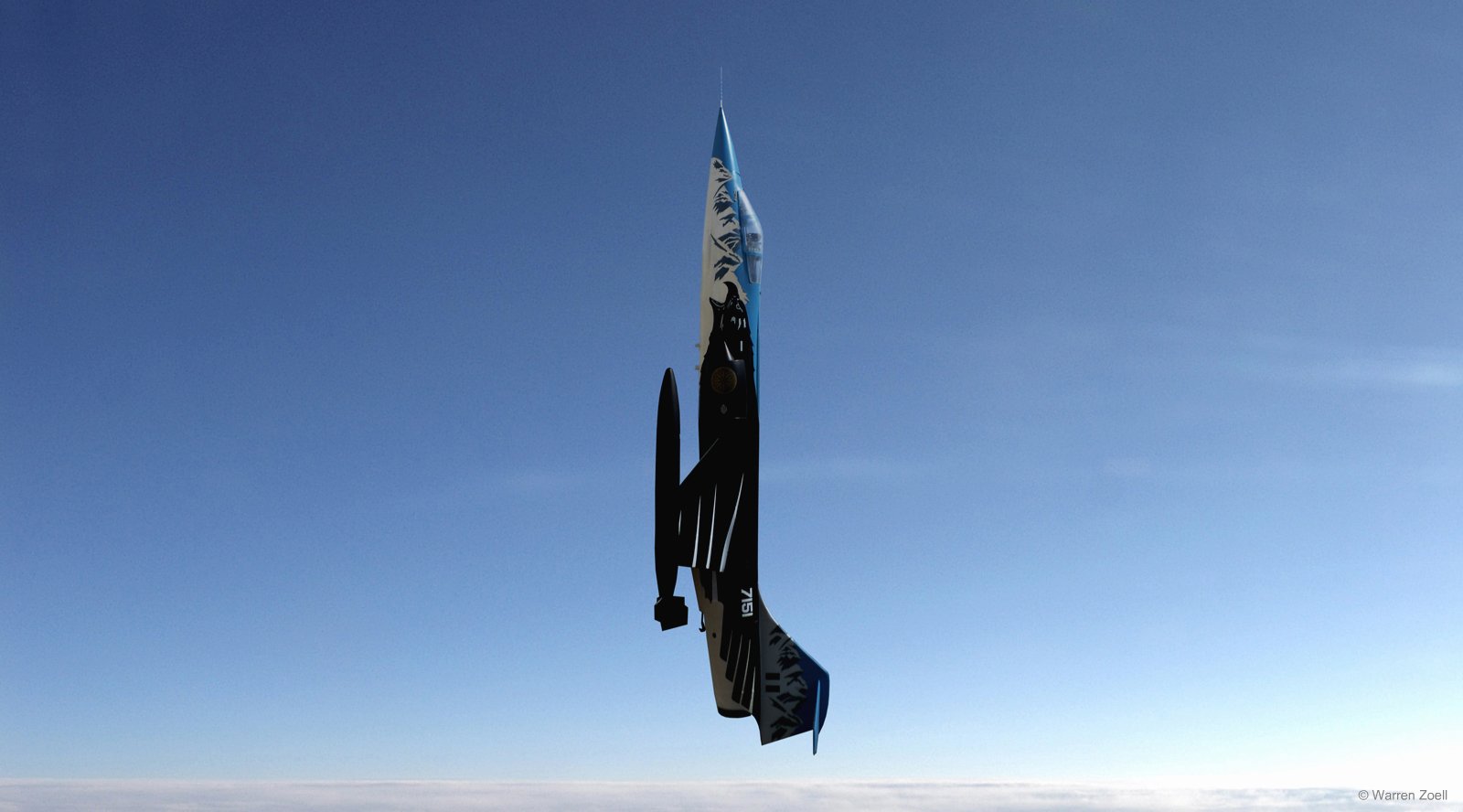
Here is my composite image of Revell's 1/32 scale Lockeheed F 104 G Starfighter in a vertical climb.
This particular aircraft belonged to No. 336Squadron, Royal Hellenic Air Force (Greece). They painted this F 104 G with a special colour scheme as a farewell to the F 104.

A composite image of the same model can be seen here.

Cylon Raider Composite

Here is my composite image of Revell's 1/32 scale Cylon Raider from Battlestar Galactica approaching Saturn.

Images of the model can be seen here.

Saturday, August 25, 2012

Colonial Viper Composite

Here is my composite image of Revell's 1/32 scale Colonial Viper from Battlestar Galactica approaching the Earth.

Images of the model can be seen here.

P-51 D Mustang Composite

Here is my composite image of Airfix's 1/24 scale North American P 51 D Mustang approaching a thunderstorm.

Images of the model can be seen here.

Friday, August 24, 2012

Heinkel HE 51 B-2 Composite

Here is my composite image of Silver Wings 1/32 scale Heinkel HE 51 B-2 Floatplane searching for a place to land.

Images of the model can be seen here.

Willy Ley's Space Taxi Composite

Here is my composite image of Monogram's 1/48 scale Willy Ley's Space Taxi orbiting the Earth.

Images of the model can be seen here.


Thursday, August 23, 2012

Bell UH-1B Iroquois gun ship (Huey) Composite

Here is my composite image of Revell's 1/24 scale Bell UH-1B Iroquois gun ship (Huey) as seen in the television series Tour Of Duty against a cloudy sky.

Images of the model can be seen here.

Tuesday, August 21, 2012

U.S.S. Explorer Composite

Here is my composite image of Lindberg's 1/200 scale U.S.S. Explorer being launched atop a Saturn Rocket.

Images of the model can be seen here.

Snowspeeder Composite

Here is my composite image of AMT/MPC/ERTL 1/35 scale Snowspeeder from Star Wars "The Empire Strikes Back flying through a snowy mountain pass.

Images of the model can be seen here.


Monday, August 20, 2012

Sunday, August 19, 2012

Westland Lysander MK. III Special Duties Composite

Here is my composite image of Matchbox's 1/32 scale Westland Lysander MK. III  Special Duties (covert operations) against an evening sky.

Images of the model can be seen here.

Thursday, August 16, 2012

Republic Star Destroyer

Here are some images of Revell's Venator Class Republic Star Destroyer.
I decided to put fiber optics into this model as I came across one of those old fiber optic Christmas Trees leaning against the dumpster outside. So I decided to strip it of all its fibery goodness.
I was never one to load up a model with lots of lights. I think it gives it a kind fake look to it. Besides with all those lights it looks too much like... well... a Christmas tree.
I also decided to paint this model in my own dark copper motif as opposed to the red example called out for in the instructions.

From Wikipedia"
Venator-class Star Destroyers, also known as "Republic attack cruisers", appear in Revenge of the Sith and in the Expanded Universe. The ship's design is meant to bridge the appearance of the Acclamator-class transports in Star Wars Episode II: Attack of the Clones and the Imperial class in the original trilogy. While the ships first appear with a red and grey Republic color scheme, the Venator at the movie's end is gray and white; this lack of color signifies the Empire's rise to power.

Sunday, August 12, 2012

DH-82C Tiger Moth

Here are some images of yet another Matchbox 1/32 scale  de Havilland DH-82C Tiger Moth.
This friendly little devil served with the N0. 19 E.F.T.S Royal Canadian Air Force. Virden Manitoba in 1943.

Images of my other Tiger Moth can be seen here and here.

Sunday, August 5, 2012

Morgan Plus 8

Here are some images of LS Models 1/16 scale Morgan Plus 8 Roadster.

From Wikipedia"
 The Morgan Plus 8 is a sports car built by British car makers Morgan between 1968 and 2004. Its instant and enduring popularity has been credited with saving the company and keeping the company famous during the 36 years of its manufacture. Among Morgan enthusiasts, it is deeply associated with Peter Morgan, the owner-chairman behind its design.

The development of the Plus 8 was led by Maurice Owen, a race car engineer taken on specifically for the role. The Plus 8 prototype was based on a modified version the chassis of the Plus 4, to which it added the Rover alloy block 215 cu in (3.5 l) V8, purchased from GM-Buick in 1967. Plus 4's Moss gearbox was carried over and the Salisbury 7HA axle was uprated with a limited slip differential. The chassis was developed in stages to accommodate gearbox changes in 1973 and 1976, the body widened in 1976 to accommodate the widened chassis and the wings widened to accommodate larger tyres to handle the increasing power and trend for lower profile and wider tyres. The original 1968 Plus 8 was 57 inches (1,400 mm) wide and the last was 64 inches (1,600 mm) (with an optional "widebody" at 67 inches (1,700 mm)) For several years in the 1960s the Plus Eight was the fastest-accelerating UK production car.
To mark the 35th year of production of its Plus 8, MMC released a commemorative 'Anniversary Edition'.
 
All Plus 8s engines were based on the Rover V8 which had been bought by Rover. Morgan was the first of a succession of sports car makers- including the likes of TVR and Marcos- to use the engine, which Rover had only just made available in the P5B saloon.
The Plus 8 development car used a Rover V8 block and the Plus 8 was launched in 1968 using Rover's production engine, itself a re-engineered version of the Buick 215 block (renamed the 3.5 L by Rover) with a compression of 10.5:1 fueled by two SU HS6 carburettors. By 1973, the Rover 3500 saloon was available with a manual 4 speed gearbox and this engine/gearbox configuration was adopted by Morgan although the compression dropped to 9.25:1 with a resulting loss of power. With the adoption of an improved version of the block developed for the Rover SD1 in 1977, compression was increased to 9.35:1 and power increased. After 1981 the engine was fueled by two Stromberg carburettors, .
At the end of 1983, the company offered a EFI version using a Bosch L-Jetronic based system. With the added power (204 bhp (152 kW; 207 PS)) and low weight, the Plus 8 was, according to the magazine road tests of the day, able to best a Porsche up to 90 mph (140 km/h). In 1990, a 3.9 L version of the block was added using the Lucas 14CUX fuel injection system.
In 1996, a 4.6 L version found its way into the car as an option, still using the 14CUX system. From 2000, all Morgan Plus 8s were fueled by the GEMS system used on the Land Rover Discovery II.


Friday, August 3, 2012

Lotus 25

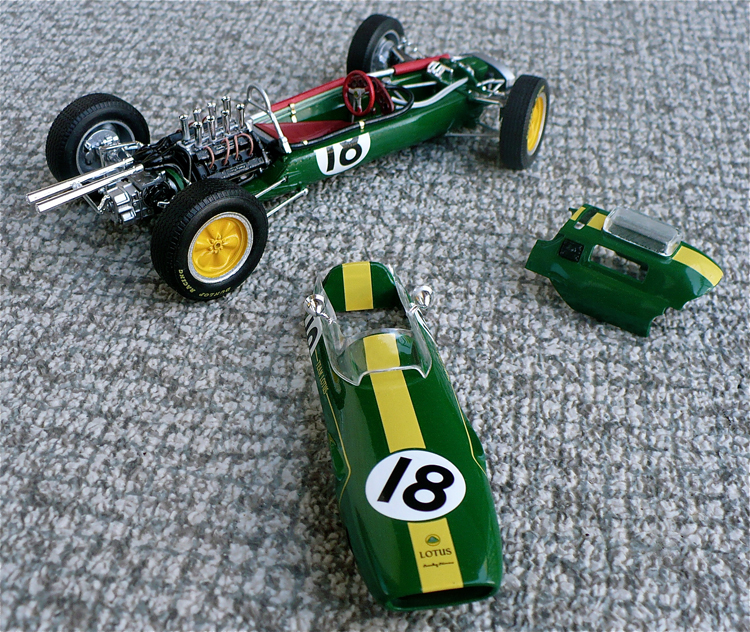
Here are some images of Tamiya's 1/20 scale Lotus 25 Formula One Racer.
Additional wiring done by yours truly.

From Wikipedia"
The Lotus 25 was a racing car designed by Colin Chapman for the 1962 Formula One season. It was a revolutionary design, the first fully stressed monocoque chassis to appear in F1. An early brainchild of Chapman's fertile mind, the original sketches for the car were made on napkins while Chapman discussed his idea while dining out with Lotus chassis designer Mike Costin.
The monocoque made the car more rigid and structurally stronger than typical F1 cars of the period. The 25 was three times stiffer than the interim 21, while the chassis weighed only half as much. As a result, the car was extremely low and narrow (frontal area only 8.0 ft², 0.74m² compared to the normal 9.5 ft², 0.88 m²)It was also envisaged to have a column gear lever, to keep cockpit width to a minimum, although this was only experimental and discarded. To assist this, the driver reclined sharply behind the wheel (an idea seen in the 18, and pioneered over a decade previously by Gustav Baumm at NSU), leading to the nickname 'The Bathtub', while front suspension pieces were moved inboard (as in the 1948 Maserati). The 25 was powered by a 1498cc Coventry Climax FWMV V8, although Reg Parnell Racing in 1964 fitted BRM P56s of similar specification to their second-hand 25s. Such was 25's effect on motor racing, even today's modern F1 cars follow its basic principles.
Some privateers who had been buying Lotus chassis were disgruntled by the fact Chapman refused to provide them 25s. These teams, including Rob Walker Racing, were given Lotus 24s, while the works team had exclusive use of the 25 for Jim Clark and Trevor Taylor. When it first appeared at the Dutch Grand Prix, the futuristic 25 was inspected by John Cooper, who asked Chapman where he had put the chassis in the car.
The car gave Clark his first Grand Prix victory, at Spa, that year. He followed by taking another win in Britain, and again in the USA, which put him in contention for the title, but at the final race, South Africa while leading, a much publicised engine seizure cost him the title to Graham Hill.
Clark gained his revenge the following year, taking his first world championship in the 25, by winning 7 races, Belgium, France, Holland, Britain, Italy, South Africa, and Mexico. Lotus also won its first constructors' championship. In addition, 25s were entered at Indianapolis, where they trialled Lucas electronic ignition for Ford. The 25 was used during the 1964 season, winning a further three races in Clark's hands. At the final race in Mexico, just as in 1962, the Climax engine developed an oil leak and with literally a lap to run Clark coasted to a halt in sight of world championship victory, this time conceding to John Surtees.
Clark went on to take the car's final win at the 1965 French Grand Prix before it was replaced by the Lotus 33. The Lotus 25 won 14 races, took 17 pole positions, and set 13 fastest laps.
In 2008/9 Lotus launched a special edition of the Elise supercharged model in the original Lotus 25 racing colours. This had track standard sports suspension and traction control. A total of 25 of these Lotus Jim Clark Type 25 cars were produced for the RHD market.

Wednesday, August 1, 2012

Volkswagen Käfer 1951/52

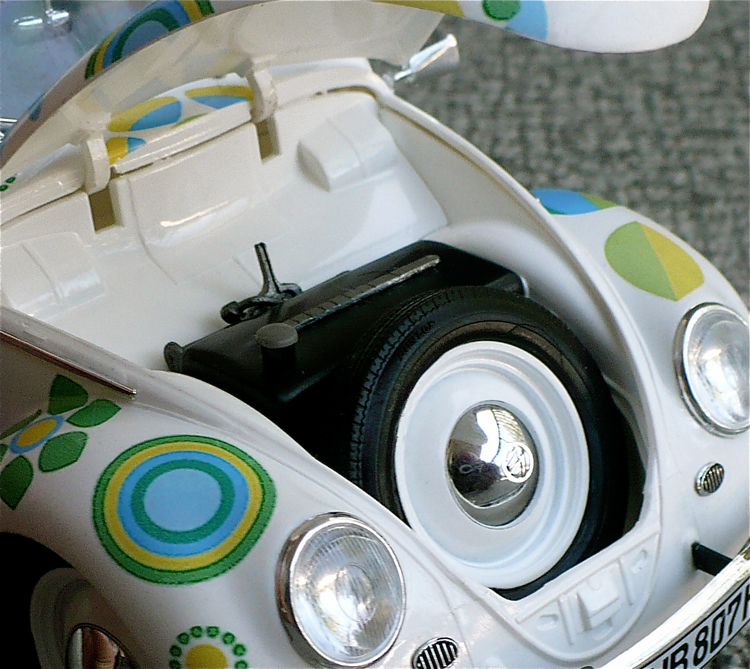
Here are some images of Revell's `/16 scale Volkswagen Käfer (Beetle) 1951/52 model.
The flower I pulled off the internet.

From Wikipedia"
The Volkswagen Beetle, officially called the Volkswagen Type 1 (or informally the Volkswagen Bug), is an economy car produced by the German auto maker Volkswagen (VW) from 1938 until 2003. With over 21 million manufactured in an air-cooled, rear-engined, rear-wheel drive configuration, the Beetle is the longest-running and most-manufactured car of a single design platform anywhere in the world.

Although designed in the 1930s, the Beetle was only produced in significant numbers from 1945 onwards, when the model was internally designated the Volkswagen Type 1, and marketed simply as the "Volkswagen". Later models were designated VW 1200, 1300, 1500, 1302 or 1303, the former three indicating engine displacement and the latter two being derived from the type number and not indicative of engine capacity. The model became widely known in its home country as the Käfer (German for "beetle") and was later marketed as such in Germany, and as the Volkswagen Beetle in other countries.
In the 1950s, the Beetle was more comfortable and powerful than most European small cars, having been designed for sustained high speed on the Autobahn. It remained a top seller in the U.S., owing much of its success to high build-quality and innovative advertising, ultimately giving rise to variants, including the Volkswagen Karmann Ghia and the Volkswagen Type 2 bus.
Along with cars including the Morris Minor, Fiat 500, Renault 4CV and Dauphine, and Citroën 2CV, the Beetle pioneered the modern continental economy car and later served as the benchmark for the initial two generations of North American compact cars, including the Chevrolet Corvair and Ford Falcon, as well as later subcompact cars such as the Chevrolet Vega and Ford Pinto.
The Beetle had marked a significant trend led by Volkswagen, Fiat, and Renault whereby the rear-engine, rear-wheel drive layout had increased from 2.6 percent of continental Western Europe's car production in 1946 to 26.6 percent in 1956. The 1948 Citroën 2CV and other European models marked a later trend to front-wheel drive in the European small car market, a trend that would come to dominate that market. In 1974, Volkswagen's own front-wheel drive Golf model succeeded the Beetle. In 1994, Volkswagen unveiled the Concept One, a "retro"-themed concept car with a resemblance to the original Beetle, and in 1998 introduced the "New Beetle", built on the Golf platform with styling recalling the original Type 1.
In a 1999 international poll for the world's most influential car of the 20th century, the Type 1 came fourth, after the Ford Model T, the Mini, and the Citroën DS.
By 2002, over 21 million Type 1s had been produced, but by 2003, annual production had dropped to 30,000 from a peak of 1.3 million in 1971. VW announced the end of production in June 2003, citing decreasing demand, and the final original Type 1 VW Beetle (No. 21,529,464) rolled off the production line at Puebla, Mexico, on 30 July 2003 – 65 years after its original launch and unprecedented 58-year production run (counting from 1945, the year VW recognizes as the first year of non-Nazi funded production). This last Beetle, nicknamed El Rey (Spanish for "The King" after a legendary Mexican song by José Alfredo Jiménez) was delivered to the company's museum in Wolfsburg, Germany.
To celebrate the occasion, Volkswagen marketed a final special series of 3,000 Beetles marketed as "Última Edición" (Final Edition) in light blue (Aquarius Blue) or beige (Harvest Moon Beige). Each car included the 1.6 engine, whitewall tires, a CD player with four speakers, chrome bumpers, trim, hub caps and exterior mirrors, a Wolfsburg emblem above the front trunk's handle, chrome glove box badge, body coloured wheels, tinted glass, a rear parcel shelf, and VW Ultima Edicion plaque.
A mariachi band serenaded production of the last car. In Mexico, there was also an advertising campaign as a goodbye for the Beetle. For example, in one of the ads was a very small parking space on the street, and many big cars tried to park in it, but could not. After a while, a sign appears in that parking space saying: "Es increíble que un auto tan pequeño deje un vacío tan grande" (It is incredible that a car so small can leave such a large void). Another depicted the rear end of a 1954 Beetle (year in which Volkswagen first established in Mexico) in the left side of the ad, reading "Erase una vez..." (Once upon a time...) and the last 2003 Beetle in the right side, reading "Fin" (The end). There were other ads with the same nostalgic tone. The Volkswagen Sedan will be used as a taxi in Mexico City until 2013. The Mexican government is removing this type of taxi and already made the green colours change into red-gold

Friday, July 27, 2012

London Black Cab

Here are some images of Aoshima's 1/24 scale London Black Cab the Austin FX4.

From Wikipedia"
A hackney or hackney carriage (also called a cab, black cab, hack or London taxi) is a carriage or automobile for hire. A livery carriage superior to the hackney was called a remise.
In the United Kingdom, the name hackney carriage today refers to a taxicab licensed by the Public Carriage Office in Greater London or by the local authority (non-metropolitan district councils or unitary authorities) in other parts of Great Britain, or by the Department of the Environment in Northern Ireland.
In the United States, the police department of the city of Boston has a Hackney Carriage Unit, analogous to taxicab regulators in other cities, that issues Hackney Carriage medallions to its taxi operators.

"An Ordinance for the Regulation of Hackney-Coachmen in London and the places adjacent" was approved by Parliament in 1654, to remedy what it described as the "many Inconveniences [that] do daily arise by reason of the late increase and great irregularity of Hackney Coaches and Hackney Coachmen in London, Westminster and the places thereabouts". The first hackney-carriage licences date from 1662, and applied literally to horse-drawn carriages, later modernised as hansom cabs (1834), that operated as vehicles for hire. There was a distinction between a general hackney carriage and a hackney coach, a hireable vehicle with specifically four wheels, two horses and six seats, and driven by a Jarvey (also spelled jarvie).
In 19th century London, private carriages were commonly sold off for use as hackney carriages, often displaying painted-over traces of the previous owner's coat of arms on the doors.
The growler was a type of four-wheel, enclosed carriage drawn by two horses used as a hackney carriage, that is, as a vehicle for hire with a coachman. It is distinguished from a cab, hansom cab or cabriolet, in that those had only two wheels. It is distinguished from most coaches by being of slightly smaller size, holding nominally four passengers, and being much less ostentatious.

Historically four-door saloon cars have been highly popular as hackney carriages, but with disability regulations growing in strength and some councils offering free licensing for disabled-friendly vehicles, many operators are now opting for wheelchair-adapted taxis such as the LTI. Other models of specialist taxis include the Peugeot E7 and rivals from Fiat, Volkswagen, Metrocab and Mercedes-Benz. These vehicles normally allow six or seven passengers, although some models can accommodate eight. Some of these 'minibus' taxis include a front passenger seat next to the driver, while others reserve this space solely for luggage.
Many black cabs have a turning circle of only 25 ft (8 m). One reason for this is the configuration of the famed Savoy Hotel: The hotel entrance's small roundabout meant that vehicles needed the small turning circle in order to navigate it. That requirement became the legally required turning circles for all London cabs, while the custom of a passenger's sitting on the right, behind the driver, provided a reason for the right-hand traffic in Savoy Court, allowing hotel patrons to board and alight from the driver's side.

The FX4 is the classic Black Cab. While the majority are black, there is in fact no requirement for them, or indeed any other make of London taxi to be black. Over the years, the FX4 has been sold under a number of different makers' names.

The FX4 London taxi was the successor to the Austin FX3, which was produced between 1948 and 1958. In its day the FX3 was the most widely used taxi in London. Like the FX3, the FX4 was designed by Austin in collaboration with Mann and Overton, the London taxi dealership that commissioned it (and paid for half of its cost) and Carbodies, the coachbuilder that built the body and assembled the cab ready for sale. The design team included Albert Moore from Austin’s engineering division, Jack Hellberg from Carbodies and David Southwell of Mann and Overton. The original design was by Austin’s Eric Bailey and it was engineered for production by Carbodies' Jake Donaldson. It would be the first London taxi to go into production that had four doors.
Like the FX3, the FX4 had a separate chassis, but with independent front suspension and dual-circuit hydraulic brakes. The first FX4, registration number VLW 431, was delivered in July 1958 and went on test with York Way Motors. The official launch was later that year at the Commercial Motor Exhibition.

Wednesday, July 25, 2012

Supermarine Spitfire F/Mk-24 Composite

Here is my composite image of Revell's (Matchbox molds) 1/32 scale Supermarine F/Mk-24 Spitfire flying over Hong Kong.

Images of the model can be seen here.

Tuesday, July 24, 2012

1953 Chevrolet Pickup Truck

Here are some images of Danbury Mint's 1/24 scale Chevorlet Advance Design 1953 Pickup Truck.
A friend of mine gave me a this model  as it had a broken front axle and a broken passenger door and he thought I might be able to do something with it. So what did I do? The pictures speak for themselves.

From Wikipedia"
General Motors' first major redesign post-World War II, the Advance Design series was billed as a bigger, stronger, and sleeker design. First available on Saturday June 28, 1947, these trucks were sold with various minor changes over the years until March 25, 1955, when the Task Force Series trucks replaced the aging Advance Design model.
From 1947 until 1955, Chevrolet trucks were number one in sales in the United States.
While GMC used this front end, and to a slightly lesser extent the cab, on all of its trucks except for the Cab Overs, there are three main sizes of this truck. The half-, three-quarter-, and full ton capacities in short and long wheelbase.

 1953 - Last year for the 216 in² I6. Hood side emblems now only read 3100, 3600, 3800, 4400, or 6400 in large print. Door post ID plate now blue with silver letters (previous models used black with silver letters). Last year to use wooden blocks as bed supports. New serial number codes: H 1/2 ton, J 3/4 ton, & L 1 ton.