Translate

Sunday, January 27, 2013

Christopher Columbus's Santa Maria 1492

Here are some images of Artesania Latina's 1/65 scale Santa Maria used by Christopher Columbus in 1492.

From Wikipedia"
The Santa María was probably a medium sized nao (carrack), about 58 ft (17.7 m) long on deck, "very little larger than 100 toneladas" (100 tons, or tuns) burthen, or burden, and was used as the flagship for the expedition. The other ships of the Columbus expedition were the smaller caravel-type ships Santa Clara, remembered as La Niña ("The Girl"), and La Pinta ("The Painted One"). All these ships were second-hand (if not third or more) and were never meant for exploration. The Niña, Pinta, and the Santa María were modest sized merchant vessels comparable in size to a modern yacht, and not the largest ships in Europe at the time. The exact measurements of length and width of the three ships have not survived, but good estimates of their size can be judged from contemporary Spanish and Portuguese ship wrecks from the late 15th and early 16th centuries; These include the ballast piles and keel lengths of the Molasses Reef Wreck and Highborn Cay Wreck in the Bahamas. Both were caravel type vessels 22 m (72 ft) in length overall, 12.6 m (41 ft) keel length and 5 to 5.7 m (16 to 19 ft) in width, and rated between 100 and 150 tons burden. The Santa María, being Columbus' largest ship, was only about this size, and the Niña and Pinta were even tinier, at only 50 to 70 tons burden (updated dimensional estimates are discussed below in the section entitled Replicas).
The Santa María was built in Castro-Urdiales, Cantabria, in Spain's north-east. It seems the ship was known to her sailors as Marigalante, Spanish for "Gallant Maria". The naos employed on Columbus's second voyage were named Marigalante and Gallega. Bartolomé de Las Casas never used La Gallega, Marigalante or Santa María in his writings, preferring to use la Capitana or La Nao.
The Santa María had a single deck and three masts. She was the slowest of Columbus's vessels but performed well in the Atlantic crossing. After engaging in festivities and drinking, Columbus ordered that the crew continue sailing to Cuba late into the night. One-by-one the crew kept falling asleep until only a cabin boy was steering the ship which caused the ship to run aground off the present-day site of Cap-Haïtien, Haiti on December 25, 1492, and was lost. Realizing that the ship was beyond repair, Columbus ordered his men to strip the timbers from the ship. The timbers from the ship were later used to build La Navidad (Christmas) because the wreck occurred on Christmas Day, north from the modern Limonade.
The anchor of the Santa María now resides in the Musée du Panthéon National Haitien (MUPANAH), in Port-au-Prince, Haiti.
Columbus's crew was not composed of criminals as is widely believed. Many were experienced seamen from the port of Palos in Andalusia and its surrounding countryside, as well as from the region of Galicia in northwest Spain. It is true, however, that the Spanish sovereigns offered an amnesty to convicts who signed up for the voyage; still, only four men took up the offer: one who had killed a man in a fight, and three friends of his who had then helped him escape from jail.
Despite the romantic legend that the Queen of Spain had used a necklace that she had received from her husband the King as collateral for a loan, the voyage was principally financed by a syndicate of seven noble Genovese bankers resident in Seville (the group was linked to Amerigo Vespucci and funds belonging to Lorenzo di Pier Francesco de Medici). Hence, all the accounting and recording of the voyage was kept in Seville. This also applies to the second voyage, even though the syndicate had by then disbanded.

Very little is known definitively about the actual dimensions of this vessel, since no documentation or illustration has survived from that era. Interest in reconstructing the Santa María started in Spain at around 1890 for the 400th anniversary of Columbus's voyage. The 1892 reconstruction, by the Spanish government, depicted the ship as a nao. A subsequent replica built in 1929 depicts the Santa María as a caravel without the high forecastle of the nao. As the ship is most commonly considered to have been a nao, the 1992 reconstruction returned to that model, and is generally considered to be an authoritative representation of modern consensus among academics and historians.
The 1992 replica was built by the Scarano Brothers Boat Building Company in Albany who later cut the ship in half with a chainsaw and transported it by semi truck to the Scioto River in Columbus, OH who paid for the replica in 1990. The replica cost about 1.2 million dollars. The ship was constructed out of white cedar wood as opposed to an oak wood used on the original to give the ship a long life in the Scioto River and to save on cost. The main mast was carved out of a single douglas fir tree like the original and was equipped with a top sail (since removed). The ship was built using power tools, with a hull length of 29.6 m (97 ft), keel length 16.1 m (53 ft), beam 7.9 m (26 ft), depth 3.2 m (10 ft) and load 223.8 metric tons of displacement. The foremast is 9.7 m (32 ft) high, the mainmast is 15.9 m (52 ft) and mizzen mast is 10.4 m (34 ft). The replica was declared by Jose Maria Martinez-Hidalgo, an internationally recognized Spanish marine historian, to be the most authentic replica of the Santa María in the world during the ship's coronation on October 12, 1991:
"I have studied Christopher Columbus for nearly fifty years. I can state that this Santa María has been perfectly rebuilt. Many compliments to the builders. I can think of only one real difference between this replica and the real Santa María. One was built in Europe, this one was built in America."
The mayor of Columbus, Dana Rinehart later christened the ship as part of the 500 year anniversary of Columbus sailing to the New World. It was rumoured that during the first christening of the ship, that the bottle did not break which is seen as bad luck. The replica has been a sight for tourism ever since.
Anchored in "Deep Sea Adventure Lake", West Edmonton Mall's Santa María is another replica located in Canada. Built at False Creek in Vancouver, British Columbia, the ship was hand-carved and hand-painted and then transported in flatbed trucks across the Rocky Mountains to Edmonton, Alberta. (I would like to point out that though its name is the Santa Maria, the ship in West Edmonton Mall looks more like a Spanish Gallion instead of a 15th century carrack).
The functional replica of Santa María was built on the island of Madeira, between July 1997 and July 1998, in the fishing village of Camara de Lobos by Robert Wijntje, a dutchman and by local craftsmen. Length of that ship is 22 m (72 ft), and width of 7 m (23 ft). In 1998, the Santa María represented the Madeira Wine Expo 98 in Lisbon, where she was visited by over 97 thousand people in only 25 days. Since then thousands more have sailed and continue to sail aboard that Santa María which is situated in Funchal.

Saturday, January 26, 2013

The Mayflower

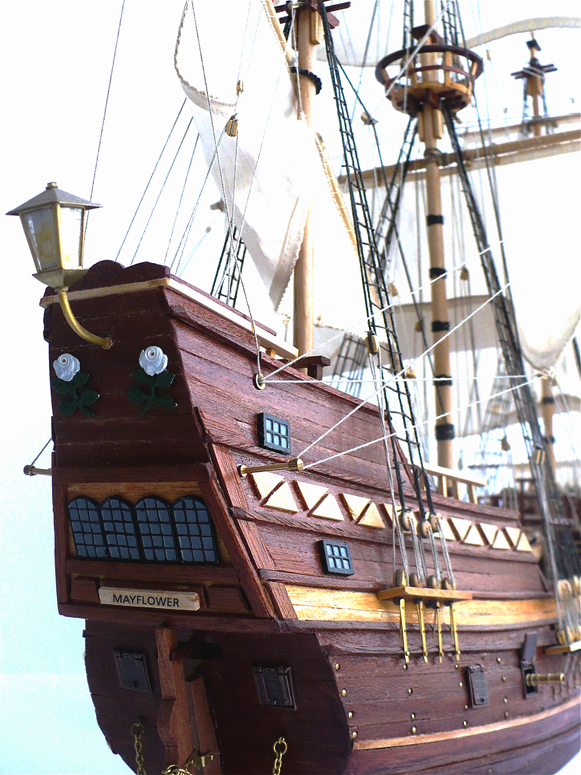
Here are some more images of Constructo's 1/65 scale Mayflower.

From Wikipedia"
When and where the Mayflower of the Pilgrim voyage of 1620 was built is not known, but it is not improbable that she was launched at Harwich in Essex county, England, and although later known ‘of London’, she was designated as ‘of Harwich’ in the Port Books of 1609-11. Harwich was the birthplace of Mayflower master Christopher Jones about 1570.
The Mayflower was rated at 180 tons—meaning it had a hold that could accommodate 180 casks of rum or wine—and was about 100 feet in length. Since Captain Jones became master eleven years prior to the Mayflower Pilgrims' voyage, the ship had sailed cross-Channel taking English woolens to France and bringing French wine to London. In addition to wine and wool, Jones had transported hats, hemp, Spanish salt, hops and vinegar to Norway and may have taken the Mayflower whaling in the North Atlantic in the Greenland area. It had traveled to Mediterranean ports, being then owned by Christopher Nichols, Robert Child, Thomas Short and Christopher Jones, the ship’s master. In 1620 Capt. Jones and Robert Child still owned their quarter shares in the ship, and it was from them that Thomas Weston chartered her in the summer of 1620 to undertake the Pilgrim voyage. Weston was deeply involved in the Mayflower voyage due to his membership in the investor group Merchant Adventurers, and eventually came to Plymouth Colony himself.
From the Port Books of England in the reign of James I (1603-1625), there were twenty-six vessels bearing the same name as the Pilgrim ship and the reason for such popularity has never been found.
A particular Mayflower that has caused historical confusion is a ‘Mayflower’ erroneously named as the Mayflower of the 1620 Pilgrims. This particular ship was partly owned by John Vassall and was outfitted for the queen in 1588 during the time of the Spanish Armada, a war for which he outfitted several ships. There are no records of this Vassall ‘Mayflower’ beyond 1594.
From records of the time, and to avoid confusion with the many other ‘Mayflower’ ships, the identity of Captain Jones’ Mayflower is based on her home port, her tonnage (est. 180-200 tons), and the master’s name in 1620.
August 1609 records first note Christopher Jones as master and part owner of the Mayflower when his ship was chartered for a voyage from London to Drontheim (Trondheim) in Norway, and back to London. Due to bad weather, on her return, the ship lost an anchor and made short delivery of her cargo of herrings. Litigation was involved and was proceeding in 1612.
In a document of January 1611, Christopher Jones is described as being ‘of Harwich’, and his ship is called the Mayflower of Harwich (in Essex co.). Records of Jones’ ship Mayflower have the ship twice in the Thames in London in 1613 – once in July and again in October and November.
Records of 1616 again state Jones’ ship was in the Thames and the noting of wine on board suggests the ship had recently been on a voyage to France, Spain, Portugal, the Canaries, or some other wine country.
After 1616, there is no record which specifically relates to Jones’ Mayflower until 1624. This is unusual for a ship trading to London, as it would not usually disappear for such a long time from the records. There is no Admiralty court document relating to the pilgrim fathers' voyage of 1620 that can be found. Perhaps the situation of the way the transfer of the pilgrims from Leyden to New England wa
The Mayflower embarked about sixty-five passengers in London, probably off Blackwall or Wapping, about the middle of July 1620 and proceeded down the Thames into the English Channel and then on to Southampton Water, the rendezvous, where for seven days she awaited the coming of the Speedwell, bringing the Leyden church members, who had sailed from Delfshaven about the 22nd of the month (Bradford).
About August 5, the two ships set sail for their destination. The unseaworthy Speedwell sprang a leak shortly after they put into Dartmouth for repairs. After the repairs, a new start was made. They were more than two hundred miles beyond Land’s End at the southwestern tip of England when Speedwell sprang another leak. Since it was now early September, they had no choice but to abandon the Speedwell and make a determination on her passengers. This was a dire event, as the ship had wasted vital funds and was considered very important to the future success of their settlement in America. Soon after the Mayflower continued on her voyage to America, Speedwell was sold, refitted, and, according to Bradford, “made many voyages…to the great profit of her owners.” Bradford later assumed that the Speedwell master Mr. Reynolds’s “cunning and deceit” (in causing what may have been ‘man-made’ leaks in the ship) had been motivated by a fear of starving to death in America.
In addition to the 102 passengers, the officers and crew consisted of about 50 persons, including about 36 men before the mast, bringing the total persons on board the Mayflower to about one hundred and fifty.
In early September, western gales begin to make the North Atlantic a dangerous place for sailing. The Mayflower's provisions, already quite low when departing Southampton, became much less by delays of more than of a month, and the passengers, having been aboard ship for all this time, were quite worn out by then and in no condition for a very taxing lengthy Atlantic journey cooped up in cramped spaces in a small ship. But on September 6, 1620, the Mayflower sailed from Plymouth with what Bradford called “a prosperous wind.”
The known names of the ship’s crew are as follows: Christopher Jones Captain/Governor; masters mates: John Clarke (Pilot), Robert Coppin (Pilot), Andrew Williamson and John Parker; Surgeon: Doctor Giles Heale; Cooper: John Alden. Alden would later marry Priscilla, daughter of William Mullins, Mayflower passengers, and together would have a large family.
Tradition has it that the last port in England for the Mayflower was actually not Plymouth but Newlyn in Cornwall on the Land's End peninsula when it was found that the water picked up at Plymouth was contaminated. Scholarly works do not mention this stop, but Newlyn has a plaque to this effort on its quay. Only the year "1620" is provided, with no date.
Aboard the Mayflower were many stores that supplied the pilgrims with the essentials needed for their journey and future lives. It is assumed that among these stores, they would have carried tools and weapons, including cannon, shot, and gunpowder; as well as some live animals, including dogs, sheep, goats, and poultry. Horses and cattle would come later. The Mayflower would also carry two boats: a long boat and a “shallop”, a sort of twenty-one foot dinghy. She also carried twelve artillery pieces (eight minions and four sakers), as the Pilgrims feared they might need to defend themselves against the Spaniards, Frenchmen, or the Dutch, as well as the Natives.

It had been a miserable passage with a huge wave crashing against the ship’s topside until a structural support timber fractured. So far the passengers had suffered agonizing delays, cold and the scorn and ridicule of the sailors, but had done everything they could the help the carpenter repair the fractured ship’s beam. A mechanical device called screw-jack was loaded on board to help them in the construction of homes in the New World. The beam was loaded into place with the screw jack making the Mayflower secure enough to continue the voyage.
There were two deaths, but this was only a precursor of what happened after their arrival in Cape Cod, where almost half the company would die in the first winter.
On November 9/19, 1620, they sighted land, which was present-day Cape Cod. After several days of trying to sail south to their planned destination of the Colony of Virginia where they had already obtained permission from the Company of Merchant Adventurers to settle, strong winter seas forced them to return to the harbor at Cape Cod hook, well north of the intended area. where they anchored on November 11/21. To establish legal order and to quell increasing strife within the ranks, the settlers wrote and signed the Mayflower Compact after the ship dropped anchor at the tip of Cape Cod on November 11/21, in what is now Provincetown Harbor. The Mayflower Compact was signed that day.
On Monday, November 27, an exploring expedition was launched to search for a settlement site under the direction of Christopher Jones. As master of the Mayflower, Jones was not required to assist in the search, but he apparently thought it in his best interest to assist the search expedition. There were thirty-four persons in an open shallop – twenty-four passengers and ten sailors. They were obviously not prepared for the bitter winter weather they encountered on their reconnoiter, the Mayflower passengers not being used to the winter weather much colder than back home. Due to the bad weather encountered on the expedition, they were forced to spend the night ashore ill-clad in below freezing temperatures with wet shoes and stockings that became frozen. “(s)ome of our people that are dead,” Bradford wrote,”took the original of their death here.”
The settlers explored the snow-covered area and discovered an empty native village. The curious settlers dug up some artificially made mounds, some of which stored corn, while others were burial sites. Nathaniel Philbrick claims that the settlers stole the corn and looted and desecrated the graves, sparking friction with the locals. Philbrick goes on to say that, as they moved down the coast to what is now Eastham, they explored the area of Cape Cod for several weeks, looting and stealing native stores as they went. He then writes about how they decided to relocate to Plymouth after a difficult encounter with the local native, the Nausets, at First Encounter Beach, in December 1620.
However, Bradford's History of Plymouth Plantation records that they took "some" of the corn to show the others back at the boat, leaving the rest. Then, later, they took what they needed from another store of grain, paying the locals back in six months, and it was gladly received.

Also there was found more of their corn and of their beans of various colors; the corn and beans they brought away, purposing to give them full satisfaction when they should meet with any of them as, about some six months afterward they did, to their good content.
During the winter, the passengers remained on board the Mayflower, suffering an outbreak of a contagious disease described as a mixture of scurvy, pneumonia and tuberculosis. When it ended, there were only 53 passengers, just over half, still alive. Likewise, half of the crew died as well. In the spring, they built huts ashore, and on March 21/31, 1621, the surviving passengers disembarked from the Mayflower. The Mayflower lay in New Plymouth harbor through the winter of 1620-1. On April 5/15, 1621, the Mayflower set sail from Plymouth to return to England, where she arrived on May 6/16, 1621.
Due to the fear of Indian attack, in late February 1621, the settlers decided to mount “our great ordnances” on the hill overlooking the settlement. Christopher Jones supervised the transportation of the “great guns” – about six iron cannons that ranged between four and eight feet in length and weighed almost half a ton. The cannon were able to hurl iron balls as big as 3 ½ inches in diameter as far as 1,700 yards. This action made what was no more than a ramshackle village almost into a well-defended fortress.
Jones had originally planned to return to England as soon as the Pilgrims found a settlement site. But after his crew members began to be ravaged by the same diseases that were felling the Pilgrims, he realized he had to remain in Plymouth Harbor “till he saw his men began to recover.”
On April 5, the Mayflower, her empty hold ballasted with stones from the Plymouth Harbor shore, set sail for England. As with the Pilgrims, her sailors had been decimated by disease. Jones had lost his boatswain, his gunner, three quartermasters, the cook, and more than a dozen sailors. The Mayflower made excellent time on her voyage back to England. The westerlies that had buffeted her coming out pushed her along going home and she arrived at the home port of Rotherhithe in London on May 6, 1621 – less than half the time it had taken her to sail to America."
Jones died after coming back from a voyage to France on March 5, 1622, at about age 52. It is suggested that his journey to the New World may have taken its toll on him. For the next two years, the Mayflower lay at her berth in Rotherhithe, not far from the grave of Captain Jones at St. Mary’s church there. By 1624, the Mayflower was no longer useful as a ship and although her subsequent fate is unknown, she was probably broken up about that time. The Mayflower was the final casualty of a voyage that had cost her master, Christopher Jones, everything he could give.”
s arranged may account for this. Or possibly many of the records of the period have been lost.

Friday, January 25, 2013

TIE M1 Experimental (Bizarro)

Here are some more images plus an older composite of my scratch 'n ' bash 1/48 scale TIE M1 Experimental (Bizarro) from the Star Wars universe.

From Wookieepedia"
The TIE Experimental M1, also known as the TIE Bizarro, was an experimental member of the TIE series and a part of the TIE Experimental Project.
One of the starfighters built by an Imperial research project led by Director Lenzer under the command of Grand Admiral Demetrius Zaarin, the M1 consisted of a single standard TIE/LN starfighter wing panel with two wing braces connected to a pair of standard TIE series cockpit pods. The port pod held the control systems, and the starboard pod held a turbolaser much heavier than the laser cannons equipped on any previous TIE.
Both pods had the trademark twin ion engines of the TIE series, and the fighter was actually slightly faster than the standard TIE/LN. The fighter was equipped with a hyperdrive, which was slaved to remote systems in a controller ship.
Rebel forces first encountered the M1 when they responded to a distress signal from a civilian convoy near the Belat system. A pair of A-wings escorting a staff transfer from Defiance to Liberty picked up the distress call during a course change between hyperspace jumps and responded to the attack. They found a squadron of TIE Experimental M1 fighters attacking a Cloburi Freight convoy, while a Beta-class ETR-3 escort transport stood by. The A-wings defeated the TIE M1s with minimal Rebel or civilian losses.
Later, when the Alliance ordered an intelligence-gathering strike on a TIE Experimental production facility, several waves of M1 fighters were found in the station's defense screen. They were also present at the main research facility, defending the hangar ship Sardis and space station Obsidian.
After the destruction of space platform Obsidian, no TIE Experimental fighters were seen again.

Thursday, January 24, 2013

Vulcan Long Range Shuttle Surak

Here are some more images of AMTs (Aluminum Model Toy) 1/187 scale Vulcan Long Range Shuttle Surak from Star Trek the Motion Picture.

From Memory Alpha"
A long range shuttle was a type of shuttlecraft utilized as a courier during the late 23rd century. They carried a Federation registry.
These long range shuttles featured a detachable cabin, capable of acting as an independent craft from the stardrive section.


In 2273, the long-range courier Surak transported Commander Spock from planet Vulcan to rendezvous with the USS Enterprise, which was en route to intercept V'Ger. (Star Trek: The Motion Picture)
In that same year, another long range shuttle, the Laika, attempted to contact the communications array Epsilon IX. (Star Trek: The Motion Picture)
A model of a long range shuttle was on display in the guest quarters aboard the USS Enterprise-D that the Brekkians Langor and Sobi stayed in late 2364. (TNG: "Symbiosis")
Wesley Crusher kept a similar model of the shuttle in his quarters aboard the Enterprise-D in 2365. (TNG: "The Dauphin")
A graphic display of a long range shuttle appeared on the USS Voyager's library computer screen that was viewed by One after Seven of Nine had activated the drone's linguistic database, and allowed him to assimilate information. (VOY: "Drone")
Throughout the rest of 2374, as well as in the year that followed, graphics of the long range shuttle appeared on the USS Defiant's library computer display. (DS9: "Favor the Bold", "Sacrifice of Angels", "What You Leave Behind")
The graphic was also seen among the data that Seven of Nine assimilated in early 2376. (VOY: "The Voyager Conspiracy")

Tuesday, January 22, 2013

Photo Montage

Here are a couple of photo montage's of my science and science fiction plus my aviation composites I have put together. I hope you like them.


Monday, January 21, 2013

Lambda Class Shuttle Composite

Here is my composite image of MPC's 1/72 scale Lambda Class Shuttle from the Star Wars universe against an intense star field.
The star field of course is a manipulation of an original star field created by Dark Maiden.

Images of the model can be seen here.

Saturday, January 19, 2013

Klingon D7 Battlecruiser Composite

Here is my composite image of Polar Lights 1/1000 scale Klingon D7 Battlecruiser from Star Trek TOS against a star field preparing to fire.

Images of the model can be seen here.

Friday, January 18, 2013

DY 100 Class Botany Bay Composite

Here is my composite image of Si Fi Spaceship Miniatures DY 100 Class Botany Bay from Star Trek TOS "Space Seed" floating in the emptiness of space.


Images of the model can be seen here.

From Memory Alpha"
DY 100 Class
The ships were especially designed for interplanetary travel. They had simple nuclear powered engines and were equipped with artificial gravity. They utilised transistors as components. DY-100 ships were launched into orbit with booster rockets. In the 1990s, this class of spaceship was considered to be one of the most advanced.
At least some of the DY-100 ships were sleeper ships. In those a crew of at least 85 could be placed into suspended animation inside life support canisters prior to liftoff. The life support of the ship was turned off for the journey. The use of suspended animation was necessary up to approximately 2018, as it took years to travel from planet to planet in the solar system prior to that.
The production of the DY-100 class ship began prior to 1996 and ended some time before the year 2000. A later generation of the class, the DY-500, was similar in configuration and some 23rd century Humans had trouble telling them apart. (TOS: "Space Seed")

Wednesday, January 16, 2013

TIE Advanced X1 Fighters Composite

Here is my composite image of AMT/ERTL 1/36 scale TIE Advanced X1 Fighters from the Star Wars universe flying in formation against a star filled sky.

Images of the model can be seen here.

Tuesday, January 15, 2013

German Orbiting Weapons Satellite From 2001 A Space Odyssey

Here are some images plus my composite of AJAModel's German Orbiting Weapons satellite from 2001 a space odyssey.

From Wikipedia"
How one views the satellites may affect one's reading of the film. Noted Kubrick authority Michel Ciment, in discussing Kubrick's attitude toward human aggression and instinct, observes "The bone cast into the air by the ape (now become a man) is transformed at the other extreme of civilization, by one of those abrupt ellipses characteristic of the director, into a spacecraft on its way to the moon." In contrast to Ciment's reading of a cut to a serene "other extreme of civilization", science fiction novelist Robert Sawyer, speaking in the Canadian documentary 2001 and Beyond, sees it as a cut from a bone to a nuclear weapons platform, explaining that "what we see is not how far we've leaped ahead, what we see is that today, '2001', and four million years ago on the African veldt, it's exactly the same—the power of mankind is the power of its weapons. It's a continuation, not a discontinuity in that jump."
Kubrick, notoriously reluctant to provide any explanation of his work, never publicly stated the intended functions of the orbiting satellites, preferring instead to let the viewer surmise what their purpose might be.

Monday, January 14, 2013

Chinese Orbiting Weapons Satellite From 2001 A Space Odyssey

Here are some images plus my composite of AJAModels Chinese Orbiting Weapons Satellite from 2001 a space odyssey.

From Wikipedia"
In the film, U.S. Air Force insignia, and flag insignia of China and Germany (including what appears to be an Iron Cross) can be seen on three of the satellites, which correspond to three of the bombs stated countries of origin in a widely circulated early draft of the script.
Production staff who continue to refer to "bombs" (in addition to Clarke) include production designer Harry Lange (previously a space industry illustrator), who has since the film's release shown his original production sketches for all of the spacecraft to Simon Atkinson, who refers to seeing "the orbiting bombs". Fred Ordway, the film's science consultant, sent a memo to Kubrick after the film's release listing suggested changes to the film, mostly complaining about missing narration and shortened scenes. One entry reads: "Without warning, we cut to the orbiting bombs. And to a short, introductory narration, missing in the present version". Multiple production staff aided in the writing of Jerome Agel's 1970 book on the making of the film, in which captions describe the objects as "orbiting satellites carrying nuclear weapons" Actor Gary Lockwood (astronaut Frank Poole) in the audio DVD commentary says the first satellite is an armed weapon, thus making the famous match-cut from bone to satellite a "weapon-to-weapon cut". Several recent reviews of the film mostly of the DVD release refer to armed satellites, possibly influenced by Gary Lockwood's audio commentary.
A few published works by scientists on the subject of space exploration or space weapons tangentially discuss 2001: A Space Odyssey and assume at least some of the orbiting satellites are space weapons. Indeed, details worked out with input from space industry experts, such as the structure on the first satellite that Pietrobon refers to as a "conning tower", match the original concept sketch drawn for the nuclear bomb platform. Modelers label them in diverse ways. On the one hand, the 2001 exhibit (given in that year) at the Tech Museum in San Jose and now online (for a subscription) referred merely to "satellites", while a special modeling exhibition at the exhibition hall at Porte de Versailles in Paris also held in 2001 (called 2001 l'odyssée des maquettes (2001: A Modeler's Odyssey)) overtly described their reconstructions of the first satellite as the "US Orbiting Weapons Platform". Some, but not all, space model manufacturers or amateur model builders refer to these entities as bombs.

Saturday, January 12, 2013

U.S. Air Force Weapons Satellite From 2001 A Space Odyssey

Here are some images plus my composite of AJA Models U.S. Air Force Weapons Satellite from 2001 a space odyssey. Scale unknown.

From Wikipedia"
In a New York Times interview in 1968, Kubrick merely referred to the satellites as "spacecraft", as does the interviewer, but he observed that the match-cut from bone to spacecraft shows they evolved from "bone-as-weapon", stating "It's simply an observable fact that all of man's technology grew out of his discovery of the weapon-tool".
Nothing in the film calls attention to the purpose of the satellites. James John Griffith, in a footnote in his book Adaptations As Imitations: Films from Novels, wrote "I would wonder, for instance, how several critics, commenting on the match-cut that links humanity's prehistory and future, can identify — without reference to Clarke's novel — the satellite as a nuclear weapon".
Arthur C. Clarke, in the TV documentary "2001: The Making Of A Myth", described the bone-to-satellite sequence in the film, saying "The bone goes up and turns into what is supposed to be an orbiting space bomb, a weapon in space. Well, that isn't made clear, we just assume it's some kind of space vehicle in a three-million-year jump cut". Former NASA research assistant Steven Pietrobon wrote "The orbital craft seen as we make the leap from the Dawn of Man to contemporary times are supposed to be weapons platforms carrying nuclear devices, though the movie does not make this clear."
The vast majority of film critics, including noted Kubrick authority Michel Ciment, interpreted the satellites as generic spacecraft (possibly Moon bound).
The perception that the satellites are nuclear weapons persists in the minds of some viewers (and some space scientists). However, due to their appearance there are statements by members of the production staff who still refer to them as weapons. Walker, in his book Stanley Kubrick, Director, noted that although the bombs no longer fit in with Kubrick's revised thematic concerns (thus becoming "red herrings"), "nevertheless from the national markings still visible on the first and second space vehicles we see, we can surmise that they are the Russian and American bombs."
Similarly, Walker in a later essay stated that two of the spacecraft seen circling Earth were meant to be nuclear weapons, after asserting that early scenes of the film "imply" nuclear stalemate. Pietrobon, who was a consultant on 2001 to the Web site Starship Modeler regarding the film's props, observes small details on the satellites such as Air Force insignia and "cannons".

Friday, January 11, 2013

French Orbiting Weapons Satellite From 2001 A Space Odyssey

Here are some images plus my composite of AJAModels French Orbiting Weapons Satellite From 2001 A Space Odyssey. Scale unknown.
This is the first of four satellite models from 2001 a space odyssey that I will be posting over the next little while, and I must say fantastic kits they are. If you're a 2001 fan these are a must have for your collection. Adam Johnson did a fantastic job in creating this kit and the ones to follow.

From Wikipedia"

Another holdover of discarded plot ideas is with regard to the famous match-cut from prehistoric bone-weapon to orbiting satellite, followed sequentially by views of three more satellites. At first, Kubrick planned to have a narrator state explicitly that these were armed nuclear weapon platforms while speaking of a nuclear stalemate between the superpowers.
This would have foreshadowed the now-discarded conclusion of the film showing the Star Child's detonating all of them. Piers Bizony, in his book 2001 Filming The Future, stated that after ordering designs for orbiting nuclear weapon platforms, Kubrick became convinced to avoid too many associations with Dr. Strangelove, and he decided not to make it so obvious that they were "war machines".
Alexander Walker, in a book he wrote with Kubrick's assistance and authorization, described the bone as "transformed into a spacecraft of the year A.D. 2001 as it orbits in the blackness around Earth", and he stated that Kubrick eliminated from his film the theme of a nuclear stalemate between the United States and the Soviet Union, each with globe-orbiting nuclear weapons. Kubrick now thought this had "no place at all in the film's thematic development", with the bombs now becoming an "orbiting red herring". Walker further noted that some filmgoers in 1968–69 would know that an agreement had been reached in 1967 between the powers not to put any nuclear weapons into outer space, and that if the film suggested otherwise, it would "merely have raised irrelevant questions to suggest this as a reality of the twenty-first century".
In the Canadian TV documentary 2001 and Beyond, Dr. Clarke stated that not only was the military purpose of the satellites "not spelled out in the film, there is no need for it to be", repeating later in this documentary that "Stanley didn't want to have anything to do with bombs after Dr. Strangelove".