Translate

Monday, March 10, 2014

Matchless G 50

Here are some images Protar's 1/9 scale Matchless G 50 Racing Motorcycle.

From Wikipedia"
The Matchless G50 is a racing British motorcycle made by Associated Motorcycles (AMC) at the former Matchless works in Plumstead, London. Developed in 1958 from the 350cc AJS 7R, but with the engine capacity increased to 500 cc, 180 G50s (for 50 bhp) were built in the next four years. Although less powerful than its main competitor the Norton Manx the G50 proved highly competitive at three hundred pounds and was faster round bends. If success is measured by longevity then this is the most successful Matchless motorcycles as high specification replicas are still being produced to this day although financial problems at AMC ended production in 1963.
In 1963, the AMA decided that the G50 should not be allowed to race in the USA as it was not based on a production street bike. Matchless solved the problem by creating the street-legal G50 CSR, fitting the G50 engine into the G80CS Scrambler frame.
The designation CSR stood for Competition, Sprung and Roadster but quickly got called the Coffee Shop racer. It later became known as the Golden Eagle after the name was used in advertising (due to the gold finish of the engine casings).
By the time the G50 was reinstated, however, it was no longer in production.
There were just two colour options - bright blue with a tan seat or bright red and black with a black seat.
  Financial problems at AMC ended production in 1963 and all the tooling and spares were sold to sidecar Grand Prix racer Colin Seeley in 1966. Seeley went on to develop the engine and made his own custom frames to produce a number of G50 'specials' some of which were known as the called the Seeley Condor. These exclusive motorcycles continue to be hand built to this day to individual customer specifications by TGA Ltd, now based in northern France. As well as building motorcycles from new parts, TGA also convert secondhand racing motorcycles for road use.

Sunday, March 9, 2014

AJS 7R 350 cc


Here are some images of Protar's 1/9 scale AJS 7R 350 cc Racing Motorcycle.

From Wikipedia"
The AJS 7R was a 350 cc racing motorcycle built from 1948 to 1963 by Associated Motor Cycles, also known as the ‘Boy Racer’, first won victories for the factory, and then went on to win races for privateers when made generally available from 1954.
A new design by Phil Walker, the chain-driven overhead camshaft 7R had the history of the pre-war AJS ‘cammy’ singles behind it. Initially, the 7R was not as powerful as its competitors, producing 32 bhp (24 kW) at 7500 rpm. The duplex frame and Teledraulic front forks remained relatively unchanged during production, while the engine had a number of changes. The included valve angle was progressively narrowed, and the crankshaft strengthened. In 1956 the engine dimensions changed from the original long-stroke 74 x 81 mm to the ‘squarer’ 75.5 x 78 mm. The AMC gearbox replaced the older Burman unit in 1958.
In 1951 AJS development engineer Ike Hatch developed a 75.5 mm bore x 78 mm stroke, three valve head version of the 7R making 36 bhp (27 kW). It was called the AJS 7R3, and was Ike's response to the Italian multi-cylinder racers. They did well enough in their first year, not as well the second. For 1954 Jack Williams, the works team manager, developed the bike further, lowering the engine in the frame, and making some tuning changes that gave 40 bhp (30 kW) @ 7800 rpm. It immediately won the first two rounds of the World Championship and took first at the Isle of Man TT. These were factory specials, but one has survived, and a second has been reconstructed from spares.
AJS 7Rs won the 1961, 62 and 63 Junior Manx TT races and came second in 1966. The 1957 AJS 7R 350 cc, with 75.5 mm bore and 78 mm stroke, gave 38.5 bhp (28.7 kW) at 7600-7800 rpm, and weighed 285 lb (129 kg). The top speed was 180-190 km/h (115-120 mph).
AMC withdrew from the world of works, and one-off, road racing at the end of the 1954, with the death of Ike Hatch, and in the face of fierce competition from the other European bikes.
After this AJS made a production version of the standard two valve AJS 7R, for privateers and a 500 cc version, badged as a Matchless G50 was also sold. By the end of production in 1963 the two valve OHC AJS 7R engine made over 40 bhp (30 kW).
 

Friday, March 7, 2014

USS Missouri BB-63

Here are some images of Trumpeter's 1/200 scale USS Missouri BB-63.
Another fantastic ship kit from Trumpeter, and at 54 inches is no slouch in size.

From Wikipedia"
USS Missouri (BB-63) ("Mighty Mo" or "Big Mo") is a United States Navy Iowa-class battleship and was the third ship of the U.S. Navy to be named in honor of the US state of Missouri. Missouri was the last battleship commissioned by the United States and was the site of the surrender of the Empire of Japan which ended World War II.
Missouri was ordered in 1940 and commissioned in June 1944. In the Pacific Theater of World War II she fought in the battles of Iwo Jima and Okinawa and shelled the Japanese home islands, and she fought in the Korean War from 1950 to 1953. She was decommissioned in 1955 into the United States Navy reserve fleets (the "Mothball Fleet"), but reactivated and modernized in 1984 as part of the 600-ship Navy plan, and provided fire support during Operation Desert Storm in January/February 1991.
Missouri received a total of 11 battle stars for service in World War II, Korea, and the Persian Gulf, and was finally decommissioned on 31 March 1992, but remained on the Naval Vessel Register until her name was struck in January 1995. In 1998, she was donated to the USS Missouri Memorial Association and became a museum ship at Pearl Harbor, Hawaii.
Missouri was one of the Iowa-class "fast battleship" designs planned in 1938 by the Preliminary Design Branch at the Bureau of Construction and Repair. She was laid down at the Brooklyn Navy Yard on 6 January 1941, launched on 29 January 1944 and commissioned on 11 June with Captain William Callaghan in command. The ship was the third of the Iowa class, but the fourth and final Iowa-class ship commissioned by the U.S. Navy. The ship was christened at her launching by Mary Margaret Truman, daughter of Harry S. Truman, then a United States Senator from Missouri.[5]
Missouri's main battery consisted of nine 16 in (406 mm)/50 cal Mark 7 guns, which could fire 2,700 lb (1,200 kg) armor-piercing shells some 20 mi (32.2 km). Her secondary battery consisted of twenty 5 in (127 mm)/38 cal guns in twin turrets, with a range of about 10 mi (16 km). With the advent of air power and the need to gain and maintain air superiority came a need to protect the growing fleet of allied aircraft carriers; to this end, Missouri was fitted with an array of Oerlikon 20 mm and Bofors 40 mm anti-aircraft guns to defend allied carriers from enemy airstrikes. When reactivated in 1984 Missouri had her 20 mm and 40 mm AA guns removed, and was outfitted with Phalanx CIWS mounts for protection against enemy missiles and aircraft, and Armored Box Launchers and Quad Cell Launchers designed to fire Tomahawk missiles and Harpoon missiles, respectively.
Missouri was the last U.S. battleship to be completed. Wisconsin, the highest-numbered U.S. battleship built, was completed before Missouri; BB-65 to BB-71 were ordered but cancelled.
 
After the Japanese agreed to surrender, Admiral Sir Bruce Fraser of the Royal Navy, the Commander of the British Pacific Fleet, boarded Missouri on 16 August and conferred the honour of Knight of the British Empire upon Admiral Halsey. Missouri transferred a landing party of 200 officers and men to the battleship Iowa for temporary duty with the initial occupation force for Tokyo on 21 August. Missouri herself entered Tokyo Bay early on 29 August to prepare for the signing by Japan of the official instrument of surrender.
High-ranking military officials of all the Allied Powers were received on board on 2 September, including Chinese General Hsu Yung-Ch'ang, British Admiral-of-the-Fleet Sir Bruce Fraser, Soviet Lieutenant-General Kuzma Nikolaevich Derevyanko, Australian General Sir Thomas Blamey, Canadian Colonel Lawrence Moore Cosgrave, French Général d'Armée Philippe Leclerc de Hautecloque, Dutch Vice Admiral Conrad Emil Lambert Helfrich, and New Zealand Air Vice Marshal Leonard M. Isitt.
Fleet Admiral Chester Nimitz boarded shortly after 0800, and General of the Army Douglas MacArthur, the Supreme Commander for the Allies, came on board at 0843. The Japanese representatives, headed by Foreign Minister Mamoru Shigemitsu, arrived at 0856. At 0902, General MacArthur stepped before a battery of microphones and opened the 23-minute surrender ceremony to the waiting world by stating, "It is my earnest hope—indeed the hope of all mankind—that from this solemn occasion a better world shall emerge out of the blood and carnage of the past, a world founded upon faith and understanding, a world dedicated to the dignity of man and the fulfillment of his most cherished wish for freedom, tolerance, and justice."
During the surrender ceremony, the deck of Missouri was decorated with a 31-star American flag that had been taken ashore by Commodore Matthew Perry in 1853 after his squadron of "Black Ships" sailed into Tokyo Bay to force the opening of Japan's ports to foreign trade. This flag was actually displayed with the reverse side showing, i.e., stars in the upper right corner: the historic flag was so fragile that the conservator at the Naval Academy Museum had sewn a protective linen backing to one side to help secure the fabric from deteriorating, leaving its "wrong side" visible. The flag was displayed in a wood-framed case secured to the bulkhead overlooking the surrender ceremony. Another U.S. flag was raised and flown during the occasion, a flag that some sources have indicated was in fact that flag which had flown over the U.S. Capitol on 7 December 1941. This is not true; it was a flag taken from the ship's stock, according to Missouri's Commanding Officer, Captain Stuart "Sunshine" Murray, and it was "...just a plain ordinary GI-issue flag".
By 09:30 the Japanese emissaries had departed. In the afternoon of 5 September, Admiral Halsey transferred his flag to the battleship South Dakota, and early the next day Missouri departed Tokyo Bay. As part of the ongoing Operation Magic Carpet she received homeward bound passengers at Guam, then sailed unescorted for Hawaii. She arrived at Pearl Harbor on 20 September and flew Admiral Nimitz's flag on the afternoon of 28 September for a reception.


With the collapse of the Soviet Union in the early 1990s and the absence of a perceived threat to the United States came drastic cuts in the defense budget, and the high cost of maintaining and operating battleships as part of the United States Navy's active fleet became uneconomical; as a result, Missouri was decommissioned on 31 March 1992 at Long Beach, California. Her last commanding officer, Captain Albert L. Kaiss, wrote in the ship's final Plan of the Day:

Our final day has arrived. Today the final chapter in battleship Missouri’s history will be written. It's often said that the crew makes the command. There is no truer statement ... for it's the crew of this great ship that made this a great command. You are a special breed of sailors and Marines and I am proud to have served with each and every one of you. To you who have made the painful journey of putting this great lady to sleep, I thank you. For you have had the toughest job. To put away a ship that has become as much a part of you as you are to her is a sad ending to a great tour. But take solace in this—you have lived up to the history of the ship and those who sailed her before us. We took her to war, performed magnificently and added another chapter in her history, standing side by side our forerunners in true naval tradition. God bless you all.

—Captain Albert L. Kaiss

Missouri facing the sunken Arizona.
Missouri returned to be part of the reserve fleet at Puget Sound Naval Shipyard, Bremerton, Washington, until 12 January 1995, when she was struck from the Naval Vessel Register. She remained in Bremerton, but was not open to tourists as she had been from 1957 to 1984. In spite of attempts by citizens' groups to keep her in Bremerton and be re-opened as a tourist site, the U.S. Navy wanted to pair a symbol of the end of World War II with one representing its beginning. On 4 May 1998, Secretary of the Navy John H. Dalton signed the donation contract that transferred her to the nonprofit USS Missouri Memorial Association (MMA) of Honolulu, Hawaii. She was towed from Bremerton on 23 May to Astoria, Oregon, where she sat in fresh water at the mouth of the Columbia River to kill and drop the saltwater barnacles and sea grasses that had grown on her hull in Bremerton, then towed across the eastern Pacific, and docked at Ford Island, Pearl Harbor on 22 June, just 500 yd (460 m) from the Arizona Memorial. Less than a year later, on 29 January 1999, Missouri was opened as a museum operated by the MMA.

Plaque commemorating the surrender of Japan to end World War II
Originally, the decision to move Missouri to Pearl Harbor was met with some resistance. The National Park Service expressed concern that the battleship, whose name has become synonymous with the end of World War II, would overshadow the battleship Arizona, whose dramatic explosion and subsequent sinking on 7 December 1941 has since become synonymous with the attack on Pearl Harbor. To help guard against this perception Missouri was placed well back from and facing the Arizona Memorial, so that those participating in military ceremonies on Missouri's aft decks would not have sight of the Arizona Memorial. The decision to have Missouri's bow face the Arizona Memorial was intended to convey that Missouri now watches over the remains of Arizona so that those interred within Arizona's hull may rest in peace.
Missouri was listed on the National Register of Historic Places on 14 May 1971 for hosting the signing of the instrument of Japanese surrender that ended World War II. She is not eligible for designation as a National Historic Landmark because she was extensively modernized in the years following the surrender.
On 14 October 2009, Missouri was moved from her berthing station on Battleship Row to a drydock at the Pearl Harbor Naval Shipyard to undergo a three-month overhaul. The work, priced at $18 million, included installing a new anti-corrosion system, repainting the hull, and upgrading the internal mechanisms. Drydock workers reported that the ship was leaking at some points on the starboard side. The repairs were completed the first week of January 2010 and the ship was returned to her berthing station on Battleship Row on 7 January 2010. The ship's grand reopening occurred on 30 January.
Missouri received three battle stars for her service in World War II, five for her service during the Korean War, and three for her service during the Gulf War. Missouri also received numerous awards for her service in World War II, Korea, and the Persian Gulf.

Tuesday, February 25, 2014

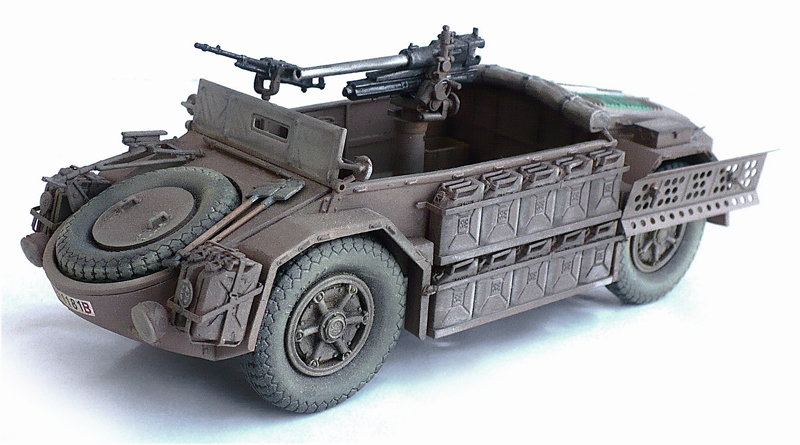
Camionetta Desertica SPA-Viberti AS.42


Here are some images of Italeri's 1/35 scale
Camionetta Desertica SPA-Viberti AS.42.

From Wikipedia"
                                                                                                                                "Camionetta Desertica SPA-Viberti AS.42, this vehicle, specifically designed to operate in the desert, was a four wheels drive car entered in service with Saharan units in November 1942. It was built on the same chassis of the AB.40/41 armoured car but it was not armoured. It was powered with a 100HP gasoline engine and reached a maximum speed of 85 Km/h. This easily recognizable vehicle, had racks on the sides to carry 24 jerrycans (most fuel) and a spare tire on the front hood. It could carry a crew of six and different kind of weapons like the 20mm Breda cannon, the 47/32 Anti-tank cannon, the 20mm Anti-tank Soloturn rifle and up to three Breda mod. 37 machineguns. The AS.42 was 1,49 meter high, 5,20 meters long and 1,80 meters wide.

Monday, February 24, 2014

Bruckenleger IVb Bridge Layer.

Here are some images of Trumpeter Models 1/35 scale Bruckenleger IVb Bridge Layer.


Sunday, February 23, 2014

Firespray-31-Class Patrol And Attack Craft, Slave 1

Here are some images of MPC's 1/84 scale Firespray-31-class patrol and attack craft, Slave 1.

From Wookieepedia"
The Firespray-31-class patrol and attack craft, or Firespray-class starship, or Firespray-class interceptor, was a patrol and transport starship designed by Kuat Systems Engineering initially for use by the Republic Correctional Authority. The most well known of the starships was Jango and Boba Fett's ship, the Slave I
As a prisoner transport, the ship featured numerous holding cells and devices made for the most exotic of creatures. A trademark of the ship was that it landed horizontally with the drive engines facing the surface and the cockpit facing upward. To transition to normal flight mode, the ship rotated so that the cockpit faced forward while the drive engines faced rearward.
The stock ship was well armed and armored for its size, with on-board storage space and room for several passengers and/or cargo. Roughly as fast as Koensayr's Y-wing starfighter/bomber, the ship had more than enough speed and maneuverability to intercept smugglers and other renegades. 

 Kuat Systems Engineering produced several prototypes shortly before the Battle of Naboo. However, all but one were destroyed when Jango Fett staged a prison break on Oovo IV. Jango kept the sole remaining Firespray, renaming it Slave I. Kuat Systems Engineering, suffering from the financial loss of the prototypes, eventually mothballed the project and concentrated instead on starship upgrades.
Many years later, K.S.E. found themselves on a more secure financial footing, and again desired to enter the starship market. The company then re-introduced the Firespray-class, hoping to build upon the reputation of the remaining prototype and its legendary pilot, Boba Fett.
The new Firesprays were, like the original prototypes, designated as patrol and attack ships and perfectly suited for law enforcement and interdiction missions. With Kuat Systems Engineering keen to expand the market for the ship, they had started to promote how easily the ship could be customized and upgraded to fulfill a myriad of roles.
At least ten were used by the Mandalorian Protectors during the Yuuzhan Vong War[source?]. By 137 ABY, these ships were legendary, but regarded as myth. During this time, Deliah Blue found and rebuilt one that was in such an advanced state of disrepair as to be falling apart. 

Slave I was a modified prototype Firespray-31-class patrol and attack craft used by famed bounty hunters Jango Fett and his cloned "son", Boba Fett. It was greatly modified with advanced weapons systems by both Fetts during their respective use.
Originating from Oovo IV, the ship was stolen by Jango Fett, replacing his previous ship, Jaster's Legacy. After Jango's death on Geonosis in 22 BBY, the ship was inherited by Boba Fett and used on several missions during and after the Clone Wars. It was subsequently replaced by the Slave II, Slave III, and Slave IV.

Space Station V

Here are some more images of my scratch built model of Space Station Five from 2001 A Space Odyssey.  The materials I used for this model were a 4'x8' sheet of 1mm styrene plastic, 1/2 inch PVC electrical pipe (this is what determined its size), the windows are from a coil book binder punch and various types of sheet and strip styrene for structure and detail.
At the time when I built this model there were (or at least I don’t think there were) really any reliable blueprints of this model kicking around. So what did I do? Answer put the movie into the player, fast forward to the pertinent points in the movie and start taking measurements which is exactly what I did. Now some eagle eyed individuals will no doubt point out some mistakes on my model when compared to the original (which by the way was tossed into a farmer’s field in the early seventies and then was never seen again, what a crying shame). All I can say to those eagle eyed viewers is Hey! I took the measurements off a friggen TV set for crying out load gimmi a break!
From Wikipedia "
Space Station V is a fictional space station seen in the movie 2001: A Space Odyssey. Operational, it is a large, international, rotating wheel space station used as a transfer point from Low Earth orbit to the moon and other planets. It also functions as an orbital hotel, mostly operated by Hilton Hotels. Rotation of the station provides artificial gravity for people aboard the station. The station contains two docking bays for docking spacecraft and is placed on its rotational axis at the opposite sides of the construction. By the time of events depicted in the film, it is still under construction, with the incomplete second wheel.
The rotating wheel depicted in the movie traces its lineage back to wheeled space station designs by Wernher von Braun and Herman Potočnik, the latter describing such a space station design in his book The Problem of Space Travel - The Rocket Motor (1928). The studio model was reported to be eight feet wide (Bizony) or six feet wide (Agel), and stuffed with tiny lights behind the windows. Due to its large size and spidery structure, the model always seemed in danger of breaking apart. Kubrick had most of the models and props used in 2001 destroyed or discarded, or stored away and inaccessible, so that they wouldn't be used in any movies not under his control. In the early 1970s, when the MGM studio in Borehamwood, England where the film was made was demolished, the model for Space Station V was dumped in a field about 20 miles from Borehamwood. It was destroyed by vandals a few days later.

Saturday, February 22, 2014

Lockheed Sea Shadow IX-529

Here are some images of Revell's 1/144 scale Lockheed Sea Shadow IX-529, built for a client.

From Wikipedia'
Sea Shadow (IX-529) was an experimental stealth ship built by Lockheed for the United States Navy to determine how a low radar profile might be achieved and to test high stability hull configurations which have been used in oceanographic ships.
Sea Shadow was built in 1984 to examine the application of stealth technology on naval vessels. She was used in secret until a public debut in 1993. In addition, the ship was designed to test the use of automation to enable the reduction of crew size. The ship was created by the Defense Advanced Research Projects Agency (DARPA), the U.S. Navy and Lockheed. Sea Shadow was developed at Lockheed's Redwood City, California, facility, inside the Hughes Mining Barge (HMB-1), which functioned as a floating drydock during construction and testing.


Sea Shadow had a SWATH hull design. Below the water were submerged twin hulls, each with a propeller, aft stabilizer, and inboard hydrofoil. The portion of the ship above water was connected to the hulls via the two angled struts. The SWATH design helped the ship remain stable even in very rough water of up to sea state 6 (wave height of 18 feet (5.5 m) or "very rough" sea). The shape of the superstructure was sometimes compared to the casemate of the ironclad ram CSS Virginia of the American Civil War. Sea Shadow was built in Redwood City, California.
The T-AGOS 19-and-23-class oceanographic ships have inherited the stabilizer and canard method to help perform their stability-sensitive surveillance missions.
Sea Shadow had only 12 bunks aboard, one small microwave oven, a refrigerator and table. She was never intended to be mission capable and was never commissioned, although she is listed in the Naval Vessel Register.
Sea Shadow was revealed to the public in 1993, and was housed at the San Diego Naval Station until September 2006, when she was relocated with the Hughes Mining Barge to the Suisun Bay Reserve Fleet in Benicia, California. Until 2006, Sea Shadow and the HMB-1 were maintained and operated by Lockheed Martin for the U. S. Navy. The vessels were available for donation to a maritime museum.
In 2006, the U.S Navy began to try to sell Sea Shadow to the highest bidder; after the initial offering met with a lack of interest, it was listed for dismantling sale on gsaauctions.gov. The U.S. Government required that the buyer not sail the ship and is required to scrap the ship. The ship was finally sold in 2012. Sea Shadow was totally dismantled in 2012 by Bay Ship.


Friday, February 21, 2014

Kazon Shuttle

Here are some more images of Monogram's Kazon Shuttle/Torpedo from Star Trek Voyager. 
This kit was released back in 1998 during Voyager's peak, and even then I don't think this kit was very popular.
I think because  most people couldn't picture in their minds exactly as to where it came from.
Sure we new it was Star Trek Voyager but what episodes?
Only the truly die hard fan knew where it was from, but for general mass appeal it wasn't well... that appealing or well known.
This is why I suspect that this kit will probably never be re released. Perhaps in 40 years like the Romulan Bird of Prey was. But I could be wrong.

From Memory Alpha"                      
A Kazon shuttle was a type of auxiliary craft utilized by the Kazon during the 2370s. These vessels were smaller in size than a Kazon raider, and could be manned by a crew of as many as three.
With the assistance of Seska, Maje Culluh of the Kazon-Nistrim had the bow of a Kazon shuttle specially modified for use in what was later a successful raid on USS Voyager in 2372.
The Kazon then lured Voyager to an ionized hydrogen cloud with an automated message beacon that transmitted a Starfleet frequency. When Voyager attempted to tractor in the beacon, they were attacked by Cullah's raider. The raider focused its attack onto on section of Voyager's shields, which created a hole that the shuttle, which had been hiding in the hydrogen cloud, passed through so as to puncture a hole in Voyager's hull.
Once aboard, the three Kazon aboard proceeded to the transporter room, where they were able to successfully steal a transporter module and return to their mother ship.
As a result of the attack, the Kazon shuttle remained lodged partway into Voyager's hull, making it impossible to the ship to create a stable warp field. Removal of the shuttle was accomplished by rerouting additional power to the containment field, and then towing the lodged shuttle out with one of Voyager's shuttles.
Neelix, who had several dealings with the Kazon during the years prior to that incident stated that he had "never seen the Kazon do anything like this before." Tuvok explained the situation, stating "until now, the Kazon have never had an adviser with Cardassian, Maquis and Starfleet tactical experience." (VOY: "Maneuvers")
Lieutenant Tom Paris used a shuttle to escape from a Kazon vessel after discovering the identity of the spy working for the Kazon-Nistrim. (VOY: "Investigations")