Here are some images of Hasbro/Kitbash 1/6 scale Speeder Bike from the Star Wars universe.
To paint this model in a winter scheme I had to tear it apart first upon which everything was repainted, weathered and then reassembled.
To create a winterized version I added hand warmers over the grips. Toe warmers on the foot rests. A wind/debris shield over the instrument panel, and some greebly bits.
From Wikipedia"
Speeder bikes and swoop bikes are small, fast transports that use repulsorlift engines in the fictional Star Wars universe. Star Wars Episode VI: Return of the Jedi includes a prominent speeder bike chase; speeders and swoops also appear in Star Wars Episode I: The Phantom Menace, Star Wars Episode II: Attack of the Clones, Star Wars Episode III: Revenge of the Sith, Star Wars Episode IV: A New Hope, and the Star Wars Expanded Universe's books, comics, and games.
Various concept sketches came from producer George Lucas' call for a "rocket-powered scooter" in Return of the Jedi. While Industrial Light & Magic's (ILM) Nilo Rodis-Jamero designed a blocky vehicle with a large engine, Ralph McQuarrie's designs were more fanciful but with less of a sense of the vehicle's power source. The final designs resulted in full-scale Imperial speeder bikes used by the actors for film against a bluescreen, along with miniatures mounted by articulated puppets. ILM used a steadicam recording at 1 frame per second to record the speeder bikes' path through the forest moon of Endor -- in reality, a California forest.
Playing the footage at the standard rate of 24 frames per second caused
a blurring effect, what looked like 100MPH actually was shot at 5MPH,
which ILM used to simulate the vehicles' high speed.
The BARC speeder in Revenge of the Sith was designed to appear like a predecessor to the speeder bikes in Return of the Jedi. ILM's Doug Chiang designed Darth Maul's (Ray Park) speeder in The Phantom Menace to resemble a scythe, and Chiang's initial designs for the droid army's STAP vehicle resembled the speeder bikes from Return of the Jedi. An all-CGI swoop appearing in A New Hope stems from a design created for Star Wars: Shadows of the Empire, and the swoop also appears briefly in The Phantom Menace.
Return of the Jedi features a speeder bike chase in which Luke Skywalker (Mark Hamill) and Leia Organa (Carrie Fisher) pilot a pair of Imperial speeders to chase down scout troopers who might reveal the Rebel Alliance's presence on Endor. Darth Maul uses his speeder to chase down Qui-Gon Jinn (Liam Neeson) and Anakin Skywalker (Jake Lloyd) in The Phantom Menace. A pair of speeder-mounted clone troopers shoot down a speeder-riding Stass Allie when Emperor Palpatine (Ian McDiarmid) initiates Order 66 in Revenge of the Sith.
Film and Expanded Universe depictions of speeder bikes and swoops
consistently portray the vehicles as fast and maneuverable: Expanded
Universe material describes the speeder bikes in Return of the Jedi as being able to travel 500 kilometers per hour. Speeders and swoops achieve high speed and maneuverability, however, at the expense of size and protection for their riders. "Swoop racing" is described in the Expanded Universe texts and portrayed in LucasArts games as a dangerous, fast-paced competition between skilled pilots.
Translate
Tuesday, August 12, 2014
Thursday, August 7, 2014
Bell Medivac AC H-13H Sioux
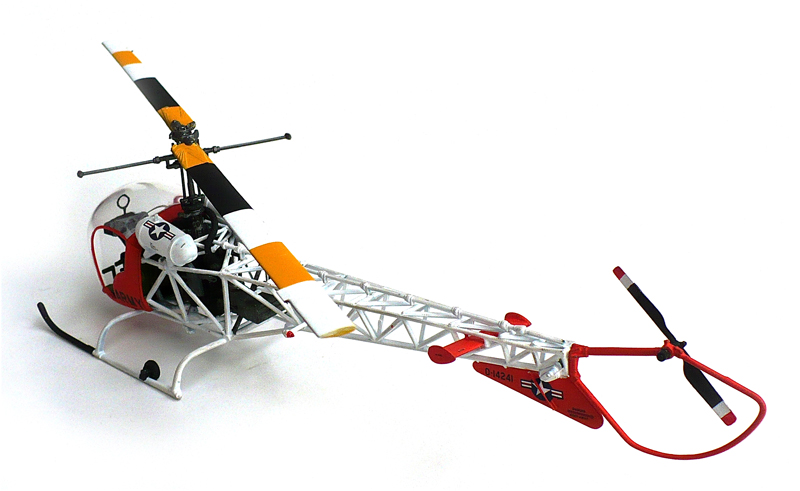
Here are some images of Revell's 1/32 scale Bell Medivac AC H-13H Sioux.
From Wikipedia"
The Bell H-13 Sioux was a two-bladed, single engine, light helicopter built by Bell Helicopter. Westland Aircraft manufactured the Sioux under license for the British military as the Sioux AH.1 and HT.2.
In 1947, the United States Army Air Forces (later the United States Air Force) ordered the improved Bell Model 47A. Most were designated YR-13 and three winterized versions were designated YR-13A. The United States Army first ordered Bell 47s in 1948 under the designation H-13. These would later receive the name Sioux.
Initially, the United States Navy procured several Bell 47s, designated HTL-1, between 1947 and 1958. The United States Coast Guard evaluated this model, and procured two HTL-1s for multi-mission support in the New York Harbor. The most common U.S. Navy version of the 47 was designated the HTL-4, and dispenses with the fabric covering on the tail boom. The U.S. Coast Guard procured three HTL-5s in 1952 (similar to the HTL-4 but powered by a Franklin O-335-5 engine) and used these until 1960. The Coast Guard procured two of Bell's Model 47G and designated them HUL-1G in 1959.
The H-13 was used as observation helicopter early in the Vietnam War, before being replaced by the OH-6 Cayuse.
The Bell 47 was ordered by the British Army as the Sioux to meet specification H.240, with licensed production by Westland Helicopters. In order to comply with the terms of its licence agreement with Sikorsky Aircraft, which prevented it building a U.S. competitors aircraft, Westland licenced the Model 47 from Agusta, who had purchased a license from Bell. the first contract was for 200 helicopters. The first 50 helicopters of the contract were built by Agusta at Gallarate in Italy followed by 150 built by Westland at Yeovil. The first Westland Sioux made its maiden flight on 9 March 1965.
The Sioux is a three-seat observation and basic training helicopter. In 1953 the Bell 47G design was introduced. It can be recognized by the full bubble canopy, exposed welded-tube tail boom, saddle fuel tanks and skid landing gear. In its UH-13J version, based on the Bell 47J, it had a metal-clad tail boom and fuselage and an enclosed cockpit and cabin.
The H-13 and its military variants were often equipped with medical evacuation panniers, one to each skid, with an acrylic glass shield to protect the patient from wind.
A single 260 hp Lycoming VO-435 piston engine was fitted to the 47G variant. Fuel was fed from two high-mounted external tanks. A single two-bladed rotor with short inertial stabilizing minor blades was used on the Sioux.
From Wikipedia"
The Bell H-13 Sioux was a two-bladed, single engine, light helicopter built by Bell Helicopter. Westland Aircraft manufactured the Sioux under license for the British military as the Sioux AH.1 and HT.2.
In 1947, the United States Army Air Forces (later the United States Air Force) ordered the improved Bell Model 47A. Most were designated YR-13 and three winterized versions were designated YR-13A. The United States Army first ordered Bell 47s in 1948 under the designation H-13. These would later receive the name Sioux.
Initially, the United States Navy procured several Bell 47s, designated HTL-1, between 1947 and 1958. The United States Coast Guard evaluated this model, and procured two HTL-1s for multi-mission support in the New York Harbor. The most common U.S. Navy version of the 47 was designated the HTL-4, and dispenses with the fabric covering on the tail boom. The U.S. Coast Guard procured three HTL-5s in 1952 (similar to the HTL-4 but powered by a Franklin O-335-5 engine) and used these until 1960. The Coast Guard procured two of Bell's Model 47G and designated them HUL-1G in 1959.
The H-13 was used as observation helicopter early in the Vietnam War, before being replaced by the OH-6 Cayuse.
The Bell 47 was ordered by the British Army as the Sioux to meet specification H.240, with licensed production by Westland Helicopters. In order to comply with the terms of its licence agreement with Sikorsky Aircraft, which prevented it building a U.S. competitors aircraft, Westland licenced the Model 47 from Agusta, who had purchased a license from Bell. the first contract was for 200 helicopters. The first 50 helicopters of the contract were built by Agusta at Gallarate in Italy followed by 150 built by Westland at Yeovil. The first Westland Sioux made its maiden flight on 9 March 1965.
The Sioux is a three-seat observation and basic training helicopter. In 1953 the Bell 47G design was introduced. It can be recognized by the full bubble canopy, exposed welded-tube tail boom, saddle fuel tanks and skid landing gear. In its UH-13J version, based on the Bell 47J, it had a metal-clad tail boom and fuselage and an enclosed cockpit and cabin.
The H-13 and its military variants were often equipped with medical evacuation panniers, one to each skid, with an acrylic glass shield to protect the patient from wind.
A single 260 hp Lycoming VO-435 piston engine was fitted to the 47G variant. Fuel was fed from two high-mounted external tanks. A single two-bladed rotor with short inertial stabilizing minor blades was used on the Sioux.
Bell OH-13 H Sioux
Here are some images of Revell's 1/35 scale Bell OH-13H Sioux Helicopter.
According to the instructions the colour scheme is referred to as "Arctic/Desert/Jungle scheme".
That's right a "Arctic/Desert/Jungle scheme". What the F...?
From Wikipedia"
The Bell H-13 Sioux was a two-bladed, single engine, light helicopter built by Bell Helicopter. Westland Aircraft manufactured the Sioux under license for the British military as the Sioux AH.1 and HT.2.
In 1947, the United States Army Air Forces (later the United States Air Force) ordered the improved Bell Model 47A. Most were designated YR-13 and three winterized versions were designated YR-13A. The United States Army first ordered Bell 47s in 1948 under the designation H-13. These would later receive the name Sioux.
Initially, the United States Navy procured several Bell 47s, designated HTL-1, between 1947 and 1958. The United States Coast Guard evaluated this model, and procured two HTL-1s for multi-mission support in the New York Harbor. The most common U.S. Navy version of the 47 was designated the HTL-4, and dispenses with the fabric covering on the tail boom. The U.S. Coast Guard procured three HTL-5s in 1952 (similar to the HTL-4 but powered by a Franklin O-335-5 engine) and used these until 1960. The Coast Guard procured two of Bell's Model 47G and designated them HUL-1G in 1959.
The H-13 was used as observation helicopter early in the Vietnam War, before being replaced by the OH-6 Cayuse.
The Bell 47 was ordered by the British Army as the Sioux to meet specification H.240, with licensed production by Westland Helicopters. In order to comply with the terms of its licence agreement with Sikorsky Aircraft, which prevented it building a U.S. competitors aircraft, Westland licenced the Model 47 from Agusta, who had purchased a license from Bell. the first contract was for 200 helicopters. The first 50 helicopters of the contract were built by Agusta at Gallarate in Italy followed by 150 built by Westland at Yeovil. The first Westland Sioux made its maiden flight on 9 March 1965.
The Sioux is a three-seat observation and basic training helicopter. In 1953 the Bell 47G design was introduced. It can be recognized by the full bubble canopy, exposed welded-tube tail boom, saddle fuel tanks and skid landing gear. In its UH-13J version, based on the Bell 47J, it had a metal-clad tail boom and fuselage and an enclosed cockpit and cabin.
The H-13 and its military variants were often equipped with medical evacuation panniers, one to each skid, with an acrylic glass shield to protect the patient from wind.
A single 260 hp Lycoming VO-435 piston engine was fitted to the 47G variant. Fuel was fed from two high-mounted external tanks. A single two-bladed rotor with short inertial stabilizing minor blades was used on the Sioux.
According to the instructions the colour scheme is referred to as "Arctic/Desert/Jungle scheme".
That's right a "Arctic/Desert/Jungle scheme". What the F...?
From Wikipedia"
The Bell H-13 Sioux was a two-bladed, single engine, light helicopter built by Bell Helicopter. Westland Aircraft manufactured the Sioux under license for the British military as the Sioux AH.1 and HT.2.
In 1947, the United States Army Air Forces (later the United States Air Force) ordered the improved Bell Model 47A. Most were designated YR-13 and three winterized versions were designated YR-13A. The United States Army first ordered Bell 47s in 1948 under the designation H-13. These would later receive the name Sioux.
Initially, the United States Navy procured several Bell 47s, designated HTL-1, between 1947 and 1958. The United States Coast Guard evaluated this model, and procured two HTL-1s for multi-mission support in the New York Harbor. The most common U.S. Navy version of the 47 was designated the HTL-4, and dispenses with the fabric covering on the tail boom. The U.S. Coast Guard procured three HTL-5s in 1952 (similar to the HTL-4 but powered by a Franklin O-335-5 engine) and used these until 1960. The Coast Guard procured two of Bell's Model 47G and designated them HUL-1G in 1959.
The H-13 was used as observation helicopter early in the Vietnam War, before being replaced by the OH-6 Cayuse.
The Bell 47 was ordered by the British Army as the Sioux to meet specification H.240, with licensed production by Westland Helicopters. In order to comply with the terms of its licence agreement with Sikorsky Aircraft, which prevented it building a U.S. competitors aircraft, Westland licenced the Model 47 from Agusta, who had purchased a license from Bell. the first contract was for 200 helicopters. The first 50 helicopters of the contract were built by Agusta at Gallarate in Italy followed by 150 built by Westland at Yeovil. The first Westland Sioux made its maiden flight on 9 March 1965.
The Sioux is a three-seat observation and basic training helicopter. In 1953 the Bell 47G design was introduced. It can be recognized by the full bubble canopy, exposed welded-tube tail boom, saddle fuel tanks and skid landing gear. In its UH-13J version, based on the Bell 47J, it had a metal-clad tail boom and fuselage and an enclosed cockpit and cabin.
The H-13 and its military variants were often equipped with medical evacuation panniers, one to each skid, with an acrylic glass shield to protect the patient from wind.
A single 260 hp Lycoming VO-435 piston engine was fitted to the 47G variant. Fuel was fed from two high-mounted external tanks. A single two-bladed rotor with short inertial stabilizing minor blades was used on the Sioux.
Tuesday, August 5, 2014
Lambda Class Shuttle
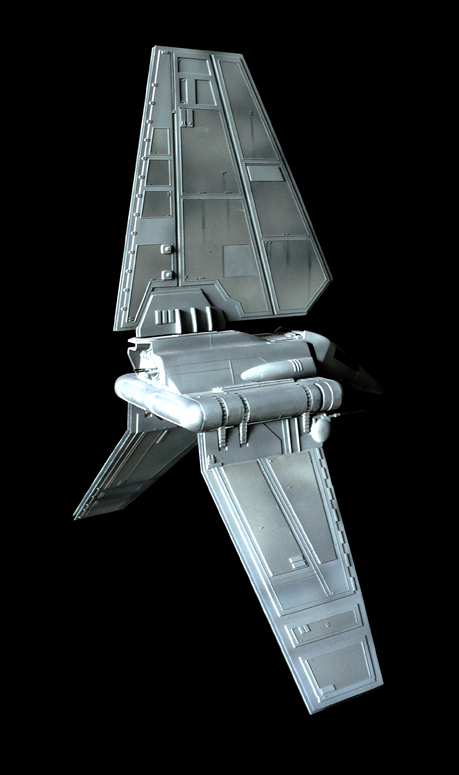
Here are some more images of MPC's 1/72 scale Lambda Class Shuttle. From Wikipedia "
Lambda-class shuttles first appear in Return of the Jedi and were later added to the Special Edition release of The Empire Strikes Back. Joe Johnston, Ralph McQuarrie, and Nilo Rodis-Jamero borrowed elements from the skyhopper designed for A New Hope when refining the shuttle's appearance. Earlier versions were boxy, boat-like, or had TIE fighter-like components. Industrial Light and Magic's modelmakers made two shooting models, although CGI versions were used for the craft's Special Edition appearance in The Empire Strikes Back. The Theta-class shuttle in Revenge of the Sith was designed to appear like a predecessor to the Lambda class. A Lambda-class shuttle makes a cameo appearance during the docking sequence of Inara Serra's shuttle in "Serenity", the pilot episode of Joss Whedon's Firefly.
Friday, August 1, 2014
ARC-170 Starfighter
Here are some images of Revell's ARC-170 Starfighter from the Star Wars universe.
This is another of those pre painted snap kits. But with a bit of weathering and paint chips, produces a fairly decent model.
From Wikipedia"
ARC-170 starfighters appear in the opening sequence of Star Wars Episode III: Revenge of the Sith and the cartoon series, Star Wars: Clone Wars and the animated CGI series Star Wars: The Clone Wars. The fighter's name stems from "ART 170", the file name of the art that established the ship's appearance—deliberately reminiscent of the X-wing.
This is another of those pre painted snap kits. But with a bit of weathering and paint chips, produces a fairly decent model.
From Wikipedia"
ARC-170 starfighters appear in the opening sequence of Star Wars Episode III: Revenge of the Sith and the cartoon series, Star Wars: Clone Wars and the animated CGI series Star Wars: The Clone Wars. The fighter's name stems from "ART 170", the file name of the art that established the ship's appearance—deliberately reminiscent of the X-wing.
Wednesday, July 30, 2014
Snowspeeder
Here are some more images of AMTs 1/35 scale Snowspeeder from Star Wars the Empire Strikes Back. From Wikipedia "A snowspeeder is a Rebel Alliance vehicle featured in Star Wars Episode V: The Empire Strikes Back (1980) and several books, comics, and video games in the Star Wars Expanded Universe. Snowspeeder models and replicas have been merchandised by several companies.
During production of The Empire Strikes Back, designer Joe Johnston conceived a ship that combined the body of an X-wing and the cockpit of the Y-wing.
However, this design was scrapped for the T-47, which featured no
elements from previous craft. Johnston's designs for the Snowspeeders
have influenced later Star Wars designers, such as Tommy Lee Edwards.
The
models were built in three different scales by Steve Gawley, Charlie
Bailey, and Mike Fulmer of ILM, with the smallest (20 inches) used for
motion control photography, and the largest (2½ feet) for hero and
pyrotechnic shots. All
models included motor-controlled flaps to imply maneuverability, and
the largest version also possessed motor-articulated crew. Several full-scale props were built in London for the hangar, cockpit, and speeder crash scenes.
Monday, July 28, 2014
TIE Advanced X1 Fighter
Here are some more images of
AMT/ERTL 1/36 scale Darth Vader's TIE Advanced X1 Fighter. From
Wookieepedia, that's right Wookieepedia "
The TIE Advanced x1, or TIE/x1 was an advanced prototype starfighter touted as a replacement for the standard TIE Fighter and tested by Darth Vader at the Battle of Yavin and used by X1 during the Battle of Mustafar. At one point, the clone of Galen Marek stole Darth Vader's TIE Advanced x1 to escape Kamino.
While it never made it into production, many of its best design features were later incorporated into the TIE/sa bomber and TIE/In interceptor. Further development of the Advanced continued, eventually leading to the TIE Avenger and TIE Defender.
The TIE Advanced x1 featured a solar ionization reactor and paired twin ion engines like the original TIE Fighter.
However, the x1 had an original spaceframe, with an elongated rear
deck and reinforced durasteel-alloy hull. The x1's most important
innovation was its "bent-wing" solar array wings, which had the
advantages of increased surface area for more power while also reducing
the craft's profile, compared to the TIE/ln starfighter's hexagonal
panel wings.
Speed was only slightly improved due to the added mass of the vessel; a good deal of the extra power was bled off to the deflector shield generators. While less maneuverable than standard TIE fighters, it was more resilient in battle.
The TIE Advanced x1 had twin heavy blaster cannons in a fixed, front-mounted position, as well as a cluster missile launcher. In addition to its shields, it had a modest hyperdrive but no life-support systems.
The target tracking system was also more sophisticated than the
already formidable advanced targeting system on standard TIE craft,
used to overcome the extremely powerful electronic jamming used by all
combat craft to defeat target lock in battle. For best performance, the
targeting system of the x1 required frequent adjustment in combat.
Sunday, July 27, 2014
Abandoned Parts Queen X Wing
Here are some more images of my 1/48 scale Abandoned Parts Queen X Wing Starfighter. This model was built from MPC's 1/48 scale X Wing.
The interiors were built from parts from my spares box.
Darth Vader
Here are some more images of MPC's 1/8 scale Darth Vader from the Star Wars franchise.
From Wikipedia"
Darth Vader (born Anakin Skywalker) is a fictional character in the Star Wars universe. He appears in the original trilogy, as well as the prequel trilogy.
The character was created by George Lucas and has been portrayed by numerous actors. His appearances span all six Star Wars films, and he is an important character in the expanded universe of television series, video games, novels, literature and comic books. Originally a Jedi prophesied to bring balance to the Force, he falls to the dark side of the Force and serves the evil Galactic Empire at the right hand of his Sith master, Darth Sidious. He is also the father of Luke Skywalker and Princess Leia Organa.
The American Film Institute listed him as the third greatest movie villain in cinema history on 100 Years... 100 Heroes and Villains, behind Hannibal Lecter and Norman Bates.
In the first draft of The Star Wars, tall, grim general "Darth Vader" came closer in line with his final depiction in the second revision, and the protagonist "Anikin Starkiller" had a role similar to Luke Skywalker's as the 16-year-old son of a respected warrior. Vader's mask was originally designed by Ralph McQuarrie as part of Vader's spacesuit and not intended to be part of the regular costume. Brian Muir sculpted Vader's costume based on McQuarrie's design.
After the success of Star Wars, Lucas hired science fiction author Leigh Brackett to write Star Wars II with him. They held story conferences and, by late November 1977, Lucas had produced a handwritten treatment. The treatment is very similar to the final film, except that Vader does not reveal he is Luke's father. In the first draft that Brackett would write from this, Luke's father appears as a ghost to instruct Luke. Lucas was disappointed with the script, but Brackett died of cancer before he could discuss it with her. With no writer available, Lucas had to write the next draft himself. In this draft, he made use of a new plot twist: Vader claiming to be Luke's father. According to Lucas, he found this draft enjoyable to write, as opposed to the year-long struggles writing the first film.
The new plot element of Luke's parentage had drastic effects on the series. Michael Kaminski argues in his book that it is unlikely that the plot point had ever seriously been considered or even conceived of before 1978, and that the first film was clearly operating under an alternate storyline where Vader was a separate character from Luke's father; there is not a single reference to this plot point before 1978 as Obi-Wan Kenobi referred to him as "Darth" as if it is his true name rather than the Sith title. After writing the second and third drafts in which the point was introduced, Lucas reviewed the new backstory he had created: Anakin had been Obi-Wan's brilliant student and had a child named Luke, but was swayed to the dark side by Palpatine. Anakin battled Kenobi on the site of a volcano and was badly wounded, but was then reborn as Vader. Meanwhile, Kenobi hid Luke on Tatooine while the Galactic Republic became the tyrannical Galactic Empire and Vader systematically hunted down and killed the Jedi. This change in character would provide a springboard to the "Tragedy of Darth Vader" storyline that underlies the prequels.
After deciding to create the prequels, Lucas indicated the series would be a tragic one depicting Anakin's fall to the dark side. He also saw that the prequels could form the beginning of one long story that started with Anakin's childhood and ended with his death. This was the final step towards turning the film series into a "Saga".
For the first prequel, Lucas made Anakin nine years old to make the character's separation from his mother more poignant. Movie trailers focused on Anakin and a one-sheet poster showing him casting Vader's shadow informed otherwise unknowing audiences of the character's eventual fate. The movie ultimately achieved a primary goal of introducing audiences to Anakin.
Michael Kaminski, in The Secret History of Star Wars, offers evidence that issues in Anakin's fall to the dark side prompted Lucas to make massive story changes, first revising the opening sequence of the third prequel to have Palpatine kidnapped and his apprentice murdered by Anakin as the first act in the latter's turn towards the dark side. After principal photography was complete in 2003, Lucas made even more massive changes in Anakin's character, re-writing his entire turn to the dark side; his fall from grace would now be motivated by a desire to save Padmé Amidala rather than the previous version in which that reason was one of several, including that he genuinely believed that the Jedi were plotting to take over the Republic. This fundamental re-write was accomplished both through editing the principal footage, and new and revised scenes filmed during pick-ups in 2004.
In Attack of the Clones, Anakin Skywalker feels "smothered" by Obi-Wan Kenobi and is unable to control his life. By Revenge of the Sith, however, his "father-son" friction with his master has matured into a more equal, brotherly relationship. Once he becomes Darth Vader, each evil act he commits makes it harder for him to return to the light, but ultimately escapes the dark side and redeems himself before he dies by saving his son Luke Skywalker and killing Palpatine in Return of the Jedi.
Eric Bui, a psychiatrist at University of Toulouse Hospital, argued at the 2007 American Psychiatric Association convention that Anakin meets six of the nine diagnostic criteria for borderline personality disorder (BPD), one more than necessary for a diagnosis. He and a colleague, Rachel Rodgers, published their findings in a 2010 letter to the editor of the journal Psychiatry Research. Bui says he found Anakin Skywalker a useful example to explain BPD to medical students. In particular, Bui points to Anakin's abandonment issues and uncertainty over his identity. Anakin's mass murders of the Tusken Raiders in Attack of the Clones and the young Jedi in Revenge of the Sith count as two dissociative episodes, fulfilling another criterion. Bui hoped his paper would help raise awareness of the disorder, especially among teens.
From Wikipedia"
Darth Vader (born Anakin Skywalker) is a fictional character in the Star Wars universe. He appears in the original trilogy, as well as the prequel trilogy.
The character was created by George Lucas and has been portrayed by numerous actors. His appearances span all six Star Wars films, and he is an important character in the expanded universe of television series, video games, novels, literature and comic books. Originally a Jedi prophesied to bring balance to the Force, he falls to the dark side of the Force and serves the evil Galactic Empire at the right hand of his Sith master, Darth Sidious. He is also the father of Luke Skywalker and Princess Leia Organa.
The American Film Institute listed him as the third greatest movie villain in cinema history on 100 Years... 100 Heroes and Villains, behind Hannibal Lecter and Norman Bates.
In the first draft of The Star Wars, tall, grim general "Darth Vader" came closer in line with his final depiction in the second revision, and the protagonist "Anikin Starkiller" had a role similar to Luke Skywalker's as the 16-year-old son of a respected warrior. Vader's mask was originally designed by Ralph McQuarrie as part of Vader's spacesuit and not intended to be part of the regular costume. Brian Muir sculpted Vader's costume based on McQuarrie's design.
After the success of Star Wars, Lucas hired science fiction author Leigh Brackett to write Star Wars II with him. They held story conferences and, by late November 1977, Lucas had produced a handwritten treatment. The treatment is very similar to the final film, except that Vader does not reveal he is Luke's father. In the first draft that Brackett would write from this, Luke's father appears as a ghost to instruct Luke. Lucas was disappointed with the script, but Brackett died of cancer before he could discuss it with her. With no writer available, Lucas had to write the next draft himself. In this draft, he made use of a new plot twist: Vader claiming to be Luke's father. According to Lucas, he found this draft enjoyable to write, as opposed to the year-long struggles writing the first film.
The new plot element of Luke's parentage had drastic effects on the series. Michael Kaminski argues in his book that it is unlikely that the plot point had ever seriously been considered or even conceived of before 1978, and that the first film was clearly operating under an alternate storyline where Vader was a separate character from Luke's father; there is not a single reference to this plot point before 1978 as Obi-Wan Kenobi referred to him as "Darth" as if it is his true name rather than the Sith title. After writing the second and third drafts in which the point was introduced, Lucas reviewed the new backstory he had created: Anakin had been Obi-Wan's brilliant student and had a child named Luke, but was swayed to the dark side by Palpatine. Anakin battled Kenobi on the site of a volcano and was badly wounded, but was then reborn as Vader. Meanwhile, Kenobi hid Luke on Tatooine while the Galactic Republic became the tyrannical Galactic Empire and Vader systematically hunted down and killed the Jedi. This change in character would provide a springboard to the "Tragedy of Darth Vader" storyline that underlies the prequels.
After deciding to create the prequels, Lucas indicated the series would be a tragic one depicting Anakin's fall to the dark side. He also saw that the prequels could form the beginning of one long story that started with Anakin's childhood and ended with his death. This was the final step towards turning the film series into a "Saga".
For the first prequel, Lucas made Anakin nine years old to make the character's separation from his mother more poignant. Movie trailers focused on Anakin and a one-sheet poster showing him casting Vader's shadow informed otherwise unknowing audiences of the character's eventual fate. The movie ultimately achieved a primary goal of introducing audiences to Anakin.
Michael Kaminski, in The Secret History of Star Wars, offers evidence that issues in Anakin's fall to the dark side prompted Lucas to make massive story changes, first revising the opening sequence of the third prequel to have Palpatine kidnapped and his apprentice murdered by Anakin as the first act in the latter's turn towards the dark side. After principal photography was complete in 2003, Lucas made even more massive changes in Anakin's character, re-writing his entire turn to the dark side; his fall from grace would now be motivated by a desire to save Padmé Amidala rather than the previous version in which that reason was one of several, including that he genuinely believed that the Jedi were plotting to take over the Republic. This fundamental re-write was accomplished both through editing the principal footage, and new and revised scenes filmed during pick-ups in 2004.
Darth Vader was portrayed by bodybuilder David Prowse, stunt performer Bob Anderson performed the character's intense lightsaber fight scenes, and James Earl Jones provided the voice but was initially uncredited in A New Hope and The Empire Strikes Back because he felt his contributions were too small to warrant recognition. The character has also been voiced by Scott Lawrence and Matt Sloan for several video games.
Anakin Skywalker has been portrayed by Sebastian Shaw in Return of the Jedi, Jake Lloyd in The Phantom Menace, and Hayden Christensen in Attack of the Clones and Revenge of the Sith and appears briefly reprising the role in the final scene of Return of the Jedi. The character has also been voiced by Mat Lucas for the 2003 micro-series and Matt Lanter in the CGI 2008 film and later animated TV series.In Attack of the Clones, Anakin Skywalker feels "smothered" by Obi-Wan Kenobi and is unable to control his life. By Revenge of the Sith, however, his "father-son" friction with his master has matured into a more equal, brotherly relationship. Once he becomes Darth Vader, each evil act he commits makes it harder for him to return to the light, but ultimately escapes the dark side and redeems himself before he dies by saving his son Luke Skywalker and killing Palpatine in Return of the Jedi.
Eric Bui, a psychiatrist at University of Toulouse Hospital, argued at the 2007 American Psychiatric Association convention that Anakin meets six of the nine diagnostic criteria for borderline personality disorder (BPD), one more than necessary for a diagnosis. He and a colleague, Rachel Rodgers, published their findings in a 2010 letter to the editor of the journal Psychiatry Research. Bui says he found Anakin Skywalker a useful example to explain BPD to medical students. In particular, Bui points to Anakin's abandonment issues and uncertainty over his identity. Anakin's mass murders of the Tusken Raiders in Attack of the Clones and the young Jedi in Revenge of the Sith count as two dissociative episodes, fulfilling another criterion. Bui hoped his paper would help raise awareness of the disorder, especially among teens.
Saturday, July 26, 2014
M-48 A-2 Patton Tank
Here are some images of Monograms 1/32 scale M-48 A-2 Patton Tank.
From Wikipedia"
The M48 Patton is a main battle tank that was designed in the United States. It was the third tank to be officially named after General George S. Patton, commander of the U.S. Third Army during World War II and one of the earliest American advocates for the use of tanks in battle It was a further development of the M47 Patton tank. The M48 Patton was in U.S. service until replaced by the M60. The M48 served as the U.S. Army and Marine Corps's primary battle tank during the Vietnam War. It was widely used by U.S. Cold War allies, especially other NATO countries.
The M48 Patton tank was designed to replace the previous M47 Pattons and M4 Shermans. Although largely resembling the M47, the M48 Patton was a completely new tank design. Some M48A5 models served well into the 1980s with American forces, and many various M48 Patton models remain in service in other countries. The M48 was the last U.S. tank to mount the 90 mm tank gun, with the last model, the M48A5, being upgraded to carry the new standard weapon of the M60, the 105mm gun.
The Turkish Army has the largest number of modernized M48 MBTs, with more than 1,400 M48s in its inventory. Of these, around 1,000 have been phased out or are in storage, or have been modified to ARVs.
On 27 February 1951, OTCM #33791 initiated the design of the new tank, designated the 90mm Gun Tank T-48 (the prefix letter "T" would be replaced by the prefix "X" beginning with the M60 series tank). A deeper modernization than the M46 and the M47, the M48 featured a new hemispherical turret, new redesigned hull, and an improved suspension. The hull machine gunner position was removed, reducing the crew to 4. It was essentially a new tank. On 2 April 1953, the Ordnance Technical Committee Minutes (OTCM) order #34765 standardized the last of the Patton series tanks as the 90mm Gun Tank M48 Patton.
Nearly 12,000 M48s were built from 1952 to 1959. The early designs, up to the M48A2C's, were powered by a gasoline 12-cylinder engine which was coupled with an auxiliary 8-cylinder engine (called the "Little Joe"). The gasoline engine gave the tank a short operating range and were prone to catching fire when hit. This version was considered unreliable but numerous examples saw combat use in various Arab-Israeli conflicts. They also were prone to fire when the turret was penetrated and the hydraulic lines ruptured spewing hydraulic fluid (nicknamed "cherry juice" because of its red color) at high pressure into the crew compartment resulting in a fireball. The flashpoint was too low, less than 300 °F (150 °C), causing many burns and deaths to crew members. Beginning in 1959, most American M48s were upgraded to the M48A3 model which featured a diesel power plant. M48s with gasoline engines, however, were still in use in the US Army through 1968 and through 1975 by many West German Army units including the 124th Panzer Battalion.
From Wikipedia"
The M48 Patton is a main battle tank that was designed in the United States. It was the third tank to be officially named after General George S. Patton, commander of the U.S. Third Army during World War II and one of the earliest American advocates for the use of tanks in battle It was a further development of the M47 Patton tank. The M48 Patton was in U.S. service until replaced by the M60. The M48 served as the U.S. Army and Marine Corps's primary battle tank during the Vietnam War. It was widely used by U.S. Cold War allies, especially other NATO countries.
The M48 Patton tank was designed to replace the previous M47 Pattons and M4 Shermans. Although largely resembling the M47, the M48 Patton was a completely new tank design. Some M48A5 models served well into the 1980s with American forces, and many various M48 Patton models remain in service in other countries. The M48 was the last U.S. tank to mount the 90 mm tank gun, with the last model, the M48A5, being upgraded to carry the new standard weapon of the M60, the 105mm gun.
The Turkish Army has the largest number of modernized M48 MBTs, with more than 1,400 M48s in its inventory. Of these, around 1,000 have been phased out or are in storage, or have been modified to ARVs.
On 27 February 1951, OTCM #33791 initiated the design of the new tank, designated the 90mm Gun Tank T-48 (the prefix letter "T" would be replaced by the prefix "X" beginning with the M60 series tank). A deeper modernization than the M46 and the M47, the M48 featured a new hemispherical turret, new redesigned hull, and an improved suspension. The hull machine gunner position was removed, reducing the crew to 4. It was essentially a new tank. On 2 April 1953, the Ordnance Technical Committee Minutes (OTCM) order #34765 standardized the last of the Patton series tanks as the 90mm Gun Tank M48 Patton.
Nearly 12,000 M48s were built from 1952 to 1959. The early designs, up to the M48A2C's, were powered by a gasoline 12-cylinder engine which was coupled with an auxiliary 8-cylinder engine (called the "Little Joe"). The gasoline engine gave the tank a short operating range and were prone to catching fire when hit. This version was considered unreliable but numerous examples saw combat use in various Arab-Israeli conflicts. They also were prone to fire when the turret was penetrated and the hydraulic lines ruptured spewing hydraulic fluid (nicknamed "cherry juice" because of its red color) at high pressure into the crew compartment resulting in a fireball. The flashpoint was too low, less than 300 °F (150 °C), causing many burns and deaths to crew members. Beginning in 1959, most American M48s were upgraded to the M48A3 model which featured a diesel power plant. M48s with gasoline engines, however, were still in use in the US Army through 1968 and through 1975 by many West German Army units including the 124th Panzer Battalion.
Subscribe to:
Posts (Atom)