Translate

Monday, August 25, 2014

Grumman F9F- Panther

Here are some more images of Revell's 1/48 scale Grumman F9F- Panther.
 This model displays the markings of the Golden Dragons from the 1954 movie The Bridges of Toko-Ri starring William Holden, Grace Kelly, Fredric March and Micky Rooney.

From Wikipedia"


 The Grumman F9F Panther was the manufacturer's first jet fighter and one of the United States Navy's first successful carrier-based jet fighters. A single-engined, straight-winged day fighter, it was fitted with an armament of four 20 mm (0.79 in) cannons and could carry a wide assortment of air-to-ground munitions. The Panther was used extensively by the U.S. Navy and the United States Marine Corps in the Korean War. Total F9F production was 1,382. Several variants were exported to Argentina. The Panther was the first jet aircraft used by the Blue Angels flight team, being used by them from 1949 through to late 1954. The design evolved into the swept wing Grumman F-9 Cougar.


Development studies at the Grumman company for jet-powered fighter aircraft began near the end of World War II as the first jet engines emerged. In a competition for a jet-powered night fighter for the United States navy, the Douglas XF3D-1 was selected over Grumman Aircraft Engineering Corporation's G-75 two-seat, four-Westinghouse J30-powered design, with Douglas being issued a contract on 3 April 1946. The U.S. Navy's Bureau of Aeronautics (BuAer) also issued a contract to Grumman for two Model G-75 experimental aircraft on 11 April 1946, being given the Navy designation XF9F-1, in case the Skyknight ran into problems. Grumman soon realized the G-75 was a losing design but had been working on a completely different, single-engine day fighter known as the Grumman G-79. Due to some interesting bureaucracy, BuAer did not cancel the G-75 (XF9F-1) contract but changed the wording to include three entirely different G-79 prototypes. The G-79 became the Grumman F9F Panther.
The prototype Panther, piloted by test pilot Corky Meyer, first flew on 24 November 1947. American engines available at the time included the Allison J33 and Westinghouse J34, but these were not considered sufficiently reliable, so the Navy specified the imported Rolls-Royce Nene turbojet, which was also more powerful at 5,000 lb. of thrust. Production aircraft would have a Nene engine built under license by Pratt & Whitney as the J42. Since there was insufficient space within the wings and fuselage for fuel for the thirsty jet, permanently mounted wingtip fuel tanks were added, which incidentally improved the fighter's rate of roll. It was cleared for flight from aircraft carriers in September 1949. During the development phase, Grumman decided to change the Panther's engine, selecting the Pratt & Whitney J48-P-2, a license built version of the Rolls-Royce RB.44 Tay. The other engine that had been tested was the Allison J33-A-16. The armament was a quartet of 20 mm guns, the Navy having already switched to this caliber (as opposed to the USAAF/USAF which continued to use 12.7 mm M2/M3 guns). As well, the Panther soon was armed with underwing air-to-ground rockets and up to 2,000 lb (910 kg) of bombs.
From 1946, a swept-wing version was considered and after concerns about the Panther's inferiority to its MiG opponents in Korea, a conversion of the Panther (Design 93) resulted in a swept-wing derivative of the Panther, the F9F Cougar, which retained the Panther's designation number.

The Grumman Panther was the primary U.S. Navy and USMC jet fighter and ground-attack aircraft in the Korean War. The Panther was the most widely used U.S. Navy jet fighter of the Korean War, flying 78,000 sorties and scoring the first air-to-air kill by the U.S. Navy in the war, the downing of a North Korean Yakovlev Yak-9 fighter. F9F-2s, F9F-3s and F9F-5s, as rugged attack aircraft, were able to sustain operations, even in the face of intense anti-aircraft fire. The pilots also appreciated the air conditioned cockpit, which was a welcome change from the humid environment of piston-powered aircraft. Despite their relative slow speed, Panthers also managed to shoot down two Yak-9s and seven Mikoyan-Gurevich MiG-15s for the loss of two F9Fs. On 3 July 1950, Lieutenant, junior grade Leonard H. Plog of U.S. Navy's VF-51 flying an F9F-3 scored the first U.S. Navy air victory of the war by shooting down a Yak-9. The first MiG-15 was downed on 9 November 1950 by Lieutenant Commander William (Bill) Amen of VF-111 "Sundowners" Squadron flying an F9F-2B. Two more MiG-15s were downed on 18 November 1950. The final four MiG-15s were downed on 18 November 1952 by Lt. Royce Williams of VF-781, flying off the carrier Oriskany during a series of air strikes against the North Korean port of Hoeryong, right across the mouth of the Yalu River from the major Soviet base at Vladivostok. Williams' victories were notable because all four were flown by Soviet Naval Aviation pilots.
In 1992, Russian authorities admitted that Captains Belyakov and Vandalov, and Lieutenants Pakhomkin and Tarshinov were lost on 18 November 1952. Information regarding this fight had been suppressed by the U.S. Navy at the time because personnel of the then-new National Security Agency had been involved in the intercept, and U.S. authorities were concerned that the Soviets might learn of this if the affair was publicized. No other fighter pilot ever scored four MiG-15s in a single combat. Future astronaut Neil Armstrong flew the F9F extensively during the war, even ejecting from one of the aircraft when it was brought down by a wire strung across a valley. Future astronaut John Glenn and Boston Red Sox all star baseball player, Ted Williams also flew the F9F as Marine Corps pilots.
Panthers were withdrawn from front-line service in 1956, but remained in training roles and with U.S. Naval Air Reserve and U.S. Marine Air Reserve units until 1958. The Navy's Blue Angels flight demonstration team used the Panther for four years, beginning in 1951. The Panther was the Blue Angels' first jet.Some Panthers continued to serve in small numbers into the 1960s.

Sunday, August 24, 2014

V-2 Rocket, Aggregat 4

Here are some more images of IMEX's 1/16 scale visible V-2 Rocket, Aggregat 4.

From Wikipedia"


The V-2 (German: Vergeltungswaffe 2, "Vengeance Weapon 2"), technical name Aggregat-4 (A4), was the world's first long-range ballistic missile. The liquid-propellant rocket was developed during the Second World War in Germany as a "vengeance weapon", designed to attack Allied cities as a form of retaliation for the ever-increasing Allied bomber effort against German cities. The V-2 rocket was also the first man-made object to enter the fringes of space.
Beginning in September 1944, over 3,000 V-2s were launched by the German Wehrmacht against Allied targets during the war, mostly London and later Antwerp and Liège. According to a BBC documentary in 2011, the attacks resulted in the deaths of an estimated 9,000 civilians and military personnel, while 12,000 forced laborers and concentration camp prisoners were killed producing the weapons.
The V-2's greatest impact may have been after the war; as Germany collapsed, teams from all of the Allied forces raced to collect rockets, designs and the German engineers and scientists involved in the V-2 effort. In the immediate post-war era, these teams were combined with local groups to re-engineer and update the V-2 design. The knowledge gained from these efforts led to rapid progress, especially in the United States and the Soviet Union, and by the mid-1950s, nuclear-armed descendants of V-2 missiles were common battlefield weapons. By the end of the decade these had reached intercontinental range and became a primary strategic weapon.
Through a lengthy sequence of events, a significant portion of the original V-2 team ended up working for the US Army at the Redstone Arsenal. This team, led by Wernher von Braun, would be turned over to NASA on its formation. For NASA they designed a series of booster rockets in the Saturn family, which successfully landed a man on the Moon.
In the late 1920s, a young Wernher von Braun bought a copy of Hermann Oberth's book, Die Rakete zu den Planetenräumen (The Rocket into Interplanetary Spaces). Starting in 1930, he attended the Technical University of Berlin, where he assisted Oberth in liquid-fueled rocket motor tests. Von Braun was working on his doctorate when the Nazi Party gained power in Germany. An artillery captain, Walter Dornberger, arranged an Ordnance Department research grant for von Braun, who from then on worked next to Dornberger's existing solid-fuel rocket test site at Kummersdorf. Von Braun's thesis, Construction, Theoretical, and Experimental Solution to the Problem of the Liquid Propellant Rocket (dated 16 April 1934), was kept classified by the German army and was not published until 1960. By the end of 1934, his group had successfully launched two rockets that reached heights of 2.2 and 3.5 km (1.4 and 2.2 mi).
At the time, Germany was highly interested in American physicist Robert H. Goddard's research. Before 1939, German scientists occasionally contacted Goddard directly with technical questions. Von Braun used Goddard's plans from various journals and incorporated them into the building of the Aggregat (A) series of rockets, named for the German for mechanism or mechanical system.
Following successes at Kummersdorf with the first two Aggregate series rockets, Wernher von Braun and Walter Riedel began thinking of a much larger rocket in the summer of 1936, based on a projected 25-metric-ton-thrust engine.

After the A-4 project was postponed due to unfavourable aerodynamic stability testing of the A-3 in July 1936, von Braun specified the A-4 performance in 1937, and, after an "extensive series of test firings of the A-5" scale test model, using a motor redesigned from the troublesome A-3's by Walter Thiel, A-4 design and construction was ordered c1938/1939. During 28–30 September 1939, Der Tag der Weisheit (English: The Day of Wisdom) conference met at Peenemünde to initiate the funding of university research to solve rocket problems.
By late 1941, the Army Research Center at Peenemünde possessed the technologies essential to the success of the A-4. The four key technologies for the A-4 were large liquid-fuel rocket engines, supersonic aerodynamics, gyroscopic guidance and rudders in jet control. At the time, Adolf Hitler was not particularly impressed by the V-2; he pointed out that it was merely an artillery shell with a longer range and much higher cost.
In early September 1943, von Braun promised the Long-Range Bombardment Commission that the A-4 development was "practically complete/concluded", but even by the middle of 1944, a complete A-4 parts list was still unavailable. Hitler was sufficiently impressed by the enthusiasm of its developers, and needed a "wonder weapon" to maintain German morale, so authorized its deployment in large numbers.
The V-2s were constructed at the Mittelwerk site by prisoners from Mittelbau-Dora, a concentration camp where an estimated 20,000 prisoners died during the war.

Saturday, August 23, 2014

The Bluenose

Here are some more images of Billings Canada Bluenose schooner.

From Wikipedia"

Bluenose was a Canadian fishing and racing schooner from Nova Scotia built in 1921. A celebrated racing ship and hard-working fishing vessel, Bluenose under the command of Angus Walters became a provincial icon for Nova Scotia and an important Canadian symbol in the 1930s. She was later commemorated by a replica Bluenose II built in 1963; leaking and worn out, it was dismantled in 2010, and rebuilt in the same shipyard as its ancestors in Lunenburg, Nova Scotia, and launched in 2013. The name "bluenose" originated as a nickname for Nova Scotians from as early as the late 18th century.  
Designed by William Roué and built by Smith and Rhuland, Bluenose was launched at Lunenburg, Nova Scotia on March 26, 1921, and christened by Audrey Marie Smith. She was built to be a racing ship and fishing vessel, in response to the defeat of the Nova Scotian Fishing Schooner Delawana by the Gloucester, Massachusetts fishing schooner Esperanto in 1920, in a race sponsored by the Halifax Herald newspaper.
After a season fishing on the Grand Banks of Newfoundland under the command of Angus Walters, Bluenose defeated Elsie (out of Gloucester), returning the International Fishermen's Trophy to Nova Scotia. In 1930, off Gloucester, Massachusetts, she was defeated 2–0 in the inaugural Sir Thomas Lipton International Fishing Challenge Cup by perhaps her most celebrated competitor, the Gertrude L. Thebaud. However, over the next 17 years of racing, no challenger, American or Canadian, could wrest the International Fishermen's Trophy from her.
She was no mere racing ship, but also a general fishing craft that was worked hard throughout her lifetime. She fished cod and other kinds of groundfish, and at least once won competitions for largest catches of the season and similar awards.
Fishing schooners became obsolete during the 1930s, displaced by motor schooners and trawlers. Despite efforts to keep her in Nova Scotia led by Capt. Walters, Bluenose was sold to work as a freighter in the West Indies. Laden with bananas, she struck a coral reef off Île à Vache, Haiti on January 28, 1946. Wrecked beyond repair, with no loss of life, she was abandoned on the reef.
Various divers and film makers have claimed to have found the wreck of Bluenose, most recently in June 2005 by divers from the Caribbean Marine Institute searching for Henry Morgan's ship HMS Oxford. However the large number of wrecks on the reef at Île à Vache and the scattered condition of the wreckage has made identification difficult.

Bluenose on the Canadian dime  

Bluenose postage stamp of 1929Stamp Canada 1929 50c Bluenose.jpg


Thursday, August 21, 2014

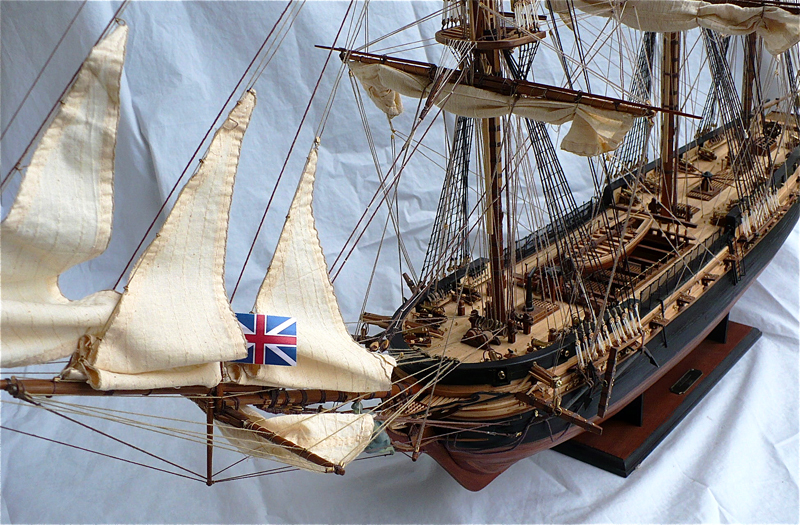
HMS Surprise

Here are some more images of Artesania Latina's 1/48 scale HMS Surprise.

From Wikipedia'
Unité was a corvette of the French Navy built in 1794, the lead ship of her class. She was captured by the Royal Navy in 1796 and renamed HMS Surprise. In 1799 she famously recaptured HMS Hermione and in 1802 was sold out of the service.
She was designed by Pierre-Alexandre Forfait, who was in charge of her construction at Le Havre. She was launched on 16 January 1794, and was armed with 24 eight-pound and 8 four-pound long guns. Although the French initially rated Unité as a corvette, the ships of her class bridged a gap between smaller warships and frigates, and at various times were rated as frigates.

On 20 March 1794, Lieutenant de Vaisseau Jean le Drézénec, who was 41 years old and had entered the naval service soon after the revolution from a career in the merchant service, arrived to take command of Unité. He supervised the fitting out of the ship, and found the long guns were too large to be easily reloaded, and the lower sails were also too large. He notified the authorities, who urged him to finish fitting out the ship because a major naval operation was imminent. Soon afterwards, Unité took part in the battle of the Glorious First of June by escorting the dismasted Révolutionnaire as she was towed by the Audacieux.
In June 1794 Unité completed repairs of damage sustained in the battle in St. Malo and Brest, and in the following months escorted merchant vessels along the coasts of France. On 28 September, with the corvette Bergere and under the command of Lieutenant de Vaisseau Gouley, the two ships left Brest to sail northwest in between Ireland and the islands of the Hebrides and St Kilda to intercept enemy merchant ships. On 17 October, the ships captured a 200 ton merchant ship Dianne. The next day the weather turned foul and the two ships were separated. Unwilling or unable to continue the mission alone, Unité searched for Bergere fruitlessly for sixteen days before finally returning to Brest on 1 November.
Under Captain Edward Hamilton, the Surprise sailed in the Caribbean for several years, capturing several privateers. HMS Surprise gained fame for the cutting-out expedition in 1799 of HMS Hermione. Hermione's crew had mutinied, and had sailed her into the Spanish possession of Puerto Cabello. Captain Edward Hamilton of Surprise led a boarding party to retake Hermione and, after an exceptionally bloody action, sailed her out of danger under Spanish gunfire. The Spanish casualties included 119 dead; 231 were taken prisoner, while another 15 jumped or fell overboard. Hamilton had 11 injured, four seriously, but none killed.
After the Peace of Amiens, Surprise was sold out of the service at Deptford in February 1802 and broken up.


HMS Surprise was the ship chosen by author Patrick O'Brian to restore Captain "Lucky" Jack Aubrey of the Aubrey–Maturin series to his place as a captain, and eventually see him raise his flag as an admiral of the Royal Navy. Surprise is an important element of the series, both because of her importance to the running plotline, and because of the emotional attachment she has earned among fans of the series.
For the 2003 film Master and Commander: The Far Side of the World, the role of Surprise was filled by the replica of HMS Rose, which was purchased by the film studio and modified for the role. The film relates that Aubrey had served aboard her as a midshipman in 1785, when the real Surprise had not yet been launched. The book HMS Surprise by O'Brian also mentions Aubrey being a midshipman aboard Surprise The series also has the Surprise in service until at least 1812, even though a 38-gun frigate by this name was commissioned in September 1812.
The fictional Surprise is sold out of the service in The Reverse of the Medal, being purchased by Stephen Maturin and employed first as a letter of marque and later as His Majesty's hired ship Surprise under Aubrey's command. Maturin agrees to sell the Surprise to Aubrey in The Nutmeg of Consolation, though later novels suggest that Maturin continues to own the ship. Surprise's ultimate fictional fate is unknown although she was still at sea in Blue at the Mizzen when Aubrey receives news of his promotion to rear-admiral of the blue in her great cabin at the end of the book.

Monday, August 18, 2014

Citroen Traction Avant 11 CV

Here are some more images of Burrago's 1/24 scale Citroen Traction Avant 11 CV. Originally used as a civilian vehicle the 11 CV was used by both French and German military's during WWII. From Wikipedia "
The Citroën Traction Avant was an innovative front wheel drive automobile produced by the French manufacturer Citroën. About 760,000 units were produced from 1934 to 1957.
The Traction Avant, French for "forward traction", was designed by André Lefèbvre and Flaminio Bertoni in late 1933 / early 1934. While not the first production front wheel drive car - Alvis built the 1928 FWD in the UK, Cord produced the L29 from 1929 to 1932 in the United States and DKW the F1 in 1931 in Germany - it was the world's first front wheel drive steel monocoque production car. Along with DKWs 1930s models, the Traction successfully pioneered front wheel drive on the European mass car market.
The Traction Avant's structure was an arc-welded monocoque (unitized body). Most other cars of the era were based on a separate frame (chassis) onto which the non-structural body ("coachwork") was built. Monocoque construction (also called Unit Body or "Unibody" in the US today) results in a lighter vehicle, and is now used for virtually all car construction, although body-on-frame construction remains suitable for larger vehicles such as trucks.
This method of construction was viewed with great suspicion in many quarters, with doubts about its strength. A type of crash test was developed, taking the form of driving the car off a cliff, to illustrate its great inherent resilience.
The novel design made the car seem very low-slung relative to its contemporaries — the Traction Avant always possessed a unique look, which went from appearing rakish in 1934 to familiar and somewhat old fashioned by 1955.
The suspension was very advanced for the car's era. The front wheels were independently sprung, using a torsion bar and wishbone suspension arrangement, where most contemporaries used live axle and cart-type leaf spring designs. The rear suspension was a simple steel beam axle and a Panhard rod, trailing arms and torsion bars attached to a 3-inch (76 mm) steel tube, which in turn was bolted to the "monocoque".
Since it was considerably lighter than "conventional" designs of the era, it was capable of 100 km/h (62 mph), and consumed gasoline / petrol only at the rate of 10 litres per 100 kilometres (28 mpg-imp; 24 mpg-US).

Model T Hot Rod

Here are some more images of AMT's 1/25 scale Model T Hot Rod.
From Wikipedia"
Hot rods are typically American cars with large engines modified for linear speed. The origin of the term "hot rod" is unclear. One explanation is that the term is a contraction of "hot roadster," meaning a roadster that was modified for speed. Roadsters were the cars of choice because they were light. The term became commonplace in the 1930s or 1940s as the name of a car that had been "hopped up" by modifying the engine in various ways to achieve higher performance.
The term can also apply to other items that are "souped up" for a particular purpose, such as "hot-rodded amplifier".
The term seems first to have appeared in the late 1930s in southern California, where people would race their modified cars on the vast, empty dry lake beds northeast of Los Angeles under the rules of the Southern California Timing Association (SCTA). The activity increased in popularity after World War II, particularly in California because many returning soldiers had been given technical training in the service. The original hot rods were old cars (most often Fords, typically Model Ts, 1928–31 Model As, or 1932-34 Model Bs), modified to reduce weight. Typical modifications were removal of convertible tops, hoods, bumpers, windshields, and/or fenders; channeling the body; and modifying the engine by tuning and/or replacing with a more powerful type. Wheels and tires were changed for improved traction and handling. "Hot Rod" was sometimes a term used in the 1950s as a derogatory term for any car that did not fit into the mainstream. Hot rodder's modifications were considered to improve the appearance as well, leading to show cars in the 1960s replicating these same modifications along with a distinctive paint job.
Engine swaps often involved fitting the Ford Flathead engine, or "flatty", in a different chassis; the "60 horse" in a Jeep was a popular choice in the '40s. After the appearance of the 255 cu in (4.2 l) V8, because of interchangeability, installing the longer-stroke Mercury crank in the 239 was a popular upgrade among hot rodders, much as the 400 cu in (6.6 l) crank in small-blocks would become. In fact, in the 1950s, the flathead block was often fitted with crankshafts of up to 4.125 in (104.8 mm) stroke, sometimes more. In addition, rodders in the 1950s routinely bored them out by 0.1875 in (4.76 mm) (to 3.375 in (85.7 mm)); due to the tendency of blocks to crack as a result of overheating, a perennial problem, this is no longer recommended. In the '50s and '60s, the flatty was supplanted by the early hemi. By the 1970s, the small-block Chevy was the most common option, and since the '80s, the 350 cu in (5.7 l) Chevy has been almost ubiquitous.

Sunday, August 17, 2014

Chevorlet Advance Design 1953 Pickup Truck

Here are some more images of Danbury Mint's 1/24 scale Chevorlet Advance Design 1953 Pickup Truck.
A friend of mine gave me a this model  as it had a broken front axle and a broken passenger door and he thought I might be able to do something with it. So what did I do? The pictures speak for themselves.

From Wikipedia"

General Motors' first major redesign post-World War II, the Advance Design series was billed as a bigger, stronger, and sleeker design. First available on Saturday June 28, 1947, these trucks were sold with various minor changes over the years until March 25, 1955, when the Task Force Series trucks replaced the aging Advance Design model.
From 1947 until 1955, Chevrolet trucks were number one in sales in the United States.
While GMC used this front end, and to a slightly lesser extent the cab, on all of its trucks except for the Cab Overs, there are three main sizes of this truck. The half-, three-quarter-, and full ton capacities in short and long wheelbase.
 1953 - Last year for the 216 in² I6. Hood side emblems now only read 3100, 3600, 3800, 4400, or 6400 in large print. Door post ID plate now blue with silver letters (previous models used black with silver letters). Last year to use wooden blocks as bed supports. New serial number codes: H 1/2 ton, J 3/4 ton, & L 1 ton.

Austin FX 4 London Black Cab

Here are some more images of Aoshima's 1/24 scale London Black Cab the Austin FX4.

From Wikipedia"

A hackney or hackney carriage (also called a cab, black cab, hack or London taxi) is a carriage or automobile for hire. A livery carriage superior to the hackney was called a remise.
In the United Kingdom, the name hackney carriage today refers to a taxicab licensed by the Public Carriage Office in Greater London or by the local authority (non-metropolitan district councils or unitary authorities) in other parts of Great Britain, or by the Department of the Environment in Northern Ireland.
In the United States, the police department of the city of Boston has a Hackney Carriage Unit, analogous to taxicab regulators in other cities, that issues Hackney Carriage medallions to its taxi operators.
"An Ordinance for the Regulation of Hackney-Coachmen in London and the places adjacent" was approved by Parliament in 1654, to remedy what it described as the "many Inconveniences [that] do daily arise by reason of the late increase and great irregularity of Hackney Coaches and Hackney Coachmen in London, Westminster and the places thereabouts". The first hackney-carriage licences date from 1662, and applied literally to horse-drawn carriages, later modernised as hansom cabs (1834), that operated as vehicles for hire. There was a distinction between a general hackney carriage and a hackney coach, a hireable vehicle with specifically four wheels, two horses and six seats, and driven by a Jarvey (also spelled jarvie).
In 19th century London, private carriages were commonly sold off for use as hackney carriages, often displaying painted-over traces of the previous owner's coat of arms on the doors.
The growler was a type of four-wheel, enclosed carriage drawn by two horses used as a hackney carriage, that is, as a vehicle for hire with a coachman. It is distinguished from a cab, hansom cab or cabriolet, in that those had only two wheels. It is distinguished from most coaches by being of slightly smaller size, holding nominally four passengers, and being much less ostentatious.
Historically four-door saloon cars have been highly popular as hackney carriages, but with disability regulations growing in strength and some councils offering free licensing for disabled-friendly vehicles, many operators are now opting for wheelchair-adapted taxis such as the LTI. Other models of specialist taxis include the Peugeot E7 and rivals from Fiat, Volkswagen, Metrocab and Mercedes-Benz. These vehicles normally allow six or seven passengers, although some models can accommodate eight. Some of these 'minibus' taxis include a front passenger seat next to the driver, while others reserve this space solely for luggage.
Many black cabs have a turning circle of only 25 ft (8 m). One reason for this is the configuration of the famed Savoy Hotel: The hotel entrance's small roundabout meant that vehicles needed the small turning circle in order to navigate it. That requirement became the legally required turning circles for all London cabs, while the custom of a passenger's sitting on the right, behind the driver, provided a reason for the right-hand traffic in Savoy Court, allowing hotel patrons to board and alight from the driver's side.
The FX4 is the classic Black Cab. While the majority are black, there is in fact no requirement for them, or indeed any other make of London taxi to be black. Over the years, the FX4 has been sold under a number of different makers' names.

The FX4 London taxi was the successor to the Austin FX3, which was produced between 1948 and 1958. In its day the FX3 was the most widely used taxi in London. Like the FX3, the FX4 was designed by Austin in collaboration with Mann and Overton, the London taxi dealership that commissioned it (and paid for half of its cost) and Carbodies, the coachbuilder that built the body and assembled the cab ready for sale. The design team included Albert Moore from Austin’s engineering division, Jack Hellberg from Carbodies and David Southwell of Mann and Overton. The original design was by Austin’s Eric Bailey and it was engineered for production by Carbodies' Jake Donaldson. It would be the first London taxi to go into production that had four doors.
Like the FX3, the FX4 had a separate chassis, but with independent front suspension and dual-circuit hydraulic brakes. The first FX4, registration number VLW 431, was delivered in July 1958 and went on test with York Way Motors. The official launch was later that year at the Commercial Motor Exhibition.

Saturday, August 16, 2014

TIE M1 Experimental (Bizarro)

Here are some better images of my kit bash model of a 1/48 scale TIE M1 Experimental from the Star Wars universe. The models I used to build this were parts from two AMT/ERTL TIE fighters, one AMT/ERTL TIE interceptor, one Tamiya Tiger 1 tank, one Revell Explorer rocket. 

From Wookieepedia"
The TIE Experimental M1, also known as the TIE Bizarro, was an experimental member of the TIE series and a part of the TIE Experimental Project.
One of the starfighters built by an Imperial research project led by Director Lenzer under the command of Grand Admiral Demetrius Zaarin, the M1 consisted of a single standard TIE/LN starfighter wing panel with two wing braces connected to a pair of standard TIE series cockpit pods. The port pod held the control systems, and the starboard pod held a turbolaser much heavier than the laser cannons equipped on any previous TIE.
Both pods had the trademark twin ion engines of the TIE series, and the fighter was actually slightly faster than the standard TIE/LN. The fighter was equipped with a hyperdrive, which was slaved to remote systems in a controller ship.
Rebel forces first encountered the M1 when they responded to a distress signal from a civilian convoy near the Belat system. A pair of A-wings escorting a staff transfer from Defiance to Liberty picked up the distress call during a course change between hyperspace jumps and responded to the attack. They found a squadron of TIE Experimental M1 fighters attacking a Cloburi Freight convoy, while a Beta-class ETR-3 escort transport stood by. The A-wings defeated the TIE M1s with minimal Rebel or civilian losses.
Later, when the Alliance ordered an intelligence-gathering strike on a TIE Experimental production facility, several waves of M1 fighters were found in the station's defense screen. They were also present at the main research facility, defending the hangar ship Sardis and space station Obsidian.
After the destruction of space platform Obsidian, no TIE Experimental fighters were seen again.