Translate

Monday, March 23, 2015

7TP Siedmiotonowy Polski

Here are some images of ? 1/35 scale 7-TP Light Tank. From Wikipedia "The 7TP (siedmiotonowy polski - 7-ton Polish) was the Polish light tank of the second world war. A development of the British Vickers 6 ton, it was significantly better armed than its most common opponents, the German Panzer one and two A standard tank of the Polish Army during the Polish defensive war of 1939, its production never exceeded 140 vehicles. Its chassis was used as the base for C7Partillery tractor".  

I got this kit in amongst a bunch of other kits I purchased a while back and I had no idea as to what type of tank it was. It took me two days of research on the internet to find out what it was. My first thought was well it looks pre war and it was a light tank so I started there and wouldn't you know it it seems all pre war tanks kind of look alike so I had to slog through several photographs until I found the right one. As for the kit manufacturer I couldn't tell you (if anyone knows I'd like to hear it) as there was no box and instructions so I had to basically wing it when building it.

Dave Porter's F-20

Here is a Hasegawa F-20 in 1/72nd scale. I always thought it was a cool looking aircraft that was significant step up from our CF-5s. I completed this kit as a “what if” using a variety of low vis markings and acrylic paint.

Sunday, March 22, 2015

Dave Porter's BRE Datsun 510 And 2000 Renard

Here is an image of Dave Porter's BRE Datsun 510 and 2000 Renard and here are his descriptions.

    Here is the BRE Datsun 510 that won the 1972  SCCA 2.5 litre Sedan Trans Am Championship. The car was driven by John Morton. This kit is a vintage repop from Revell in 1/25 scale. I painted it with Tamiya Lacquers and acrylics and I did some extra details in the interior.


 Here is Paul Tracy’s 2000 Renard in 1/25 scale. The kit is by Monogram and the Kool decals are aftermarket.


Saturday, March 21, 2015

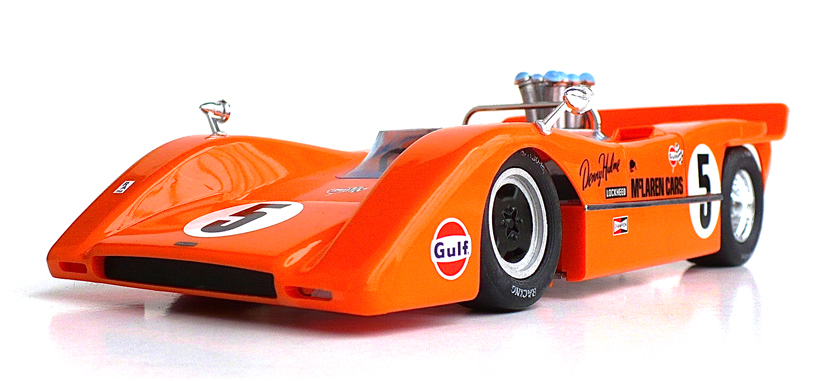
1968 McLaren M8A

Here are some better images of Tamiya's 1/18 scale McLaren M8A 1968.


From the instructions"
1966 saw the inauguration of the Canadian-American Challenge Cup (CAN-AM), which raced two seater open top machines with unlimited engine displacements. Although held domestically, this unique series saw many F1drivers in attendance and quickly gained popularity due to the dynamic performances of the high powered machines. It became one of the most exciting race categories after F1 GP and the World Sports Car Chamionship. Founded by F1 driver Bruce McLaren in 1963 Bruce McLaren Motor Racing raced CAN AM and F1 GP from 1966. The 1966 CAN-AM season saw Bruce McLaren drive the McLaren M1B to the third place overall ranking. The following year he drove the M6A and won the championship, which led to the teams succesful period.
In 1968, the team entered the M8A which was lighter, had enhanced aerodynamics, and adapted the same monocoque structure of other F1 machines with the engine firmly connected to the rear bulkhead. The wedge-shaped body producd the increased downforce effect and featured air intakes with NASA ducts.
It was powered by a 620 hp Chevrolet V8 7-liter engine with eight 40cm long air funnels. In this six race series Denny Hulme and Bruce McLaren drove the M8A and took 3 and 1 wins respectively to dominate the season. Not resting on their laurels, the M8A continually evolved with the M8B, M8D, and M8F respectively. Despite the tragic test drive accident that involved Bruce McLaren in 1970, the team swept the CAN-AM, taking 5 consecutive championships from 1967 to 1971.

Wednesday, March 18, 2015

1934 Bugatti Type 59

Here are some images of Bburago's 1/18 scale Bugatti Type 59.
This kit within itself is a very simple kit to assemble. However I decided to punch it up a few notches with a new paint job done with a used patina look. I also scratched out a hood belt (built earlier) and a bug screen. I also decided to paint the front number and not use a decal. This enabled me to hold a screen look on the number which with a decal is difficult to obtain.
Here is how it appeared before

From Wikipedia"
 The final Bugatti race car of the 1930s was the Type 59 of 1934. It used an enlarged 3.3 L (3257 cc/198 in³) version of the straight-8 Type 57's engine sitting in a modified Type 54 chassis. The engine was lowered for a better center of gravity, and the frame was lightened with a number of holes drilled in the chassis. The signature piano wire wheels used splines between the brake drum and rim, and relied on the radial spokes to handle cornering loads. 250 hp (186 kW) was on tap, and 8 were made.

Saturday, March 14, 2015

New Bedford Whaleboat 1860


Here are some images of Amati's 1/16 scale New Bedford Whaleboat 1860.

From Wikipedia"
A whaleboat is a type of open boat that is relatively narrow and pointed at both ends, enabling it to move either forwards or backwards equally well. It was originally developed for whaling, and later became popular for work along beaches, since it does not need to be turned around for beaching or refloating. The term "whaleboat" may be used informally of larger whalers, or of a boat used for whale watching.

Today whaleboats are used as safety vessels aboard marine vessels. The United States Coast Guard has been using them since 1791. Their simple open structure allows for easy access and personnel loading in the event of an emergency. These whaleboats are now considered very important, and highly regimented safety vessels. Boats must include a hatchet, lifeboat compass, lifeboat sea anchor, emergency signal mirror, emergency drinking water, lifeboat first aid kit, jack knife with can opener, lifeboat bilge pump,and emergency provisions. On modern warships, a relatively light and seaworthy boat for transport of ship's crew may be referred to as a whaleboat or whaler. It may also refer to a type of vessel designed as a lifeboat or "monomoy" used for recreational and competitive rowing in the San Francisco Bay Area and coastal Massachusetts.

Whaleboats were also extensively used in warfare. Colonel Benjamin Church is credited with first pioneering their use for amphibious combat operations against Abenaki and Mi'kmaq tribes in what is today Maine and Acadia . His troops, New England colonial forces and Native allies from southern New England, used them as early as 1696 (during King William's War). Others in the Northeastern borderlands followed suit and they were utilized throughout the imperial conflicts of the early 18th century, and extensively used by both British and colonial troops during the French and Indian war. Units that made extensive use of whaleboats were the 7th Massachusetts Infantry Regiment at the siege of Louisburg in 1745, often referred to as "the whaleboat regiment," and Gorham's Rangers, formed in 1744, initially a company of Indians mainly from Cape Cod, many of whom were employed as whalers, and which later evolved into a British Army ranger company in the 1750s and 1760s. John Bradstreet's Bateaux and Transport service, a corps of armed boatmen tasked with moving supplies on inland waterways during the French and Indian War also used whaleboats extensively. In 1772, American colonials used whaleboats to attack and destroy HMS Gaspée in Narragansett Bay. During the American Revolutionary War, there were many whaleboat raids, including one with 230 men led by Return J. Meigs, Sr. to sack Sag Harbor on Long Island in 1777. On December 7, 1782, two fleets of whaleboats fought a bloody battle on Long Island Sound known as the Boats Fight. During the desperate hand-to-hand conflict, every man involved was either killed or injured.

The whaleboat's design takes after those the Vikings used during the 11th century, around the time Beowulf was written and Leif Erickson came to America briefly, before the Vikings really made their mark on English culture. As a whaling vessel, it fulfilled its purposes for what it went through and its “superior handling characteristics soon made it a popular general-purpose ship’s boat”. The whaleboat generally is outfitted with a dismountable sail post for sailing across seas, but in close proximity, they can use oars for rapid rowing to nearby areas with a large rowing crew. The basics of the whaleboat consists of a rudder, main sail, and occasionally a jib. Without the rudder, the boat would have no steering capabilities, and without the sails, the vessel would have no propulsion, assuming there were no oars or a sizable rowing crew to compensate for the lack of propulsion. After 1850 most were fitted with a centreboard that would keep the boat from swaying too far to one side or another, located in the center of the boat. The main sail would catch the wind, which would in turn push the sail, pushing the boat in the process, and the rudder, depending on the direction the person manning it pointed it at, would push the stern of the boat in a certain direction, steering the whaleboat essentially. The rudder consists of basically two parts: the part that sticks in the water in order to give thrust, and the part the coxswain, or the person steering, holds onto in order to push or pull the first part. The jib sail is a significantly smaller sail that serves to help steer and propel the boat forward as well. By catching the wind at a specific angle, the sail can either double as a second main sail catching the wind, or help by adding “better close-hauled sailing and of setting extra sail with comparatively little labor demand”

Whaleboats became prevalent in ancient Inuit and Yupik culture when trade and other forms of nutrition were sparse. Whaleboats gave them a means of travelling to distant places in order to obtain resources. Natives had to gather sustenance, generally large game such as whales, when at all possible, from the sea. Whaleboats were not always taken out to sea to hunt whales, but they could also be used to transport dead whales that they had scavenged from the shallow waters. Whaleboats used in whaling had a stout post mounted on the aft deck, around which the steersman would cinch the rope once the whale had been harpooned, and by which the whale would drag the boat until it was killed. Large baleen and bow heads whales became their main export to Europe and the Americas, which in turn would help in revitalizing the trade in their region, an area that ranged from the Bering-Chukchi Sea to eastern Arctic.
Norwegians began to dominate whaling when they turned it into a full-blown industry in 1904. They were more skilled and had better techniques than other civilizations around this same time period. The Norwegians had very efficient gunners, men who fired the weapons, the technology of the Sven Foyn gun and the grenade harpoon, and they utilized the powered whale catcher. Although all these factors were effective and sped trade, the demand of oil was its own issue. Whales were mainly used for their fat that was melted to oil. The Norwegians had a system in place and partnered with the British to profit. The simple whale boat received a number of modifications throughout this period. What was once a simple single hull, open boat became a body of new technologies to make whaling more efficient. Changes included the use of radar and radio instead of a lookout and new handling tools.(Tonneson and Johnson, 798)


Wednesday, March 11, 2015

Dave Porter's MiG 21

This is a Minicraft MiG 21 in 1/48 scale. The aircraft represented served late in the Vietnam war. The kit is pretty much SOB. The paints are Tamiya acrylics.

Dave

Saturday, March 7, 2015

1913 Mercer Raceabout Type 35R

Here are some images of Bandai's 1/16 scale 1913 Mercer Raceabout Type 35R.

From Wikipedia"
Mercer was an American automobile manufacturer from 1909 until 1925. It was notable for its high-performance cars, especially the Type 35 Raceabout.

There was considerable talent and backing for the Mercer Automobile Company; Ferdinand Roebling, son of John A. Roebling, was the president, and his nephew Washington A. Roebling II was the general manager. The Roeblings had extensive success with wire rope manufacturing and suspension bridge design; engineering was not a recent concept for them. The secretary-treasurer was John L. Kuser, who, with his brothers Frederick and Anthony, had amassed a fortune from banking, bottling and brewing.
Washington A. Roebling II was friends with William Walter, who had been making a small number of high-quality automobiles in New York City. The Kusers owned a vacant brewery in Hamilton, New Jersey, and brought Walter and his car factory there in 1906. However, Walter found himself deeply in debt by 1909, so the Roeblings and Kusers bought him out in a foreclosure sale. They changed the company name to Mercer, named after Mercer County, New Jersey. Talented designers and race drivers contributed to the new effort, and the focus became proving their product in competition.

 The result was one of the most admired sports cars of the decade; the 1910 Type-35R Raceabout, a stripped-down, two-seat speedster, designed to be "safely and consistently" driven at over 70 mph (110 km/h). It was capable of over 90 mph (140 km/h). The Raceabout's inline 4-cylinder T-head engine displaced 293 cubic inches (4,800 cc) and developed 55 horsepower (41 kW) at 1,650 revolutions per minute. It won five of the six 1911 races it was entered in, losing only the first Indianapolis 500. Hundreds of racing victories followed. The Raceabout became one of the premier racing thoroughbreds of the era- highly coveted for its quality construction and exceptional handling.
 In the 1914 road races in Elgin, Illinois, two Raceabouts collided and wrecked. Spencer Wishart, a champion racer who always wore shirt and tie under his overalls, was killed along with the car's mechanic, John Jenter. This prompted the company to cancel its racing program. The Raceabout's designer left the company that year, and subsequent designs did not live up to the glory and appeal the Type-35R had earned.
 Earlier in February 1914, Eddie Pullen, who worked at the factory from 1910, won the American Grand Prize held at Santa Monica, California, by racing for 403 mi (649 km) in a Raceabout. Later that same year, Eddie also won The Corona Road Race held in Corona, California, on November 26. For winning the 300-mile (480 km) big car event, Pullen won $4,000 and an additional $2,000 for setting a new world road race record. His average speed of 86.5 mph (139.21 km/h) broke the record of 78.72 mph (126.69 km/h) set by Teddy Tetzlaff at Santa Monica in 1912.
 n October, 1919, after the last involved Roebling brother died (Washington A. Roebling II perished in the 1912 Titanic disaster), the company was obtained by a Wall Street firm that placed ex-Packard vice-president Emlem Hare in charge, organizing Mercer under the Hare's Motors corporate banner. Hare looked to expand, increasing Mercer's models and production, and also purchasing the Locomobile & Crane-Simplex marques. Within a few years, the cost of these acquisitions and the economic recession took a financial toll on Hare's Motors. Locomobile was liquidated and purchased by Durant Motors in 1922, and Mercer produced its last vehicles in 1925, after some 5,000 had been built.
 An independent effort to revive the marque in 1931 resulted in only 3 vehicles being constructed and displayed.
The company is currently owned by Fred Hoch of Schaeffer & Long.

Thursday, March 5, 2015

1919 Hispano Suiza "The Alfonso"

Here are some images of Minicraft's 1/16 scale 1919 Hispano Suiza's "The Alphonso".

From the instructions"
Made in France, they used the strange name which means "Spanish Swiss". This was derived from the fact that the company originated in Spain and the designer, Mark Birkit, was of Swiss origin.

1919 was a very significant year in the world of automobiles... presumably due to the termination of World War 1. In this year... Rolls Royce resumed production, But they did not have the prestige or performance of the Hispano Suiza with its 37.2 HP engine (SAE equal to approximately 200 BHP).

In the same year Bentley was introduced to the racing world, using a 3 litre engine... Napier announced its first automobile which did not get beyond the completed chassis stage until 1920. In the United States... Ford introduced electrical starting... Auburn, previously not too successful was taken over, recapitalized, and became a very significant entity in the United states automobile market.

The Hispano Suiza was still king of the automotive world. Its servo assisted brakes were years ahead of their time. The name later gained further reputation as a result of the introduction of V-12 engines... which were a development of the V-8's that were produced for use in aircraft during World War 1.

Tuesday, March 3, 2015

Star Destroyer

Here are some images of MPC/AMT Star Destroyer from Star Wars.
I have to say that this kit in its original form isn't much to say the least.
However with a bit of greebling and some lights one can turn out a fine example..

From Wikipedia"

 Star Destroyers and Star Dreadnaughts are capital ships in the fictional Star Wars universe. The Imperial Star Destroyer, which first appears in the first seconds of Star Wars (1977), is "the signature vessel of the Imperial fleet". The term "Star Destroyer" also refers to other vessels in the Star Wars universe. Star Destroyers appear in the original three Star Wars movies and in Star Wars Episode III: Revenge of the Sith (2005). In addition to their movie appearances, Star Destroyers appear throughout the Star Wars Expanded Universe in books, comics, and games. Numerous Star Destroyer models and toys have been released.Depiction
An Imperial Star Destroyer first appears in the opening scene of A New Hope, chasing a Rebel ship (the Tantive IV). This appearance shows the Imperial ship's massive size in comparison to the Tantive IV.
Imperial-class Star Destroyers are constructed by Kuat Drive Yards and hold a distinguished place in the Imperial Navy, symbolizing the Empire's military might with a peak number of more than 25,000 vessels though thousands were lost/destroyed to warlordism following Palpatine's death. The Imperial-class Star Destroyer is also informally referred to as an Imperial cruiser. Like the Victory- and Venator-class ships that precede it, the Imperial Star Destroyer is most notable for its massive size and overwhelming firepower; a single Imperial-class ship is capable of overwhelming most starships or devastating a hostile planet, and its mere presence is often enough to deter rebellion. At 1,600 meters (5,200 ft) long, Imperial-class Star Destroyers are armed with turbolasers, ion cannons and tractor beam projectors. They carry 72 TIE fighters, numerous ground forces (including stormtroopers, 20 AT-ATs and 30 AT-STs), a prefabricated base for rapid deployment to planetary surfaces and a variety of support and landing craft.
In the Expanded Universe, after the climactic Battle of Endor, the Rebel Alliance captured several Imperial-class ships and added them to their own fleet. As the Rebel Alliance transitioned into the New Republic and gradually took large portions of the galaxy from the remnants of the Empire, it was able to procure more of the powerful ships as well as the vital shipyards and facilities with which to operate them. Although the New Republic eventually upgrades its starfleet with newer ship types, the Imperial-class Star Destroyer remains in service well into the New Jedi Order era and fights during the Yuuzhan Vong war.

In 2002, Lego released a 3,104-piece Imperial-class Star Destroyer building kit for their Ultimate Collectors' Series line. The model is almost one meter long and includes a scale model of the Rebel Blockade Runner. In 2004, they released a Star Destroyer set for their Minis series. This one is just a few inches long and has no minifigures. In 2006, a smaller set was released, just over half a meter long and containing various minifigures. In 2010 a Midi-Scale model was also released. This includes no minifigures and is less than one foot long. Lego also released a 50-inch (130 cm), 3,152-piece model of the Executor in September 2011.
The Super Star Destroyer has also been merchandised. Kenner wanted to use a less ominous name than Executor for the toy playset of Darth Vader's meditation chamber. An advertisement agency's list of 153 alternatives included Starbase Malevolent, Black Coven, Haphaestus VII, and Cosmocurse; ultimately, the toy was labeled "Darth Vader's Star Destroyer" In 2006, Wizards of the Coast created an Executor miniature as part of its Star Wars Miniatures Starship Battles game. An electronic Super Star Destroyer toy released by Hasbro "is the rarest among Hasbro's Collector Fleet".