Here are some more images of Iron Shipwrights 1/72 scale U.S.S. Holland (SS-1) and Holland Boat No.1.
Over all this is a nice kit though I had to do some scratch work like the stand, anchor and masts.
From Wikipedia"
John Philip Holland (Irish: Seán Pilib Ó hUallacháin / Ó Maolchalann) (29 February 1840 – 12 August 1914) was an Irish engineer who developed the first submarine to be formally commissioned by the U.S. Navy, and the first Royal Navy submarine, the Holland 1.
Holland emigrated to the United States
in 1873. Initially working for an engineering firm, he returned to
teaching again for a further six years in St. John’s Catholic School in Paterson, New Jersey. In 1875, his first submarine designs were submitted for consideration by the U.S. Navy, but turned down as unworkable. The Fenians,
however, continued to fund Holland's research and development expenses
at a level that allowed him to resign from his teaching post. In 1881, Fenian Ram
was launched, but soon after, Holland and the Fenians parted company
angrily, primarily due to issues of payment within the Fenian
organization, and between the Fenians and Holland. The submarine is now preserved at Paterson Museum, New Jersey.
Holland continued to improve his designs and worked on several
experimental boats, prior to his successful efforts with a privately
built type, launched on 17 May 1897. This was the first submarine having
power to run submerged for any considerable distance, and the first to
combine electric motors for submerged travel and gasoline engines for
use on the surface. She was purchased by the U.S. Navy, on 11 April
1900, after rigorous tests and was commissioned on 12 October 1900 as USS Holland. Six more of her type were ordered and built at the Crescent Shipyard in Elizabeth, New Jersey. The company that emerged from under these developments was called The Electric Boat Company, founded on 7 February 1899. Isaac Leopold Rice became the company's first President with Elihu B. Frost acting as vice president and chief financial officer.
The USS Holland design was also adopted by others, including the Royal Navy in developing the Holland-class submarine. The Imperial Japanese Navy
employed a modified version of the basic design for their first five
submarines, although these submarines were at least 10 feet longer at
about 63 feet. These submarines were also developed at the Fore River Ship and Engine Company in Quincy, MA.
USS Holland (SS-1) was the United States Navy's first commissioned submarine, named for her Irish-American inventor, John Philip Holland, although not the first submarine of the US Navy, which was the 1862 Alligator. The boat was originally laid down as Holland VI, and launched on 17 May 1897.
The work was done at (Ret.) Navy Lieutenant Lewis Nixon's Crescent Shipyard of Elizabeth, New Jersey for John Holland's company, then known as the Holland Torpedo Boat Company. The craft was built under the supervision of John Holland, who designed the vessel and her details. The keel
to this craft was laid at Nixon's Crescent Shipyard with both men
present. The two men worked together using many of John Holland's proven
concepts and patents to make the submarine a reality, each man
complementing the other's contributions to the development of the modern
submarine.
Holland VI included many features that submarines of the early
20th century would exhibit, albeit in later, more advanced forms. She
had both an internal combustion engine for running on the surface, and an electric motor for submerged operation. She had a reloadable torpedo tube and a deck gun (a pneumatic dynamite gun). There was a conning tower from which the boat and her weapons could be directed. Finally, she had all the necessary ballast and trim tanks to make precise changes in depth and attitude underwater.
Holland VI eventually proved her validity and worthiness as a
warship and was ultimately purchased by the U.S. government for the sum
of $150,000 on 11 April 1900. She was considered to be the first truly
successful craft of her type. The United States Government soon ordered more submarines from Holland's company, which were to be known as the Plunger class. These became America's first fleet of underwater naval vessels.
Holland VI was modified after her christening, and was renamed USS Holland (SS-1) when she was commissioned by the US Navy on 12 October 1900, at Newport, Rhode Island, with Lieutenant Harry H. Caldwell in command.
Holland was the first commissioned submarine in the US Navy
and is the first of the unbroken line of submarines in the Navy. She
was the third submarine to be owned by the Navy, however. (The first
submarine was Propeller (also known as Alligator) and the second was Intelligent Whale.)
On 16 October 1900, in order to be kept serviceable throughout the winter, Holland left Newport under tow of the tug Leyden for Annapolis, Maryland, where she was used to train midshipmen of the United States Naval Academy,
as well as officers and enlisted men ordered there to receive training
vital in preparing for the operation of other submarines being built for
the Fleet.[citation needed]
Holland proved valuable for experimental purposes in
collecting data for submarines under construction or contemplation. Her
166 mi (267 km) surface run, from Annapolis to Norfolk, Virginia from 8–10 January 1901, provided useful data on her performance underway over an extended period.
Holland, along with six other Holland-type submarines, was based in New Suffolk, New York on the North Fork of Long Island from 1899–1905, prompting the hamlet to claim to be the First Submarine Base in the United States.
Except for the period from 15 June to 1 October, which was passed training cadets at the Naval Torpedo Station, Newport, Rhode Island, Holland remained at Annapolis as a training submarine until 17 July 1905.[contradiction]
Holland finished her career at Norfolk, Virginia. Her name was struck from the Naval Vessel Register on 21 November 1910. This revolutionary submarine was sold as scrap to Henry A. Hitner & Sons, of Philadelphia, Pennsylvania
on 18 June 1913 for $100. Her purchaser was required to put up $5,000
bond as assurance that the submarine would be broken up and not used as a
ship.
The success of the submarine was instrumental in the founding of the Electric Boat Company, now known as the General Dynamics Electric Boat, a division of General Dynamics Corporation.
This company, therefore, can trace its origins to the formation of John
Philip Holland's original company and the revolutionary submarines that
were developed at this shipyard.
Holland Boat No. I was a prototype submarine designed and operated by John Philip Holland.
Work on the vessel began at the Albany Iron Works in New York City, moving to Paterson, New Jersey,
in early 1878. The boat was launched on 22 May 1878. It was 14 feet
long, weighed 2.25 tons, and was powered by a 4-horsepower Brayton petroleum engine driving a single screw. The boat was operated by Holland himself.
After several tests, on 6 June Holland conducted his first proper
trial. The boat ran on the surface at approximately 3.5 knots, then
submerged to a depth of 12 feet, before eventually surfacing. However,
problems with the engine, meant that Holland eventually connected the
engine, by a flexible hose, to a steam engine in an accompanying launch
and powered the boat externally. In a second trial, Holland remained
submerged for an hour. Holland eventually stripped the boat of usable
equipment and scuttled it in the Passaic River.
These trails impressed Holland's backers, the Fenian Brotherhood who on the strength of this success financed the Holland Boat No. II, which became known as the Fenian Ram.
The vessel was recovered in 1927 and is now on display at the Paterson Museum in New Jersey.
Translate
Wednesday, May 13, 2015
Tuesday, May 12, 2015
R.M.S. Titanic
From Wikipedia"
RMS Titanic was a British passenger liner that sank in the North Atlantic Ocean on 15 April 1912 after colliding with an iceberg during her maiden voyage from Southampton, UK to New York City, US. The sinking of Titanic caused the deaths of 1,502 people in one of the deadliest peacetime maritime disasters in modern history. The RMS Titanic was the largest ship afloat at the time of her maiden voyage. She was the second of three Olympic class ocean liners operated by the White Star Line, and she was built by the Harland and Wolff shipyard in Belfast with Thomas Andrews, who perished with the ship, as her naval architect. On her maiden voyage, she carried 2,224 passengers and crew.
Under the command of Edward Smith, her passengers included some of the wealthiest people in the world, as well as hundreds of emigrants from Great Britain and Ireland, Scandinavia and elsewhere throughout Europe seeking a new life in North America. The ship was designed to be the last word in comfort and luxury, with an on-board gymnasium, swimming pool, libraries, high-class restaurants and opulent cabins. She also had a powerful wireless telegraph provided for the convenience of passengers as well as for operational use. Though she had advanced safety features such as watertight compartments and remotely activated watertight doors, she lacked enough lifeboats to accommodate all of those aboard. Because of outdated maritime safety regulations, she carried only enough lifeboats for 1,178 people—slightly more than half of the number travelling on the maiden voyage, and one-third her total passenger and crew capacity.
After leaving Southampton on 10 April 1912, Titanic called at Cherbourg in France and Queenstown (now Cobh) in Ireland before heading westwards towards New York. On 14 April 1912, four days into the crossing and about 375 miles (600 km) south of Newfoundland, she hit an iceberg at 11:40 pm ship's time. The glancing collision caused Titanic's hull plates to buckle inwards along her starboard side and opened five of her sixteen watertight compartments to the sea; the ship gradually filled with water. Meanwhile, passengers and some crew members were evacuated in lifeboats, many of which were launched only partly loaded. A disproportionate number of men were left aboard because of a "women and children first" protocol followed by some of the officers loading the lifeboats. By 2:20 AM, she broke apart and foundered, with well over one thousand people still aboard. Just under two hours after the Titanic foundered, the Cunard liner RMS Carpathia arrived on the scene of the sinking, where she brought aboard an estimated 705 survivors.
The disaster was greeted with worldwide shock and outrage at the huge loss of life and the regulatory and operational failures that had led to it. Public inquiries in Britain and the United States led to major improvements in maritime safety. One of their most important legacies was the establishment in 1914 of the International Convention for the Safety of Life at Sea (SOLAS), which still governs maritime safety today. Additionally, several new wireless regulations were passed around the world in an effort to learn from the many missteps in wireless communications---which could have saved many more passengers. Many of the survivors lost all of their money and possessions and were left destitute; many families, particularly those of crew members from Southampton, lost their primary bread-winners. They were helped by an outpouring of public sympathy and charitable donations. Some of the male survivors were accused of cowardice for leaving the ship while people were still on board; the White Star Line's chairman, J. Bruce Ismay, faced social ostracism for the rest of his life.
The wreck of the Titanic remains on the seabed, split in two and gradually disintegrating at a depth of 12,415 feet (3,784 m). Since its discovery in 1985, thousands of artefacts have been recovered and put on display at museums around the world. Titanic has become one of the most famous ships in history, her memory kept alive by numerous books, folk songs, films, exhibits, and memorials.
Monday, May 11, 2015
1934 Rolls Royce Phantom II Continental Grey
Here are some images of Revell's 1/16 scale 1934 Rolls Royce Phantom II Continental. I wanted to see what a flat grey Rolls would look like, and now I know.
From Wikipedia"
The Rolls-Royce Phantom II was the third and last of Rolls-Royce's 40/50 hp models, replacing the New Phantom in 1929. It used an improved version of the Phantom I engine in an all-new chassis. A "Continental" version, with a short wheelbase and stiffer springs, was offered.
The Phantom II used a refinement of the Phantom I's 7.7 L (7,668 cc or 467.9 cu in) pushrod-OHV straight-6 engine with a new crossflow cylinder head. Unlike on previous 40/50 hp models, the engine was bolted directly to the 4-speed manual transmission. Synchromesh was added on gears 3 and 4 in 1932 and on gear 2 in 1935. Power was transmitted to the rear wheels using an open driveshaft, a hypoid bevel final drive, and Hotchkiss drive, replacing the torque tube from a remotely mounted gearbox used on earlier 40/50 hp models.
The chassis of the Phantom II was completely new. The front axle was mounted on semi-elliptical leaf springs as on earlier 40/50 hp models, but the rear axle was now also mounted on semi-elliptical springs instead of cantilever springs. This, along with the drivetrain changes, allowed the frame to be lower than before, improving the handling. The 4-wheel servo-assisted brakes from the Phantom I were continued, and the Bijur centralized lubrication system from the Springfield-built Phantom I was included on all Phantom II chassis.
The standard wheelbase of the Phantom II was 150 inches (3,800 mm). A 144 inches (3,700 mm) short-wheelbase chassis was also available.
A total of 1,281 Phantom II chassis of all types were built.
Royce had body designer Ivan Evernden build him a one-off short-wheelbase Phantom. Designated 26EX, the car had a tuned engine, five-leaf springs that were stiffer than standard and a Barker four-seat lightweight close-coupled saloon body painted with an artificial pearl lacquer made from ground herring scales. The sales department initially showed no interest in 26EX but, when Evernden returned to the office from the 1930 Biarritz Grand Concours d'Elegance, where 26EX had won the Grand Prix d'Honneur, he found that the sales department had already announced the new "Phantom II Continental Saloon", prepared a brochure for it, and costed it.
According to Evernden, neither he, Royce, nor the Rolls-Royce sales department had written specifications for the "Continental" model, although he and Royce had a clear specification in mind. Based on Evernden's writings and examination of company records, historian Ray Gentile determined that the common specifications of the Continental chassis were the short wheelbase and stiffer, five-leaf springs. By this definition, two hundred and eighty-one Continental Phantom II's were produced, including 125 left-hand drive versions.
Regarded as the two most important P-II Continentals are 20MS and 2SK, the only two P-II Continental Roadsters ever built. 20MS has been in a private Mid-Atlantic collection since 1989, 2SK, the Thrupp and Maberly Roadster once owned by Tyrone Power, was in the Fred Buess collection since 1958 but was sold at auction in 2010.
All Phantom II rolling chassis were built at Rolls-Royce's factory in Derby. The factory in Springfield, Massachusetts was closed upon ending production of the US-market Phantom I in 1931. Two US-market series, AJS and AMS, were built at Derby.
Only the chassis and mechanical parts were made by Rolls-Royce. The body was made and fitted by a coachbuilder selected by the owner. Some of the most famous coachbuilders who produced bodies for Rolls Royce cars are Park Ward, Thrupp & Maberly, Mulliner, Henley, and Hooper.
When Marlene Dietrich came to the USA in 1930, the Blue Angel director Josef von Sternberg welcomed her with gifts including a green Rolls-Royce Phantom II. The car later appeared in their first US film Morocco.
The Phantom II was featured in the films The Sorcerer's Apprentice (2010 film) and Indiana Jones and the Last Crusade. When its specifications are quoted during the scene in the Kingdom of Hatay, the Sultan states that the Rolls-Royce Phantom II has a "4.3 litre, 30 horsepower, six cylinder engine, with Stromberg downdraft carburetor" and "can go from zero to 100 kilometers an hour in 12.5 seconds (and I even like the color)." However, the car used in the film was actually a Rolls-Royce Barker Saloon, with 20/25 hp. It is also the star of the 1964 movie The Yellow Rolls-Royce where its engine specifications are given as the engine having a bore of 4.5" and stroke of 5.5", which would equate to 525 cubic inches
From Wikipedia"
The Rolls-Royce Phantom II was the third and last of Rolls-Royce's 40/50 hp models, replacing the New Phantom in 1929. It used an improved version of the Phantom I engine in an all-new chassis. A "Continental" version, with a short wheelbase and stiffer springs, was offered.
The Phantom II used a refinement of the Phantom I's 7.7 L (7,668 cc or 467.9 cu in) pushrod-OHV straight-6 engine with a new crossflow cylinder head. Unlike on previous 40/50 hp models, the engine was bolted directly to the 4-speed manual transmission. Synchromesh was added on gears 3 and 4 in 1932 and on gear 2 in 1935. Power was transmitted to the rear wheels using an open driveshaft, a hypoid bevel final drive, and Hotchkiss drive, replacing the torque tube from a remotely mounted gearbox used on earlier 40/50 hp models.
The chassis of the Phantom II was completely new. The front axle was mounted on semi-elliptical leaf springs as on earlier 40/50 hp models, but the rear axle was now also mounted on semi-elliptical springs instead of cantilever springs. This, along with the drivetrain changes, allowed the frame to be lower than before, improving the handling. The 4-wheel servo-assisted brakes from the Phantom I were continued, and the Bijur centralized lubrication system from the Springfield-built Phantom I was included on all Phantom II chassis.
The standard wheelbase of the Phantom II was 150 inches (3,800 mm). A 144 inches (3,700 mm) short-wheelbase chassis was also available.
A total of 1,281 Phantom II chassis of all types were built.
Royce had body designer Ivan Evernden build him a one-off short-wheelbase Phantom. Designated 26EX, the car had a tuned engine, five-leaf springs that were stiffer than standard and a Barker four-seat lightweight close-coupled saloon body painted with an artificial pearl lacquer made from ground herring scales. The sales department initially showed no interest in 26EX but, when Evernden returned to the office from the 1930 Biarritz Grand Concours d'Elegance, where 26EX had won the Grand Prix d'Honneur, he found that the sales department had already announced the new "Phantom II Continental Saloon", prepared a brochure for it, and costed it.
According to Evernden, neither he, Royce, nor the Rolls-Royce sales department had written specifications for the "Continental" model, although he and Royce had a clear specification in mind. Based on Evernden's writings and examination of company records, historian Ray Gentile determined that the common specifications of the Continental chassis were the short wheelbase and stiffer, five-leaf springs. By this definition, two hundred and eighty-one Continental Phantom II's were produced, including 125 left-hand drive versions.
Regarded as the two most important P-II Continentals are 20MS and 2SK, the only two P-II Continental Roadsters ever built. 20MS has been in a private Mid-Atlantic collection since 1989, 2SK, the Thrupp and Maberly Roadster once owned by Tyrone Power, was in the Fred Buess collection since 1958 but was sold at auction in 2010.
All Phantom II rolling chassis were built at Rolls-Royce's factory in Derby. The factory in Springfield, Massachusetts was closed upon ending production of the US-market Phantom I in 1931. Two US-market series, AJS and AMS, were built at Derby.
Only the chassis and mechanical parts were made by Rolls-Royce. The body was made and fitted by a coachbuilder selected by the owner. Some of the most famous coachbuilders who produced bodies for Rolls Royce cars are Park Ward, Thrupp & Maberly, Mulliner, Henley, and Hooper.
When Marlene Dietrich came to the USA in 1930, the Blue Angel director Josef von Sternberg welcomed her with gifts including a green Rolls-Royce Phantom II. The car later appeared in their first US film Morocco.
The Phantom II was featured in the films The Sorcerer's Apprentice (2010 film) and Indiana Jones and the Last Crusade. When its specifications are quoted during the scene in the Kingdom of Hatay, the Sultan states that the Rolls-Royce Phantom II has a "4.3 litre, 30 horsepower, six cylinder engine, with Stromberg downdraft carburetor" and "can go from zero to 100 kilometers an hour in 12.5 seconds (and I even like the color)." However, the car used in the film was actually a Rolls-Royce Barker Saloon, with 20/25 hp. It is also the star of the 1964 movie The Yellow Rolls-Royce where its engine specifications are given as the engine having a bore of 4.5" and stroke of 5.5", which would equate to 525 cubic inches
Saturday, May 9, 2015
1911 Buick Model 14 Roadster
From Wikipedia"
Buick is currently the oldest active North American automotive maker (Autocar, the truck-maker, is the oldest motor vehicle brand) and among the oldest automobile brands in the world. It originated as the Buick Auto-Vim and Power Company in 1899, an independent internal combustion engine and motor-car manufacturer, and was later incorporated as the Buick Motor Company on May 19, 1903, by Scottish born David Dunbar Buick in Detroit, Michigan. Later that year, the company was taken over by James H. Whiting (1842–1919), who moved it to his hometown of Flint, Michigan, and brought in William C. Durant in 1904 to manage his new acquisition. He teamed up with R S McLaughlin in Canada in 1907 with a 15-year contract for motors. In 1908 GM Holding was founded. Buick sold his stock for a small sum upon departure, and died in modest circumstances 25 years later.
Between 1899 and 1902, two prototype vehicles were built in Detroit, Michigan by Walter Lorenzo Marr. Some documentation exists of the 1901 or 1902 prototype with tiller steering similar to the Oldsmobile Curved Dash. In mid-1904, another prototype was constructed for an endurance run, which convinced James H. Whiting to authorize production of the first models offered to the public. The architecture of this prototype was the basis for the Model B.
The first Buick made for sale, the 1904 Model B, was built in Flint, Michigan. There were 37 Buicks made that year, none of which survive. There are, however, two replicas in existence: the 1904 endurance car, at the Buick Gallery & Research Center in Flint, and a Model B assembled by an enthusiast in California for the division's 100th anniversary. Both of these vehicles use various parts from Buicks of that early era, as well as fabricated parts. These vehicles were each constructed with the two known surviving 1904 engines.
The power train and chassis architecture introduced on the Model B was continued through the 1909 Model F. The early success of Buick is attributed in part to the valve-in-head, or overhead valve (OHV), engine patented by Eugene Richard and developed by David Dunbar Buick. The Model F had a two-cylinder engine, an 87-inch wheelbase and weighed 1,800 lbs. The creation of General Motors is attributed in part to the success of Buick, so it can be said Marr and Richard's designs directly led to GM.
The basic design of the 1904 Buick was optimally engineered even by today's standards. The flat-twin engine is inherently balanced, with torque presented to the chassis in a longitudinal manner, actually cancelling front end lift, rather than producing undesirable lateral motion. The engine was mounted amidships, now considered the optimal location.
Durant was a natural promoter, and Buick soon became the largest car maker in America. Using the profits from this, Durant embarked on a series of corporate acquisitions, calling the new megacorporation General Motors. At first, the manufacturers comprising General Motors competed against each other, but Durant ended that. He wanted each General Motors division to target one class of buyer, and in his new scheme, Buick was near the top — only the Cadillac brand had more prestige, a ranking that Buick occupies currently in the General Motors lineup. To save on resources, Buick vehicles shared a common platform, called the GM A platform, that was shared with Chevrolet, Oakland, Oldsmobile and Cadillac. The ideal Buick customer is comfortably well off, possibly not quite rich enough to afford a Cadillac, nor desiring the ostentation of one, but definitely in the market for a car above the norm.
At first, Buick followed the likes of Napier in automobile racing, winning the first-ever race held at Indianapolis Motor Speedway.
In 1911, Buick introduced its first closed-body car, four years ahead of Ford. In 1929, as part of General Motors' companion make program, Buick Motor Division launched the Marquette sister brand, designed to bridge the price gap between Buick and Oldsmobile; however, Marquette was discontinued in 1930. All Buick, Marquette, Viking, and Oldsmobile products shared the newly introduced GM B platform starting in 1926. Buick debuted two major achievements for the 1931 model year, the OHV Buick Straight-8 engine and a synchromesh transmission in all models but the Series 50. The Eight was offered in three displacements, the 220 cubic inch (bore 2 7/8 in. stroke 4.25 in.), was available in the Series 50 with 77 brake HP. The Series 60 engine was a 272 cu. in. unit (bore 3 1/16 in., stroke 5 in.) giving 90 brake HP. The Series 80 and Series 90 used a 344 cu. in. version (bore 3 5/16 in., stroke 5 in.) for 104 brake HP. Automatic vacuum-operated spark advance was another new feature replacing the steering column mounted spark lever although an emergency lever was now dash mounted. Buick scored another first in 1939, when it became the first company to introduce turn signals. All 1939 models also had a steering column mounted shift lever.
In the 1930s Buicks were popular with the British royal family, particularly Edward VIII. He imported and used a Canadian built McLaughlin-Buick that were GMs top brand in Canada, Cadillac not having caught on there. George VI used one for a coast to coast royal tour of Canada in 1939.
Thursday, May 7, 2015
1934 Rolls Royce Phantom II Continental
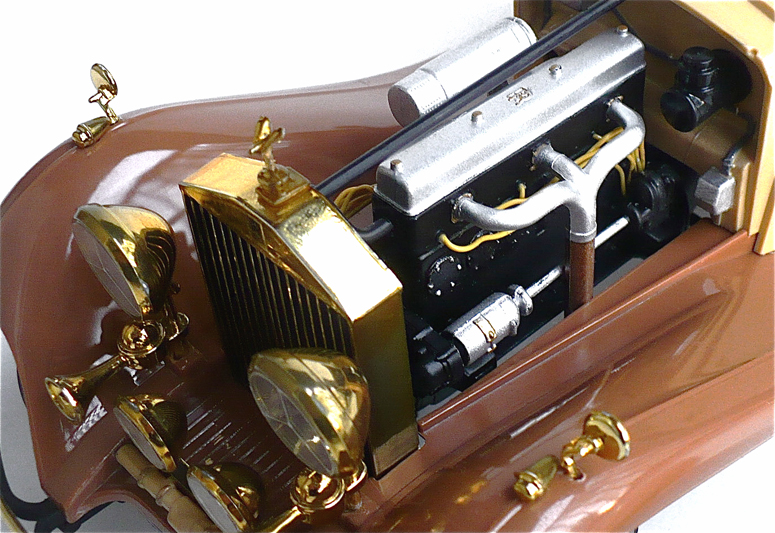
Here are some images of Revell's 1/16 scale 1934 Rolls Royce Phantom II Continental.
From Wikipedia"
The Rolls-Royce Phantom II was the third and last of Rolls-Royce's 40/50 hp models, replacing the New Phantom in 1929. It used an improved version of the Phantom I engine in an all-new chassis. A "Continental" version, with a short wheelbase and stiffer springs, was offered.
The Phantom II used a refinement of the Phantom I's 7.7 L (7,668 cc or 467.9 cu in) pushrod-OHV straight-6 engine with a new crossflow cylinder head. Unlike on previous 40/50 hp models, the engine was bolted directly to the 4-speed manual transmission. Synchromesh was added on gears 3 and 4 in 1932 and on gear 2 in 1935. Power was transmitted to the rear wheels using an open driveshaft, a hypoid bevel final drive, and Hotchkiss drive, replacing the torque tube from a remotely mounted gearbox used on earlier 40/50 hp models.
The chassis of the Phantom II was completely new. The front axle was mounted on semi-elliptical leaf springs as on earlier 40/50 hp models, but the rear axle was now also mounted on semi-elliptical springs instead of cantilever springs. This, along with the drivetrain changes, allowed the frame to be lower than before, improving the handling. The 4-wheel servo-assisted brakes from the Phantom I were continued, and the Bijur centralized lubrication system from the Springfield-built Phantom I was included on all Phantom II chassis.
The standard wheelbase of the Phantom II was 150 inches (3,800 mm). A 144 inches (3,700 mm) short-wheelbase chassis was also available.
A total of 1,281 Phantom II chassis of all types were built.
Royce had body designer Ivan Evernden build him a one-off short-wheelbase Phantom. Designated 26EX, the car had a tuned engine, five-leaf springs that were stiffer than standard and a Barker four-seat lightweight close-coupled saloon body painted with an artificial pearl lacquer made from ground herring scales. The sales department initially showed no interest in 26EX but, when Evernden returned to the office from the 1930 Biarritz Grand Concours d'Elegance, where 26EX had won the Grand Prix d'Honneur, he found that the sales department had already announced the new "Phantom II Continental Saloon", prepared a brochure for it, and costed it.
According to Evernden, neither he, Royce, nor the Rolls-Royce sales department had written specifications for the "Continental" model, although he and Royce had a clear specification in mind. Based on Evernden's writings and examination of company records, historian Ray Gentile determined that the common specifications of the Continental chassis were the short wheelbase and stiffer, five-leaf springs. By this definition, two hundred and eighty-one Continental Phantom II's were produced, including 125 left-hand drive versions.
Regarded as the two most important P-II Continentals are 20MS and 2SK, the only two P-II Continental Roadsters ever built. 20MS has been in a private Mid-Atlantic collection since 1989, 2SK, the Thrupp and Maberly Roadster once owned by Tyrone Power, was in the Fred Buess collection since 1958 but was sold at auction in 2010.
All Phantom II rolling chassis were built at Rolls-Royce's factory in Derby. The factory in Springfield, Massachusetts was closed upon ending production of the US-market Phantom I in 1931. Two US-market series, AJS and AMS, were built at Derby.
Only the chassis and mechanical parts were made by Rolls-Royce. The body was made and fitted by a coachbuilder selected by the owner. Some of the most famous coachbuilders who produced bodies for Rolls Royce cars are Park Ward, Thrupp & Maberly, Mulliner, Henley, and Hooper.
When Marlene Dietrich came to the USA in 1930, the Blue Angel director Josef von Sternberg welcomed her with gifts including a green Rolls-Royce Phantom II. The car later appeared in their first US film Morocco.
The Phantom II was featured in the films The Sorcerer's Apprentice (2010 film) and Indiana Jones and the Last Crusade. When its specifications are quoted during the scene in the Kingdom of Hatay, the Sultan states that the Rolls-Royce Phantom II has a "4.3 litre, 30 horsepower, six cylinder engine, with Stromberg downdraft carburetor" and "can go from zero to 100 kilometers an hour in 12.5 seconds (and I even like the color)." However, the car used in the film was actually a Rolls-Royce Barker Saloon, with 20/25 hp. It is also the star of the 1964 movie The Yellow Rolls-Royce where its engine specifications are given as the engine having a bore of 4.5" and stroke of 5.5", which would equate to 525 cubic inches
From Wikipedia"
The Rolls-Royce Phantom II was the third and last of Rolls-Royce's 40/50 hp models, replacing the New Phantom in 1929. It used an improved version of the Phantom I engine in an all-new chassis. A "Continental" version, with a short wheelbase and stiffer springs, was offered.
The Phantom II used a refinement of the Phantom I's 7.7 L (7,668 cc or 467.9 cu in) pushrod-OHV straight-6 engine with a new crossflow cylinder head. Unlike on previous 40/50 hp models, the engine was bolted directly to the 4-speed manual transmission. Synchromesh was added on gears 3 and 4 in 1932 and on gear 2 in 1935. Power was transmitted to the rear wheels using an open driveshaft, a hypoid bevel final drive, and Hotchkiss drive, replacing the torque tube from a remotely mounted gearbox used on earlier 40/50 hp models.
The chassis of the Phantom II was completely new. The front axle was mounted on semi-elliptical leaf springs as on earlier 40/50 hp models, but the rear axle was now also mounted on semi-elliptical springs instead of cantilever springs. This, along with the drivetrain changes, allowed the frame to be lower than before, improving the handling. The 4-wheel servo-assisted brakes from the Phantom I were continued, and the Bijur centralized lubrication system from the Springfield-built Phantom I was included on all Phantom II chassis.
The standard wheelbase of the Phantom II was 150 inches (3,800 mm). A 144 inches (3,700 mm) short-wheelbase chassis was also available.
A total of 1,281 Phantom II chassis of all types were built.
Royce had body designer Ivan Evernden build him a one-off short-wheelbase Phantom. Designated 26EX, the car had a tuned engine, five-leaf springs that were stiffer than standard and a Barker four-seat lightweight close-coupled saloon body painted with an artificial pearl lacquer made from ground herring scales. The sales department initially showed no interest in 26EX but, when Evernden returned to the office from the 1930 Biarritz Grand Concours d'Elegance, where 26EX had won the Grand Prix d'Honneur, he found that the sales department had already announced the new "Phantom II Continental Saloon", prepared a brochure for it, and costed it.
According to Evernden, neither he, Royce, nor the Rolls-Royce sales department had written specifications for the "Continental" model, although he and Royce had a clear specification in mind. Based on Evernden's writings and examination of company records, historian Ray Gentile determined that the common specifications of the Continental chassis were the short wheelbase and stiffer, five-leaf springs. By this definition, two hundred and eighty-one Continental Phantom II's were produced, including 125 left-hand drive versions.
Regarded as the two most important P-II Continentals are 20MS and 2SK, the only two P-II Continental Roadsters ever built. 20MS has been in a private Mid-Atlantic collection since 1989, 2SK, the Thrupp and Maberly Roadster once owned by Tyrone Power, was in the Fred Buess collection since 1958 but was sold at auction in 2010.
All Phantom II rolling chassis were built at Rolls-Royce's factory in Derby. The factory in Springfield, Massachusetts was closed upon ending production of the US-market Phantom I in 1931. Two US-market series, AJS and AMS, were built at Derby.
Only the chassis and mechanical parts were made by Rolls-Royce. The body was made and fitted by a coachbuilder selected by the owner. Some of the most famous coachbuilders who produced bodies for Rolls Royce cars are Park Ward, Thrupp & Maberly, Mulliner, Henley, and Hooper.
When Marlene Dietrich came to the USA in 1930, the Blue Angel director Josef von Sternberg welcomed her with gifts including a green Rolls-Royce Phantom II. The car later appeared in their first US film Morocco.
The Phantom II was featured in the films The Sorcerer's Apprentice (2010 film) and Indiana Jones and the Last Crusade. When its specifications are quoted during the scene in the Kingdom of Hatay, the Sultan states that the Rolls-Royce Phantom II has a "4.3 litre, 30 horsepower, six cylinder engine, with Stromberg downdraft carburetor" and "can go from zero to 100 kilometers an hour in 12.5 seconds (and I even like the color)." However, the car used in the film was actually a Rolls-Royce Barker Saloon, with 20/25 hp. It is also the star of the 1964 movie The Yellow Rolls-Royce where its engine specifications are given as the engine having a bore of 4.5" and stroke of 5.5", which would equate to 525 cubic inches
Wednesday, May 6, 2015
1910 Model M6-40 Thomas Flyabout
From Wikipedia"
E. R. Thomas Motor Company was a manufacturer of motorized bicycles, motorized tricycles, motorcycles, and automobiles in Buffalo, New York between 1900 and 1919.
In 1896, Edwin Ross Thomas (1850 – 1936) of Buffalo, New York began selling gasoline engine kits for propelling ordinary bicycles. After forming the Thomas Motor Company, he began selling complete motor-assisted bicycles under the name Thomas Auto-Bi. The Auto-Bi is generally considered to be the first production motorized bicycle made in the United States. By 1903, the company was the largest manufacturer of single-cylinder, air-cooled engines. The Thomas Auto-Bi was later joined by the Auto-Tri, a three-wheeled motorcycle, and the Auto-Two Tri, a motorcycle that could hold three riders.
In 1905, the Thomas Auto-Bi established a new record for a transcontinental crossing of the United States in 48 days. By 1912, the demand for motorcycles had dropped significantly, and the Thomas Motor company discontinued all production of two-wheeled machines.
The E.R. Thomas Motor Company built automobiles from 1902 to 1919. The first Models were the 1902 Model 17, this was available in either a detachable rear entrance tonneau or runabout, equipped with a single cylinder 8hp and 2 speed plantery transmission. This was followed in January 1903 by the Model 18 with its sliding selective transmission and none detachable Tonneau with rear entrance or runabout body styles. Both the Model 17 and 18 sold side by side until stocks of the Model 17 were sold out in April-May 1903. The 1904 Thomas was the first Thomas to bear the "Flyer" name a touring car model and was the first multi cylinder vehicle produced by the firm. It was a 3 cylinder with plantery transmission on the earlier cars late change to the trans axle transmission that would continue for many years. Equipped with a tonneau, it could seat 5 passengers and sold for US$2500. The vertically mounted water-cooled straight-3, situated at the front of the car, produced 24 hp (17.9 kW). The steel-framed car weighed 1900 lb (862 kg). A modern cellular radiator was used for cooling. An 8 hp (6 kW) tonneau model sold for US$1250. In 1912 the company went into receivership and was purchased by Empire Smelting & Refining Company owner C.A. Finnegan. E.R. Thomas was finally shut down between 1918 and 1919.
A 1907 Model 35 with 4 cylinders and 60 horsepower, dubbed Thomas Flyer, won the 1908 New York to Paris Race, the first and only around-the-world automobile race ever held. The race began in Times Square, New York, on February 12 and covered some 22,000 miles (35,000 km), finishing in Paris on July 30, 1908. Six teams started the race (one Italian, one German, three French (De Dion-Bouton, Motobloc, and Sizaire-Naudin), and the American Flyer). Only three of the cars finished, the Thomas Flyer which won, the German Protos, and the Italian Züst. The original intent was to drive the full distance using the frozen Bering Strait to drive across the Pacific Ocean. In the course of the race, the Flyer was the first car to cross the United States taking 41 days 8 hours and 15 minutes, and the first to do so in the winter with George Schuster the first automobile driver to ever make the transcontinental winter crossing of the US.[6] Finishing in 169 days was a remarkable feat, considering the lack of roads and services in 1908. Schuster, the driver, was the only member of the Thomas crew to go the full distance.
The Flyer survived and was restored to the exact condition it entered Paris on that day by William F. Harrah. It is now on exhibit at the National Automobile Museum in Reno, Nevada. Additional details with numerous photos and videos on the 1908 New York to Paris Race are available at The Great Auto Race of 1908
The Germans arrived in Paris on July 26, 1908. The American Flyer arrived at the edge of the city on July 30, and initially was not allowed into Paris by police because it had a broken headlamp. A passerby offered the team a bicycle light. With no tools to remove the light, they simply strapped the bike on the Thomas Flyer so they could enter Paris and finish the race. It was later discovered the Protos took some shortcuts on its path and was penalized, so the American team that actually arrived second was declared the official winner of the epic race.
Saturday, May 2, 2015
Boeing AH-64 Apache
Here are some images of Sky Pilot's 1/32 scale Boeing AH-64 Apache.
This model started off life as a toy.
However with a bit of effort it produces a fairly decent model.
From Wikipedia"
The Boeing AH-64 Apache is a four-blade, twin-turboshaft attack helicopter with a tailwheel-type landing gear arrangement, and a tandem cockpit for a two-man crew. It features a nose-mounted sensor suite for target acquisition and night vision systems. It is armed with a 30 mm (1.18 in) M230 chain gun carried between the main landing gear, under the aircraft's forward fuselage. It has four hardpoints mounted on stub-wing pylons, typically carrying a mixture of AGM-114 Hellfire missiles and Hydra 70 rocket pods. The AH-64 has a large amount of systems redundancy to improve combat survivability.
The Apache originally started as the Model 77 developed by Hughes Helicopters for the United States Army's Advanced Attack Helicopter program to replace the AH-1 Cobra. The prototype YAH-64 was first flown on 30 September 1975. The U.S. Army selected the YAH-64 over the Bell YAH-63 in 1976, and later approved full production in 1982. After purchasing Hughes Helicopters in 1984, McDonnell Douglas continued AH-64 production and development. The helicopter was introduced to U.S. Army service in April 1986. The first production AH-64D Apache Longbow, an upgraded Apache variant, was delivered to the Army in March 1997. Production has been continued by Boeing Defense, Space & Security; over 2,000 AH-64s have been produced to date.
The U.S. Army is the primary operator of the AH-64; it has also become the primary attack helicopter of multiple nations, including Greece, Japan, Israel, the Netherlands and Singapore; as well as being produced under license in the United Kingdom as the AgustaWestland Apache. U.S. AH-64s have served in conflicts in Panama, the Persian Gulf, Kosovo, Afghanistan, and Iraq. Israel used the Apache in its military conflicts in Lebanon and the Gaza Strip; British and Dutch Apaches have seen deployments in Afghanistan and Iraq.
Following the cancellation of the AH-56 Cheyenne in 1972, in favor of U.S. Air Force and Marine Corps projects like the A-10 Thunderbolt II and Harrier, the United States Army sought an aircraft to fill an anti-armor attack role that would still be under Army command; the 1948 Key West Agreement forbade the Army from owning combat fixed-wing aircraft. The Army wanted an aircraft better than the AH-1 Cobra in firepower, performance and range. It would have the maneuverability for terrain following nap-of-the-earth (NoE) flying. To this end, the U.S. Army issued a Request For Proposals (RFP) for an Advanced Attack Helicopter (AAH) on 15 November 1972. As a sign of the importance of this project, in September 1973 the Army designated its five most important projects, the "Big Five" with AAH included.
Proposals were submitted by Bell, Boeing Vertol/Grumman team, Hughes, Lockheed, and Sikorsky. In July 1973, the U.S. Department of Defense selected finalists Bell and Hughes Aircraft's Toolco Aircraft Division (later Hughes Helicopters). This began the phase 1 of the competition. Each company built prototype helicopters and went through a flight test program. Hughes' Model 77/YAH-64A prototype first flew on 30 September 1975, while Bell's Model 409/YAH-63A prototype first flew on 1 October 1975. After evaluating the test results, the Army selected Hughes' YAH-64A over Bell's YAH-63A in 1976. Reasons for selecting the YAH-64A included its more damage tolerant four-blade main rotor and the instability of the YAH-63's tricycle landing gear arrangement.
The AH-64A then entered phase 2 of the AAH program under which three pre-production AH-64s would be built, additionally, the two YAH-64A flight prototypes and the ground test unit were upgraded to the same standard. Weapons and sensor systems were integrated and tested during this time, including the laser-guided AGM-114 Hellfire missile. Development of the Hellfire missile had begun in 1974, originally known by the name of Helicopter Launched, Fire and Forget Missile ('Hellfire' being a shortened acronym), for the purpose of arming helicopter platforms with an effective anti-tank missile.
The AH-64 Apache has a four-blade main rotor and a four-blade tail rotor. The crew sits in tandem, with the pilot sitting behind and above the copilot/gunner. Both crew members are capable of flying the aircraft and performing methods of weapon engagements independently. The AH-64 is powered by two General Electric T700 turboshaft engines with high-mounted exhausts on either side of the fuselage. Various models of engines have been used on the Apache; those in British service use engines from Rolls-Royce instead of General Electric. In 2004, General Electric Aviation began producing more powerful T700-GE-701D engines, rated at 2,000 shp (1,500 kW) for AH-64Ds.
The crew compartment has shielding between the cockpits, such that at least one crew member can survive hits. The compartment and the rotor blades are designed to sustain a hit from 23 mm (0.91 in) rounds. The airframe includes some 2,500 lb (1,100 kg) of protection and has a self-sealing fuel system to protect against ballistic projectiles. The aircraft was designed to meet the crashworthiness requirements of MIL-STD-1290, which specifies minimum requirement for crash impact energy attenuation to minimize crew injuries and fatalities. This was achieved through incorporation of increased structural strength, crashworthy landing gear, seats and fuel system.
This model started off life as a toy.
However with a bit of effort it produces a fairly decent model.
From Wikipedia"
The Boeing AH-64 Apache is a four-blade, twin-turboshaft attack helicopter with a tailwheel-type landing gear arrangement, and a tandem cockpit for a two-man crew. It features a nose-mounted sensor suite for target acquisition and night vision systems. It is armed with a 30 mm (1.18 in) M230 chain gun carried between the main landing gear, under the aircraft's forward fuselage. It has four hardpoints mounted on stub-wing pylons, typically carrying a mixture of AGM-114 Hellfire missiles and Hydra 70 rocket pods. The AH-64 has a large amount of systems redundancy to improve combat survivability.
The Apache originally started as the Model 77 developed by Hughes Helicopters for the United States Army's Advanced Attack Helicopter program to replace the AH-1 Cobra. The prototype YAH-64 was first flown on 30 September 1975. The U.S. Army selected the YAH-64 over the Bell YAH-63 in 1976, and later approved full production in 1982. After purchasing Hughes Helicopters in 1984, McDonnell Douglas continued AH-64 production and development. The helicopter was introduced to U.S. Army service in April 1986. The first production AH-64D Apache Longbow, an upgraded Apache variant, was delivered to the Army in March 1997. Production has been continued by Boeing Defense, Space & Security; over 2,000 AH-64s have been produced to date.
The U.S. Army is the primary operator of the AH-64; it has also become the primary attack helicopter of multiple nations, including Greece, Japan, Israel, the Netherlands and Singapore; as well as being produced under license in the United Kingdom as the AgustaWestland Apache. U.S. AH-64s have served in conflicts in Panama, the Persian Gulf, Kosovo, Afghanistan, and Iraq. Israel used the Apache in its military conflicts in Lebanon and the Gaza Strip; British and Dutch Apaches have seen deployments in Afghanistan and Iraq.
Following the cancellation of the AH-56 Cheyenne in 1972, in favor of U.S. Air Force and Marine Corps projects like the A-10 Thunderbolt II and Harrier, the United States Army sought an aircraft to fill an anti-armor attack role that would still be under Army command; the 1948 Key West Agreement forbade the Army from owning combat fixed-wing aircraft. The Army wanted an aircraft better than the AH-1 Cobra in firepower, performance and range. It would have the maneuverability for terrain following nap-of-the-earth (NoE) flying. To this end, the U.S. Army issued a Request For Proposals (RFP) for an Advanced Attack Helicopter (AAH) on 15 November 1972. As a sign of the importance of this project, in September 1973 the Army designated its five most important projects, the "Big Five" with AAH included.
Proposals were submitted by Bell, Boeing Vertol/Grumman team, Hughes, Lockheed, and Sikorsky. In July 1973, the U.S. Department of Defense selected finalists Bell and Hughes Aircraft's Toolco Aircraft Division (later Hughes Helicopters). This began the phase 1 of the competition. Each company built prototype helicopters and went through a flight test program. Hughes' Model 77/YAH-64A prototype first flew on 30 September 1975, while Bell's Model 409/YAH-63A prototype first flew on 1 October 1975. After evaluating the test results, the Army selected Hughes' YAH-64A over Bell's YAH-63A in 1976. Reasons for selecting the YAH-64A included its more damage tolerant four-blade main rotor and the instability of the YAH-63's tricycle landing gear arrangement.
The AH-64A then entered phase 2 of the AAH program under which three pre-production AH-64s would be built, additionally, the two YAH-64A flight prototypes and the ground test unit were upgraded to the same standard. Weapons and sensor systems were integrated and tested during this time, including the laser-guided AGM-114 Hellfire missile. Development of the Hellfire missile had begun in 1974, originally known by the name of Helicopter Launched, Fire and Forget Missile ('Hellfire' being a shortened acronym), for the purpose of arming helicopter platforms with an effective anti-tank missile.
The AH-64 Apache has a four-blade main rotor and a four-blade tail rotor. The crew sits in tandem, with the pilot sitting behind and above the copilot/gunner. Both crew members are capable of flying the aircraft and performing methods of weapon engagements independently. The AH-64 is powered by two General Electric T700 turboshaft engines with high-mounted exhausts on either side of the fuselage. Various models of engines have been used on the Apache; those in British service use engines from Rolls-Royce instead of General Electric. In 2004, General Electric Aviation began producing more powerful T700-GE-701D engines, rated at 2,000 shp (1,500 kW) for AH-64Ds.
The crew compartment has shielding between the cockpits, such that at least one crew member can survive hits. The compartment and the rotor blades are designed to sustain a hit from 23 mm (0.91 in) rounds. The airframe includes some 2,500 lb (1,100 kg) of protection and has a self-sealing fuel system to protect against ballistic projectiles. The aircraft was designed to meet the crashworthiness requirements of MIL-STD-1290, which specifies minimum requirement for crash impact energy attenuation to minimize crew injuries and fatalities. This was achieved through incorporation of increased structural strength, crashworthy landing gear, seats and fuel system.
Subscribe to:
Posts (Atom)