Here are some images of Kitty Hawk's 1/32 scale North American T6 Texan converted to a Harvard with World War Two Canadian Markings.
From Wikipedia"
The North American Aviation T-6 Texan is a single-engined advanced trainer aircraft used to train pilots of the United States Army Air Forces (USAAF), United States Navy, Royal Air Force and other air forces of the British Commonwealth during World War II and into the 1970s. Designed by North American Aviation, the T-6 is known by a variety of designations depending on the model and operating air force. The United States Army Air Corps (USAAC) and USAAF designated it as the AT-6, the United States Navy the SNJ, and British Commonwealth air forces, the Harvard, the name it is best known by outside of the US. After 1962, US forces designated it the T-6. It remains a popular warbird aircraft used for airshow demonstrations and static displays. It has also been used many times to simulate the Japanese Mitsubishi Zero in movies depicting World War II in the Pacific.
The Texan originated from the North American NA-16
prototype (first flown on April 1, 1935) which, modified as the NA-26,
was submitted as an entry for a USAAC "Basic Combat" aircraft
competition in March, 1937. The first model went into production and 180 were supplied to the USAAC as the BC-1 and 400 to the RAF as the Harvard I. The US Navy received 16 modified aircraft, designated the SNJ-1, and a further 61 as the SNJ-2 with a different engine.
The BC-1 was the production version of the NA-26 prototype, with
retractable tailwheel landing gear and the provision for armament, a
two-way radio, and the 550 hp (410 kW) R-1340-47 engine as standard
equipment. Production versions included the BC-1 (Model NA-36) with only minor modifications (177 built), of which 30 were modified as BC-1I instrument trainers; the BC-1A (NA-55) with airframe revisions (92 built); and a single BC-1B with a modified wing center-section.
Three BC-2 aircraft were built before the shift to the "advanced trainer" designation, AT-6,
which was equivalent to the BC-1A. The differences between the AT-6 and
the BC-1 were new outer wing panels with a swept forward trailing edge,
squared-off wingtips and a triangular rudder, producing the canonical
Texan silhouette. After a change to the rear of the canopy, the AT-6 was
designated the Harvard II for RAF/RCAF orders and 1,173 were supplied by purchase or Lend Lease, mostly operating in Canada as part of the British Commonwealth Air Training Plan.
Next came the AT-6A which was based on the NA-77 design and was powered by the Pratt & Whitney R-1340-49 Wasp radial engine. The USAAF received 1,549 and the US Navy 270 (as the SNJ-3). The AT-6B was built for gunnery training and could mount a .30 in machine gun
on the forward fuselage. It used the R-1340-AN-1 engine, which was to
become the standard for the remaining T-6 production. Canada's Noorduyn Aviation built an R-1340-AN-1-powered version of the AT-6A, which was supplied to the USAAF as the AT-16 (1,500 aircraft) and the RAF/RCAF as the Harvard IIB (2,485 aircraft), some of which also served with the Fleet Air Arm and Royal Canadian Navy.
In late 1937 Mitsubushi purchased two NA-16s as technology demonstrators and possibly a licence to build more. However, the aircraft developed by Watanabe/Kyushu as the K10W1 (Allied code name Oak) bore no more than a superficial resemblance to the North American design. It featured a full monocoque
fuselage as opposed to the steel tube fuselage of the T-6 and NA-16
family of aircraft, as well as being of smaller dimensions overall and
had no design details in common with the T-6. It was used in very small
numbers by the Imperial Japanese Navy from 1942 onwards. After the war
the Japanese Air Self Defense Force operated Texans.
The NA-88 design resulted in 2,970 AT-6C Texans and 2,400 as the SNJ-4. The RAF received 726 of the AT-6C as the Harvard IIA. Modifications to the electrical system produced the AT-6D (3,713 produced) and SNJ-5 (1,357 produced). The AT-6D, redesignated the Harvard III,
was supplied to the RAF (351 aircraft) and Fleet Air Arm (564
aircraft). The AT-6G (SNJ-7) involved major advancements including a
full-time hydraulic system and a steerable tailwheel and persisted into
the 1950s as the USAF advanced trainer.
Subsequently the NA-121 design with a completely clear rearmost section on the canopy, gave rise to 25 AT-6F Texans for the USAAF and 931, as the SNJ-6 for the US Navy. The ultimate version, the Harvard 4, was produced by Canada Car and Foundry during the 1950s, and supplied to the RCAF, USAF and Bundeswehr.
A total of 15,495 T-6s of all variants were built.
Translate
Saturday, December 5, 2015
Tuesday, December 1, 2015
WWII US Navy LCM (3) Landing Craft
Here are some images of Trumpeter's 1/35 scale WWII US Navy LCM (3) Landing Craft
From Wikipedia"
The Landing Craft Mechanized (LCM) or Landing Craft Mechanical is a landing craft designed for carrying vehicles. They came to prominence during the Second World War when they were used to land troops or tanks during Allied amphibious assaults.
There was no single design of LCM used, unlike the Landing Craft, Vehicle, Personnel (LCVP) or Landing Craft Assault (LCA) landing craft made by the US and UK respectively. There were several different designs built by the UK and US and by different manufacturers.
The British Motor Landing Craft was conceived and tested in the 1920s and was used from 1924 in exercises. It was the first purpose built tank landing craft. It was the progenitor of all subsequent LCM designs.
There were two designs:
From Wikipedia"
The Landing Craft Mechanized (LCM) or Landing Craft Mechanical is a landing craft designed for carrying vehicles. They came to prominence during the Second World War when they were used to land troops or tanks during Allied amphibious assaults.
There was no single design of LCM used, unlike the Landing Craft, Vehicle, Personnel (LCVP) or Landing Craft Assault (LCA) landing craft made by the US and UK respectively. There were several different designs built by the UK and US and by different manufacturers.
The British Motor Landing Craft was conceived and tested in the 1920s and was used from 1924 in exercises. It was the first purpose built tank landing craft. It was the progenitor of all subsequent LCM designs.
LCM (3)
Higgins LCM-3 at Battleship Cove
- BUREAU
- Higgins
- Displacement: 52 tons (loaded); 23 tons (empty)
- Length: 50 feet (15 m)
- Beam: 14 feet (4.3 m)
- Draft: 3 feet (0.91 m) (forward); 4 feet (1.2 m) (aft)
- Speed: 8 knots (9.2 mph) (loaded); 11 knots (13 mph) (empty)
- Armament: two .50-cal M2 Browning machine guns
- Crew: 4
- Capacity: One 30-ton tank (e.g. M4 Sherman), 60 troops, or 60,000 lb (27,000 kg) of cargo
Sunday, November 29, 2015
Leonardo da Vinci's Multiple Sling
Here are some images of Edu-Toys Leonardo da Vinci's Multiple Sling.
From the instructions"
Leonardo da Vinci's idea was to build a very powerful machine which could throw eight large projectiles at the same time.
He positioned eight long arms around a central pin, each of which had a sling capable of throwing a projectile attached to it.
This kind of project, where weapons were developed to hurl multiple projectiles to be more powerful, was common in da Vinci's time, because doing this meant creating more powerful weapons, simply by increasing their number and power, without the need to develop new building techniques and using familiar materials. They were therefore potentially attractive weapons because they were powerful,but they were also relatively inexpensive.
From the instructions"
Leonardo da Vinci's idea was to build a very powerful machine which could throw eight large projectiles at the same time.
He positioned eight long arms around a central pin, each of which had a sling capable of throwing a projectile attached to it.
This kind of project, where weapons were developed to hurl multiple projectiles to be more powerful, was common in da Vinci's time, because doing this meant creating more powerful weapons, simply by increasing their number and power, without the need to develop new building techniques and using familiar materials. They were therefore potentially attractive weapons because they were powerful,but they were also relatively inexpensive.
Saturday, November 28, 2015
Leonardo da Vinci's Mechanical Drum
Here are some images of Academy's Leonardo da Vinci's Mechanical Drum.
From the instructions"
The cart was equipped with a mechanical mechanism that caused the two side drums to beat whenever the cart was pulled or pushed.
From the instructions"
The cart was equipped with a mechanical mechanism that caused the two side drums to beat whenever the cart was pulled or pushed.
Thursday, November 26, 2015
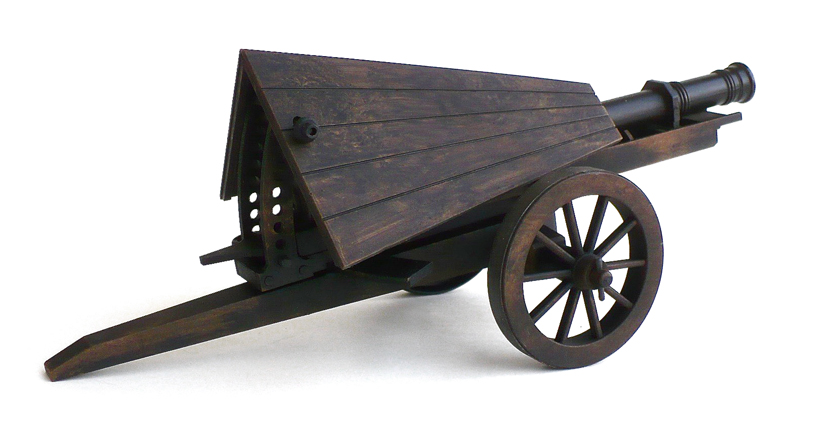
Leonardo da Vinci's Spingarde
Here are some images of Academy's Leonardo da Vinci's Spingarde.
These are simple kits but they're fun.
From the instructions"
The Leonardo da Vinci Spingarde launcher was placed on a firm wooden structure and could launch projectiles at targets over a wide range, due to its ability to move in all directions. Although heavy, efficient aiming was not difficult, making it highly functional on the battlefield.
These are simple kits but they're fun.
From the instructions"
The Leonardo da Vinci Spingarde launcher was placed on a firm wooden structure and could launch projectiles at targets over a wide range, due to its ability to move in all directions. Although heavy, efficient aiming was not difficult, making it highly functional on the battlefield.
Friday, November 20, 2015
HMS Halifax 1768
From Wikipedia"
HMS Halifax was a schooner built for merchant service at Halifax, Nova Scotia in 1765 that the British Royal Navy purchased in 1768 for coastal patrol in North America in the years just prior to the American Revolution. She is one of the best documented schooners from early North America.
The schooner was built by a group of Halifax merchants with government support as the Nova Scotia Packet, to establish a reliable packet service of mail and passengers between Halifax and Boston in 1765. The managing owner was, Joseph Grey, the son in law of the commissioner of the Halifax Naval Yard where the schooner was likely built. Launched in late September 1765, the schooner made her first voyage on 15 October 1765 under the command of Benjamin Green Jnr. Weather permitting, the packet sailed every eight days between Halifax and Boston and made 23 round trips during her merchant career. In July 1768, the Nova Scotia Packet was chartered by Commodore Samuel Hood in Halifax to take dispatches to Portsmouth, England. Hood also recommended that the schooner be purchased by the British Royal Navy.
The Royal Navy purchased the schooner on 12 October 1768 and renamed her Halifax; she met a need for more coastal patrol schooners to combat smuggling and deal with colonial unrest in New England. The careful record of her lines and construction by Portsmouth dockyard naval architects, and the detailed record of her naval service, make the schooner a much-studied example of early schooners in North America.
Original Royal Navy plans of HMS Halifax
After an active career on the coast on North America she was wrecked on 15 February 1775 at Foster Island near Machias, Maine. she was reportedly intentionally run aground by a local pilot. The court martial of Nunn, his officers, and crew, attributed the loss to the pilot's ignorance; nothing came of this as the pilot had disappeared while Nunn was arranging transport from Sheep's Island to Boston for his crew with a local shipowner, Mr. Beale.
The wreck played a role in the Battle of Machias later that year, when Admiral Samuel Graves ordered that her guns be recovered. A later schooner named Halifax serving in North America was recorded as being purchased in 1775, though her lines were identical to the Halifax sunk that year, and she may therefore have been salved and returned to service.
Wednesday, November 11, 2015
Tuesday, November 3, 2015
15CM Nebelwerfer 41
From Wikipedia"
The 15 cm Nebelwerfer 41 (15 cm NbW 41) was a German multiple rocket launcher used in the Second World War. It served with units of the Nebeltruppen, the German equivalent of the U.S. Army's Chemical Corps. Just as the Chemical Corps had responsibility for poison gas and smoke weapons that were used instead to deliver high-explosives during the war, so did the Nebeltruppen. The name Nebelwerfer is best translated as "smoke thrower".
Rocket development had begun during the 1920s and reached fruition in the late-30s. These offered the opportunity for the Nebeltruppen to deliver large quantities of poison gas or smoke simultaneously. The first weapon to be delivered to the troops was the 15 cm Nebelwerfer 41 in 1940, after the Battle of France, a purpose-designed rocket with gas, smoke and high-explosive warheads. It, like virtually all German rocket designs, was spin-stabilized to increase accuracy. One very unusual feature was that the rocket motor was in the front, the exhaust venturi being about two-thirds down the body from the nose, with the intent to optimize the blast and fragmentation effect of the rocket as the warhead would still be above the ground when it detonated. This proved to greatly complicate manufacture for not much extra effect and it was not copied on later rocket designs. It was fired from a six-tube launcher mounted on a towed carriage adapted from that used by the 3.7 cm PaK 36 to a range of 6,900 metres (7,500 yd). Almost five and a half million 15 cm rockets and six thousand launchers were manufactured over the course of the war.
Sunday, November 1, 2015
Renault FT 17
Here are some images of Takom Models 1/16 scale Renault FT 17 light tank.
From Wikipedia"
The Renault FT, frequently referred to in post-World War I literature as the "FT-17" or "FT17", was a French light tank that was among the most revolutionary and influential tank designs in history. The FT was the first production tank to have its armament within a fully rotating turret. The Renault FT's configuration – crew compartment at the front, engine compartment at the back, and main armament in a revolving turret – became and remains the standard tank layout. Over 3,000 Renault FT tanks were manufactured by French industry, most of them during the year 1918. Another 950 of an almost identical licensed copy of the FT (the M1917) were made in the United States, but not in time to enter combat. Armoured warfare historian Steven Zaloga has called the Renault FT "the world's first modern tank."
The FT was designed and produced by the Société des Automobiles Renault (Renault Automobile Company), one of France's major manufacturers of motor vehicles then and now.
It is thought possible that Louis Renault began working on the idea as early as 21 December 1915, after a visit from Colonel J.B.E. Estienne. Estienne had drawn up plans for a tracked armoured vehicle based on the Holt caterpillar tractor, and, with permission from General Joffre, approached Renault as a possible manufacturer. Renault declined, saying that his company was operating at full capacity producing war materiel and that he had no experience of tracked vehicles. Estienne took his plans to the Schneider company, where they became France's first operational tank, the Schneider CA.
At a later, chance meeting with Renault on 16 July 1916, Estienne asked him to reconsider, which he did. The speed with which the project then progressed to the mock-up stage has led to the theory that Renault had been working on the idea for some time.
Louis Renault himself conceived the new tank's overall design and set its basic specifications. He imposed a realistic limit to the FT's projected weight which could not exceed 7 tons. Louis Renault was unconvinced that a sufficient power-to-weight ratio could be achieved with the production engines available at the time to give sufficient mobility to the heavy tank types requested by the military. Renault's most talented industrial designer, Rodolphe Ernst-Metzmaier, generated the FT's detailed execution plans . Charles-Edmond Serre, a long time associate of Louis Renault, organized and supervised the new tank's mass production. The FT's tracks were kept automatically under tension to prevent derailments, while a rounded tail piece facilitated the crossing of trenches . Because the engine had been designed to function normally under any slant, very steep slopes could be negotiated by the Renault FT without loss of power. Effective internal ventilation was provided by the engine's radiator fan which drew its air through the front crew compartment of the tank and forced it out through the rear engine's compartment.
Renault's design was technically far more advanced than the other two French tanks at the time, namely the Schneider CA1 (1916) and the heavy Saint-Chamond (1917). Nevertheless Renault encountered some early difficulties in getting his proposal fully supported by the head of the French tank arm, Colonel (later General) Jean Baptiste Eugène Estienne. After the first British use of heavy tanks on 15 September 1916 during the Battle of the Somme, the French military still pondered whether a large number of light tanks would be preferable to a smaller number of superheavy tanks (the later Char 2C). However, on 27 November 1916, Estienne had sent to the French Commander in Chief a personal memorandum proposing the immediate adoption and mass manufacture of a light tank based on the specifications of the Renault prototype. After receiving two large government orders for the FT tank, one in April 1917 and the other in June 1917, Renault was at last able to proceed. However his design remained in competition with the superheavy Char 2C until the end of the war.
The prototype was refined during the second half of 1917, but the Renault FT remained plagued by radiator fan belt problems throughout the war. Only 84 were produced in 1917 but 2,697 were delivered to the French army before the Armistice.
About half of all FTs were manufactured in Renault's factory at Boulogne-Billancourt near Paris, with the remainder subcontracted to other concerns. Of the original order for 3,530, Renault accounted for 1,850 (52 per cent), Berliet 800 (23 per cent), SOMUA (a subsidiary of Schneider & Cie) 600 (17 per cent), and Delaunay-Belleville 280 (8 per cent). When the order was increased to 7,820 in 1918, production was distributed in roughly the same proportion. Louis Renault agreed to waive royalties for all French manufacturers of the FT.
When the USA entered the War in April 1917, its army was short of heavy materiel, and had no tanks at all. Because of the wartime demands on French industry, it was decided that the quickest way to supply the American forces with sufficient armour was to manufacture the FT in the USA. A requirement of 4,400 of a modified version, the M1917, was decided on, with delivery expected to begin in April, 1918. By June 1918, US manufacturers had failed to produce any, and delivery dates were put back until September. France therefore agreed to lend 144 FTs, enough to equip 2 battalions. No M1917s reached the American Expeditionary Forces (AEF) until the War was over.
The Renault FT was widely used by French forces in 1918 and by the American Expeditionary Forces (AEF) in France in the later stages of World War I.
The battlefield debut of the Renault FT occurred on 31 May 1918 east of the Forest of Retz, near Chaudun, between Soissons and Villers-Cotterets, during the Second Battle of the Marne. This engagement, with 30 FTs, successfully broke up a German advance, but in the absence of infantry support, the vehicles later withdrew. From then on, gradually increasing numbers of FTs were deployed, together with smaller numbers of the older Schneider CA1 and Saint-Chamond tanks. As the war had become a war of movement during the summer of 1918, the lighter FTs were often transported on heavy trucks and special trailers rather than by rail on flat cars. Estienne had initially proposed to overwhelm the enemy defences using a "swarm" of light tanks, a tactic that was eventually successfully implemented. Beginning in late 1917, the Entente allies were attempting to outproduce the Central Powers in all respects, including artillery, tanks, and chemical weapons. Consequently a goal was set of manufacturing 12,260 Renault FT tanks (including 4,440 of the US version) before the end of 1919.
After the end of World War I, Renault FTs were exported to many countries (Belgium, Brazil, Czechoslovakia, Estonia, Finland, Iran, Japan, Lithuania, Netherlands, Poland, Romania, Spain, Switzerland, Turkey, and Yugoslavia). Renault FT tanks were used by most nations having armoured forces, generally as their prominent tank type. The tanks were used in many later conflicts, such as the Russian Civil War, Polish-Soviet War, Chinese Civil War, Rif War, Spanish Civil War, and Estonian War of Independence.
Renault FT tanks were also fielded in limited numbers during World War II, in Poland, Finland, France, and the Kingdom of Yugoslavia, although they were already obsolete. In 1940 the French Army still had eight battalions equipped with 63 FTs each and three independent companies with ten each, for a total organic strength of 534, all equipped with machine guns. These were put to use after most of the modern equipment was lost in earlier battles.
Many smaller units assembled after the start of World War II also used the Renault FT. This usage gave rise to the popular myth that the French had no modern equipment at all; in fact, they had more modern tanks than the Germans. The French suffered from tactical and strategic weaknesses rather than from equipment deficiencies. When the best French units were cut off by the German drive to the English Channel, the complete French materiel reserve was sent to the front as an expediency measure; this included 575 FTs. Earlier, 115 sections of FTs had been formed for airbase defence. The Wehrmacht captured 1,704 FTs. They used about a hundred for airfield defence and about 650 for patrolling occupied Europe. Some were used by the Germans in 1944 for street-fighting in Paris, but by this time they were hopelessly out of date. Vichy France used Renault FTs against Allied invasion forces during Operation Torch in Morocco and Algeria. The French tanks, however, were no match for the newly arrived American M4 Sherman and M3 Stuart tanks.
Much confusion surrounds the name of this tank.
It is sometimes stated that the letters FT stand for the French terms faible tonnage (low tonnage), faible taille (small size), franchisseur de tranchées (trench crosser), or force terrestre (land force). None is correct. Nor was it named the FT 17 or FT-17; nor was there an FT18.
All new Renault projects were given a two-letter product code for internal use, and the next one available was 'FT.'
The prototype was at first referred to as the automitrailleuse à chenilles Renault FT modèle 1917. Automitrailleuse à chenilles means "armoured car with tracks." By this stage of the War, automitrailleuse was the standard word for an armoured car, but by the time the FT was designed there were two other types of French tank in existence and the term char d'assaut (from the French char - a cart or wagon, and assaut; attack or assault), soon shortened to char, had at the insistence of Colonel Estienne, already been adopted by the French and was in common use. Once orders for the vehicle had been secured it was the practice at Renault to refer to it as the "FT." The vehicle was originally intended to carry a machine-gun, and was therefore described as a char mitrailleur. Mitrailleur (from mitraille; grapeshot) had by this time come to mean "machine-gunner."
Many sources, predominantly English language accounts, refer to the FT as the "FT 17" or "FT-17." This term is not contemporary, and appears to have arisen post World War One. In Estienne's biography, his granddaughter states, "It is also referred to as the FT 17: the number 17 was added after the war in history books, since it was always referred to at Renault as the FT." Lieutenant-Colonel Paul Malmassari (French tank officer and Doctor of History) states, "The Renault tank never carried the name FT 17 during the First World War, although the initials F.T. seem to appear in August 1917." Some confusion might also have been caused by the fact that the American version of the vehicle, produced in the USA under licence from Renault, was designated the M1917.
When it was decided to equip the FTs with either cannon or machine-guns, the cannon version was designated char canon (cannon tank) and the latter, in accordance with French grammar, renamed char mitrailleuse (machine-gun tank).
It is frequently claimed that some of these tanks were designated FT 18. Reasons given for the claim include: it distinguished tanks produced in 1918 from those of 1917; it was applied to FTs armed with cannon as opposed to those with machine-guns; it distinguished FTs with a cast, rounded turret from those with a hexagonal one; it referred to the 18 horsepower engine; it indicated a version to which various modifications had been made.
However, Renault records make no distinction between 1917 and 1918 output; the decision to arm FTs with a 37mm gun was made in April, 1917, before any tanks had been manufactured; because of various production difficulties and design requirements, a range of types of turret were produced by several manufacturers, but they were all fitted to the basic FT body without any distinguishing reference; all FTs had the same model 18 hp engine. The Renault manual of April, 1918 is entitled RENAULT CHAR D'ASSAUT 18 HP, and the illustrations are of the machine-gun version. The official designation was not changed until the 1930s, when the FT was fitted with a Model 1931 machine-gun and renamed the FT31. By this time the French Army was equipped with several other Renault models and it had become necessary to distinguish between the various types.
From Wikipedia"
The Renault FT, frequently referred to in post-World War I literature as the "FT-17" or "FT17", was a French light tank that was among the most revolutionary and influential tank designs in history. The FT was the first production tank to have its armament within a fully rotating turret. The Renault FT's configuration – crew compartment at the front, engine compartment at the back, and main armament in a revolving turret – became and remains the standard tank layout. Over 3,000 Renault FT tanks were manufactured by French industry, most of them during the year 1918. Another 950 of an almost identical licensed copy of the FT (the M1917) were made in the United States, but not in time to enter combat. Armoured warfare historian Steven Zaloga has called the Renault FT "the world's first modern tank."
The FT was designed and produced by the Société des Automobiles Renault (Renault Automobile Company), one of France's major manufacturers of motor vehicles then and now.
It is thought possible that Louis Renault began working on the idea as early as 21 December 1915, after a visit from Colonel J.B.E. Estienne. Estienne had drawn up plans for a tracked armoured vehicle based on the Holt caterpillar tractor, and, with permission from General Joffre, approached Renault as a possible manufacturer. Renault declined, saying that his company was operating at full capacity producing war materiel and that he had no experience of tracked vehicles. Estienne took his plans to the Schneider company, where they became France's first operational tank, the Schneider CA.
At a later, chance meeting with Renault on 16 July 1916, Estienne asked him to reconsider, which he did. The speed with which the project then progressed to the mock-up stage has led to the theory that Renault had been working on the idea for some time.
Louis Renault himself conceived the new tank's overall design and set its basic specifications. He imposed a realistic limit to the FT's projected weight which could not exceed 7 tons. Louis Renault was unconvinced that a sufficient power-to-weight ratio could be achieved with the production engines available at the time to give sufficient mobility to the heavy tank types requested by the military. Renault's most talented industrial designer, Rodolphe Ernst-Metzmaier, generated the FT's detailed execution plans . Charles-Edmond Serre, a long time associate of Louis Renault, organized and supervised the new tank's mass production. The FT's tracks were kept automatically under tension to prevent derailments, while a rounded tail piece facilitated the crossing of trenches . Because the engine had been designed to function normally under any slant, very steep slopes could be negotiated by the Renault FT without loss of power. Effective internal ventilation was provided by the engine's radiator fan which drew its air through the front crew compartment of the tank and forced it out through the rear engine's compartment.
Renault's design was technically far more advanced than the other two French tanks at the time, namely the Schneider CA1 (1916) and the heavy Saint-Chamond (1917). Nevertheless Renault encountered some early difficulties in getting his proposal fully supported by the head of the French tank arm, Colonel (later General) Jean Baptiste Eugène Estienne. After the first British use of heavy tanks on 15 September 1916 during the Battle of the Somme, the French military still pondered whether a large number of light tanks would be preferable to a smaller number of superheavy tanks (the later Char 2C). However, on 27 November 1916, Estienne had sent to the French Commander in Chief a personal memorandum proposing the immediate adoption and mass manufacture of a light tank based on the specifications of the Renault prototype. After receiving two large government orders for the FT tank, one in April 1917 and the other in June 1917, Renault was at last able to proceed. However his design remained in competition with the superheavy Char 2C until the end of the war.
The prototype was refined during the second half of 1917, but the Renault FT remained plagued by radiator fan belt problems throughout the war. Only 84 were produced in 1917 but 2,697 were delivered to the French army before the Armistice.
About half of all FTs were manufactured in Renault's factory at Boulogne-Billancourt near Paris, with the remainder subcontracted to other concerns. Of the original order for 3,530, Renault accounted for 1,850 (52 per cent), Berliet 800 (23 per cent), SOMUA (a subsidiary of Schneider & Cie) 600 (17 per cent), and Delaunay-Belleville 280 (8 per cent). When the order was increased to 7,820 in 1918, production was distributed in roughly the same proportion. Louis Renault agreed to waive royalties for all French manufacturers of the FT.
When the USA entered the War in April 1917, its army was short of heavy materiel, and had no tanks at all. Because of the wartime demands on French industry, it was decided that the quickest way to supply the American forces with sufficient armour was to manufacture the FT in the USA. A requirement of 4,400 of a modified version, the M1917, was decided on, with delivery expected to begin in April, 1918. By June 1918, US manufacturers had failed to produce any, and delivery dates were put back until September. France therefore agreed to lend 144 FTs, enough to equip 2 battalions. No M1917s reached the American Expeditionary Forces (AEF) until the War was over.
The Renault FT was widely used by French forces in 1918 and by the American Expeditionary Forces (AEF) in France in the later stages of World War I.
The battlefield debut of the Renault FT occurred on 31 May 1918 east of the Forest of Retz, near Chaudun, between Soissons and Villers-Cotterets, during the Second Battle of the Marne. This engagement, with 30 FTs, successfully broke up a German advance, but in the absence of infantry support, the vehicles later withdrew. From then on, gradually increasing numbers of FTs were deployed, together with smaller numbers of the older Schneider CA1 and Saint-Chamond tanks. As the war had become a war of movement during the summer of 1918, the lighter FTs were often transported on heavy trucks and special trailers rather than by rail on flat cars. Estienne had initially proposed to overwhelm the enemy defences using a "swarm" of light tanks, a tactic that was eventually successfully implemented. Beginning in late 1917, the Entente allies were attempting to outproduce the Central Powers in all respects, including artillery, tanks, and chemical weapons. Consequently a goal was set of manufacturing 12,260 Renault FT tanks (including 4,440 of the US version) before the end of 1919.
After the end of World War I, Renault FTs were exported to many countries (Belgium, Brazil, Czechoslovakia, Estonia, Finland, Iran, Japan, Lithuania, Netherlands, Poland, Romania, Spain, Switzerland, Turkey, and Yugoslavia). Renault FT tanks were used by most nations having armoured forces, generally as their prominent tank type. The tanks were used in many later conflicts, such as the Russian Civil War, Polish-Soviet War, Chinese Civil War, Rif War, Spanish Civil War, and Estonian War of Independence.
Renault FT tanks were also fielded in limited numbers during World War II, in Poland, Finland, France, and the Kingdom of Yugoslavia, although they were already obsolete. In 1940 the French Army still had eight battalions equipped with 63 FTs each and three independent companies with ten each, for a total organic strength of 534, all equipped with machine guns. These were put to use after most of the modern equipment was lost in earlier battles.
Many smaller units assembled after the start of World War II also used the Renault FT. This usage gave rise to the popular myth that the French had no modern equipment at all; in fact, they had more modern tanks than the Germans. The French suffered from tactical and strategic weaknesses rather than from equipment deficiencies. When the best French units were cut off by the German drive to the English Channel, the complete French materiel reserve was sent to the front as an expediency measure; this included 575 FTs. Earlier, 115 sections of FTs had been formed for airbase defence. The Wehrmacht captured 1,704 FTs. They used about a hundred for airfield defence and about 650 for patrolling occupied Europe. Some were used by the Germans in 1944 for street-fighting in Paris, but by this time they were hopelessly out of date. Vichy France used Renault FTs against Allied invasion forces during Operation Torch in Morocco and Algeria. The French tanks, however, were no match for the newly arrived American M4 Sherman and M3 Stuart tanks.
Much confusion surrounds the name of this tank.
It is sometimes stated that the letters FT stand for the French terms faible tonnage (low tonnage), faible taille (small size), franchisseur de tranchées (trench crosser), or force terrestre (land force). None is correct. Nor was it named the FT 17 or FT-17; nor was there an FT18.
All new Renault projects were given a two-letter product code for internal use, and the next one available was 'FT.'
The prototype was at first referred to as the automitrailleuse à chenilles Renault FT modèle 1917. Automitrailleuse à chenilles means "armoured car with tracks." By this stage of the War, automitrailleuse was the standard word for an armoured car, but by the time the FT was designed there were two other types of French tank in existence and the term char d'assaut (from the French char - a cart or wagon, and assaut; attack or assault), soon shortened to char, had at the insistence of Colonel Estienne, already been adopted by the French and was in common use. Once orders for the vehicle had been secured it was the practice at Renault to refer to it as the "FT." The vehicle was originally intended to carry a machine-gun, and was therefore described as a char mitrailleur. Mitrailleur (from mitraille; grapeshot) had by this time come to mean "machine-gunner."
Many sources, predominantly English language accounts, refer to the FT as the "FT 17" or "FT-17." This term is not contemporary, and appears to have arisen post World War One. In Estienne's biography, his granddaughter states, "It is also referred to as the FT 17: the number 17 was added after the war in history books, since it was always referred to at Renault as the FT." Lieutenant-Colonel Paul Malmassari (French tank officer and Doctor of History) states, "The Renault tank never carried the name FT 17 during the First World War, although the initials F.T. seem to appear in August 1917." Some confusion might also have been caused by the fact that the American version of the vehicle, produced in the USA under licence from Renault, was designated the M1917.
When it was decided to equip the FTs with either cannon or machine-guns, the cannon version was designated char canon (cannon tank) and the latter, in accordance with French grammar, renamed char mitrailleuse (machine-gun tank).
It is frequently claimed that some of these tanks were designated FT 18. Reasons given for the claim include: it distinguished tanks produced in 1918 from those of 1917; it was applied to FTs armed with cannon as opposed to those with machine-guns; it distinguished FTs with a cast, rounded turret from those with a hexagonal one; it referred to the 18 horsepower engine; it indicated a version to which various modifications had been made.
However, Renault records make no distinction between 1917 and 1918 output; the decision to arm FTs with a 37mm gun was made in April, 1917, before any tanks had been manufactured; because of various production difficulties and design requirements, a range of types of turret were produced by several manufacturers, but they were all fitted to the basic FT body without any distinguishing reference; all FTs had the same model 18 hp engine. The Renault manual of April, 1918 is entitled RENAULT CHAR D'ASSAUT 18 HP, and the illustrations are of the machine-gun version. The official designation was not changed until the 1930s, when the FT was fitted with a Model 1931 machine-gun and renamed the FT31. By this time the French Army was equipped with several other Renault models and it had become necessary to distinguish between the various types.
Subscribe to:
Posts (Atom)