Translate

Thursday, November 18, 2010

Stupa


Here are some images of Dragon Model's 1/35 scale Sd. Kfz Sturmpanzer IV
From Wikipedia "The Sturmpanzer IV (also known as Sturmpanzer 43 or Sd.Kfz. 166) was a German armoured infantry support gun based on the Panzer IV chassis used in the Second World War. It was used at the Battles of Kursk, Anzio, Normandy, and helped to put down the Warsaw Uprising. It was known by the nickname Brummbär (German: "Grumbler", not "Grizzly Bear") by Allied intelligence, a name which was not used by the Germans. German soldiers nicknamed it the "Stupa", a contraction of the term Sturmpanzer.

The first unit to take the Sturmpanzer IV into battle was Sturmpanzer-Abteilung 216. It was formed at the end of April 1943 and transferred in early May to Amiens to train on its new assault guns. It was organized into 3 line companies, each with 14 vehicles, and a battalion headquarters with 3 vehicles. It arrived in Central Russia on 10 June 1943 to prepare for Unternehmen Zitadelle (Operation Citadel), the German attack on the Kursk Salient. For this action it was temporarily assigned as the third battalion of schweres Panzerjäger Regiment 656 ("Heavy Anti-tank Regiment 656") under the command of the 9th Army of Army Group Center. It remained in the Orel-Bryansk area until its transfer to the Dnepropetrovsk-Zaporozhe area at the end of August. Its vehicles were refitted there and it remained there until the Zaporozhe Bridgehead was abandoned on 15 October. The battalion retreated to Nikopol where it helped to defend the German salient there until it was withdrawn back to the Reich at the end of December.

The Allied landing at Anzio on 22 January 1944 caused the battalion, fully independent once more, to be transferred there in early February with 28 vehicles to participate in the planned counterattack against the Allied beachhead, Unternehmen Fischfang. This failed in its objective, but the battalion remained in Italy for the rest of the war. The battalion still had 42 vehicles on hand when the Allies launched their Po Valley offensive in April 1945, but all were blown up to prevent capture or lost during the retreat before the war ended in May.

Sturmpanzer-Abteilung 217 was formed on 20 April 1944 at the Grafenwöhr Training Area from cadres provided by Panzer-Kompanie 40 and Panzer-Ersatz Abteilung 18, although it did not have any armoured fighting vehicles until 19 'Stupas' were delivered at the end of May. It departed 1/2 July for the Normandy Front. Here it had to detrain in Condé sur Noireau, some 170 kilometres (110 mi) behind the front lines, because the Allies had heavily damaged the French rail network. Many of the battalion's vehicles broke down during the road march to the front lines. The first mention of Sturmpanzer IVs in combat is on 7 August near Caen. On 19 August, the battalion had 17 Sturmpanzers operational and another 14 in maintenance. Most of the battalion was not trapped in the Falaise Pocket and managed to retreat to the northeast. It had only 22 vehicles in October, which were divided between the 1st and 2nd Companies; the surplus crews were sent to Panzer-Ersatz Abteilung 18. It participated in the Battle of the Bulge, only advancing as far as St. Vith. It was continually on the retreat for the rest of the war and was captured in the Ruhr Pocket in April 1945.

Sturmpanzer-Kompanie z.b.V. 218 was raised in August 1944. It was sent to Warsaw where it was attached to Panzer Abteilung (Fkl) 302. It remained on the Eastern Front after the Warsaw Uprising was suppressed and was eventually wiped out in East Prussia in April 1945. It was supposed to have been the cadre for Sturmpanzer Abteilung 218 in January 1945, but it was never pulled out of the front lines to do so.

Sturmpanzer-Kompanie z.b.V. 2./218 was raised simultaneously with Sturmpanzer Kompanie z.b.V. 218, but was transferred to the Paris area on 20 August. Nothing is known of its service in France, but company personnel were sent to Panzer-Ersatz Abteilung 18 at the end of the year and were supposed to have been used in the formation of Sturmpanzer Abteilung 218.

Sturmpanzer-Abteilung 218 was ordered formed on 6 January 1945 with three companies with a total of 45 Stupas, but it received Sturmgeschütz III assault guns during February instead.

Sturmpanzer-Abteilung 219 was originally to be formed from Sturmgeschütz-Brigade 914, but this was changed to Sturmgeschütz-Brigade 237 in September 1944. In mid-September 1944 the brigade transferred to the Döllersheim Training Area to reorganize and re-equip. Only ten Stupas had been received when the battalion was alerted on 15 October to participate in 'Unternehmen Eisenfaust', the German coup to forestall Hungary's attempt to surrender to the Allies. All the vehicles were given to the First Company and it departed for Budapest on the following day. Bomb damage to the rails delayed its arrival until 19 October, by which time it was no longer needed as a pro-German government had been installed. It was railed to St. Martin, Slovakia for more training. The battalion was transferred to the vicinity of Stuhlweißenburg to relieve trapped German forces in Budapest. It remained in the vicinity of Budapest until forced to retreat by advancing Soviet forces.

Wednesday, November 17, 2010

ISU-152


Here are some images of Italeri's 1/35 scale ISU-152 Self Propelled Gun. From Wikipedia "ISU-152 was a Soviet multirole fully enclosed and armored self-propelled gun developed and used during World War II, with a subsequent use, mainly in the Soviet military, till the 1970s. The ISU-152 marks its beginning on January 24, 1943. This was the moment of appearance of the first fighting vehicle of this family. It was designated Object 236 (Объект 236), using the same concept as the ISU-152. The Object 236 was completed in Factory No. 100 in Chelyabinsk, and on the same day, January 24, underwent trials on the Chebarkulski artillery range, 107 km from Chelyabinsk. By the February 7, 1943 the trials were over, passed with success. On February 14 the vehicle was adopted and put on production under the KV-14 (КВ-14) designation. In April 1943 was ordered KV-14 to be henceforth designated SU-152 (СУ-152). In time, the combat performance of SU-152, based on the KV-1S tank, made necessary the modernisation of the vehicle, using the new IS tank as a base. On May 25, 1943, shortly after deployment, the administration of Factory No. 100 ordered the beginning of the SU-152 modernization, which included an increase of the armor protection and other improvements. The development began in July 1943, under the supervision of Joseph Yakovlevich Kotin (the chief designer of Soviet heavy tanks) and G. N. Moskvin as the main designer, and in about a month the first modernized variant was ready. It was designated IS-152 (ИС-152). It underwent factory trials in September 1943, revealing a large number of different deficiencies, which sent it back for further improvement. In October 1943 a second (different) modernized variant was ready, designated Object 241 (Объект 241). It was an improvement over the IS-152. The factory trials began the same month, followed by state trials on the Gorohovetskom test range. On November 6, 1943, an order was issued for adoption of this variant, under the ISU-152 (ИСУ-152) designation, and in December its production began at the Chelyabinsk Kirovsk Plant, replacing the SU-152.

Tuesday, November 16, 2010

Canadair F-86 F Sabre Golden Hawks


Here are some more images of Kinetics 1/32 scale Canadair F 86 F Sabre with the Canadian Golden Hawks Aerobatic team markings. Currently I believe to be the best 1/32 scale Sabre on the market today although some improvements could be made such extendable leading edge air brakes. From Wikipedia "
The Golden Hawks were a Canadian military aerobatic flying team established in 1959 to celebrate the 35th anniversary or the Royal Canadian Air Force (RCAF) and the "Golden" 50th anniversary of Canadian flight, which began with the AEA Silver Dart in 1909.
Initially a six-plane team was envisioned as performing for only one year with the Canadair Sabre, but the Golden Hawks were so popular after their single 63-show season that the team was expanded. Another Sabre was added to the team, allowing for a five-aircraft main formation with two solo jets. They continued performing for three more seasons until they were disbanded for financial reasons, on February 7, 1964, having flown a total of 317 shows across North America.
Not only did the team perform the loops, rolls and other maneuvers standard to military formation flying, they had their own trademark maneuvers. One of the Golden Hawks' signature stunts was a low-level flyby of the crowd with their canopies open, waving at the spectators. The Golden Hawks pioneered the bomb burst maneuver and a two-aircraft coordinated solo program which virtually every military team since has adopted in various ways.
In Oakville, Ontario, 540 Golden Hawks Royal Canadian Air Cadet Squadron is named for the air demonstration team.
During the 1980s, 851 Royal Canadian Air Cadet Squadron based in Prince Edward County, Ontario owned a Sabre that at one time was used by the Golden Hawks. From 1961 to 1977 the same Sabre was on display at Pinecrest school in Bloomfield, Ontario. The Sabre currently resides in Barrie, Ontario.
In 2009, Hawk One, a fully refurbished Canadair Sabre in Golden Hawk colours, owned by Vintage Wings of Canada helped to celebrate the Centennial of Flight in Canada. Hawk One performed in air shows and flypasts across Canada.

Sunday, November 14, 2010

Mosquito Re Post


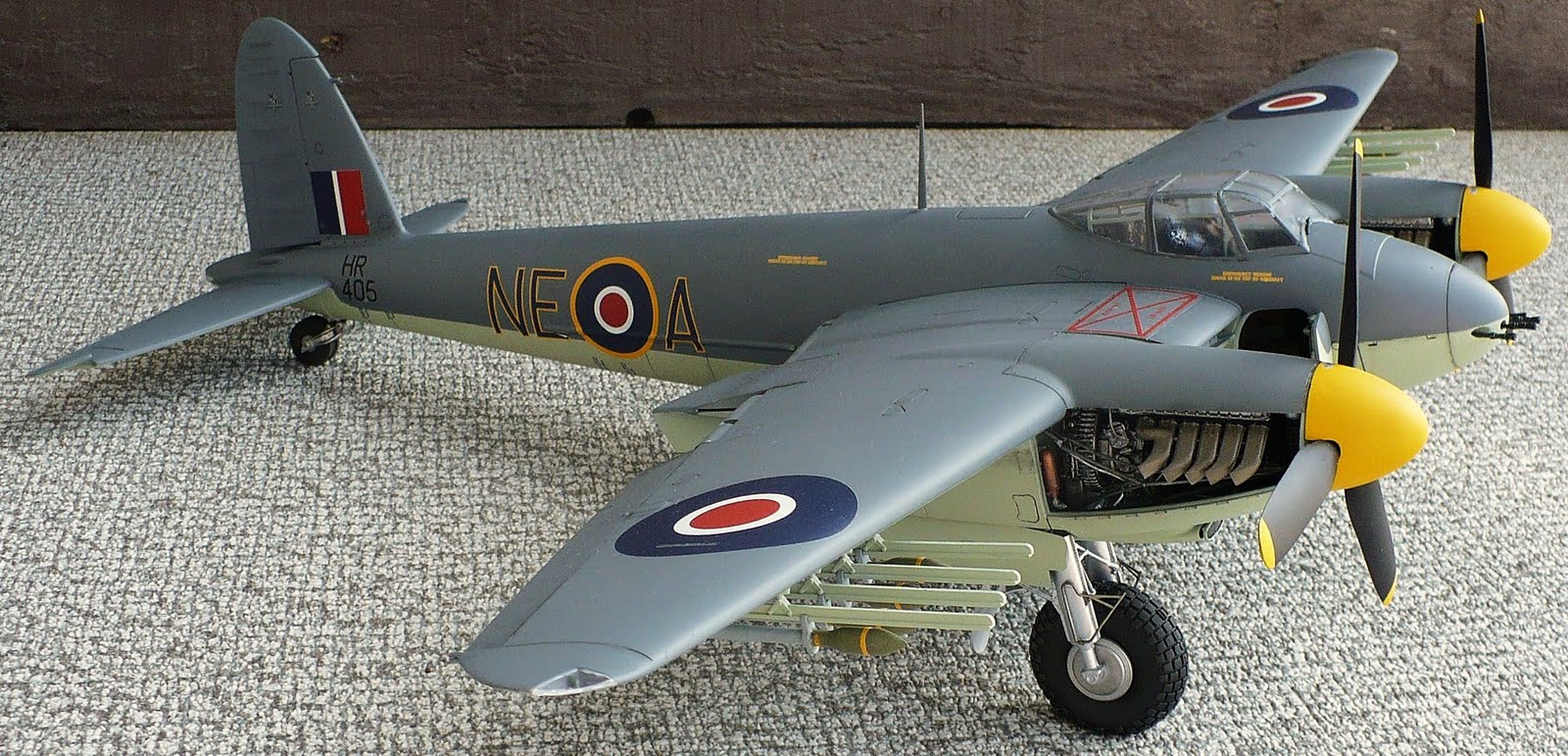
Here are some better images plus a Youtube video of the Airfix 1/24 scale Mosquito MK VI Fighter Bomber. Like I said in a earlier post if you are going to buy this kit be aware that there are a number of mold release pin marks in visible places so there will be some sanding and filling plus you will find that the fit of the main wing to the fuselage is going to be the devils own time. Other then that this is one beautifully detailed and BIG model the wingspan being around 30 inches.
From Wikipedia "

The de Havilland DH.98 Mosquito was a British combat aircraft that excelled in versatility during the Second World War. It was known affectionately as the "Mossie" to its crews and was also nicknamed "The Wooden Wonder" or "The Timber Terror" as the bulk of the aircraft was made of laminated plywood. It saw service with the Royal Air Force (RAF) and many other air forces in the European theatre, the Pacific theatre of Operations and the Mediterranean Theatre, as well as during the postwar period.

Originally conceived as an unarmed fast bomber, the Mosquito was adapted to many other roles during the air war, including: low to medium altitude daytime tactical bomber, high altitude night bomber, pathfinder, day or night fighter, fighter-bomber, intruder, maritime strike, and fast photo reconnaissance aircraft carrying out aerial reconnaissance. It was even used by the British Overseas Airways Corporation (BOAC) as a transport. It was also the basis for a single-seat heavy fighter, the de Havilland Hornet.

Upon the Air Ministry's decision to enter the Mosquito into production in 1941, it was the fastest operational aircraft in the world. Entering widespread service in 1942, the Mosquito supported RAF strategic night fighter defence forces in the United Kingdom from Luftwaffe raids, most notably defeating the German aerial offensive Operation Steinbock in 1944. Offensively, the Mosquito units also conducted night time fighter sweeps in indirect and direct protection of RAF Bomber Command's bomber fleets to reduce RAF bomber losses in 1944 and 1945. The Mosquito increased German night fighter losses to such an extent the Germans were said to have awarded two victories for shooting one down. As a bomber it took part in "special raids", such as pinpoint attacks on prisoner-of-war camp, Gestapo or German intelligence and security force bases as well as tactical strikes in support of the British Army in the Normandy Campaign. Some Mosquitos also saw action in RAF Coastal Command during the Battle of the Atlantic, attacking Kriegsmarine U-Boat and transport ship concentrations, particularly in the Bay of Biscay offensive in 1943 in which significant numbers of U-Boats were sunk or damaged.

The most numerous Mosquito variant was the FB Mk VI fighter-bomber of which 2,298 were built, some one-third of Mosquito production. The protoype was converted from a B.VI first flew in February 1943.

The FB Mk VI was powered by two 1,460 hp (1,088 kW) Merlin 21s or 1,635 hp (1,218 kW) Merlin 25s. It first flew on 1 June 1942. Some 19 that were built by Airspeed Ltd were eventually modified to be completed as FB.XVIIIs. Two were converted to TR.33 maritime assault prototypes. The variant was generally armed with four 20 mm cannon and four .303 (7.7 mm) machine guns for hitting soft ground targets. The main hitting power came from the two 250 lb (115 kg) bombs enclosed in the bomb bay plus more and was later plus two RP-3 "60 lb" rockets to carry out anti-shipping strikes. Other variations of armament fixtures could have entailed eight 60 lb (27 kg) rockets in place of any other internal load. Later the main bomb load was upgraded to two 500 lb (230 kg) bombs. Alternatively, a third option could have been an aerial mine or depth charge for attacking German submarines. All-out level speed is often given as 368 mph (592 km/h), however this speed applies to aircraft fitted with saxophone exhausts. The test aircraft (HJ679) fitted with stub exhausts was found to be performing below expectations. It was returned to de Havilland at Hatfield where it was serviced. Its top speed was then tested and found to be 384 mph (618 km/h), in line with expectations.

The FB Mk VI proved durable in dogfights with single-engine fighter aircraft. Retaining the forward firing armament Mosquito FB Mk VIs of No. 143 Squadron RAF were engaged by 30 Focke-Wulf Fw 190s from Jagdgeschwader 5 on 15 January 1945. In the ensuing battle the Mosquitos lost five aircraft but shot down five Fw 190s in return as well as sinking an armed trawler and two merchant ships.

Saturday, November 13, 2010

Alligator


Here are some images of Modelcraft's 1/35 scale LVT (A) 5 Alligator.
From Wikipedia "The Landing Vehicle Tracked (LVT) was a class of amphibious vehicles introduced by the United States Navy, Marine Corps and Army during World War II. Originally intended solely as cargo carriers for ship to shore operations, they rapidly evolved into assault troop and fire support vehicles as well. The types were all widely known as amphtrack, amtrak, amtrac etc., a portmanteau of amphibious tractor.

The LVT had its origins in a civilian rescue vehicle called the Alligator. Developed by Donald Roebling in 1935, the Alligator was intended to operate in swampy areas, inaccessible to both traditional cars and boats. Two years later, Roebling built a redesigned vehicle with greatly improved water speed. The United States Marine Corps, which had been developing amphibious warfare doctrine based on the ideas of Lt. Col. Earl Hancock "Pete" Ellis and others, became interested in the machine after learning about it through an article in Life magazine and convinced Roebling to design a more seaworthy model for military use. After more improvements, made difficult by Roebling's lack of blueprints for the initial designs, to meet requirements of the Navy, the vehicle was adopted as Landing Vehicle Tracked, or LVT.

The contract to build the first 200 LVTs was awarded to the Food Machinery Corporation (FMC), a manufacturer of insecticide spray pumps and other farm equipment which built some parts for the Alligators, the initial 200 LVTs were built at FMC's Dunedin, Florida factory, where most of the improvement work had been done as well. Eventually the company became a prominent defense contractor, United Defense (now part of BAE Systems Land and Armaments). During the War LVT production was expanded by FMC and the Navy to four factories, including the initial facility in Dunedin, Florida; the new facilities were located in Lakeland, Florida, Riverside, California, and San Jose, California. Roebling Construction would get the lucrative construction contract for the Lakeland factory, this being the sum total of Roebling's profit from his Invention, as the quite patriotic Roebling refused to accept any direct royalties or commissions from the government, seeing it as his personal duty in support of the war effort.

The LVT 1 could carry 18 fully equipped men or 4,500 pounds (2,041 kg) of cargo. Originally intended to carry replenishments from ships ashore, they lacked armor protection and their tracks and suspension were unreliable when used on hard terrain. However, the Marines soon recognized the potential of the LVT as an assault vehicle. Armored versions were introduced as well as fire support versions, dubbed Amtanks, which were fitted with turrets from Stuart series light tanks (LVT(A)-1) and Howitzer Motor Carriage M8s (LVT(A)-4). Among other upgrades were a new powerpack, also borrowed from the Stuarts, and a torsilastic suspension which significantly improved performance on land.

Production continued throughout the war, resulting in 18,621 LVTs delivered. In late 1940s a series of prototypes were built and tested, but none reached production stage due to lack of funding. Realizing that acquisition of new vehicles was unlikely, the Marines modernized some of the LVT-3s and LVT(A)-5s and kept them in service until late 1950s.


  • LVT(A)-5 (1945)
    • LVT(A)-5 with powered turret and a gyrostabilizer for the howitzer. Some were upgraded in late 1940s by changing armor configuration. 269 units produced.

Friday, November 12, 2010

Water Truck


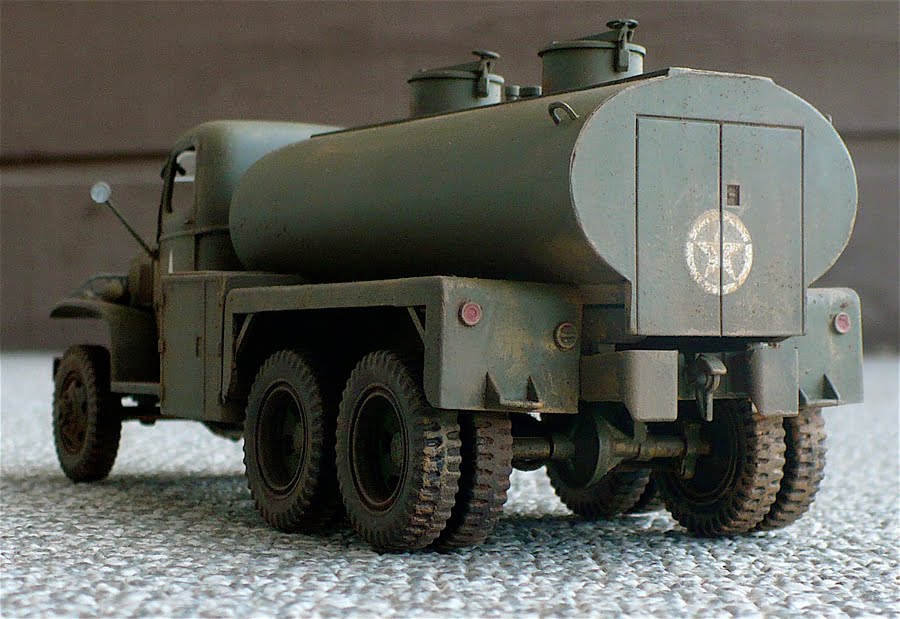
Here are some images of Italeri's 1/35 scale GMC CCKW Water Tank Truck.
From Wikipedia "

The GMC CCKW is a 2½ ton 6X6 U.S. Army cargo truck that saw service in World War II and the Korean War, often incorrectly referred to as a "Deuce and a Half" or "Jimmy". The CCKW came in many variants, the simplest being open or closed cab, and Long Wheel Base (LWB) or Short Wheel Base (SWB).

CCKWs were employed in large numbers for the Red Ball Express, an enormous convoy system created by Allied forces to supply their forces moving through Europe following the breakout from the D-Day beaches in Normandy, from August 25 to November 16, 1944, when the port facilities at Antwerp were opened. At its peak the Red Ball operated 5,958 vehicles, and carried about 12,500 tons of supplies a day.

The designation CCKW comes from model nomenclature used by GMC; the first C indicated a vehicle designed in 1941, the second C signified a conventional cab, the K indicated all-wheel drive and the W indicated dual powered rear axles. The term "Deuce and a Half" is apparently a post war term that was generally applied to all 2½ ton cargo trucks.

Initially all versions were of closed cab design (having a metal roof and doors) with all steel cargo beds. But as the war progressed an open cab version was designed that had fixed 'half doors' and a canvas top/sides and the steel bed was replaced by a wooden one to conserve steel.

Thursday, November 11, 2010

The Work of Jay Moffat Pt 4


Here are some more images of the work of Jay Moffat and here in his own words is his description.
This is a combination of two kits, Frankenstein and The Victim, both from Moebius Models. These were originally issued by Aurora (I think) in the 1970s, and Moebius used the original molds. As such, the detail and molding on both are not up to current standards, but OK for their age.

Both figures have had some re-working. The girl is pretty much a complete rebuild from the original, which was dressed in 70's "Daisy Duke" shorts and a tank top and not really properly positioned to lay in The Monster's arms. I wanted something that was more of a throwback to the Mary Shelly novel and the old black and white films from the 1930s, so I repositioned the figure and created new hair, Victorian-style night dress and slippers using Milliput and a few bits of wire. The Monster was less work, with just a bit of putty added around the collar, wrists and pant cuffs to improve the detail. Fortunately, the Frankenstein kit comes with two sets of arms, straight and curled.

Both figures were painted in artists oils - I went with a yellowish-green skin tone on The Monster to mirror more closely Shelly's description of him. (The green skin tone that is sometimes represented on The Monster comes from the posters of the day, which had a bit of artistic license.)

The base is foam core board with the stone pattern cut in. The clapper board was done on the computer, and put on a piece of Styrofoam.

Wednesday, November 10, 2010

High Flight

Oh! I have slipped the surly bonds of Earth
And danced the skies on laughter-silvered wings;
Sunward I’ve climbed, and joined the tumbling mirth
Of sun-split clouds, and done a hundred things
You have not dreamed of; wheeled and soared and swung
High in the sunlit silence. Hov’ring there,
I’ve chased the shouting wind along, and flung
My eager craft through footless halls of air.

Up, up the long, delirious burning blue
I’ve topped the wind-swept heights with easy grace
Where never lark, or ever eagle flew -
And, while with silent, lifting mind I’ve trod
The high untresspassed sanctity of space,
Put out my hand, and touched the face of God.

Written September 3, 1941 by John Gillespie Magee, Jr

Lest We Forget

Tuesday, November 9, 2010

Lyre


Here are some images of Dragon models 1/350 scale Soviet Alpha Class submarine.
From Wikipedia " The Soviet Union/Russian Navy Project 705 (Лира/Lira, "Lyre") was a submarine class of hunter/killer nuclear powered vessels (abbreviated PLA: Podvodnaya lodka atomnaya, nuclear submarine). The class is also known by the NATO reporting name of Alfa. They were the fastest and deepest diving class of military submarines built, with only the prototype K-278 Komsomolets (NATO "Mike" class) exceeding in crush depth and the prototype K-222 (NATO "Papa" class) exceeding in submerged speed.
Production started in 1974 as Project 705 with construction at both the Admiralty yard, Leningrad and at Sevmashpredpriyatiye (SEVMASH - Northern Machinebuilding Enterprise), Severodvinsk. The lead unit was a Project 705 design and all subsequent were 705K. The first vessel was commissioned in 1971.
Project 705 boats were intended to be an experimental platform themselves, to test all innovations and rectify their faults, that would afterwards found a new generation of submarines. This highly experimental nature mostly predetermined their future.[citation needed]
In 1981, with the completion of the seventh vessel, production ended. All vessels were assigned to the Northern Fleet.

Monday, November 8, 2010

Space Station V Re Post


Here are some images plus a composite of my scratch built model of Space Station Five from 2001 A Space Odyssey. You can read my article on 2001 here. The materials I used for this model were a 4'x8' sheet of 1mm styrene from Cadillac Plastics here in Edmonton, 1/2 inch PVC electrical pipe (this is what determined its size), the windows are from a coil book binder punch and various types of sheet and strip styrene from Evergreen Scale Models for structure and detail. The model itself has a two foot diameter and as I mentioned before my calculations were taken directly off the TV screen. One does what is necessary to get the job done I suppose.
From Wikipedia "
Space Station V is a fictional space station seen in the movie 2001: A Space Odyssey. Operational, it is a large, international, rotating wheel space station used as a transfer point from Low Earth orbit to the moon and other planets. It also functions as an orbital hotel, mostly operated by Hilton Hotels. Rotation of the station provides artificial gravity for people aboard the station. The station contains two docking bays for docking spacecraft and is placed on its rotational axis at the opposite sides of the construction. By the time of events depicted in the film, it is still under construction, with the incomplete second wheel.
The rotating wheel depicted in the movie traces its lineage back to wheeled space station designs by Wernher von Braun and Herman Potočnik, the latter describing such a space station design in his book The Problem of Space Travel - The Rocket Motor (1928). The studio model was reported to be eight feet wide (Bizony) or six feet wide (Agel), and stuffed with tiny lights behind the windows. Due to its large size and spidery structure, the model always seemed in danger of breaking apart. Kubrick had most of the models and props used in 2001 destroyed or discarded, or stored away and inaccessible, so that they wouldn't be used in any movies not under his control. In the early 1970s, when the MGM studio in Borehamwood, England where the film was made was demolished, the model for Space Station V was dumped in a field about 20 miles from Borehamwood. It was destroyed by vandals a few days later.

Sunday, November 7, 2010

The Mayflower Re Post


Here are some better images of Constructo's 1/65 scale 1620 Mayflower. Though really this model is based off the 1957 Mayflower II. The original whose remains are believed to be part of a barn somewhere in Buckinghamshire England no longer exists. The original Mayflowers appearance is though an educated guess basically speculative. The thing about a wooden ship kit and a scratch built wooden ship is that they both build up the same, the only difference of course is that in a kit the wood has been cut for you though there is still a hellavalot of cutting and shaping to be done. The woods used for this ship are Bokapy, Ramin, Mukaly and of coarse Plywood and Samba for the framework. A question often asked is why not use Oak when building ship models just like on the real ships? The problem with that is Oak does not lend itself well to flexibility when working with small parts particularly when working with hull planking as it has a tendency to break even after being soaked in water for several hours. Besides it wouldn't look that good anyway as the woodgrain in Oak does not look all that well when working in miniature as the grain is to big.

Saturday, November 6, 2010

Frank


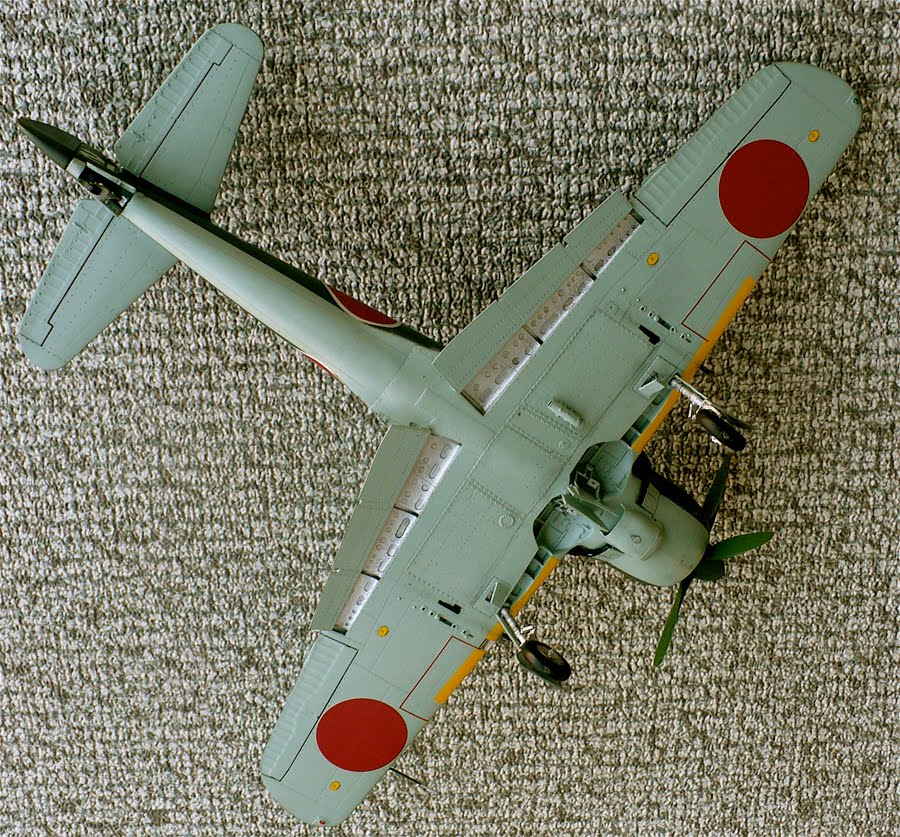
Here are some images of Hasegawa's 1/32 scale Nakajima Ki-84 Hayate (Frank) Prototype. From Wikipedia "The Nakajima Ki-84 Hayate (疾風 hayate) ("Gale") was a single-seat fighter used by the Imperial Japanese Army Air Force in World War II. The Allied codename was "Frank"; the Japanese Army designation was Army Type 4 Fighter. Featuring excellent performance and high maneuverability, the Ki-84 was considered to be the best Japanese fighter to see large scale operations during WWII. It was able to match any Allied fighter, and to intercept the high-flying B-29 Superfortresses. Its powerful armament (that could include two 30 mm and two 20 mm cannons) increased its lethality. Though hampered by poor production quality in later models, a high-maintenance engine, a landing gear prone to buckle,and lack of experienced pilots above all else, Hayates proved to be fearsome opponents. Exactly 3,514 aircraft were built.

Design of the Ki-84 commenced in early 1942 to meet an Imperial Japanese Army Air Service requirement for a replacement to Nakajima's Ki-43 fighter, just entering service. The specification recognized the need to combine the maneuverability of the Ki-43 with performance to match the best western fighters and heavy firepower. The Ki-84 first flew in March 1943. Although the design itself was solid, the shortage of fuel, construction materials, poor production quality, and lack of skilled pilots prevented the fighter from reaching its potential.

The Ki-84 addressed the most common complaints about the popular and highly maneuverable Ki-43: insufficient firepower, poor defensive armor, and lack of climbing power. The Ki-84 was a cantilever low-wing monoplane of all-metal construction, except for the fabric-covered control surfaces. It had retractable tailwheel landing gear. Armament comprised two fuselage-mounted 12.7 mm (.50 in) machine guns and two wing-mounted 20 mm cannons, a considerable improvement over the two 12.7 mm (.50 in) machine guns used in the Hayabusa. Defensive armor offered Hayate pilots better protection than the unsealed wing tanks and light-alloy airframe of the Ki-43. In addition, the Ki-84 used a 65 mm (2.56 in) armor-glass canopy, 13 mm (.51 in) of head and back armor, and multiple bulkheads in the fuselage, which protected both the methanol-water tank (used to increase the effectiveness of the supercharger) and the centrally located fuel tank.

It was the Nakajima Ha-45 radial powerplant that gave the Hayate its high speed and prowess in combat. Derived from the Homare engine common to many Japanese aircraft, the Hayate used a direct-injection version of the engine, using water injection to aid the supercharger in giving the Ki-84 a rated 1,491 kW (2,000 hp) at takeoff. This combination—in theory, at least—gave it a climb rate and top speed roughly competitive with the top Allied fighters. Initial Hayate testing at Tachikawa in early summer 1943 saw test pilot Lieutenant Funabashi reach a maximum level airspeed of 624 km/h (387 mph) in the second prototype. But after the war a late-production, captured example was tested in the US with high octane fuel, and achieved a speed of 687 km/h (426 mph).

The complicated direct-injection engine required a great deal of care in construction and maintenance and, as the Allies advanced toward the Japanese homeland, it became increasingly difficult to support the type's designed performance. Compounding reliability issues was the Allied submarine blockade which prevented delivery of crucial components, such as the landing gear. Many further landing gear units were compromised by the poor-quality heat treatment of late-war Japanese steel. Many Hayates consequently suffered strut collapses on landing.

The Ki-84 is known to have appeared in three Japanese Ministry of Munitions sanctioned camouflage schemes;

Type N: The entire airframe was left in its original natural metal. Because of the different grades of alloy used for various panels the overall finish soon weathered or oxidized to a pale metallic grey, with variations in shade and texture, depending on the grade of duralumin used for each area of skin. A black "anti-glare" panel was painted on the top forward fuselage and engine cowling (see photo of 73 Hiko-Sentai aircraft).

Type B: Irregular blotches or stripes of dark green on the basic natural metal scheme. This was applied once the aircraft reached its operational base. On occasion the edges of national (hinomaru) and Sentai markings were accidentally covered.

Type S: Three variations were seen on Ki-84s; S1 – Dark green upper surfaces, with light gray/green lower surfaces. S2 – The light gray/green on the lower surfaces was replaced by a pale blue/gray. These colors were often applied on an unprimed airframe; because of this and the poor adhesion of Japanese paints in the later years of the war this scheme often weathered quickly, with large patches of natural metal being visible (see photo of 85 Hiko-Sentai Ki-84 on a Korean base). S10 – The upper surfaces were left in a red/brown primer with the under surfaces in natural metal. The black anti-glare panel was optional.

Other schemes were applied, particularly by the Shinbu-Tai "Special Attack" units. For example, a Ki-84 of 57 Shinbu-Tai, flown by Corporal Takano, had very dark brown-green upper surfaces (some sources state black), with a large red "arrow" outlined in white painted along the entire length of the fuselage and engine cowling. White Kana characters "hitt-chin" (be sure to sink) were painted above the arrow on the rear fuselage. The under surfaces were light gray.

Factory applied markings included six hinomaru (national insignia), outlined with a 75 mm (2.95 in) white border on camouflaged aircraft, on either side of the rear fuselage and on the upper and lower outer wings. Yellow/orange identification strips were applied to the leading edges of wings, extending from the roots to ⅓ rd of the wingspan.

It was a general rule that Japanese planes in overseas territories had a narrow white line called the "border break through line" or "field identification mark" surrounding their hinomaru; planes belonging to interception forces in Japan proper placed the insignia inside a white square (colloquially known as the "Homeland Defense bandage"), so anti-aircraft defense units could more easily distinguish them from enemy planes.

The inside of the fuselage and the wheel cover wells were painted in a dark opaque bluish gray, and the propeller spinner was painted with a variety of colors based on the unit it belonged to.