
Here is a nice Revell F-102 in 1/48 scale. It is built by Saskatoon modeler Vern Gwin. Some cockpit details were added and the panel lines were scribed.

Here is a nice Revell F-102 in 1/48 scale. It is built by Saskatoon modeler Vern Gwin. Some cockpit details were added and the panel lines were scribed.


Zündapp (aka Zuendapp) was a major German motorcycle manufacturer. The company was founded in 1917 in Nuremberg by Fritz Neumeyer, together with the Friedrich Krupp AG and the machine tool manufacturer Thiel under the name "Zünder- und Apparatebau G.m.b.H." as a producer of detonators. In 1919, as the demand for weapons parts declined after the First World War, Neumeyer became the sole proprietor of the company, and two years later he diversified into the construction of motorcycles. The company folded in 1984.
The first Zündapp motorcycle was the model Z22 in 1921. This was the Motorrad für Jedermann ("motorcycle for everyone"), a simple and reliable design that was produced in large series. Zündapp's history of heavy motorcycles began in 1933 with the K-series. The "K" stands for "Kardanantrieb", i.e. enclosed driveshaft with two universal joints, the type of drivetrain that these models used. They introduced the enclosed engine case, a novelty at the time. The series encompassed models from 200 to 800 cc displacement and was a major success, increasing Zündapp's market share in Germany from 5% in 1931 to 18% in 1937.
From 1931 Ferdinand Porsche and Zündapp developed the prototype Auto für Jedermann ("car for everyone"), which was the first time the name "Volkswagen" was used. Porsche preferred the 4-cylinder flat engine, but Zündapp used a water-cooled 5-cylinder radial engine. In 1932 three prototypes were running. All three cars were lost during the war, the last in 1945 in Stuttgart during a bombing raid.
From 1936 to 1938 Zündapp produced the KKS500 model. This was the first Zündapp with a foot gearchange, and 170 examples were built. From 1940 onwards Zündapp produced more than 18,000 units of the Zündapp KS 750. This is a sidecar outfit with a driven side wheel and a locking differential, supplied to the German Wehrmacht.
After the Second World War the company gradually shifted to producing smaller machines, notably the "Bella" motor scooter, which was, however, a relatively heavy machine for its type. In 1951 Zündapp released the last of its heavy motorcycle models, but also one of its most famous: the KS601 (the "green elephant") with a 598 cc two cylinder engine. From 1957 to 1958 the company also produced the Zündapp Janus microcar.
In 1958 the company moved from Nuremberg to Munich. Subsequently, the company developed several new smaller models, discontinued the development of four-stroke engines and only produced two-stroke models. Initially, Zündapp scooters and mopeds sold well, but later sales declined and in 1984 the company went bankrupt and closed.
After the bankruptcy, the entire production line and intellectual properties was bought by Xunda Motor Co., Tianjin, China. They produced small Zündapp motorcycles from 1987 till early 1990s. Zundapp is still in business, but makes Honda based 4-stroke motorcycles and electric mopeds. [
Zündapp also had a technical collaboration with Enfield India to build mopeds and motorcycles. A dedicated factory was built at Ranipet near Chennai in early 1980’s to manufacture small, lightweight two stroke motorcycles to be offered along with their flagship Royal Enfield Bullet. Enfield launched two 50cc motorcycles first,the step- thru Silver Plus and the 3-speed Explorer motorcycle. Later, 175cc Enfield Fury (based on Zündapp KS175) was introduced as a performance motorcycle. It had 5-speed gearbox, a hydraulic Brembo disc brake and a sleeveless hard chromed cylinder barrel, all were a first on a motorcycle in that country.


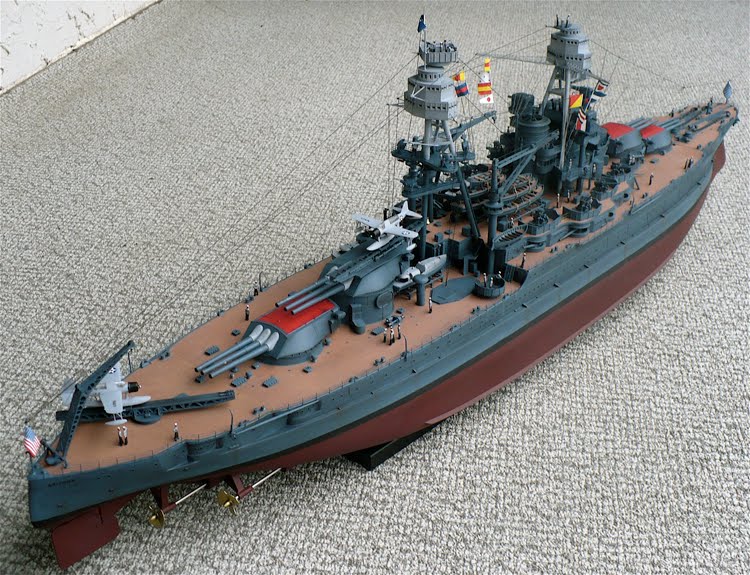

USS Arizona (BB-39) was a Pennsylvania-class battleship built for the United States Navy and the first to be named "Arizona". On 4 March 1913, Congress authorized the construction of Arizona, named to honor the 48th state's admission into the union on 14 February 1912. The ship was the second and last of the Pennsylvania class of "super-dreadnought" battleships. Her keel was laid at the Brooklyn Navy Yard on 16 March 1914. She was launched on 19 June 1915, sponsored by Esther Ross, the daughter of a prominent Arizona pioneer, W.W. Ross of Prescott, Arizona. The ship's remaining machinery, including new Parsons turbines, was installed, and she was commissioned at her builder's yard on 17 October 1916, with Captain John D. McDonald in command.
Arizona served stateside during World War I. She is mostly remembered because of her sinking, with the loss of 1,177 lives, during the Japanese attack on Pearl Harbor on 7 December 1941, the event that provoked the United States into entering World War II. Unlike most of the other ships sunk or damaged that day, the Arizona could not be salvaged, although the U.S. Navy removed several elements of the ship that were reused.
The wreck still lies at the bottom of Pearl Harbor. The USS Arizona Memorial, dedicated in 1962 to all those who died during the Pearl Harbor attack, was built astraddle the ship's hull. The Arizona retains the right, in perpetuity, to fly the United States flag as if she were an active, commissioned naval vessel.
Arizona was significantly larger than her predecessors of the Nevada class. As completed she had an overall length of 608 feet (185.3 m), a beam of 97 feet (29.6 m) (at the waterline), and a draft of 29 feet 3 inches (8.9 m) at deep load. This was 25 feet (7.6 m) longer than the older ships. She displaced 29,158 long tons (29,626 t) at standard and 31,917 long tons (32,429 t) at deep load, over 4,000 long tons (4,060 t) more than the older ships. The ship had a metacentric height of 7.82 feet (2.4 m) at deep load.
The ship had four Parsons steam turbine sets, each of which drove a propeller 12 feet 1.5 inches (3.7 m) in diameter. They were powered by twelve Babcock & Wilcox water-tube boilers. The turbines were designed to produce a total of 31,500 shaft horsepower (23,500 kW), but only achieved 29,366 shp (21,898 kW) during Arizona's sea trials, when she slightly exceeded her designed speed of 21 knots (39 km/h; 24 mph). She was designed to carry 1,548 long tons (1,573 t) of fuel oil, but had a maximum capacity of 2,305 long tons (2,342 t). At full capacity, the ship could steam at a speed of 12 knots (22 km/h; 14 mph) for an estimated 7,552 nautical miles (13,990 km; 8,690 mi) with a clean bottom. She had four 300-kilowatt (402 hp) turbo generators.
Arizona carried twelve 45-caliber 14-inch guns in triple gun turrets. The turrets were numbered from I to IV from front to rear. The guns could not elevate independently and were limited to a maximum elevation of +15° which gave them a maximum range of 21,000 yards (19,000 m). The ship carried 100 shells for each gun. Defense against torpedo boats was provided by twenty-two 51-caliber five-inch guns mounted in individual casemates in the sides of the ship's hull. They proved to be very wet and could not be worked in heavy seas. At an elevation of 15°, they had a maximum range of 14,050 yards (12,850 m). Each gun was provided with 230 rounds of ammunition. The ship mounted four 50-caliber three-inch guns for anti-aircraft defense, although only two were fitted when completed. The other pair were added shortly afterwards on top of Turret III. Arizona also mounted two 21-inch (533 mm) torpedo tubes and carried 24 torpedoes for them.
The Pennsylvania-class design continued the all or nothing principle of armoring only the only most important areas of the ship begun in the preceding Nevada class. The waterline armor belt of Krupp armour measured 13.5 inches (343 mm) thick and only covered the ship's machinery spaces and magazines. It had a total height of 17 feet 6 inches (5.3 m), of which 8 feet 9.75 inches (2.7 m) was below the waterline; beginning 2 feet 4 inches (0.7 m) below the waterline, the belt tapered to its minimum thickness of 8 inches (203 mm). The transverse bulkheads at each end of the ship ranged from 13 to 8 inches in thickness. The faces of the gun turrets were 18 inches (457 mm) thick while the sides were 9–10 inches (230–250 mm) thick and the turret roofs were protected by 5 inches (127 mm) of armor. The armor of the barbettes was 18 to 4.5 inches (457 to 114 mm) thick. The conning tower was protected by 16 inches (406 mm) of armor and had a roof eight inches thick.
The main armor deck was three plates thick with a total thickness of 3 inches (76 mm); over the steering gear the armor increased to 6.25 inches (159 mm) in two plates. Beneath it was the splinter deck that ranged from 1.5 to 2 inches (38 to 51 mm) in thickness. The boiler uptakes were protected by a conical mantlet that ranged from 9–15 inches (230–380 mm) in thickness. A three-inch torpedo bulkhead was placed 9 feet 6 inches (2.9 m) inboard of the ship's side and the ship was provided with a complete double bottom. Testing in mid-1914 revealed that this system could withstand 300 pounds (140 kg) of TNT.
Shortly before 8:00 am, Japanese aircraft from six aircraft carriers struck the Pacific Fleet as it lay in port at Pearl Harbor, and—in the ensuing two attack waves—wrought devastation on the Battle Line and on air and military facilities defending Pearl Harbor. Onboard Arizona, the ship's air raid alarm went off about 07:55, and the ship went to general quarters soon thereafter. Shortly after 08:00, the ship was attacked by 10 Nakajima B5N "Kate" torpedo bombers, five each from the carriers Kaga and Hiryū. All of the B5Ns were carrying 410-millimeter (16.1 in) armor-piercing shells modified into 797-kilogram (1,760 lb) aircraft bombs. Flying at an estimated altitude of 3,000 meters (9,800 ft) Kaga's aircraft bombed from amidships to the ship's stern and were followed shortly afterwards by Hiryu's bombers which bombed the bow area.
The preliminary report, filed on 28 January 1942, on the damage suffered by Arizona during the attack listed seven bomb hits as well one torpedo hit on the port bow forward. This last hit was based on a report from the captain of the repair ship Vestal moored alongside and could not be verified at the time. One bomb was thought to have gone down the stack, but this was contradicted when the ship's superstructure was salvaged in 1942 and the cap of the funnel was intact. Later assessments show a total of four hits on the Arizona, plus three near misses. The near miss off the port bow is believed to have caused observers to believe that the ship had been torpedoed, although no torpedo damage has been found. The sternmost bomb ricocheted off the face of Turret IV and penetrated the deck to detonate in the captain's pantry, causing a small fire. The next forwardmost hit was near the port edge of the ship, abreast the mainmast, and probably detonated in the area of the anti-torpedo bulkhead. The next bomb struck near the port rear 5-inch AA gun.
The last bomb hit at 08:06 in the vicinity of Turret II, likely penetrating the armored deck near the ammunition magazines located in the forward section of the ship. While not enough of the ship is intact to judge the exact location, its effects are indisputable. About seven seconds after the hit, the forward magazines detonated in a cataclysmic explosion. It mostly vented through the sides of the ship and destroyed much of the interior structure of the forward part of the ship. This caused the forward turrets and conning tower to collapse downwards some 25–30 feet (7.6–9.1 m) and the foremast and funnel to collapse forward. The explosion took 1,177 lives of the 1,400 crewmen on board at the time, almost half of the lives lost during the attack. The explosion touched off fierce fires that burned for two days; debris showered down on Ford Island in the vicinity. Ironically, the blast from this explosion also put out fires on the repair ship Vestal, which was moored alongside.
Two competing theories have arisen about the cause of the explosion. The first is that that the bomb detonated in or near the black powder magazine used for the ship's saluting guns. This would have detonated first and then ignited the smokeless powder magazine which was used for the ship's main armament. A 1944 Navy Bureau of Ships report suggests that a hatch leading to the black powder magazine was left open, possibly with inflammable materials stocked nearby. The Naval History & Heritage Command explained that black powder might have been stockpiled outside of the armored magazine. This theory is attractive because black powder is easy to ignite and the relatively small amount of explosive filler in the bomb could have easily done so. The alternative explanation is that the bomb penetrated the armored decks and detonated directly inside one of the starboard magazines for the main armament. The problem is that smokeless powder is relatively insensitive to fire and the 14-inch powder bags actually required a black powder pad to ignite the powder. However, it seems unlikely that a definitive answer to this question will ever be found as the surviving physical evidence is insufficient to determine the cause of the magazine explosion.
Credit for the hit was officially given to Petty Officer Noburu Kanai, who was considered to be the JNAF's "crack" bombardier; his pilot was Tadashi Kusumi.
Acts of heroism on the part of Arizona's officers and men were many, headed by those of Lieutenant Commander Samuel G. Fuqua, the ship's damage control officer, whose coolness in attempting to quell the fires and get survivors off the ship earned him the Medal of Honor.
Posthumous awards of the Medal of Honor also went to Rear Admiral Isaac C. Kidd, the first flag officer killed in the Pacific war, and to Captain Franklin Van Valkenburgh, who reached the bridge and was attempting to defend his ship when the bomb that hit the ammunition magazines destroyed her.


The scheme originally involved replacing the entire nose-located crew compartment of a war-weary bomber airframe (usually a Junkers Ju 88 variant) with a specially-designed solid nose filled with a large load of explosive, and guiding it to its target by a fighter aircraft mounted above it on a set of struts. After releasing the bomber, the fighter would return to base. The first such composite aircraft flew in July 1943 and was promising enough to begin a programme by Luftwaffe test unit KG 200, code-named "Beethoven"". Quite honestly I have no idea why Dragon would make an ME 262 Mistel kit when the Germans hadn't even conceptualized it on paper. Still looks kinda neat.


RMS Queen Mary 2 is a transatlantic ocean liner. She was the first major ocean liner built since Queen Elizabeth 2 in 1969, the vessel she succeeded as flagship of the Cunard Line.
The ship was named by Queen Elizabeth II in 2004 after the first RMS Queen Mary, completed in 1936. Queen Mary was in turn named after Mary of Teck, consort of King George V. With the retirement of Queen Elizabeth 2 from active duty in 2008, Queen Mary 2 is currently the only transatlantic ocean liner in operation as a liner (in scheduled service between Southampton and New York ), although the ship is often used for cruising, including an annual world cruise.[6][dead link]
At the time of her construction in 2003 by Chantiers de l'Atlantique, Queen Mary 2 was the longest, widest and tallest passenger ship ever built, and with her 151,400 gross register tons (GRT), was also the largest. She no longer holds this distinction after the construction of Royal Caribbean International's 154,407 GT Freedom of the Seas in April 2006, which was in turn superseded by the same company's 225,282 GT Oasis of the Seas in October 2009. However, Queen Mary 2 remains the largest ocean liner (as opposed to cruise ship) ever built.
Queen Mary 2 was intended primarily to cross the Atlantic Ocean, and was therefore designed differently from many other passenger ships. The ship's final cost was approximately $300,000 US per berth, nearly double that of many contemporary cruise ships. This was due to the size of the ship, the high quality of materials, and that, having been designed as an ocean liner, she required 40% more steel than a standard cruise ship. She has a maximum speed of just over 30 knots (56 km/h; 35 mph) and a cruising speed of 26 knots (48 km/h; 30 mph), much faster than contemporary cruise ships, such as Oasis of the Seas, which has a top speed of 22.6 knots (41.9 km/h; 26.0 mph). Instead of the diesel-electric configuration found on many ships, Queen Mary 2 uses a CODLAG configuration (Combined diesel-electric and gas) in order to achieve her maximum speed. This uses additional gas turbines to augment the power given by the diesel generators onboard, and allow the ship to reach a higher maximum speed.
Queen Mary 2's facilities include fifteen restaurants and bars, five swimming pools, a casino, a ballroom, a theatre, and the first planetarium at sea. There are also kennels onboard, as well as a nursery. Queen Mary 2 is one of the few ships afloat today to have remnants of a class system onboard, most prominently seen in her dining options.


The Lockheed Martin C-130J "Super" Hercules is a four-engine turboprop military transport aircraft. The C-130J is a comprehensive update of the venerable Lockheed C-130 Hercules, with new engines, flight deck, and other systems. The Hercules family has the longest continuous production run of any military aircraft in history. During more than 50 years of service, the family has participated in military, civilian, and humanitarian aid operations. The Hercules has outlived several planned successor designs, most notably the Advanced Medium STOL Transport contestants. Fifteen nations have placed orders for a total of 300 C-130Js, of which 206 aircraft have been delivered by December 2010.
The C-130J is the newest version of the Hercules and the only model still in production. Externally similar to the classic Hercules in general appearance, the J-model features considerably updated technology. These differences include new Rolls-Royce AE 2100 D3 turboprops with Dowty R391 composite scimitar propellers, digital avionics (including head-up displays (HUDs) for each pilot), and reduced crew requirements. These changes have improved performance over its C-130E/H predecessors, such as 40% greater range, 21% higher maximum speed, and 41% shorter takeoff distance. The J-model is available in a standard-length or stretched -30 variant.
The C-130J's crew includes two pilots and one loadmaster (no navigator or flight engineer). The United States Marine Corps utilizes a crew chief for expeditionary operations. Its cargo compartment is approximately 41 feet (12.5 m) long, 9 feet (2.74 m) high, and 10 feet (3.05 m) wide, and loading is from the rear of the fuselage. The aircraft can also be configured with the "enhanced cargo handling system". The system consists of a computerized loadmaster's station from which the user can remotely control the under-floor winch and also configure the flip-floor system to palletized roller or flat-floor cargo handling. Initially developed for the USAF, this system enables rapid role changes to be carried out and so extends the C-130J's time available to complete taskings.
Lockheed Martin received the launch order for the J-model from the RAF, which ordered 25 aircraft, with first deliveries beginning in 1999 as Hercules C4 (C-130J-30) and Hercules C5 (C-130J). The standard C-130J had a flyaway cost of US$62 million in 2008.
In mid-June 2008, the United States Air Force awarded a $470 million contract to Lockheed Martin for six modified KC-130J aircraft for use by the Air Force and Special Operations Command. The contract led to C-130J variants that will replace aging HC-130s and MC-130s. The HC-130J Combat King II personnel recovery aircraft completed developmental testing on 14 March 2011. The final test point was air-to-air refueling, and was the first ever boom refueling of a C-130 where the aircraft’s refueling receiver was installed during aircraft production. This test procedure also applied to the MC-130J Combat Shadow II aircraft in production for Air Force Special Operations Command.

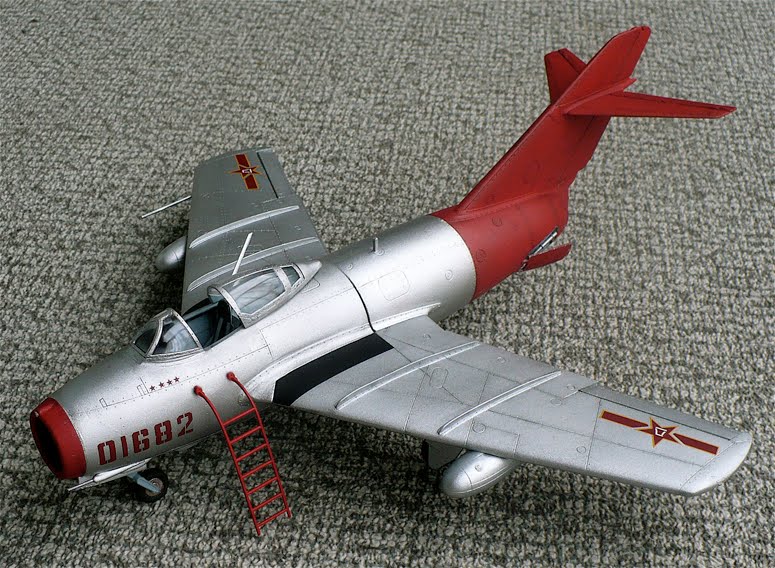


The Mikoyan-Gurevich MiG-15 (Russian: Микоян и Гуревич МиГ-15) was a jet fighter developed for the USSR by Artem Mikoyan and Mikhail Gurevich. The MiG-15 was one of the first successful swept-wing jet fighters, and it achieved fame in the skies over Korea, where early in the war, it outclassed all straight-winged enemy fighters in daylight. The MiG-15 also served as the starting point for development of the more advanced MiG-17 which was still an effective threat to supersonic American fighters over North Vietnam in the 1960s. The MiG-15 is believed to have been the most widely produced jet aircraft ever made, with over 12,000 built. Licensed foreign production perhaps raised the total to over 18,000. The MiG-15 is often mentioned along with the North American F-86 Sabre in lists of the best fighter aircraft of the Korean War and in comparison with fighters of other eras.
NATO and USAF reporting names were as follows:


In the 1950s and early 1960s, the Soviet Union shared most of its conventional weapons technology with the People's Republic of China. One of these was the limited cooperation between the two countries in the early stage development of the famous MiG-21 short-range interceptor-fighter aircraft. Powered by a single engine and designed on a simple airframe, these fighters were inexpensive but fast, suiting the strategy of forming large groups of 'people's fighters' to overcome the technological advantages of Western aircraft. However, the Sino-Soviet split ended Chinese early participation in the developmental program of the MiG-21 abruptly, and from July 28 to September 1, 1960, the Soviet Union withdrew its advisers from China, resulting in the project being forced to stop in China.
However, Nikita Khrushchev suddenly wrote to Mao Zedong in February, 1962 to inform Mao that the Soviet Union was ready to transfer MiG-21 technology to China and asked the Chinese to send their representatives to the Soviet Union as soon as possible to discuss the details. The Chinese viewed this as a Soviet gesture to make peace, and were obviously suspicious, but they were extremely quick to take up on the Soviet offer for the aircraft deal. A delegation headed by Colonel General Liu Yalou (刘亚楼), the commander-in-chief of the PLAAF and a Soviet military academy graduate was dispatched to Moscow immediately and the Chinese delegation was even allowed to have three days to visit the production facility of the MiG-21, which was previously off limits to foreigners. The authorization was personally given by Nikita Khrushchev himself, and on March 30, 1962, the deal was signed. However, given the political situation and relationship between the two countries, the Chinese were not optimistic about gaining the technology and thus were prepared for reverse engineering.
Russian sources stated that complete examples of the MiG-21 were sent to China flown by Soviet pilots, and China did receive MiG-21Fs in kits along with parts and technical documents. Just as the Chinese had expected, when the Soviets delivered the kits, parts and documents to Shenyang Aircraft Factory five months after the deal was signed the Chinese discovered that the technical documents provided by the Soviets were incomplete and some of the parts could not be used. China set about to reverse engineer the aircraft for local production, and in doing so, succeeded in solving 249 major problems and came up with eight major technical documents that were not delivered. The effort was largely successful, as the Chinese design showed only minor differences from the original. In March, 1964, Shenyang Aircraft Factory began the first domestic production of the jet fighter, which they successfully achieved the next year. However, the mass production of the aircraft was severely hindered by an unexpected problem—the Cultural Revolution, which resulted in poor initial quality and slow progress, which in turn, resulted in full scale production only coming about in the 1980s, by which time the design was showing its age. However, the fighter is affordable and widely exported as the F-7, often with Western systems incorporated like the ones sold to Pakistan. Based on the expertise gained by this program, China later developed the Shenyang J-8 by utilizing the incomplete technical information of the Soviet Ye-152 developmental jet.


