Translate

Saturday, September 21, 2013

Grumman F8F-1 Bearcat

Here are some more images of Trumpeters 1/32 scale Grumman F8F-1 Bearcat. Being this was Grumman's last piston fighter aircraft it was meant to be the replacement for the F6F Hellcat. Though this aircraft was to late to see combat in World War Two some units did receive the first production examples. The Bearcat affectionately referred to by its units as "The Bear" was based heavily off a captured Focke Wulf FW 190 though no parts were copied.

From Wikipedia"
The Grumman F8F Bearcat (affectionately called "Bear") was an American single-engine naval fighter aircraft of the 1940s. It went on to serve into the mid-20th century in the United States Navy, the United States Marine Corps, and the air forces of other nations. It would be Grumman Aircraft's final piston engined fighter aircraft. Modified versions have broken speed records for propeller-driven aircraft, and are popular among warbird owners.
The Bearcat concept began during a meeting between Battle of Midway veteran F4F Wildcat pilots and Grumman Vice President Jake Swirbul at Pearl Harbor on 23 June 1942. At which time Lieutenant Commander Jimmie Thach emphasized one of his most important factors in fighters to Mr. Swirbul, "climb rate", which connoted "power." After intensively analyzing carrier warfare in the Pacific Theater of Operations for a year and a half, Grumman commenced designing the F8F Bearcat, and the first prototype flew on 31 August 1944. Prior to the F8F Bearcat, F6F Hellcats had been tasked with the primary missions of outperforming the exceptionally long range and highly maneuverable late-model Japanese fighter aircraft such as the A6M5 Zero; a later role was defending the fleet against incoming airborne suicide (kamikaze) attacks.
Work on the Grumman G-58 Bearcat began in 1943 with the specifications calling for an aircraft able to operate from the smallest carrier, primarily in the interceptor role. The F6F's Pratt & Whitney R-2800 engine was retained but compared to the Hellcat, the Bearcat was 20% lighter, had a 30% better rate of climb and was 50 mph (80 km/h) faster. To achieve this, range was necessarily sacrificed.

An XF8F-1 prototype at the NACA, in 1945.
In comparison with the Vought F4U Corsair, the initial F8F-1 Bearcat series was marginally slower but was more maneuverable and climbed more quickly. Its huge 12 ft 4 in Aero Products four-bladed propeller required a long landing gear, giving the Bearcat a "nose-up" profile. The hydraulically operated undercarriage used an articulated trunnion which extended the length of the oleo legs to lengthen when down; as the undercarriage retracted the legs were shortened, enabling them to fit into a wheel well which was entirely in the wing. An additional benefit of the inward retracting units was a wide track, which helped counter propeller torque on takeoff and gave the F8F good ground and carrier deck handling. For the first time in a production U.S. Navy fighter, a bubble canopy offered 360° visibility.
The target loaded weight of 8,750 lb/3,969 kg (derived from the land-based German aircraft) was essentially impossible to achieve as the structure of the new fighter had to be made strong enough for aircraft carrier landings. Structurally the fuselage used flush riveting as well as spot welding, with a heavy gauge 302W aluminum alloy skin. Armor protection was provided for the pilot, engine and oil cooler; weight saving measures include restricting the internal fuel capacity to 160 gal (606 l) (later 183) and limiting the fixed armament to four .50 cal Browning M2/AN machine guns, two in each wing.
As a weight-saving concept the designers came up with detachable wingtips; if the "g"-force exceeded 7.5 "g", then the tips would snap off, leaving a perfectly flyable aircraft still capable of carrier landing. While this worked very well under carefully controlled conditions in flight and on the ground, in the field, where aircraft were repetitively stressed by landing on carriers and since the wings were slightly less carefully made in the factories, there was a possibility that only one wingtip would break away with the possibility of the aircraft crashing. This was replaced with an explosives system to blow the wing tips off together, which also worked well, however this ended when a ground technician died due to accidental triggering. In the end the wings were reinforced and the aircraft limited to 7.5 "g".
An unmodified production F8F-1 set a 1946 time-to-climb record (after a run of 115 ft/35 m) of 10,000 ft (3,048 m) in 94 seconds (6,383 fpm). The Bearcat held this record for 10 years until it was broken by a modern jet fighter (which still could not match the Bearcat's short takeoff distance).

The F8F prototypes were ordered in November 1943 and first flew on 21 August 1944, a mere nine months later. The first production aircraft was delivered in February 1945 and the first squadron, Fighter Squadron 19 (VF-19), was operational by 21 May 1945, but World War II was over before the aircraft saw combat service.
Postwar, the F8F became a major U.S. Navy and U.S. Marine Corps fighter, equipping 24 fighter squadrons in the Navy and a smaller number in the Marines. Often mentioned as one of the best-handling piston-engine fighters ever built, its performance was sufficient to outperform many early jets.Its capability for aerobatic performance is illustrated by its selection as the first demonstration aircraft for the navy's elite Blue Angels flight demonstration squadron in 1946, who flew it until the team was temporarily disbanded in 1950 during the Korean War and pressed into operational combat service. The F9F Panther and McDonnell F2H Banshee largely replaced the Bearcat as their performance and other advantages eclipsed piston-engine fighters.
 The first combat for the F8F Bearcat was during the French Indochina War (aka First Indochina War 1946-1954) when nearly 200 Bearcats were delivered to the French forces in 1951. When the war ended in 1954, 28 surviving Bearcats were supplied to the new South Vietnamese Air Force and entered service in 1956 The SVAF retired their F8Fs in 1959 which were replaced by North American T-28 Trojans, then later Douglas A-1 Skyraiders as the Vietnam War (aka Second Indochina War 1957–1975) continued through the 1960s. F8Fs were also supplied to Thailand during the same time period.
 Bearcats have long been popular in air racing. A stock Bearcat flown by Mira Slovak and sponsored by Bill Stead won the first Reno Air Race in 1964. Rare Bear, a highly-modified F8F owned by Lyle Shelton, went on to dominate the event for decades, often competing with Daryl Greenamyer, another famous racer with victories in his own Bearcat ("Conquest I", now at the Smithsonian's NASM) and holder of a propeller-driven aircraft world speed record in it. Rare Bear also set many performance records, including the 3 km World Speed Record for piston-driven aircraft (528.33 mph/850.26 km/h), set in 1989, and a new time-to-climb record (3,000 m in 91.9 seconds (6,425.9 fpm), set in 1972, breaking the 1946 record cited above)

Friday, September 20, 2013

Junkers JU 88 A1 - 2


Here are some more images of Revell's 1/32 scale Junkers JU 88 A1.

From Wikipedia"
The Junkers Ju 88 was a World War II German Luftwaffe twin-engine, multi-role aircraft. Designed by Hugo Junkers' company in the mid-1930s, it suffered from a number of technical problems during the later stages of its development and early operational roles, but became one of the most versatile combat aircraft of the war. Affectionately known as "The Maid of all Work" (a feminine version of "jack of all trades"), the Ju 88 proved to be suited to almost any role. Like a number of other Luftwaffe bombers, it was used successfully as a bomber, dive bomber, night fighter, torpedo bomber, reconnaissance aircraft, heavy fighter, and even as a flying bomb during the closing stages of conflict.

Despite its protracted development, the aircraft became one of the Luftwaffe's most important assets. The assembly line ran constantly from 1936 to 1945, and more than 16,000 Ju 88s were built in dozens of variants, more than any other twin-engine German aircraft of the period. Throughout the production, the basic structure of the aircraft remained unchanged, proof of the outstanding quality of the original design.
n August 1935, the Reichsluftfahrtministerium submitted its requirements for an unarmed, three-seat, high-speed bomber, with a payload of 800-1,000 kg (1,760-2,200 lb). Junkers presented their initial design in June 1936, and were given clearance to build two prototypes (Werknummer 4941 and 4942). The first two aircraft were to have a range of 2,000 km (1,240 mi) and were to be powered by two DB 600s. Three further aircraft, (Werknummer 4943, 4944 and 4945), were to be powered by Jumo 211 engines. The first two prototypes, Ju 88 V1 and V2, were different from the V3, V4 and V5 in that the latter three models were equipped with three defensive armament positions to the rear of the cockpit, and were able to carry two 1,000 kg (2,200 lb) bombs under the inner wing.
The first five prototypes had conventionally-operating dual-strut leg rearwards-retracting main gear, but starting with the V6 prototype, a main gear design that twisted the new, single-leg main gear strut through 90° during the retraction sequence debuted, much like the American Curtiss P-40 fighter design used. This feature allowed the main wheels to end up above the lower end of the strut when fully retracted and was adopted as standard for all future production Ju 88s, and only minimally modified for the later Ju 188 and 388 developments of it. These single-leg landing gear struts also made use of stacks of conical Belleville washers inside them, as their main form of suspension for takeoffs and landings.
By 1938 radical modifications from the first prototype began to produce a "heavy" dive bomber. The wings were strengthened, dive brakes were added, the fuselage was extended and the number of crewmembers was increased to four. Due to these advances, the Ju 88 was to enter the war as a medium bomber.
The choice of annular radiators for engine cooling on the Ju 88, which placed these radiators immediately forward of each engine, and directly behind each propeller, allowed the cooling lines for the engine coolant and oil-cooling radiators (integrated within the annular design) to be just about as short as possible. The concept may have led to a number of other German military aircraft designs adopting the same solution, such as the Arado Ar 240, Heinkel He 177, Heinkel He 219, the inline powered developments of the Focke-Wulf Fw 190 and the twin engined Focke-Wulf Ta 154.
The aircraft's first flight was made by the prototype Ju 88 V1, which bore the civil registration D-AQEN, on 21 December 1936. When it first flew, it managed about 580 km/h (360 mph) and Hermann Göring, head of the Luftwaffe was ecstatic. It was an aircraft that could finally fulfill the promise of the Schnellbomber, a high-speed bomber. The streamlined fuselage was modeled after its contemporary, the Dornier Do 17, but with fewer defensive guns because the belief still held that it could outrun late 1930s-era fighters. The fifth prototype set a 1,000 km (620 mi) closed-circuit record in March 1939, carrying a 2,000 kg (4,410 lb) payload at a speed of 517 km/h (320 mph). However, by the time Luftwaffe planners had had their own "pet" features added (including dive-bombing), the Ju 88's top speed had dropped to around 450 km/h (280 mph). The Ju 88 V7 was fitted with cable-cutting equipment to combat the potential threat of British barrage balloons, and was successfully tested in this role. The V7 then had the Ju 88 A-1 "beetle's eye" faceted nose glazing installed, complete with the Bola under nose ventral defensive machine gun emplacement, and was put through a series of dive-bombing tests with 250 kg (550 lb) and 500 kg (1,100 lb) bombs, and in early 1940, with 1,000 kg (2,200 lb) bombs. The Ju 88 V8 (DG+BF, Wrk Nr 4948) flew on the 3 October 1938. The A-0 series was developed through the V9 and V10 prototypes. The A-1 series prototypes were Wrk Nrs 0003, 0004 and 0005. The A-1s were given the Jumo 211B-1 or G power plants.
Dr. Heinrich Koppenberg (managing director of Jumo) assured Göring in the autumn of 1938 that 300 Ju 88s per month was definitely possible. Göring was in favour of the A-1 variant for mass production.
Production was delayed drastically with developmental problems. Although planned for a service introduction in 1938, the Ju 88 finally entered squadron service (with only 12 aircraft) on the first day of the attack on Poland in 1939. Production was painfully slow with only one Ju 88 manufactured per week, as problems continually kept cropping up. The Ju 88C series of heavy fighter was also designed very early in 1940, but kept secret from Göring, as he only wanted bombers.

MiG 21 UM "Mongol" - 2

Here are some more images of Trumpeter's 1/32 scale MiG 21 UM "Mongol"

From Wikipedia"
The Mikoyan-Gurevich MiG-21 (Russian: Микоян и Гуревич МиГ-21; NATO reporting name "Fishbed") is a supersonic jet fighter aircraft, designed by the Mikoyan-Gurevich Design Bureau in the Soviet Union. It was popularly nicknamed "balalaika", from the aircraft's planform-view resemblance to the Russian stringed musical instrument or ołówek (English: pencil) by Polish pilots due to the shape of its fuselage. Early versions are considered second-generation jet fighters, while later versions are considered to be third-generation jet fighters. Some 50 countries over four continents have flown the MiG-21, and it still serves many nations a half-century after its maiden flight. The fighter made aviation records. At least by name, it is the most-produced supersonic jet aircraft in aviation history and the most-produced combat aircraft since the Korean War, and it had the longest production run of a combat aircraft (1959 to 1985 over all variants).
The UM Variant was a two seat advanced trainer version of the MiG 21 MF.

This aircraft bears the markings of Finland. Finland. Finland.

Thursday, September 19, 2013

Heinkel He 111 P-1 - 2

Here are some more images of Revell's 1/32 scale Heinkel He 111 P-1 medium bomber.
This is a beautiful kit. The detail is amazing and the parts fit together very well. Other then a few minor points as regards the instructions this is well worth the money and it's big.

From Wikipedia"
The He 111P incorporated the updated Daimler-Benz DB 601A-1 water cooled engine and featured a newly designed nose section, including an asymmetric Ikaria nose mounting for an MG 15 machine gun that replaced the 'stepped' cockpit with a roomier and aerodynamically favourable glazed "dome" over the front of the aircraft. This new "bullet" smooth glazed nose was first tested out on the He 111 V8 in January 1938. These improvements allowed the aircraft to reach 475 km/h (295 mph) at 5,000 m (16,400 ft) and a cruise speed of 370 km/h (230 mph), although a full bombload reduced this figure to 300 km/h (190 mph). The design was implemented in 1937 because pilot reports indicated problems with visibility. The pilot's seat could actually be elevated, with the pilot's eyes above the level of the upper glazing, complete with a small pivoted windscreen panel, to get the pilot's head above the level of the top of the "glass tunnel" for a better forward view for takeoffs and landings.
One of Heinkel's rivals, Junkers, built 40 He 111Ps at Dessau. On 8 October 1938, the Junkers Central Administration commented:
Two aircraft were able to be inspected on 6th October in Bernburg. Apparent are the externally poor, less carefully designed components at various locations, especially at the junction between the empennage and the rear fuselage. All parts have an impression of being very weak; especially when one is used to taking a long look at Junkers' designs, one cannot dispel a feeling of uncertainty. The visible flexing in the wing must also be very high. The left and right powerplants are interchangeable. Each motor has an exhaust-gas heater on one side, but it is not connected to the fuselage since it is probable that as a result of incorrect air feed, the warm air in the fuselage is not free of carbon monoxide (CO). The fuselage is not subdivided into individual segments, but is attached over its entire length, after completion, to the wing centre section. Outboard of the powerplants, the wings are attached by universal joints. The latter can in no way be satisfactory and have been the cause of several failures.
The new design was powered by the DB 601 Ba engine with 1,175 PS and reduced the length of the aircraft by 1.1 m (3.6 ft). The He 111P's DB601 powerplant exhaust pipes had a second outlet on the top of the engine which pumped hot air back into the aircraft to warm crews. It was designated as P-0, and the first production lines reached their units in Fall 1938. In May 1939, the P-1 and P-2 went into service with improved radio equipment. The P-1 variant was produced with two DB 601Aa powerplants of 1,150 hp (860 kW). The fuel tanks had the added innovation of self-sealing fuel tanks to protect them from enemy fire. The Nose department itself was now fully glazed and the "stepped up" cockpit was dispensed with. The P-1 was powered by a DB 601Aa engine and given a semi-retractable tail wheel to decrease drag. Armament consisted of a MG 15 mounted in the Ikaria A Stand mount in the nose, and a sliding hood for the fuselage's dorsal B-Stand position. Installation of upgraded FuG III radio communication devices were also made and a new ESAC-250/III vertical bomb magazine was added. The overall takeoff weight was now 13,300 kg (29,321 lb).
The P-2, like the later P-4, was given stronger armour and two MG 15 machine guns in "waist" mounts on either side of the fuselage and two external bomb racks. Radio communications consisted of FuG IIIaU radios and the DB601 A-1 replaced the 601Aa powerplants. The Lotfernrohr 7 bombsights, which became the standard bombsight for German bombers, were also fitted to the P-2. The P-2 was also given "field equipment sets", to upgrade the weak defensive armament to four or five MG 15 machine guns. The P-2 had its bomb capacity raised to 4 ESA-250/IX vertical magazines. The P-2 thus had an empty weight of 6,202 kg (13,272 lb), a loaded weight increased to 12,570 kg (27,712 lb) and a maximum range of 2,100 km (1,305 mi).
The P-3 was powered with the same DB601A-1 engines. The aircraft was also designed to take off with a land catapult (KL-12). A towing hook was added to the fuselage under the cockpit for the cable. Just eight examples were produced, all without bomb equipment. The P-4 contained many changes from the P-2 and P-3. The jettisonable loads were capable of considerable variation. Two external SC 1800 kg (3,960 lb) bombs; two LMA air-dropped anti-shipping mines; one SC 1,800 kg plus four SC 250 kg; or one SC 2,500 kg external bomb could be carried on a ETC Rüstsatz rack. Depending on the load variation, a 835 L fuel and 120 L oil tank could be added in place of the internal bomb bay. The armament consisted of three defensive MG 15 machine guns. But these were not sufficient, so a further six MG 15s and one MG 17 machine gun was added. The radio communications were standard FuG X(10), Peil G V direction finding and FuBI radio devices. Because of the increase in defensive firepower, the crew numbers increased from four to five. The empty weight of the P-4 increased to 6,775 kg (14,936 lb), and the full takeoff weight increased to 13,500 kg (29,762 lb) owing to the mentioned alterations. The P-5 was powered by the DB601A. The variant was mostly used as a trainer and at least 24 production variants were produced before production ceased. The P-5 was alleged to have been fitted with PVC bomb racks, which cannot be confirmed. The P-5 was fitted with meteorological equipment, and was used in Luftwaffe weather units. Many of the He 111 Ps served during the Polish Campaign. With the Junkers Ju 88 experiencing technical difficulties, the He 111 and the Do 17 formed the backbone of the Kampfwaffe. On 1 September 1939, Luftwaffe records indicate the Heinkel strength at 705 (along with 533 Dorniers).
The P-6 variant was the last production model of the He 111 P series. In 1940, the RLM abandoned further production of the P series in favour of the H versions, mostly because the P-series' Daimler-Benz engines were sorely needed for Messerschmitt Bf 109 and Bf 110 fighter production. The remaining P-6s were redesignated P-6/R2s and used as heavy glider tugs. The most notable difference with previous variants was the upgraded DB 601N powerplants.
The P-7 variant's history is unclear. German archives do not produce any reliable information for this variant, if it existed. The P-8 was said to have been similar to the H-5 fitted with dual controls. Its existence cannot be established. The P-9 was produced as an export variant for the Hungarian Air Force. Due to the lack of DB 601E engines, the line was terminated in Summer 1940.

Wednesday, September 18, 2013

Sukhoi Su-27 B Flanker


Here are some images of Trumpeter, Zacto Models, Eduard, Master Casters, Black Box, Aires, Linden Hill 1/32 scale Sukhoi Su-27 B Flanker.
You may be wondering "What's with all the aftermarket parts?".
Well this was necessary to correct the many inaccuracies of the Trumpeter kit.
The parts corrected were the nose (which was short by almost 1cm), the air intakes,the entire cockpit, the wheel wells, the wheels, the exhausts, various greebling, and the stencils.
As a friend of mine pointed out being that China of which Trumpeter Models is from is a communist country, one would think that they would have an SU-27 sitting on the ramp.
Why Trumpeter models screwed up on this one is anyone's guess. 
So if you wish to build a reasonably accurate 1/32 scale model of an Su-27., it's going to cost you at least twice the price of the kit and the Trumpeter kit is currently the only one available.
 I've decided to do "Blue 17" for this kit of which I had to make my own "17's".
During my search of "Blue 17" on the internet I came across about 4 different versions of it, so I picked the best one I liked. Whether or not it is completely accurate I couldn't say. Which would be in keeping with the rest of the model LOL!!

From Wikipedia"
 The Sukhoi Su-27 (Russian: Сухой Су-27) (NATO reporting name: Flanker) is a twin-engine supermanoeuverable fighter aircraft designed by Sukhoi. It was intended as a direct competitor for the large United States fourth generation fighters, with 3,530-kilometre (1,910 nmi) range, heavy armament, sophisticated avionics and high manoeuvrability. The Su-27 most often flies air superiority missions, but is able to perform almost all combat operations. Complementing the smaller MiG-29, the Su-27's closest US counterpart is the F-15 Eagle. The Su-27 entered service with the Soviet Air Force in 1985.
There are several related developments of the Su-27 design. The Su-30 is a two-seat, dual-role fighter for all-weather, air-to-air and air-to-surface deep interdiction missions. The Su-33 ‘Flanker-D’ is a navy fleet defence interceptor for use on aircraft carriers. Further versions include the side-by-side 2-seat Su-34 ‘Fullback’ strike variant and the Su-35 ‘Flanker-E’ improved air defence fighter.

In 1969, the Soviet Union learned of the U.S. Air Force's "F-X" program, which resulted in the F-15 Eagle. The Soviet leadership soon realised that the new American fighter would represent a serious technological advantage over existing Soviet fighters. What was needed was a better-balanced fighter with both good agility and sophisticated systems. In response, the Soviet General Staff issued a requirement for a Perspektivnyy Frontovoy Istrebitel (PFI, literally "Prospective Frontline Fighter", roughly "Advanced Frontline Fighter"). Specifications were extremely ambitious, calling for long range, good short-field performance (including the ability to use austere runways), excellent agility, Mach 2+ speed, and heavy armament. The aerodynamic design for the new aircraft was largely carried out by TsAGI in collaboration with the Sukhoi design bureau.
When the specification proved too challenging and costly for a single aircraft in the number needed, the PFI specification was split into two: the LPFI (Lyogkyi PFI, Lightweight PFI) and the TPFI (Tyazholyi PFI, Heavy PFI). The LPFI program resulted in the Mikoyan MiG-29, a relatively short-range tactical fighter, while the TPFI program was assigned to Sukhoi OKB, which eventually produced the Su-27 and its various derivatives.

The Sukhoi design, which was altered progressively to reflect Soviet awareness of the F-15's specifications, emerged as the T-10 (Sukhoi's 10th delta wing design), which first flew on 20 May 1977. The aircraft had a large delta wing, clipped, with two separate podded engines and a twin tail. The ‘tunnel’ between the two engines, as on the F-14 Tomcat, acts both as an additional lifting surface and hides armament from radar.

Su-27 (T-10) in front of a Mil Mi-12
The T-10 was spotted by Western observers and assigned the NATO reporting name 'Flanker-A'. The development of the T-10 was marked by considerable problems, leading to a fatal crash on 7 May 1978. Extensive redesigns followed, and a heavily revised version, the T-10S, made its first flight on 20 April 1981.
 The production Su-27 (sometimes Su-27S, NATO designation 'Flanker-B') began to enter VVS operational service in 1985, although manufacturing difficulties kept it from appearing in strength until 1990. The Su-27 served with both the V-PVO and Frontal Aviation.

The Su-27's basic design is aerodynamically similar to the MiG-29, but it is substantially larger. The swept wing blends into the fuselage at the leading edge extensions and is essentially a cropped delta (the delta wing with tips cropped for missile rails or ECM pods). The Su-27 is also an example of a tailed delta wing configuration, retaining conventional horizontal tailplanes, though it is not a true delta.

Sketch of Su-27 performing Pugachev's Cobra manoeuvre
The Su-27 had the Soviet Union’s first operational fly-by-wire control system, developed based on Sukhoi OKB’s experience in the Sukhoi T-4 bomber project. Combined with relatively low wing loading and powerful basic flight controls, it makes for an exceptionally agile aircraft, controllable even at very low speeds and high angles of attack. In airshows the aircraft has demonstrated its manoeuvrability with a Cobra (Pugachev’s Cobra) or dynamic deceleration – briefly sustained level flight at a 120° angle of attack.
The naval version of the 'Flanker', the Su-27K (or Su-33), incorporates canards for additional lift, reducing take-off distances. These canards have also been incorporated in some Su-30s, the Su-35, and the Su-37.

Su-27 carrying R-27 missiles
The Su-27 is armed with a single 30 mm Gryazev-Shipunov GSh-30-1 cannon in the starboard wingroot, and has up to 10 hardpoints for missiles and other weapons. Its standard missile armament for air-to-air combat is a mixture of Vympel R-73 (AA-11 Archer), Vympel R-27 (AA-10 'Alamo') weapons, the latter including extended range and IR guided models.

Radar and sensors

The Su-27 is equipped with a Phazotron N001 Myech coherent pulse-Doppler radar with track-while-scan and look-down / shoot-down capability. The fighter also has an OLS-27 infrared search and track (IRST) system in the nose just forward of the cockpit with a 80–100 km range.

Tuesday, September 17, 2013

Hawker Sea Fury Mk T-20 Target Tug

Here are some more images of Fisher Model and Pattern's 1/32 scale Hawker Sea Fury Mk T-20 Target Tug.
I decided to give this aircraft a very weathered look.

From Wikipedia"
Two-seat training version for the Royal Navy, 60 built, 10 of which were later converted to target tugs for West Germany (version shown).

Sunday, September 15, 2013

Eurofighter Typhoon

Here are some images of Revell's 1/32 scale Eurofighter Typhoon.

From Wikipedia"
The Eurofighter Typhoon is a twin-engine, canard-delta wing, multirole combat aircraft, designed and built by a consortium of three companies: Alenia Aeronautica, BAE Systems, and EADS; working through a holding company, Eurofighter GmbH, which was formed in 1986. The project is managed by the NATO Eurofighter and Tornado Management Agency, which acts as the prime customer.
The series production of the Eurofighter Typhoon is underway, and the aircraft is being procured under three separate contracts (named "tranches"), each for aircraft with generally improved capabilities. The aircraft has entered service with the Royal Air Force, the German Luftwaffe, the Italian Air Force, the Spanish Air Force, the Austrian Air Force and the Royal Saudi Air Force.
The financial burdens placed on Germany by reunification caused Helmut Kohl to make an election promise to cancel the Eurofighter. In early to mid-1991 German Defence Minister Volker Rühe sought to withdraw Germany from the project in favour of using Eurofighter technology in a cheaper, lighter plane. Due to the amount of money already spent on development, the number of jobs dependent on the project, and the binding commitments on each partner government, Germany was unable to withdraw; "Rühe's predecessors had locked themselves into the project by a punitive penalty system of their own devising."
In 1995 concerns over workshare appeared. Since the formation of Eurofighter the workshare split had been agreed at the 33/33/21/13 (United Kingdom/Germany/Italy/Spain) based on the number of units being ordered by each contributing nation. All the nations then reduced their orders. The UK cut its orders from 250 to 232, Germany from 250 to 140, Italy from 165 to 121 and Spain from 100 to 87. According to these order levels the workshare split should have been 39/24/22/15 UK/Germany/Italy/Spain, Germany was unwilling to give up such a large amount of work. In January 1996, after much negotiation between UK and German partners, a compromise was reached whereby Germany would purchase another 40 aircraft. The workshare split is now 43% for EADS MAS in Germany and Spain; 37.5% BAE Systems in the UK; and 19.5% for Alenia in Italy.
The next major milestone came at the Farnborough Airshow in September 1996. The UK announced the funding for the construction phase of the project. In November 1996 Spain confirmed its order but Germany again delayed its decision. After much diplomatic activity between the UK and Germany, an interim funding arrangement of DM100 million (51 million) was contributed by the German government in July 1997 to continue flight trials. Further negotiation finally resulted in German approval to purchase the Eurofighter in October 1997.

Saturday, September 14, 2013

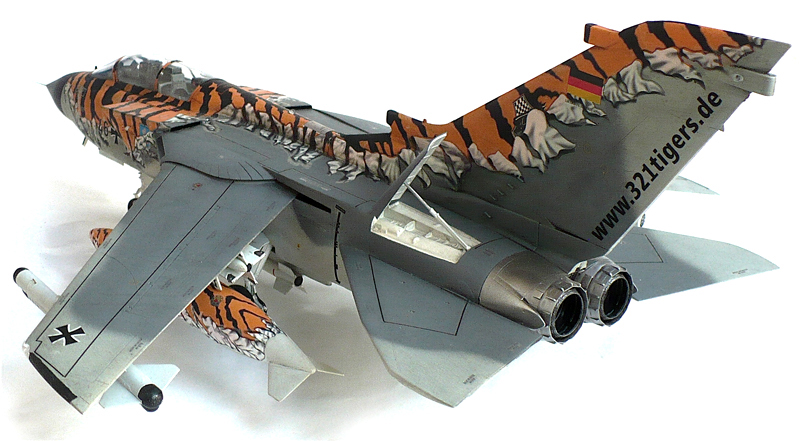
Panavia Tornado ECR - 2

Here are some more images of Revell's 1/32 scale Panavia Tornado ECR in tiger markings for the 2002 tigermeet.

From Wikipedia"
The Panavia Tornado is a family of twin-engine, variable-sweep wing combat aircraft, which was jointly developed and manufactured by the United Kingdom, West Germany and Italy. There are three primary variants of the Tornado; the Tornado IDS (interdictor/strike) fighter-bomber, the suppression of enemy air defences Tornado ECR (electronic combat/reconnaissance) and the Tornado ADV (air defence variant) interceptor.
The Tornado was developed and built by Panavia Aircraft GmbH, a tri-national consortium consisting of British Aerospace (previously British Aircraft Corporation), MBB of West Germany, and Aeritalia of Italy. It first flew on 14 August 1974 and was introduced into service in 1979–1980. Due to its multirole nature, it was able to replace several different fleets of aircraft in the adopting air forces. The Royal Saudi Air Force (RSAF) become an export operator of the Tornado in addition to the three original partner nations. A tri-nation training and evaluation unit operating from RAF Cottesmore, the Tri-National Tornado Training Establishment, maintained a level of international cooperation beyond the production stage.
The Tornado was used by the Royal Air Force (RAF), Italian Air Force and Royal Saudi Air Force during the 1991 Gulf War, in which the Tornado conducted many low-altitude penetrating strike missions. The Tornados of various operators were used in conflicts in the former Yugoslavia during the Bosnian War and Kosovo War, Iraq during the Gulf War and the Iraq War, Libya during the Libyan civil war, as well as smaller roles in Afghanistan and Yemen. Including all variants, a total of 992 aircraft were built.
On 26 March 1969, four partner nations – United Kingdom, Germany, Italy and the Netherlands, agreed to form a multinational company, Panavia Aircraft GmbH, to develop and manufacture the MRCA. The project's aim was to produce an aircraft capable of undertaking missions in the tactical strike, reconnaissance, air defence, and maritime roles; thus allowing the MRCA to replace several different aircraft then in use by the partner nations.Various concepts, including alternative fixed-wing and single-engine designs, were studied while defining the aircraft. The Netherlands pulled out of the project in 1970, citing that the aircraft was too complicated and technical for the RNLAF's preferences, which had sought a simpler aircraft with outstanding manoeuvrability.[12] An additional blow was struck by the German requirement reduced from an initial 600 aircraft to 324 in 1972.
When the agreement was finalised, the United Kingdom and West Germany each had a 42.5% stake of the workload, with the remaining 15% going to Italy; this division of the production work was heavily influenced by international political bargaining. The front fuselage and tail assembly was assigned to BAC (now BAE Systems) in the United Kingdom; the centre fuselage to MBB (now EADS) in West Germany; and the wings to Aeritalia (now Alenia Aeronautica) in Italy. Similarly, tri-national worksharing was used for engines, general and avionic equipment. A separate multinational company, Turbo-Union, was formed in June 1970 to develop and build the RB199 engines for the aircraft, with ownership similarly split 40% Rolls-Royce, 40% MTU, and 20% FIAT.
At the conclusion of the project definition phase in May 1970, the concepts were reduced to two designs; a single seat Panavia 100 which West Germany initially preferred, and the twin-seat Panavia 200 which the RAF preferred and which would become the Tornado. The aircraft was briefly called the Panavia Panther, the project soon coalesced towards the two-seat option.In September 1971, the three governments signed an Intention to Proceed (ITP) document, at which point the aircraft was intended solely for the low-level strike mission, where it was viewed as a viable threat to Soviet defences in that role. It was at this point that Britain's Chief of the Defence Staff announced "two thirds of the fighting front line will be composed of this single, basic aircraft type".

Tornado ECR

Operated by Germany and Italy, the ECR is a Tornado variant devoted to Suppression of Enemy Air Defences (SEAD) missions. It was first delivered on 21 May 1990. The ECR has sensors to detect radar usage and is equipped with anti-radiation AGM-88 HARM missiles. The Luftwaffe's 35 ECRs were delivered new, while Italy received 16 converted IDSs. Italian Tornado ECRs differ from the Luftwaffe aircraft as they lack of build-in reconnaissance capability and use RecceLite reconnaissance pods, also only Luftwaffe ECRs are equipped with RB199 Mk.105 engine which has a slightly higher thrust rating. The German ECRs do not carry a cannon.