Translate

Friday, April 10, 2015

1936 Mercedes-Benz 540K Maharaja

Here are some images of Minicraft's 1/16 scale 1936 Mercedes-Benz 540K Maharaja.

From Wikipedia"
Mercedes-Benz 540K (type W24) is a car which was fabricated by the German firm Mercedes-Benz from 1935 to 1940.

Introduced at the 1936 Paris Motor Show, the Friedrich Geiger designed car was a development to the 500K, itself a development of the SSK. Available as a two seater cabriolet, four seater coupé or seven seater limousine with armoured sides and armoured glass, it was one of the largest cars of the time.
The straight-8 cylinder engine of the 500K was increased to 5,401 cubic centimetres (329.6 cu in), which aspirated by twin pressurized updraft carburetors, developed a natural 115 hp (86 kW). However, there was an attached Roots supercharger which could either be engaged manually for short periods, or automatically when the accelerator was pushed fully to the floor. This increased power to 180 hp (130 kW), creating a top speed of 170 kilometres per hour (110 mph).
Power was sent to the rear wheels through a four-speed or optional five speed manual gearbox that featured synchromesh on the top three gears. Vacuum-assisted hydraulic brakes kept the car under the driver's control.
The 540K had the same chassis layout at the 500K, but was significantly lightened by replacing the girder-like frame of the 500K with oval-section tubes - an influence of the Silver Arrows racing campaign.
To meet individual wishes of customers, three chassis variants were available as for the 500K: two long versions with a 3,290 mm (130 in) wheelbase, differing in terms of powertrain and bodywork layout; and a short version with 2,980 mm (117 in). The long variant, termed the normal chassis with the radiator directly above the front axle, served as the backbone for the four-seater cabriolets 'B' (with four side windows) and 'C' (with two side windows), and for touring cars and sedans. The shorter chassis was for the two-seater cabriolet 'A,' set up on a chassis on which radiator, engine, cockpit and all rearward modules were moved 185 mm (7.3 in) back from the front axle.
The Sindelfingen factory employed 1,500 people to create the 540K, and allowed a great deal of owner customisation, meaning only 70 chassis were ever bodied by independent builders. Owners included Jack Warner of Warner Brothers film studios.
With the outbreak of World War II in 1939, the proposed further boring-out of the engine to 5,800 cubic centimetres (5.8 l) for a 580K was aborted, probably after only one such car was made. Chassis production ceased in 1940, with the final 2 being completed that year, and earlier chassis were still being bodied at a steady rate during 1940, with smaller numbers being completed in the 1941–1943 period. Regular replacement bodies were ordered in 1944 for a few cars.

On top of the normal and roadster cars, 12 special cars were developed on an extended chassis length with a 3,880 mm (153 in) wheelbase. All of these cars were developed for the Nazi hierarchy, as six seater convertible saloons. To allow for armour plate, these cars had developed De Dion rear suspension. Due to their higher weight, their maximum speed was 140 km/h (87 mph).
After the assassination attempt on Reinhard Heydrich in Prague at the end of May 1942, the Reich Chancellery would only use armoured cars for ministers and leaders of friendly powers. Beside 20 large Mercedes-Benz 770s, in 1942 they ordered an additional 20 540Ks developed as two door armoured saloons. These were delivered during 1942 and 1943. A further order for 17 armored saloons was placed in late 1943, and these were delivered in April 1944. One of these cars was given as a gift from Adolf Hitler to Ante Pavelić, leader of the Independent State of Croatia. After the war this car was captured and used first by Ivan Krajacic, and then by Josip Broz Tito.

In 1936, Mercedes-Benz launched the 540K special, designated 540Ks. Based on the shorter 2,980 mm (117 in) wheelbase chassis, its body was carefully crafted. Its price tag of 28,000 Reichsmarks, some RM6,000 above the price of standard models, meant only 32 were ever built.
In 1937, Reichsmarschall Hermann Göring ordered a 540Ks, in his favorite color of sky blue with his family crest on both doors. It included armor plated sides and bulletproof glass. Nicknamed the Blue Goose, Goering was often photographed in the car.
On May 4, 1945, the US Army, C Company, 326th Engineers, 101st Airborne Division 'Screaming Eagles' entered Berchtesgaden, and on finding the car took possession. Major General Maxwell Taylor used the car as his command vehicle in West Germany until it was commissioned by the US Treasury. Shipped to Washington, D.C., it successfully toured the United States in a victory bond tour. In 1956 the car was auctioned off by the US Army at the Aberdeen Proving Grounds in Maryland, sold to Jacques Tunick of Greenwich, Connecticut, with a high bid of $2167.
In 1958, he sold it to the private collection of veterinarian Dr George Bitgood, Jr, who had it repainted into black and the chrome re plated. Kept private, Bitgood only displayed it once at the 1973 county fair in Durham, Connecticut. After Dr Bitgood's death, Blue Goose was shown by his family at the 101st Airborne Reunion at Fort Campbell, Kentucky in June, 2002. The car was then sold to Carnlough International Limited of Guernsey, on the agreement that she be restored to her "as found" at Berchtesgaden condition.

Wednesday, April 8, 2015

1901 De Dion - Bouton

Here are some images of Entex's 1/16 scale 1901 De Dion - Bouton.

From Wikipedia"

De Dion-Bouton was a French automobile manufacturer and railcar manufacturer operating from 1883 to 1932. The company was founded by the Marquis Jules-Albert de Dion, Georges Bouton, and Bouton's brother-in-law Charles Trépardoux.
The company was formed after de Dion in 1881 saw a toy locomotive in a store window and asked the toymakers to build another. Engineers Bouton and Trépardoux had been making a starvation living on scientific toys at a shop in the Passage de Léon, close to the "rue de la Chapelle" in Paris. Trépardoux had long dreamed of building a steam car, but neither could afford it. De Dion, already inspired by steam (though in the form of rail locomotives) and with plenty of money, agreed, and De Dion, Bouton et Trépardoux was formed in Paris in 1883. This became the De Dion-Bouton automobile company, the world's largest automobile manufacturer for a time, becoming well known for their quality, reliability, and durability.

Already by 1889, de Dion was becoming convinced the future lay in the internal combustion engine, and the company had even built a ten-cylinder two-row rotary. After Trépardoux resigned in 1894, the company became De Dion, Bouton et Compagnie. For 1895, Bouton created a new 137 cc (8.4 in3) one-cylinder engine with trembler coil ignition. Proving troublesome at its designed speed of 900 rpm (throwing bearings and running rough), when Bouton increased the revs, the problems vanished; in trials, it hit an unheard of 3500 rpm, and was usually run at 2,000 rpm, a limit imposed by its atmospheric valves and surface carburettor. Both inlet and exhaust valves were overhead and a flywheel was fitted to each end of the crankshaft.
This engine was fitted behind the rear axle of a tricycle frame bought in from Decauville, fitted with the new Michelin pneumatic tires. It showed superb performance, and went on the market in 1896 with the engine enlarged to 1¼ CV (Horsepower) (932 W) 185 cc (11.3 cu in), with 1¾ CV (1.3 kW) in 1897. By the time production of the petite voiture tricar stopped in 1901, it had 2¾ CV (2 kW), while racers had as much as 8 CV (6 kW).
In 1898, Louis Renault had a De Dion-Bouton modified with fixed drive shaft and ring and pinion gear, making "perhaps the first hot rod in history".
The same year, the tricar was joined by a four-wheeler and in 1900 by a vis a vis voiturette, the Model D, with its 3¾ CV (2.8 kW) 402 cc (24.5 cu in) single-cylinder engine under the seat and drive to the rear wheels through a two speed gearbox. This curious design had the passenger facing the driver, who sat in the rear seat. The voiturette had one inestimable advantage: the expanding clutches of the gearbox were operated by a lever on the steering column. The Model D was developed through Models E, G, I, and J, with 6 CV (4.5 kW) by 1902, when the 8 CV (6 kW) Model K rear-entry phaeton appeared, with front-end styling resembling the contemporary Renault. Until World War I, De Dion-Boutons had an unusual decelerator pedal which reduced engine speed and ultimately applied a transmission brake. In 1902, the Model O introduced three speeds, which was standard for all De Dion-Boutons in 1904.   In 1901, the De Dion-Bouton Motorette Company began manufacturing De Dion-Bouton automobiles under license in Brooklyn, New York. A small quantity of American De Dion Motorettes were made. These had either 2 seater vis-a-vis or closed coachwork and were powered by 3.5 hp American made engines.
The venture was in operation for only one year. They gained a reputation for unreliability during that time. Representatives of De Dion in the United States claimed that the licensee violated their contract and advertised for a new licensee.


Tuesday, April 7, 2015

Canadian 40MM Bofors Antl-Aircraft Gun

Here are some images of Bronco models 1/35 scale Canadian 40MM Bofors Antl-Aircraft Gun.

From Wikipedia"
The Bofors 40 mm gun, often referred to simply as the Bofors gun, is an anti-aircraft/multi-purpose autocannon designed in the 1930s by the Swedish arms manufacturer AB Bofors. It was one of the most popular medium-weight anti-aircraft systems during World War II, used by most of the western Allies as well as by the Axis powers. The cannon remains in service (as the main armament in the CV 90, among other uses) making it both one of the longest-serving and most widespread artillery pieces of all time. Bofors itself has been part of BAE Systems AB since March 2005.
The Swedish Navy purchased a number of 2 pounder Pom-Poms from Vickers as anti-aircraft guns in 1922. The Navy approached Bofors about the development of a more capable replacement. Bofors signed a contract in late 1928. Bofors produced a gun that was a smaller version of a 57 mm (6-pounder) semi-automatic gun developed as an anti-torpedo boat weapon in the late 19th century by Finspong. Their first test gun was a re-barreled Nordenfelt version of the Finspong gun, to which was added a semi-automatic loading mechanism.
Testing of this gun in 1929 demonstrated that a problem existed feeding the weapon in order to maintain a reasonable rate of fire. A mechanism that was strong enough to handle the stresses of moving the large round was too heavy to move quickly enough to fire rapidly. One attempt to solve this problem used zinc shell cases that burned up when fired. This proved to leave heavy zinc deposits in the barrel, and had to be abandoned. In the summer of 1930 they began experimenting with a new test gun that did away with controlled feed and instead flicked the spent casing out the rear whereafter a second mechanism reloaded the gun by "throwing" a fresh round from the magazine into the open breech. This seemed to be the solution they needed, improving firing rates to an acceptable level, and the work on a prototype commenced soon after.
During this period Krupp purchased a one-third share of Bofors. Krupp engineers started the process of updating the Bofors factories to use modern equipment and metallurgy, but the 40 mm project was kept secret.
 The prototype was completed and fired in November 1931, and by the middle of the month it was firing strings of two and three rounds. Changes to the feed mechanism were all that remained, and by the end of the year it was operating at 130 rounds per minute. Continued development was needed to turn it into a weapon suitable for production, which was completed in October 1933. Since acceptance trials had been passed the year before, this became known as the "40 mm akan M/32". Most forces referred to it as the "Bofors 40 mm L/60", although the barrel was actually 56.25 calibres in length, not the 60 calibres that the name implies.
 The gun fired a 900 g (2.0 lb) high explosive 40 × 311R (rimmed) shell at 2,960 ft/s (900 m/s).[2] The rate of fire was normally about 120 rounds per minute (2.0 rounds per second), which improved slightly when the barrels were closer to the horizontal as gravity assisted the feeding from the top-mounted magazine. In practice firing rates were closer to 80–100 rpm (1.3–1.7 rounds per second), as the rounds were fed into the breech from four round clips which had to be replaced by hand. The maximum attainable ceiling was 7,200 m (23,600 ft), but the practical maximum was about 3,800 m (12,500 ft).
 The gun was provided with an advanced sighting system. The trainer and layer were both provided with reflector sights for aiming, while a third crew-member standing behind them "adjusted" for lead using a simple mechanical computer. Power for the sights was supplied from a 6V battery.

In spite of the successful development, the Swedish Navy changed its mind and decided it needed a smaller hand-swung weapon of 13 mm-25 mm size, and tested various designs from foreign suppliers. With the 40 mm well along in development, Bofors offered a 25 mm version in 1932, which was eventually selected as the 25 mm akan M/32.
The first version of the 40 mm the Navy ordered was intended for use on submarines, where the larger calibre allowed the gun to be used for both AA and against smaller ships. The barrel was shorter at 42 calibers long, with the effect of reducing the muzzle velocity to about 700 m/s (2,300 ft/s). When not in use, the gun was pointed directly up and retracted into a watertight cylinder. The only known submarines that used this arrangement was the Sjölejonet-class boats. The guns were later removed as the subs were modified with streamlined conning towers.
The first order for the "real" L/60 was made by the Dutch Navy, who ordered five twin-gun mounts for the cruiser De Ruyter in August 1934. These guns were stabilized using the Hazemeyer mount, in which one set of layers aimed the gun, while a second manually stabilized the platform the gun sat on. All five mounts were operated by one fire control system.
Bofors also developed a towable carriage which they displayed in April 1935 at a show in Belgium. This mount allowed the gun to be fired from the carriage with no setup required, although with limited accuracy. If time was available for setup, the gunners used the tow-bar and muzzle lock as levers, raising the wheels off the ground and thereby lowering the gun onto supporting pads. Two additional legs folded out to the sides, and the platform was then leveled with hand cranks. The entire setup process could be completed in under a minute.
Orders for the land based versions were immediate, starting with an order for eight weapons from Belgium in August 1935, and followed by a flood of orders from other forces including Poland, Norway, and Finland. It was accepted into the Swedish Army the next year, known as the "40 mm lvakan m/36", the lower-case "m" indicating an Army model as opposed to the capital "M" for Navy.
Because of the labour shortages some of the Bofors 40mm factories were opened in Poland.
The Swedish Navy adopted the weapon as the m/36 in hand-worked single air-cooled, and power operated twin water-cooled version. A twin air-cooled mounting, probably hand-worked was also used by the navies of Sweden and Argentina and a twin air-cooled wet mounting was developed for Polish submarines.

Sunday, April 5, 2015

Canadian AVGP Huskey

Here are some images of Trumpeter's 1/35 scale Canadian AVGP Huskey  (Late Version).

From Wikipedia"
The AVGP (Armoured Vehicle General Purpose) is a series of three armoured fighting vehicles ordered by the Canadian military in 1977. The three vehicles are the Grizzly, Cougar and Husky. These were based on the six-wheeled version of the Swiss MOWAG Piranha I.
The Canadian Army retired all AVGP variants beginning in 2005; however, a number of the retired vehicles were transferred to other militaries and police forces, where they continue to serve.
The AVGP had propellers and trim vanes for amphibious use, like the eight-wheeled Bison which was the vehicle family's immediate successor. Recent retrofits have removed the marine drive system, as it was seldom used and maintenance was costly. The Canadian Army's LAV III, the United States Marine Corps' LAV-25, and the US Army's Stryker are other variants of the Piranha family, and directly evolved from the Canadian designs.

The AVGP variants were introduced into Canadian service in the late 1970s Intended for use only in Canada, they were pressed into service for several United Nations missions, including UNPROFOR and the mission to Somalia. One Grizzly was captured by Serb forces in the late 1990s, despite it being present on a peace keeping mission.
The Cougar was used for training in Canada as a reconnaissance vehicle. During the 1980s and 1990s it was used by armored units as a tank substitute, for those units not equipped with the Leopard tank. The squadrons equipped with the Cougar in those regiments were humorously referred to as the "boat squadron" as opposed to the reconnaissance squadrons which were equipped with the Lynx, and later the Coyote (another AVGP successor).
The Grizzly was used as an armoured personnel carrier in regular force infantry battalions not equipped with the M113 APC, and also by reserve units. The majority of vehicles had their marine propulsion systems removed. Under the Wheeled LAV Life Extension project, the Canadian Forces planned to convert Grizzly and Husky vehicles to support variants such as Command Post and Mobile Repair Team Vehicle. However, the project was cancelled in 2005, and the vehicles retired.
In May 2007, the Edmonton Police Service accepted the donation of a disarmed Grizzly from the Canadian Army.
In March 2010, the Canadian Army donated two disarmed Cougar AVGPs to the Royal Canadian Mounted Police in British Columbia for use by the Emergency Response Team. They were retrofitted to transport ERT assault teams into hazardous areas where transport in unarmored vehicles would not be safe.
In April 2014, The department of National Defence donated a Cougar AVGP to the Windsor Police Service in Windsor Ontario.

In June 2005, the Canadian government announced plans to loan 105 AVGPs (100 Grizzlys and 5 Huskys) to African peacekeepers in the Darfur region of Sudan. The AVGP was considered sufficiently modern to be useful in this low-intensity conflict. Canada planned to arrange for civilian contractors to maintain these vehicles. As the vehicles contained some U.S.-manufactured or licensed parts, U.S. permission would be required to loan the vehicles. Initially, the vehicles were to be shipped without their Cadillac-Gage turrets. The vehicles arrived in Senegal in the late summer of 2005.
The Sudanese government required various kinds of assurances before they would allow peacekeepers to use the vehicles in Sudan. On November 18, 2005 the vehicles started arriving in Sudan, in white livery, with their turrets. The loan of vehicles for peace-keeping service in Sudan was originally for one year.
However, the loan was extended, and transferred from the African Union to the United Nations. According to Amnesty International the soldiers who used the loaned vehicles served in Sudan for too short a term to be properly trained, and become experienced. One of the vehicles was destroyed by a rocket-propelled grenade. A second vehicle was damaged when it rammed a more heavily armed, but unarmored Technical vehicle.

In 2008, the Uruguayan Army bought 44 surplus Cougars from the Canadian Army. They were rebuilt without the turret by the Chilean MOWAG-Piranha builder FAMAE, as they will act as armoured personnel carriers for the UN deployment in the Republic of Congo (MONUC), and domestically.
In 2009 Uruguay bought 98 Grizzlys and 5 Huskys that were on loan with the AMIS/UNAMID mission in Darfur.

Tuesday, March 31, 2015

Leith James's Curbside Porsche 962

Here is a 1/24 scale curbside Porsche 962 from Hasegawa. It was built by Regina modeler Leith James. Leith finished the wheels in Alclad chrome and black enamels.

Monday, March 30, 2015

Romulan D7 Battlecruiser.

Here are some images of Polar Light's 1/1000 scale Romulan D7 Battlecruiser.
From Wikipedia"
In the original series, at least three starships of the Klingon D-7 class were used by the Romulans. (This came to pass when a fire at NBC's studio warehouse destroyed the only existing Romulan ship model (the 2260s Bird of Prey), necessitating re-use of the surviving Klingon props.) Novels (as well as fans) have speculated that these vessels were given to the Romulans during a brief alliance with the Klingon Empire against the Federation (in exchange for which, the Romulans provided the Klingons with cloaking technology), though this is non-canon and has never been confirmed onscreen. The Romulans refitted the D-7s in their service with cloaking devices and the Federation occasionally referred to Romulan controlled vessels of this class as "battlecruisers."

Saturday, March 28, 2015

Soviet NKL-16 Aerosan

Here are some images of Trumpeter's 1/35 scale Soviet NKL-16 Aerosan in Finland markings.

From Wikipedia"


An aerosani (Russian: aэросани, aerosani, literally 'aerosled') is a type of propeller-driven snowmobile, running on skis, used for communications, mail deliveries, medical aid, emergency recovery and border patrolling in northern Russia, as well as for recreation. Aerosanis were used by the Soviet Red Army during the Winter War and World War II.
The first aerosanis may have been built in 1903-05 by Sergei Nezhdanovsky. In 1909–10 young Igor Sikorsky tested self designed aerosani, before he built multi-engine airplanes and helicopters. They were very light plywood vehicles on skis, propelled by old airplane engines and propellers.

Military use of the aerosani goes back to at least the 1910s. During WWI, aerosanis were found to be useful for reconnaissance, communicating and light raiding in northern areas. During the 1939–40 Winter War against Finland, some were equipped with a machine-gun ring mount on the roof. They could carry four to five men, and tow four more on skis. The aerosanis were initially used for transport, liaison, and medical evacuation in deep snow, and mostly used in open country and on frozen lakes and rivers because of their poor hill-climbing ability and limited maneuverability on winding forest roads.
During WWII, aerosanis were found to be useful for reconnaissance and light raiding in northern areas, thanks to their high mobility in deep snow (25–35 km/h, where many vehicles couldn't move at all). Responsibility for aerosanis was transferred to the Soviet Armoured Forces (GABTU) and orders were submitted for design and fabrication of lightly armoured versions, protected by ten millimetres of steel plate on front. They were organized into transport or combat battalions of 45 vehicles, in three companies, often employed in co-operation with ski infantry. Troops were usually carried or towed by transport aerosanis, while fire support was provided by the heavier machine gun-armed, armoured models. Aerosanis were not used for direct assault because of their vulnerability to explosives such as mortar rounds.
The ANT-I through ANT-V were a successful series of aerosanis of the 1920s and ’30s, designed by aircraft engineer Andrei Tupolev. However, there is reason to believe that in 1924 the Soviets obtained plans and specifications for 'air sleighs' from Chester B. Wing, an aviator, automobile dealer and former mayor of St. Ignace, Michigan, U.S.A. He had built practical aerosleds to aid transportation across the ice between St. Ignace and Mackinac Island, and for use by fishermen. The Spring 1943 issue of the magazine Science and Mechanics states that "from his aerosleds the Russians developed their present battle sled." The claim though has to be viewed in the context of a picture of an Igor Sikorsky machine in Kiev pre-WWI.
The first military aerosanis used in Finland, the KM-5 and OSGA-6 (later called NKL-6), were initially built at the Narkomles Factory in Moscow. During WWII, improved NKL-16/41 and NKL-16/42 models were built, and production started at the ZiS and GAZ car factories, and at smaller industries such as the Stalingrad Bekietovskiy Wood Works. In 1941 the armoured NKL-26, designed by M. Andreyev, started production at Narkomles. The following year, Gorki Narkorechflota developed the smaller, unarmoured GAZ-98, or RF-8, powered by a GAZ-M1 truck engine and durable metal propeller. There was also an ASD-400 heavy assault sled used in WWII.

Tuesday, March 24, 2015

Dave Porter's B-47

Built this B-47 not too long ago. It’s a 1/144 kit from Hobbycraft. It was very nice indeed. Good fit, nice decals, and decent detail made it a fun build. I finished it in Alclad lacquers and Tamiya acrylics.

Monday, March 23, 2015

7TP Siedmiotonowy Polski

Here are some images of ? 1/35 scale 7-TP Light Tank. From Wikipedia "The 7TP (siedmiotonowy polski - 7-ton Polish) was the Polish light tank of the second world war. A development of the British Vickers 6 ton, it was significantly better armed than its most common opponents, the German Panzer one and two A standard tank of the Polish Army during the Polish defensive war of 1939, its production never exceeded 140 vehicles. Its chassis was used as the base for C7Partillery tractor".  

I got this kit in amongst a bunch of other kits I purchased a while back and I had no idea as to what type of tank it was. It took me two days of research on the internet to find out what it was. My first thought was well it looks pre war and it was a light tank so I started there and wouldn't you know it it seems all pre war tanks kind of look alike so I had to slog through several photographs until I found the right one. As for the kit manufacturer I couldn't tell you (if anyone knows I'd like to hear it) as there was no box and instructions so I had to basically wing it when building it.

Dave Porter's F-20

Here is a Hasegawa F-20 in 1/72nd scale. I always thought it was a cool looking aircraft that was significant step up from our CF-5s. I completed this kit as a “what if” using a variety of low vis markings and acrylic paint.

Sunday, March 22, 2015

Dave Porter's BRE Datsun 510 And 2000 Renard

Here is an image of Dave Porter's BRE Datsun 510 and 2000 Renard and here are his descriptions.

    Here is the BRE Datsun 510 that won the 1972  SCCA 2.5 litre Sedan Trans Am Championship. The car was driven by John Morton. This kit is a vintage repop from Revell in 1/25 scale. I painted it with Tamiya Lacquers and acrylics and I did some extra details in the interior.


 Here is Paul Tracy’s 2000 Renard in 1/25 scale. The kit is by Monogram and the Kool decals are aftermarket.


Saturday, March 21, 2015

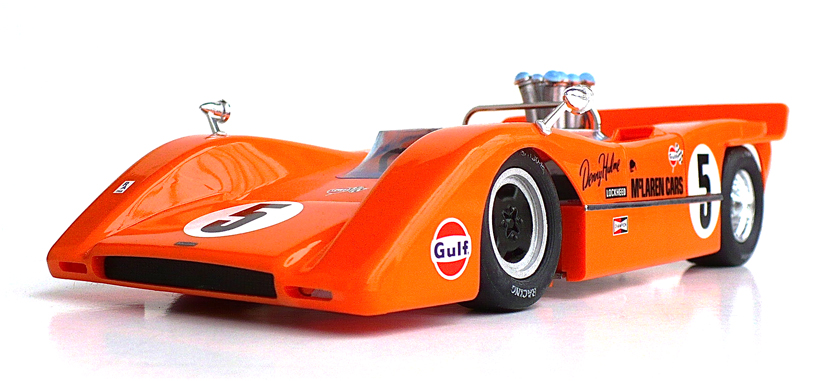
1968 McLaren M8A

Here are some better images of Tamiya's 1/18 scale McLaren M8A 1968.


From the instructions"
1966 saw the inauguration of the Canadian-American Challenge Cup (CAN-AM), which raced two seater open top machines with unlimited engine displacements. Although held domestically, this unique series saw many F1drivers in attendance and quickly gained popularity due to the dynamic performances of the high powered machines. It became one of the most exciting race categories after F1 GP and the World Sports Car Chamionship. Founded by F1 driver Bruce McLaren in 1963 Bruce McLaren Motor Racing raced CAN AM and F1 GP from 1966. The 1966 CAN-AM season saw Bruce McLaren drive the McLaren M1B to the third place overall ranking. The following year he drove the M6A and won the championship, which led to the teams succesful period.
In 1968, the team entered the M8A which was lighter, had enhanced aerodynamics, and adapted the same monocoque structure of other F1 machines with the engine firmly connected to the rear bulkhead. The wedge-shaped body producd the increased downforce effect and featured air intakes with NASA ducts.
It was powered by a 620 hp Chevrolet V8 7-liter engine with eight 40cm long air funnels. In this six race series Denny Hulme and Bruce McLaren drove the M8A and took 3 and 1 wins respectively to dominate the season. Not resting on their laurels, the M8A continually evolved with the M8B, M8D, and M8F respectively. Despite the tragic test drive accident that involved Bruce McLaren in 1970, the team swept the CAN-AM, taking 5 consecutive championships from 1967 to 1971.