Translate

Tuesday, May 19, 2015

Luger P.08 8 Inch Barrel

Here are some images of LS Models 1/1 scale Luger P.08  Inch Barrel Artillery model.

From Wikipedia"
The Pistole Parabellum 1908—or Parabellum-Pistole (Pistol Parabellum)—is a toggle-locked recoil-operated semi-automatic pistol. The design was patented by Georg J. Luger in 1898 and produced by German arms manufacturer Deutsche Waffen- und Munitionsfabriken (DWM) starting in 1900 with other manufacturers such as W+F Bern, Krieghoff, Simson, Mauser and Vickers; it was an evolution of the 1893 Hugo Borchardt–designed C-93. The first Parabellum pistol was adopted by the Swiss army in May 1900. In German Army service, it was succeeded and partly replaced by the Walther P38 in caliber 9mm Parabellum.
The Luger is well known from its use by Germans during World War I and World War II, along with the interwar Weimar Republic and the postwar East German Volkspolizei. Although the P.08 was introduced in 7.65mm Parabellum, it is notable for being the pistol for which the 9×19mm Parabellum (also known as the 9 mm Luger) cartridge was developed. Because of its association with Nazi Germany, the pistol has been used in fictional works by many villainous characters over the past several decades.
 One of the first semi-automatic pistols, the Luger was designed to use a toggle-lock action, which uses a jointed arm to lock, as opposed to the slide actions of almost every other semi-automatic pistol. After a round is fired, the barrel and toggle assembly (both locked together at this point) travel rearward due to recoil. After moving roughly 13 mm (0.5 in) rearward, the toggle strikes a cam built into the frame, causing the knee joint to hinge and the toggle and breech assembly to unlock. At this point the barrel impacts the frame and stops its rearward movement, but the toggle assembly continues moving (bending the knee joint) due to momentum, extracting the spent casing from the chamber and ejecting it. The toggle and breech assembly subsequently travel forward under spring tension and the next round from the magazine is loaded into the chamber. The entire sequence occurs in a fraction of a second. This mechanism works well for higher-pressure cartridges, but cartridges loaded to a lower pressure can cause the pistol to malfunction because they do not generate enough recoil to work the action fully. This results in either the breech block not clearing the top cartridge of the magazine, or becoming jammed open on the cartridge's base.
In World War I, as submachine guns were found to be effective in trench warfare, experiments with converting various types of pistols to machine pistols (Reihenfeuerpistolen, literally "row-fire pistols" or "consecutive fire pistols") were conducted. Among those the Luger pistol (German Army designation Pistole 08) was examined; however, unlike the Mauser C96, which was later manufactured in a selective-fire version (Schnellfeuer) or Reihenfeuerpistolen, the Luger proved to have an excessive rate of fire in full-automatic mode.
The Luger pistol was manufactured to exacting standards and had a long service life. William B. "Bill" Ruger praised the Luger's 145° (55° for Americans) grip angle and duplicated it in his .22 LR pistol.

The Swiss Army evaluated the Luger pistol in 7.65×21 mm Parabellum and adopted it in 1900 as its standard side arm, designated Ordonnanzpistole 00 or OP00, in 1900. This model uses a 120 mm barrel.
The Luger pistol was accepted by the Imperial German Navy in 1904. The Navy model had a 150 mm barrel and a two-position (100/200 metre) rear sight. This version is known as Pistole 04.
In 1908 the German Army adopted the Luger to replace the Reichsrevolver in front-line service. The Pistole 08 (or P.08) had a 100 mm barrel and was chambered in 9×19 mm Parabellum. The P.08 was the usual side arm for German Army personnel in both world wars, though it was being replaced by the Walther P38 starting in 1938. In 1930, Mauser took over manufacture of the P.08 (until 1943).
The Bolivian Army adopted the DWM Luger in 9 mm Parabellum as the main officer's side arm in 1908; a few hundred were bought, starting with a batch of about 250 that were included in an order of 4,000 Mauser DWM 1907 rifles and 1,000 Mauser DWM 1907 short rifles, both in caliber 7.65×53 mm, and continued with smaller batches every year until 1913. Only the first batch wore crests and the Legend "Ejercito Boliviano" stamped in the receiver.

The Lange Pistole 08 (German: "Long Pistol 08") or Artillery Luger was a pistol carbine for use by German Army artillerymen as a sort of early Personal Defense Weapon. It had a 200 mm barrel, an 8-position tangent rear sight (calibrated to 800 metres) and a shoulder stock with holster. It was sometimes used with a 32-round drum magazine (Trommelmagazin 08). It was also available in various commercial carbine versions with yet longer barrels.
The firm Armeria Belga of Santiago Chile, manufactured the Benke Thiemann retractable stock that could fold out from the grip section.
The United States evaluated several semi-automatic pistols in the late 19th century, including the Colt M1900, Steyr Mannlicher M1894, and an entry from Mauser. In 1900 the US purchased 1000 7.65 mm Lugers for field trials. Later, a small number were sampled in the then-new, more powerful 9 mm round. Field experience with .38 caliber revolvers in the Philippines and ballistic tests would result in a requirement for still-larger rounds.


In 1906 and 1907, the US Army held trials for a large-caliber semi-automatic. DWM provided two sample Luger pistols chambered in .45 ACP for testing, with serial numbers 1 and 2. The fate of serial number 1 is unknown, as it was not returned. The serial number 2 Luger .45 passed the tests, and survived to be traded among collectors. Its rarity gives its value of around US$1 million at the time the "Million Dollar Guns" episode of History Channel's "Tales of the Gun" was filmed, recheck by Guns & Ammo as of 1994.
At least two pistols were manufactured later for possible commercial or military sales, and one is exhibited at the Norton Gallery, in Shreveport, Louisiana. The other was sold in 2010 and remains in a private collection. After initial trials, DWM, Savage, and Colt were asked to provide further samples for evaluation. DWM withdrew for reasons that are still debated, though the Army did place an order for 200 more samples. A single .45 Luger carbine is also known to exist.
In 1936 Mauser phased out "straw finishing" the small parts and levers on their pistols, choosing to blue them with the rest of the weapon. When in combination with black bakelite grip panels, used on some examples starting in 1941, these pistols were named the "Black Widow" model by a postwar US arms dealer as a marketing ploy.
Captured Lugers were much prized by Allied soldiers during both of the world wars as war trophies. However, during World War II, German soldiers were aware of this and would use Lugers as "bait", rigging them to detonate land mines or hidden booby traps when disturbed. This tactic was common enough to make experienced Allied soldiers deeply suspicious of an apparently discarded Luger that they discovered.

Although outdated, the Luger is still sought after by collectors both for its sleek design and accuracy, and for its connection to Imperial and Nazi Germany. Limited production of the P.08 by its original manufacturer resumed when Mauser refurbished a quantity of them in 1999 for the pistol's centennial. More recently, Krieghoff announced the continuation of its Parabellum Model 08 line with 200 examples at $17,545.00 apiece.
In 1923, Stoeger, Inc. obtained the American copyright for the "Luger" name for the import of German-built parabellum pistols into the United States. The 1923 commercial models, in .30 Luger and 9mm, and with barrel lengths from 75 mm to 600 mm were the first pistols to bear the name "Luger", roll stamped on the right side of the receiver. Stoeger has retained the rights to the "Luger" name. Over the past seven decades, Stoeger imported a number of different handguns under the "Luger" mark, including an Erma-built .380 version and an American-manufacture .22 which only remotely resembled the original design.
In 1991, the Houston, Texas firm of Aimco, Inc. began making an all new remake of the original Georg Luger design. At that time Mitchell Arms, Inc., under the "Mitchell" name marketed Aimco’s "new" parabellum. Stoeger, Inc. bought the rights to market the Texas-built pistols in 1994, and since that time the "Luger" name is once again on these toggle-action autoloaders.
Stoeger’s current offering is named the "American Eagle" model. This refers to the U.S. eagle roll-stamped above the chamber, closely resembling the eagle used to mark the original pistols designated for U.S. import. The "American Eagle" is available in 4-inch and 6-inch barrel lengths in 9mm Luger only.
Thousands were taken home by returning Allied soldiers during both wars, and are still in circulation today. Colonel David Hackworth mentions in his autobiography that it was still a sought-after sidearm in the Vietnam War. Recently the first serious study on the Post World War II Luger has been published (The Parabellum is Back! 1945–2000); it covers the Luger production from 1945 until 2000. In fact, in 1945 Mauser set up again the Luger production under the control of the French forces. In 1969, Mauser Werke in Oberndorf restarted the production until 1986 when the last commemorative model was produced.


Monday, May 18, 2015

Colt Buntline Special

Here are some images of LS Models 1/1 scale Colt Buntline Special.

From Wikipedia"
The Colt Buntline Special is a long-barreled variant of the Colt Single Action Army revolver that author Stuart N. Lake described in his best-selling but largely fictionalized 1931 biography, Wyatt Earp: Frontier Marshal. According to Lake, dime novelist Ned Buntline had five Buntline Specials commissioned. Lake described them as extra-long, 12 inches (300 mm)-long barrel Colt Single Action Army revolvers. Lake wrote that Buntline presented them to five lawmen in thanks for their help with contributing “local color” to his western yarns. But modern researchers have not found any evidence to confirm that Buntline ordered the guns or that Colt manufactured them in that time period.
Lake attributed the gun to Earp, but modern researchers have not found any supporting evidence from secondary sources or in available primary documentation of the gun's existence prior to the publication of Lake's book. After the publication of Lake's book, various Colt revolvers with long (10″ or 16″) barrels were referred to as "Colt Buntlines" or "Buntline Specials". Colt manufactured the pistol among its second generation revolvers produced after 1956. A number of other manufacturers, such as Uberti, Navy Arms, and Cimarron Arms, have made their own version of this long-barreled revolver.
 
Wyatt Earp
The revolver was first described by Stuart Lake in his highly fictionalized 1931 biography Wyatt Earp: Frontier Marshal. The extremely popular book turned Wyatt Earp into a "Western superman". Lake's creative biography and later Hollywood portrayals exaggerated Wyatt's profile as a western lawman.

Ned Buntline, the pseudonym for dime-novelist Edward Zane Carroll Judson.
Lake wrote that dime novelist Edward Zane Carroll Judson, Sr., writing under the pseudonym of Ned Buntline, commissioned the guns in repayment for "material for hundreds of frontier yarns." Yet Buntline, in fact, only wrote four western yarns, all about Buffalo Bill and none that mentioned Earp. According to descendants of Wyatt Earp's cousins, he owned a Colt .45-caliber and a Winchester lever-action shotgun.
There is no conclusive evidence as to the kind of pistol that Earp usually carried, though it is known that on the day of the Gunfight at the O.K. Corral, October 26, 1881, he carried an 8 inch (200mm) barreled Smith & Wesson Model 3. Earp had received the revolver as a gift from Tombstone mayor and Tombstone Epitaph newspaper editor John Clum. Lake later admitted that he had 'put words into Wyatt's mouth because of the inarticulateness and monosyllabic way he had of talking'.
The book later inspired a number of stories, movies, and television programs about outlaws and lawmen in Dodge City and Tombstone, including the 1955 television series The Life and Legend of Wyatt Earp.


Lake conceived the idea of a revolver that would be more precise and could be easily modified to work similarly to a rifle. According to Lake, the Colt Buntline was a single-action revolver chambered for .45 Long Colt cartridge. However, it had a 12″ (305mm) long barrel, in comparison to the Colt Peacemaker's 7.5″ (190mm) barrel. A 16″ (406mm) barrel was available, as well. According to Lake, it had a removable stock that could be easily affixed through a combination of screws and lead-ins. This accessory gave the revolver better precision and range, Lake claimed, and allowed the user to fire it like a rifle. The Colt Buntline was further popularized by The Life and Legend of Wyatt Earp television series.

Lake wrote that Ned Buntline commissioned the revolvers in 1876 and that he presented them to Wyatt Earp and four other well-known western lawmen: Bat Masterson, Bill Tilghman, Charlie Bassett, and Neal Brown. However, neither Tilghman nor Brown were lawmen at that time. According to Lake, Earp kept his pistol at the original 12″ length, but the four other recipients of the Specials cut their barrels down to the standard 7½″ or shorter.

Lake spent much effort trying to track down the Buntline Special through the Colt company, Masterson, and contacts in Alaska. Lake described it as a Colt Single Action Army model with a long, 12 inches (30 cm) barrel, standard sights, and wooden grips into which the name “Ned” was ornately carved. Researchers have never found any record of an order received by the Colt company, and Ned Buntline's alleged connections to Earp have been largely discredited.

The revolver could have been specially ordered from the Colt factory in Hartford, Connecticut, as extra-long barrels were available from Colt at a dollar an inch over 7.5 inches (190 mm). Several such revolvers with 16-inch barrels and detachable stocks were displayed at the 1876 Centennial Exposition, but these were marketed as "Buggy rifles". There are no company records for the Buntline Special, nor a record of any orders from or sent to Ned Buntline. This does not absolutely preclude the historicity of the revolvers, however. Massad Ayoob writing for Guns Magazine cited notes by Josie Earp in which she mentioned an extra-long revolver as a favorite of Wyatt Earp. He cited an order by Tombstone, Arizona, bartender Buckskin Frank Leslie for a revolver of near-identical description. This order predated the O.K. Corral fight by several months.

Wednesday, May 13, 2015

U.S.S. Holland (SS-1) and Holland Boat No.1

Here are some more images of Iron Shipwrights 1/72 scale U.S.S. Holland (SS-1) and Holland Boat No.1.
Over all this is a nice kit though I had to do some scratch work like the stand, anchor and masts.

From Wikipedia"
John Philip Holland (Irish: Seán Pilib Ó hUallacháin / Ó Maolchalann) (29 February 1840 – 12 August 1914) was an Irish engineer who developed the first submarine to be formally commissioned by the U.S. Navy, and the first Royal Navy submarine, the Holland 1.

Holland emigrated to the United States in 1873. Initially working for an engineering firm, he returned to teaching again for a further six years in St. John’s Catholic School in Paterson, New Jersey. In 1875, his first submarine designs were submitted for consideration by the U.S. Navy, but turned down as unworkable. The Fenians, however, continued to fund Holland's research and development expenses at a level that allowed him to resign from his teaching post. In 1881, Fenian Ram was launched, but soon after, Holland and the Fenians parted company angrily, primarily due to issues of payment within the Fenian organization, and between the Fenians and Holland. The submarine is now preserved at Paterson Museum, New Jersey.


Holland continued to improve his designs and worked on several experimental boats, prior to his successful efforts with a privately built type, launched on 17 May 1897. This was the first submarine having power to run submerged for any considerable distance, and the first to combine electric motors for submerged travel and gasoline engines for use on the surface. She was purchased by the U.S. Navy, on 11 April 1900, after rigorous tests and was commissioned on 12 October 1900 as USS Holland. Six more of her type were ordered and built at the Crescent Shipyard in Elizabeth, New Jersey. The company that emerged from under these developments was called The Electric Boat Company, founded on 7 February 1899. Isaac Leopold Rice became the company's first President with Elihu B. Frost acting as vice president and chief financial officer.
The USS Holland design was also adopted by others, including the Royal Navy in developing the Holland-class submarine. The Imperial Japanese Navy employed a modified version of the basic design for their first five submarines, although these submarines were at least 10 feet longer at about 63 feet. These submarines were also developed at the Fore River Ship and Engine Company in Quincy, MA.
 USS Holland (SS-1) was the United States Navy's first commissioned submarine, named for her Irish-American inventor, John Philip Holland, although not the first submarine of the US Navy, which was the 1862 Alligator. The boat was originally laid down as Holland VI, and launched on 17 May 1897.

The work was done at (Ret.) Navy Lieutenant Lewis Nixon's Crescent Shipyard of Elizabeth, New Jersey for John Holland's company, then known as the Holland Torpedo Boat Company. The craft was built under the supervision of John Holland, who designed the vessel and her details. The keel to this craft was laid at Nixon's Crescent Shipyard with both men present. The two men worked together using many of John Holland's proven concepts and patents to make the submarine a reality, each man complementing the other's contributions to the development of the modern submarine.
Holland VI included many features that submarines of the early 20th century would exhibit, albeit in later, more advanced forms. She had both an internal combustion engine for running on the surface, and an electric motor for submerged operation. She had a reloadable torpedo tube and a deck gun (a pneumatic dynamite gun). There was a conning tower from which the boat and her weapons could be directed. Finally, she had all the necessary ballast and trim tanks to make precise changes in depth and attitude underwater.
Holland VI eventually proved her validity and worthiness as a warship and was ultimately purchased by the U.S. government for the sum of $150,000 on 11 April 1900. She was considered to be the first truly successful craft of her type. The United States Government soon ordered more submarines from Holland's company, which were to be known as the Plunger class. These became America's first fleet of underwater naval vessels.
Holland VI was modified after her christening, and was renamed USS Holland (SS-1) when she was commissioned by the US Navy on 12 October 1900, at Newport, Rhode Island, with Lieutenant Harry H. Caldwell in command.
Holland was the first commissioned submarine in the US Navy and is the first of the unbroken line of submarines in the Navy. She was the third submarine to be owned by the Navy, however. (The first submarine was Propeller (also known as Alligator) and the second was Intelligent Whale.)
On 16 October 1900, in order to be kept serviceable throughout the winter, Holland left Newport under tow of the tug Leyden for Annapolis, Maryland, where she was used to train midshipmen of the United States Naval Academy, as well as officers and enlisted men ordered there to receive training vital in preparing for the operation of other submarines being built for the Fleet.[citation needed]
Holland proved valuable for experimental purposes in collecting data for submarines under construction or contemplation. Her 166 mi (267 km) surface run, from Annapolis to Norfolk, Virginia from 8–10 January 1901, provided useful data on her performance underway over an extended period.
Holland, along with six other Holland-type submarines, was based in New Suffolk, New York on the North Fork of Long Island from 1899–1905, prompting the hamlet to claim to be the First Submarine Base in the United States.
Except for the period from 15 June to 1 October, which was passed training cadets at the Naval Torpedo Station, Newport, Rhode Island, Holland remained at Annapolis as a training submarine until 17 July 1905.[contradiction]
Holland finished her career at Norfolk, Virginia. Her name was struck from the Naval Vessel Register on 21 November 1910. This revolutionary submarine was sold as scrap to Henry A. Hitner & Sons, of Philadelphia, Pennsylvania on 18 June 1913 for $100. Her purchaser was required to put up $5,000 bond as assurance that the submarine would be broken up and not used as a ship.
The success of the submarine was instrumental in the founding of the Electric Boat Company, now known as the General Dynamics Electric Boat, a division of General Dynamics Corporation. This company, therefore, can trace its origins to the formation of John Philip Holland's original company and the revolutionary submarines that were developed at this shipyard.

Holland Boat No. I was a prototype submarine designed and operated by John Philip Holland.
Work on the vessel began at the Albany Iron Works in New York City, moving to Paterson, New Jersey, in early 1878. The boat was launched on 22 May 1878. It was 14 feet long, weighed 2.25 tons, and was powered by a 4-horsepower Brayton petroleum engine driving a single screw. The boat was operated by Holland himself.
After several tests, on 6 June Holland conducted his first proper trial. The boat ran on the surface at approximately 3.5 knots, then submerged to a depth of 12 feet, before eventually surfacing. However, problems with the engine, meant that Holland eventually connected the engine, by a flexible hose, to a steam engine in an accompanying launch and powered the boat externally. In a second trial, Holland remained submerged for an hour. Holland eventually stripped the boat of usable equipment and scuttled it in the Passaic River.
These trails impressed Holland's backers, the Fenian Brotherhood who on the strength of this success financed the Holland Boat No. II, which became known as the Fenian Ram.
The vessel was recovered in 1927 and is now on display at the Paterson Museum in New Jersey.

Tuesday, May 12, 2015

R.M.S. Titanic

Here are some more images of Academy's 1/400 scale R.M.S. Titanic.

From Wikipedia"
RMS Titanic was a British passenger liner that sank in the North Atlantic Ocean on 15 April 1912 after colliding with an iceberg during her maiden voyage from Southampton, UK to New York City, US. The sinking of Titanic caused the deaths of 1,502 people in one of the deadliest peacetime maritime disasters in modern history. The RMS Titanic was the largest ship afloat at the time of her maiden voyage. She was the second of three Olympic class ocean liners operated by the White Star Line, and she was built by the Harland and Wolff shipyard in Belfast with Thomas Andrews, who perished with the ship, as her naval architect. On her maiden voyage, she carried 2,224 passengers and crew.
Under the command of Edward Smith, her passengers included some of the wealthiest people in the world, as well as hundreds of emigrants from Great Britain and Ireland, Scandinavia and elsewhere throughout Europe seeking a new life in North America. The ship was designed to be the last word in comfort and luxury, with an on-board gymnasium, swimming pool, libraries, high-class restaurants and opulent cabins. She also had a powerful wireless telegraph provided for the convenience of passengers as well as for operational use. Though she had advanced safety features such as watertight compartments and remotely activated watertight doors, she lacked enough lifeboats to accommodate all of those aboard. Because of outdated maritime safety regulations, she carried only enough lifeboats for 1,178 people—slightly more than half of the number travelling on the maiden voyage, and one-third her total passenger and crew capacity.
After leaving Southampton on 10 April 1912, Titanic called at Cherbourg in France and Queenstown (now Cobh) in Ireland before heading westwards towards New York. On 14 April 1912, four days into the crossing and about 375 miles (600 km) south of Newfoundland, she hit an iceberg at 11:40 pm ship's time. The glancing collision caused Titanic's hull plates to buckle inwards along her starboard side and opened five of her sixteen watertight compartments to the sea; the ship gradually filled with water. Meanwhile, passengers and some crew members were evacuated in lifeboats, many of which were launched only partly loaded. A disproportionate number of men were left aboard because of a "women and children first" protocol followed by some of the officers loading the lifeboats. By 2:20 AM, she broke apart and foundered, with well over one thousand people still aboard. Just under two hours after the Titanic foundered, the Cunard liner RMS Carpathia arrived on the scene of the sinking, where she brought aboard an estimated 705 survivors.
The disaster was greeted with worldwide shock and outrage at the huge loss of life and the regulatory and operational failures that had led to it. Public inquiries in Britain and the United States led to major improvements in maritime safety. One of their most important legacies was the establishment in 1914 of the International Convention for the Safety of Life at Sea (SOLAS), which still governs maritime safety today. Additionally, several new wireless regulations were passed around the world in an effort to learn from the many missteps in wireless communications---which could have saved many more passengers. Many of the survivors lost all of their money and possessions and were left destitute; many families, particularly those of crew members from Southampton, lost their primary bread-winners. They were helped by an outpouring of public sympathy and charitable donations. Some of the male survivors were accused of cowardice for leaving the ship while people were still on board; the White Star Line's chairman, J. Bruce Ismay, faced social ostracism for the rest of his life.
The wreck of the Titanic remains on the seabed, split in two and gradually disintegrating at a depth of 12,415 feet (3,784 m). Since its discovery in 1985, thousands of artefacts have been recovered and put on display at museums around the world. Titanic has become one of the most famous ships in history, her memory kept alive by numerous books, folk songs, films, exhibits, and memorials.

Monday, May 11, 2015

1934 Rolls Royce Phantom II Continental Grey

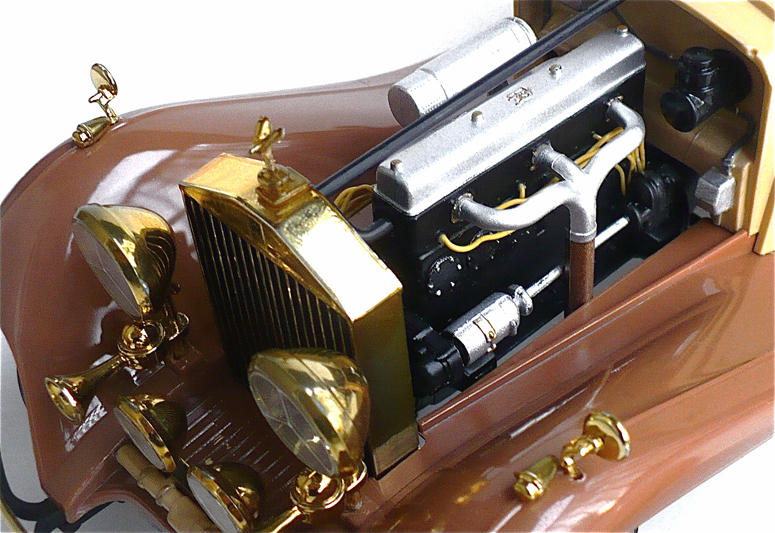
Here are some images of Revell's 1/16 scale 1934 Rolls Royce Phantom II Continental. I wanted to see what a flat grey Rolls would look like, and now I know.

From Wikipedia"
The Rolls-Royce Phantom II was the third and last of Rolls-Royce's 40/50 hp models, replacing the New Phantom in 1929. It used an improved version of the Phantom I engine in an all-new chassis. A "Continental" version, with a short wheelbase and stiffer springs, was offered.
 The Phantom II used a refinement of the Phantom I's 7.7 L (7,668 cc or 467.9 cu in) pushrod-OHV straight-6 engine with a new crossflow cylinder head. Unlike on previous 40/50 hp models, the engine was bolted directly to the 4-speed manual transmission. Synchromesh was added on gears 3 and 4 in 1932 and on gear 2 in 1935. Power was transmitted to the rear wheels using an open driveshaft, a hypoid bevel final drive, and Hotchkiss drive, replacing the torque tube from a remotely mounted gearbox used on earlier 40/50 hp models.

The chassis of the Phantom II was completely new. The front axle was mounted on semi-elliptical leaf springs as on earlier 40/50 hp models, but the rear axle was now also mounted on semi-elliptical springs instead of cantilever springs. This, along with the drivetrain changes, allowed the frame to be lower than before, improving the handling. The 4-wheel servo-assisted brakes from the Phantom I were continued, and the Bijur centralized lubrication system from the Springfield-built Phantom I was included on all Phantom II chassis.
The standard wheelbase of the Phantom II was 150 inches (3,800 mm). A 144 inches (3,700 mm) short-wheelbase chassis was also available.
A total of 1,281 Phantom II chassis of all types were built.

Royce had body designer Ivan Evernden build him a one-off short-wheelbase Phantom. Designated 26EX, the car had a tuned engine, five-leaf springs that were stiffer than standard and a Barker four-seat lightweight close-coupled saloon body painted with an artificial pearl lacquer made from ground herring scales. The sales department initially showed no interest in 26EX but, when Evernden returned to the office from the 1930 Biarritz Grand Concours d'Elegance, where 26EX had won the Grand Prix d'Honneur, he found that the sales department had already announced the new "Phantom II Continental Saloon", prepared a brochure for it, and costed it.
According to Evernden, neither he, Royce, nor the Rolls-Royce sales department had written specifications for the "Continental" model, although he and Royce had a clear specification in mind. Based on Evernden's writings and examination of company records, historian Ray Gentile determined that the common specifications of the Continental chassis were the short wheelbase and stiffer, five-leaf springs. By this definition, two hundred and eighty-one Continental Phantom II's were produced, including 125 left-hand drive versions.
Regarded as the two most important P-II Continentals are 20MS and 2SK, the only two P-II Continental Roadsters ever built. 20MS has been in a private Mid-Atlantic collection since 1989, 2SK, the Thrupp and Maberly Roadster once owned by Tyrone Power, was in the Fred Buess collection since 1958 but was sold at auction in 2010.
 All Phantom II rolling chassis were built at Rolls-Royce's factory in Derby. The factory in Springfield, Massachusetts was closed upon ending production of the US-market Phantom I in 1931. Two US-market series, AJS and AMS, were built at Derby.
 Only the chassis and mechanical parts were made by Rolls-Royce. The body was made and fitted by a coachbuilder selected by the owner. Some of the most famous coachbuilders who produced bodies for Rolls Royce cars are Park Ward, Thrupp & Maberly, Mulliner, Henley, and Hooper.

When Marlene Dietrich came to the USA in 1930, the Blue Angel director Josef von Sternberg welcomed her with gifts including a green Rolls-Royce Phantom II. The car later appeared in their first US film Morocco.
The Phantom II was featured in the films The Sorcerer's Apprentice (2010 film) and Indiana Jones and the Last Crusade. When its specifications are quoted during the scene in the Kingdom of Hatay, the Sultan states that the Rolls-Royce Phantom II has a "4.3 litre, 30 horsepower, six cylinder engine, with Stromberg downdraft carburetor" and "can go from zero to 100 kilometers an hour in 12.5 seconds (and I even like the color)." However, the car used in the film was actually a Rolls-Royce Barker Saloon, with 20/25 hp. It is also the star of the 1964 movie The Yellow Rolls-Royce where its engine specifications are given as the engine having a bore of 4.5" and stroke of 5.5", which would equate to 525 cubic inches

Saturday, May 9, 2015

1911 Buick Model 14 Roadster

Here are some images of Aurora Models 1911 Buick Model 14 Roadster.

From Wikipedia"
 Buick is currently the oldest active North American automotive maker (Autocar, the truck-maker, is the oldest motor vehicle brand) and among the oldest automobile brands in the world. It originated as the Buick Auto-Vim and Power Company in 1899, an independent internal combustion engine and motor-car manufacturer, and was later incorporated as the Buick Motor Company on May 19, 1903, by Scottish born David Dunbar Buick in Detroit, Michigan. Later that year, the company was taken over by James H. Whiting (1842–1919), who moved it to his hometown of Flint, Michigan, and brought in William C. Durant in 1904 to manage his new acquisition. He teamed up with R S McLaughlin in Canada in 1907 with a 15-year contract for motors. In 1908 GM Holding was founded. Buick sold his stock for a small sum upon departure, and died in modest circumstances 25 years later.

Between 1899 and 1902, two prototype vehicles were built in Detroit, Michigan by Walter Lorenzo Marr. Some documentation exists of the 1901 or 1902 prototype with tiller steering similar to the Oldsmobile Curved Dash. In mid-1904, another prototype was constructed for an endurance run, which convinced James H. Whiting to authorize production of the first models offered to the public. The architecture of this prototype was the basis for the Model B.
The first Buick made for sale, the 1904 Model B, was built in Flint, Michigan. There were 37 Buicks made that year, none of which survive. There are, however, two replicas in existence: the 1904 endurance car, at the Buick Gallery & Research Center in Flint, and a Model B assembled by an enthusiast in California for the division's 100th anniversary. Both of these vehicles use various parts from Buicks of that early era, as well as fabricated parts. These vehicles were each constructed with the two known surviving 1904 engines.
The power train and chassis architecture introduced on the Model B was continued through the 1909 Model F. The early success of Buick is attributed in part to the valve-in-head, or overhead valve (OHV), engine patented by Eugene Richard and developed by David Dunbar Buick. The Model F had a two-cylinder engine, an 87-inch wheelbase and weighed 1,800 lbs. The creation of General Motors is attributed in part to the success of Buick, so it can be said Marr and Richard's designs directly led to GM.
The basic design of the 1904 Buick was optimally engineered even by today's standards. The flat-twin engine is inherently balanced, with torque presented to the chassis in a longitudinal manner, actually cancelling front end lift, rather than producing undesirable lateral motion. The engine was mounted amidships, now considered the optimal location.
Durant was a natural promoter, and Buick soon became the largest car maker in America. Using the profits from this, Durant embarked on a series of corporate acquisitions, calling the new megacorporation General Motors. At first, the manufacturers comprising General Motors competed against each other, but Durant ended that. He wanted each General Motors division to target one class of buyer, and in his new scheme, Buick was near the top — only the Cadillac brand had more prestige, a ranking that Buick occupies currently in the General Motors lineup. To save on resources, Buick vehicles shared a common platform, called the GM A platform, that was shared with Chevrolet, Oakland, Oldsmobile and Cadillac. The ideal Buick customer is comfortably well off, possibly not quite rich enough to afford a Cadillac, nor desiring the ostentation of one, but definitely in the market for a car above the norm.
At first, Buick followed the likes of Napier in automobile racing, winning the first-ever race held at Indianapolis Motor Speedway.
In 1911, Buick introduced its first closed-body car, four years ahead of Ford. In 1929, as part of General Motors' companion make program, Buick Motor Division launched the Marquette sister brand, designed to bridge the price gap between Buick and Oldsmobile; however, Marquette was discontinued in 1930. All Buick, Marquette, Viking, and Oldsmobile products shared the newly introduced GM B platform starting in 1926. Buick debuted two major achievements for the 1931 model year, the OHV Buick Straight-8 engine and a synchromesh transmission in all models but the Series 50. The Eight was offered in three displacements, the 220 cubic inch (bore 2 7/8 in. stroke 4.25 in.), was available in the Series 50 with 77 brake HP. The Series 60 engine was a 272 cu. in. unit (bore 3 1/16 in., stroke 5 in.) giving 90 brake HP. The Series 80 and Series 90 used a 344 cu. in. version (bore 3 5/16 in., stroke 5 in.) for 104 brake HP. Automatic vacuum-operated spark advance was another new feature replacing the steering column mounted spark lever although an emergency lever was now dash mounted. Buick scored another first in 1939, when it became the first company to introduce turn signals. All 1939 models also had a steering column mounted shift lever.
In the 1930s Buicks were popular with the British royal family, particularly Edward VIII. He imported and used a Canadian built McLaughlin-Buick that were GMs top brand in Canada, Cadillac not having caught on there. George VI used one for a coast to coast royal tour of Canada in 1939.

Thursday, May 7, 2015

1934 Rolls Royce Phantom II Continental

Here are some images of Revell's 1/16 scale 1934 Rolls Royce Phantom II Continental.

From Wikipedia"
The Rolls-Royce Phantom II was the third and last of Rolls-Royce's 40/50 hp models, replacing the New Phantom in 1929. It used an improved version of the Phantom I engine in an all-new chassis. A "Continental" version, with a short wheelbase and stiffer springs, was offered.
 The Phantom II used a refinement of the Phantom I's 7.7 L (7,668 cc or 467.9 cu in) pushrod-OHV straight-6 engine with a new crossflow cylinder head. Unlike on previous 40/50 hp models, the engine was bolted directly to the 4-speed manual transmission. Synchromesh was added on gears 3 and 4 in 1932 and on gear 2 in 1935. Power was transmitted to the rear wheels using an open driveshaft, a hypoid bevel final drive, and Hotchkiss drive, replacing the torque tube from a remotely mounted gearbox used on earlier 40/50 hp models.

The chassis of the Phantom II was completely new. The front axle was mounted on semi-elliptical leaf springs as on earlier 40/50 hp models, but the rear axle was now also mounted on semi-elliptical springs instead of cantilever springs. This, along with the drivetrain changes, allowed the frame to be lower than before, improving the handling. The 4-wheel servo-assisted brakes from the Phantom I were continued, and the Bijur centralized lubrication system from the Springfield-built Phantom I was included on all Phantom II chassis.
The standard wheelbase of the Phantom II was 150 inches (3,800 mm). A 144 inches (3,700 mm) short-wheelbase chassis was also available.
A total of 1,281 Phantom II chassis of all types were built.

Royce had body designer Ivan Evernden build him a one-off short-wheelbase Phantom. Designated 26EX, the car had a tuned engine, five-leaf springs that were stiffer than standard and a Barker four-seat lightweight close-coupled saloon body painted with an artificial pearl lacquer made from ground herring scales. The sales department initially showed no interest in 26EX but, when Evernden returned to the office from the 1930 Biarritz Grand Concours d'Elegance, where 26EX had won the Grand Prix d'Honneur, he found that the sales department had already announced the new "Phantom II Continental Saloon", prepared a brochure for it, and costed it.
According to Evernden, neither he, Royce, nor the Rolls-Royce sales department had written specifications for the "Continental" model, although he and Royce had a clear specification in mind. Based on Evernden's writings and examination of company records, historian Ray Gentile determined that the common specifications of the Continental chassis were the short wheelbase and stiffer, five-leaf springs. By this definition, two hundred and eighty-one Continental Phantom II's were produced, including 125 left-hand drive versions.
Regarded as the two most important P-II Continentals are 20MS and 2SK, the only two P-II Continental Roadsters ever built. 20MS has been in a private Mid-Atlantic collection since 1989, 2SK, the Thrupp and Maberly Roadster once owned by Tyrone Power, was in the Fred Buess collection since 1958 but was sold at auction in 2010.
 All Phantom II rolling chassis were built at Rolls-Royce's factory in Derby. The factory in Springfield, Massachusetts was closed upon ending production of the US-market Phantom I in 1931. Two US-market series, AJS and AMS, were built at Derby.
 Only the chassis and mechanical parts were made by Rolls-Royce. The body was made and fitted by a coachbuilder selected by the owner. Some of the most famous coachbuilders who produced bodies for Rolls Royce cars are Park Ward, Thrupp & Maberly, Mulliner, Henley, and Hooper.

When Marlene Dietrich came to the USA in 1930, the Blue Angel director Josef von Sternberg welcomed her with gifts including a green Rolls-Royce Phantom II. The car later appeared in their first US film Morocco.
The Phantom II was featured in the films The Sorcerer's Apprentice (2010 film) and Indiana Jones and the Last Crusade. When its specifications are quoted during the scene in the Kingdom of Hatay, the Sultan states that the Rolls-Royce Phantom II has a "4.3 litre, 30 horsepower, six cylinder engine, with Stromberg downdraft carburetor" and "can go from zero to 100 kilometers an hour in 12.5 seconds (and I even like the color)." However, the car used in the film was actually a Rolls-Royce Barker Saloon, with 20/25 hp. It is also the star of the 1964 movie The Yellow Rolls-Royce where its engine specifications are given as the engine having a bore of 4.5" and stroke of 5.5", which would equate to 525 cubic inches