Translate

Saturday, August 13, 2011

Kommandeurwagen Re Post


Here are some images of Tamiyas 1/35 scale S.gl.Pkw. Steyr Kommandeurwagen. This was the vehicle of choice for high ranking German officers of World War 2 when out and about in the field. Originally this vehicle was designed to carry 8 passengers but to accommodate for comfort could only now carry 5 passengers. The model itself went together without any difficulty and is nicely detailed.


Friday, August 12, 2011

Red Dragon Re Post


Here are some images of Artesania Latinas 1/60 scale Chinese Junk Red Dragon. These ships plied the rivers and oceans of the far east from Singapore up the northern China.Ships like this had such a sturdy and tough workhorse like design that even to this day there are still similar examples in use. The woods used for this model were Sapelly, African Walnut, Boxwood, Applewood and of coarse Plywood.

From Wikipedia"
A junk is an ancient Chinese sailing vessel design still in use today. Junks were developed during the Han Dynasty (206 BC–220 AD) and were used as sea-going vessels as early as the 2nd century AD. They evolved in the later dynasties, and were used throughout Asia for extensive ocean voyages. They were found, and in lesser numbers are still found, throughout South-East Asia and India, but primarily in China, perhaps most famously in Hong Kong. Found more broadly today is a growing number of modern recreational junk-rigged sailboats.

Junks were efficient and sturdy ships that sailed long distances as early as the 2nd century AD. They incorporated numerous technical advances in sail plan and hull designs that were later adopted in Western shipbuilding.

The historian H. Warington Smyth considered the junk one of the most efficient ship designs, stating that "As an engine for carrying man and his commerce upon the high and stormy seas as well as on the vast inland waterways, it is doubtful if any class of vessel… is more suited or better adapted to its purpose than the Chinese or Indian junk, and it is certain that for flatness of sail and handiness, the Chinese rig is unsurpassed."

Thursday, August 11, 2011

Onager Re Post


Here are some images of Corel Models 1/25 scale Onager Catapult. The Roman Onager was a field and siege catapult and is believed to have been invented sometime in the 3rd and 4th centuries A.D. It is believed the Romans got the idea for this catapult when they had seen a wild Donkey being chased by hunters kicking back at them the stones it had come across on the road. Hence the name Onager which is a type of Donkey. The materials for this model were Walnut, Brass and copper and was a straight forward build.

Wednesday, August 10, 2011

Ben Gun Carrier Re Post


Here are some better images of my 1/35 scale Universal Carrier (Ben Gun Carrier) diorama. The Universal Carrier and soldiers are from Tamiya and the building ruin is from Mini Art. With a bit of imagination one can create a decent diorama without having to scratch build and without hurting the pocket book to much and they make great display pieces.

Tuesday, August 9, 2011

Dragon Wagon Re Post


Here are some images plus a composite of Tamiya's 1/35 scale M 26 Armored Tank Recovery Vehicle " Dragon Wagon" The M 26 first saw action in Italy in 1943 and was later used for the allies following the invasion of Normandy. After the war many M 26 tractors were left behind in Europe, some of which were used by the French military. This is one of the better Tamiya armored vehicle kits. My only complaint is that you cannot buy the flatbed separately which goes with this vehicle. So if like me you have only bought the M 26 you're screwed unless you wish to buy the M 26 again with the flatbed. Why do model companies do that? It's infuriating. Never mind I know why.

Monday, August 8, 2011

Raupenschlepper Ost Re Post


Here are some better images of Italeri's 1/35 scale STEYR RSO/1 Tractor. The RSO stands for Raupenschlepper Ost which means "crawling tractor east" In order to cope with poor road conditions on the Eastern front the Germans built tracked tractors to tow all types of vehicles and to carry various loads such as food, ammunition and supplies. The RSO/1 was built by Steyr Werks in Austria. It had a pressed steel cab and a wood cargo body. The RSO/1 proved to be ideal for the mud and slush conditions of the Russian front. These vehicles were part of the Germans desperate efforts to avoid defeat by an overwhelming Soviet military. Approximately 23,000 were produced.

Saturday, August 6, 2011

Nebelwerfer Re Post


Here are some better images of my 1/35 scale Nebelwerfer diorama. The Nebelwerfer is from Italeri, the figures are from Tamiya/Dragon and the building ruin is from Mini Art. Used by the German Army to launch smoke grenades to hide troop movements the Nebelwerfer could cover targets with up to 650 rockets in approx 90 seconds.

Friday, August 5, 2011

F6 Mustang Re Post


Here are some images of Dragon models 1/32 scale F6 Mustang. This model boasts varying depths of recessed panel lines although I have found one big problem with this kit. The main landing gear was to weak and as a result I had to reinforce them, a real pain I can tell you. I also noticed that problem with Dragons BF 110 tail wheel. The plastic I believe is to rubbery in consistency. I hope they fix that problem some day.

From Wikipedia"

In the aftermath of World War II, the USAAF consolidated much of its wartime combat force and selected the P-51 as a "standard" piston-engine fighter, while other types, such as the P-38 and P-47, were withdrawn or given substantially reduced roles. However, as more advanced jet fighters (P-80 and P-84) were being introduced, the P-51 was relegated to secondary status.

In 1947, the newly-formed USAF Strategic Air Command employed Mustangs alongside F-6 Mustangs and F-82 Twin Mustangs, due to their range capabilities. In 1948, the designation P-51 (P for pursuit) was changed to F-51 (F for fighter), and the existing F designator for photographic reconnaissance aircraft was dropped because of a new designation scheme throughout the USAF. Aircraft still in service in the USAF or Air National Guard (ANG) when the system was changed included: F-51B, F-51D, F-51K, RF-51D (formerly F-6D), RF-51K (formerly F-6K), and TRF-51D (two-seat trainer conversions of F-6Ds). They remained in service from 1946 through 1951. By 1950, although Mustangs continued in service with the USAF after the war, the majority of the USAF's Mustangs had been surplussed or transferred to the Air Force Reserve (AFRES) and the Air National Guard (ANG).

During the Korean War, F-51s, though obsolete as fighters, were used as close ground-support aircraft and reconnaissance aircraft until the end of the war in 1953. Because of its lighter structure and less availability of spare parts, the newer, faster F-51H was not used in Korea. With the aircraft being used for ground attack, their performance was less of a concern than their ability to carry a load.

Thursday, August 4, 2011

The work of Joey Stebanuk and Dennis Ezmerlian


This is Saskatoon modeller Joey Stebanuk’s 1/48 scale Airfix Seafire 47. There is a lot of brass and resin detail parts added to the model that are compliments of Aries.

This second model is a 1/24 scale Lamborghini Diablo built by Dennis Ezmerlian.

Tuesday, August 2, 2011

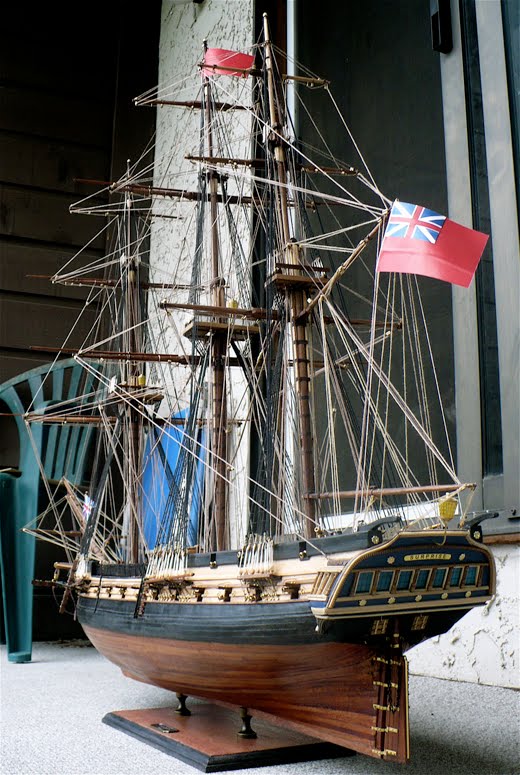
H.M.S. Surprise


According to the clock this model took me about 480 hours to construct which of course is faster then I expected.
I don't know if the construction was easier than I thought it would be or if I've just gotten better and faster at ship building over the ages or a bit of both.
Anyway despite the problems with the kit itself in the end it produced a very fine model.

Now to find a place for this 4 1/2 foot\ 1/48 scale beast.

Monday, August 1, 2011

H.M.S. Surprise (It'll Be Ready When It's Ready)

Some of you may have noticed that I haven't put up a progress post in a couple of days. The reason for this is that I felt that any pictures posted beyond my last post may be mistaken for a completed model. So on that thought I decided that the next post will be of the finished model to which I figure will be in the next two or three days.

In the meantime I present to you a Clip from the movie Master And Commander The Far Side Of The World. Enjoy.

Thursday, July 28, 2011

H.M.S. Surprise (Fore Yards Installed)


Over the next few days will be the construction and installation masts yards.
After that will be the installations of the anchors, launch, more rigging, yet even more rigging, some more rigging, gun port doors, rigging,flags and finally the display stand.

Tuesday, July 26, 2011

H.M.S. Surprise (Rigging Continues)


As expected Artesania Latina again has failed to provide enough raw cotton thread to complete the running rigging. I would estimate that I am 1/5 complete as regards the running rigging and I'm already out of raw cotton thread. So off I go to the local craft store to try and find some crochet thread that will hopefully match. They have however supplied a whole slew black cotton thread for the standing rigging and ratlines that I am already finished with. I have 4 roles left! Another error as regards the plans is Artesania Latina's complete failure to provide information as to what belaying pin goes to what running rigging. This is common information provided in every model ship kit I've seen... until now. Fortunately I have enough information on this from other ship plans that I shouldn't any real problem. I've also noticed a failure to indicate measurements as regards certain yard parts. What are they smoking down their?

Also I have decided to rig this model without sails as all the other Surprise models I have seen on the interweb are all rigged with sails. This will be a bit tricky as rigging a ship without sails (as they are seen in dock) is done differently and the plans for this model are drawn out for rigging with sails. The beauty about rigging a ship without sails is that the viewing of the ship's detail are more obvious and easier to see plus one sees the rigging more. Sails as beautiful as they are have a tendency of hiding detail. To each his own I suppose.

Sunday, July 24, 2011

H.M.S. Surprise (Bowsprit Installed)


Now that the Bowsprit is installed and the Bows Watercloset is complete, continuation of the stay rigging can carry on.

It is often thought that rigging is the most difficult part of model ship building however I never found this to be so. It just appears that way when the rigging is completed.
I've always found that the most difficult part about model ship building to be the planking of the Hull.

Friday, July 22, 2011

H.M.S. Surprise (Rat Lines Completed)


Now that the Rat Lines (pronounced ratlins) and the back stays are completed (whew!) work can now continue on the completion of the bows water closet and the construction of the Bowsprit.