Translate

Thursday, March 22, 2012

Focke Wulf FW 190 A-5


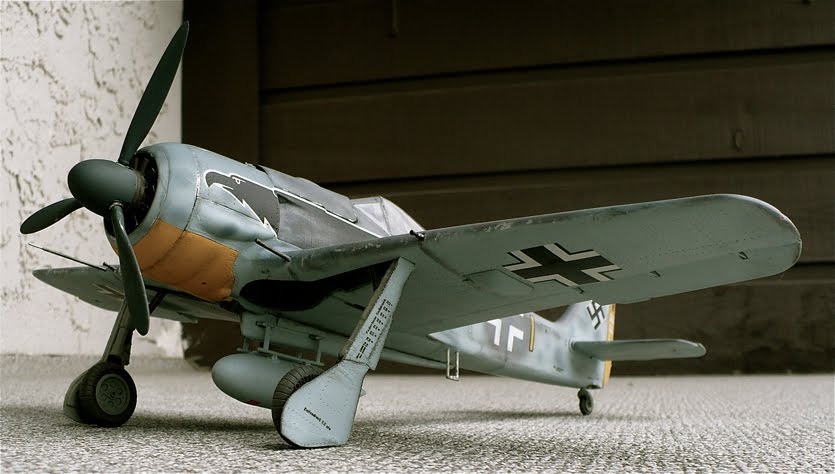
Here are some better images of Airfix's 1/24 scale Focke Wulf FW 190 A-5.

From Wikipedia"

The A-5 was developed after it was determined that the Fw 190 could easily carry more ordnance. The D-2 engine was moved forward another 15 cm (6 in), moving the center of gravity forward to allow more weight to be carried aft. Some A-5s were tested with the MW 50 installation: this was a mix of 50% methyl alcohol and 50% water, which could be injected into the engine to produce a short-term power boost to 2,000 PS (1,973 hp, 1,471 kW), but this system was not adopted for serial production. New radio gear, including FuG 25a Erstling IFF, and an electric artificial horizon found their way into the A-5. The A-5 retained the same basic armament as the A-4.

The A-5 too, saw several Umrüst-Bausätze kits. The U2 was designed as a night Jabo-Rei and featured anti-reflective fittings and exhaust flame dampeners. A centre-line ETC 501 rack typically held a 250 kg (550 lb) bomb, and wing-mounted racks mounted 300 L drop tanks. A EK16 gun camera, as well as landing lights, were fitted to the wing leading edge. The U2 was armed with only two 20 mm MG 151 cannon. The U3 was a Jabo fighter fitted with ETC 501s for drop tanks and bombs; it too featured only two MG 151s for armament. The U4 was a "recon" fighter with two RB 12.5 cameras and all armament of the basic A-5 with the exception of the MG FF cannon. The A-5/U8 was another Jabo-Rei outfitted with SC-250 centreline-mounted bombs, under-wing 300-litre drop tanks and only two MG 151s; it later became the Fw 190 G-2. A special U12 was created for bomber attack, outfitted with the standard 7.92 mm (.312 in) MG 17 and 20 mm MG 151 but replacing the outer wing 20 mm MG-FF cannon with two underwing gun pods containing two 20 mm MG 151/20 each, for a total of two machine guns and six cannon. The A-5/U12 was the prototype installation of what was known as the R1 package from the A-6 onwards. The A-5/R11 was a night fighter conversion fitted with FuG 217 Neptun (Neptune) radar equipment with arrays of three dipole antenna elements vertically mounted fore and aft of the cockpit and above and below the wings. Flame-dampening boxes were fitted over the exhaust exits. 1,752 A-5s were built from November 1942 to June 1943.

Monday, March 19, 2012

1910 Ford Model T


Here are some images of Lindberg models 1/16 scale 1910 Ford Model T.
I know what you're thinking. There is no such thing as a white 1910 Ford Model T. The fact is I wanted to see what a white one would look like, and I must say it looks pretty good.

From Wikipedia"

By 1918, half of all the cars in the US were Model T’s. However it was a monolithic bloc; Ford wrote in his autobiography that he told his management team in 1909 that in the future “Any customer can have a car painted any color that he wants so long as it is black”.

However, in the first years of production from 1908 to 1914, the Model T was not available in black but rather only grey, green, blue, and red. Green was available for the touring cars, town cars, coupes, and Landaulets. Grey was only available for the town cars, and red only for the touring cars. By 1912, all cars were being painted midnight blue with black fenders. It was only in 1914 that the "any color as long as it is black" policy was finally implemented. It is often stated that Ford suggested the use of black from 1914 to 1926 due to the cheap cost and durability of black paint. During the lifetime production of the Model T, over 30 different types of black paint were used on various parts of the car. These were formulated to satisfy the different means of applying the paint to the various parts, and had distinct drying times, depending on the part, paint, and method of drying.

Sunday, March 18, 2012

ISS Extravehicular Mobility Unit (EMU)


Here are some images of Bandai's 1/10 scale ISS Extravehicular Mobility Unit (EMU).
Being the patriotic Canadian that I am I decided to base this suit off of one of the ones worn by astronaut/physician Dafydd Rhys Williams on STS mission 118. With the addition of little glasses I tried to kinda sorta to make it in a indirect way to look like him. Kinda :-/
This kit is the usual Bandai high quality and a great addition to any space model collection, and yes it even comes with a lighting pack.
My only complaints are that for an expensive model it only took a day to build. Plus they failed to supply a waste belt which is clearly a part of the space suit. They do show it on the box top but as to why it wasn't supplied is anyone's guess. I will have to scratch one in the future when I get some proper material to work with.

From Wikipedia"
The Space Shuttle/International Space Station Extravehicular Mobility Unit (EMU) is an independent anthropomorphic system that provides environmental protection, mobility, life support, and communications for a Space Shuttle or International Space Station (ISS) crew member to perform extra-vehicular activity (EVA) in earth orbit. Introduced in 1982, it is a two-piece semi-rigid suit, and is currently one of two spacesuits used by crew members on the ISS, the other being the Russian Orlan space suit.

The EMU, like the Apollo/Skylab A7L spacesuit, was the result of years of research and development. It consists of a Hard Upper Torso (HUT) assembly, a Primary Life Support System (PLSS) which incorporates the life support and electrical systems, arm sections, gloves, an Apollo-style "bubble" helmet, the Extravehicular Visor Assembly (EVVA), and a soft Lower Torso Assembly (LTA), incorporating the Body Seal Closure (BSC), waist bearing, brief, legs, and boots. Prior to donning the pressure garment, the crew member puts on a Maximum Absorbency Garment (MAG) (basically a modified incontinence diaper – Urine Collection Devices (UCDs) are no longer used), and possibly a Thermal Control Undergarment (long johns). The final item donned before putting on the pressure suit is the "Liquid Cooling and Ventilation Garment" (LCVG), which incorporates clear plastic tubing through which chilled liquid water flows for body temperature control, as well as ventilation tubes for waste gas removal.

After donning the LCVG, the astronaut then puts on the LTA, before entering the airlock. The astronaut then dons the HUT, connects the LCVG umbilical to the umbilical in the HUT, and then locks the two parts of the suit together using the Body Seal Closure. Once the suit is turned on and checked out, the astronaut dons a "Snoopy cap," a brown and white fabric communications cap dating back to the Apollo days, which incorporates a pair of earphones and microphones, allowing the EVA astronaut to communicate with both the crew members in the orbiter and ground controllers in Houston. After donning the "Snoopy cap," the gloves and helmet are then locked on, pressurizing the suit. The suit's regulator and fans activate when the servicing umbilicals are removed and the suit reaches an internal pressure of 4.3 psi (30 kPa). A typical EMU can support an astronaut for 8.5 hours, with 30 minutes of reserves in the case of primary life support failure. To perform an EVA from the shuttle, the cabin pressure is reduced from 14.7 psi to 10.2 psi for 24 hours, after which an astronaut must pre-breathe for 45 minutes. For EVAs onboard the ISS, the astronaut must pre-breathe for about four hours.

The EMU hardware and accessories (PLSS, helmet, communications cap, and locking rings for the helmet and gloves), is manufactured by the Hamilton Sundstrand division of United Technologies out of Windsor Locks, Connecticut, while the suit's soft components (the arms of the HUT and the entire LTU) are produced by ILC Dover out of Frederica, Delaware. The two companies, who were rivals during the early days of Apollo for the contract to build the "Block II" (moonwalking) space suit, teamed up in 1974 against the David Clark Company and Garrett AiResearch for the EMU development and construction. During Apollo, the ILC Dover-produced A7L used the life support backpack, helmet, and locking rings supplied by Hamilton United, but originally, ILC Dover was to just supply the arms and legs of the suit, a similar process that is still going on today.

Dafydd Rhys "Dave" Williams (born May 16, 1954) is a Canadian physician and a retired CSA astronaut. He had two spaceflights, both of which were Space Shuttle missions. His first spaceflight, STS-90 in 1998, was a 16-day mission aboard Space Shuttle Columbia dedicated to neuroscience research. His second flight, STS-118 in August 2007, was flown by Space Shuttle Endeavour to the International Space Station. During that mission he performed three spacewalks, becoming the second Canadian to perform a spacewalk and setting a Canadian record for total number of spacewalks. These spacewalks combined for a total duration of 17 hours and 47 minutes.

In 1998, Williams became the first non-American to hold a senior management position within NASA, when he held the position of Director of the Space and Life Sciences Directorate at the Johnson Space Center.

STS-118

Williams was assigned to the crew of STS-118 (August 8 to 21, 2007), an assembly mission to the International Space Station. He completed three spacewalks during this mission, and set two new records during his final EVA on Saturday, 18 August: he is the Canadian with the most spacewalks (3); and he passed Canadian Astronaut Chris Hadfield in total EVA time. Williams ended Saturday's EVA with a total of 17 hours, 47 minutes of extravehicular time. He was the second Canadian to lead an EVA, after Chris Hadfield, who led an EVA during STS-100.


Friday, March 16, 2012

U-Boot Typ 212 A


Here are some images of Revell's 1/144 scale type 212 A U Boat.
What can I say but this model was fun to build. Not much to it but a nice result in the end.

From Wikipedia"
The German Type 212 class, also Italian Todaro class, is a highly advanced design of non-nuclear submarine (U-boat) developed by Howaldtswerke-Deutsche Werft AG (HDW) and Fincantieri S.p.a. for the German and Italian Navy. It features diesel propulsion and an additional air-independent propulsion (AIP) system using Siemens proton exchange membrane (PEM) hydrogen fuel cells. The submarine can operate at high speed on diesel power or switch to the AIP system for silent slow cruising, staying submerged for up to three weeks without surfacing and with no exhaust heat. The system is also said to be vibration-free, extremely quiet and virtually undetectable.
Type 212 is the first of the only two fuel cell propulsion system equipped submarines ready for series production by 2007, the other being the Project 677 Lada class submarine designed by Russian Rubin Design Bureau.
At the beginning of the 1990s the German Navy was seeking a replacement for the Type 206 submarines. Initial study started on a Type 209 improved design, with AIP capability, called Type 212.
The final programme started in 1994 as the two navies of Germany and Italy began working together to design a new conventional submarine, respectively to operate in the shallow and confined waters of the Baltic sea and in the deeper waters of the Mediterranean sea. The two different requirements were mixed into a common one and, because of significant updates to the design, the designation was changed to Type 212A since then.
In 1996 a Memorandum of Understanding (MOU) gave the start to the cooperation. Its main aim was the construction of identical boats and the start of a collaboration in logistic and life-cycle support for the two navies.
The German government placed an initial order of four Type 212A submarines in 1998. The German Submarine Consortium built them at the shipyards of HDW and Thyssen Nordseewerke GmbH (TNSW) of Emden. Different sections of the submarines were constructed at both sites at the same time and then half of them were shipped to the respective other yard so that both HDW and Thyssen Nordseewerke assembled two complete submarines each.
In the same year the Italian government placed an order of two U212A submarines built by Fincantieri for the Marina Militare (Italian Navy) at Muggiano shipyard, designated as the Todaro class.
The German Navy ordered two additional, improved submarines in 2006, to be delivered from 2012 on. They will be 1.2 meters longer to give additional space for a new reconnaissance mast.
On 21 April 2008 the Italian Navy ordered a second batch of submarine in the same configuration of the original ones. Some upgrading should involve materials and components of commercial derivation, as well as the software package of the CMS. The intention is to keep the same configuration of the first series and reduce maintenance costs.
The export-oriented Type 214 submarine succeeds the Type 209 submarine and shares certain features with the Type 212A, such as the AIP fuel cell propulsion.
Partly owing to the "X" arrangement of the stern planes, the Type 212 is capable of operating in as little as 17 metres of water, allowing it to come much closer to shore than most contemporary submarines. This gives it an advantage in covert operations, as SCUBA-equipped commandos operating from the boat can surface close to the beach and execute their mission more quickly and with less effort.
A notable design feature is the prismatic hull cross-section and smoothly faired transitions from the hull to the sail, improving the boat's stealth characteristics. The ship and internal fixtures are constructed of nonmagnetic materials, significantly reducing the chances of it being detected by magnetometers or setting off magnetic naval mines.
The low emission profile allowed the submarines in exercises to intrude even into well protected opposing forces such as carrier formations with their screen.
Although hydrogen–oxygen propulsion had been considered for submarines as early as World War I, the concept was not very successful until recently due to fire and explosion concerns. In the Type 212 this has been countered by storing the fuel and oxidizer in tanks outside the crew space, between the pressure hull and outer light hull. The gases are piped through the pressure hull to the fuel cells as needed to generate electricity, but at any given time there is only a very small amount of gas present in the crew space.
Currently, the Type 212A is capable of launching the fiber optic-guided DM2A4 Seehecht ("Seahake") heavyweight torpedoes, the WASS A184 Mod.3 torpedoes, the WASS BlackShark torpedoes and short-range missiles from its six torpedo tubes, which use a water ram expulsion system. Future capability may include tube-launched cruise missiles.
The short-range missile IDAS (based on the IRIS-T missile), primarily intended for use against air threats as well as small or medium-sized sea- or near land targets, is currently being developed by Diehl BGT Defence to be fired from Type 212's torpedo tubes. IDAS is fiber-optic guided and has a range of approx. 20 km. Four missiles fit in one torpedo tube, stored in a magazine. First deliveries of IDAS for the German Navy are scheduled from 2014 on.
A 30 mm auto-cannon called Muräne (moray) to support diver operations or to give warning shots is being considered too. The cannon, probably a version of the RMK30 built by Rheinmetall, will be stored in a retractable mast and can be fired without the boat emerging. The mast will also be designed to contain three Aladin UAVs for reconnaissance missions. This mast is likely to be mounted on the 2nd batch of Type 212 submarines for the German Navy.

Hawker Class Composite


Here is my composite image of my kit bash model of the Hawker class starship the U.S.S. Gambit cruising past the Neptune moon Triton.

Images of the model can be seen here.

Wednesday, March 14, 2012

U.S.S. Defiant


Here are some images of Round 2/AMT 1/537 scale U.S.S. Defiant plus a couple of Tholian craft from the TOS Star Trek episode "The Tholian Web".
One of the main issues when building a kit like this is the lack of paint that is required. Because it is a glow in the dark kit one must be careful with seam lines and to avoid any blemishes upon its construction. One doesn't have the luxury of hiding sins with a paint covering.

From Wikipedia"

"The Tholian Web" was a third season episode of Star Trek: The Original Series. It is episode #64, production #64, first broadcast on November 15, 1968 and repeated August 19, 1969. It was written by Judy Burns and Chet Richards and directed by Herb Wallerstein.

Overview: Captain Kirk is caught between dimensions while the crew of the Enterprise works to retrieve him. All the while, the Tholians demand that the Enterprise leave their space.

On stardate 5693.2, the starship USS Enterprise enters an uncharted region of space to search for her sister ship, the USS Defiant, which disappeared three weeks previously. The Enterprise's warp engines begin to slowly lose power for no apparent cause, yet sensors detect nearby dimensional fractures in space.

They visually find the Defiant, adrift and glowing eerily, despite sensors reporting the vessel is not really there. Captain Kirk assembles a boarding party consisting of himself, Dr. McCoy, Mr. Spock and Mr. Chekov in environmental suits, as the conditions of the Defiant are unknown. They discover the entire crew dead, having apparently killed each other. What's worse, the ship appears to be dissolving as McCoy is able to put his hand through a corpse and a table.

The dematerialising of the Defiant is causing the Enterprise's transporter frequencies to be blocked; only three are working and even these are dubious. Kirk orders the landing party back whilst he remains. But before Kirk himself can be beamed off, the Defiant disappears altogether, taking the Captain with it.

Spock determines that due to the Enterprise's transporter lock, Kirk has been left in the interdimensional rift when the Defiant phased out, and they can recover him again during the next period of spatial interphase. Spock notes that the Captain has just over three hours of oxygen left in his environmental suit.

Meanwhile, Chekov suddenly goes berserk and attacks the bridge personnel. McCoy surmises that the spatial interphase causes psychotic effects in the human brain, and the same murderous hostilities that affected the Defiant's crew will eventually overcome the Enterprise. McCoy strongly suggests that they put some distance between themselves and the Defiant but Spock refuses, believing any movement from their position could disrupt the delicate fabric of space in their region and jeopardize their chances of finding the Captain.

A small vessel of unknown configuration approaches the Enterprise. A crystalline being initiates contact and identifies itself as Commander Loskene of the Tholian Assembly, and demands that the Enterprise leave their territory immediately. Spock apologizes for their intrusion and explains their situation to Loskene, asking they be given time to retrieve the Captain. Loskene agrees to give the Enterprise precisely 1 hour and 53 minutes until the next spatial interphase period.

The moment comes when the Defiant should phase in again, and Spock attempts to lock onto the Captain; however the ship is not where she is supposed to be. Spock believes the arrival of the Tholian vessel has somehow disturbed the Defiant's position and they have lost Captain Kirk for good. Before any other action can be taken, the Tholians open fire on the Enterprise and refuse any attempts at communication. Spock returns fire and disables the Tholian vessel. Scotty reports that the Enterprise's damage coupled with the lack of power means he cannot hold the Enterprise purely stationary and she might even drift through the rift herself. Meanwhile, another Tholian vessel arrives and begins to form a filament structure between itself and the other ship. This filament thread is spun by either ship around the Enterprise in a web-like pattern. Spock explains that it is an energy field that, if activated before the Enterprise is repaired, means they "will not see home again."

McCoy and Spock conduct a makeshift funeral in the Captain's quarters where McCoy plays a recording Kirk made for them just in case he was ever killed on a mission. The somber recording gives the officers their final orders and some words of advice for their future missions without him; especially when he exhorts them to use their constant arguments and different points of view to support and help each other.

After the message is heard, Spock orders the Enterprise to leave the area. However, in the midst of her private memorial for Kirk in her quarters, Lt. Uhura notices a ghostly image of the Captain, still in his space suit, and floating inside the ship, beckoning for help. Spock thinks Uhura is seeing things and suggests she report to Dr. McCoy, but then Scotty reports catching a glimpse of Kirk in engineering and confirms that Uhura isn't hallucinating.

Spock rushes to locate the Captain, but Kirk phases out again before he can get a lock. If indeed the Captain is still alive, his pressure suit's life support would be dangerously low and his time is running out.

More reports of Kirk's "ghost" come in from around the ship and Spock tries to lock a tractor beam on him when he appears again. In the meantime, Doctor McCoy has discovered an antidote for the phasing effect by using a diluted form of the Klingon nerve agent, Theragen.

As the Tholian web is nearing completion, Kirk's image is spotted once more and Spock locks onto him with the tractor beam.

Just before the Tholians were able to complete the web, Spock takes a gamble and activates the ship's engines. The Enterprise briefly drops into the rift, and is hurled 2.72 parsecs away, enabling it to escape the Tholian web. At this time, it was possible to retrieve Captain Kirk from the rift, barely in time, for his oxygen supply was exhausted.

Kirk makes a full recovery and is keen on learning what happened aboard his ship while he was "away". He was surprised to learn McCoy and Spock worked well together, and a little disappointed when McCoy claims they didn't have time to open their Captain's "last orders" and his words of wisdom had gone unheard.

Monday, March 12, 2012

Artwerks For Sale


Here are some images of... Yep you guessed it, some of my artwerks and they're for sale.
Each image is 20 inches across. The height of the image of course varies depending on the image chosen. These works are printed once and only once on a high quality canvas (they look incredible), never to be printed in that format ever again. Plus each work is signed by yours truly.
I am selling each work for the sum of $400 Cdn professionally framed plus shipping and handling or if you wish to have it framed yourself each work is $160 plus shipping and handling. Shipment will be made upon receipt of payment either by check or money order. Upon the sale of any work an update will be placed on the specific post indicating that it has been sold.
You can can choose from any of the examples above. If these works are not quite to your taste or if you wish to find out more information on the above images you may wish to visit the Composite section of this site.
To view the above poster in its largest format, in Mac click on image and then right click your mouse and select view image. I can't remember what it is for a PC but I would imagine it is something similar. When I find out I will update this post.
If you wish to purchase any of my humble works, or if you have any further questions you can contact me at wz2001@shaw.ca.
Thank You Warren Zoell

Saturday, March 10, 2012

Beaufighter Composite


Here is my composite image of Revell's 1/32 scale Bristol Beaufighter MK VI flying out towards the ocean.

Images of the the model can be seen here.

Friday, March 9, 2012

Bell P 39 D Airacobra Composite


Here is my composite image of Special Hobby's 1/32 scale Bell P 39 D Airacobra flying over an ocean coastline on a rainy day.

Images of the model can be seen here.

Thursday, March 8, 2012

U.S.S. Enterprise Refit Composite


Here is my composite image of Polar Lights 1/1000 scale U.S.S. Enterprise Refit from Star Trek's The Motion Picture, Wrath of Khan and The Search for Spock over the Saturn moon Tethys (teethus).

Images of the model can be seen here.


Wednesday, March 7, 2012

U.S.S. Reliant Composite


Here is my composite image of AMT/Round 2 model's 1/537 scale U.S.S. Reliant from Star Trek the Wrath of Khan flying past the Saturn moon Enceladus.

Images of the model can be seen here.

Avro Lancaster Grand Slam Bomber B1 Special Composite


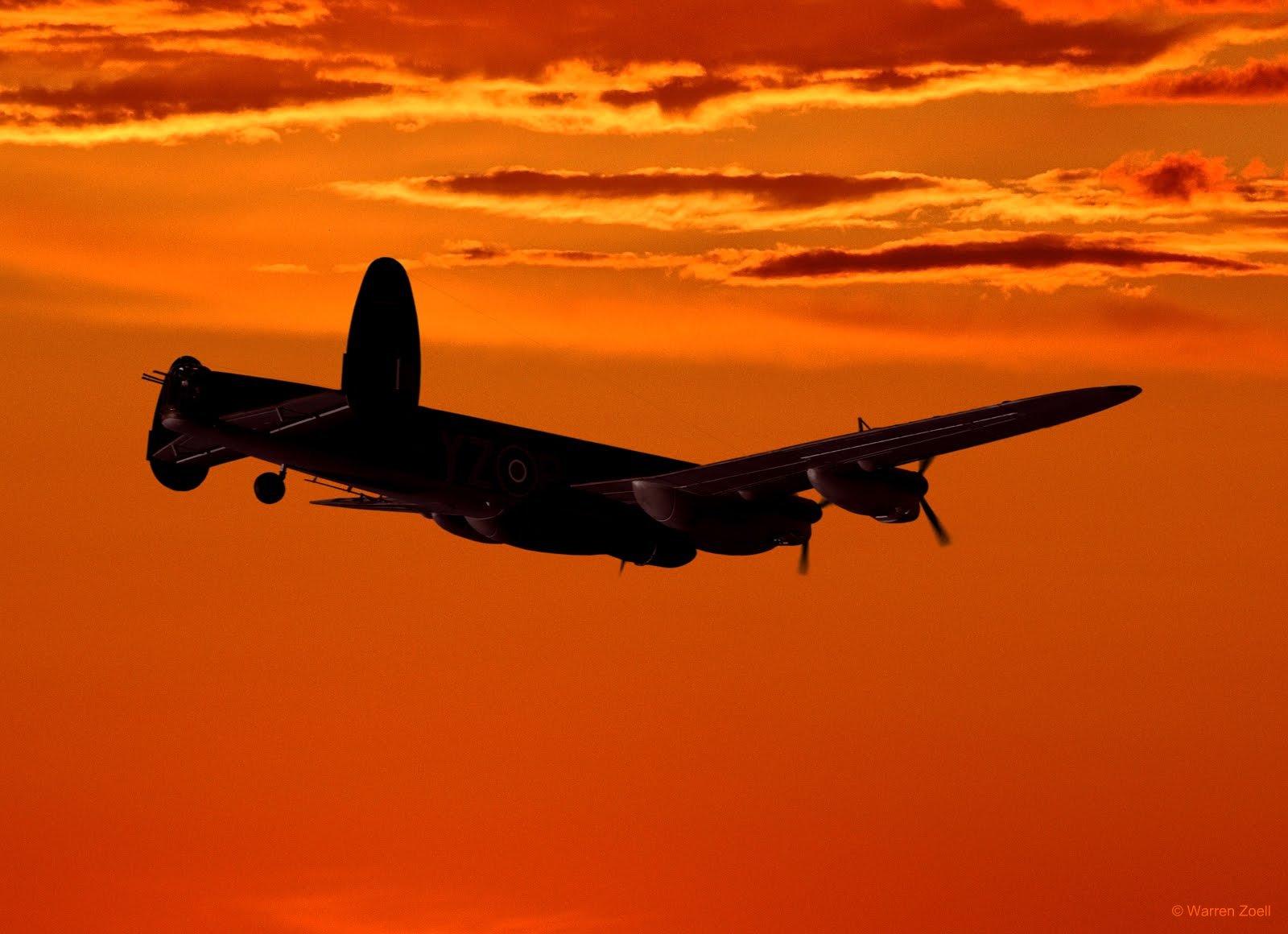
Here is my composite image of Tamiya's 1/48 scale Avro Lancaster Grand Slam Bomber B1 Special flying against an early evening sky.
I have to admit the Lancaster is one of my favourite aircraft.

Images of the model can be seen here.

Tuesday, March 6, 2012

U.S.S. Enterprise D Composite


Here is my composite image of AMT/Round 2 models of the U.S.S. Enterprise NCC - 1701 - D from Star Trek The Next Generation flying over the state of Florida. At least I think it's Florida... in reverse.

Images of the model can be seen here.

Monday, March 5, 2012

Sunday, March 4, 2012

U.S.S. Enterprise NCC - 1701 - B Composite


Here is my composite image of Round 2's 1/1000 scale U.S.S. Enterprise NCC - 1701 - B cruising over a water planet (It's really the Earth).

Images of the model can be seen here.

Saturday, March 3, 2012

The Eye of Japetus Composite


"When Bowman had first observed Japetus, that curious elliptical patch, of brilliance had been partly in shadow, illuminated only by the light of Saturn. Now, as the Moon moved slowly along its seventy-nine-day orbit, it was emerging into the full light of day.
As he watched it grow, and Discovery rose more and more sluggishly toward her inevitable appointment, Bowman became aware of a disturbing obsession. He never mentioned it in his conversations – or, rather, his running commentaries – with Mission Control, because it might have seemed that he was already suffering from delusions."- Arthur C Clarke from the novel 2001 a space odyssey-

Here is my composite image of Discovery XD 1 from the novel 2001 a space odyssey approaching the Saturn moon Japetus.

Images of the model can be seen here

Friday, March 2, 2012

German Telemeter KDO Mod.40 w/Sd.Anh 52 Trailer (Kommandogerat 40).


Here are some images of Bronco Models 1/35 scale German Telemeter KDO Mod.40 w/Sd.Anh 52 Trailer (Kommandogerat 40).

From the instructions"
The Kommandogerat 40 was a director used principally for large anti-aircraft guns, such as the 8.8 cm Flak.36 or the 10.5 cm Flak 40. Introduced by the German military in 1941 this small director was used by all three services and could be modified for use with almost any anti-aircraft weapon. In the field the director used a 5 man crew, two men are required to input azimuth and elevation data. A third man sets the slant range by means of a 4 meter stereo range finder which is mounted on top of the director. A fourth man sets the horizontal angle of approach, while the fifth man is a general operator. The time from first acquiring the target to firing. the first round could be achieved in less than 30 seconds. The slant range could be up to 18,000 meters. For transport the director is mounted on a special trailer, equipped with lifting devices, and towed by a light truck.

Tuesday, February 28, 2012

Shinkai (しんかい) 6500


Here are some images of Bandai's 1/48 scale Jamstec Shinkai 6500 Manned Research Submersible.

This is one of the best kits I have seen in a long time. The detail is amazing plus there are lots of moving parts and removable panels. It even comes with a lighting pack.
What I found interesting is the lack of glue that was required in assembling such a complex kit.
It also comes with one of the most complex display stands I've seen.
However this kit isn't cheap. It retails at around $100 CDN.

From Wikipedia"
The Shinkai 6500 (しんかい) is a manned research submersible that can dive up to a depth of 6,500 m. It was completed in 1990 and has the greatest depth range of any manned research vehicle in the world. The only manned expedition to have gone deeper was the dive of the Trieste bathyscaphe in 1960. However, the vessel could not navigate along the bottom of the sea bed. The Shinkai 6500 is owned and run by the Japan Agency for Marine-Earth Science and Technology (JAMSTEC) and it is launched from the support vessel Yokosuka.
Two pilots and one researcher operate within a 73.5 mm thick titanium pressure hull with an internal diameter of 2.0 m. Buoyancy is provided by syntactic foam.
Three 14 cm methacrylate resin view ports are arranged at the front and on each side of the vehicle.